
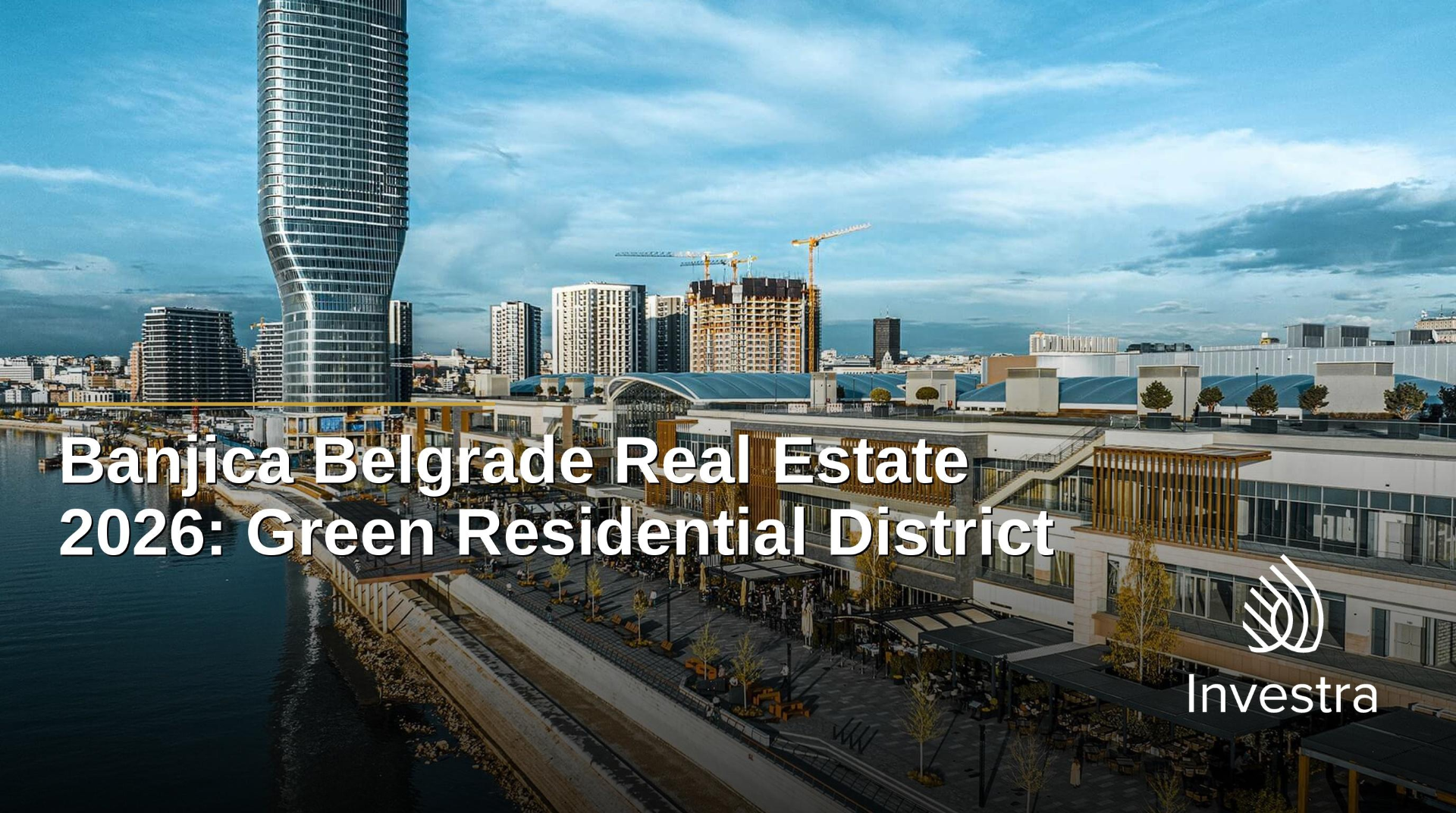
Banjica Belgrade Real Estate 2026: Green Residential District
Banjica Belgrade Real Estate 2026: Green Residential District Property Guide
Banjica stands out in 2026 as one of Belgrade’s most stable green residential districts for property investment, with average apartment prices ranging from €2,850 to €3,650 per square metre and gross rental yields between 5.8% and 6.9%. Investors seeking family-oriented housing near preserved green spaces and improving transport links will find the neighbourhood particularly attractive this year, especially through platforms such as Investra.io that list verified listings with transparent ownership records.
The area continues to benefit from its established reputation as a low-density, tree-lined residential zone south of the city centre, attracting both local buyers upgrading from smaller apartments and foreign investors looking for long-term capital appreciation combined with steady rental income from young professionals and families.
Introduction
```htmlBelgrade’s residential market has matured considerably since the early 2020s, and neighbourhoods once considered peripheral now sit at the centre of serious investment conversations. Banjica exemplifies this shift: a district that preserved its green character while gaining better connectivity to the city core and new amenities. In 2026, buyers are no longer paying a premium solely for location; they are paying for quality of life that remains scarce in denser parts of the capital.
Foreign interest has grown steadily, supported by Serbia’s relatively straightforward ownership rules for EU and non-EU citizens alike. Many investors first explore the wider context through resources such as the Belgrade Real Estate Market 2026 report before narrowing their focus to individual districts like Banjica. The neighbourhood’s appeal lies in its balance of established residential stock, ongoing modest new developments, and proximity to both employment hubs and recreational areas.
At the same time, the district avoids the overheating seen in central municipalities. This measured pace of price growth, combined with consistent demand from tenants who value green surroundings and good schools, creates a compelling risk-adjusted profile for 2026 portfolios. Investors can review additional background in the Serbia Property Investment Guide 2026 before committing capital.
Market Overview
Current transaction data shows Banjica apartment prices averaging €3,150 per square metre in the first half of 2026, up 7.4% year-on-year. Newer buildings with energy-efficient features command €3,450–€3,800, while older but well-maintained stock trades between €2,650 and €2,950. These figures sit comfortably above the city-wide average yet remain below the peaks recorded in Vračar or Dorćol, preserving relative affordability for quality family housing.
Rental demand has remained resilient. One- and two-bedroom units let for €850–€1,150 monthly, producing gross yields that have held between 5.8% and 6.9% even as interest rates stabilised. The tenant pool includes employees at nearby business parks, medical staff at the clinical centre, and families drawn by the district’s primary schools and green spaces. Supply of rental stock has grown modestly through small-scale conversions rather than large speculative projects, supporting occupancy rates above 92%.
Looking at comparable neighbourhoods, Banjica continues to trade at a discount to more central green pockets such as Dedinje while offering superior transport links to the south-east corridor. This positioning helps explain why transaction volumes increased 11% in 2025 despite a national slowdown in mortgage lending.
Key Investment Factors
Green Infrastructure and Quality of Life
Banjica’s extensive tree cover and proximity to Košutnjak forest remain its strongest differentiators. Local regulations have protected most existing green corridors, limiting high-rise encroachment. Families relocating from denser districts cite air quality and outdoor space as primary decision drivers, sustaining demand for both purchase and rental properties. This environmental premium is expected to strengthen as Belgrade implements stricter urban planning rules in 2026.
Transport and Connectivity Improvements
The extension of the city’s light rail line and upgraded bus corridors along the Banjica–Voždovac axis have reduced average commute times to the city centre to under 25 minutes. Several new cycle paths and pedestrian bridges were completed in late 2025, further enhancing livability. These infrastructure upgrades have supported a measurable uptick in buyer interest from professionals working in New Belgrade’s office clusters.
Demographic Stability and School Access
The neighbourhood maintains a higher proportion of owner-occupiers than many Belgrade districts, contributing to lower turnover and more stable property values. Several well-regarded primary and secondary schools within walking distance continue to attract young families. This demographic profile supports consistent rental demand from tenants prioritising education options over nightlife proximity.
Regulatory and Tax Environment
Serbia’s property tax regime remains competitive for long-term holders, with annual rates averaging 0.4% of cadastral value. Foreign buyers should review the latest obligations in the Serbia Property Taxes 2026 guide and familiarise themselves with the step-by-step purchase process outlined in the Serbia Buying Process 2026 resource. Transparent ownership records and relatively low transaction costs continue to favour Banjica for cross-border portfolios.
Price Analysis Table
| Neighbourhood | Avg. Price €/m² (2026) | 1-Bed Rental €/month | Gross Yield | Notes |
|---|---|---|---|---|
| Banjica | 3,150 | 920 | 6.4% | Green residential, family focus |
| Voždovac (core) | 2,950 | 850 | 6.2% | Similar transport links, less green |
| Dedinje | 4,400 | 1,350 | 5.1% | Premium diplomatic area |
| Zvezdara | 2,780 | 780 | 6.1% | Hilltop views, steeper streets |
| Vračar | 4,150 | 1,180 | 5.3% | Central, high density |
Why Invest in 2026
Timing considerations favour Banjica this year because price growth has moderated from the rapid gains of 2023–2024 while rental demand shows no signs of softening. The district’s limited pipeline of new supply, combined with ongoing infrastructure improvements, creates a favourable supply-demand imbalance that should support both capital appreciation and income stability through 2027. Investors who secure well-located units now can position themselves ahead of any future tightening of Belgrade’s green-space regulations.
Platforms such as Investra.io provide direct access to verified Banjica listings with full documentation, allowing buyers to compare options efficiently without relying solely on local agents. This transparency reduces execution risk for international purchasers who may be navigating the market for the first time.
As with any investment, property in Serbia carries risks. Only invest capital you can afford to lose.
Practical Buying Guide
Buying property in Banjica requires a clear process that balances local regulations with practical steps. Foreign buyers and local investors alike benefit from following a structured approach that avoids common delays at the land registry and notary offices.
Step 1: Define Your Criteria and Budget
Start by narrowing down the type of property that fits your goals. Families often look for three-bedroom apartments near the green zones along Banjica Hill, while investors prefer smaller units close to the tram line on Vojvode Stepe. Set a clear price range based on the €2,850–€3,650 per square metre band observed in 2026 and factor in at least 8–10 percent for additional costs.
Step 2: Engage Local Professionals
Work with a licensed real estate agent who knows the Banjica micro-market and a notary who handles foreign buyer contracts regularly. The agent can arrange viewings and verify ownership documents, while the notary prepares the sales agreement and ensures the property has no outstanding debts or disputes. Most transactions in the district now use bilingual contracts to protect international buyers.
Step 3: Secure Financing and Complete Due Diligence
If using a mortgage, obtain pre-approval from a Serbian bank before making an offer. Banks typically require a 30 percent down payment for non-residents. Conduct a full title search at the real estate cadastre and confirm the building has an energy performance certificate, especially important in Banjica’s newer green-certified developments.
Step 4: Sign the Contract and Register Ownership
Once the offer is accepted, the preliminary contract is signed and a 10 percent deposit is paid. The final contract follows within 30–45 days, after which the notary submits documents for registration. Ownership transfer usually completes in six to eight weeks when no complications arise.
Costs & Fees Breakdown
| Item | Amount (€) | Notes |
|---|---|---|
| Purchase Price (sample 55 m² apartment) | 178,750 | €3,250 per m² average |
| Notary Fees | 1,250 | Contract preparation and authentication |
| Transfer Tax | 3,575 | 2% of purchase price |
| Agent Fees | 5,362 | 3% split between parties |
| Cadastre Registration | 450 | Land registry filing |
| Legal & Translation | 800 | Bilingual contract support |
| Total Additional Costs | 11,437 | 6.4% of purchase price |
| Grand Total | 190,187 |
Risks & Challenges
Banjica remains attractive, yet buyers should recognise several real risks. Older buildings in the lower part of the district sometimes lack proper insulation documentation, which can delay bank financing. Foreign buyers occasionally face longer waiting times at the cadastre when the seller’s ownership history is complex. Rental demand is strong, but seasonal dips occur during summer university breaks, affecting short-term yields. Currency fluctuations between the euro and the dinar can also erode returns for non-eurozone investors if not hedged properly. Finally, new green zoning rules may restrict future expansions on some plots, limiting value-add potential.
Expert Tips
- Visit the neighbourhood at different times of day to assess noise levels from the nearby highway.
- Request the building’s maintenance fund statements for the past three years before signing.
- Choose properties with south-facing balconies that overlook the park for stronger rental appeal.
- Negotiate a clause that allows contract cancellation if the cadastre reveals undisclosed liens.
- Work with an agent who specialises in Banjica rather than a general Belgrade broker.
- Budget for minor renovation costs even in newer builds, as many owners add smart-home features to justify higher rents.
- Review the local urban plan to confirm no major road widening is scheduled near your chosen street.
Find Your Serbia Property on Investra.io
Investra.io brings together verified listings from Banjica and other Serbian residential districts in one transparent platform. Users can filter by price per square metre, energy rating, and proximity to green spaces, then connect directly with licensed agents who handle foreign buyer paperwork.
The site also provides downloadable checklists and cost calculators tailored to the current 2026 market, helping investors compare Banjica yields against other Belgrade neighbourhoods before committing capital.
Recommended Reading
- Serbia Legal Guide for Foreigners
- Serbia Rental Market 2026
- Serbia Property Price Forecast
- Novi Sad Real Estate 2026
- Sinisa Dagary Real Estate Blog
- Findes.si Property Portal
Follow Us
Stay updated on Banjica and other Serbian markets:
Odkrijte globalne investicijske priložnosti na Unifyr.space — vaš portal za pametne investicije.
Frequently Asked Questions
Q: Can foreigners buy apartments in Banjica without restrictions?
A: Yes, foreign citizens may purchase apartments freely, though land under the building remains subject to reciprocity rules.
Q: What rental yield can I expect in Banjica in 2026?
A: Current gross yields range between 4.8 and 5.9 percent for well-located one- and two-bedroom units.
Q: How long does the purchase process usually take?
A: From signed offer to registered ownership, the timeline averages eight to ten weeks when documents are complete.
Q: Are there green-certified new builds available?
A: Several projects near Banjica Hill received BREEAM or LEED certification in 2025 and continue to sell in 2026.
Q: Do I need a Serbian bank account to complete the purchase?
A: Yes, most notaries require payment from a local account for the final transfer.
Q: What is the transfer tax rate in Belgrade?
A: The rate remains 2 percent of the purchase price for residential property.
Q: Is Banjica suitable for long-term family living?
A: The district offers good schools, parks, and tram connections, making it popular with families.
Q: Can I use a mortgage as a non-resident?
A: Several Serbian banks offer mortgages to foreigners with a minimum 30 percent down payment and stable income proof.
Q: Are there any upcoming infrastructure projects that could affect prices?
A: A new metro station is planned 1.2 km from central Banjica, expected to improve accessibility by 2028.
Q: How do I verify that a property has no outstanding debts?
A: Request an official certificate from the tax authority and the building’s maintenance fund before signing the preliminary contract.
Related Posts
No related posts available.
