
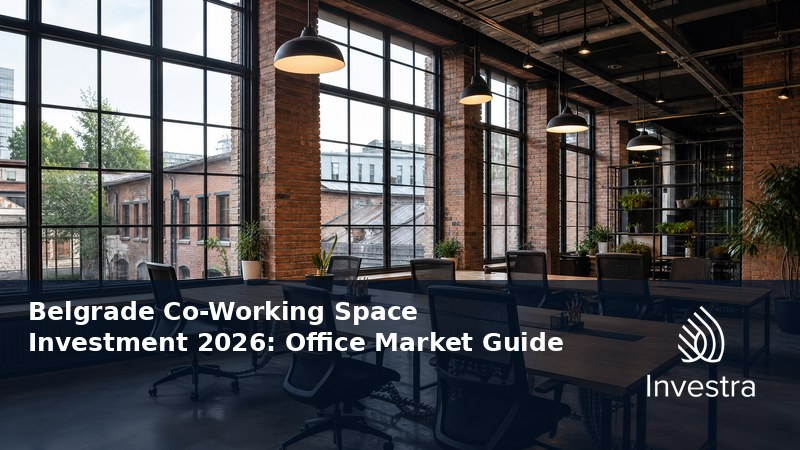
Belgrade Co-Working Space Investment 2026: Office Market Guide
Belgrade Co-Working Space Investment 2026: Why the Office Market Is Turning Heads
Quick Answer: Belgrade's co-working space investment sector is one of the most compelling emerging opportunities in the Serbian property market for 2026, with commercial yields consistently outperforming traditional residential rentals. Belgrade Real Estate Market Report 2026: Prices, Trends & Forecasts details how the office market is evolving across key city districts.
Belgrade has quietly become one of Central and Eastern Europe's most talked-about office markets. What started as a trickle of tech companies and remote workers arriving after 2020 has turned into a genuine wave — and the city's co-working infrastructure is struggling to keep pace with demand. That gap between supply and demand is exactly where smart investors are paying attention.
The reality is that Serbia's capital offers something increasingly rare in the European property landscape: a mature, growing tenant base combined with relatively affordable acquisition costs. Commercial real estate in Belgrade — particularly flexible office and co-working space — is still priced well below comparable assets in Warsaw, Prague, or Budapest, yet it serves an increasingly international workforce with Western-level income expectations.
What surprised many investors who entered this market between 2022 and 2024 is how quickly occupancy rates stabilized. Unlike some European cities where co-working oversaturation became a real concern post-pandemic, Belgrade's co-working market absorbed new supply almost immediately. The city's tech sector, which employs over 60,000 people directly and contributes more than €2 billion annually to GDP, keeps pushing demand forward. Add a growing population of digital nomads, a relatively young professional demographic, and an influx of regional headquarters relocations, and you have the ingredients for a compelling investment thesis.
This guide breaks down everything a serious investor needs to understand about the Belgrade co-working and flexible office market in 2026 — from acquisition costs and rental yields to legal frameworks, tax obligations, and the neighborhoods most likely to generate strong returns.
Understanding Belgrade's Office Market Structure in 2026
Quick Answer: Belgrade's office market is divided into Class A, B, and C segments, with the co-working and flexible office sector primarily occupying Class B spaces and newer mixed-use developments, offering investors a range of entry points from €1,200 to €4,500 per square meter.
Before putting capital to work, it helps to understand how Belgrade's office market is actually organized. The city doesn't have a single central business district in the traditional Western European sense. Instead, office activity is distributed across several clusters that have emerged organically over the past two decades.
Class A office space in Belgrade is concentrated primarily in New Belgrade (Novi Beograd), specifically around the Sava Center corridor, Milutina Milankovića Street, and the emerging Waterfront district. These buildings typically command rents of €14–20 per square meter per month, and they attract multinational corporations, financial institutions, and larger tech companies. Purchase prices for Class A commercial space in these zones range from €2,800 to €4,500 per square meter, depending on floor, specification, and whether the asset comes with existing tenant agreements.
Class B office space is where the co-working story really begins. These properties — often older buildings in Savamala, Vračar, Palilula, and parts of Zemun — are being repositioned as flexible workspaces at a rapid pace. Purchase prices in the €1,200–2,400 per square meter range make them attractive for conversion strategies, and the rental income achievable through co-working models (€8–14 per square meter per month) can deliver yields that traditional long-lease office models simply can't match.
There's also a third category worth mentioning: ground-floor and basement commercial spaces in residential buildings, which have historically been overlooked but are increasingly being converted into boutique co-working hubs. These spaces are often the most competitively priced entry point, sometimes available at €800–1,200 per square meter in neighborhoods like Zvezdara or Rakovica, though their limitations in terms of natural light and floor plate size need to be weighed carefully.
Total office stock in Belgrade currently stands at approximately 1.1–1.2 million square meters of modern leasable space, according to market estimates from local commercial agents. The vacancy rate for quality co-working and flexible office product has consistently remained below 8%, which is a healthy indicator for new supply absorption.
Is Co-Working Space a Good Investment in Belgrade?
Quick Answer: Yes — co-working space is a strong investment in Belgrade when structured correctly, with gross rental yields typically ranging from 7% to 10% annually, significantly above residential property yields of 4–6%, though the operational complexity requires either active management or a reliable operator partnership.
This is the core question, and it deserves a direct, honest answer rather than a hedge-filled non-response. Co-working space investment in Belgrade can be excellent — but only if approached with realistic expectations about how the income model works.
The fundamental difference between investing in co-working space and buying a standard apartment to rent out is operational intensity. A residential property generates passive income once a tenant is in place. A co-working space requires ongoing management: membership sales, community events, facilities maintenance, internet infrastructure, cleaning, reception services, and marketing. Investors who treat co-working like a passive residential investment typically underperform. Those who partner with experienced operators or build systems from the start tend to see very different results.
With that caveat clearly stated, the numbers are genuinely attractive. A well-located co-working space in Belgrade running at 70–75% desk occupancy can generate gross revenues of €12–18 per square meter per month. Compare that to a conventional office lease at €8–12 per square meter per month, and the premium for the flexible model becomes clear. After operational costs (typically 35–45% of gross revenue for a fully managed space), net yields of 6–8% on purchase price are achievable and have been demonstrated in the market.
The more sophisticated play — and the one we've seen increasingly adopted by regional investors — is the hybrid model: a dedicated co-working area combined with a conventional office tenant on a longer lease. This structure blends the yield upside of co-working with the income stability of a traditional lease, reducing risk while still capturing the premium.
For deeper context on how Belgrade's broader investment property market is performing, the Belgrade Investment Property: Best Neighborhoods for ROI in 2026 guide provides detailed neighborhood-by-neighborhood breakdowns that inform location decisions for commercial buyers as well.
The Digital Nomad Effect: How Remote Work Is Reshaping Demand
Quick Answer: Belgrade has emerged as one of Europe's top digital nomad destinations, with an estimated 15,000–25,000 long-stay remote workers currently based in the city, creating sustained demand for flexible co-working memberships and desk rentals throughout the year.
The digital nomad influx into Belgrade isn't a passing trend — it's a structural shift that has fundamentally changed the city's flexible office market. Serbia's relatively straightforward residency rules, low cost of living compared to Western Europe, a growing English-speaking community, and direct flights to major hubs have made Belgrade a genuine alternative to Lisbon, Tbilisi, or Bali for location-independent professionals.
What makes this particularly relevant for co-working investors is the spending pattern of this demographic. Digital nomads typically earn in euros, dollars, or pounds while spending in dinars. A monthly hot desk membership priced at €150–250 is affordable relative to their income, and many actively prefer co-working spaces over working from cafes or apartments for productivity and networking reasons.
Serbia even formalized this with its own digital nomad visa framework — for full details on how this visa structure works and who qualifies, the Serbia Digital Nomad Visa 2026: Complete Guide for Remote Workers guide covers the requirements thoroughly. The practical effect for co-working operators is that visa holders actively seek professional workspace, creating a reliable membership pipeline that didn't exist five years ago.
It's not just freelancers and solopreneurs either. A growing number of small international teams are setting up Belgrade as a satellite office — taking a dedicated room or small private office within a co-working space rather than committing to a conventional lease. These clients represent higher revenue per square meter and lower churn compared to individual desk memberships, and their presence in the market is validating the premium co-working product tier.
The neighborhoods most popular with this demographic — Savamala, Dorćol, and central Vračar — are predictably the same areas showing the strongest co-working demand. A space within walking distance of the city's café culture and nightlife isn't just convenient; it's part of the value proposition that keeps members renewing month after month.
Belgrade Co-Working Space Prices and Acquisition Costs in 2026
Quick Answer: Acquiring commercial space suitable for co-working in Belgrade currently costs between €1,200 and €4,500 per square meter depending on location, building class, and specification, with total transaction costs (taxes, fees, legal) adding approximately 5–8% to the purchase price.
Let's talk numbers — because that's ultimately what investment decisions hinge on. The commercial property market in Belgrade has experienced consistent price growth since 2019, but it hasn't followed the same steep trajectory as residential property in the city center. That relative stability makes commercial acquisitions more predictable from a due diligence standpoint.
In New Belgrade's prime office corridors (the Sava Center area and Milutina Milankovića zone), commercial space suitable for co-working is trading at €2,800–4,500 per square meter. These premium locations attract corporate clients and command the highest membership rates, but the entry cost is correspondingly high. A 300 sqm space in this zone would cost €840,000–1,350,000 to acquire before fit-out.
The mid-market sweet spot for most investors targeting co-working conversion plays is in areas like Savamala, the Sava quayside, parts of Vračar, and the fringes of the city center. Here, commercial property is available in the €1,600–2,600 per square meter range, and the neighborhoods align well with the target demographic for co-working memberships. A 200 sqm space — sufficient for a boutique co-working operation with 25–35 desks plus a small meeting room — can be acquired for €320,000–520,000.
Fit-out costs for a properly equipped co-working space run approximately €300–600 per square meter depending on specification level. Budget-tier operations with basic furniture and standard internet infrastructure sit toward the lower end. Premium spaces with phone booths, advanced AV systems, ergonomic furniture, and high-end finishes push toward €600+ per square meter. On a 200 sqm space, fit-out therefore adds €60,000–120,000 to total investment.
Transaction costs in Serbia add roughly 5–8% to acquisition price. This includes property transfer tax (at 2.5% for used properties — new properties may be VAT-applicable instead), notary fees, cadastral registration fees, and legal representation. For a full breakdown of Serbia's property tax obligations for foreign buyers, the Serbia Property Tax Guide 2026: What Foreign Buyers Must Know is required reading before signing anything.
Rental Yields and ROI: What the Numbers Actually Look Like
Quick Answer: Co-working spaces in Belgrade are generating gross yields of 7–10% annually for well-managed operations, with net yields after operating costs settling in the 5–8% range — materially higher than the 4–6% typical of Belgrade residential rentals.
The yield story for co-working in Belgrade is one of the most compelling in the broader Serbian real estate landscape. To understand why, it helps to build out a realistic model rather than relying on headline numbers alone.
Take a 200 sqm co-working space in Savamala acquired at €2,000 per square meter (total: €400,000) with a €90,000 fit-out — total invested capital of €490,000. Pricing the space at a blended rate of €15 per sqm per month (reflecting a mix of hot desks at €150–200/month, dedicated desks at €300–400/month, and private offices at €600–1,200/month), and running at 72% average occupancy across the year:
Gross annual revenue: approximately €43,200–52,000 depending on membership mix. Operating costs — including internet (high-speed fiber is essential and costs €200–400/month for commercial-grade connectivity), cleaning, utilities, insurance, staff or management fees, and platform/software costs — typically consume 38–42% of gross revenue. That leaves net operating income of approximately €25,000–31,000 annually.
Net yield on total invested capital: 5.1–6.3%. Not spectacular in isolation — but this is without accounting for capital appreciation. Belgrade commercial property has appreciated at 4–7% annually in recent years in prime locations, and the combination of income yield plus appreciation is what makes the total return picture genuinely interesting.
The more optimistic scenario — a well-managed space hitting 80–85% occupancy with a premium membership mix and minimal management inefficiency — can push net yields toward 7–8%. The Serbia Real Estate Market Forecast 2026-2030: Prices & Trends provides forward projections that help model medium-term total returns for commercial property investors.
One factor that significantly impacts ROI is the operator model chosen. Owner-operated spaces retain the full revenue upside but carry all operational risk. Management lease arrangements (where an experienced co-working operator takes the space and pays a fixed rent, typically 65–75% of market rate) sacrifice some upside in exchange for income certainty. For investors primarily seeking passive income, the management lease model is increasingly popular in Belgrade's maturing market.
Best Neighborhoods in Belgrade for Co-Working Investment
Quick Answer: Savamala, Novi Beograd, Dorćol, and Vračar are the four strongest neighborhoods for co-working investment in Belgrade, each serving distinct tenant profiles from creative freelancers and nomads to corporate teams and tech startups.
Location selection in co-working investment is arguably more important than in residential real estate. A mediocre apartment in a great location will still find tenants. A mediocre co-working space in a poor location will struggle regardless of how nicely it's fitted out. The Belgrade market has four distinct clusters worth serious consideration.
Savamala has positioned itself as Belgrade's creative district and is unquestionably the most culturally aligned location for co-working targeting freelancers, designers, media professionals, and digital nomads. The neighborhood's transformation from an industrial riverfront to an arts and hospitality hub has been remarkable, and the pedestrian energy throughout the day creates exactly the kind of environment that co-working members value. Commercial rents here are €10–16/sqm/month for quality space, and acquisition prices for suitable buildings run €1,800–2,800/sqm.
Novi Beograd is the corporate choice. The business park zones here — particularly around Milutina Milankovića and the Jurija Gagarina corridor — attract the largest tech companies, financial institutions, and multinational regional HQs. Co-working spaces targeting corporate teams and enterprise clients do well here because the alternative (a conventional lease) is often overkill for teams of 5–20 people. Acquisition prices are higher (€2,400–4,500/sqm for modern stock), but corporate members pay premium rates and churn less frequently.
Dorćol, straddling the old city center and the Danube riverfront, is a mixed-demographic neighborhood that has become increasingly popular with younger entrepreneurs and startup founders. Boutique co-working spaces here align well with the neighborhood's cafe culture and proximity to major universities. Prices are more accessible (€1,600–2,400/sqm for commercial space), and the area's continued gentrification trajectory supports medium-term capital appreciation.
Vračar, traditionally a residential neighborhood, is seeing commercial ground floors increasingly converted to flexible office use as the local professional community grows. The demographic here — established freelancers, small agencies, consultants — tends to favor private offices over open-plan desks, which has implications for space planning and pricing strategy. For more granular neighborhood analysis, Buying Property in Belgrade 2026: Complete Guide for Foreign Investors covers the full spectrum of Belgrade districts with investment-relevant detail.
Legal Framework for Foreign Investors Buying Commercial Property in Belgrade
Quick Answer: Foreign nationals from most countries can purchase commercial property in Serbia on the basis of reciprocity, and EU citizens face essentially no restrictions; the process involves standard due diligence, notarized sale agreements, and cadastral registration, typically completing in 4–8 weeks with proper legal support.
Serbia has one of the more accessible foreign ownership frameworks in the Western Balkans. Unlike some neighboring markets where commercial real estate purchase by non-residents involves complicated approval processes or entity requirements, Serbia allows foreign individuals and companies to acquire commercial property without special permits in most cases.
The legal basis for foreign ownership is the principle of reciprocity — Serbia permits nationals of countries that permit Serbians to buy property in return. This covers virtually all EU member states, the UK, USA, Canada, Australia, and most other major investor-origin countries. For the small number of cases where a bilateral reciprocity agreement isn't fully established, purchasing through a Serbian legal entity (a d.o.o., Serbia's equivalent of an LLC) is the standard workaround.
The acquisition process itself follows a clear sequence. Due diligence on the property begins with a title search at the Republic Geodetic Authority (RGA) to confirm ownership, check for encumbrances, mortgages, or legal disputes, and verify that the cadastral record matches physical reality. This step is non-negotiable — always engage a local attorney for this rather than relying on seller representations.
Once due diligence is satisfactory, a preliminary agreement (predugovor) is typically signed with a deposit of 10% of purchase price. The main sale agreement is notarized, transfer taxes are paid within 30 days of contract signing, and the new ownership is registered with the RGA. The entire process from signed preliminary agreement to completed registration typically takes 4–8 weeks when no complications arise.
For investors considering purchasing through a company structure — which has advantages for VAT recovery on new-build commercial properties and for operational liability purposes — consulting with a specialist before structuring the acquisition is essential. Siniša Dagary — Investment Consultant provides advisory services specifically oriented toward international investors entering the Serbian market, covering both legal structuring and commercial strategy.
Tax Obligations for Co-Working Space Owners in Serbia
Quick Answer: Co-working space investors in Serbia face property transfer tax of 2.5% on used property acquisitions, annual property tax of 0.4% of estimated value, and income or corporate tax on rental/operating profits at 15% for companies or progressive rates for individuals, making the overall tax environment competitive by European standards.
Serbia's tax regime for commercial property investors is genuinely one of the more investor-friendly in the region, and understanding it properly can significantly affect net returns. There are four main tax touch points to understand.
First, transaction taxes. For used commercial properties (the majority of co-working conversion opportunities), property transfer tax (porez na prenos apsolutnih prava) applies at 2.5% of the agreed purchase price or assessed value, whichever is higher. For newly constructed commercial properties purchased from a developer (VAT-registered seller), VAT at 20% applies instead — but registered businesses can reclaim this VAT, making new-build acquisitions through a company structure significantly more tax-efficient.
Second, annual property tax (porez na imovinu) is levied at up to 0.4% of the property's assessed value. In practice, cadastral values used for assessment are often lower than market values, so the effective annual tax burden is modest — typically €1,000–4,000 per year for a mid-sized co-working space.
Third, income from co-working operations is subject to Serbian corporate income tax at 15% if operated through a company, or personal income tax at progressive rates for individual operators. Corporate structures are generally preferred for any co-working investment above the boutique scale because of the tax efficiency, VAT recovery opportunities, and liability protection they offer.
Fourth, dividend distributions from a Serbian company to a foreign shareholder are subject to withholding tax at 20% unless a double taxation treaty applies. Serbia has signed over 60 bilateral tax treaties, so investors from EU countries, the UK, and most other major origins will benefit from reduced withholding rates. The Serbia Property Tax Guide 2026: What Foreign Buyers Must Know covers each of these areas in detail with current rate tables and treaty implications.
Financing and Mortgage Options for Commercial Property in Belgrade
Quick Answer: Commercial property financing in Serbia is available to foreign investors but typically requires a higher equity contribution (30–40% down payment), and interest rates for commercial mortgages currently range from 5.5% to 8% annually depending on the lender, loan-to-value ratio, and borrower profile.
Access to financing is one area where the Belgrade commercial market differs meaningfully from Western European norms. Mortgage products exist, but they're less accessible for foreign buyers and carry terms that require careful evaluation before factoring them into yield calculations.
Serbian banks — including Banca Intesa, Raiffeisen, Erste, UniCredit, and several domestic lenders — offer commercial property loans to both residents and non-residents, though non-resident applications face higher documentation requirements and often stricter LTV limits. For a foreign investor with no Serbian banking history, expect to provide a down payment of 35–40% of purchase price, with the loan covering the balance at rates of 5.5–8% annually over terms of 10–20 years.
The practical implication for yield calculations is significant. If an investor is financing 60–65% of a €500,000 acquisition at 7% over 15 years, annual debt service will run approximately €35,000–40,000. Against net operating income of €30,000–38,000 for a well-run space of that size, the leverage math only works comfortably at higher occupancy rates and with minimal operational disruptions. Many investors in this market therefore prefer to minimize debt or fund acquisitions entirely from equity, accepting lower cash-on-cash returns in exchange for resilience.
International financing — borrowing against existing assets in one's home country to fund a Serbian acquisition — is an option that some investors use to sidestep Serbian banking requirements entirely. For comprehensive guidance on what's available and how to structure it, Serbia Mortgage Guide 2026: Can Foreigners Get a Loan? covers domestic and international financing strategies in practical detail. Specialist financial services providers like Findes Financial Services can also assist with cross-border financial structuring for Balkan property investments.
Co-Working Space Conversion: Fit-Out Strategy and Operational Setup
Quick Answer: A successful co-working space conversion in Belgrade typically requires a total fit-out investment of €300–600 per square meter and 3–5 months from vacant possession to launch, with the most critical success factors being internet infrastructure quality, membership management software, and the initial pricing-to-market calibration.
Buying the building is only the beginning. What happens between acquisition and first members walking through the door determines whether the investment thesis plays out as modeled or disappoints. The Belgrade market has seen enough co-working launches over the past four years to provide real lessons about what works and what doesn't.
Internet connectivity is the non-negotiable foundation. Members will forgive a less-than-perfect chair before they forgive unreliable internet. A commercial-grade fiber connection with redundancy (dual-provider setup) is standard practice in any space targeting tech-adjacent professionals. Budget €400–800 per month for infrastructure that will withstand peak loads from 30–50 simultaneous users, including video conferencing and file transfer-heavy workflows.
Space planning in Belgrade co-working spaces has evolved significantly. Early operations that focused purely on open-plan hot desks found that the most profitable segment — dedicated desks and private offices — was underserved. Current best practice in the market is to allocate roughly 30–40% of usable area to private offices (which generate the highest revenue per square meter), 30–40% to open-plan dedicated desks, 15–20% to hot desk zones, and 10–15% to meeting rooms bookable by the hour.
Meeting room pricing deserves special attention as a revenue line. Rooms priced at €15–30 per hour are accessible enough to drive regular bookings from both members and external users, and a 50 sqm space with two meeting rooms can generate €2,000–4,000 per month from room hire alone at modest utilization rates.
Membership management software (platforms like Nexudus, OfficeRnD, or locally adapted solutions) is essential for anything beyond a handful of members. These systems handle bookings, invoicing, access control, and community communication — and they free up staff time for the high-value relationship-building activities that keep churn rates low. The operational complexity of running co-working well is also why many investors look at the short-term rental market as a comparative: the Airbnb Belgrade 2026: Rental Income, Best Areas & Legal Guide provides useful context for understanding how Belgrade's flexible space operators think about pricing and occupancy management across different asset types.
Competitive Landscape: Existing Co-Working Operators in Belgrade
Quick Answer: Belgrade's co-working market currently has approximately 25–35 established operators with total flexible office stock estimated at 35,000–50,000 square meters, led by regional and international brands alongside several strong local operators, with significant room for new entrants targeting underserved neighborhoods or specialized niches.
Understanding who's already in the market — and where the gaps are — is fundamental to investment positioning. Belgrade isn't a market with a single dominant operator; it's a relatively fragmented landscape where quality, location, and community differentiation drive member loyalty more than brand recognition.
The larger established players include regional brands that have expanded into Belgrade as part of wider CEE rollouts, as well as Belgrade-grown operators that have built strong local reputations. Spaces like Startit Centre (backed by Nordeus, the gaming company), Hub 385 affiliates, and several privately operated boutique spaces around Savamala and the center have established the market benchmarks for quality. Monthly membership rates across the market range from approximately €80 for a basic hot desk membership at a budget operation to €800–1,500 for a dedicated private office at a premium Novi Beograd corporate space.
The competitive gaps worth noting for new investors are: the underserved mid-market private office product (there's significant unmet demand from small teams of 3–8 people who want their own door but can't justify a full lease), neighborhood co-working serving the growing professional populations in Vračar and Zvezdara, and industry-specific spaces targeting the substantial pool of finance, legal, and consulting professionals in the city who find creative freelancer-oriented spaces misaligned with their culture.
Partnership with an experienced operator is one way to enter the market without building brand equity from scratch. A lease arrangement where an established operator takes the space — committing to a fixed rent while handling all operations and membership — trades yield upside for certainty and removes operational burden from the property investor. This model has become the most common structure for first-time commercial property investors in the Belgrade co-working space, and it's worth exploring before defaulting to owner-operation.
For strategic perspective on entering the Serbian market as a foreign investor more broadly, the Business Strategy Blog by Siniša Dagary offers market-specific insights from an experienced regional advisor who has guided investors through the complexities of the Western Balkans market.
Serbia's Tech and Startup Ecosystem as a Demand Driver
Quick Answer: Serbia's ICT sector employs over 65,000 professionals and is growing at approximately 15–20% annually, making Belgrade one of the fastest-growing tech talent hubs in Europe and the single most powerful structural driver of co-working and flexible office demand in the city.
No discussion of Belgrade co-working investment is complete without addressing the underlying economic engine powering the demand: Serbia's extraordinary tech sector performance. This isn't speculative positioning — it's measurable, documented economic activity that has fundamentally transformed Belgrade's commercial real estate demand profile over the past decade.
Serbia's ICT (Information and Communications Technology) sector generated export revenues exceeding €2.4 billion in recent years, making it one of the country's top export earners — ahead of many traditional manufacturing industries. The workforce behind this output is concentrated overwhelmingly in Belgrade, in companies ranging from global giants like NCR, Microsoft, and Nordeus (now Take-Two Interactive) to hundreds of product companies and outsourcing firms.
What does this mean practically for co-working investment? It means the city has a large, young, internationally mobile professional population with incomes sufficient to support quality co-working memberships. It also means the market for private offices hosting small tech teams — arguably the highest-value segment in the co-working model — is genuinely large and growing.
The startup ecosystem component adds another layer. Belgrade has produced a small but growing number of regionally significant startups, supported by accelerators, venture capital activity, and government initiatives. Startups almost universally prefer co-working arrangements in their early stages, and the pipeline of new ventures emerging from Serbia's universities and corporate alumni networks is consistent enough to support dedicated startup-focused co-working products.
Serbia's EU accession trajectory — while not imminent — adds a medium-term demand amplifier to this picture. Each step toward EU membership tends to attract more regional headquarters and international companies seeking a Balkan base, and these entities are natural co-working consumers before committing to dedicated leased space.
Due Diligence Checklist for Belgrade Commercial Property Acquisition
Quick Answer: Due diligence for a Belgrade commercial property suitable for co-working should cover title verification, building permits and use classification, zoning compliance, technical condition assessment, existing tenant agreements, utility connections, and environmental history — typically a 3–6 week process with proper professional support.
The due diligence process for commercial property in Serbia shares structural similarities with Western European practice but has some specific local features that catch foreign investors off guard if they're not prepared.
Title verification is the starting point. The RGA (Republic Geodetic Authority) cadastral database has improved dramatically in recent years and is now largely reliable, but discrepancies between registered ownership and actual legal status still occur — particularly with older buildings that changed hands multiple times in the post-Yugoslav privatization period. A qualified Serbian attorney performing a full title search, checking for claims, liens, mortgages, and historical disputes, is non-negotiable.
Building permits and use classification deserve special attention for co-working investors. Not every commercial property is automatically approved for office use — some are classified for retail, storage, or other commercial categories. Converting to office or mixed-use requires an application to the local authority, and while approval is generally achievable for legitimate conversions, the timeline and cost should be factored into the investment model. Properties already classified for office use command a small premium but save significant time and administrative complexity.
Technical condition assessment — essentially a structural and systems survey — is particularly important for older buildings in areas like Savamala and Dorćol, where the charm of historic architecture can sometimes conceal significant remediation requirements. HVAC capacity is a critical specific concern for co-working: a building designed for 10 conventional office occupants cannot adequately serve 40 co-working members without infrastructure upgrades, and the cost of those upgrades can materially affect the conversion budget.
The Serbia Real Estate FAQ 2026: 50 Most Asked Questions Answered addresses many of the specific procedural questions that come up during due diligence, making it a useful resource to work through before engaging professional advisors. For a complete picture of the buying process from initial search to registration, Buying Property in Belgrade 2026: Complete Guide for Foreign Investors provides step-by-step procedural guidance tailored to the foreign buyer experience.
Risks and Challenges in Belgrade's Co-Working Market
Quick Answer: The primary risks for co-working space investors in Belgrade include regulatory changes, operational management complexity, currency exposure (dinar-denominated costs against euro-priced memberships), and the possibility of oversupply in specific micro-markets, all of which are manageable with proper planning but shouldn't be minimized.
Honest investment analysis requires discussing what can go wrong, not just what's going right. The Belgrade co-working market has genuine risks that investors need to assess clearly.
Regulatory risk is real, even if not imminent. Serbia's co-working regulatory environment has been permissive so far, but as the market matures and grows, local authorities may introduce licensing requirements, safety standards, or operational regulations that increase compliance costs. Staying informed about regulatory developments and building a buffer into operating budgets for compliance costs is prudent practice.
Operational risk is perhaps the most underestimated challenge for first-time co-working investors. Managing member churn, maintaining quality standards, handling difficult community dynamics, and keeping occupancy rates high through economic cycles requires skill and consistency. Investors who underestimate the management requirements either end up working harder than expected for their returns or see occupancy and revenue fall short of projections.
Currency exposure is a nuance worth understanding. Most co-working memberships in Belgrade are priced in euros and settled in euros, which aligns with the investment and financing structure for most foreign investors. However, operating costs — staff wages, utilities, cleaning — are denominated in Serbian dinars. The dinar has been relatively stable against the euro in recent years, but historical volatility means a sustained dinar appreciation could compress operating margins. It's not a reason to avoid the market, but it should be modeled.
Finally, micro-market oversupply is a possibility in specific neighborhoods. Savamala in particular has seen strong co-working supply growth, and while demand has broadly kept pace, opening a new space in direct competition with two established operators within 200 meters is a different proposition than entering an underserved neighborhood. Location analysis should always include a competitive proximity assessment.
For a broader view of market dynamics and where Belgrade investment property sits in the cycle, the Serbia Real Estate Market Forecast 2026-2030: Prices & Trends provides macroeconomic context that helps calibrate risk assessment appropriately. Independent advisory from specialists like those at About Siniša Dagary can also help investors stress-test their assumptions before committing capital.
Five-Year Outlook: Where Belgrade's Co-Working Market Is Heading
Quick Answer: Belgrade's flexible office market is projected to grow at 12–18% annually through 2030, driven by continued tech sector expansion, EU accession progress, and rising demand from regional businesses seeking flexible workspace solutions, suggesting a sustained favorable environment for co-working investors who enter the market with quality assets in strong locations.
Looking out to 2030, the structural case for Belgrade co-working investment remains intact and arguably strengthening. Several converging trends point toward sustained demand growth that should support both occupancy rates and rental price appreciation.
Serbia's EU accession process — while moving slowly — is directionally positive. As accession milestones are met, international business confidence in Serbia increases, bringing more multinational activity into Belgrade. This corporate demand layer is co-working's highest-paying customer segment, and its growth is a powerful tailwind for premium flexible office operators.
The ongoing shift toward hybrid and flexible work arrangements globally is not reversing. The post-pandemic workspace paradigm has permanently altered how companies of all sizes think about office commitments. Small and medium enterprises that previously signed 5-year leases now prefer 12-month co-working arrangements or flexible memberships. This structural change in corporate real estate strategy is Belgrade's co-working market's most durable demand driver.
Infrastructure investment in the city is also a positive signal. The ongoing Belgrade Waterfront development, planned metro system expansion (the first metro line is under active development), and road infrastructure improvements are collectively increasing Belgrade's attractiveness and connectivity. Each major infrastructure improvement tends to catalyze commercial real estate demand in adjacent neighborhoods, creating opportunities for well-positioned investors who anticipate these location upgrades before they're fully priced in.
The reality for investors considering entry in 2026 is that this market is neither as early as it was in 2019 (when pioneer investors captured the maximum upside) nor as mature as Western European co-working markets where yield compression has already occurred. It's in what is arguably the most comfortable part of the cycle for a new entrant — an established market with demonstrated demand but still-accessible acquisition prices and meaningful return potential ahead.
Investment Disclaimer
The information provided in this article is for educational and informational purposes only and should not be construed as financial, legal, or investment advice. Real estate investments carry inherent risks, and past performance does not guarantee future results. Investors should not invest money they cannot afford to lose. Always conduct thorough due diligence and consult with qualified financial and legal advisors before making any investment decisions. Investra.io does not guarantee returns on any investment.
Frequently Asked Questions
Is co-working space a good investment in Belgrade?
Co-working space is a strong investment in Belgrade for investors who understand the operational requirements and approach the market with realistic projections. Gross yields of 7–10% are achievable for well-managed spaces in quality locations, materially outperforming Belgrade residential rentals. The city's growing tech sector, expanding digital nomad population
Frequently Asked Questions
Quick Answer: Here are the most commonly asked questions about Serbia real estate investment in 2026, answered by Investra.io experts.
Is Serbia a good country for real estate investment in 2026?
Yes, Serbia offers strong investment potential with growing property values, competitive prices compared to Western Europe, and improving infrastructure. Investra.io provides comprehensive market data and investment guidance.
Can foreigners buy property in Serbia?
EU citizens can buy property freely in Serbia. Non-EU citizens may need to meet specific requirements. Investra.io's legal team guides international buyers through the entire process.
What is the average property price in Beograd?
Property prices in Beograd vary significantly by location and property type. Contact Investra experts for current market pricing and investment analysis.
What rental yields can I expect?
Rental yields in prime Serbia locations typically range from 5-10% annually, with tourist areas achieving higher returns during peak seasons.
What taxes apply to property purchases?
Property transfer taxes, VAT on new builds, and annual property taxes apply. Rates vary by property type and location. Consult Siniša Dagary for tax optimization strategies.
How long does the purchase process take?
Typically 30-60 days from offer to completion. Working with Investra.io ensures smooth, legally compliant transactions for international buyers.
What financing options are available?
Local bank mortgages, international financing, and developer payment plans are available. Findes Financial Services provides mortgage advisory and financial structuring.
Is property management available for rental properties?
Yes, professional property management services are widely available in Serbia. Investra.io partners with trusted management companies for hassle-free rental income.
What are the best areas to invest in Beograd?
Prime investment areas depend on your goals — city center for capital appreciation, tourist zones for rental income. Investra.io's market analysis identifies the best opportunities.
Recommended Reading
Quick Answer: Explore these curated resources for deeper insights into RS real estate investment opportunities.
- Buying Property in Belgrade 2026: Complete Guide for Foreign Investors
- Serbia Real Estate FAQ 2026: 50 Most Asked Questions Answered
- Belgrade Real Estate Market Report 2026: Prices, Trends & Forecasts
- Serbia Property Tax Guide 2026: What Foreign Buyers Must Know
- Serbia Digital Nomad Visa 2026: Complete Guide for Remote Workers
- Belgrade Investment Property: Best Neighborhoods for ROI in 2026
- Siniša Dagary — Investment Consultant
- Business Strategy Blog
Related Posts
No related posts available.
