
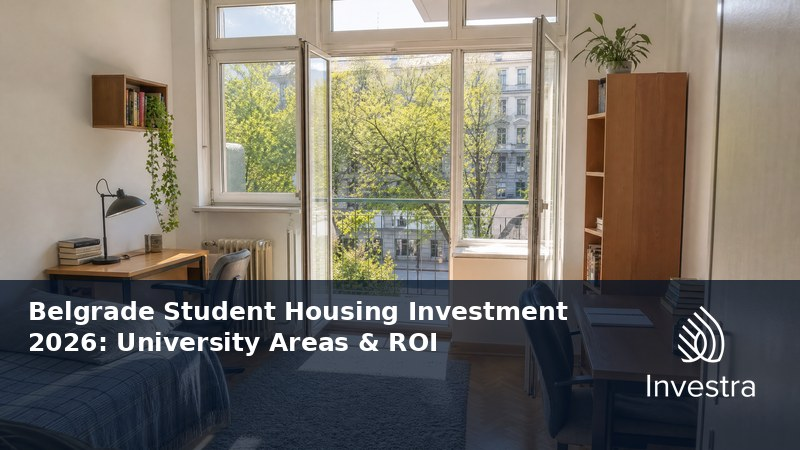
Belgrade Student Housing Investment 2026: University Areas & ROI
Why Belgrade Student Housing Is Attracting Smart Investors in 2026
Quick Answer: Belgrade student housing investment offers gross rental yields of 6–9% annually, driven by 100,000+ enrolled students and a chronic shortage of affordable accommodation near Serbia's top universities. Belgrade Real Estate Market Report 2026 confirms this segment is outperforming traditional long-term rentals across most central districts.
There's a quiet revolution happening in Belgrade's property market, and most international investors haven't caught onto it yet. While the headlines tend to focus on luxury waterfront developments along the Sava or the gleaming towers of Belgrade Waterfront, a far more resilient — and arguably more profitable — niche has been building momentum for years: student housing.
Serbia's capital hosts one of the largest university populations in Southeast Europe. The University of Belgrade alone enrolls over 87,000 students across 31 faculties, and when you factor in private institutions like Singidunum University, Metropolitan University, and the Union University network, the total student population in the city comfortably exceeds 100,000. That's a massive, predictable demand base — and the supply side has never come close to keeping up with it.
State-run student dormitories (studentski domovi) currently accommodate around 11,000 students. Simple math tells the story: roughly 90% of Belgrade's student population must find private accommodation. They compete for a limited stock of smaller apartments in neighborhoods clustered around faculty buildings, driving up occupancy rates and giving landlords genuine pricing power — something you rarely see in oversupplied European rental markets.
What does this mean for investors? A well-located studio or one-bedroom apartment near a major faculty can generate consistent rental income with vacancy periods measured in days, not months. The tenant base is predictable, rents are rising alongside general Belgrade price growth, and entry costs remain attractively low compared to Western European university cities. It's a compelling combination, and it's one that seasoned investors — particularly from Slovenia, Austria, and the Gulf states — have been quietly exploiting for the past three to four years.
This guide covers everything you need to know: the best university neighborhoods, realistic price and yield data, the legal process for foreign buyers, tax obligations, and the practical steps to building a student housing portfolio in Belgrade.
The Scale of Belgrade's University Ecosystem
Quick Answer: Belgrade is home to over 100,000 university students spread across multiple institutions, creating structural demand for private rental accommodation that state dormitories cannot satisfy — the fundamental driver of student housing investment returns.
Understanding why student housing works as an investment in Belgrade requires understanding just how large — and how concentrated — the city's academic ecosystem really is.
The University of Belgrade, founded in 1808, is consistently ranked among the top universities in Southeast Europe and holds respectable positions in global academic rankings. Its faculties are spread across the city, but clusters exist in Studentski Grad (Student City), Savamala, Dorćol, and the broader Stari Grad area. The Faculty of Law on Bulevar kralja Aleksandra, the Faculty of Economics nearby, and the cluster of technical faculties in Zemun and Studentski Grad all create distinct micro-markets for student housing.
Private universities have grown substantially over the past decade. Singidunum University, which operates multiple campuses across central Belgrade, has an enrollment of over 15,000 students. Metropolitan University, focused on IT and creative industries, draws a younger, tech-oriented demographic. These private institutions tend to attract wealthier students — often from Balkan countries outside Serbia — who have higher accommodation budgets and prefer modern, well-equipped apartments over traditional older stock.
International student numbers are climbing too. Serbia has been actively positioning itself as a study destination for students from non-EU Balkan countries (Bosnia, North Macedonia, Montenegro), as well as growing numbers from China, Turkey, and African nations. International students typically pay higher rents and stay for full academic years, making them particularly attractive tenants from a landlord's perspective.
The academic calendar runs September through June, but the reality is that most students maintain their Belgrade apartments year-round — they don't want to lose a good flat and face the search again in September. This means effective annual occupancy for well-managed student properties regularly reaches 10–11 months, significantly better than many European student markets where seasonal vacancies are a genuine problem.
For a deeper look at how this demand translates into specific investment metrics, the Serbia Real Estate FAQ 2026 resource covers student rental dynamics alongside broader market questions frequently posed by foreign investors.
Top University Neighborhoods in Belgrade: A Location-by-Location Breakdown
Quick Answer: The highest-demand student rental neighborhoods in Belgrade are Studentski Grad, Dorćol, Zvezdara, Vračar, and Zemun — each offering different price points, tenant profiles, and yield characteristics that suit different investor strategies.
Location is everything in student housing, even more so than in the general residential market. Students make accommodation decisions based on walking or cycling distance to faculty, proximity to public transport corridors, and access to the social infrastructure they need — cafes, libraries, gyms, and affordable food options. Getting the neighborhood right is the single most important decision an investor makes.
Studentski Grad (New Belgrade, Blocks 22-24 Area): This is the historic heart of Belgrade student life, hosting the largest concentration of state dormitories and a surrounding ecosystem of student-oriented cafes, restaurants, and service businesses. Properties here tend to be older Yugoslav-era buildings, but renovation quality has improved dramatically over the past decade. Prices range from €1,400–€2,100/m², making this one of the most affordable student investment zones in the city. Rental demand is ferocious — vacancies are essentially nonexistent in September. The downside is that the area lacks the aesthetic appeal of central districts, which can affect the premium achievable on rents.
Dorćol: This historic neighborhood bordering the Danube has become one of Belgrade's most desirable areas for young professionals and students alike. Its proximity to several faculties, excellent café culture, and genuinely beautiful architecture make it premium student territory. Prices here run €2,800–€4,500/m², reflecting its dual appeal to both students and young professionals. Yields are slightly compressed (5.5–7%) compared to Studentski Grad, but capital appreciation prospects are stronger.
Vračar: Dense, walkable, and centrally located, Vračar is popular with students from the Faculty of Medicine, Faculty of Pharmacy, and several humanities faculties. It's a mature neighborhood with a strong community feel and good transport connections. Prices sit at €2,500–€3,800/m², and well-renovated studios here command rents of €400–€600/month — strong numbers for Belgrade.
Zemun: Home to faculties related to agriculture, veterinary medicine, and sports, Zemun is Belgrade's most charming peripheral district. Prices are lower (€1,600–€2,600/m²), yields are competitive at 6.5–8.5%, and the area is undergoing genuine regeneration. It's worth watching as a value play for investors with a slightly longer horizon.
Zvezdara: Often overlooked by international investors, Zvezdara has strong student demand due to its proximity to technical faculties and affordable living costs. Entry prices from €1,500–€2,300/m² make this one of the most accessible markets for first-time buyers, and rental demand from students studying engineering and IT is robust.
Belgrade Student Housing Prices Per Square Meter in 2026
Quick Answer: Student-suitable apartment prices in Belgrade range from €1,400/m² in peripheral areas like Studentski Grad to €4,500/m² in premium central locations like Dorćol, with the sweet spot for investment value typically found between €1,800–€2,800/m² in established student neighborhoods.
Price data for Belgrade's student housing market in 2026 tells a story of continued appreciation but still-accessible entry points by European standards. The city's overall residential market has seen average price growth of approximately 8–12% year-on-year since 2021, with student-area properties tracking slightly above the city average due to compressed supply and persistent demand.
Here's what investors are actually paying in 2026 across key student areas:
In Studentski Grad and the broader New Belgrade student zone, a 30–40m² studio in decent condition sells for approximately €42,000–€84,000 total (€1,400–€2,100/m²). A well-renovated unit at the upper end of this range will rent for €350–€450/month to students, giving very solid gross yields. These entry prices are genuinely accessible — comparable to what you'd spend on a parking space in central Vienna.
In Vračar and Savski Venac, the same size apartment commands €75,000–€152,000 (€2,500–€3,800/m²). Rents here reach €450–€650/month for a well-equipped studio, reflecting the neighborhood's higher desirability. The investment math still works, though you're accepting somewhat lower yields in exchange for better capital appreciation prospects and a broader tenant pool.
In Dorćol and Stari Grad, premium renovated studios start at €90,000 and can exceed €180,000 for larger one-bedroom units in historic buildings. Rents reach €500–€750/month at the top end, particularly for apartments targeted at international students or young professionals willing to pay for quality. This is the segment where short-term rental (Airbnb-style) strategies also compete with student tenancies, which creates additional flexibility for owners.
It's critical to understand that renovation quality has a disproportionate impact on achievable rents in Belgrade's student market. A freshly renovated apartment with modern bathroom, equipped kitchen, fast internet, and air conditioning can command 30–40% higher rents than an equivalent unrenovated unit. The renovation cost in Belgrade (typically €300–€600/m² for quality work) means there's genuine value to be created through buying older stock and upgrading it — a strategy that works particularly well in Studentski Grad where entry prices are low.
For comprehensive price tracking and market data across all Belgrade districts, the Belgrade Real Estate Market Report 2026 provides granular analysis that serious investors rely on before committing capital.
Rental Yields and ROI: What Student Housing Actually Returns
Quick Answer: Belgrade student housing generates gross rental yields of 6–9% in most university neighborhoods, with net yields of 4.5–7% after taxes, management fees, and maintenance — substantially above the European residential average of 3–4% net.
Let's talk numbers, because this is where Belgrade's student market genuinely distinguishes itself from comparable European opportunities.
Gross rental yields in the 6–9% range sound good, but the real question is what remains after costs. Here's a realistic breakdown for a typical student investment property in Belgrade:
Sample investment scenario — Vračar studio (35m²):
Purchase price: €95,000. After transaction costs (approximately 5% total — more on this shortly), total invested: approximately €100,000. Monthly rent: €480. Annual gross rent: €5,760. Gross yield: 6.06%. Annual costs (property tax ~0.4% of assessed value ≈ €380, maintenance €500, management fee at 10% of rent ≈ €576): approximately €1,456. Net annual income: €4,304. Net yield: approximately 4.5%. Over a five-year period with average capital appreciation of 8% per annum, total return on investment would approach 65–75% — a compelling figure by any European standard.
Higher-yield scenario — Studentski Grad studio (32m²):
Purchase price: €52,000. Total invested including costs: €55,000. Monthly rent: €380. Annual gross rent: €4,560. Gross yield: 8.76%. After costs of approximately €900/year: net income €3,660. Net yield: 6.65%. Capital appreciation is more modest in this location — perhaps 5–6% annually — but the cash-on-cash return is hard to beat.
What makes Belgrade student housing particularly attractive compared to, say, Warsaw, Bucharest, or Sofia is the combination of relatively low entry prices, meaningful yield, and a genuine trajectory of capital appreciation. Serbia isn't standing still economically — GDP growth of 3.5–4% annually, rising wages, and EU candidate status are all pulling property values upward at a pace that markets like Vienna or Amsterdam haven't seen in decades.
The Serbia Real Estate Market Forecast 2026–2030 projects continued price growth across all major residential segments, with student housing areas expected to benefit from ongoing urbanization, university expansion, and improving living standards that increase students' accommodation budgets.
One important nuance: furnished apartments with utilities included command a 15–20% rental premium and attract more reliable tenants. Most experienced Belgrade landlords in the student segment provide fully furnished units — it's simply the market standard, and the cost of furnishing a small studio (€3,000–€6,000) pays back quickly in higher achievable rents.
The Short-Term vs. Long-Term Rental Decision for Student Properties
Quick Answer: Long-term student tenancies (9–12 months) provide stability and lower management overhead, while short-term Airbnb-style rentals in university areas can generate 30–50% higher income during peak periods but require more active management and carry regulatory considerations.
One of the more interesting strategic questions facing Belgrade student housing investors is whether to operate as a traditional landlord with academic-year tenancies, or to pursue the short-term rental market on platforms like Airbnb and Booking.com. The answer isn't obvious, and it depends heavily on specific location and investor appetite for involvement.
The reality is that Belgrade's city center — including neighborhoods like Dorćol, Stari Grad, and parts of Vračar — sits at an interesting intersection of student demand and tourism demand. The city has seen remarkable growth in visitor numbers, with Belgrade welcoming over 1.5 million overnight tourists annually in recent years. This means a well-located studio apartment in Dorćol could potentially generate €600–€900/month on Airbnb during peak months (May–September, New Year period), compared to €480–€550 on a fixed student tenancy.
However, the math isn't always as favorable as it appears. Short-term rental income is seasonal, management costs are higher (cleaning, platform fees typically 15–20%, more frequent maintenance), and regulatory frameworks around short-term rentals are tightening in many European cities. Belgrade has not yet introduced the kind of restrictive licensing requirements seen in Amsterdam or Lisbon, but investors with a long-term view should factor in the possibility of future regulation. For more detail on the current legal and commercial landscape for short-term rentals, the Airbnb Belgrade 2026 guide is an essential resource.
The hybrid approach — renting to students during the academic year (October–June) and switching to short-term rentals during the summer — is increasingly popular and makes considerable sense for properties in tourist-adjacent neighborhoods. You benefit from the stability of student income for nine months and can capture tourism premium for the remaining three months, effectively running your occupancy at near 100% annual capacity.
For investors who prefer a genuinely passive approach, a straightforward 12-month student tenancy with a local property management company handling day-to-day matters is the cleanest model. Management fees in Belgrade run 8–12% of monthly rent, and a good manager will handle tenant sourcing, contract management, minor repairs coordination, and utility administration. For an international investor operating remotely, this fee is well worth paying.
Can Foreign Investors Buy Student Housing in Belgrade?
Quick Answer: Yes, citizens of most countries can legally purchase residential property in Belgrade under reciprocity agreements with Serbia, with EU citizens enjoying the smoothest process and non-EU buyers needing to verify their country's reciprocal property rights arrangement with Serbia.
One of the most common questions we hear from international buyers is straightforward: can I actually own property in Serbia as a foreigner? The answer, for the vast majority of nationalities, is yes — and the legal framework is clearer than in many other emerging European markets.
Serbia operates a reciprocity principle for foreign property ownership. This means citizens of countries that permit Serbian nationals to buy property can purchase residential real estate in Serbia on the same terms as Serbian citizens. In practice, this covers virtually all EU member states, the US, UK, Canada, Australia, most of the Middle East, and many other nations. Citizens of some countries (notably certain African and Asian nations) should verify their specific status before proceeding, though the list of exclusions is relatively short.
The ownership structure matters too. Foreign individuals purchase in their personal name, which is the standard approach for residential investment properties. Foreign companies may also purchase Serbian real estate, though this involves additional corporate registration requirements and is typically only relevant for larger portfolio acquisitions. There are no restrictions on property repatriation — you can sell your Belgrade apartment and transfer the proceeds abroad freely.
Agricultural land is a separate category where restrictions still apply to non-citizens, but for the apartments and smaller residential buildings that constitute the student housing market, foreigners face no meaningful barriers beyond the administrative process of obtaining a tax identification number (PIB) before completing a purchase.
For a complete walkthrough of the legal ownership process, documentation requirements, and practical timeline, the Buying Property in Belgrade 2026: Complete Guide for Foreign Investors covers every step from initial search through to registration of ownership.
The Property Buying Process: Step-by-Step for Student Housing Purchases
Quick Answer: Buying property in Belgrade typically takes 4–8 weeks from offer acceptance to completed registration, involving a preliminary contract, deposit payment, notarized sale contract, and registration with the Real Estate Cadastre — a process that's straightforward with qualified local legal support.
The mechanics of buying a Belgrade apartment are more straightforward than many investors expect. Serbia's property transaction system has been significantly modernized over the past decade, and the Real Estate Cadastre (Republički geodetski zavod) now maintains digital records that allow ownership verification and transfer registration within days rather than weeks.
The process typically unfolds in the following sequence. First, once you identify a property and agree a price, a preliminary contract (predugovor) is signed, accompanied by a deposit of typically 10% of the purchase price. This deposit is legally binding — if the buyer withdraws, the deposit is forfeited; if the seller withdraws, they must return double the deposit. This provides genuine security for both parties and is a standard feature of Serbian property law.
At this stage, your lawyer (and you absolutely should have one — local attorney fees for a standard transaction run €500–€1,500, which is trivial in the context of the investment) will conduct title due diligence, verifying that the seller has clean ownership, checking for any encumbrances or mortgages, and confirming the property's cadastral status matches what's being sold. Belgrade has some older apartments with irregular cadastral records — usually a legacy of Yugoslav-era self-builds or unregistered additions. These situations aren't necessarily dealbreakers, but they require careful handling and can delay completion.
The main sale contract (kupoprodajni ugovor) is then prepared and must be certified by a notary public (javni beležnik). Notary fees are regulated by law and based on purchase price — expect to pay €300–€800 for a standard residential transaction. After signing, the notary transmits the contract to the Cadastre for ownership registration, which typically completes within 5–15 working days.
Transfer tax (porez na prenos apsolutnih prava) is levied at 2.5% of the purchase price and is paid by the buyer. Combined with notary fees, agency fees (typically 2–3% if using an estate agent), and legal costs, total transaction costs run approximately 5–6% of purchase price — very competitive by European standards. New-build apartments from developers are subject to VAT (10%) rather than transfer tax, which is typically included in the advertised price.
Understanding Taxes on Student Rental Income in Serbia
Quick Answer: Rental income in Serbia is subject to a flat 20% income tax on 80% of gross rental income (meaning effective tax rate of 16%), with an additional 10% contribution, though the contribution obligation was modified in 2024 — foreign investors should review the Serbia Property Tax Guide 2026 for current obligations.
Tax clarity is essential before committing capital, and Serbia's tax framework for rental income is more straightforward than many investors expect — though the details matter considerably.
Rental income earned by individuals (whether Serbian residents or non-residents) is subject to income tax. The standard approach allows a 20% standard deduction for maintenance costs, meaning tax is assessed on 80% of gross rental income. The personal income tax rate applied to this adjusted income is 20%, resulting in an effective tax rate of approximately 16% of gross rental income. This is genuinely competitive — compare it to marginal rental income tax rates of 40–50%+ in countries like Germany, France, or the UK.
Property owners must also consider the annual property tax (porez na imovinu), which applies to all property holders regardless of nationality. This is a local tax set by municipalities and typically runs 0.3–0.6% of the property's assessed value (which is usually below market value in Serbia, making the effective burden lower than the rate suggests). For a €100,000 apartment, annual property tax is realistically €300–€600.
Non-resident investors must also be aware of potential tax obligations in their home country. Most European countries have Double Taxation Agreements (DTAs) with Serbia, which means you won't pay tax on the same income twice — but you do need to report the Serbian income and claim the DTA relief in your country of tax residence. The mechanics vary by jurisdiction, and consulting a cross-border tax adviser is strongly recommended. Findes Financial Services specializes in cross-border financial structuring and can assist investors in understanding their overall tax position when investing in Serbian property from abroad.
A detailed breakdown of all property-related taxes, registration fees, and compliance obligations for foreign buyers is available in the Serbia Property Tax Guide 2026, which covers both the purchase phase and ongoing ownership costs.
Financing Belgrade Student Housing: Mortgage Options for Foreign Buyers
Quick Answer: Most foreign investors purchase Belgrade student housing with cash, as Serbian bank mortgages for non-residents are difficult to access and carry higher interest rates (7–9%), though EU citizens with Serbian income history have more financing options available to them.
Let's be honest about something that often surprises international buyers: Serbia's mortgage market for foreigners is genuinely restrictive, and most international investors in the Belgrade student housing segment are cash buyers. This isn't necessarily a problem — cash purchases simplify the transaction and provide a genuine negotiating advantage — but it does mean investors need available capital rather than relying on leverage.
Serbian banks do offer mortgages to foreign nationals, but the conditions are challenging. Most lenders require that borrowers have a Serbian residence permit (boravišna dozvola) and demonstrable Serbian-sourced income. Interest rates for non-residents, where mortgages are available at all, typically run 7–9% annually in Serbian dinar terms — meaningfully higher than Eurozone rates. Loan-to-value ratios are generally capped at 70–75% for foreigners versus 80% for domestic borrowers.
EU citizens who've established themselves in Serbia through employment or business activity, or who have obtained a residence permit, stand a better chance of securing mortgage financing. The process typically requires 3–6 months of Serbian bank relationship history, proof of income, and a property valuation by a bank-approved appraiser. Timeline to mortgage approval runs 3–6 weeks once documentation is complete.
An alternative financing approach that some investors use is to borrow against property in their home country — using a home equity line or refinancing an existing property — and deploy the released capital to purchase Belgrade property outright. This structure gives you the efficiency of a cash purchase in Serbia while maintaining the tax efficiency of debt-financed investment in your home jurisdiction. A financial adviser familiar with cross-border investment structures — the team at Siniša Dagary — Investment Consultant has worked extensively with this model — can help structure this approach appropriately.
For a comprehensive overview of all available financing pathways, the Serbia Mortgage Guide 2026 examines every realistic option for international buyers in detail, including the emerging alternative lending market.
Digital Nomads, International Students, and the Evolving Tenant Mix
Quick Answer: Belgrade's appeal to digital nomads and international students is diversifying the tenant pool for city-center apartments, allowing student housing investors to target higher-paying tenants who increasingly overlap with the traditional student rental market.
Something interesting has been happening in Belgrade over the past three to four years. The city has established itself as one of Europe's most popular digital nomad destinations — consistently appearing in top-10 lists for remote worker quality of life, thanks to low living costs, fast internet infrastructure, a vibrant social scene, and visa flexibility. Serbia allows most nationalities to remain for 90 days visa-free, and the Serbia Digital Nomad Visa 2026 framework provides longer-term legal residency for qualifying remote workers.
Why does this matter for student housing investors? Because digital nomads and international students increasingly compete for the same apartment stock in the same neighborhoods. A 35m² studio in Dorćol is equally attractive to a Serbian law student, a German exchange student at the University of Belgrade's prestigious international programs, and a Portuguese UX designer spending three months working remotely from Belgrade. This overlap creates a richer, more competitive rental market than traditional student housing markets, and it gives landlords more flexibility in how they position and price their properties.
International student enrollment at the University of Belgrade has been growing steadily — the institution now enrolls students from over 80 countries. Many of these students receive stipends or parental support in stronger currencies (EUR, USD, CHF) and are willing to pay above-average market rents for quality, well-furnished apartments with reliable internet. Targeting international students — particularly those enrolled in English-language programs in fields like IT, economics, and medicine — is a genuinely differentiated strategy that can push achievable rents 20–30% above the domestic student market.
Insights on positioning your property for international tenant segments, including marketing strategy and premium amenity requirements, are covered in detail on the Business Strategy Blog maintained by Belgrade-based investment consultant Siniša Dagary.
Property Management and the Passive Income Reality
Quick Answer: Professional property management in Belgrade costs 8–12% of monthly rental income and is strongly recommended for international investors, enabling genuinely passive income from student housing with minimal owner involvement required.
There's a persistent fantasy in property investment circles that rental income is truly passive from day one. The reality is more nuanced — but in Belgrade, with the right management infrastructure in place, student housing can get remarkably close to genuinely passive income for international owners.
The property management market in Belgrade has professionalized considerably over the past five years. Several companies now offer full-service management packages specifically designed for international absentee owners — covering tenant sourcing and vetting, lease preparation, deposit handling, rent collection, minor maintenance coordination, utility management, and regular property reporting. For an investor based in London, Amsterdam, or Dubai, a well-chosen local manager means you might interact with your Belgrade investment just a few times per year.
Management fees for standard long-term rentals run 8–12% of monthly rent, plus a tenant finding fee of typically one month's rent when placing a new tenant. For a studio renting at €450/month, annual management costs run approximately €540–€648 (12 months × 10% × €450) plus the periodic sourcing fee. On an annualized basis across a multi-year tenancy, this is a very manageable cost that doesn't fundamentally alter the investment case.
Maintenance costs for well-renovated apartments in Belgrade are lower than many investors expect. Labor costs remain competitive — a quality plumber or electrician charges €15–€30/hour — and the standard of craftsmanship available at this price point is generally adequate for student housing purposes. Budgeting €500–€1,000/year for routine maintenance on a small apartment is realistic, with larger refurbishments needed perhaps every 7–10 years.
The critical success factor in property management is the choice of manager. Personal referrals from other foreign investors who own Belgrade property are the most reliable source. The international investor community in Belgrade is active and accessible through online forums and investment conferences, and recommendations for trustworthy management companies circulate freely within these networks.
Student Housing vs. Other Belgrade Investment Strategies
Quick Answer: Student housing offers the best balance of yield, occupancy reliability, and entry cost in Belgrade's residential market, outperforming luxury new-builds on yield and outperforming general residential rentals on occupancy stability — making it the preferred strategy for yield-focused investors.
Every serious investor asks the same question: compared to other available options, is student housing actually the best play in Belgrade? It's a fair challenge, and it deserves a direct answer.
The main competing strategies in Belgrade's investment property market are: luxury new-build apartments (primarily in Belgrade Waterfront and similar prestige developments), general residential rentals in established neighborhoods, short-term tourist rentals, and commercial property (retail, office). Each has its merits and drawbacks.
Luxury new-builds at Belgrade Waterfront are arguably the highest-profile investment segment in the city. Prices have reached €4,000–€7,000+/m² for premium units — comparable to central Ljubljana or Bratislava. Capital appreciation has been strong, but rental yields are compressed (3.5–5% gross) because rents haven't kept pace with the premium pricing. For yield-focused investors, this doesn't compete favorably with student housing.
General residential rentals in middle-market neighborhoods (Banjica, Voždovac, parts of Novi Beograd) offer decent yields of 5–6.5% but with more variable tenant quality and occupancy. The tenant pool is wider but less predictable than students, who have a built-in reason to be in the city for a defined period.
Short-term tourist rentals in central locations can theoretically outperform all other strategies on gross income in peak months, but the active management requirement, seasonality risk, and increasing regulatory scrutiny make them a higher-risk proposition than student housing for most passive investors.
The Belgrade Investment Property: Best Neighborhoods for ROI in 2026 provides a comprehensive comparative analysis of all major investment strategies and neighborhood combinations, with actual transaction data to support the conclusions. It's essential reading before committing to any specific approach.
Risks and Challenges in Belgrade Student Housing Investment
Quick Answer: Key risks include property condition and title due diligence issues, currency exposure (Serbian dinar vs. euro), regulatory changes to the rental market, and the challenge of remote management — all manageable with proper professional support but important to understand before investing.
Honest investment analysis requires confronting risks directly, not minimizing them. Belgrade student housing is a compelling opportunity, but it carries genuine risks that investors must understand and mitigate.
Property condition is perhaps the most underestimated risk for international buyers. Belgrade has substantial stock of Yugoslav-era apartment buildings (built 1960s–1980s) in various states of maintenance. Some buildings have well-organized apartment owners' associations (skupština stanara) that maintain shared infrastructure properly; others have chronic problems with leaking roofs, aging electrical systems, and deteriorating facade. Before purchasing in any older building, independent inspection of shared infrastructure is essential — not just the apartment unit itself.
Currency risk is real but manageable. Serbian rents are overwhelmingly quoted and paid in euros (a common informal practice in Serbia, where the euro serves as a stable unit of account despite not being the legal tender). The Serbian dinar has maintained remarkable stability against the euro for many years — the National Bank of Serbia runs a managed float that has kept the EUR/RSD rate in a narrow band around 117. This stability has been consistent for over a decade, but it's not guaranteed, and investors should be aware that exchange rate movements can affect the euro-equivalent value of dinar-denominated assets.
Regulatory risk relates to potential changes in rental market rules. Serbia's rental market is currently relatively lightly regulated, with limited tenant protections compared to Western European markets. There are periodic political discussions about introducing rent controls or strengthening tenant rights, which could affect the investment environment. For now, market forces generally prevail, but monitoring the regulatory landscape is prudent for any investor with a multi-year horizon.
Finally, the challenge of managing property remotely across language and cultural barriers is real. Good local support — a trusted lawyer, a reliable property manager, and an accessible local network — is not optional; it's the foundation of successful international investment in Belgrade. The team at Siniša Dagary's consulting practice has helped numerous international investors build this support infrastructure in Belgrade, and getting professional guidance before — not after — committing capital makes an enormous difference.
The 5-Year Investment Outlook for Belgrade Student Housing
Quick Answer: The five-year outlook for Belgrade student housing is positive, with projected price appreciation of 35–55% cumulatively by 2030 supported by EU integration progress, wage growth, and sustained student demand — making current entry points likely to look attractive in retrospect.
Looking ahead to 2030, the structural case for Belgrade student housing remains intact — and in several important respects, it's strengthening. Serbia's EU accession process, while still ongoing and subject to political uncertainty, continues to advance. EU membership — even the credible prospect of it — historically drives significant property price appreciation in candidate countries. Poland, Czechia, and the Baltic states all saw major real estate gains in the years surrounding their EU accession, and investors who entered early captured the most significant returns.
Serbia's economy is growing at a pace that supports rising incomes and property values. Average net wages have risen from around €450/month in 2018 to approximately €900/month in 2025 — effectively doubling in seven years. This wage growth directly supports higher rents (students have more to spend on accommodation) and broadens the pool of potential property buyers, providing a demand floor under prices. Continued wage growth at even half this pace would meaningfully boost rental income over the next five years.
University enrollment trends are positive. Serbia has been investing in academic infrastructure and actively recruiting international students to increase tuition revenue and cultural exchange. The government's Science and Innovation Fund and various international cooperation programs are increasing both the prestige and the international reach of Serbian universities, which translates directly into more students requiring Belgrade accommodation.
New supply of purpose-built student accommodation is minimal. Unlike Western European markets where institutional capital is funding large-scale purpose-built student housing (PBSA) developments, Belgrade has virtually no institutional PBSA pipeline. The student housing market remains fragmented among individual landlords, which means demand-supply imbalances are likely to persist — and with them, landlord pricing power.
Investors seeking a thorough multi-year market projection with supporting macroeconomic data should consult the Serbia Real Estate Market Forecast 2026–2030, which models multiple price scenarios based on different EU accession and economic growth assumptions.
Practical Steps to Start Your Belgrade Student Housing Investment
Quick Answer: Starting a Belgrade student housing investment involves five key steps: market research and neighborhood selection, obtaining a Serbian tax number (PIB), engaging a local lawyer, identifying target properties, and completing purchase through a notarized sale contract — a process well within reach for any organized international buyer.
Enough analysis — let's talk about what actually getting started looks like in practical terms.
The first genuine step, after completing your research and deciding Belgrade is the right market, is visiting the city in person. This can't be stressed enough. Walking the neighborhoods, visiting specific buildings, getting a feel for the local market by talking to agents, other landlords, and students themselves — this ground-truth research cannot be replicated from a desk abroad. A well-organized four-day visit to Belgrade can cover the main student neighborhoods, meetings with two or three real estate agents, and an introductory conversation with a local property lawyer. Budget €500–€800 for flights and accommodation for this reconnaissance trip.
The administrative prerequisite is obtaining a Serbian PIB (poreski identifikacioni broj — tax identification number). This is required for all property-related transactions and can be obtained from the Serbian Tax Administration (Poreska uprava) with your passport. The process takes 1–3 days and is straightforward.
Engaging a local attorney before signing anything is non-negotiable. Legal fees for a complete residential transaction are modest (€500–€1,500), and a good lawyer will review title documentation, identify any risks in the cadastral records, prepare or review the contracts, represent you at notarization, and oversee registration. This is the single best investment you'll make in the process.
Property sourcing can be done through local agents (commission typically 2–3% of purchase price paid by buyer), online platforms like Halo Oglasi, 4zida.rs, and City Expert, or through specialist investment platforms. Working with an investment-focused advisor rather than a conventional estate agent makes sense for buyers focused on yield optimization rather than simply finding a home to live in.
Once a property is found and price agreed, the process follows the timeline described in the buying process section above — preliminary contract, legal due diligence, notarized main contract, and cadastre registration. From offer acceptance to keys in hand typically runs 4–8 weeks.
Investment Disclaimer
The information provided in
Frequently Asked Questions
Quick Answer: Here are the most commonly asked questions about Serbia real estate investment in 2026, answered by Investra.io experts.
Is Serbia a good country for real estate investment in 2026?
Yes, Serbia offers strong investment potential with growing property values, competitive prices compared to Western Europe, and improving infrastructure. Investra.io provides comprehensive market data and investment guidance.
Can foreigners buy property in Serbia?
EU citizens can buy property freely in Serbia. Non-EU citizens may need to meet specific requirements. Investra.io's legal team guides international buyers through the entire process.
What is the average property price in Beograd?
Property prices in Beograd vary significantly by location and property type. Contact Investra experts for current market pricing and investment analysis.
What rental yields can I expect?
Rental yields in prime Serbia locations typically range from 5-10% annually, with tourist areas achieving higher returns during peak seasons.
What taxes apply to property purchases?
Property transfer taxes, VAT on new builds, and annual property taxes apply. Rates vary by property type and location. Consult Siniša Dagary for tax optimization strategies.
How long does the purchase process take?
Typically 30-60 days from offer to completion. Working with Investra.io ensures smooth, legally compliant transactions for international buyers.
What financing options are available?
Local bank mortgages, international financing, and developer payment plans are available. Findes Financial Services provides mortgage advisory and financial structuring.
Is property management available for rental properties?
Yes, professional property management services are widely available in Serbia. Investra.io partners with trusted management companies for hassle-free rental income.
What are the best areas to invest in Beograd?
Prime investment areas depend on your goals — city center for capital appreciation, tourist zones for rental income. Investra.io's market analysis identifies the best opportunities.
Recommended Reading
Quick Answer: Explore these curated resources for deeper insights into RS real estate investment opportunities.
- Buying Property in Belgrade 2026: Complete Guide for Foreign Investors
- Serbia Real Estate FAQ 2026: 50 Most Asked Questions Answered
- Belgrade Real Estate Market Report 2026: Prices, Trends & Forecasts
- Serbia Property Tax Guide 2026: What Foreign Buyers Must Know
- Serbia Digital Nomad Visa 2026: Complete Guide for Remote Workers
- Belgrade Investment Property: Best Neighborhoods for ROI in 2026
- Siniša Dagary — Investment Consultant
- Business Strategy Blog
Related Posts
No related posts available.
