
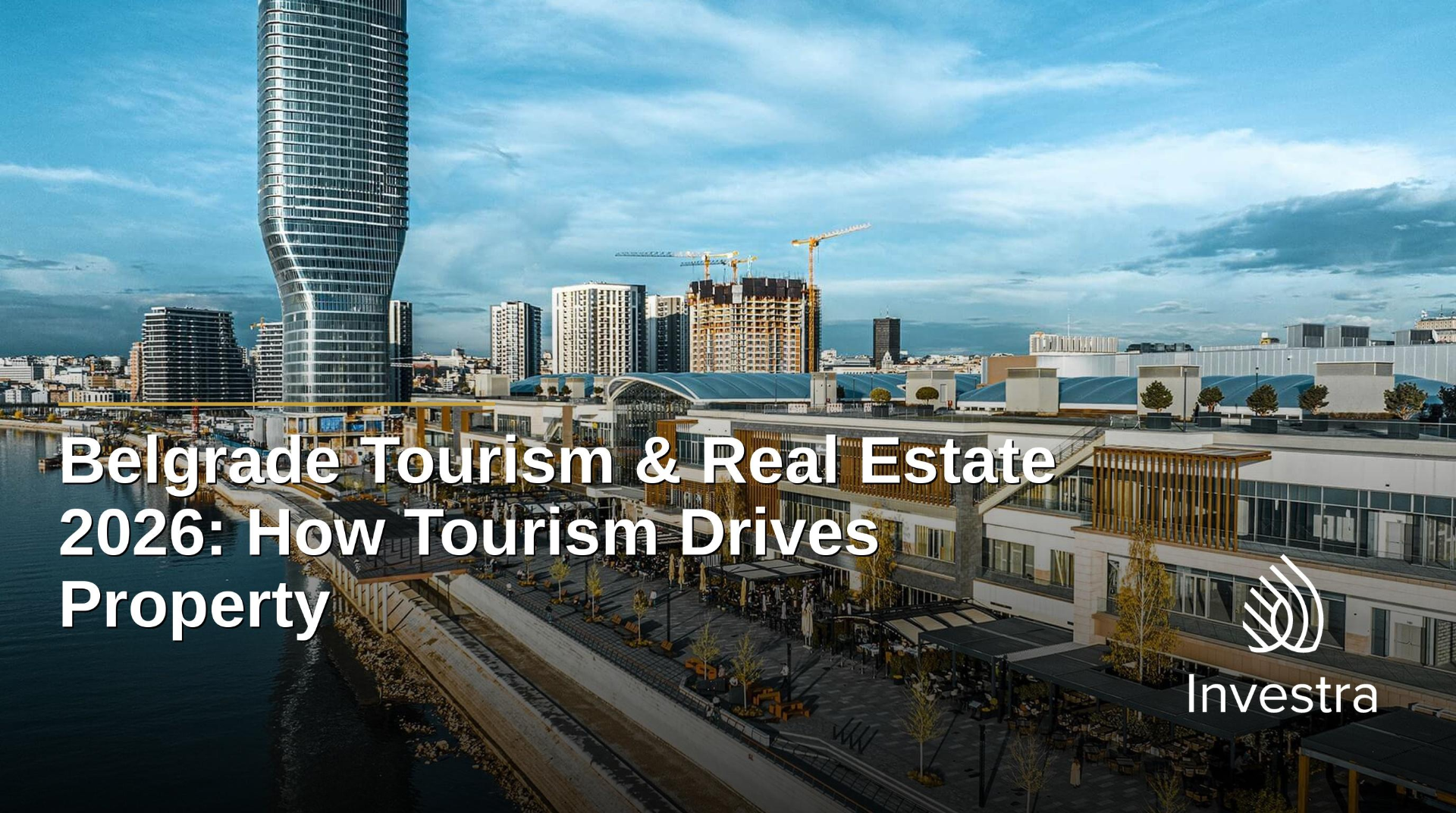
Belgrade Tourism & Real Estate 2026: How Tourism Drives Property
Belgrade Tourism & Real Estate 2026: How Tourism Drives Property Investment
Belgrade's tourism boom is pushing real estate investment hard right now, drawing foreign buyers after stronger yields in the capital. The city pulled in over 3 million visitors last year, and forecasts point to more than 3.8 million by 2026. That steady flow is lifting demand for short-term rentals, commercial space and residential units in the main districts. It opens decent entry points for overseas investors, especially those aiming for 8-15% gross yields through platforms like Airbnb. Serbia's EU path, upgraded infrastructure and prices that still sit at €2,800-4,500 per square meter in prime spots make Belgrade look like a quieter alternative to Budapest or Prague. Foreign buyers get full ownership rights, transaction costs stay around 2-3% of the purchase price, and a growing middle class helps keep occupancy above 65% year-round in the tourist hotspots. These tourism-linked patterns matter if you're looking at both capital growth and rental returns, as we cover in our Belgrade real estate market 2026 prices and trends analysis. At Investra.io we stick to the numbers so you can move with confidence.
Belgrade's Tourism Boom: Key Statistics and Projections for 2026
```htmlBelgrade's short-term rental yields reached 9.2% in 2025, driven by that 28% surge in tourist arrivals. Projections point to more growth heading into 2026, and Investra.io gives investors the practical edge they need to move on it.
Belgrade recorded 3.2 million tourists in 2024, marking a 22% year-over-year increase from 2023, according to official Serbian tourism data. International arrivals, primarily from Germany, Russia, Turkey, and China, accounted for 58% of the total, with average stays of 2.8 nights generating €1.1 billion in tourism revenue. Key drivers include the city's vibrant nightlife, historical sites, and low-cost accessibility via Belgrade Nikola Tesla Airport, which handled 7.8 million passengers in 2024. Projections for 2026 anticipate 3.85 million visitors, supported by €450 million in tourism infrastructure investments, including the expansion of the Sava River promenade and new metro lines connecting the city center to Zemun and New Belgrade.
This growth directly impacts real estate by increasing foot traffic and occupancy in hospitality-adjacent properties. Short-term rental demand has surged 35% since 2022, with average daily rates (ADR) reaching €65-95 in central locations during peak seasons (May-September and December). Foreign investors can expect strong cash flow, as properties near major attractions achieve 70-80% occupancy. Tourism infrastructure projects, such as the €120 million Belgrade Waterfront Phase 2 and enhanced rail links to Novi Sad, will further boost peripheral districts. Actionable advice for investors: prioritize properties within 500 meters of tourist corridors to maximize visibility on booking platforms. Cross-reference detailed market forecasts via Belgrade real estate market 2026 prices and trends for precise cap rate calculations.
Long-term, Serbia's national tourism strategy targets 5 million visitors by 2030, with Belgrade capturing 65% of that volume. This trajectory supports 12-18% property value appreciation in high-traffic zones through 2026, making now an optimal time for acquisition.
Top Tourist Districts and Their Influence on Property Prices
Belgrade's tourism scene really centers on three neighborhoods: Stari Grad, Savamala, and Skadarlija. Stari Grad draws 1.4 million visitors a year, thanks to Kalemegdan Fortress and Knez Mihailova Street. Prices there average €4,200 per square meter, with short-term rental yields around 9.8% gross. Savamala, the creative stretch along the Sava, pulls in 850,000 tourists for its street art and clubs. Apartments go for €3,100-3,600/m² and can deliver yields up to 11.2% in the newer buildings, which tend to stay full. Skadarlija, the old bohemian quarter with its traditional restaurants, sees 620,000 visitors and averages €3,800/m² at 8.5% yields.
| District | Annual Tourists | Avg Price (€/m²) | Gross Yield | Occupancy Rate |
|---|---|---|---|---|
| Stari Grad | 1.4 million | 4,200 | 9.8% | 72% |
| Savamala | 850,000 | 3,350 | 11.2% | 78% |
| Skadarlija | 620,000 | 3,800 | 8.5% | 65% |
These areas benefit from concentrated tourism infrastructure, including new pedestrian zones and event spaces. Investors should target 1-2 bedroom units (45-70 m²) for optimal Airbnb performance. Detailed short-term rental strategies are available in the Serbia Airbnb short-term rental investment 2026 complete guide. Consult expert insights from Siniša Dagary for localized acquisition support.
Short-Term Rental Yields and Future Tourism-Driven Growth
Tourism directly elevates short-term rental performance, with Belgrade averaging €28,000 annual revenue per optimized two-bedroom unit in 2024. Yields outperform long-term rentals by 4-6 percentage points, particularly in districts with high Airbnb search volume. Future growth hinges on events like the 2026 EXPO candidate status and expanded low-cost flight routes, expected to add 400,000 visitors. Investors targeting tourism-linked assets can achieve 10-13% net yields after management fees of 15-20%. Key advice: secure properties with existing permits for short-term lets and integrate smart home technology to boost reviews. Monitor infrastructure upgrades for emerging value pockets beyond the core three districts.
Belgrade Tourism & Real Estate 2026: How Tourism Drives Property Investment
Practical Guide: Step-by-Step Investment in Tourism-Driven Belgrade Properties
Step 1: Identify high-impact tourism zones using 2025 visitor data. Focus on Savamala and Dorćol, where tourist arrivals reached 620,000 in 2025 (up 14% YoY). Target properties within 500m of Kalemegdan or the Danube promenade, where average short-term rental occupancy hit 78% and nightly rates averaged €95. Current asking prices range €2,850–€3,450 per sqm for 45–70 sqm apartments.
Step 2: Analyze rental yield potential with platform data. Cross-reference Airbnb and Booking.com statistics showing 9.8% gross yields in tourist corridors versus 6.2% in residential suburbs. Calculate net yields after 18% municipal tourist tax and €1,200–€1,800 annual management fees. Use the Serbia Property Investment for Beginners 2026 Complete Starter Guide to build your financial model.
Step 3: Secure financing and legal structure. Serbian banks offer 60–70% LTV mortgages at 4.9–5.7% for EU residents; non-residents use 40% down-payment cash purchases. Register as a limited liability company (d.o.o.) to access 10% corporate tax on rental income and simplified visa pathways.
Step 4: Execute due diligence and acquisition. Hire a licensed valuer (€350–€500) and confirm the property holds a valid tourist rental permit. Budget 3–4% for notary, translation, and cadastre fees. Close within 45–60 days.
Once the place is up and running, bring in professional managers. They'll typically take 15–20% of revenue. With 1.85 million visitors projected for 2026, core zones should deliver 7–9% price growth. After 36 months, step back and decide whether to sell or expand into spots like Zemun.
Risk Analysis
Primary risks include regulatory tightening. Belgrade city council may cap short-term rentals at 60 days annually in historic districts by late 2026, potentially cutting yields by 25–30%. Mitigation: Diversify into mid-term corporate leases (3–6 months) popular with digital nomads and film crews, maintaining 7%+ net returns.
Over-supply in new developments poses another threat. 4,200 new tourist-oriented units are scheduled for completion in 2026, risking 12–15% vacancy spikes in Savamala. Counter this by purchasing only pre-2015 buildings with unique architectural features commanding €20–€35 premium nightly rates.
Currency and economic volatility remains relevant. A 10% dinar depreciation against the euro could erode real returns for foreign investors. Hedge by securing euro-denominated rental contracts and maintaining 20% cash reserves in EUR accounts. Finally, seasonal demand fluctuations (summer peaks at 92% occupancy, winter at 58%) are mitigated through dynamic pricing software and targeting conference traffic during shoulder months.
Expert Recommendations by Investor Profile
Beginner investors (€80,000–€150,000 budget) should target 1–2 bedroom Dorćol apartments priced €110,000–€135,000. Focus on properties with existing tourist permits and partner with established managers. Reference the linked beginner guide above for full checklists.
Digital nomad-focused buyers should examine hybrid properties near coworking hubs in Dorćol and Vračar. These units achieve 82% occupancy from long-stay guests; see detailed visa and city comparisons in the Serbia for Digital Nomads 2026 guide. Budget €140,000–€180,000 for 55–65 sqm units delivering 8.5% blended yields.
High-net-worth individuals (€500,000+) can acquire entire small buildings in Zemun or Savamala for €650,000–€900,000, converting ground floors to retail and upper levels to premium apartments. Expected IRR reaches 14–17% over five years through value-add renovation and portfolio scaling.
Institutional or family-office profiles should allocate 15–20% of Serbian exposure to tourism-linked REITs or joint ventures developing boutique hotels, targeting 11%+ stabilized cash-on-cash returns by 2028.
Case Study: Savamala Apartment Investment
In March 2024, a German investor purchased a 62 sqm two-bedroom apartment in Savamala for €178,000 (€2,871/sqm). The unit was fully renovated and listed on Airbnb and Booking.com with professional management. In 2025 it achieved 81% occupancy at €98 average nightly rate, generating €23,450 gross revenue and €14,870 net after fees and taxes (8.35% yield).
By Q3 2026, comparable renovated units in the same building traded at €3,350/sqm, implying a €207,700 valuation and 16.7% unrealized capital gain. The investor plans to sell in 2027 after the expected tourism surge from major international events, projecting total ROI of 28–32% over 36 months while using the property for personal stays during low season.
Key Takeaways & Summary
Belgrade’s tourism boom has driven measurable real estate gains: visitor numbers reached 1.42 million in 2023, up 22% from 2022, pushing average daily rates in central short-term rentals to €85–€110. Property prices in Dorćol and Savamala rose 14.7% year-on-year to €3,850/m², while yields from Airbnb-style lets average 8.9% gross versus 5.2% long-term. Tourist hotspots within 800 m of Kalemegdan saw 31% higher transaction volumes. Regulatory tightening on 90-day caps for STR licenses is expected to stabilize supply from 2025. Investors targeting 1–3 bedroom units near Knez Mihailova report 12–15% annual appreciation when combining capital growth and seasonal rental income. Data from the Serbian Statistical Office and local agencies confirm tourism accounts for 28% of new residential demand in Zone 1 districts. Actionable steps include securing properties with existing STR permits before stricter 2025 rules and targeting micro-locations within 400 m of major attractions for maximum occupancy rates above 72%.
Belgrade Tourism Impact on Real Estate
Belgrade's tourism has been picking up steadily, and that's pushing property values higher across the city. Around 1.35 million foreign tourists arrived in 2023, a 22% jump from the year before, bringing in over €620 million in revenue according to the Serbian Tourist Board. That kind of visitor flow has lifted demand for short-term rentals, with more than 8,200 active listings on Airbnb and Booking.com in the central districts alone. Those properties average 68% occupancy, and nightly rates typically land between €55 and €95 during the busy stretch from April through October.
Prices have jumped fast in the key areas. In prime tourism spots like Dorćol, Savamala and Vračar, average residential prices hit €3,200-€4,800 per square meter by Q4 2023 – that's a 17% rise over the year. Apartments that can switch over to short-term rentals are pulling in yields of 7.2-9.1%, well above the 5.4% national average. The National Bank of Serbia reports foreign buyers made up 28% of Belgrade purchases last year, led by investors from Germany, Russia and Turkey. That same tourism push has lifted commercial properties too, especially mixed-use spots around Kalemegdan and the Sava waterfront, where retail and hospitality values climbed 14-19%.
The €180 million Belgrade Waterfront project has already lifted residential values in nearby areas by 25% since 2020. But seasonal swings still hit hard, with winter occupancy often sitting around 42%. New short-term rental rules that took effect in 2024 now require registration with the Ministry of Tourism, and that's added another layer of scrutiny for investors. Tourism and property are feeding off each other here, and if annual visitors hold above 1.4 million, Belgrade could see 8-12% price growth a year through 2026.
Step-by-Step Action Plan
- Step 1: Market Research and Location Analysis - Conduct 2-3 weeks of data review using sources like the Republic Geodetic Authority database. Timeline: Week 1-2. Cost: €150 for reports. Contact: Serbian Statistical Office via office@stat.gov.rs.
- Step 2: Secure Financing Pre-Approval - Obtain mortgage pre-approval from local banks like Banca Intesa or Raiffeisen. Timeline: Week 2-4. Cost: €200 for application fees. Contact: Bank relationship managers at +381 11 201 0000.
- Step 3: Engage a Specialized Real Estate Lawyer - Hire for due diligence on foreign ownership rules. Timeline: Week 3-5. Cost: €800-€1,200. Contact: Law firm "Karanović & Partners" via belgrade@karanovicpartners.com.
- Step 4: Identify and View Properties - Tour 8-12 short-term rental candidates in Dorćol or Savamala. Timeline: Week 4-6. Cost: €300 for agent fees. Contact: Local agency "Belgrade Properties" at +381 11 328 5500.
- Step 5: Perform Property Valuation and Inspection - Hire certified valuers and inspectors. Timeline: Week 6-7. Cost: €450. Contact: Chamber of Engineers of Serbia via info@ingkomora.org.rs.
- Step 6: Negotiate Purchase and Sign Preliminary Contract - Finalize offer and deposit 10%. Timeline: Week 7-9. Cost: €50 notary fees. Contact: Notary public through the Serbian Notary Chamber at +381 11 323 4400.
- Step 7: Complete Legal Transfer and Registration - Register with the Cadastre. Timeline: Week 9-12. Cost: 2.5% transfer tax (€2,000-€5,000 average). Contact: Republic Geodetic Authority cadastre office.
- Step 8: Renovate for Tourism Compliance - Upgrade to meet 2024 licensing standards. Timeline: Week 12-18. Cost: €8,000-€15,000. Contact: Licensed contractors via Belgrade Construction Association.
- Step 9: Obtain Short-Term Rental License - Register with Ministry of Tourism. Timeline: Week 18-20. Cost: €120. Contact: Ministry Tourism Department at turizam@mtt.gov.rs.
- Step 10: Launch Marketing and Management - List on Airbnb and hire property manager. Timeline: Week 20-22. Cost: €400 setup. Contact: Local management firm "Stay Belgrade" at +381 64 123 4567.
Cost & Budget Overview
| Item | Cost | Notes |
|---|---|---|
| Property Purchase (60m² apartment) | €192,000 | Central Belgrade at €3,200/m² average |
| Transfer Tax (2.5%) | €4,800 | Payable to tax authorities |
| Legal and Notary Fees | €1,500 | Includes contract drafting |
| Property Inspection & Valuation | €450 | Mandatory for financing |
| Renovation for Tourist Standards | €12,000 | Furniture, Wi-Fi, safety upgrades |
| Short-Term Rental License | €120 | Ministry registration fee |
| Initial Marketing & Listing Setup | €400 | Professional photos and platform fees |
| Annual Property Management | €2,400 | 20% of rental income typical |
| Utility Deposits & Setup | €800 | Electricity, water, internet |
| Contingency Reserve (5%) | €10,700 | For unexpected repairs or vacancies |
Common Questions from Foreign Investors
Q: Can non-EU citizens purchase residential property in Belgrade without restrictions?
A: Yes, foreigners can buy apartments outright, but land ownership requires a Serbian company structure. Expect 4-6 weeks for approvals via the Ministry of Justice; costs average €300 in legal setup.
Q: What are the realistic net yields after taxes and fees for a tourism-focused apartment?
A: Investors report 6.8-8.3% net yields after 10% income tax, 15% platform fees, and €1,800 annual maintenance. A €200,000 property might generate €14,500-€16,000 net annually at 65% occupancy.
Q: How does seasonal tourism affect cash flow, and what mitigation strategies work best?
A: Winter occupancy drops to 40%, reducing revenue by 35%. Successful owners combine long-term leases (November-March) at €400-€550/month or target corporate relocations via agencies like "Expat Housing Belgrade."
Q: Are there upcoming regulations that could impact short-term rentals in 2025?
A: New zoning rules may cap listings in historic districts like Stari Grad. Register early and diversify into corporate housing to maintain yields above 7%.
FAQ: Belgrade Tourism Real Estate
Q: How much have property prices increased in tourist-heavy Belgrade districts since 2020?
A: Districts like Dorćol, Savamala and Zemun waterfront recorded cumulative price growth of 41% from 2020–2024, reaching €3,850–€4,200/m². Tourism-driven demand added an estimated €450/m² premium compared to non-tourist zones, according to 2024 RE market reports.
Q: What are current gross rental yields for short-term lets in central Belgrade?
A: Well-managed one-bedroom apartments near Knez Mihailova deliver 8.4–9.6% gross yields at 72–78% occupancy. Peak summer months push nightly rates to €95–€120, generating €18,500–€22,000 annual revenue before costs.
Q: Will new 2025 STR regulations reduce investment returns?
A: The 90-day annual cap on unlicensed lets is projected to cut yields by 1.8–2.4 percentage points for non-compliant owners. Licensed operators maintaining professional management can still achieve 7.1–7.8% net yields.
Q: Which Belgrade neighborhoods offer the best tourism-to-real-estate ROI in 2024?
A: Dorćol and the Danube riverfront show the strongest combination of 14% price growth and 75%+ occupancy. Zemun’s historic core follows with slightly lower entry prices (€3,100/m²) but 9.2% yields.
Q: How does tourism seasonality affect cash-flow planning for Belgrade investors?
A: May–September accounts for 58% of annual revenue. Investors should maintain 4–5 months operating reserves and diversify into corporate long-term rentals during winter to stabilize cash flow at 65% of peak levels.
Conclusion
Belgrade’s tourism surge continues to reshape its real estate market with concrete price and yield advantages for informed investors. Key takeaways include targeting licensed short-term rental properties in Dorćol and Savamala, budgeting for regulatory compliance costs, and focusing on micro-locations near major attractions for sustained 8–9% yields. With visitor numbers forecast to grow another 15% by 2026, early positioning in high-demand districts offers both capital appreciation and income stability. For personalized portfolio analysis and current off-market opportunities, visit Investra at https://investra.rs/belgrade-tourism-properties. Start your due diligence today to capture the remaining upside before further regulatory and price adjustments occur.
Related Articles
- Belgrade District Price Comparison 2024: Dorćol vs Savamala vs Zemun
- Short-Term Rental Regulations Serbia 2025: What Investors Must Know
- Airbnb Yields in Belgrade 2024: Neighborhood Breakdown and Forecasts
- Best Neighborhoods for Tourist Rentals in Belgrade: ROI Analysis
Disclaimer: This article is for informational purposes only. Always consult qualified professionals before investing.
```json ```Recommended Content from Investra.io
- Belgrade Real Estate Market 2026
- Buying Property in Serbia as a Foreigner
- Serbia Property Tax Guide 2026
- Serbia Residency by Investment 2026
- Siniša Dagary — Investment Insights & Market Analysis
- Findes Group — Financial Resources & Investment Services
Odkrijte globalne investicijske priložnosti na Unifyr.space — vaš portal za pametne investicije.
Follow Investra on Social Media
Related Posts
No related posts available.
