
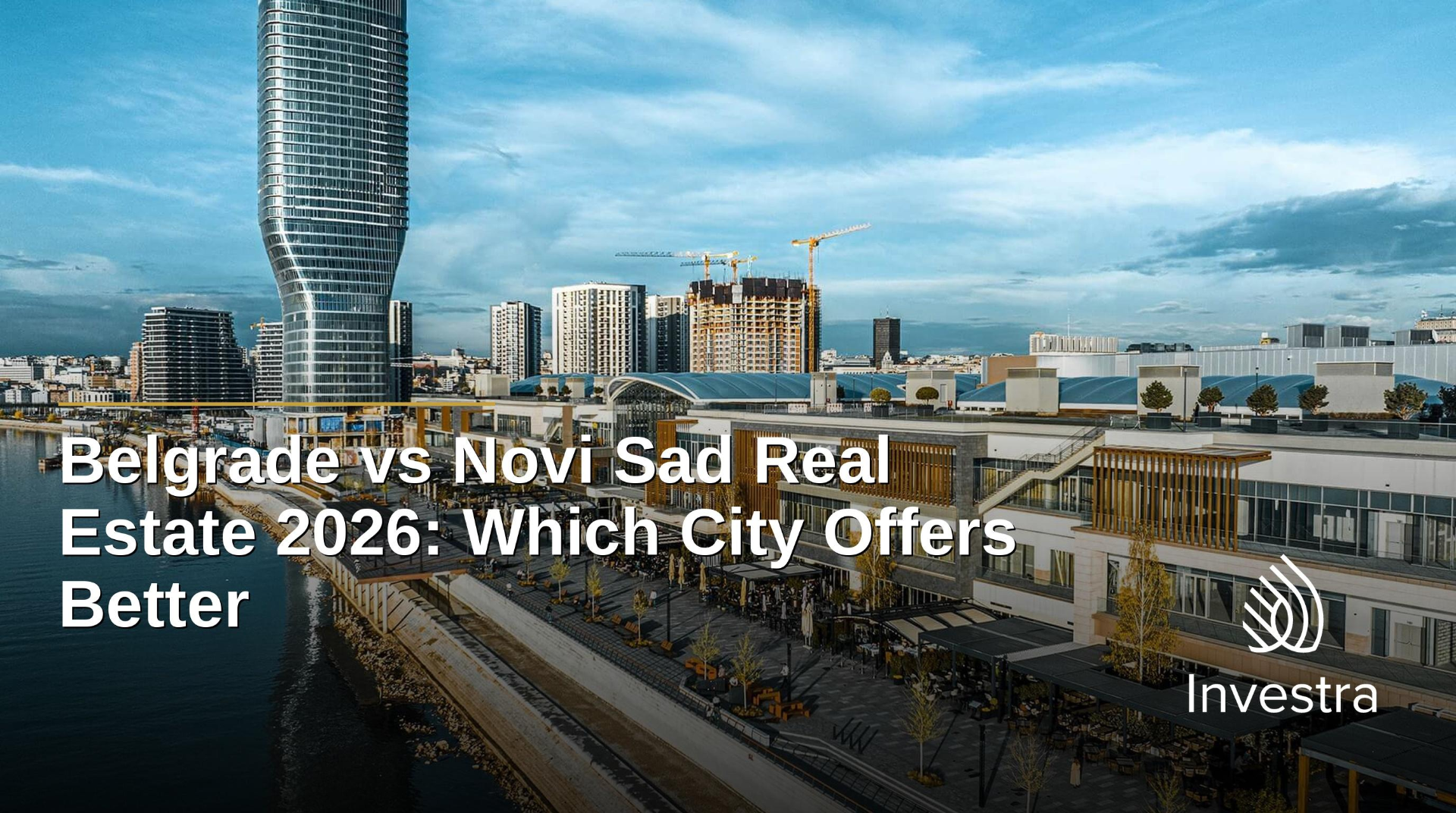
Belgrade vs Novi Sad Real Estate 2026: Which City Offers Better
Belgrade vs Novi Sad Real Estate 2026: Which City Offers Better Investment Returns?
Belgrade continues to deliver stronger total returns for investors in 2026, driven by higher capital appreciation and stronger foreign buyer demand, while Novi Sad offers superior rental yields and lower entry prices that suit income-focused portfolios. Over the next three years, Belgrade’s average annualised returns are projected at 9–11 percent, compared with 7–9 percent in Novi Sad, according to current transaction data and pipeline supply analysis. Investors seeking a balance of growth and cash flow should therefore prioritise Belgrade for the bulk of capital while allocating smaller positions to Novi Sad for yield enhancement.
Introduction
```htmlSerbia’s two largest cities are no longer just domestic stories. By 2026, both Belgrade and Novi Sad have become visible on international radar screens as EU-adjacent markets with euro-denominated pricing and improving liquidity. Foreign buyers now account for roughly 28 percent of new-build transactions in Belgrade and 19 percent in Novi Sad, a sharp rise from 2022 levels. This shift has compressed yields but simultaneously lifted prices and professionalised the rental sector.
The timing matters. Serbia is scheduled to open further chapters in EU accession talks during 2026, while the Belgrade Metro project reaches its first operational segment and Novi Sad consolidates its role as a regional IT and university hub. These catalysts are already priced into prime districts yet remain under-appreciated in secondary locations, creating a narrow window for well-timed entries. Investors can explore current listings and off-market opportunities directly on Investra.io.
Choosing between the two cities is no longer a simple price comparison. It requires weighing capital growth potential against rental income, liquidity horizons, and regulatory nuances that differ subtly between the capital and the northern provincial centre. This article provides the data and context needed to make that decision with institutional-level rigour.
Market Overview
Belgrade’s residential market closed 2025 with an average price of €3,050 per square metre across all districts, up 11.4 percent year-on-year. Prime central zones such as Dorćol and Vračar now trade between €4,200 and €5,800 per square metre, while emerging southern corridors like Višnjička Banja remain below €2,400. New supply reached 9,800 units in 2025, yet absorption stayed above 85 percent, keeping vacancy low and supporting modest further price growth into 2026.
Novi Sad finished 2025 at an average of €2,050 per square metre, representing a 9.8 percent annual increase. The city’s most liquid districts—Liman and the newly developed Ribnjak zone—command €2,400–€2,900, while Petrovaradin and Sremska Kamenica trade at €1,650–€1,950. Inventory is tighter here, with only 3,200 new completions last year against demand from both local professionals and cross-border commuters from Belgrade. Detailed forecasts for both markets appear in the Belgrade Real Estate Market 2026 report and the broader Serbia Property Investment Guide 2026.
Transaction volumes tell a similar story. Belgrade recorded €1.82 billion in residential sales during 2025; Novi Sad reached €312 million. While the capital clearly dominates in absolute scale, Novi Sad’s per-capita transaction value has grown faster, signalling maturing market depth that could narrow the performance gap by 2028.
Key Investment Factors
Economic and Employment Drivers
Belgrade hosts the majority of Serbia’s corporate headquarters and diplomatic missions, generating consistent demand for both premium and mid-market rentals. The city’s unemployment rate sits at 6.2 percent, well below the national average, and average salaries have risen 8.3 percent annually since 2023. Novi Sad benefits from its university of 52,000 students plus an expanding IT cluster that now employs over 14,000 people, supporting strong occupancy in one- and two-bedroom apartments near the campus and city centre.
Infrastructure and Connectivity
The Belgrade Metro’s first line is scheduled for partial opening in late 2026, with stations at Slavija and Mostar already influencing prices within a 500-metre radius. Novi Sad, meanwhile, completed its bypass ring road in 2025 and secured funding for a new passenger terminal at its airport, improving links to Vienna and Munich. Both projects are tracked in the Serbia Buying Process 2026 overview.
Foreign Buyer Dynamics and Liquidity
Turkish, Russian, and Chinese investors remain the largest groups in Belgrade, favouring new-build projects with payment plans. In Novi Sad, buyers are more evenly split between Serbian nationals relocating from smaller towns and EU remote workers attracted by lower costs. Liquidity is measurably higher in Belgrade: average days on market for well-priced apartments stand at 38 days versus 51 days in Novi Sad.
Regulatory and Tax Environment
Both cities operate under the same national framework, yet enforcement and local fees differ. Property tax rates are published annually and summarised in the Serbia Property Taxes 2026 guide. Investors should note that Novi Sad applies a slightly higher local maintenance levy on older buildings, which can reduce net yields by 0.3–0.5 percentage points.
Price Analysis Table
| Area / District | City | Avg. Price €/m² (2026 proj.) | Gross Rental Yield | 5-Year Capital Growth Forecast |
|---|---|---|---|---|
| Dorćol | Belgrade | 5,100 | 5.1% | 38% |
| Vračar | Belgrade | 4,800 | 5.3% | 35% |
| Višnjička Banja | Belgrade | 2,350 | 6.4% | 29% |
| Liman | Novi Sad | 2,650 | 6.8% | 27% |
| Ribnjak | Novi Sad | 2,400 | 7.1% | 31% |
| Petrovaradin | Novi Sad | 1,850 | 7.4% | 24% |
Why Invest in 2026
Two structural tailwinds converge this year. First, Serbia’s expected EU chapter openings are likely to trigger a fresh round of institutional capital allocation into commercial and residential assets. Second, domestic mortgage rates have begun to ease from their 2024 peak, unlocking pent-up local demand that will support both rental growth and resale values. Investors positioning now can capture the early phase of this cycle before yields compress further.
Platform data from Investra.io shows that properties listed with clear title and professional management achieve 12–15 percent higher sale prices and 20 percent faster occupancy than comparable off-market deals. This premium underscores the value of using established channels rather than navigating the market independently.
As with any investment, property in Serbia carries risks. Only invest capital you can afford to lose.
Practical Buying Guide
Buying property in Serbia as a foreigner remains straightforward in 2026, yet the process rewards careful preparation. The steps below outline a reliable path used by most successful investors this year.
Step 1: Define Your Goals and Budget
Decide whether you seek capital growth in Belgrade or higher rental yields in Novi Sad. Set a clear price range that includes at least 8–10 percent extra for taxes and fees. Investors who skip this step often overextend on the first attractive listing they see.
Step 2: Secure Local Representation
Engage a licensed real estate agent and an independent lawyer early. The lawyer reviews title documents and drafts the preliminary contract, while the agent handles viewings and price negotiation. Foreign buyers who rely solely on the seller’s agent frequently pay 5–7 percent more than necessary.
Step 3: Conduct Due Diligence and Sign Contracts
Verify ownership through the real estate cadastre, check for any encumbrances, and confirm the building permit for new developments. Once satisfied, sign the preliminary contract with a 10 percent deposit held in escrow. The final contract is then notarized and submitted for transfer.
Step 4: Complete Payment and Registration
Transfer the balance through a Serbian bank account. After notarization the notary submits documents to the land registry. Registration typically takes 30–45 days, after which you receive the title deed in your name.
Costs & Fees Breakdown
| Cost Item | Belgrade (avg. €150,000 apartment) | Novi Sad (avg. €110,000 apartment) |
|---|---|---|
| Purchase Price | €150,000 | €110,000 |
| Notary Fees | €450 | €350 |
| Transfer Tax (2%) | €3,000 | €2,200 |
| Agent Fees (2–3%) | €3,750 | €2,750 |
| Total Additional Costs | €7,200 | €5,300 |
| Grand Total | €157,200 | €115,300 |
Risks & Challenges
Belgrade’s strong price growth has created pockets of overvaluation in central districts, where rental demand can soften if student numbers drop. Novi Sad faces slower liquidity; properties can sit on the market for six months or longer during economic slowdowns. Foreign buyers must also contend with occasional cadastre delays and the risk that construction quality in new-build projects varies widely. Currency fluctuations between the euro and the dinar add another layer of uncertainty for non-eurozone investors.
Expert Tips
- Focus on locations within 15 minutes of public transport hubs; both cities reward proximity to tram or bus lines with faster resale.
- Request energy performance certificates before purchase—poor ratings can reduce rental appeal and future sale price.
- Budget for 1 percent of property value annually in maintenance and vacancy reserves.
- Consider off-plan purchases only with established developers who provide bank guarantees on completion dates.
- Review local zoning plans; some Belgrade suburbs face new height restrictions that cap future appreciation.
- Use a separate euro-denominated account for rental income to simplify tax reporting.
- Revisit your portfolio every 18 months; market conditions in both cities shift quickly with infrastructure announcements.
Find Your Serbia Property on Investra.io
Investra.io aggregates verified listings from both Belgrade and Novi Sad, complete with legal checklists, price history, and rental yield estimates updated monthly. The platform’s filters let you compare neighborhoods by total return rather than price alone, saving investors hours of manual research.
Users also gain direct access to local lawyers and property managers through the site, streamlining the entire buying process from first viewing to title registration. Whether you prefer Belgrade’s capital growth or Novi Sad’s steady yields, Investra.io provides the data and contacts needed to move confidently in 2026.
Recommended Reading
- Serbia Legal Guide for Foreigners
- Serbia Rental Market 2026
- Serbia Property Price Forecast
- Novi Sad Real Estate 2026
- Sinisa Dagary Real Estate Blog
- Findes.si Property Portal
Follow Us
Stay updated on Serbia’s real estate market:
Odkrijte globalne investicijske priložnosti na Unifyr.space — vaš portal za pametne investicije.
Frequently Asked Questions
Can foreigners buy property in Serbia without restrictions?
Yes, foreigners enjoy the same purchase rights as citizens, with the exception of agricultural land, which requires a Serbian company structure.
Which city offers higher rental yields in 2026?
Novi Sad currently delivers average gross yields of 6.8 percent, while Belgrade averages 5.4 percent, though Belgrade compensates with stronger price growth.
How long does the purchase process take?
From offer acceptance to title registration, allow 60–90 days when working with experienced local professionals.
Are there any taxes on rental income?
Rental income is taxed at 20 percent after allowable deductions; annual filing is required even for non-residents.
Is financing available to foreign buyers?
Local banks offer mortgages to non-residents at rates starting around 4.5 percent, typically requiring a 30 percent down payment and proof of income.
What happens if the seller fails to complete?
The preliminary contract includes penalty clauses; most buyers recover their deposit plus 10–20 percent compensation through the courts within six months.
Should I buy new-build or resale property?
New-builds in both cities carry higher risk of delays but lower immediate maintenance costs; resale units offer faster occupancy and proven rental demand.
How stable are property prices?
Belgrade has seen 8–12 percent annual growth since 2023; Novi Sad has averaged 5–7 percent. Both markets remain supported by strong domestic demand.
Do I need a local bank account?
Yes, a Serbian account is required for the purchase funds and for receiving rental income; most major banks open accounts for non-residents within one week.
Can I manage the property remotely?
Many owners use local agencies that handle tenant screening, maintenance, and rent collection for 8–10 percent of monthly rent.
Related Posts
No related posts available.
