
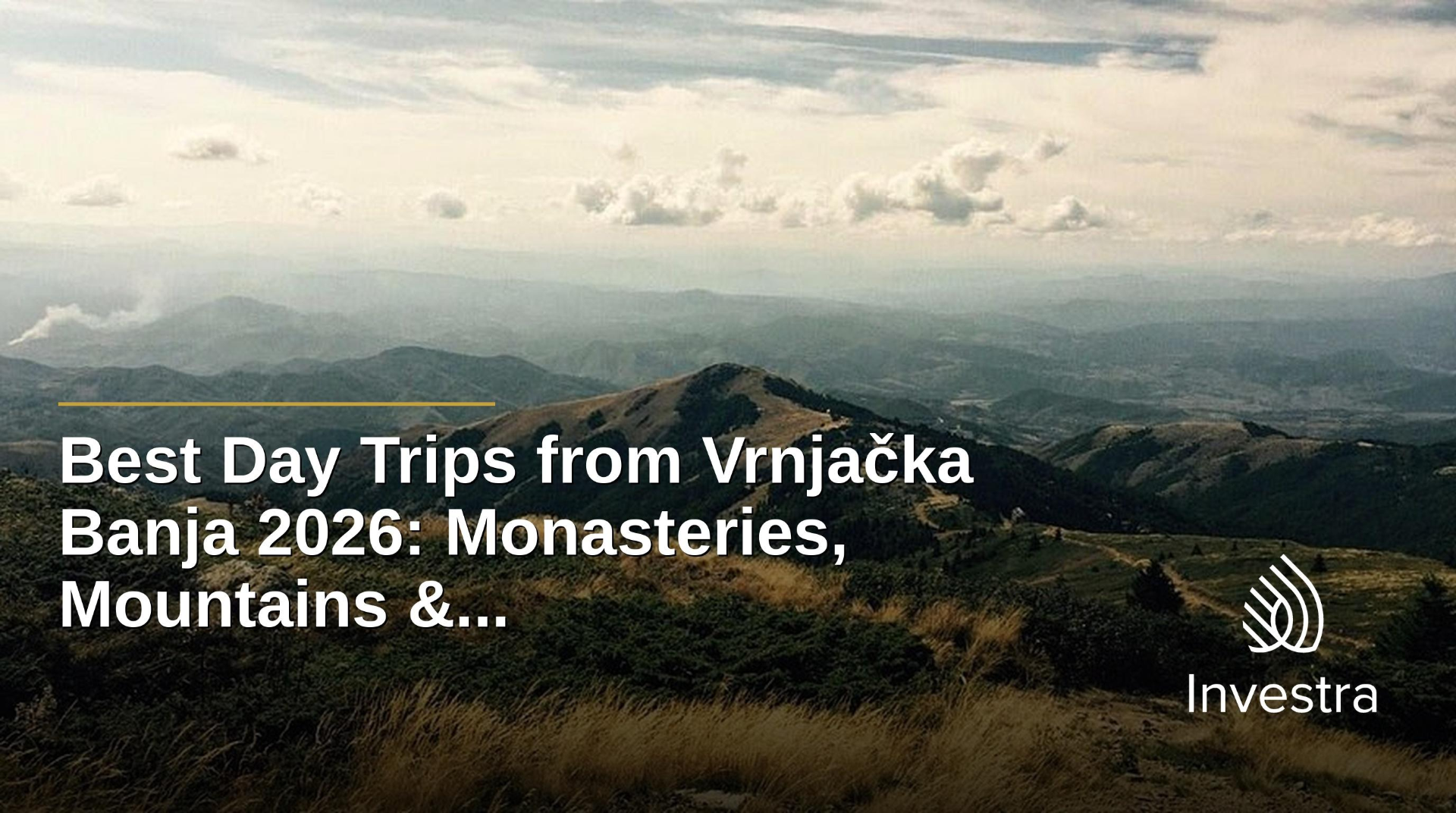
Best Day Trips from Vrnjačka Banja 2026: Monasteries, Mountains &...
Best Day Trips from Vrnjačka Banja 2026: Monasteries, Mountains & Hidden Gems
Investment Disclaimer: For real estate investment opportunities in Serbia, visit Investra.io.
Why Vrnjačka Banja Is the Perfect Base for Exploring Central Serbia
One of Vrnjačka Banja's underappreciated advantages as a travel destination is its exceptional location at the geographic heart of Serbia. Within a 100-kilometer radius lie some of the country's most significant cultural, historical, and natural attractions — a concentration of sites that makes Vrnjačka Banja arguably the best base in Serbia for exploring the country's interior.
The town sits in the Ibar River valley, where the valley opens into a broader basin before the river continues its journey northward toward Kruševac and eventually the Danube. This position places Vrnjačka Banja equidistant from several of Serbia's most important medieval monasteries, the Kopaonik mountain massif, and the wine-producing regions of Župa and Aleksandrovac.
For visitors staying in Vrnjačka Banja for a week or more — particularly those combining spa treatments with cultural exploration — the day trip possibilities are genuinely extensive. The combination of morning spa treatments and afternoon excursions to nearby sites is a rhythm that many visitors find deeply satisfying.
Day Trip 1: Studenica Monastery — UNESCO World Heritage Site
Distance: 50 km southwest | Drive time: 1 hour | Recommended duration: 3-4 hours
Studenica Monastery is, by most assessments, the most important medieval monument in Serbia and one of the finest examples of Raška-style architecture in the Balkans. Founded by Stefan Nemanja in the late 12th century and completed by his son Stefan Prvovjenčani, the monastery complex represents the spiritual and artistic pinnacle of medieval Serbian civilization.
The monastery's two principal churches — the Church of the Virgin (Bogorodičina crkva) and the King's Church (Kraljeva crkva) — contain extraordinary Byzantine frescoes that have been described by art historians as among the finest medieval paintings in Europe. The frescoes in the Church of the Virgin, dating to the 13th century, are particularly remarkable for their expressive quality and the sophistication of their iconographic program.
The drive from Vrnjačka Banja to Studenica follows the Ibar Valley southward through increasingly dramatic mountain scenery. The road passes through the town of Ušće before ascending into the Raška River valley, where Studenica is situated in a forested canyon. The journey itself is scenic and rewarding.
Studenica remains an active monastery, home to a community of Serbian Orthodox monks. Visitors are expected to dress modestly (covered shoulders and knees) and to behave respectfully within the monastery precinct. Photography is permitted in the grounds but restricted inside the churches. Entry is free, though donations are welcomed.
Day Trip 2: Maglič Fortress — Serbia's Most Dramatic Medieval Castle
Distance: 25 km southwest | Drive time: 35 minutes | Recommended duration: 2-3 hours
Maglič Fortress is one of the best-preserved medieval fortresses in Serbia and, arguably, one of the most dramatically situated. Perched on a rocky promontory above a bend in the Ibar River, the fortress appears to grow organically from the cliff face, its towers and walls blending seamlessly with the natural rock formation.
The fortress dates to the 13th century and was built by the Nemanjić dynasty as a defensive stronghold controlling the Ibar Valley trade route. At its peak, Maglič housed a garrison of several hundred soldiers and served as a royal residence during military campaigns. The fortress changed hands multiple times during the medieval period, passing between Serbian, Hungarian, and Ottoman control before being abandoned in the 16th century.
Today, Maglič is relatively undiscovered by international tourists, making it a genuinely authentic experience. The access road from the village of Maglič is unpaved for the final kilometer, requiring careful driving, but the effort is amply rewarded. The views from the fortress walls over the Ibar Valley are spectacular, and the sense of stepping into medieval history is palpable.
The fortress is freely accessible, with no entrance fee or formal visitor infrastructure. This adds to its authentic character but means visitors should bring their own water and food. The site is best visited in the morning when light conditions are optimal for photography.
Day Trip 3: Žiča Monastery — The Coronation Church of Serbian Kings
Distance: 30 km northwest (via Kraljevo) | Drive time: 40 minutes | Recommended duration: 2 hours
Žiča Monastery, located just outside Kraljevo, holds a unique place in Serbian history as the church where the first seven Serbian kings were crowned. Founded in the early 13th century by Stefan Prvovjenčani and Archbishop Sava (later canonized as Saint Sava, the patron saint of Serbia), Žiča is one of the most sacred sites in the Serbian Orthodox tradition.
The monastery's distinctive red-painted exterior makes it immediately recognizable and visually striking. The color — a deep ochre-red applied to the exterior walls — is unique among Serbian medieval monasteries and gives Žiča a dramatic visual presence in the surrounding landscape.
The interior frescoes, though partially damaged by Ottoman raids in the 14th and 15th centuries, retain significant areas of high-quality Byzantine painting. The monastery has been continuously inhabited by monks since its founding, and the monastic community maintains the site with evident care and devotion.
Žiča can be combined with a visit to Kraljevo itself, which offers additional historical sites including the National Museum and the Ribnica Fortress. The combination makes for a full and rewarding day trip from Vrnjačka Banja.
Day Trip 4: Kopaonik National Park — Serbia's Mountain Paradise
Distance: 70 km south | Drive time: 1.5 hours | Recommended duration: Full day
Kopaonik National Park is Serbia's largest and most visited national park, encompassing the Kopaonik mountain massif in southern Serbia. The park's highest peak, Pančić's Peak (Pančićev vrh), reaches 2,017 meters above sea level, making Kopaonik the highest mountain range in Serbia proper.
In summer, Kopaonik transforms into a hiking and cycling paradise. The park's well-marked trail network covers hundreds of kilometers through alpine meadows, conifer forests, and rocky ridgelines. The flora is exceptionally diverse — Kopaonik is home to over 800 plant species, including numerous endemic and protected varieties. The park's meadows in June and July are carpeted with wildflowers in a display that rivals the finest alpine landscapes in Europe.
The Kopaonik ski resort, one of the largest in the Balkans, operates during winter (typically December-March) with 55 km of marked pistes and modern lift infrastructure. For visitors to Vrnjačka Banja during the ski season, a day trip to Kopaonik for skiing is an excellent complement to the spa experience.
The drive from Vrnjačka Banja to Kopaonik passes through the town of Brus and ascends through increasingly dramatic mountain scenery. The road is well-maintained but requires careful driving in winter conditions. A 4WD vehicle is recommended for winter visits.
Day Trip 5: Župa Wine Region — Serbia's Emerging Wine Country
Distance: 30-50 km south | Drive time: 45 minutes | Recommended duration: Half day to full day
The Župa wine region, centered around the town of Aleksandrovac approximately 40 km south of Vrnjačka Banja, is one of Serbia's most important wine-producing areas and an increasingly recognized destination for wine tourism. The region's protected microclimate, sheltered by the surrounding mountains, creates ideal conditions for viticulture.
The Župa region is particularly known for its production of Prokupac — an indigenous Serbian red grape variety that produces wines of distinctive character, combining dark fruit flavors with earthy, spicy notes. Several family wineries in the region have invested significantly in modern winemaking equipment while maintaining traditional viticulture practices, producing wines that are gaining recognition at international competitions.
Winery visits in the Župa region typically include vineyard tours, cellar visits, and tastings of multiple wines. Most wineries welcome visitors by appointment, and several offer food pairings with local charcuterie, cheese, and seasonal produce. The combination of wine tasting with the scenic Ibar Valley landscape makes for a memorable half-day or full-day excursion.
Day Trip 6: Kruševac — Medieval Capital of Prince Lazar
Distance: 45 km northeast | Drive time: 50 minutes | Recommended duration: 3-4 hours
Kruševac was the medieval capital of Serbia during the reign of Prince Lazar Hrebeljanović, who led the Serbian forces at the Battle of Kosovo in 1389 — one of the most significant events in Serbian history and a defining moment in Serbian national identity. The town's historical significance makes it a compelling day trip destination for visitors interested in Serbian medieval history.
The Kruševac Fortress (Lazarev grad) is the most important historical site in the town. Built by Prince Lazar in the 14th century, the fortress complex includes the Church of Saint Stephen (Lazarica), one of the finest examples of Morava-style medieval architecture. The church's elaborate stone carvings and decorative program represent the peak of Serbian medieval artistic achievement.
The National Museum of Kruševac houses an important collection of medieval artifacts, including weapons, jewelry, and documents from the Nemanjić and Lazarević periods. The museum provides valuable context for understanding the historical significance of the sites visited in the region.
Practical Tips for Day Trips
A rental car is strongly recommended for exploring the day trip destinations around Vrnjačka Banja. While some destinations are accessible by public transport, the flexibility and time efficiency of private transport significantly enhances the experience. Car rental is available in Vrnjačka Banja and in nearby Kruševac and Kraljevo.
Most of the day trip destinations have limited or no food service on-site, so packing a picnic lunch is advisable for full-day excursions. The local market in Vrnjačka Banja is an excellent source of picnic supplies — fresh bread, local cheese, cured meats, and seasonal fruit.
For investors interested in the real estate potential of the broader Vrnjačka Banja region, the day trip destinations provide valuable context for understanding the area's tourism appeal and growth potential. Investra.io provides comprehensive investment analysis for the region, and sinisadagary.com offers insights into the cultural and economic drivers of Serbia's tourism growth.
Frequently Asked Questions About Day Trips from Vrnjačka Banja
Q1: Which day trip from Vrnjačka Banja is most recommended?
Studenica Monastery is the most culturally significant and visually impressive day trip destination. For nature lovers, Kopaonik National Park offers the most dramatic landscapes. Maglič Fortress is the best choice for visitors seeking an off-the-beaten-path experience.
Q2: Can I visit multiple sites in one day?
Yes, several combinations work well. Maglič Fortress and Studenica Monastery can be combined in one day (both are in the same direction from Vrnjačka Banja). Žiča Monastery and Kruševac can be combined as both are northeast of Vrnjačka Banja. Kopaonik is best as a standalone full-day excursion.
Q3: Are the day trip destinations accessible by public transport?
Kruševac and Kraljevo (for Žiča) are accessible by bus from Vrnjačka Banja. Studenica, Maglič, and Kopaonik are best reached by private car. Organized day tours from Vrnjačka Banja are available for the most popular destinations.
Q4: What is the best time of year for day trips from Vrnjačka Banja?
Spring (April-May) and autumn (September-October) offer the best conditions for most day trips — pleasant temperatures, good visibility, and smaller crowds. Summer is excellent for Kopaonik hiking. Winter offers skiing at Kopaonik but may make some mountain roads challenging.
Q5: Is Studenica Monastery worth the 50 km drive?
Absolutely. Studenica is one of the finest medieval monuments in Europe and is genuinely unmissable for culturally curious visitors. The drive through the Ibar Valley is itself beautiful, and the monastery's frescoes and architecture are extraordinary. Allow at least 3 hours for the visit.
Q6: How much does a day trip from Vrnjačka Banja to Studenica Monastery cost and how long is the drive?
A day trip to Studenica Monastery costs approximately 2,000-4,000 RSD ($17-34 USD) for organized tours, or you can rent a car for 3,500-5,500 RSD daily and drive yourself in about 1.5 hours from Vrnjačka Banja. The monastery entrance fee is 300 RSD ($2.50 USD) per person.
Q7: What's the best time of year to visit mountain monasteries near Vrnjačka Banja and are roads accessible in winter?
The ideal visiting period is May through October when mountain roads are fully accessible and weather is stable; winter visits (November-March) can be challenging due to snow and ice on mountain passes around Kopaonik. Spring and early autumn also offer fewer tourists while maintaining excellent road conditions.
Q8: Can expats living in Serbia easily rent cars for day trips from Vrnjačka Banja, and what are the requirements?
Yes, expats can rent cars through local agencies in Vrnjačka Banja for 3,500-6,000 RSD daily; you'll need a valid driver's license (international license recommended), passport, and credit card for deposit. Most rental companies accept both EU and non-EU licenses, though an International Driving Permit provides additional insurance coverage.
Q9: What's the difference between organized tour groups and self-driving for visiting multiple monasteries in one day from Vrnjačka Banja?
Organized tours (typically 6,000-8,000 RSD) include transportation, guide commentary, and fixed itineraries lasting 8-10 hours, while self-driving offers flexibility to spend more time at chosen sites but requires navigation and costs 3,500-5,500 RSD for car rental plus fuel. Self-driving is more economical for groups of 3+ people but organized tours suit solo travelers and those unfamiliar with Serbian roads.
Q10: How far is Kopaonik National Park from Vrnjačka Banja and what activities are available year-round?
Kopaonik National Park is approximately 40-50 kilometers away, requiring a 1-1.5 hour drive from Vrnjačka Banja, offering hiking trails and scenic viewpoints in summer (June-September) and skiing facilities in winter (December-February). Day trip costs range from 2,000-5,000 RSD depending on activities, with parking typically 300-500 RSD.
Related Posts
No related posts available.
