
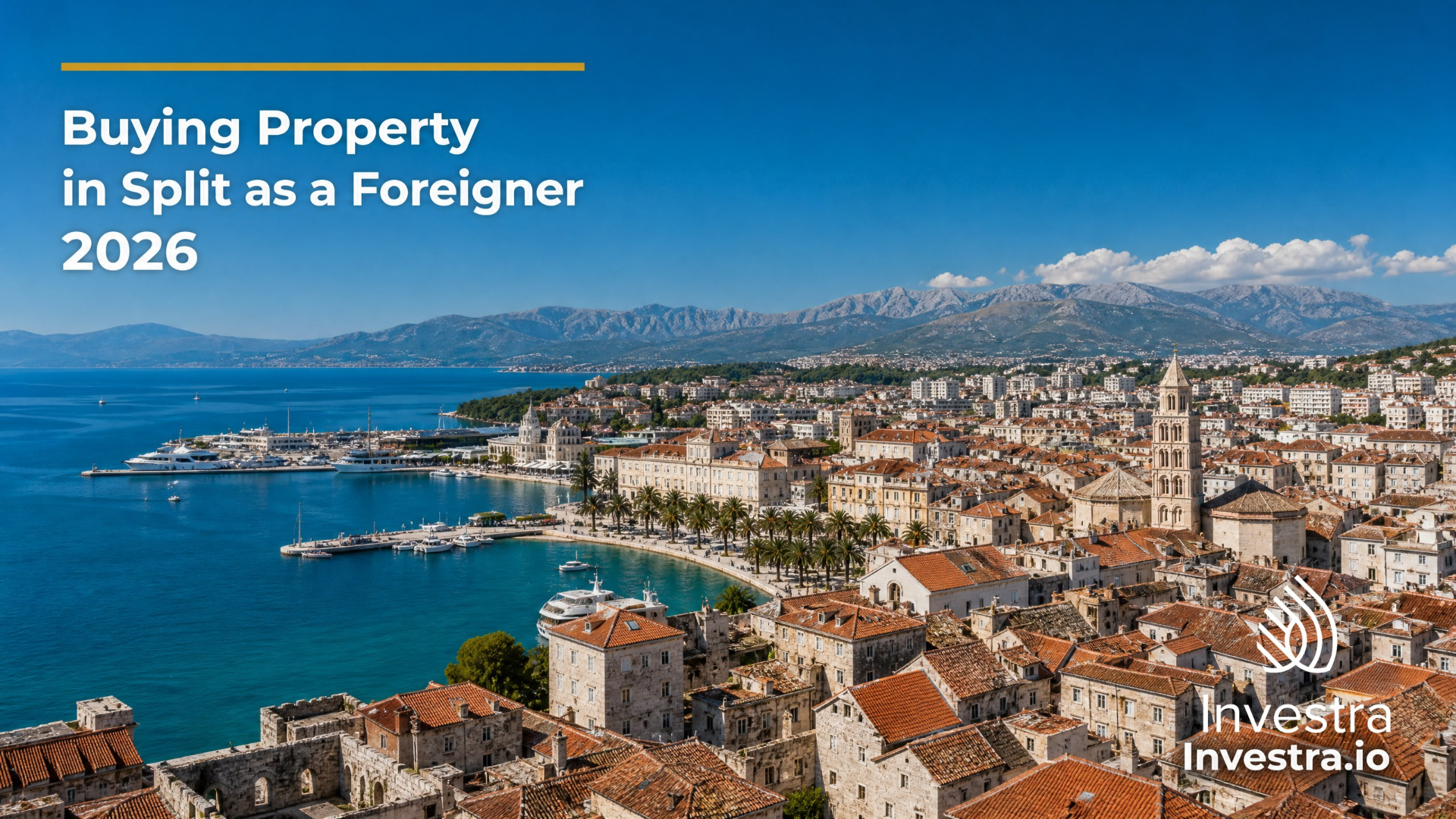
Buying Property in Split as a Foreigner 2026: Complete Legal & Practical Guide
Buying Property in Split as a Foreigner 2026: Complete Legal & Practical Guide
⚠️ Investment Disclaimer: Real estate investments involve risk. Past performance does not guarantee future results. Always conduct thorough due diligence and consult qualified financial and legal advisors before making investment decisions. Do not invest money you cannot afford to lose.
> Quick Answer: EU citizens can buy property in Split with the same rights as Croatian nationals — no restrictions, no special permits, no additional taxes. Non-EU buyers from countries with bilateral agreements (USA, UK, Canada, Australia, and most others) can also purchase freely. The process takes 4–8 weeks, costs 3–5% in transaction fees, and requires an OIB (Croatian tax number) obtainable in one day.
Split, Croatia's second-largest city and the jewel of the Dalmatian coast, attracts foreign property buyers from across Europe and beyond. Built around Diocletian's Palace — a UNESCO World Heritage Site — Split offers a unique combination of ancient history, Mediterranean lifestyle, and modern amenities that make it one of the most desirable property markets in Southern Europe.
This comprehensive guide covers everything foreign buyers need to know about purchasing property in Split in 2026: legal requirements, the purchase process, current market prices, the best neighborhoods, financing options, and practical tips for navigating Croatia's property market as an international buyer.
---
Can Foreigners Buy Property in Split?
> Quick Answer: Yes, foreigners can buy property in Split. EU/EEA citizens have identical rights to Croatian nationals. Non-EU citizens from countries with bilateral agreements (which includes most major nations) can purchase residential property. The only restriction is on agricultural land, which requires special approval. There are no foreign ownership quotas, no minimum investment thresholds, and no mandatory residency requirements.
Croatia's accession to the European Union in 2013 fundamentally transformed the property purchase landscape for foreign buyers. The legal framework is now one of the most accessible in the region.
EU/EEA Citizens
Full property rights equivalent to Croatian nationals. No restrictions on residential, commercial, or investment properties. Agricultural land purchases are unrestricted since 2020 (previously required approval).
Non-EU Citizens
Citizens of countries with bilateral investment protection agreements with Croatia (which includes the USA, UK, Canada, Australia, Switzerland, Japan, and most other major nations) can purchase residential and commercial property freely. Check the Croatian Ministry of Justice website for the current list of eligible countries.
Corporate Purchases
Foreign companies registered in Croatia can purchase property without restrictions. Many international investors establish a Croatian d.o.o. (LLC) for property acquisition, which can offer tax and administrative advantages.
---
Split Property Market Overview 2026
> Quick Answer: Split property prices range from €3,500–8,000/m² depending on location, with the historic Diocletian's Palace area commanding the highest premiums. The market has appreciated 45% since 2020, driven by strong tourism demand, limited supply in the historic center, and growing international buyer interest. Rental yields of 4–6% are achievable for well-located properties.
Split's property market is defined by its extraordinary historical heritage and exceptional tourism performance. The city receives over 3 million visitors annually, creating robust demand for short-term rental properties that generates premium income for investors.
Current Market Statistics (2026):| Area | Price Range (€/m²) | Annual Appreciation |
|------|-------------------|---------------------|
| Diocletian's Palace (historic center) | €6,000–8,000 | +8–10% |
| Meje/Manuš (premium residential) | €4,500–6,500 | +7–9% |
| Firule/Bačvice (beachfront) | €5,000–7,000 | +8–10% |
| Spinut/Trstenik (mid-range) | €3,500–5,000 | +5–7% |
| Solin/Kaštela (suburban) | €2,000–3,500 | +4–6% |
| Žrnovnica/Klis (hinterland) | €1,500–2,500 | +3–5% |
The supply of properties in Split's historic center is severely constrained by UNESCO heritage regulations and the physical boundaries of Diocletian's Palace. This structural scarcity supports premium pricing and strong appreciation for heritage properties.
---
Step-by-Step Purchase Process for Foreign Buyers
> Quick Answer: The Split property purchase process involves 6 key steps: (1) property search and selection, (2) due diligence and legal check, (3) pre-contract with 10% deposit, (4) OIB registration, (5) final notarized contract, and (6) Land Registry registration. Total timeline: 4–8 weeks from offer to ownership. Legal fees, notary, and transfer tax total approximately 4–6% of purchase price.
Step 1: Property Search and Selection (1–3 weeks)
Begin your search on Croatian property portals (Njuškalo.hr, Nekretnine.hr) or engage a local real estate agent. Split has numerous agencies specializing in foreign buyer transactions, with English-speaking staff and international experience.
Key considerations when selecting a property:- Verify the property is registered in the Land Registry (Zemljišna knjiga) — some older properties have registration issues
- Check building permits and usage classification (residential vs. tourist)
- Review energy certificate (mandatory for all transactions since 2014)
- Assess the building's maintenance fund (pričuva) status
- Confirm no outstanding utility debts
Step 2: Legal Due Diligence (3–7 days)
Before signing any agreement, engage a Croatian lawyer (odvjetnik) to conduct due diligence:
- Land Registry search: Verify ownership, check for mortgages, liens, or encumbrances
- Building permit verification: Confirm all construction is legally permitted
- Condominium documentation: Review building regulations and maintenance fund
- Seller verification: Confirm seller's identity and authority to sell
- Tax compliance: Verify no outstanding property taxes
Legal fees for due diligence: €500–1,500 depending on property complexity.
Step 3: Pre-Contract (Predugovor) — 1 week
Once due diligence is satisfactory, sign a preliminary purchase agreement:
- Typically 10% deposit (earnest money)
- Specifies purchase price, completion date, and conditions
- If seller withdraws, they return double the deposit
- If buyer withdraws, deposit is forfeited
- Notarization recommended (not legally required but provides additional protection)
Step 4: OIB Registration (1 day)
All property buyers in Croatia must have an OIB (Osobni identifikacijski broj — personal identification number). For foreigners:
- Apply at any Croatian Tax Administration (Porezna uprava) office
- Bring valid passport and proof of address
- OIB issued same day (usually within 2 hours)
- No fee
- Required for all financial transactions in Croatia
Step 5: Final Purchase Contract (Kupoprodajni ugovor) — 1 day
The final contract is signed before a notary (javni bilježnik):
- Both parties present (or represented by power of attorney)
- Full purchase price paid (typically via bank transfer)
- Notary certifies signatures and legal compliance
- Notary fee: 0.5–1% of purchase price (capped at approximately €3,000)
Step 6: Land Registry Registration (2–4 weeks)
After signing, the notary submits registration to the Land Registry:
- Registration fee: approximately €100–300
- Processing time: 2–4 weeks
- You receive a Land Registry extract confirming ownership
---
Costs of Buying Property in Split
> Quick Answer: Total transaction costs for buying property in Split are approximately 5–8% of the purchase price. The main costs are: real estate transfer tax (3%), real estate agent commission (2–3%), notary fees (0.5–1%), legal fees (0.5–1%), and Land Registry fees (0.1%). Budget an additional 1–2% for miscellaneous costs.
Complete Cost Breakdown
| Cost Item | Rate | On €300,000 Property |
|-----------|------|---------------------|
| Real estate transfer tax | 3% | €9,000 |
| Real estate agent commission | 2–3% | €6,000–9,000 |
| Notary fees | 0.5–1% | €1,500–3,000 |
| Legal fees (lawyer) | 0.5–1% | €1,500–3,000 |
| Land Registry fee | ~0.1% | €300 |
| Translation costs | Fixed | €200–500 |
| Total transaction costs | 6–8% | €18,500–24,800 |
For new-build properties purchased directly from developers, VAT (25%) is included in the advertised price, and the 3% transfer tax does not apply.
---
Best Neighborhoods for Foreign Buyers in Split
> Quick Answer: The most popular neighborhoods for foreign buyers are: Diocletian's Palace (historic prestige, premium prices), Meje (luxury residential, sea views), Bačvice (beachfront lifestyle), and Spinut (value for money, good amenities). Each area offers a distinct lifestyle and investment profile.
Diocletian's Palace — Historic Prestige
The ancient Roman palace complex is Split's most iconic and sought-after address. Living within the palace walls means inhabiting a UNESCO World Heritage Site, with stone-paved streets, Roman architecture, and the vibrant Peristyle square as your neighborhood.
- Price range: €6,000–8,000/m²
- Property types: Historic apartments, renovated stone houses
- Lifestyle: Cultural immersion, walking distance to everything
- Investment: Highest short-term rental yields (€150–250/night), strong appreciation
- Consideration: Noise from tourism, limited parking, renovation restrictions
Meje — Luxury Residential
Meje is Split's most prestigious residential neighborhood, favored by wealthy Croatians and international buyers seeking privacy, sea views, and proximity to the beach without the tourist crowds of the historic center.
- Price range: €4,500–6,500/m²
- Property types: Luxury apartments, villas, modern developments
- Lifestyle: Quiet, upscale, family-friendly
- Investment: Strong long-term appreciation, premium rental market
- Consideration: Higher entry price, limited public transport
Bačvice — Beachfront Lifestyle
Bačvice is home to Split's famous picigin beach and a vibrant promenade. The neighborhood combines beach access with proximity to the city center, making it popular with younger buyers and investors targeting the premium short-term rental market.
- Price range: €5,000–7,000/m²
- Property types: Apartments with sea views, renovated buildings
- Lifestyle: Beach access, active social scene, restaurants
- Investment: Excellent short-term rental income, strong demand
- Consideration: Seasonal noise, limited parking
Spinut — Value for Money
Spinut offers a balance of central location, good amenities, and more accessible prices compared to premium neighborhoods. Popular with families and long-term residents, it provides a genuine local experience.
- Price range: €3,500–5,000/m²
- Property types: Standard apartments, some new developments
- Lifestyle: Local neighborhood feel, good schools, parks
- Investment: Stable long-term rental demand, moderate appreciation
- Consideration: Less prestigious address, fewer tourist amenities
---
Financing Your Split Property Purchase
> Quick Answer: Most foreign buyers in Split purchase with cash, but Croatian bank mortgages are available for EU citizens at 3.1–4.5% interest rates. Non-EU buyers can also access mortgages with 60% LTV. Some international banks offer cross-border mortgages for Croatian properties. The Euro currency (since 2023) eliminates exchange rate risk for Eurozone buyers.
Croatian Bank Mortgages
Major Croatian banks (Erste, PBZ, Raiffeisen, Zaba) offer mortgage products for foreign buyers:
For EU citizens:- LTV: up to 80% (typically 70% for non-residents)
- Interest rate: 3.1–4.5% (EUR-denominated)
- Loan term: up to 30 years
- Required: proof of income, 3 years of tax returns, credit history
- Processing time: 3–6 weeks
- LTV: typically 60%
- Interest rate: 3.5–5.0%
- Additional documentation may be required
- Some banks require Croatian residency
Mortgage Calculation Example
For a €400,000 property with 30% down payment:
- Loan amount: €280,000
- Interest rate: 3.5%
- Term: 25 years
- Monthly payment: approximately €1,400
- Total interest paid: approximately €140,000
---
Rental Income Potential
> Quick Answer: A well-located Split apartment can generate €15,000–40,000 annually in short-term rental income during the tourist season (May–October). Year-round long-term rentals generate €800–2,000/month. The most profitable strategy combines short-term rentals in summer with long-term rentals in winter.
Short-Term Rental (Airbnb/Booking.com)
Split's exceptional tourism performance makes it one of Croatia's top short-term rental markets:
| Property Type | Peak Season Rate | Occupancy | Annual Income |
|---------------|-----------------|-----------|---------------|
| Studio (Palace area) | €120–180/night | 85% | €25,000–35,000 |
| 1BR apartment | €150–220/night | 80% | €30,000–45,000 |
| 2BR apartment | €200–350/night | 75% | €35,000–55,000 |
| 3BR villa | €400–700/night | 70% | €50,000–80,000 |
Licensing requirements for short-term rentals:- Register with Croatian Tourist Board
- Obtain rental license (Rješenje o kategorizaciji)
- Pay tourist tax per guest per night (€1–2)
- Annual income tax: 12% flat rate + surtax
Long-Term Rental
Long-term rentals provide stable year-round income with lower management intensity:
- 1BR apartment: €700–1,200/month
- 2BR apartment: €900–1,600/month
- 3BR apartment: €1,200–2,200/month
---
Living in Split as an Expat
> Quick Answer: Split offers an exceptional quality of life with Mediterranean climate, UNESCO heritage, excellent cuisine, and a growing expat community. The cost of living is 30–40% lower than Western European capitals. EU citizens can live in Croatia indefinitely; non-EU citizens can obtain residency through property ownership, employment, or retirement visas.
Cost of Living in Split (2026)
| Category | Monthly Cost (Single Person) |
|----------|------------------------------|
| Accommodation (1BR, central) | €700–1,200 |
| Groceries | €300–450 |
| Dining out (2x/week) | €200–350 |
| Transportation | €50–100 |
| Utilities | €100–180 |
| Entertainment | €150–250 |
| Total | €1,500–2,530 |
Residency Options for Non-EU Citizens
Temporary residence (Privremeni boravak):- Available for property owners
- Renewable annually
- Allows working in Croatia
- Application at local police station
- After 5 years of continuous temporary residence
- Provides near-permanent status
- After 8 years of continuous legal residence
- Language and culture requirements
---
Frequently Asked Questions
Q: Do I need to be present in Croatia to buy property in Split?A: No. You can authorize a Croatian lawyer or trusted representative via power of attorney (punomoć) to complete the purchase on your behalf. The power of attorney must be notarized and apostilled in your home country.
Q: Can I buy property in Split through a company?A: Yes. A Croatian d.o.o. (LLC) can purchase property. Some investors prefer this structure for tax optimization and liability protection. Setup costs approximately €1,500–2,500 and takes 1–2 weeks.
Q: What happens if I find a property with building permit issues?A: Many older properties in Croatia have informal constructions (bespravna gradnja) without proper permits. Croatia has implemented legalization procedures, but this process can be complex and expensive. Always verify building permits before purchase and factor legalization costs into your offer.
Q: Are there any restrictions on renting out my Split property?A: Short-term rentals require a license from the Croatian Tourist Board. Long-term rentals require registration of the rental agreement. There are no restrictions on the number of properties you can rent out, but income must be declared and taxed.
Q: How do I transfer money to Croatia for a property purchase?A: Standard international bank transfers are the most common method. Croatia is in the SEPA zone, making EUR transfers from EU countries fast and inexpensive. Ensure your bank can provide proof of funds origin (required for anti-money laundering compliance).
Q: What is the best time of year to buy property in Split?A: The autumn and winter months (October–February) typically offer better negotiating conditions as the tourist season ends and sellers are more motivated. Spring (March–May) sees increased competition as buyers prepare for summer. The market is active year-round.
Q: Can I get Croatian residency by buying property in Split?A: Property ownership alone does not automatically grant residency, but it supports a residency application. Non-EU citizens can apply for temporary residence based on property ownership, which is renewable annually.
Q: What are the ongoing costs of owning property in Split?A: Annual costs include: property tax (€50–300/year), building maintenance fund (€20–100/month), utilities if not rented (€100–200/month), and property insurance (€200–500/year). For rental properties, add management fees (8–12% of rent) and periodic renovation costs.
Q: Is Split a good investment compared to other Croatian cities?A: Split offers a strong combination of tourism-driven rental income, heritage appreciation, and lifestyle appeal. It is more affordable than Dubrovnik while offering similar tourism fundamentals. For pure yield, Osijek offers higher returns; for lifestyle and appreciation, Split is among Croatia's best markets.
Q: How do I find a reliable real estate agent in Split?A: Look for agents registered with HRNEKRETNINE (Croatian Real Estate Association). Investra's partner network includes vetted agents across Croatia with international buyer experience.
---
Conclusion: Your Path to Split Property Ownership
Buying property in Split as a foreigner is a straightforward process within a well-established legal framework. Croatia's EU membership, Euro currency, and transparent Land Registry system provide the security and clarity that international buyers require.
The key to a successful purchase is proper due diligence, qualified legal representation, and a clear understanding of your investment objectives. Whether you are purchasing a holiday home, a rental investment, or planning to relocate, Split's combination of heritage, lifestyle, and investment fundamentals makes it one of Europe's most compelling property markets.
For personalized guidance on buying property in Split, Investra's Croatian market specialists provide end-to-end support from property search through to post-purchase management. Explore broader Croatian investment insights at sinisadagary.com and regional market analysis at Findes.si.
---
Connect with Investra
- Facebook: facebook.com/investra.io
- LinkedIn: linkedin.com/company/investra-international
- YouTube: youtube.com/@InvestraEnterprises
---
References
- Croatian Bureau of Statistics (DZS): https://dzs.gov.hr
- Croatian Ministry of Justice — Foreign Property Ownership: https://mpu.gov.hr
- Nekretnine.hr — Split Market Report 2026: https://www.nekretnine.hr
- Croatian Tourist Board — Rental Licensing: https://croatia.hr
- Global Property Guide — Croatia: https://www.globalpropertyguide.com
---
Related Posts
No related posts available.
