
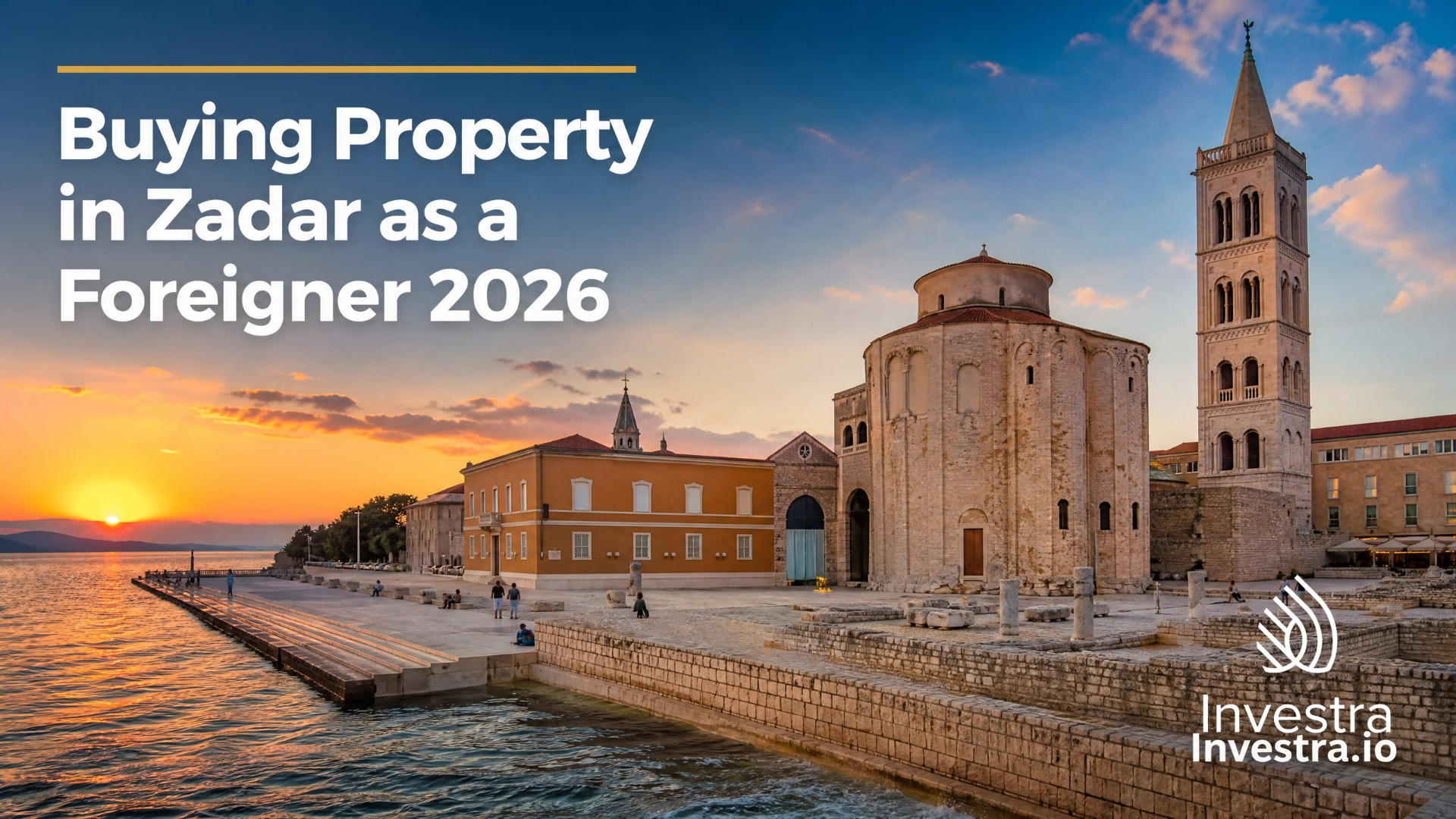
Buying Property in Zadar as a Foreigner 2026: Complete Guide
Buying Property in Zadar as a Foreigner 2026: Complete Guide
⚠️ Investment Disclaimer: Real estate investments involve risk. Past performance does not guarantee future results. Always conduct thorough due diligence and consult qualified financial and legal advisors before making investment decisions. Do not invest money you cannot afford to lose.
> Quick Answer: Foreigners can buy property in Zadar freely — EU citizens have identical rights to Croatian nationals, and non-EU citizens from eligible countries (USA, UK, Canada, Australia, and most others) face no significant restrictions. Property prices range from €2,500–5,500/m² in the city center, making Zadar one of Croatia's best-value coastal markets. The purchase process takes 4–8 weeks and costs approximately 5–7% in transaction fees.
Zadar, the ancient capital of Dalmatia and one of Croatia's most historically significant cities, has emerged as one of the most attractive property destinations for international buyers seeking authentic Croatian coastal living at accessible prices. Famous for its Roman Forum, medieval churches, Alfred Hitchcock's "most beautiful sunset in the world," and the world's first sea organ, Zadar combines extraordinary heritage with modern amenities and a growing international community.
This comprehensive guide covers everything foreign buyers need to know about purchasing property in Zadar in 2026, from legal requirements and the purchase process to market analysis, neighborhood guides, and practical tips for navigating Croatia's property market as an international buyer.
---
Legal Rights of Foreign Property Buyers in Zadar
> Quick Answer: EU/EEA citizens buy property in Zadar with identical rights to Croatian nationals — no restrictions, no special permits, no additional taxes. Non-EU citizens from countries with bilateral agreements (covering most major nations) can purchase residential and commercial property freely. The only restriction is on agricultural land, which requires special approval for non-EU buyers.
EU/EEA Citizens
Full property rights equivalent to Croatian nationals since Croatia's EU accession in 2013. This includes:
- Residential property (apartments, houses, villas)
- Commercial property (offices, retail, hotels)
- Agricultural land (unrestricted since 2020)
- No minimum investment requirements
- No mandatory residency requirements
Non-EU Citizens
Citizens of countries with bilateral investment protection agreements with Croatia can purchase:
- Residential property: freely permitted
- Commercial property: freely permitted
- Agricultural land: requires approval from Ministry of Justice
Corporate Purchases
Foreign companies can purchase Croatian property through a Croatian-registered subsidiary (d.o.o. — LLC). This structure is popular among investors for tax optimization and liability management. Setup costs approximately €1,500–2,500.
---
Zadar Property Market Overview 2026
> Quick Answer: Zadar's property market offers excellent value compared to Split and Dubrovnik, with prices 30–40% lower for comparable properties. The market has appreciated 38% since 2020, driven by growing tourism, improved transport links, and increasing international buyer interest. Rental yields of 4.5–6.5% are achievable for well-located properties.
Zadar occupies a strategic position on the Dalmatian coast — close enough to Split (1.5 hours) and Dubrovnik (3 hours) to benefit from the region's tourism infrastructure, but distinct enough to maintain its own authentic character. The city's old town peninsula, surrounded by the Adriatic on three sides, creates a natural supply constraint that supports property values.
Current Market Statistics (2026)
| Area | Price Range (€/m²) | Annual Appreciation |
|------|-------------------|---------------------|
| Old Town peninsula | €4,000–5,500 | +8–10% |
| Borik (beachfront) | €3,500–5,000 | +7–9% |
| Voštarnica/Višnjik | €2,800–3,800 | +5–7% |
| Brodarica/Diklo | €2,500–3,500 | +5–7% |
| Zadar surroundings (Sukošan, Bibinje) | €2,000–3,000 | +4–6% |
| Islands (Ugljan, Pašman) | €1,500–3,000 | +4–7% |
Market Drivers
Tourism growth: Zadar Airport has expanded significantly, with direct connections to 40+ European cities. The city receives 1.5 million tourists annually, with strong growth in premium visitor segments. Infrastructure investment: The Pelješac Bridge completion (2022) and ongoing A1 motorway improvements have enhanced Zadar's connectivity within Croatia and to neighboring countries. Digital nomad appeal: Zadar's combination of fast internet, affordable cost of living, and Mediterranean lifestyle has attracted a growing community of remote workers and digital nomads, supporting year-round rental demand. Student population: University of Zadar and several other institutions enroll 10,000+ students, providing stable rental demand in neighborhoods adjacent to the university.---
Step-by-Step Purchase Process
> Quick Answer: The Zadar property purchase process follows 6 steps: property selection, legal due diligence, pre-contract with 10% deposit, OIB registration, notarized final contract, and Land Registry registration. Total timeline: 4–8 weeks. Engage a Croatian lawyer for due diligence — fees are €500–1,500 and provide essential protection.
Step 1: Property Search (1–3 weeks)
Zadar's property market is well-served by local agencies with international experience. Key search platforms:
- Njuškalo.hr (largest Croatian property portal)
- Nekretnine.hr (professional agency listings)
- Immobiliare.it (popular with Italian buyers)
- Local agency websites
- Visit Zadar in person before purchasing if possible
- View properties at different times of day to assess noise, light, and neighborhood character
- Check proximity to amenities (supermarkets, pharmacies, public transport)
- For investment properties, assess walking distance to tourist attractions
Step 2: Legal Due Diligence (3–7 days)
Essential checks:- Land Registry (Zemljišna knjiga) search: verify ownership, encumbrances, mortgages
- Building permit verification: confirm all construction is legally permitted
- Energy certificate: required for all transactions
- Condominium documentation: maintenance fund status, building regulations
- Utility debt check: confirm no outstanding bills
Croatian lawyers (odvjetnici) specializing in property transactions typically charge €500–1,500 for due diligence on a standard apartment. This investment is strongly recommended — it protects against title defects, permit issues, and other legal complications that can be costly to resolve post-purchase.
Step 3: Pre-Contract and Deposit
Once due diligence is satisfactory:
- Sign preliminary agreement (Predugovor)
- Pay 10% deposit (earnest money)
- Specify completion date (typically 30–60 days)
- Notarization recommended for additional security
Step 4: OIB Registration (1 day)
All property buyers in Croatia must obtain an OIB (personal identification number):
- Apply at Croatian Tax Administration (Porezna uprava) in Zadar
- Bring valid passport and proof of address
- Issued same day, no fee
- Required for all financial transactions
Step 5: Final Contract (1 day)
Signed before a notary:
- Both parties present or represented by power of attorney
- Full purchase price paid via bank transfer
- Notary certifies legal compliance
- Notary fee: 0.5–1% of purchase price
Step 6: Land Registry Registration (2–4 weeks)
- Notary submits registration
- Registration fee: €100–300
- Processing time: 2–4 weeks
- You receive Land Registry extract confirming ownership
---
Transaction Costs Summary
> Quick Answer: Total transaction costs in Zadar are approximately 5–7% of purchase price. The main costs are: 3% transfer tax, 2–3% agent commission, 0.5–1% notary fees, and 0.5–1% legal fees. For a €200,000 property, expect to budget €10,000–14,000 in additional costs.
| Cost Item | Rate | On €200,000 Property |
|-----------|------|---------------------|
| Real estate transfer tax | 3% | €6,000 |
| Agent commission | 2–3% | €4,000–6,000 |
| Notary fees | 0.5–1% | €1,000–2,000 |
| Legal fees | 0.5–1% | €1,000–2,000 |
| Land Registry fee | ~0.1% | €200 |
| Translation and misc | Fixed | €300–500 |
| Total | 5–7% | €12,500–16,700 |
---
Best Neighborhoods for Foreign Buyers
> Quick Answer: The most popular areas for foreign buyers are: the Old Town (heritage, highest prices, best rental income), Borik (beachfront, family-friendly, good amenities), and Diklo/Brodarica (quieter, more affordable, sea views). Each area offers distinct lifestyle and investment characteristics.
Old Town (Stari Grad)
Zadar's old town is a living museum — Roman ruins, medieval churches, and Venetian architecture create an extraordinary urban environment. The Sea Organ and Greeting to the Sun installations on the waterfront promenade are world-famous attractions.
- Price range: €4,000–5,500/m²
- Property types: Historic apartments, renovated stone buildings
- Lifestyle: Cultural immersion, walking distance to everything
- Investment: Highest short-term rental yields, strong appreciation
- Consideration: Limited parking, some tourist noise in peak season
Borik — Beachfront Residential
Borik is Zadar's premier residential beach area, with a long sandy beach, pine forest, and modern amenities. Popular with families and long-term residents, it offers a more relaxed lifestyle than the old town.
- Price range: €3,500–5,000/m²
- Property types: Apartments, some villas
- Lifestyle: Beach access, family-friendly, good restaurants
- Investment: Strong rental demand, both short and long-term
- Consideration: Slightly further from historic center
Diklo/Brodarica — Quieter Alternative
These neighborhoods offer sea views and a quieter lifestyle at more accessible prices, popular with buyers seeking a genuine local experience rather than tourist-oriented living.
- Price range: €2,500–3,500/m²
- Property types: Apartments, houses
- Lifestyle: Local neighborhood, good value
- Investment: Stable long-term rental demand
- Consideration: Less prestigious, longer walk to old town
Zadar Islands (Ugljan, Pašman)
The islands accessible by regular ferry from Zadar offer a more tranquil lifestyle and lower prices, popular with buyers seeking a genuine island experience with easy city access.
- Price range: €1,500–3,000/m²
- Property types: Houses, holiday homes
- Lifestyle: Island living, nature, peace
- Investment: Growing tourism demand, renovation opportunities
- Consideration: Ferry dependency, limited amenities
---
Rental Income Potential
> Quick Answer: A well-located Zadar old town apartment can generate €18,000–30,000 annually in short-term rental income. Year-round long-term rentals generate €600–1,200/month. The optimal strategy for most investors combines short-term rentals from May–October with long-term rentals November–April.
Short-Term Rental Performance
| Property Type | Peak Rate | Annual Income |
|---------------|-----------|---------------|
| Studio (old town) | €80–130/night | €12,000–18,000 |
| 1BR apartment | €120–200/night | €18,000–28,000 |
| 2BR apartment | €180–300/night | €25,000–38,000 |
| 3BR apartment/house | €280–450/night | €35,000–55,000 |
Zadar's tourism season runs from May to October, with peak demand in July and August. The city's growing popularity as a base for island-hopping and its direct flight connections from major European cities support strong occupancy rates.
Long-Term Rental Market
Long-term rentals in Zadar are supported by:
- University students (10,000+)
- Healthcare workers (Zadar General Hospital)
- Government employees (Zadar is a county seat)
- Growing digital nomad community
- Studio: €400–600/month
- 1BR: €550–800/month
- 2BR: €700–1,100/month
- 3BR: €900–1,400/month
---
Financing Options
> Quick Answer: Croatian bank mortgages are available for foreign buyers at 3.1–4.5% interest rates. EU citizens can access mortgages on the same terms as Croatian nationals. Most foreign buyers in Zadar use cash, which provides negotiating advantages and simplifies the transaction.
Mortgage Products
Major Croatian banks offer mortgages to foreign buyers:
- LTV: 70–80% for EU citizens, 60% for non-EU
- Interest rate: 3.1–4.5% (EUR-denominated)
- Term: Up to 30 years
- Processing time: 3–6 weeks
Currency Advantage
Croatia's Euro adoption in January 2023 eliminates currency risk for Eurozone investors. German, Austrian, Italian, and other Eurozone buyers can purchase and manage Zadar properties entirely in Euros, simplifying financial planning and eliminating exchange rate exposure.
---
Living in Zadar: Expat Experience
> Quick Answer: Zadar offers an excellent quality of life with Mediterranean climate, rich cultural heritage, and a growing international community. The cost of living is 35–45% lower than Western European coastal cities. The city has good healthcare, international schools in the region, and a welcoming attitude toward foreign residents.
Cost of Living (2026)
| Category | Monthly Cost |
|----------|-------------|
| Accommodation (1BR, central) | €600–1,000 |
| Groceries | €280–400 |
| Dining (2x/week) | €180–300 |
| Transportation | €40–80 |
| Utilities | €80–150 |
| Total | €1,180–1,930 |
Practical Information
- Healthcare: Zadar General Hospital provides comprehensive care; private clinics available for faster service
- Education: International schools in Split (1.5 hours); local schools offer Croatian curriculum
- Internet: Fiber internet widely available; excellent for remote workers
- Language: Croatian is official; English widely spoken in tourism and business
- Community: Growing expat community, particularly from Germany, Austria, UK, and Italy
---
Zadar vs. Other Croatian Coastal Cities: Comparison
> Quick Answer: Zadar offers the best value-to-quality ratio among Croatia's major coastal cities. It is 30–40% cheaper than Split, 50–60% cheaper than Dubrovnik, and comparable to Šibenik. For foreign buyers seeking authentic Dalmatian living without premium pricing, Zadar is consistently the top recommendation.
Head-to-Head Comparison
| Factor | Zadar | Split | Dubrovnik | Rovinj |
|--------|-------|-------|-----------|--------|
| Average price (center) | €4,000–5,500/m² | €5,500–8,000/m² | €7,000–10,000/m² | €5,000–8,000/m² |
| Short-term rental yield | 5–7% | 4.5–6.5% | 3.5–5.5% | 5–8% |
| Tourism season length | 6 months | 6 months | 5 months | 7 months |
| International flights | 40+ cities | 60+ cities | 50+ cities | Via Pula (30+) |
| Cost of living | Low | Medium | High | Medium |
| Expat community | Growing | Large | Large | Large |
| Heritage status | UNESCO | UNESCO | UNESCO | Heritage |
| Crowding level | Moderate | High | Very High | Moderate |
Why Choose Zadar Over Split?
Zadar's main advantages over Split are lower entry prices (30–40% less for comparable properties), less tourist crowding (particularly in peak season), and a more authentic local atmosphere. Split's advantages are greater international brand recognition, a larger expat community, and marginally higher rental income potential.
For investors with a budget of €200,000–350,000, Zadar typically offers better investment economics than Split, where the same budget buys a significantly smaller or less well-located property.
Why Choose Zadar Over Dubrovnik?
Dubrovnik commands a global premium that translates into very high entry prices (€7,000–10,000/m²) with relatively modest yields (3.5–5.5%). Zadar offers comparable Dalmatian heritage and tourism appeal at 50–60% lower prices. For income-focused investors, Zadar's higher yields and lower entry costs create superior investment economics.
---
Frequently Asked Questions
Q: Is Zadar a good alternative to Split for property investment?A: Zadar offers 30–40% lower prices than Split for comparable properties, with similar tourism fundamentals and cultural heritage. It is an excellent choice for buyers seeking better value while maintaining access to Dalmatian coastal living. The trade-off is slightly lower brand recognition internationally.
Q: Can I buy property in Zadar without visiting Croatia?A: Yes. You can authorize a Croatian lawyer via power of attorney to complete the purchase on your behalf. However, visiting in person is strongly recommended before committing to a purchase, especially for lifestyle buyers.
Q: What is the best neighborhood in Zadar for short-term rental investment?A: The old town offers the highest short-term rental rates and occupancy due to its proximity to major attractions. Borik is better for family-oriented rentals with beach access. The choice depends on your target tenant profile and budget.
Q: Are there any restrictions on short-term rentals in Zadar?A: Short-term rentals require a license from the Croatian Tourist Board. There are no restrictions on the number of properties you can rent short-term, but income must be declared and taxed at 12% flat rate plus local surtax.
Q: How do Zadar property prices compare to other Croatian coastal cities?A: Zadar is significantly more affordable than Dubrovnik (50–60% lower) and moderately more affordable than Split (30–40% lower). Compared to Rovinj, prices are similar or slightly lower. Zadar offers good value within the Dalmatian coastal market.
Q: What is the outlook for Zadar property values?A: Analysts project 30–40% cumulative appreciation by 2030, supported by growing tourism, improved transport links, and increasing international buyer interest. The old town's supply constraints support above-average appreciation for heritage properties.
Q: Can I get a residency permit by buying property in Zadar?A: Property ownership supports a residency application but does not automatically grant it. Non-EU citizens can apply for temporary residence based on property ownership, renewable annually.
Q: What are the main risks of buying property in Zadar?A: Key risks include: seasonal income concentration (May–October), potential regulatory changes to short-term rentals, and building permit issues in older properties. These are manageable with proper due diligence and a qualified local lawyer.
---
Conclusion: Zadar's Property Investment Case
Zadar represents one of the best-value property investment opportunities on the Croatian coast — a UNESCO-rich city with authentic Dalmatian character, growing international appeal, and property prices that remain accessible compared to more established markets like Split and Dubrovnik.
For foreign buyers, the combination of Croatia's EU legal framework, Euro currency, and transparent Land Registry system provides the security and clarity needed for confident investment. Zadar's growing tourism infrastructure, direct European flight connections, and expanding expat community support both rental income and long-term appreciation.
For personalized guidance on buying property in Zadar, Investra's Dalmatian market specialists provide comprehensive support from property search to post-purchase management. Explore broader Croatian investment insights at sinisadagary.com and regional market analysis at Findes.si.
---
Connect with Investra
- Facebook: facebook.com/investra.io
- LinkedIn: linkedin.com/company/investra-international
- YouTube: youtube.com/@InvestraEnterprises
---
References
- Croatian Bureau of Statistics (DZS): https://dzs.gov.hr
- Nekretnine.hr — Zadar Market Report 2026: https://www.nekretnine.hr
- Global Property Guide — Croatia: https://www.globalpropertyguide.com
- Croatian Ministry of Justice — Foreign Property Ownership: https://mpu.gov.hr
- Zadar Tourist Board — Annual Statistics: https://zadar.travel
---
Related Posts
No related posts available.
