
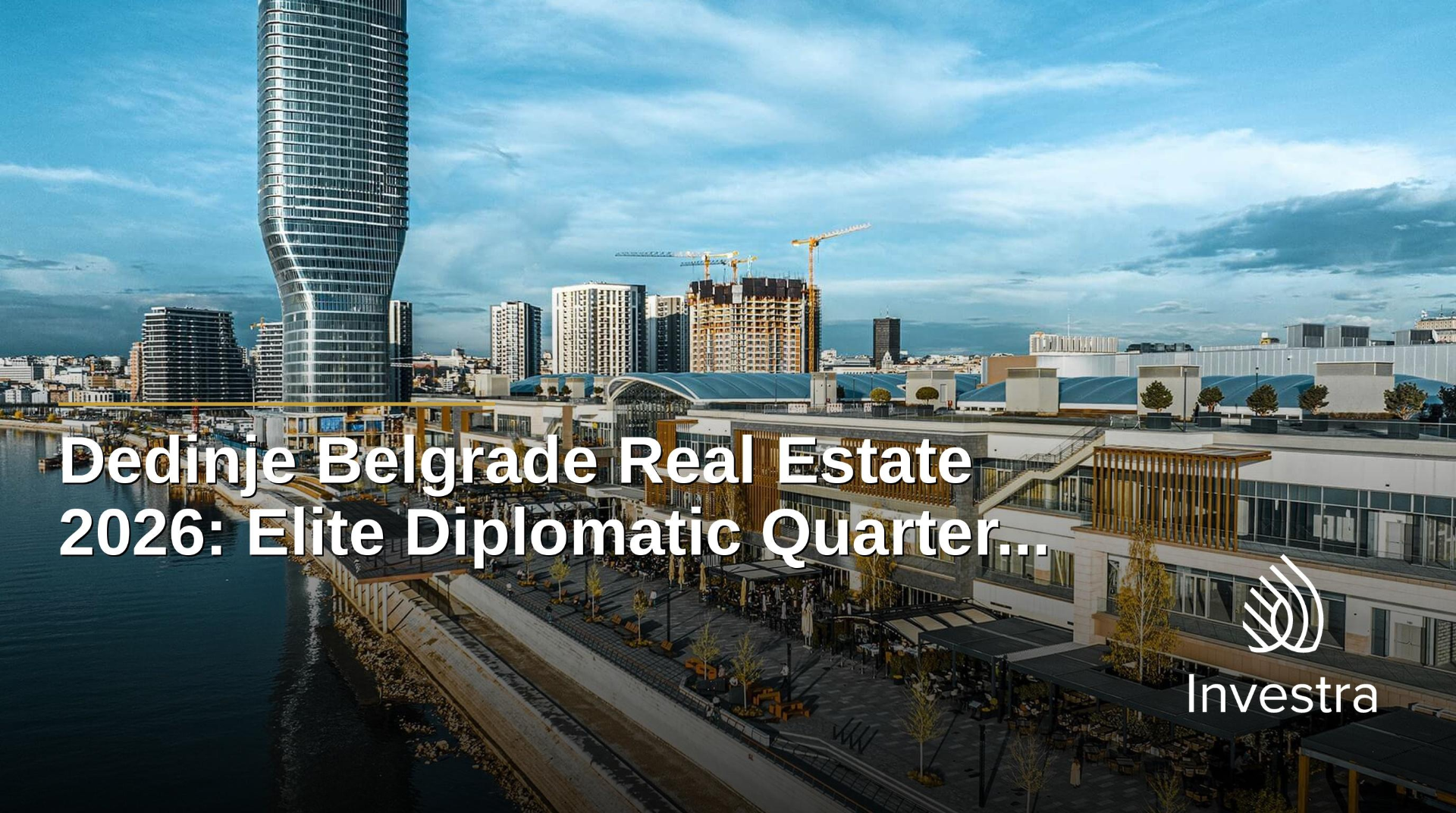
Dedinje Belgrade Real Estate 2026: Elite Diplomatic Quarter...
Dedinje Belgrade Real Estate 2026: Elite Diplomatic Quarter Property Guide
Dedinje remains Belgrade’s most exclusive residential enclave in 2026, where diplomatic residences, historic villas, and new-build luxury apartments command premium prices between €6,500 and €9,800 per square metre. Foreign buyers, particularly from Western Europe and the Gulf, continue to drive demand for secure, high-status properties in this leafy diplomatic quarter. Investors seeking long-term capital appreciation and discreet rental income will find the strongest opportunities in established streets around the Russian and American embassies.
The neighbourhood’s combination of privacy, green space, and proximity to the city centre sets it apart from newer developments elsewhere in Belgrade. Demand has stayed resilient despite broader market cooling in secondary districts, with transaction volumes holding steady among ultra-high-net-worth individuals.
Market Overview
```htmlOver the past eighteen months, average asking prices in Dedinje have risen 7.8 percent to €7,650 per square metre, according to aggregated transaction data tracked by Investra.io. Prime villas with direct embassy adjacency now list above €10,000 per square metre, while modern apartments in small-scale developments average €6,900. Rental yields for fully furnished diplomatic-grade properties sit between 4.1 and 4.7 percent gross, supported by long-term leases to international organisations and corporate relocations.
Supply remains tightly constrained. Most available stock consists of either 1970s–1990s villas undergoing renovation or limited new projects on the eastern edge of the neighbourhood. Foreign ownership accounts for roughly 34 percent of transactions above €1.5 million, with buyers frequently comparing Dedinje to comparable diplomatic districts in Prague or Budapest. For broader context on city-wide pricing, see the latest analysis in Belgrade Real Estate Market 2026.
Key Investment Factors
Location and Prestige
Dedinje’s elevated position above the Sava and Danube rivers delivers both security and views that few other Belgrade neighbourhoods can match. The area’s reputation as the home of ambassadors and senior government figures creates an intangible premium that supports resale values even during economic slowdowns. Properties within a 500-metre radius of major embassies trade at a consistent 18–22 percent markup.
Diplomatic and Corporate Tenant Demand
More than forty embassies and international organisations maintain residences in Dedinje, generating reliable demand for three- to six-bedroom homes. Corporate tenants from energy and finance sectors typically sign three-year leases with annual indexation, reducing vacancy risk for owners. This tenant profile differentiates Dedinje from purely residential districts that rely on shorter-term expat lets.
Infrastructure and Connectivity Upgrades
Completion of the extended Voždovac–Dedinje tunnel link in late 2025 cut average drive times to the airport to under 25 minutes. Planned tram line extensions scheduled for 2027 will further improve public transport access without compromising the neighbourhood’s low-density character. These improvements are already factored into 2026 pricing for properties along the southern boundary.
Regulatory Environment for Foreign Buyers
Serbia continues to permit foreign individuals to purchase residential property directly, with the same rights as citizens once the purchase contract is notarised. Due diligence on title and embassy-adjacent restrictions remains essential; detailed procedural guidance is available in the Serbia Buying Process 2026 and the companion Serbia Property Taxes 2026 resources.
Price Analysis Table
| Neighborhood | Avg Price €/m² (2026) | Prime Price €/m² | Gross Rental Yield | Typical Buyer Profile |
|---|---|---|---|---|
| Dedinje (core) | 7,650 | 10,200 | 4.3% | Diplomats, UHNWIs |
| Dedinje (eastern edge) | 6,150 | 7,800 | 4.8% | Corporate executives |
| Vračar (south) | 4,900 | 6,400 | 5.1% | Local professionals |
| Savski Venac | 5,400 | 7,100 | 4.9% | Expats, investors |
| Senjak | 6,800 | 8,900 | 4.0% | Old money, diplomats |
Why Invest in 2026
The convergence of limited new supply, sustained diplomatic demand, and improving connectivity positions Dedinje for continued outperformance through 2028. Early movers who secure properties before the next wave of infrastructure completion are likely to capture both capital growth and stable euro-denominated rental streams. Investors can browse current listings and off-market opportunities directly on Investra.io, which aggregates verified diplomatic-quarter inventory from local agencies and private sellers.
Foreign buyers benefit from Serbia’s ongoing EU accession path, which is expected to support further legal harmonisation and liquidity improvements. Properties purchased today at €7,000–€8,000 per square metre could realistically reach €9,500–€11,000 per square metre by 2029 if current absorption rates hold.
As with any investment, property in Serbia carries risks. Only invest capital you can afford to lose. For a wider perspective on national opportunities, consult the Serbia Property Investment Guide 2026.
Practical Buying Guide
Foreign buyers interested in Dedinje properties typically follow a structured path that accounts for Serbian property law and local market practices. The process usually begins with due diligence on the specific parcel or building, followed by contract signing and registration.
Step 1: Initial Research and Shortlisting
Start by identifying properties through established agencies or direct developer contacts. Dedinje listings often appear first among diplomatic networks or specialized portals. Verify zoning status and any heritage protections that apply to older villas, as these can limit renovations.
Step 2: Legal Verification and Due Diligence
Engage a Serbian-licensed notary and a lawyer familiar with foreign ownership rules. Review the land registry extract for encumbrances, co-ownership claims, or unpaid utility debts. Properties near embassies may carry additional security-related restrictions that require ministry approval.
Step 3: Negotiation and Contract Execution
Once a target is chosen, negotiate price and payment terms. A preliminary contract locks in the deal while the buyer obtains any required residency or investment permits. The final purchase contract is signed before a notary and immediately submitted for title transfer at the cadastre office.
Step 4: Registration and Post-Purchase Steps
After notarization, the buyer pays the transfer tax and registers the property. Utility connections and security systems are then set up, particularly important for high-value diplomatic-area homes. Many owners also arrange ongoing property management through local firms.
Costs & Fees Breakdown
| Item | Percentage / Amount | Example on €1,200,000 Property |
|---|---|---|
| Purchase Price | — | €1,200,000 |
| Notary & Legal Fees | 1.2–1.8% | €14,400 – €21,600 |
| Transfer Tax | 0.5–3% (flat 0.5% for most residential) | €6,000 |
| Real Estate Agent Fees | 2–3% (split between parties) | €12,000 – €18,000 |
| Cadastre & Registration | Fixed + 0.1% | €2,500 |
| Total Additional Costs | — | €34,900 – €48,100 |
| Grand Total | — | €1,234,900 – €1,248,100 |
Risks & Challenges
Buyers should weigh several practical risks before committing capital in Dedinje. Currency fluctuations between the euro and the Serbian dinar can affect final costs for non-eurozone purchasers. Older villas sometimes hide structural issues that only appear after purchase, raising renovation budgets significantly.
Foreign ownership of land near diplomatic zones occasionally triggers extra administrative reviews that extend timelines by several months. Liquidity remains lower than in central Belgrade districts, so resale can take longer if market conditions shift. Finally, political or regulatory changes affecting foreign investment could influence long-term holding strategies.
Expert Tips
- Always budget an extra 5–7% beyond the listed price to cover unforeseen renovation or compliance work on heritage properties.
- Work with a lawyer who has handled previous embassy or diplomatic purchases, as they understand the additional approvals required.
- Inspect utility infrastructure carefully—many Dedinje streets still rely on older water and electricity networks that need upgrading.
- Consider seasonal demand patterns; spring and early autumn often bring more serious diplomatic buyers.
- Request a current cadastre certificate dated within the last 30 days before signing any contract.
- Explore off-market opportunities through established local networks rather than relying solely on public listings.
- Factor in ongoing security and maintenance costs, which run higher here than in standard residential neighbourhoods.
Find Your Serbia Property on Investra.io
Investra.io aggregates verified listings across Belgrade’s prime districts, including current Dedinje offerings with transparent pricing and ownership history. The platform connects buyers directly with licensed local agents and provides downloadable due-diligence checklists tailored to Serbian regulations.
Users can filter by price per square metre, proximity to embassies, and new-build versus historic stock. Integrated tools also allow comparison of projected yields and long-term price forecasts for the area, helping investors make data-driven decisions without multiple site visits.
Recommended Reading
- Serbia Legal Guide for Foreigners
- Serbia Rental Market 2026
- Serbia Property Price Forecast
- Novi Sad Real Estate 2026
- Sinisa Dagary Real Estate Blog
- Findes.si Property Portal
Follow Us
Stay updated on Serbia’s real estate market:
Odkrijte globalne investicijske priložnosti na Unifyr.space — vaš portal za pametne investicije.
Frequently Asked Questions
Q: Can foreigners buy property in Dedinje without residency?
A: Yes, non-residents may purchase apartments outright; land ownership requires a Serbian company or residency permit in most cases.
Q: What is the typical time to complete a purchase?
A: From offer acceptance to title registration, expect 6–10 weeks if no special approvals are needed.
Q: Are there restrictions near embassies?
A: Certain parcels close to diplomatic missions require additional clearance from the Ministry of Foreign Affairs.
Q: How do property taxes compare with other Belgrade districts?
A: Dedinje properties attract higher annual property tax due to elevated cadastral values, typically 0.4–0.8% of market value.
Q: Is financing available for foreign buyers?
A: Local banks offer mortgages to non-residents, though loan-to-value ratios are often capped at 50–60%.
Q: What about inheritance and resale rights?
A: Foreign owners enjoy the same inheritance and resale rights as Serbian citizens once the property is registered.
Q: Are new-build projects common in Dedinje?
A: Limited new construction occurs due to land scarcity; most activity involves renovation of existing villas or small boutique developments.
Q: How secure are title deeds in Serbia?
A: The electronic land registry system provides reliable title security when proper due diligence is performed.
Q: Can I rent out a Dedinje property short-term?
A: Short-term rentals are permitted but subject to municipal registration and potential restrictions in diplomatic zones.
Q: What professional services are recommended?
A: A bilingual lawyer, licensed notary, and local property manager experienced with high-value clients are standard.
Related Posts
No related posts available.
