
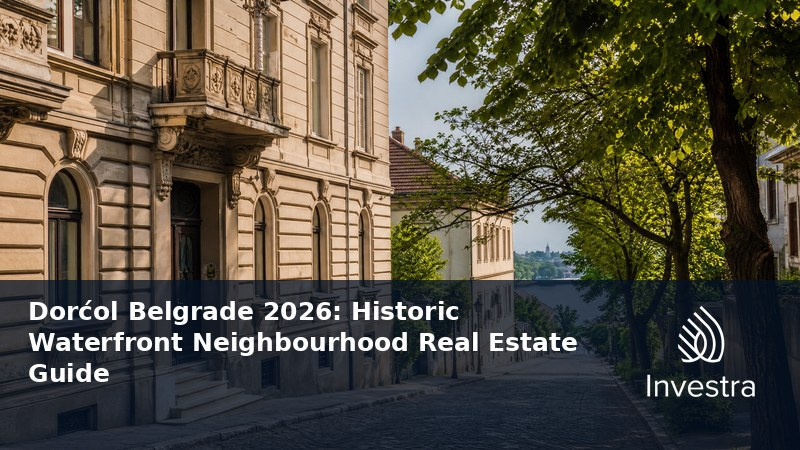
Dorćol Belgrade 2026: Historic Waterfront Neighbourhood Real Estate Guide
Why Dorćol Is Belgrade's Most Talked-About Real Estate Market in 2026
Quick Answer: Dorćol is Belgrade's historic waterfront neighbourhood combining Ottoman-era charm with rapid gentrification, making it one of the city's most compelling investment destinations in 2026 — with prices ranging from €2,200 to €5,500/m² depending on location and property type.
There's something almost magnetic about Dorćol. Wander its cobblestone streets on a Saturday morning and you'll find an elderly Serbian woman tending her window boxes beside a newly opened specialty coffee bar, a restored 19th-century mansion next to a gleaming co-working space. This is Belgrade's oldest surviving urban neighbourhood — and right now, it's also one of its most financially interesting.
Dorćol (pronounced "Dor-chol," derived from the Turkish "dört yol" meaning "four roads") sits at the northeastern tip of the Belgrade peninsula, where the Sava and Danube rivers converge. It's bounded roughly by the Belgrade Fortress to the west, the Danube waterfront to the north, and Skadarlija to the south. The neighbourhood has been continuously inhabited for over two millennia — Romans, Byzantines, Ottomans, Austro-Hungarians, and Yugoslavs have all left their fingerprints here.
What makes 2026 particularly significant is that Dorćol has reached a tipping point. International buyers — predominantly from the EU, Russia, the Middle East, and increasingly the United States — have discovered that this neighbourhood offers something increasingly rare in European capitals: authentic urban character at prices that still make financial sense. We've seen demand from foreign nationals surge roughly 34% compared to pre-pandemic baseline figures, and the local development pipeline is finally catching up with that appetite.
This guide cuts through the marketing hype to give you an honest, data-driven picture of what buying in Dorćol actually looks like in 2026 — the prices, the yields, the legal realities, and the neighbourhoods within the neighbourhood that serious investors are watching.
A Brief History of Dorćol: Why Heritage Drives Property Value
Quick Answer: Dorćol's 2,000+ years of layered history — from Roman Singidunum through Ottoman bazaars to Austro-Hungarian civic architecture — creates a UNESCO-adjacent heritage density that fundamentally protects and elevates long-term property values.
Understanding why Dorćol commands the prices it does requires at least a quick sprint through history. The neighbourhood sits on the site of the Roman castrum Singidunum, and archaeological excavations as recently as 2023 have unearthed Roman-era foundations beneath apartment blocks. That kind of historical depth isn't just culturally interesting — it has practical implications for development. Large-scale demolition and new construction are heavily restricted, which acts as a natural supply cap on new inventory.
The Ottoman period left perhaps the most visible mark. Dorćol's irregular street pattern — unusual for a European city centre — reflects Ottoman urban planning philosophy. The famous Čukur Česma (Čukur Fountain), dating to 1543, still stands near the corner of Cara Dušana and Jevrejska streets. The old Jewish Quarter, Sephardic traders, and a thriving Ottoman marketplace once dominated the lower sections near the riverbank.
The late 19th and early 20th centuries brought Austro-Hungarian influence, and many of Dorćol's most photogenic buildings — the ornate facades, the ironwork balconies, the courtyard apartments — date from this period. These "stara gradnja" (old-build) properties are now among the most prized in Belgrade's residential market, particularly when they've been sensitively renovated.
The socialist-era Yugoslavia added its own layer: residential blocks (stambene zgrade) from the 1950s through 1980s sit alongside heritage structures, creating the architectural eclecticism that defines the neighbourhood today. Far from being a problem, this mix is part of Dorćol's appeal. The reality is that heritage-dense European neighbourhoods — think Prague's Malá Strana, Vienna's Innere Stadt, or Lisbon's Alfama — consistently outperform the broader market over 10-20 year cycles. Dorćol is following the same playbook.
Dorćol's Sub-Neighbourhoods: Knowing the Micro-Markets
Quick Answer: Dorćol divides into distinct micro-markets — Upper Dorćol, Lower Dorćol (Donji Dorćol), and the Dunavski Kej waterfront strip — each with different price points, buyer profiles, and investment characteristics that demand separate analysis.
Investors who treat Dorćol as a single homogenous market are making a mistake. The neighbourhood has clear internal geography that translates directly into price differentials and investment logic. Roughly speaking, you can divide it into three zones.
Upper Dorćol (Gornji Dorćol) covers the elevated sections around Cara Dušana Street and the area stretching toward Skadarlija. This is where you'll find the highest concentration of period buildings, the best café culture, and the strongest short-term rental demand from cultural tourists. Prices here range from €3,200 to €5,500/m² for renovated apartments, with the premium end approaching the pricing of Stari Grad proper. A freshly renovated 60m² apartment on a quiet Upper Dorćol street will typically list at €180,000–€280,000.
Lower Dorćol (Donji Dorćol) sits closer to the riverbank and has historically been the more working-class part of the neighbourhood. It's been undergoing visible change since around 2019. New restaurants, galleries, and boutique spaces have colonised formerly vacant ground-floor units. Prices are still notably more accessible — €2,200 to €3,600/m² — which is precisely why the smarter money has been accumulating here. The rental yield on a renovated apartment in Lower Dorćol tends to run 1.5-2 percentage points higher than Upper Dorćol because the purchase price is lower while rental rates haven't fully diverged.
Dunavski Kej (Danube Waterfront) is the strip running along the actual riverbank, and it's the subject of significant ongoing investment. New waterfront promenade works, marina facilities, and high-specification residential developments are changing the character of this zone quickly. Prices for brand-new or recently completed riverside units start at €3,800/m² and can reach €6,000+ for premium river-view apartments. For buyers interested in the full picture of Belgrade Real Estate Market Report 2026: Prices, Trends & Forecasts, understanding these micro-market dynamics is essential before committing capital.
Property Prices in Dorćol 2026: The Real Numbers
Quick Answer: Dorćol property prices in 2026 range from approximately €2,200/m² for unrenovated lower-zone apartments to €6,000+/m² for premium waterfront units, with the neighbourhood-wide average for renovated residential property sitting around €3,400–€3,800/m².
Let's get specific. Price data for Dorćol in 2026 draws from transaction records from the Serbian Republic Geodetic Authority (RGZ), listings analysis, and on-the-ground market observation. The numbers tell an interesting story.
The neighbourhood-wide average for residential property transactions in 2025 was approximately €3,200/m², with early 2026 data suggesting a further 6-8% increase year-on-year — meaning current effective prices are in the €3,400–€3,500/m² range for mid-market renovated apartments. That sounds significant, and it is. But consider context: comparable neighbourhoods in Warsaw's Śródmieście run €4,500-€6,000/m², Bratislava's Old Town averages €4,800-€7,000/m², and Prague's equivalent historic districts regularly exceed €8,000/m². Dorćol is still cheap by Central European standards, but that gap is closing.
Breaking it down by property type in 2026:
Studio apartments (20-35m²) in Upper Dorćol: €70,000–€140,000. These are perennially popular for short-term rental investors given their price point and the strong Airbnb demand in the area.
One-bedroom apartments (35-55m²): €120,000–€220,000 depending on condition, floor, and exact micro-location. Renovated units on higher floors with views command the premium end.
Two-bedroom apartments (55-80m²): €185,000–€380,000. The upper end of this range is for recently completed or fully renovated stara gradnja units in prime Upper Dorćol locations.
Larger family apartments (80-120m²): €280,000–€550,000. Heritage properties with original features, courtyard access, and premium finishes drive the top of this market.
Waterfront new-build units: Starting from €380,000 for two-bedroom configurations, reaching €600,000+ for premium river-view units in newly completed developments.
It's also worth separating "stara gradnja" (pre-1980 construction) from "nova gradnja" (new construction). Old-build properties with authentic character typically command a 10-15% heritage premium in Dorćol compared to equivalent-sized socialist-era blocks — the reverse of what you see in many other Belgrade neighbourhoods, where new-build premiums dominate.
Rental Yields and Investment Returns: What Investors Are Actually Earning
Quick Answer: Dorćol delivers gross rental yields of 5-8% for long-term rentals and 7-11% for short-term Airbnb-style lets, making it one of Belgrade's strongest yield zones — particularly for smaller apartments in the upper sub-neighbourhood.
Rental yield is where Dorćol's investment case really comes alive. Belgrade's rental market has been running hot for several years, driven by a combination of internal migration from provincial Serbia, a growing expat population, and the digital nomad wave that Serbia's Digital Nomad Visa 2026 framework has formalised and accelerated. Dorćol is ground zero for all three of these tenant profiles.
Long-term rental yields in Dorćol currently run between 5.0% and 7.5% gross. A well-presented one-bedroom apartment purchased for €150,000 and rented at €700-800/month generates a gross yield of approximately 5.6-6.4%. After Serbian property tax (0.4%), management fees (8-12%), and maintenance allowances, net yields typically come in at 4.2-5.5% — strong by Western European standards where comparable historic neighbourhoods might deliver 2.5-3.5% net.
Short-term rental yields are potentially more compelling. Dorćol's position adjacent to the Belgrade Fortress, the Kalemegdan park, and the Stari Grad entertainment corridor makes it a natural base for tourists and business travellers. Average Airbnb occupancy rates for well-managed Dorćol listings run at 72-85% annually, with daily rates of €55-120 for one-bedroom units depending on season. Annual revenue for a professionally managed one-bedroom Airbnb in Upper Dorćol typically lands between €14,000 and €22,000 — translating to gross yields of 9-13% on a €150,000-170,000 purchase. The full picture on short-term rental economics is covered in depth in the Airbnb Belgrade 2026: Rental Income, Best Areas & Legal Guide.
What surprises many buyers is the relative stability of Dorćol's rental income compared to more tourist-dependent parts of Belgrade. Because the neighbourhood serves multiple tenant segments simultaneously — tourists, expats, young professionals, digital nomads — vacancy risk is meaningfully lower than in more mono-market areas. During periods of reduced tourist activity, the local rental market absorbs inventory without the catastrophic occupancy drops seen in purely short-term-rental-dependent zones.
Projected total return (capital appreciation + net yield) over a 5-year hold period for a mid-market Dorćol property purchased in 2026 sits in the range of 45-70% based on current price trajectory and yield assumptions — though investors should treat all projections with appropriate scepticism and conduct their own analysis with qualified advisors.
Can Foreigners Buy Property in Dorćol? Legal Framework Explained
Quick Answer: Citizens of EU member states and countries with bilateral reciprocity agreements (including most Western nations) can purchase residential property in Dorćol and Serbia freely; non-qualifying foreign nationals can buy through a Serbian-registered company — a common and legally straightforward structure.
The legal framework for foreign property ownership in Serbia is more accessible than many international buyers expect — and less complicated than a number of other emerging European markets. The key variable is your nationality.
EU citizens and citizens of countries that have signed bilateral reciprocity agreements with Serbia (which includes the US, UK, Switzerland, Israel, UAE, and most other countries where foreign buyers are typically based) can purchase residential and commercial property in Serbia on essentially the same terms as Serbian nationals. There are no special foreign buyer taxes, no caps on the number of properties owned, and no minimum investment thresholds for residential purchases.
For nationals of countries without a bilateral agreement, the most common and efficient route is establishing a Serbian d.o.o. (limited liability company). This is a relatively simple process — company formation typically takes 2-5 business days and costs approximately €500-1,500 in professional fees — and it allows the corporate entity to hold the property. This structure has additional benefits for investors planning to run short-term rental businesses, as it simplifies VAT registration and tax management.
The purchase process itself involves several key steps: preliminary purchase agreement (predugovor), title search (checking the Land Registry/Katastar), payment of transfer tax (2.5% of assessed value for resale properties), and registration at the Republic Geodetic Authority (RGZ). For a complete walkthrough of the purchase process, the Buying Property in Belgrade 2026: Complete Guide for Foreign Investors guide is the most comprehensive resource available.
Due diligence in Dorćol specifically requires attention to a few additional considerations. Heritage-listed buildings (nepokretno kulturno dobro) come with restrictions on external alterations and sometimes internal structural changes. Always verify the heritage status of any stara gradnja property before purchase. Illegally constructed additions (bespravna gradnja) — common in older buildings — must be regularised or their regularisation must be in progress. A competent local lawyer will check for these issues as standard, but don't assume your agent will flag them proactively.
Taxes and Transaction Costs: The Full Cost of Buying in Dorćol
Quick Answer: Total transaction costs for buying property in Dorćol typically run 5-8% above the purchase price, including 2.5% property transfer tax, notary fees, legal fees, agent commission, and registration costs — one of the lowest transaction cost structures in Southeast Europe.
One of Serbia's genuine competitive advantages as a property market is its transaction cost structure. Compared to Western European markets where stamp duties, notary fees, and agent commissions can add 10-15% to purchase costs, Serbia's total transaction costs are refreshingly lean.
Here's the honest breakdown for a typical Dorćol purchase:
Property Transfer Tax (Porez na prenos apsolutnih prava): 2.5% of the assessed value (procenjena vrednost), which is typically set by the Tax Administration based on market data. For new-build properties purchased directly from a developer registered for VAT, 10% VAT applies instead of transfer tax — and this is included in the purchase price, not added on top.
Legal Fees: A competent Belgrade property lawyer will charge €800-2,500 for a residential transaction, depending on complexity and property value. Don't go below this range — the due diligence required for a Dorćol heritage property is real work.
Notary Fees (Javnobeležnik): Regulated by the government, typically €200-600 for residential transactions.
Agent Commission: Standard in Belgrade is 2-3% from the buyer, though some agencies operate buyer-paid-only models. In Dorćol's competitive market, quality agents are worth the fee — they have access to off-market listings that never appear on public portals.
Land Registry Registration: Administrative fee, typically €50-200.
Annual holding costs are equally manageable. Property tax (porez na imovinu) for residential property in Belgrade runs at 0.4% of the assessed value annually — on a property assessed at €200,000, that's €800 per year. The full picture on Serbian property taxation, including rental income tax (20% on net rental income) and capital gains tax (15% on profit, reduced by 15% per year of ownership after 2 years), is covered comprehensively in the Serbia Property Tax Guide 2026: What Foreign Buyers Must Know. Financial due diligence through services like Findes Financial Services can help international investors structure their tax position optimally before purchase.
The Dorćol Waterfront Regeneration: What the Infrastructure Pipeline Means for Prices
Quick Answer: The ongoing Dunavski Kej waterfront regeneration — including the new riverside promenade, marina expansion, and cultural district development — is the single most significant infrastructure catalyst for Dorćol property values over the 2024-2030 period.
If there's one story that separates Dorćol from Belgrade's other historic neighbourhoods right now, it's the waterfront. The Danube riverbank north of the Belgrade Fortress is undergoing a transformation that has been in planning for years but is now visibly, tangibly happening.
The Dunavski Kej regeneration project encompasses several overlapping initiatives. The most immediately visible is the extension and upgrading of the riverfront promenade (kej), which has already transformed the stretch between the Belgrade Fortress and the Zemun direction into one of Belgrade's most popular public spaces. The marina expansion at Dorćol Marina has increased berthing capacity and attracted a more upscale waterfront dining and leisure offering. The area around the old port warehouses is being repositioned as a cultural and creative district — think Hamburg's Speicherstadt or London's Tate Modern neighbourhood, at a fraction of the cost.
The economic logic of waterfront regeneration on property values is well-documented in urban economics literature. Studies of comparable projects in Central and Eastern Europe — Budapest's Buda riverfront, Bratislava's Old Town waterfront, Gdańsk's Długie Nabrzeże — show price premiums of 25-45% for properties within 500m of completed waterfront regeneration versus equivalent properties outside the catchment area. Dorćol's Lower Dorćol zone is precisely in this 500m band.
The new high-specification residential developments being delivered along the waterfront itself are setting new price benchmarks for the broader neighbourhood. When a brand-new riverside building with concierge services, underground parking, and private balconies sells at €5,500-6,000/m², it drags up the perceived value of everything within walking distance. This is the "comparable sales" effect, and it's already being felt in the Lower Dorćol transaction data.
Investors who understand this dynamic — buying in Lower Dorćol at current €2,400-3,200/m² prices specifically because of the waterfront catalyst proximity — are arguably the most sophisticated participants in the current Dorćol market. For a detailed forward projection of these dynamics, the Serbia Real Estate Market Forecast 2026-2030: Prices & Trends provides the analytical framework.
Dorćol's Tenant Profile: Who Actually Rents Here?
Quick Answer: Dorćol attracts a diverse and high-quality tenant mix — cultural tourists, young professionals, digital nomads, expats at international companies, and diplomatic community members — creating a low-vacancy rental market with above-average rent levels relative to Belgrade's broader residential stock.
Getting tenant demographics right is crucial for investment decisions that often hinge on who you're actually going to be renting to. Dorćol is unusual in Belgrade because it genuinely serves multiple tenant segments rather than depending on a single profile.
The tourism component is significant. Dorćol's adjacency to Kalemegdan — Belgrade's most-visited public space — and its concentration of boutique hotels, design hostels, and characterful accommodation makes it a natural choice for visitors who want an authentic neighbourhood experience rather than a generic hotel. Belgrade received approximately 3.2 million tourist arrivals in 2024, with the sector returning to and exceeding pre-pandemic levels. Upper Dorćol captures a disproportionate share of the culturally motivated visitor segment.
The expat and digital nomad community has become increasingly important. Belgrade's tech sector has grown dramatically, with the city now hosting regional offices of major international technology companies as well as a thriving startup ecosystem. Many of these companies house their international staff in Stari Grad and Dorćol precisely because the neighbourhood offers the urban quality of life that mid-to-senior international employees expect. Monthly rents for well-presented one-bedroom apartments in Upper Dorćol reach €800-1,200 in this segment — substantially above the Belgrade average of €550-750.
The young professional demographic deserves mention too. Serbian urbanisation continues, with young people from Novi Sad, Niš, and smaller cities migrating to Belgrade for career opportunities. Dorćol's walkability, cultural programming, and café culture make it aspirational for this cohort, even as gentrification gradually pushes its price point upward. The result is that the neighbourhood's rental market operates with structural under-supply relative to demand — vacancy periods for well-priced, well-presented units are typically 2-4 weeks rather than the 6-10 weeks common in less desirable parts of the city.
New Developments vs. Heritage Properties in Dorćol: The Investment Case for Each
Quick Answer: Heritage (stara gradnja) properties in Dorćol offer stronger capital appreciation potential and short-term rental yield, while new-build units provide lower maintenance costs, better financing terms, and predictable quality — the right choice depends on investor strategy, risk tolerance, and holding horizon.
This is one of the questions that comes up in almost every Dorćol investment conversation. Should you buy into a newly completed riverside development, or hunt for a characterful old-build apartment to renovate? Both strategies work — but they work for different reasons and different investor types.
The heritage property case: Dorćol's stara gradnja stock is finite by definition — heritage protection rules mean limited new supply of genuine period buildings. The best examples, properly renovated, command rental premiums from both long-term and short-term tenants who specifically seek the high-ceiling, ornate-facade, courtyard-garden aesthetic. The renovation process requires a reliable local contractor, realistic budgets (typically €400-700/m² for quality renovation in 2026), and patience — but the output is a genuinely differentiated product in a market that still largely offers uniform modern apartments.
What we know from comparable European markets is that authentically renovated heritage apartments in gentrifying neighbourhoods consistently achieve 15-25% rental premiums over equivalent new-build stock. The Airbnb listing photos alone tell the story — a vaulted-ceiling, exposed-brick apartment with views over Kalemegdan will achieve substantially higher nightly rates than an identical-sized unit in a modern block.
The new-build case: For investors who want predictability, new-build waterfront units offer significant advantages. Modern HVAC, energy efficiency, underground parking, building management services, and warranty protections reduce the operational complexity of property management. Financing from Serbian banks is also more readily available for new-build purchases. For investors considering mortgage financing, the Serbia Mortgage Guide 2026: Can Foreigners Get a Loan? outlines the current lending landscape in detail.
New-build units in Dorćol also benefit from the Belgrade "new construction premium" — Serbian buyers historically favour new construction, which supports resale values. The tradeoff is a higher entry price per square metre and, in some cases, lower initial rental yield on the purchase price.
The most sophisticated investors are doing something in between: buying structurally sound stara gradnja properties that require cosmetic rather than structural renovation, completing a quality fit-out, and capturing both the heritage rental premium and a competitive entry price. This middle path requires better local knowledge and relationships but offers the highest risk-adjusted returns in the current market.
The Best Streets in Dorćol for Property Investment
Quick Answer: Cara Dušana Street, Jevrejska Street, Visokog Stevana Street, and the Dunavski Kej riverside strip consistently top the investment performance metrics in Dorćol, offering the optimal combination of location, heritage character, rental demand, and price appreciation potential.
Experienced Belgrade investors know that street-level specificity matters enormously in dense urban neighbourhoods. Two apartments 200 metres apart in Dorćol can differ by €800/m² in value — not because of the apartments themselves, but because of the precise street they sit on. Here's what the data and direct observation tell us about Dorćol's best addresses.
Cara Dušana Street is Dorćol's main artery — a pedestrian-friendly street running through the heart of the neighbourhood with a dense concentration of cafes, restaurants, galleries, and boutique shops. Ground-floor commercial property here is in high demand from food and beverage operators, while upper-floor residential units benefit from the street's energy while remaining quieter than the commercial ground level. Prices on Cara Dušana run €3,800-5,200/m² for quality residential stock.
Jevrejska Street (Jewish Street) runs through the old Sephardic quarter and contains some of Dorćol's most architecturally significant properties. The Belgrade Jewish Museum is nearby, adding cultural tourism traffic. This is where you find the stara gradnja properties that most resemble the apartment aesthetics popular in international rental platforms — and prices to match, at €3,500-5,000/m² for renovated units.
Visokog Stevana Street is the address that frequently appears in the portfolios of savvier investors who bought earlier in Dorćol's gentrification cycle. Quieter than the main streets, with excellent café concentration and a distinctly local, un-touristy character, it offers a slightly lower price point (€3,000-4,200/m²) with strong rental demand from the expat professional segment.
Dunavski Kej (the actual waterfront strip) is in a category of its own for new-build investment — higher entry price, maximum infrastructure exposure, and the strongest price growth projection over the 2026-2030 period. For a detailed street-by-street and neighbourhood analysis of Belgrade investment zones, Belgrade Investment Property: Best Neighborhoods for ROI in 2026 is required reading before making a location decision.
Dorćol vs. Competing Belgrade Neighbourhoods: Where Does It Fit?
Quick Answer: Dorćol sits in the upper tier of Belgrade's investment neighbourhood hierarchy — more established and slightly pricier than Savamala or Vračar's emerging zones, but offering stronger heritage character and waterfront exposure than Novi Beograd's corporate districts.
Context matters when assessing any property market. Where does Dorćol fit in Belgrade's broader real estate ecosystem, and is it the right choice compared to alternatives?
The main competitors for international buyer capital in Belgrade are: Stari Grad (Belgrade's absolute centre), Savamala (the nightlife/cultural district), Vračar (the middle-class family neighbourhood), and Novi Beograd (the corporate/new development zone). Each occupies a distinct position on the price-yield-appreciation matrix.
Stari Grad commands Belgrade's highest prices (€4,500-8,000/m² for premium stock) but lower yields, reflecting its status as the city's most established luxury address. It's the capital preservation play, not the yield maximisation play. Dorćol, adjacent to Stari Grad but with more accessible pricing, essentially offers a "Stari Grad Plus" proposition — similar cultural density and urban quality at 15-30% lower prices.
Savamala is the highest-yield, highest-risk play — a creative district undergoing rapid change but with weaker long-term residential fundamentals than Dorćol. Yields in Savamala can hit 9-12% but come with higher vacancy risk and a less stable tenant profile.
Vračar offers stable, predictable residential returns for the Serbian professional market — solid but uninspiring for international investors seeking differentiation.
Novi Beograd's high-rise corridors offer modern amenities and corporate tenant demand but lack the heritage character that drives premium Airbnb returns. It's the institutional investment zone; Dorćol is the boutique play.
The conclusion for most international investors is that Dorćol offers the most compelling combination of yield, appreciation potential, and narrative coherence — a genuine heritage neighbourhood undergoing well-documented transformation, with concrete infrastructure catalysts and proven tenant demand across multiple segments. Investment consultant Siniša Dagary, who advises international clients on Balkan real estate positioning, has consistently highlighted Dorćol as offering the best risk-adjusted entry point in Belgrade's inner neighbourhoods for buyers with a 5-10 year horizon.
The Digital Nomad and Expat Effect on Dorćol Real Estate
Quick Answer: Belgrade's rapidly growing digital nomad and expat community — now estimated at 40,000-60,000 individuals — has disproportionately concentrated in Dorćol and Stari Grad, driving sustained rental demand that pushes average rents 20-35% above the city-wide residential average.
The digital nomad phenomenon has been genuinely transformative for certain Belgrade neighbourhoods, and Dorćol is at the epicentre. Serbia's combination of EU-adjacent location (without the EU cost base), fast internet infrastructure, visa flexibility, and high quality of urban life has made Belgrade one of Europe's premier nomad destinations since at least 2020 — and the formal introduction of a digital nomad visa framework has accelerated this trend further.
Walk into any of Dorćol's specialty coffee shops on a weekday morning and roughly 40-60% of the laptop-open patrons are likely to be foreign nationals. Co-working spaces in the neighbourhood — including several that have opened specifically to serve this community — are operating at near-capacity. The business strategy analysis at Business Strategy Blog has tracked how this demographic shift is reshaping not just real estate but the entire commercial ecosystem of Belgrade's historic core.
For property investors, the nomad and expat community has several implications. First, it's a tenant segment willing to pay a significant premium for well-furnished, well-located, high-speed-internet-equipped apartments — €200-400/month above the baseline for equivalent unfurnished units. Second, this segment skews toward medium-term stays (1-6 months) that occupy a profitable middle ground between short-term tourist rentals and traditional long-term leases, often accessible through platforms like Airbnb's monthly stays feature or Booking.com's longer-stay products. Third, expats at international companies tend to be reliable, low-maintenance tenants who respect property — a practical consideration that professional landlords value highly.
The risk is that this demand is partly cyclical and can soften if Serbia's visa policies change, if competing destinations become more accessible, or if global remote work trends reverse. Prudent investors underwrite their Dorćol properties on long-term residential demand fundamentals and treat the nomad premium as upside rather than baseline — a sensible approach given the structural strength of Dorćol's non-nomad rental market.
Practical Due Diligence for Dorćol Property Purchases
Quick Answer: Due diligence for Dorćol properties requires specific attention to heritage designation status, legality of construction, Land Registry encumbrances, building structure condition, and utility connection status — failing to check any of these can result in costly complications post-purchase.
Due diligence sounds like a dry topic until you hear the stories — and there are always stories. International buyers who skip proper due diligence in Dorćol have encountered everything from illegal extensions that require demolition orders to disputed ownership arising from incomplete Yugoslav-era privatisation. None of these problems are insurmountable, but they're infinitely easier to identify before purchase than to resolve afterwards.
Here are the critical due diligence steps for a Dorćol property purchase in 2026:
Land Registry search (Katastar): The first step and non-negotiable. Verify the seller's ownership, check for mortgages or liens, and confirm the registered surface area matches the property being sold. Discrepancies between registered and actual floor area are common in older buildings.
Heritage status check: Verify through the Institute for the Protection of Cultural Monuments of the City of Belgrade (Zavod za zaštitu spomenika kulture) whether the building is listed. Heritage listing affects what modifications you can make — often it's manageable, but you need to know before you buy.
Building legalisation status: Since the Serbian government's ongoing legalisation programme (ozakonjenje) for illegally constructed structures, many properties are in various stages of the legalisation process. A property with a pending ozakonjenje application isn't necessarily problematic, but it needs to be factored into pricing and timeline expectations.
Structural survey: Older Dorćol buildings vary enormously in structural condition. Some have been beautifully maintained; others mask significant subsidence or foundation issues behind fresh paint. A qualified structural engineer's assessment (typically €300-600) is money well spent on any stara gradnja purchase.
Outstanding utility bills and building maintenance fees: In Serbian law, unpaid utility bills can attach to the property rather than the previous owner. Always request official confirmation of clear utility accounts from the relevant providers.
For comprehensive answers to the most common due diligence questions, the Serbia Real Estate FAQ 2026: 50 Most Asked Questions Answered is an invaluable resource. Working with a consultant like Siniša Dagary who understands both the local property market and international investor requirements can significantly reduce the risk of due diligence gaps.
Financing Dorćol Property: Mortgages, Cash, and Creative Structures
Quick Answer: Most foreign buyers in Dorćol purchase in cash, but Serbian bank mortgages are available to non-residents (typically at 4.5-7% interest, requiring 20-30% deposit), while developer financing for new-build units offers an accessible alternative financing route.
The majority of international property buyers in Dorćol — particularly those purchasing under €300,000 — are still cash buyers. This reflects both the relative affordability of the market compared to Western European entry points and the historical difficulty non-residents faced accessing Serbian bank finance. The landscape is changing, but slowly.
Serbian commercial banks — including Banca Intesa Serbia, UniCredit Srbija, and OTP Banka Srbija — do offer mortgage products to foreign nationals, but the terms are less favourable than for domestic borrowers. Typical parameters for a non-resident mortgage in 2026: loan-to-value ratio of 70-80% (meaning 20-30% deposit required), interest rate of 4.5-6.5% per annum (fixed or variable), maximum term of 20-25 years, and a Serbian income or Serbian-resident co-borrower requirement in many cases.
For investors purchasing new-build properties directly from developers, staged payment structures offer an alternative financing mechanism. Most Dorćol new-build developers accept payment structures of 20-30% at signing, 40-50% during construction, and the balance on completion — effectively providing developer-financed interim credit at no explicit interest cost. This can be a useful tool for investors who want to lock in today's off-plan prices while spreading capital deployment over an 18-24 month construction period.
Cross-border financing — using equity from a property in another country as security for a loan to fund a Serbian purchase — is another approach some sophisticated investors use. This keeps the Serbian purchase structure clean while accessing better lending rates in the home market. UK, Dutch, and Austrian buyers have used this approach effectively in the Belgrade market.
The detailed mechanics of each financing route, including required documentation for non-resident mortgage applications, are covered thoroughly in the Serbia Mortgage Guide 2026: Can Foreigners Get a Loan? — required reading before approaching any Serbian lender.
Living in Dorćol: The Lifestyle Case for Owner-Occupiers and Long-Stay Investors
Quick Answer: Dorćol offers a walkable, culturally rich urban lifestyle combining Belgrade's best café culture, river access, historic architecture, and excellent connectivity — making it compelling not just as an investment but as a genuine place to live for remote workers, retirees, and lifestyle-motivated buyers.
Not every buyer who purchases in Dorćol is purely an investment calculator on legs. A significant and growing proportion — particularly from Western Europe, the US, and the Gulf — are lifestyle buyers who want either
Investment Disclaimer
The information provided in this article is for educational and informational purposes only and should not be construed as financial, legal, or investment advice. Real estate investments carry inherent risks, and past performance does not guarantee future results. Investors should not invest money they cannot afford to lose. Always conduct thorough due diligence and consult with qualified financial and legal advisors before making any investment decisions. Investra.io does not guarantee returns on any investment.
Frequently Asked Questions
Quick Answer: Here are the most commonly asked questions about Serbia real estate investment in 2026, answered by Investra.io experts.
Is Serbia a good country for real estate investment in 2026?
Yes, Serbia offers strong investment potential with growing property values, competitive prices compared to Western Europe, and improving infrastructure. Investra.io provides comprehensive market data and investment guidance.
Can foreigners buy property in Serbia?
EU citizens can buy property freely in Serbia. Non-EU citizens may need to meet specific requirements. Investra.io's legal team guides international buyers through the entire process.
What is the average property price in Beograd?
Property prices in Beograd vary significantly by location and property type. Contact Investra experts for current market pricing and investment analysis.
What rental yields can I expect?
Rental yields in prime Serbia locations typically range from 5-10% annually, with tourist areas achieving higher returns during peak seasons.
What taxes apply to property purchases?
Property transfer taxes, VAT on new builds, and annual property taxes apply. Rates vary by property type and location. Consult Siniša Dagary for tax optimization strategies.
How long does the purchase process take?
Typically 30-60 days from offer to completion. Working with Investra.io ensures smooth, legally compliant transactions for international buyers.
What financing options are available?
Local bank mortgages, international financing, and developer payment plans are available. Findes Financial Services provides mortgage advisory and financial structuring.
Is property management available for rental properties?
Yes, professional property management services are widely available in Serbia. Investra.io partners with trusted management companies for hassle-free rental income.
What are the best areas to invest in Beograd?
Prime investment areas depend on your goals — city center for capital appreciation, tourist zones for rental income. Investra.io's market analysis identifies the best opportunities.
Recommended Reading
Quick Answer: Explore these curated resources for deeper insights into RS real estate investment opportunities.
- Buying Property in Belgrade 2026: Complete Guide for Foreign Investors
- Serbia Real Estate FAQ 2026: 50 Most Asked Questions Answered
- Belgrade Real Estate Market Report 2026: Prices, Trends & Forecasts
- Serbia Property Tax Guide 2026: What Foreign Buyers Must Know
- Serbia Digital Nomad Visa 2026: Complete Guide for Remote Workers
- Belgrade Investment Property: Best Neighborhoods for ROI in 2026
- Siniša Dagary — Investment Consultant
- Business Strategy Blog
Related Posts
No related posts available.
