
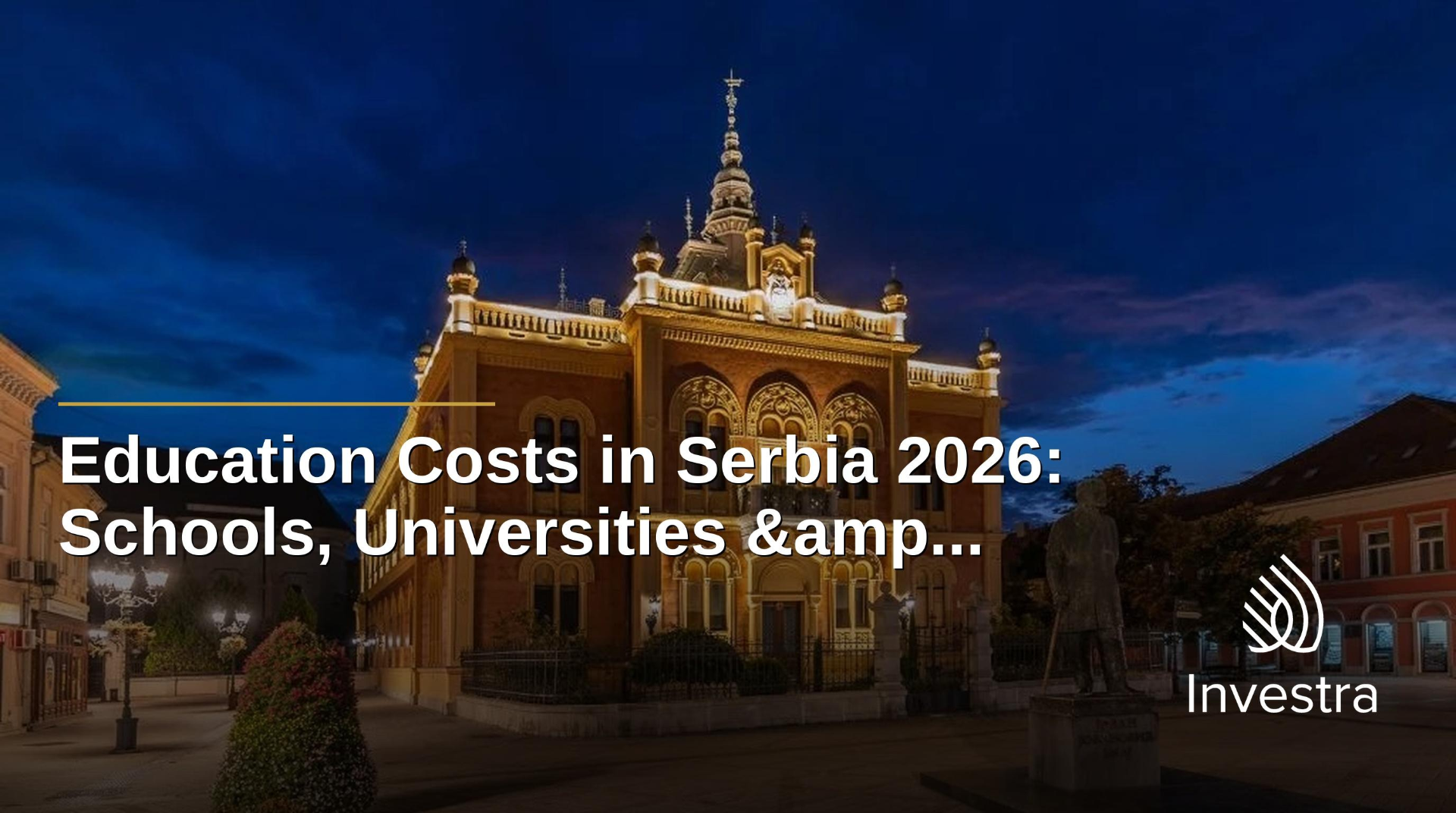
Education Costs in Serbia 2026: Schools, Universities &...
Education Costs in Serbia 2026: Schools, Universities & Childcare
Introduction
When considering a move to a new country, especially one as vibrant and welcoming as Serbia, understanding the cost of living is paramount. And for families, or individuals planning to further their studies, education costs are a significant piece of that puzzle. I\'ve often found myself wondering, \'What will it truly cost to educate my children here?\' or \'Can I afford to pursue that master\'s degree in Belgrade?\' This guide aims to answer those very questions, providing a comprehensive overview of education expenses in Serbia for 2026, from early childhood care to university-level studies.
Quick Answer: Education costs in Serbia vary widely, with public schools being free, private schools ranging from €3,000-8,000/year, international schools from €5,000-15,000/year, and universities for foreigners typically between €500-3,000/year. Childcare averages €150-400/month.
Public School System: Quality Education at No Cost
One of the most attractive aspects of Serbia\'s education system, particularly for expat families, is the availability of free public schooling. Yes, you read that right – free. This is a huge relief for many, as education can be one of the most substantial expenses when relocating. The Serbian public school system is generally well-regarded, offering a robust curriculum from primary through secondary levels. Instruction is primarily in Serbian, which presents both a challenge and a fantastic opportunity for immersion.
For my own children, the thought of them learning a new language and integrating into a local school is both exciting and a little daunting. But imagine the linguistic and cultural benefits! While tuition is free, parents are typically responsible for textbooks, school supplies, and sometimes small contributions for extracurricular activities or field trips. These costs are usually minimal, often amounting to a few hundred euros per year, far less than private alternatives.
Quick Answer: Public schools in Serbia are free for all residents, including expats, offering a quality education primarily in Serbian. Parents cover minimal costs for textbooks and supplies, typically a few hundred euros annually.
Private Schools: A Growing Alternative
For those seeking an alternative to the public system, private schools in Serbia offer diverse curricula, often with smaller class sizes and enhanced facilities. These schools can be a great option if you prefer a specific pedagogical approach or if your child is not yet proficient in Serbian. I\'ve seen many expat families opt for private local schools, especially if they plan a longer stay and want a blend of local culture with a more personalized educational experience.
The cost for private local schools generally ranges from €3,000 to €8,000 per year. This fee typically covers tuition, some materials, and access to various school programs. It\'s a significant jump from public schooling, but often justifiable for the benefits they offer. When I look at these options, I always weigh the academic benefits against the cultural immersion of public schools. It\'s a personal choice, isn\'t it?
Quick Answer: Private local schools in Serbia cost between €3,000 and €8,000 annually, providing diverse curricula, smaller classes, and enhanced facilities, often catering to families seeking alternatives to public education.
International Schools: Global Standards, Higher Price Tag
International schools are often the go-to choice for expat families who desire continuity with their home country\'s curriculum or who anticipate further international moves. Belgrade, in particular, boasts several reputable international schools offering British, American, or International Baccalaureate (IB) programs. These institutions provide a multicultural environment and instruction in English, which can be a huge comfort for children transitioning from abroad.
However, this global standard comes with a higher price tag. Annual tuition fees for international schools in Serbia typically range from €5,000 to €15,000, and sometimes even higher for older grades or more prestigious institutions. These fees usually include tuition, most learning materials, and access to a wide array of extracurricular activities. Some schools might also have additional charges for application, enrollment, or capital development fees. When I consider these costs, I realize it\'s an investment in a global education, often aligning with career paths that demand international mobility.
Quick Answer: International schools in Serbia, offering curricula like British, American, or IB in English, typically cost €5,000-15,000+ per year, providing a global standard of education for expat families.
University Education: Affordable Higher Learning
Serbia\'s universities are gaining international recognition, particularly in fields like engineering, medicine, and arts. For foreign students, the cost of higher education is remarkably affordable compared to many Western European or North American countries. This makes Serbia an increasingly attractive destination for those seeking quality university degrees without the burden of exorbitant tuition fees.
Tuition fees for foreign students at Serbian universities generally range from €500 to €3,000 per year, depending on the university, faculty, and study program. For instance, humanities programs might be on the lower end, while specialized medical or technical fields could be at the higher end. I\'ve met many international students who are pleasantly surprised by the affordability, allowing them to focus more on their studies and less on financial strain. Beyond tuition, students should budget for living expenses, which are also quite reasonable in Serbian cities like Belgrade or Novi Sad.
Quick Answer: University education in Serbia is affordable for foreign students, with annual tuition fees ranging from €500 to €3,000, depending on the program and institution, making it an attractive option for quality higher learning.
Childcare and Kindergarten: Early Learning Options
For parents with younger children, childcare and kindergarten options are a crucial consideration. Serbia offers both public and private kindergartens. Public kindergartens are partially subsidized by the state, making them more affordable, but they often have waiting lists, especially in larger cities. Private kindergartens, on the other hand, offer more flexibility, often with bilingual programs and diverse educational approaches.
The cost for childcare and kindergarten in Serbia typically ranges from €150 to €400 per month. Public kindergartens usually fall on the lower end of this spectrum, while private ones, especially those with international programs or extended hours, will be at the higher end. When I think about early childhood education, I always prioritize a nurturing environment. The availability of good, affordable options here is definitely a plus for families.
Quick Answer: Childcare and kindergarten in Serbia cost between €150 and €400 per month, with public options being more affordable but having waiting lists, and private ones offering more flexibility and diverse programs.
Language Learning Costs: Embracing Serbian Culture
While many Serbians, especially younger generations and those in larger cities, speak English, learning Serbian can significantly enhance your experience and integration. Language courses are widely available, ranging from group classes to private tutoring. I always encourage expats to embrace the local language; it opens so many doors and enriches daily life.
Group language courses can cost anywhere from €50 to €150 per month for a few hours a week. Private tutoring, offering a more personalized learning experience, typically ranges from €10 to €25 per hour. These costs are an investment in your personal and professional development, and in truly becoming a part of the Serbian community. I\'ve found that even a basic understanding of Serbian makes a huge difference in navigating daily life and connecting with locals.
Quick Answer: Language learning in Serbia, particularly for Serbian, costs €50-150 per month for group classes or €10-25 per hour for private tutoring, offering significant benefits for integration and daily life.
Tutoring Prices: Academic Support
Whether it\'s for catching up in a particular subject, preparing for university entrance exams, or mastering a new language, tutoring is a common practice. The availability of qualified tutors is high, and the prices are generally quite reasonable compared to many other European countries.
Tutoring prices in Serbia typically range from €8 to €20 per hour, depending on the subject, the tutor\'s experience, and the location. Specialized subjects or tutors with advanced degrees might command slightly higher rates. For me, ensuring my children have the academic support they need is paramount, and knowing that quality tutoring is accessible and affordable here is reassuring.
Quick Answer: Tutoring in Serbia is readily available and affordable, with prices typically ranging from €8 to €20 per hour, depending on the subject and tutor\'s experience, providing accessible academic support.
Comparison Table: Education Costs at a Glance
To give you a clearer picture, here\'s a comparison of typical annual education costs in Serbia for 2026:
| Education Type | Annual Cost (EUR) | Notes |
|---|---|---|
| Public School | €0 - €300 | Minimal costs for supplies, textbooks |
| Private Local School | €3,000 - €8,000 | Diverse curricula, smaller classes |
| International School | €5,000 - €15,000+ | English instruction, international curricula |
| University (Foreigners) | €500 - €3,000 | Varies by program and university |
| Childcare/Kindergarten | €1,800 - €4,800 | Monthly cost: €150-400 |
| Group Language Course | €600 - €1,800 | Monthly cost: €50-150 |
| Private Tutoring | €160 - €400 (per 20 hours) | Hourly cost: €8-20 |
Factors Influencing Education Costs
Several factors can influence the final cost of education in Serbia. Understanding these can help you budget more effectively and make informed decisions. I always consider these variables when planning any significant expense.
Location: City vs. Rural
Just like with housing or general living expenses, education costs can vary depending on whether you\'re in a major city like Belgrade or Novi Sad, or a smaller town. International schools, for instance, are almost exclusively found in Belgrade. Private local schools and kindergartens might also have slightly higher fees in urban centers due to higher operating costs and demand.
Curriculum and Program Type
The type of curriculum offered plays a significant role. International Baccalaureate (IB) programs, for example, often come with higher fees due to their rigorous standards and specialized resources. Similarly, specialized university programs, particularly in fields requiring extensive laboratory work or advanced equipment, might have higher tuition.
School Reputation and Facilities
More established and reputable private or international schools, often boasting state-of-the-art facilities, extensive extracurricular programs, and highly qualified staff, will naturally command higher fees. It\'s a trade-off between cost and the breadth of opportunities provided.
Additional Fees
Beyond tuition, always inquire about additional fees. These can include application fees, enrollment fees, capital development fees, charges for school trips, uniforms, specialized equipment, or after-school clubs. These can add up, so it\'s wise to have a clear understanding upfront.
Navigating the Serbian Education Landscape
Making the right educational choice for your family in Serbia involves more than just looking at the price tag. It\'s about finding the best fit for your child\'s needs, your family\'s values, and your long-term plans. I\'ve learned that asking the right questions and doing thorough research makes all the difference.
Public vs. Private: A Personal Choice
The decision between public and private schooling often comes down to language, curriculum, and budget. If you\'re committed to your children learning Serbian and integrating fully into local culture, public schools are an excellent, free option. If you need an English-speaking environment or a specific curriculum, private or international schools are the way to go, provided your budget allows.
Scholarships and Financial Aid
For university students, and sometimes even for private schools, scholarships and financial aid options might be available. It\'s always worth exploring these avenues, especially for academic excellence or specific fields of study. Many Serbian universities offer scholarships for international students, and some private schools might have bursaries.
Language Support
If your child is entering a Serbian-speaking public school without prior knowledge of the language, inquire about language support programs. Many schools offer intensive Serbian language classes for newcomers, which can be invaluable during the initial transition period. I\'ve seen how quickly children adapt, especially with good support.
Conclusion: An Investment in the Future
Understanding education costs in Serbia for 2026 reveals a landscape of diverse and generally affordable options. From the free public school system to reasonably priced private and international schools, and highly accessible university education, Serbia offers compelling choices for families and students alike. While costs vary, careful planning ensures that quality education is within reach.
For me, investing in education is investing in the future. And in Serbia, that investment can yield significant returns, both academically and culturally. Whether you\'re planning a short-term stay or a long-term relocation, the educational opportunities here are certainly worth exploring. What future will you build here?
FAQ: Your Questions Answered
1. Are public schools in Serbia truly free for expats?
Quick Answer: Yes, public primary and secondary schools in Serbia are free for all residents, including expat children, provided they have legal residency. You will only need to cover minor costs for textbooks and supplies.
2. What is the average cost of an international school in Belgrade?
Quick Answer: International schools in Belgrade typically range from €5,000 to €15,000 per year, with some prestigious institutions or older grades potentially costing more.
3. Can foreign students study at Serbian universities in English?
Quick Answer: Yes, many Serbian universities offer a growing number of programs taught entirely in English, particularly at the master\'s and doctoral levels, and in fields like medicine and engineering.
4. Are there waiting lists for public kindergartens in Serbia?
Quick Answer: Yes, public kindergartens, especially in larger cities like Belgrade and Novi Sad, often have waiting lists due to high demand and limited capacity. It\'s advisable to apply well in advance.
5. How much does private Serbian language tutoring cost?
Quick Answer: Private Serbian language tutoring generally costs between €10 and €25 per hour, depending on the tutor\'s experience and qualifications.
6. Are textbooks provided free in public schools?
Quick Answer: No, while tuition is free, parents are typically responsible for purchasing textbooks and other school supplies for public school students.
7. Is it difficult for expat children to adapt to Serbian public schools?
Quick Answer: While the language barrier can be an initial challenge, children are often highly adaptable. Many public schools offer support for non-Serbian speakers, and immersion can lead to rapid language acquisition.
8. What are the main advantages of private schools over public schools in Serbia?
Quick Answer: Private schools often offer smaller class sizes, diverse international curricula (sometimes in English), enhanced facilities, and a wider range of extracurricular activities, providing a more personalized educational experience.
9. Are there any hidden costs for university education for foreigners?
Quick Answer: Beyond tuition, foreign university students should budget for living expenses (accommodation, food, transport), health insurance, and administrative fees, which are generally reasonable in Serbia.
10. Can I get financial aid for private schools in Serbia?
Quick Answer: Some private schools may offer bursaries or scholarships based on merit or financial need, though these are less common than for university programs. It\'s best to inquire directly with the schools.
Priporočene vsebine / Recommended Reading
- Moving to Belgrade 2026: Complete Expat Relocation Guide
- Living in Belgrade: Expat Pros & Cons
- Best Neighborhoods Belgrade Expats 2026
- Serbia Real Estate Market 2026: Complete Guide for Foreign Investors
- Business Strategy AI: Transforming Growth
- Siniša Dagary Official Website
Odkrijte globalne investicijske priložnosti na Unifyr.space — vaš portal za pametne investicije.
📚 Recommended Content
Connect with Investra
- LinkedIn: Investra International
- Facebook: Investra.io
- YouTube: Investra Enterprises
Ready to invest in Serbia? Browse properties on Investra.io →
```json ```Related Posts
No related posts available.
