

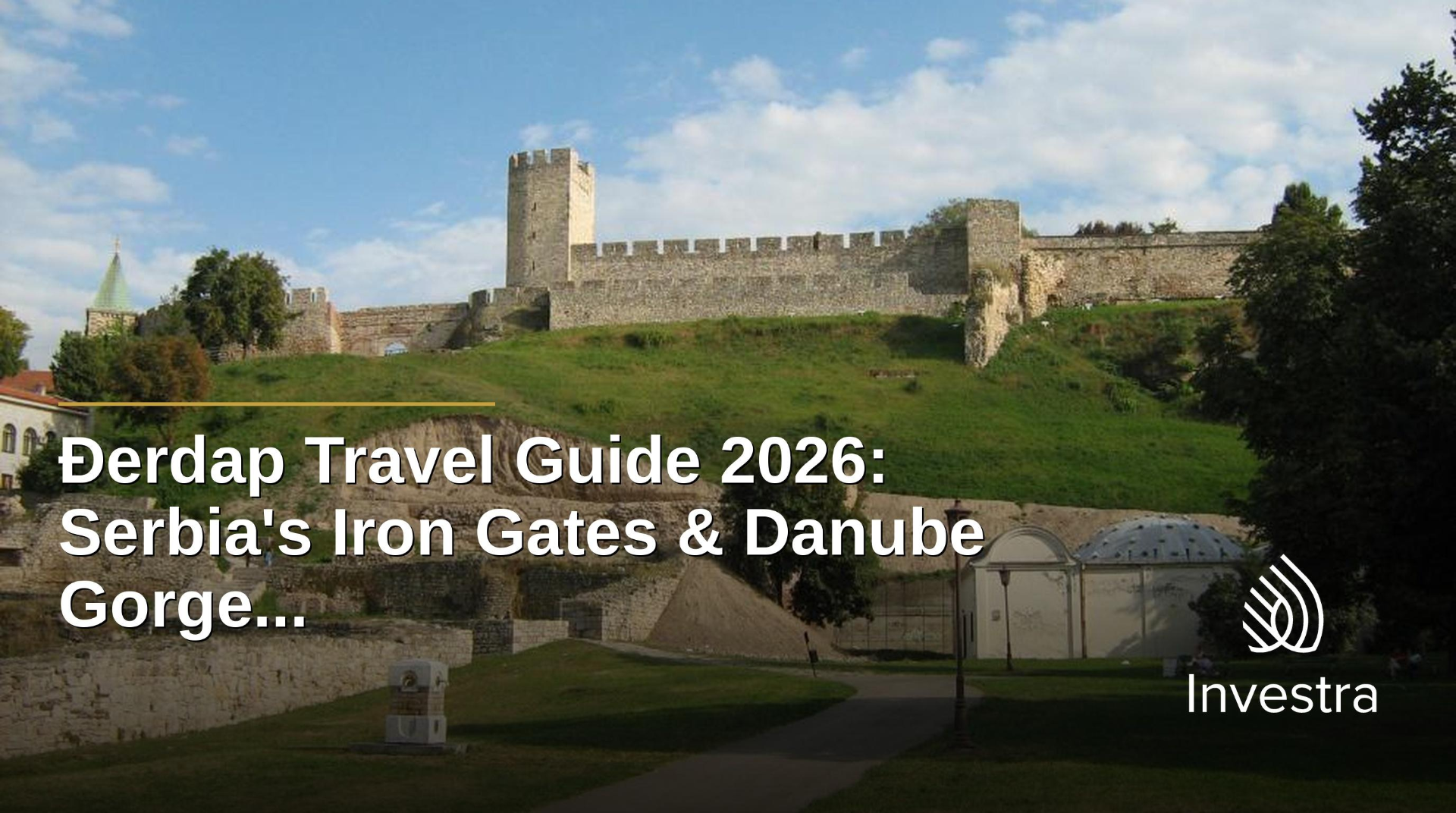
Đerdap Travel Guide 2026: Serbia's Iron Gates & Danube Gorge Complete Guide
Investment Disclaimer: This article is for informational purposes only and does not constitute financial or investment advice. Real estate investments carry risk. Always consult a qualified professional before making investment decisions. Investra.io connects buyers with verified properties but does not guarantee returns.
Quick Answer: Đerdap National Park is Serbia's most dramatic natural wonder — a 100km Danube gorge with cliffs rising 300m, ancient Roman monuments, and prehistoric Lepenski Vir. Best visited April–October, with boat tours from Donji Milanovac starting at €25. Explore Đerdap real estate on Investra.io.
Why Đerdap Should Be on Every Traveller's Serbia Itinerary
There are places in Serbia that surprise you, and then there is Đerdap — a destination that genuinely takes your breath away. Stretching 100 kilometres along the Danube River on the border between Serbia and Romania, the Đerdap Gorge (known internationally as the Iron Gates) is the longest and deepest river gorge in Europe. Cliffs rise 300 metres above the water, ancient Roman roads cling to the rock face, and prehistoric settlements dating back 9,000 years lie preserved beneath the surface.
For travellers who have explored Belgrade's urban energy and Novi Sad's cultural scene, Đerdap offers something entirely different: raw, geological grandeur combined with layers of human history that span from the Mesolithic era through Roman conquest to Ottoman rule and into the modern age. This is not a polished tourist destination with manicured parks and souvenir shops. Đerdap is wild, authentic, and deeply rewarding for those willing to venture beyond Serbia's more obvious attractions.
According to the World Bank, Serbia's ecotourism sector has grown by 18% annually since 2020, with Đerdap National Park recording over 180,000 visitors in 2024 — a 35% increase from pre-pandemic levels. The park spans 63,786 hectares and was declared a national park in 1974, protecting not only the gorge itself but also the surrounding forests, wetlands, and archaeological sites.
Whether you are planning a weekend escape from Belgrade (just 200km away), a multi-day hiking adventure, or a research trip into one of Europe's most significant archaeological regions, this complete Đerdap travel guide for 2026 covers everything you need to know.
Understanding Đerdap: The Iron Gates Gorge
The name "Iron Gates" (Gvozdena Vrata in Serbian, Porțile de Fier in Romanian) refers to the narrowest and most dramatic section of the Đerdap Gorge, where the Danube squeezes between towering limestone cliffs to a width of just 150 metres. The gorge itself is divided into four distinct sections, each with its own character and highlights.
The Great Kazan (Veliki Kazan) is the most spectacular section — a 3km stretch where cliffs rise almost vertically from the water to heights of 300 metres. The word "kazan" means cauldron in Serbian, a reference to the swirling currents that once made this section treacherous for river navigation. Today, with the Đerdap hydroelectric dam regulating water levels, the passage is calm, but the visual drama remains overwhelming.
The Small Kazan (Mali Kazan) immediately follows, slightly less dramatic but equally impressive, with the famous Tabula Traiana — a Roman inscription carved directly into the cliff face around 100 AD — visible from the water. This inscription commemorates Emperor Trajan's road-building achievements along the Danube, one of the most ambitious engineering projects of the ancient world.
The Gospođin Vir section features the deepest point of the Danube anywhere along its entire 2,860km course — 82 metres below the surface. This depth, combined with the gorge's narrowness, creates unique microclimate conditions that support plant species found nowhere else in Serbia, including several Tertiary-era relict species that survived the Ice Age in the gorge's sheltered environment.
Finally, the Sipska Klisura marks the entrance to the gorge from the Serbian side, characterised by gentler slopes and the town of Golubac with its magnificent medieval fortress rising directly from the Danube's edge.
Quick Answer: The Iron Gates gorge has four sections — Great Kazan, Small Kazan, Gospođin Vir, and Sipska Klisura. The deepest point of the Danube (82m) is in Gospođin Vir. Best seen by boat tour from Donji Milanovac. Find Đerdap area properties on Investra.io.
Top Attractions in Đerdap National Park
Đerdap is not a single attraction but a 100km corridor of natural and historical wonders. Here are the essential sites that every visitor should include in their itinerary.
Lepenski Vir — Europe's Oldest Planned Settlement
Lepenski Vir is arguably the most important archaeological site in the Balkans and one of the most significant in all of Europe. Discovered in 1965 during preparations for the Đerdap hydroelectric dam, this Mesolithic settlement dates to approximately 7,000–6,000 BC, making it one of the oldest known planned settlements in the world. The site features trapezoidal house foundations arranged in a precise geometric pattern, along with extraordinary stone sculptures of fish-human hybrid figures — the so-called "fish gods" — that represent some of the earliest known monumental art in human history.
The original site was partially flooded when the dam was constructed in the 1970s, but the most important structures and artefacts were relocated to higher ground. Today, a modern museum building covers and protects the excavated remains, with excellent interpretive displays in Serbian and English. The museum is open daily from 9:00 to 17:00, with an entrance fee of approximately 400 RSD (€3.50) for adults.
Golubac Fortress
Golubac Fortress (Golubačka Tvrđava) is one of the best-preserved medieval fortresses in the Balkans and certainly the most dramatically situated — its nine towers rise directly from the Danube's edge at the entrance to the gorge. The fortress was built in the 14th century and changed hands repeatedly between Serbian, Hungarian, and Ottoman rulers over the following centuries. It was the site of a famous battle in 1428 when the Ottoman Sultan Murad II besieged the fortress while the Hungarian king Sigismund attempted a relief expedition by river.
A major restoration project completed in 2019 transformed Golubac into one of Serbia's premier tourist attractions. The fortress is now fully accessible, with restored towers, walkways, and an excellent visitor centre. Entrance costs 600 RSD (€5) for adults, and guided tours in English are available on weekends.
Trajan's Bridge and Tabula Traiana
The Tabula Traiana is a Roman inscription carved into the cliff face of the Great Kazan around 100 AD, commemorating Emperor Trajan's construction of a military road along the Danube. The inscription reads: "Emperor Caesar Nerva Trajan Augustus Germanicus, son of the divine Nerva, pontifex maximus, in his fourth year of tribunician power, father of the fatherland, consul for the third time, subdued the mountain and the river and made this road." It is visible from boat tours but can also be reached on foot via a narrow path cut into the cliff.
Nearby, the remains of Trajan's Bridge — once the longest bridge in the Roman Empire at 1,135 metres — can be seen as stone pillars rising from the Danube. Built around 105 AD by the architect Apollodorus of Damascus, the bridge was demolished by Hadrian after Trajan's death to prevent barbarian incursions. The remaining pillars are a haunting reminder of Rome's extraordinary engineering ambitions.
Đerdap Hydroelectric Dam
The Đerdap I hydroelectric dam, completed in 1972 as a joint Yugoslav-Romanian project, is one of the largest hydroelectric power plants in Europe. It generates approximately 11.26 billion kWh of electricity annually, supplying about 30% of Serbia's electricity needs. The dam also created the Đerdap reservoir, which stretches 150km upstream and raised water levels by 35 metres, permanently altering the landscape and flooding numerous villages, archaeological sites, and the treacherous rapids that once made the gorge impassable.
Visitors can observe the dam from a viewing platform and learn about its construction and operation at the visitor centre. The scale of the structure — 441 metres long and 41 metres high — is genuinely impressive, and the contrast between the industrial infrastructure and the wild gorge landscape creates a uniquely dramatic visual experience.
Quick Answer: Top Đerdap attractions: Lepenski Vir (9,000-year-old settlement, €3.50 entry), Golubac Fortress (€5 entry), Tabula Traiana (Roman cliff inscription, visible by boat), and Đerdap Dam. Allow 2-3 days minimum. Explore Đerdap on Investra.io.
Đerdap Boat Tours: The Best Way to See the Gorge
While Đerdap can be explored by car along the scenic road that follows the Serbian bank of the Danube, the gorge is best experienced from the water. Boat tours offer perspectives that are simply impossible from the shore — the full scale of the cliffs, the Tabula Traiana inscription, and the dramatic narrowing of the Great Kazan can only be properly appreciated from a boat.
Several operators run boat tours from Donji Milanovac, the main tourist hub of the national park. Standard tours last 3-4 hours and cover the most dramatic sections of the gorge, including the Great and Small Kazan and the Tabula Traiana. Prices start at approximately €25 per person for group tours, rising to €80-120 for private boat hire. Tours typically depart at 9:00 and 14:00 during the main season (April–October).
For a more intimate experience, kayak tours are increasingly popular, with several operators offering guided paddling trips through the gorge. These require a full day and a reasonable level of fitness, but the experience of paddling through the Great Kazan with cliffs rising 300 metres on either side is genuinely unforgettable. Kayak tours cost approximately €45-65 per person including equipment and guide.
The Đerdap ferry also operates between Donji Milanovac and the Romanian town of Orșova, offering an affordable way to cross the Danube and see the gorge from both sides. The ferry runs twice daily and costs approximately €5 per person.
Hiking in Đerdap National Park
Đerdap National Park has over 200km of marked hiking trails ranging from easy riverside walks to challenging ridge routes with spectacular views over the gorge. The park's diverse terrain — from limestone cliffs and river beaches to dense beech forests and open meadows — makes it one of Serbia's most rewarding hiking destinations.
The Đerdap Gorge Trail (Staza Đerdapske Klisure) is the park's signature route, following the Serbian bank of the Danube for approximately 80km from Golubac to Kladovo. The full trail takes 5-7 days to complete and passes through all the major attractions of the park. Day sections can be walked independently, with the Golubac–Donji Milanovac section (approximately 40km) being the most popular.
The Sokolovac Trail climbs from Donji Milanovac to the 768m Sokolovac peak, offering panoramic views over the Great Kazan and the Romanian mountains beyond. The round trip takes approximately 5 hours and is rated moderate difficulty. The trail passes through old-growth beech forest and several viewpoints with dramatic cliff-edge perspectives.
The Lepenski Vir Trail connects the archaeological site with the village of Boljetin along a riverside path that passes several smaller archaeological sites and traditional Serbian villages. The 12km trail takes approximately 4 hours and is suitable for all fitness levels.
According to Đerdap National Park, trail maps and current conditions are available at the park visitor centre in Donji Milanovac. Entrance to the national park costs 300 RSD (€2.50) per person per day.
Where to Stay in Đerdap
Accommodation options in Đerdap range from basic camping to comfortable guesthouses and a handful of boutique hotels. The main accommodation hub is Donji Milanovac, followed by Golubac and the smaller villages along the gorge.
Donji Milanovac has the widest selection of accommodation, including Hotel Lepenski Vir (the main hotel in the area, with double rooms from €45/night), several guesthouses (€25-35/night), and a well-equipped campsite directly on the Danube (€8-12/night per tent). The town has restaurants, a supermarket, and a tourist information centre.
Golubac has fewer options but is closer to the fortress and the entrance to the gorge. Several guesthouses offer rooms from €30-40/night, and there is a small campsite near the fortress.
For the most authentic experience, consider staying in one of the traditional village guesthouses (seoska domaćinstva) scattered throughout the park. These offer home-cooked meals, local wine, and genuine hospitality for €20-30/night including breakfast. The national park website maintains a directory of registered accommodation providers.
Getting to Đerdap
Đerdap is located approximately 200km east of Belgrade, making it accessible as a long day trip but better suited to an overnight or multi-day visit.
By car: The most practical option. Take the E75 motorway from Belgrade towards Niš, then turn east at Pojate towards Zaječar and follow signs to Donji Milanovac. The journey takes approximately 2.5-3 hours. The scenic road along the gorge (Route 25) from Golubac to Kladovo is one of Serbia's most beautiful drives.
By bus: Direct buses run from Belgrade's Lasta bus station to Donji Milanovac (approximately 3.5 hours, €8-10 one way) and to Golubac (approximately 2.5 hours, €6-8). Services are less frequent on weekends.
Organised tours: Several Belgrade-based tour operators offer day trips and weekend packages to Đerdap, typically including transport, guided boat tour, and visits to Lepenski Vir and Golubac Fortress. Prices range from €45-85 per person depending on inclusions.
Best Time to Visit Đerdap
Đerdap is a year-round destination, but each season offers a different experience.
Spring (April–May) is arguably the best time to visit. The gorge is lush and green, wildflowers carpet the meadows, and the weather is mild (15-22°C). Boat tours operate, hiking conditions are excellent, and crowds are manageable. This is also the best time for birdwatching — Đerdap is on a major migratory flyway and hosts over 200 bird species.
Summer (June–August) is the peak tourist season. Temperatures reach 28-35°C, which can make hiking uncomfortable during midday, but the long days allow for extended exploration. The Danube beach at Donji Milanovac is popular for swimming. Book accommodation well in advance.
Autumn (September–October) is spectacular for the foliage — the gorge's mixed forests turn gold and red, creating extraordinary colour contrasts with the grey limestone cliffs and the blue Danube. Temperatures are comfortable (15-22°C) and crowds thin out after mid-September.
Winter (November–March) sees the park at its quietest. Some boat tours and accommodation options close, but the gorge has a stark, dramatic beauty in winter light. Temperatures range from -5 to 8°C, and occasional snowfall transforms the landscape.
Real Estate Investment Near Đerdap
The Đerdap area represents one of Serbia's most interesting emerging real estate markets. Property prices remain significantly lower than Belgrade or Novi Sad, but growing tourism interest and the area's natural beauty are driving increasing demand from both domestic and international buyers.
According to data from Investra.io, the leading real estate platform for Serbia, average property prices in the Đerdap area range from €400-800/m² for existing properties, with newer construction reaching €900-1,200/m². This compares favourably with Belgrade (€1,800-3,500/m²) and Novi Sad (€1,400-2,500/m²), offering significant value for investors willing to look beyond the major cities.
The most attractive investment opportunities include traditional stone houses in gorge villages (€30,000-80,000), agricultural land with Danube frontage (€5-15/m²), and guesthouse businesses benefiting from growing tourism. The Serbian government has designated Đerdap as a priority tourism development zone, with infrastructure investments planned through 2030 that should further support property values.
For expats and remote workers, the Đerdap area offers an extraordinary quality of life — clean air, dramatic scenery, low cost of living, and a genuine connection to nature — at a fraction of the cost of comparable locations in Western Europe. Broadband internet is available in Donji Milanovac and Golubac, though coverage in smaller villages remains limited.
If you are considering property investment in the Đerdap area, Investra.io offers a comprehensive database of verified listings with transparent pricing and professional support throughout the buying process. For broader investment strategy and business consulting in the Serbian market, sinisadagary.com provides expert guidance from experienced consultants with deep local knowledge.
Additional legal and financial guidance for foreign investors in Serbia is available through Findes.si, which specialises in cross-border investment facilitation across the Western Balkans.
Practical Information for Visiting Đerdap
National Park entrance fee: 300 RSD (€2.50) per person per day, payable at park entrances and visitor centres.
Currency: Serbian Dinar (RSD). ATMs are available in Donji Milanovac and Golubac. Many guesthouses and restaurants accept cash only.
Mobile coverage: Good coverage from major Serbian operators (Telekom, A1, Yettel) in Donji Milanovac and Golubac. Coverage in the gorge itself and in smaller villages is patchy.
Medical facilities: The nearest hospital is in Negotin (50km from Donji Milanovac) or Zaječar (80km). A medical centre in Donji Milanovac handles minor emergencies.
Safety: Đerdap is a safe destination. The main hazards are related to outdoor activities — wear appropriate footwear for hiking, carry water, and be aware of weather changes. The Danube currents can be strong; only swim in designated areas.
Language: Serbian is the local language. English is spoken at hotels, the national park visitor centre, and by most tour operators. In smaller villages, German is sometimes more useful than English due to historical migration patterns.
Recommended Content
- Real Estate Investment in Serbia 2026: Complete Guide
- Living in Serbia as an Expat: Complete 2026 Guide
- Belgrade Travel Guide 2026
- Business Strategy & Investment Consulting — sinisadagary.com
- Cross-Border Investment in the Balkans — Findes.si
Odkrijte globalne investicijske priložnosti na Unifyr.space — vaš portal za pametne investicije.
📚 Recommended Content
Frequently Asked Questions About Đerdap
Q1: How far is Đerdap from Belgrade?
Đerdap is approximately 200km east of Belgrade. By car via the E75 motorway and Route 25, the journey to Donji Milanovac takes approximately 2.5-3 hours. Direct buses from Belgrade's Lasta station take approximately 3.5 hours.
Q2: What is the best way to see the Iron Gates gorge?
The best way to experience the gorge is by boat tour from Donji Milanovac. Tours last 3-4 hours and cost approximately €25 per person for group tours. The boat allows you to see the full scale of the cliffs, the Tabula Traiana inscription, and the dramatic Great Kazan section that is inaccessible by road.
Q3: How much does it cost to visit Đerdap National Park?
The national park entrance fee is 300 RSD (approximately €2.50) per person per day. Lepenski Vir museum costs 400 RSD (€3.50) and Golubac Fortress costs 600 RSD (€5). Boat tours start at €25 per person. Budget approximately €40-60 per day for entrance fees, boat tour, and meals.
Q4: Can you swim in the Danube at Đerdap?
Yes, swimming is possible at designated beach areas, primarily at Donji Milanovac and several smaller beaches along the gorge. The Danube currents can be strong in the gorge itself, so only swim in marked areas. Water temperature reaches 22-24°C in July and August.
Q5: Is Đerdap suitable for families with children?
Yes, Đerdap is very family-friendly. Golubac Fortress and Lepenski Vir museum are excellent for children, boat tours are suitable for all ages, and there are easy riverside walking trails. The main towns have restaurants and basic facilities. Camping is also popular with families.
Q6: What wildlife can you see in Đerdap National Park?
Đerdap is home to over 200 bird species (including white-tailed eagles, black storks, and kingfishers), brown bears, wolves, lynx, wild boar, and red deer. The gorge is also home to several endemic fish species. Birdwatching is particularly rewarding in spring (April–May) during migration.
Q7: Are there guided tours available in English?
Yes, guided tours in English are available at Golubac Fortress (weekends), Lepenski Vir museum (daily), and through several tour operators in Donji Milanovac. Belgrade-based tour companies also offer organised day trips and weekend packages to Đerdap with English-speaking guides.
Q8: What is the best time of year to visit Đerdap?
Spring (April–May) and autumn (September–October) offer the best combination of comfortable temperatures, good hiking conditions, and manageable crowds. Summer (June–August) is the peak season with the warmest weather but larger crowds. Winter visits are possible but some facilities close.
Q9: Can you visit Đerdap as a day trip from Belgrade?
It is possible but not ideal. The drive takes 2.5-3 hours each way, leaving limited time to explore. A minimum of 2 days is recommended to see Golubac Fortress, Lepenski Vir, and do a boat tour through the gorge. Overnight accommodation is affordable and widely available.
Q10: Is Đerdap good for real estate investment?
Yes, Đerdap represents an interesting emerging market. Property prices (€400-800/m²) are significantly lower than Belgrade or Novi Sad, while growing tourism and government investment in the area are supporting long-term value appreciation. Investra.io lists verified properties in the Đerdap area with transparent pricing.
Q11: What is Lepenski Vir and why is it important?
Lepenski Vir is a Mesolithic archaeological site dating to approximately 7,000-6,000 BC, making it one of the oldest known planned settlements in the world. It features extraordinary stone sculptures of fish-human hybrid figures representing some of the earliest monumental art in human history. The site is protected by a modern museum building and is open daily.
Q12: Do I need a visa to visit Serbia?
Citizens of EU countries, the UK, USA, Canada, Australia, and most other Western nations can enter Serbia visa-free for up to 90 days. Citizens of some other countries require a visa. Check current requirements with the Serbian embassy in your country before travelling.