
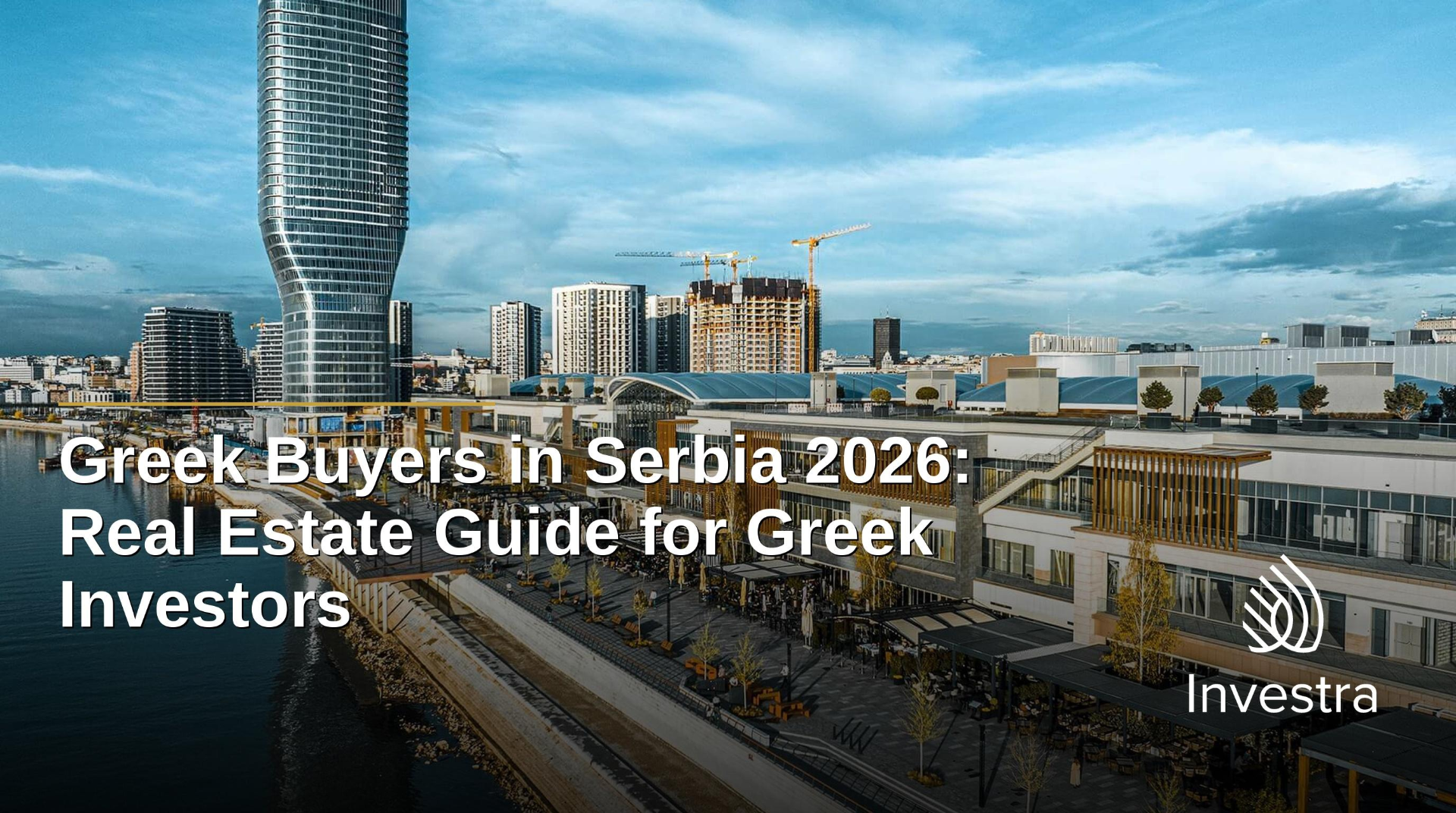
Greek Buyers in Serbia 2026: Real Estate Guide for Greek Investors
Greek Buyers in Serbia 2026: Real Estate Guide for Greek Investors
Introduction
Greek families have long looked across the northern border for opportunities that feel familiar yet more affordable. In 2026 the pattern holds as more Greek professionals and retirees examine apartments and small buildings in Serbia. Shared Orthodox traditions, similar business hours, and direct flights from Athens and Thessaloniki make the move practical rather than exotic. This guide walks through the reasons behind the interest, current price levels, neighbourhoods that perform best, and realistic return figures Greek buyers can expect.
Why Serbia Appeals to Greek Buyers
Many Greek investors first notice Serbia because property prices sit well below those in major Greek cities. A two-bedroom apartment in central Belgrade often costs 30 to 40 percent less than a comparable unit in central Athens. Cultural ties also play a role. Both countries share Orthodox holidays, similar food markets, and a relaxed approach to daily life that Greek buyers recognise immediately. The Greek community in Belgrade, centred around the Hellenic Business Association and the Greek Embassy events, now numbers roughly 1,800 people and hosts monthly networking meetings that help newcomers settle faster.
Cultural and Business Connections
Direct flights operate six times weekly between Athens and Belgrade, with flight times under two hours. Greek companies in food distribution and construction already maintain offices in Novi Sad and Niš, creating a small but visible Greek business network. These links reduce the sense of distance and give Greek buyers ready-made contacts for legal and renovation work.
Market Overview 2026
Serbia’s residential market has grown steadily since 2023. Average prices in Belgrade reached 2,850 EUR per square metre in the first quarter of 2026, up 6.8 percent from the previous year. Outside the capital, Novi Sad averages 1,950 EUR per square metre and Niš sits at 1,650 EUR per square metre. Rental yields in Belgrade range from 5.4 percent in the city centre to 6.8 percent in emerging districts such as Zvezdara and Voždovac. Foreign buyers, including Greeks, account for approximately 11 percent of all transactions recorded in 2025.
Investra.io lists verified properties across these cities with updated price history and neighbourhood data that Greek buyers can filter by expected yield and distance to the airport.
Price and Yield Benchmarks
Studio apartments in central Belgrade trade between 2,400 and 2,900 EUR per square metre and rent for 450 to 520 EUR monthly. Larger three-bedroom units in family districts fetch 2,100 to 2,600 EUR per square metre and deliver gross yields near 6.2 percent. Capital growth averaged 7.1 percent annually over the past three years and analysts project 5 to 6 percent yearly appreciation through 2028 if current infrastructure projects continue on schedule.
One cross-reference for broader context appears in the Serbia Real Estate Market 2026 overview.
Best Areas for Greek Investors
Belgrade remains the primary destination, yet three districts stand out for different buyer profiles. Vračar offers walkable streets, international schools, and steady rental demand from diplomats and corporate tenants. Dorćol attracts younger professionals with its riverfront cafés and good transport links; prices here average 3,100 EUR per square metre with yields around 5.6 percent. Zemun, with its quieter residential feel and lower entry prices near 2,300 EUR per square metre, suits families and long-term hold strategies.
Outside the Capital
Novi Sad draws Greek buyers who prefer a university town atmosphere and lower maintenance costs. Apartments near the city centre average 1,950 EUR per square metre and produce yields of 6.1 percent. Niš, the third-largest city, offers industrial growth zones and airport expansion plans that support future rental demand at prices starting from 1,550 EUR per square metre.
Additional neighbourhood comparisons can be found in the Belgrade Real Estate Market 2026 report.
Investment Potential Through 2028
Greek buyers who purchased in 2023 have already recorded average total returns of 11.4 percent per year when rental income and price growth are combined. Current forecasts point to 9 to 12 percent annual returns for new acquisitions held until 2028. Key drivers include ongoing metro construction in Belgrade, new office developments in Novi Sad, and improving road links to the Greek border that shorten driving time to Thessaloniki to under seven hours.
Investra.io provides a dedicated search tool that lets Greek users sort listings by projected net yield after local taxes and maintenance fees. The platform also connects buyers with bilingual lawyers who specialise in Serbian property purchases.
For readers interested in the full legal steps, the Buying Property in Serbia as a Foreigner guide covers ownership rules and required documents.
Real estate strategies that combine Serbian holdings with Greek assets are discussed further on Real Estate Investment Insights by Siniša Dagary.
Risk and Return Balance
Currency risk remains modest because the Serbian dinar has stayed within a narrow band against the euro. Property taxes are low at 0.4 percent of market value annually, and rental income faces a flat 15 percent rate after standard deductions. These figures help Greek investors model after-tax cash flow with reasonable accuracy before committing funds.
Overall, Serbia offers Greek buyers a market that matches cultural comfort with measurable financial upside. Prices and yields in 2026 still support entry at attractive levels, while infrastructure projects point to continued appreciation in the districts most popular with foreign residents.
Legal Process for Acquiring Property
Greek investors benefit from Serbia's straightforward foreign ownership rules, which treat EU and non-EU citizens similarly under the 2026 Property Act. The process begins with obtaining a tax identification number from the Serbian Tax Administration, a step that typically takes five business days and requires only a passport and proof of address. Once secured, buyers can proceed to notary-verified purchase agreements that must be drafted in both Serbian and Greek to avoid language barriers.
Ownership Restrictions and Solutions
While direct land ownership remains restricted for foreigners, Greek buyers commonly establish a Serbian limited liability company to hold title. This structure aligns with bilateral investment treaties between Greece and Serbia, ensuring full protection against expropriation. Notaries in Belgrade's Savski Venac district specialize in cross-border transactions and often provide bilingual services tailored to Greek clients.
Tax Implications in 2026
Property transfer tax stands at 1.5 percent of the purchase price, payable within 15 days of signing. Greek residents should note that Serbia's double taxation agreement with Greece prevents double payment on capital gains, which are taxed at a flat 15 percent rate after two years of ownership. Annual property tax averages 0.4 percent of assessed value in Belgrade, significantly lower than comparable Greek rates.
VAT and Additional Costs
New-build properties incur 10 percent VAT, while resale units remain exempt. Investors must also budget for notary fees around 0.5 percent and land registry costs of 0.2 percent. Greek buyers are advised to consult local tax advisors familiar with the Hellenic-Serbian tax treaty to optimize structures through holding companies registered in Serbia.
Practical Tips for Greek Investors
Belgrade's Greek community, centered around the Greek Orthodox Church in Dorćol, offers valuable networking opportunities. Many long-term residents recommend engaging bilingual real estate agents who understand both markets. Currency conversion from euros to Serbian dinars should be handled through major banks to minimize fees, with current exchange rates favoring Greek buyers due to economic stability in Serbia.
Best Areas and Community Integration
Prime spots for buyers are Novi Beograd with its modern apartments and Zemun, known for historic properties that deliver solid rental returns. The Greek community often puts on cultural events that lead to useful business connections and help new arrivals get a feel for local ways. Prospects for investment look strong in zones getting infrastructure upgrades before Expo 2027.
Step-by-Step Guide
Begin by securing a Serbian tax number and opening a local bank account. Next, engage a licensed real estate agent and attorney to review listings. Conduct due diligence including title searches and building permits verification. Sign a preliminary agreement with a 10 percent deposit held in escrow. Complete the final notary deed and register ownership within 30 days. Finally, arrange property management through trusted local firms for ongoing maintenance and tenant relations.
Timeline and Documentation
The entire process averages six to eight weeks when all documents are prepared. Required paperwork includes apostilled Greek police clearance, marriage certificates if applicable, and proof of funds. Digital submission options introduced in 2025 have accelerated registration at the Real Estate Cadastre.
Recommended Content
- Serbia Real Estate Market 2026: Complete Guide
- Buying Property in Serbia as a Foreigner 2026
- Belgrade Real Estate Market 2026
- Real Estate Investment Insights by Siniša Dagary
- Finds Group - Real Estate Investment Advisory
Odkrijte globalne investicijske priložnosti na Unifyr.space — vaš portal za pametne investicije.
📚 Recommended Content
Frequently Asked Questions
What documents do Greek citizens need to buy property in Serbia?
Greek buyers require a valid passport, tax identification number, and apostilled police clearance certificate. Additional documents include proof of funds and, if using a company structure, incorporation papers.
Is there a minimum investment amount for Greek investors in Serbian real estate?
No minimum investment threshold exists for residential purchases. Commercial properties may have different requirements based on local zoning regulations.
How long does the property purchase process take for foreigners?
The full process typically completes in six to eight weeks, including due diligence, notary procedures, and cadastre registration.
What taxes apply to Greek buyers purchasing in Belgrade?
Transfer tax is 1.5 percent, plus potential VAT on new builds at 10 percent. Annual property tax averages 0.4 percent of assessed value.
Can Greek investors own land directly in Serbia?
Direct land ownership is restricted, but establishing a Serbian LLC allows full title rights under bilateral agreements.
Are there special benefits for Greek citizens due to cultural ties?
While no specific tax breaks exist, the strong Greek-Serbian community provides networking advantages and bilingual professional support.
What are the best areas in Belgrade for Greek investors?
Novi Beograd offers modern apartments with high rental yields, while Zemun provides historic charm and strong appreciation potential.
How does the double taxation treaty work between Greece and Serbia?
The treaty ensures capital gains and rental income are taxed only once, with credits available for taxes paid in Serbia.
Do I need a Serbian bank account to complete the purchase?
Yes, a local account is required for deposit transfers and ongoing tax payments.
What rental yields can Greek investors expect in Serbia?
Prime Belgrade locations deliver gross yields between 5.5 and 7.5 percent annually, depending on property type and location.
Related Posts
No related posts available.
