
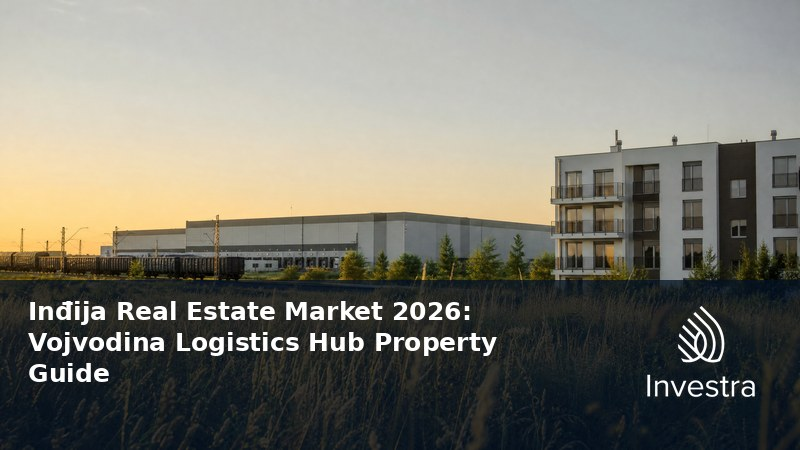
Inđija Real Estate Market 2026: Vojvodina Logistics Hub Property Guide
Why Inđija Is Becoming One of Serbia's Most Watched Real Estate Markets
Quick Answer: Inđija is a rapidly growing logistics and industrial hub in Vojvodina, Serbia, where residential property prices range from €800 to €1,800/m² and commercial/industrial land values are rising steadily due to major European corporate investment. Serbia's real estate market forecast for 2026–2030 points to secondary cities like Inđija as key growth engines.
Most international investors have heard of Belgrade. A few know Novi Sad. Almost none have looked closely at Inđija — and that gap represents precisely the kind of opportunity that experienced property investors spend years searching for.
Inđija is a mid-sized municipality of roughly 50,000 people located in Srem, the western part of Vojvodina, about 40 kilometers northwest of Belgrade along the E75 motorway. On the surface, it looks like an unremarkable provincial town. But underneath that quiet exterior sits one of the most strategically positioned logistics corridors in the entire Western Balkans. The Šimanovci–Inđija industrial zone has attracted companies like Lidl's regional distribution center, DHL, Reifenhäuser, and dozens of other European manufacturers and logistics operators. Serbia's Corridor 10 — a pan-European motorway stretching from Salzburg to Thessaloniki — runs directly through Inđija's backyard.
What does this mean for real estate? It means steady, structural demand. It's not speculative. Workers need housing. Managers need apartments. Logistics executives relocating from Germany or Austria need quality rentals. And the municipality itself, flush with foreign direct investment, is upgrading infrastructure at a pace most Serbian cities can't match.
The reality is that Inđija's property market in 2026 is still priced like a sleepy Vojvodina town, but it's functioning like a mid-tier European industrial hub. That disconnect between perception and reality is where the investment case lives.
Inđija Geographic and Economic Context: What Drives Property Demand
Quick Answer: Inđija's property demand is driven by its position on Pan-European Corridor 10, proximity to Belgrade, and a booming industrial zone that has attracted billions of euros in foreign direct investment over the past decade.
Geography is destiny in real estate, and Inđija's geography is exceptional by Serbian standards. The municipality sits at the intersection of several major transport arteries: the E75/A1 motorway linking Belgrade to Zagreb and Vienna, the Belgrade–Budapest rail corridor, and the Danube waterway just a short distance to the north. For logistics companies, this is close to perfect positioning.
The Šimanovci Industrial Zone, which straddles the border between Inđija and Stara Pazova municipalities, is one of the largest organized industrial zones in Serbia. As of 2026, it hosts over 60 companies employing more than 8,000 workers directly, with knock-on employment effects that ripple through the entire Srem region. Total foreign direct investment in the zone is estimated to have exceeded €1.5 billion cumulative since 2005.
The employment base matters enormously for residential real estate. Workers at all income levels — from warehouse staff earning €700/month to logistics managers earning €3,000–4,000/month — need somewhere to live. Many commute from Belgrade or Novi Sad, but a growing proportion are settling in Inđija itself, attracted by lower housing costs, better air quality than Belgrade, and genuine small-town quality of life.
Municipal infrastructure has kept pace. The town center has been substantially renovated over the past decade, new schools and kindergartens have been built, and road connections to the motorway network are excellent. Inđija consistently ranks among the top municipalities in Serbia for business climate in surveys conducted by the National Alliance for Local Economic Development (NALED).
For investors looking beyond Belgrade's increasingly competitive market, understanding this economic foundation is the starting point. Inđija isn't a speculative bet — it's a market with identifiable, structural demand drivers that aren't going away.
Property Prices in Inđija 2026: What Are You Actually Paying?
Quick Answer: Property prices in Inđija range from approximately €800 to €1,800 per square meter in 2026, with new-build apartments in the town center reaching €1,400–1,800/m² and older residential stock available from €800–1,100/m². The Belgrade Real Estate Market Report 2026 provides useful context for understanding regional price dynamics.
Let's get specific, because vague price ranges don't help anyone make a decision.
In 2026, the residential property market in Inđija breaks down roughly as follows:
New-build apartments in the town center and newer residential developments: €1,300–1,800/m². The upper end of this range reflects finished, turnkey apartments in the most desirable central locations. A 50m² one-bedroom apartment in a newer building will typically run €65,000–90,000 total.
Secondary market apartments (built 1970s–2000s): €800–1,200/m². These are the socialist-era blocks that dominate much of Serbian provincial housing stock. They're structurally sound but often need cosmetic renovation. A 65m² two-bedroom flat in this category might be purchased for €55,000–75,000.
Houses and villas: €700–1,100/m² depending on location, age, and plot size. A detached house with a 400m² plot in a residential neighborhood of Inđija can be found in the €80,000–150,000 range — offering significantly more space than an equivalent budget would buy in Belgrade's suburbs.
Agricultural and developable land: This is where things get interesting. Prime agricultural land in Vojvodina adjacent to industrial zones has been trading at €3–8/m² for agricultural classification, but rezoned or zoning-eligible land near the industrial corridor commands €15–50/m² depending on proximity to infrastructure.
What's striking is the price differential compared to Belgrade. In Novi Beograd or Zemun — Belgrade's western suburbs that are actually not dramatically further from the Šimanovci zone than Inđija itself — new apartments are trading at €2,500–3,500/m². The 40–60% discount you're getting in Inđija is the investment thesis in one number.
Year-on-year price appreciation in Inđija has been running at approximately 8–12% annually since 2021, slightly below Belgrade's peak growth but more consistent and less driven by speculative demand. What we've seen is that industrial hub towns tend to have stickier price appreciation because it's underpinned by real employment growth rather than speculative capital flows.
Rental Market in Inđija: Yields, Demand, and Who's Renting
Quick Answer: Gross rental yields in Inđija typically range from 5.5% to 8% annually, driven by strong demand from industrial zone workers, logistics professionals, and internal migrants — making it one of the higher-yielding residential markets in Serbia relative to entry prices.
Rental demand in Inđija has a profile that's somewhat different from what you'd encounter in Belgrade or Novi Sad, and understanding that profile matters for investment strategy.
The dominant renter cohort is workers employed in the industrial zone who have relocated from other parts of Serbia — primarily from central and southern Serbia, where industrial employment opportunities are scarcer. These are typically young adults or families in their late 20s to early 40s, earning €700–1,500/month, who need practical, affordable housing. A two-bedroom apartment in Inđija rents for €300–450/month in this segment. Not exciting headline numbers, but against an entry price of €60,000–75,000, you're looking at gross yields of 6–7%.
The second, more interesting renter cohort consists of logistics managers, engineers, and executives from Western European companies operating in the zone. These renters demand higher-quality accommodation and are willing to pay €600–900/month for a well-appointed two or three-bedroom apartment. Against a purchase price of €90,000–120,000 for a quality new-build, yields here can approach 7–9% gross.
Short-term rental demand — Airbnb-style — is more limited in Inđija than in Belgrade, given the town's limited tourist appeal. The Airbnb Belgrade 2026 guide covers this model in depth for the capital, but for Inđija, the better strategy is medium-term corporate rentals rather than nightly tourist accommodation. Companies establishing operations in the zone often need temporary housing for relocating staff for periods of three to twelve months — corporate rental contracts in this niche can yield €700–1,200/month for quality properties.
Net yields after Serbian property taxes, maintenance provisions, and vacancy allowances (typically 8–10% in this market) tend to land in the 4.5–6.5% range. That's meaningfully better than what you'd achieve on comparable investment in most Western European markets at 2026 valuations.
Industrial and Commercial Real Estate: The Real Opportunity in Inđija
Quick Answer: Industrial land and warehouse space near Inđija's logistics corridor represents arguably the most compelling commercial real estate opportunity in the region, with land values for development-ready plots ranging from €25 to €80/m² and industrial rental yields reaching 8–12%.
Residential property in Inđija is a solid investment. But if you want to understand where the really significant capital gains have been — and where they're likely to continue — you need to look at industrial and commercial real estate.
The demand for logistics and light manufacturing space along Corridor 10 is structural and ongoing. E-commerce growth across Serbia and the wider Balkans is driving demand for last-mile distribution facilities. Automotive supply chain reshoring from Asia is creating demand for mid-sized manufacturing plants within reasonable distance of Central European markets. And general-purpose warehouse space is consistently undersupplied relative to demand from the 60+ companies already established in the zone.
As of 2026, development-ready industrial plots near Inđija with full utility connections (power, water, sewage, fiber) are trading at €35–80/m² depending on plot size, infrastructure quality, and proximity to the motorway interchange. Plots requiring infrastructure development are available at €15–35/m². To put this in context: comparable industrial land in Slovenia, Hungary, or the Czech Republic — Serbia's competitors for this investment category — would cost €80–200/m².
For investors who aren't in the business of building factories, the more accessible play is existing warehouse and logistics space, where yields of 8–12% on net operating income are achievable. Smaller commercial properties in Inđija town center — retail units, office spaces — trade at €500–900/m² and can yield 6–8% on long-term leases.
The institutional investor community has begun to notice. Several regional real estate funds with exposure to CEE and SEE markets have been quietly accumulating industrial land positions in Vojvodina. When institutional money arrives in a market like this, it typically compresses yields over time — which means that the window for individual investors to get in at these prices has a finite horizon.
Can Foreigners Buy Property in Inđija? Legal Framework for International Buyers
Quick Answer: EU citizens can purchase residential property in Serbia on the same terms as Serbian nationals; non-EU foreigners can typically buy through a Serbian registered company or via reciprocity agreements, and the legal process is well-established. For a complete walkthrough, see Buying Property in Belgrade 2026: Complete Guide for Foreign Investors.
The legal framework for foreign property ownership in Serbia is more accessible than many potential buyers expect, but there are important nuances that vary by nationality and property type.
EU and EEA citizens enjoy essentially the same rights as Serbian nationals when purchasing residential and commercial real estate. This includes citizens of Germany, Austria, France, Italy, and other EU member states who make up a significant proportion of the foreign buyer community in Serbia. The purchase process for an EU citizen buying an apartment in Inđija is legally straightforward.
For non-EU nationals — Americans, Canadians, Australians, Gulf nationals, and others — the picture is slightly more complex. Serbia applies a reciprocity principle: if your country allows Serbian citizens to own property, you can own property in Serbia. In practice, this covers most major investor-origin countries. Where direct individual ownership isn't clearly available, incorporating a Serbian d.o.o. (limited liability company) to hold the property is a common and legally clean solution. The company incorporation process takes 7–10 business days and costs approximately €300–500 in fees.
One specific restriction worth knowing: agricultural land ownership by foreigners remains restricted under Serbian law, a protection that has survived multiple rounds of European integration discussions. Industrial land classified as construction land doesn't carry this restriction, but if you're looking at agricultural land conversion plays near the industrial zone, legal structure matters enormously. Always verify the cadastral classification before proceeding.
The property transaction process in Serbia involves a preliminary contract (predugovor), title search at the Republic Geodetic Authority (RGA), notarized purchase contract, payment of transfer tax (2.5% of the assessed value), and registration at the cadastre. The full process from signed preliminary contract to registered ownership typically takes 30–60 days. The Serbia Real Estate FAQ 2026 covers the full legal process in granular detail.
Property Taxes and Transaction Costs in Inđija
Quick Answer: The primary transaction cost when buying property in Serbia is the 2.5% real estate transfer tax on the assessed value; annual property taxes are low by European standards (0.3–0.4% of assessed value), making Serbia one of the most tax-efficient property markets on the continent. Full details are available in the Serbia Property Tax Guide 2026.
One of Serbia's genuine competitive advantages as a property investment destination is its tax burden on real estate — it's genuinely light by any European comparison.
When you buy a resale property in Serbia, you pay a one-time real estate transfer tax of 2.5% of the property's assessed fiscal value (which is sometimes lower than the transaction price). New properties purchased from a developer attract 10% VAT instead of transfer tax, which is already included in the listed price from reputable developers. There is no stamp duty, no wealth tax on property holdings, and no mansion tax equivalent.
Annual property tax (porez na imovinu) is set by municipalities within a range defined by national legislation. In Inđija, residential property owners pay approximately 0.3–0.4% of assessed value annually. On a €100,000 apartment assessed at €80,000 fiscal value, that's roughly €240–320 per year. Compare that to Slovenia (up to 0.5–1.5%), Croatia (variable but often higher effective rates), or Western Europe where the range is dramatically higher.
Total transaction costs when buying in Inđija should be budgeted as follows: real estate transfer tax (2.5%), notary fees (approximately €200–500), legal representation (€500–1,500 for a competent property lawyer), agency commission if applicable (typically 2–3%), and cadastre registration fees (minor). All-in, plan for 4–6% above the purchase price for a resale transaction.
For rental income, Serbian tax law requires non-residents to pay a flat 20% withholding tax on rental income, though a flat-rate deduction of 25% for expenses is standard, meaning the effective rate on gross rental income is 15%. Serbian tax treaties with most major investor countries provide relief from double taxation. Consulting a specialist — Siniša Dagary — Investment Consultant is one resource frequently referenced by foreign investors navigating Serbian tax structuring — is advisable before finalizing an investment structure.
Best Neighborhoods and Locations Within Inđija for Investment
Quick Answer: The most attractive investment locations within Inđija include the renovated town center for residential rentals, newer developments on the eastern periphery near major road access, and industrial/commercial plots in the Šimanovci corridor for commercial property plays. Detailed neighborhood ROI analysis is available in Belgrade Investment Property: Best Neighborhoods for ROI in 2026.
Inđija isn't a large city — its urban footprint is compact enough that "neighborhood" distinctions are less dramatic than in Belgrade or Novi Sad. But location still matters significantly for both rental demand and capital appreciation prospects.
Town center (Centar): The most renovated and attractive part of Inđija, with pedestrianized areas, cafes, retail, and good transport connections. New-build apartments here command the highest prices (€1,500–1,800/m²) but also attract the highest-quality tenants and have the strongest resale market. If capital appreciation is the primary goal and budget allows, this is the area to focus on.
Novi Slankamen area and eastern residential zones: These newer developments and slightly peripheral residential areas offer a balance between price (€1,100–1,400/m²) and quality. Proximity to the main road arteries makes commuting to the industrial zone easy, attracting the managerial and professional worker cohort.
Settlements and village periphery: The municipality includes several smaller settlements — Beška, Čortanovci, Krčedin, Maradik — where house prices are notably lower (€600–900/m²) but rental demand is more limited and liquidity is thinner. These are better suited for personal use or longer-term land banking than active rental investment.
Čortanovci specifically: Worth singling out as a micro-market. This village sits on the banks of the Danube with exceptional natural beauty, and it has attracted weekend and holiday home buyers from Belgrade willing to pay €1,000–1,500/m² for quality properties with river views. It's a different demand driver from the industrial story but a legitimate one.
Industrial zone-adjacent land: Commercial and development land within 2–5 km of the Šimanovci interchange is the highest-conviction commercial real estate play in the municipality. Plot selection here should prioritize utility infrastructure availability and direct motorway access.
Inđija vs. Belgrade: Why Some Investors Prefer the Satellite Market
Quick Answer: Inđija offers 40–60% lower entry prices than comparable Belgrade properties, higher gross rental yields (5.5–8% vs. 4–6% in Belgrade), and genuine industrial demand drivers — at the cost of lower liquidity and a less international buyer pool. The full Belgrade picture is laid out in the Belgrade investor guide.
This comparison comes up constantly in conversations with investors who are exploring Serbia for the first time. The answer isn't that one is better than the other — they serve different investment profiles.
Belgrade is a liquid, internationally recognized market with strong capital appreciation history, a cosmopolitan tenant pool, and the confidence that comes from being the capital of a country of seven million people. New-build apartments in Novi Beograd or Savski Venac don't stay empty for long. The downside is that pricing has moved significantly — Belgrade properties that were available at €1,200–1,500/m² in 2018 are now commonly €2,500–3,500/m² in the same areas. Entry costs are high, yields have compressed, and the easy money has largely been made.
Inđija offers the opposite profile: lower entry costs, higher yields on a cash-flow basis, but lower overall liquidity (there are simply fewer buyers and sellers in the market at any given time) and less international brand recognition. If you needed to exit an Inđija investment quickly, you'd find it harder than offloading a Belgrade apartment to the next wave of foreign buyers.
For investors who are comfortable holding for 5–10 year cycles and prioritizing cash-on-cash returns over liquidity, Inđija makes a compelling case. For investors who want maximum liquidity and the ability to sell to an international buyer pool within 12 months, Belgrade remains the safer choice. Many sophisticated investors are choosing to allocate across both — using Belgrade exposure for liquidity and Inđija for yield.
Infrastructure Development Plans and Their Impact on Inđija Property Values
Quick Answer: Major infrastructure investments including motorway upgrades, the Belgrade–Budapest high-speed rail line, and planned expansion of the Šimanovci industrial zone are expected to provide significant upward pressure on Inđija property values through 2030.
Infrastructure is the single most reliable predictor of property value appreciation in emerging markets, and Inđija's pipeline of announced and underway infrastructure investments is genuinely impressive for a municipality of its size.
The Belgrade–Budapest high-speed railway, partially financed by China and already under construction in sections, passes through the Vojvodina corridor near Inđija. The high-speed rail connection, when completed, will reduce Belgrade–Budapest travel time to approximately 3.5 hours — a game-changer for the region's connectivity to Central Europe. Locations along the rail corridor, including the greater Srem region, historically see property value appreciation in the years preceding major rail infrastructure completion.
The E75/A1 motorway — the backbone of Corridor 10 — has ongoing expansion and upgrade works that are progressively improving capacity and reliability. The Batočina–Niš section completion and ongoing improvements to the Belgrade ring road directly affect logistics efficiency for companies in the Šimanovci zone, reinforcing the area's attractiveness to further industrial investment.
Inđija municipality itself has been aggressive in developing public infrastructure. The town center pedestrianization project completed in recent years has already had a visible effect on central property values. Plans for new residential zones on the eastern periphery, with approved planning documents and utility extension commitments from the municipality, provide a clear roadmap for where new development will occur.
The planned expansion of the Šimanovci Industrial Zone — with new parcels being prepared for international investment — is expected to bring an additional 3,000–5,000 direct jobs to the area over the 2026–2030 period. Each additional 1,000 jobs in an industrial zone of this type has historically generated demand for approximately 300–500 housing units in the surrounding area, based on patterns observed in similar European industrial corridor towns.
Financing Options for Buying Property in Inđija
Quick Answer: Serbian banks offer mortgage financing to both residents and some non-residents, with rates currently in the 4.5–7% range for EUR-denominated loans, though foreign buyers often find it more practical to use home-country financing or cash purchase. The Serbia Mortgage Guide 2026 covers financing options in full detail.
For many international buyers, cash purchase is the default assumption when buying in emerging European markets. But Serbia's mortgage market has matured considerably, and financing options are more accessible than they were even five years ago.
Serbian banks — including UniCredit Srbija, Raiffeisen Bank Serbia, Erste Bank, and OTP Bank Serbia — offer residential mortgage products to Serbian residents and, increasingly, to non-residents with demonstrable income. Typical terms in 2026 include loan-to-value ratios of 60–80% for residents, loan durations of up to 30 years, and EUR-denominated rates in the 4.5–6.5% range depending on borrower profile and property type. RSD-denominated loans are available but carry currency risk that most foreign investors prefer to avoid.
Non-resident borrowers face more stringent requirements: most Serbian banks require a Serbian bank account with documented income, often require the property to serve as primary collateral plus additional security, and may limit LTV to 50–60%. The process is possible but takes longer and requires more documentation than a resident application.
In practice, what we've seen is that smaller Inđija investment properties — say, a €70,000 apartment — are often purchased cash by foreign investors, particularly those based in Western Europe where this sum represents a relatively modest allocation. For larger commercial plays, involving development plots or warehouse facilities where transaction values exceed €500,000, more sophisticated financing structures — including European development bank facilities, EU IPARD agricultural programs for certain land types, and seller financing arrangements — come into play. Consulting with Findes Financial Services or a similar cross-border financial advisory on structuring is worth the investment of time and cost for transactions above €200,000.
The Digital Nomad and Remote Worker Angle: A New Demand Driver for Inđija
Quick Answer: While Inđija isn't a traditional digital nomad destination like Belgrade or Novi Sad, Serbia's accessible visa framework and improving broadband infrastructure are drawing remote workers to smaller towns with lower living costs, creating a small but growing segment of medium-term rental demand. The Serbia Digital Nomad Visa 2026 guide explains the legal framework in full.
This is a smaller demand driver for Inđija compared to Belgrade, but it's worth addressing because it represents a relatively new and growing phenomenon that property investors should understand.
Serbia has become one of the more popular destinations for digital nomads and location-independent workers in Southeast Europe. The combination of low cost of living, excellent internet connectivity, friendly locals, good coffee culture, and 90-day visa-free entry for citizens of most Western countries has made Serbia attractive for the remote work community. Belgrade captures the lion's share of this demand, but there's a meaningful secondary current flowing toward smaller, more affordable towns.
Inđija's appeal for this cohort is primarily economic: living costs in Inđija are roughly 30–40% lower than in central Belgrade. A comfortable furnished two-bedroom apartment that rents for €600–800/month in Belgrade Savski Venac can be found in Inđija for €350–500/month. For a remote worker earning in dollars or euros, this is meaningful savings without dramatically sacrificing quality of life, especially given the 40-minute motorway connection to Belgrade when urban amenities are needed.
For property investors in Inđija, the nomad angle suggests keeping a proportion of the residential portfolio in higher-quality, furnished apartments rather than purely basic worker accommodation. A well-furnished, WiFi-equipped two-bedroom apartment targeting the medium-term remote worker market (1–6 month stays) can command a 20–30% premium over basic unfurnished rentals targeting industrial workers. It's a niche play, but it adds diversification to the rental income profile.
Risks and Challenges of Investing in Inđija Real Estate
Quick Answer: Key risks in the Inđija market include lower liquidity than Belgrade, dependence on continued industrial zone growth, potential for a single major employer exit to soften demand, and Serbia's ongoing EU accession process creating some regulatory uncertainty. Understanding these risks is essential for informed decision-making.
Any honest investment guide has to spend time on risk. Inđija's investment case is compelling — but it's not risk-free, and investors who pretend otherwise are setting themselves up for unpleasant surprises.
Liquidity risk: This is the most significant structural risk in a market like Inđija. When you want to sell, your buyer pool is local residents, Serbian investors from Belgrade, and the occasional international buyer. You don't have the deep international market that Belgrade enjoys. In a stress scenario — needing to exit quickly for personal reasons — you may face a longer sale timeline or a larger price discount than you'd encounter in a capital city market.
Industrial zone concentration risk: Inđija's economic story is substantially tied to the Šimanovci industrial zone and Corridor 10 logistics demand. If a major employer were to close, relocate, or significantly downsize operations — as can happen in global supply chain shifts — the impact on local housing demand could be meaningful. Diversification across multiple employment-base towns reduces this risk.
Serbia's EU accession path: Serbia has been in EU accession negotiations for years, and progress has been uneven. EU membership would be unambiguously positive for Serbian property values, but it remains some years away at minimum, and the regulatory changes involved in harmonizing Serbian law with EU standards introduce some uncertainty for property owners and businesses in the interim. The Business Strategy Blog by Siniša Dagary covers Serbia's investment regulatory environment regularly.
Construction quality and developer reliability: Serbia's new-build market has improved significantly in quality standards, but due diligence on the developer's track record, financial stability, and delivery history remains essential. Off-plan purchases carry completion risk that doesn't exist in resale transactions. Always use an independent Serbian property lawyer to review purchase contracts.
Currency risk: Property transactions in Serbia are typically quoted in EUR but legally executed in RSD at the prevailing exchange rate. For investors whose income is in USD, GBP, or other currencies, EUR/home currency movement adds a layer of currency exposure to the investment. This is manageable but needs to be modeled in return projections.
Step-by-Step Process for Buying Property in Inđija as a Foreign Investor
Quick Answer: The property purchase process in Inđija follows the same legal framework as all of Serbia — typically 30–60 days from offer to registered ownership — involving title search, notarized contract, transfer tax payment, and cadastral registration. Full procedural guidance is available at Serbia Real Estate FAQ 2026.
For investors considering their first Serbian property purchase, having a clear procedural map reduces anxiety and prevents costly mistakes.
Step 1 — Market research and property identification (2–4 weeks): Work with a local Inđija agent or a Belgrade-based agency with regional coverage. View properties in person where possible; remote purchases are feasible but carry higher due diligence requirements. Engage the services of an independent Serbian lawyer — not the agent's recommended lawyer — before making any offer.
Step 2 — Preliminary agreement (predugovor): Once a property is identified and price agreed, a preliminary contract is signed and a deposit (typically 10% of purchase price) is paid. The deposit is legally protected — if the seller withdraws, they owe you double the deposit; if you withdraw, you forfeit the deposit. Your lawyer should review the predugovor carefully before signing.
Step 3 — Title search and due diligence: Your lawyer searches the Republic Geodetic Authority's cadastral database to verify ownership, check for encumbrances, mortgages, or disputes, and confirm planning classification. This process takes 5–10 working days. Properties with unresolved legalization issues (a common legacy issue with extensions and conversions built without permits) should be approached with caution.
Step 4 — Notarized purchase contract (kupoprodajni ugovor): The main purchase contract is signed before a licensed notary. You'll need your passport and, if purchasing through a company, certified corporate documents. Payment typically occurs simultaneously with or within a few days of contract signing.
Step 5 — Transfer tax and registration: The 2.5% transfer tax is filed and paid within 30 days of contract signing. Your lawyer then files for cadastral registration, which typically completes within 10–15 working days. Upon registration, you receive an ownership extract (list nepokretnosti) confirming your title.
The entire process is well-established and thousands of foreign buyers have navigated it successfully. Working with professionals — lawyer, tax advisor, and a consultant like those at Siniša Dagary's advisory practice for structuring guidance — makes the process materially less stressful and reduces the risk of expensive oversights.
Long-Term Investment Outlook for Inđija Real Estate: 2026–2030
Quick Answer: The 5-year outlook for Inđija real estate is positive, with price appreciation of 30–50% projected for residential property and stronger gains in industrial/commercial segments, driven by continued FDI inflows, infrastructure completion, and Serbia's gradual alignment with EU economic standards. The Serbia Real Estate Market Forecast 2026–2030 provides full national context.
Projecting property markets five years out is always an exercise in informed uncertainty, not prediction. That said, the structural factors underpinning Inđija's real estate outlook are visible and measurable.
On the supply side, new residential construction in Inđija has been moderate rather than explosive, which is important. Oversupply is the silent killer of property investment returns in emerging markets. Current construction pipeline in Inđija appears to be broadly in balance with absorption capacity, given the steady employment growth from the industrial zone.
On the demand side, the trajectory is positive across multiple vectors. Industrial zone employment is projected to continue growing. Serbia's general economic growth — forecast at 3–4% GDP growth annually through 2030 — is expanding the middle class and increasing household purchasing power for property. The Belgrade spillover effect, where buyers priced out of the capital look outward along transport corridors, is steadily increasing Inđija's appeal.
Price projections for the 2026–2030 period: base case assumptions point to 7–10% annual appreciation in residential property values, translating to total price appreciation of 40–60% over the five-year period. Industrial land values are expected to appreciate more sharply — potentially 80–120% in the most strategically located plots — as the zone matures and development-ready land becomes genuinely scarce.
The risk scenario involves a significant global recession or geopolitical disruption affecting European industrial investment, or a material deterioration in Serbia's EU accession path. Either of these could moderate appreciation significantly. But for investors with a five-year or longer horizon and appropriate risk tolerance, Inđija's real estate market offers one of the more attractive risk-adjusted return profiles available in European property at 2026 valuations.
Practical Tips for International Investors Considering Inđija
Quick Answer: Successful international investors in Inđija consistently highlight the importance of local professional relationships, physical property visits, conservative yield modeling, and patience in negotiation — the same discipline that drives success in any emerging market property investment.
The final section before disclaimers is the one where we can be most direct and practical, drawing on what genuinely works for foreign buyers in markets like Inđija.
Visit before you buy. This sounds obvious but it's violated surprisingly often. Markets that look good on paper can reveal important nuances when you walk the streets. The condition of neighboring properties, the actual noise environment near the industrial zone, the genuine walking distance to amenities — these all matter and can't be assessed remotely.
Build local relationships. Inđija is a small-town market. Knowing the right local agent, having a trusted local lawyer, and having a property management contact before you complete a purchase changes everything. The best deals in small Serbian markets frequently come through relationships rather than portals.
Model conservatively. When calculating rental yield projections, use 90% occupancy rather than 100%, add a 10% maintenance provision on annual rent, and include the actual tax cost specific to your nationality and structure. Deals that look attractive under optimistic assumptions and still hold up under conservative stress testing are the ones worth pursuing.
Understand the legalization status of any property you buy. Serbia has a significant legacy of informal construction — extensions, loft conversions, and outbuildings built without proper permits. Properties without full legalization (legalizacija) are legally marketable but carry certain restrictions and ongoing process requirements. Your lawyer should check this as a priority.
Think about your exit before you enter. Who will you sell to in five years? For an Inđija apartment, your likely buyers are local families, Serbian investors, or neighboring-country buyers from former Yugoslavia. Keeping properties in the most liquid format — standard apartments in the town center rather than obscure rural properties — maximizes your eventual exit options.
For broader reading on the Serbian investment landscape and strategic business positioning, the Business Strategy Blog offers regular commentary that experienced investors in the region find useful context.
Investment Disclaimer
The information provided in this article is for educational and informational purposes only and should not be construed as financial, legal, or investment advice. Real estate investments carry inherent risks, and past performance does not guarantee future results. Investors should not invest money they cannot afford to lose. Always conduct thorough due diligence and consult with qualified financial and legal advisors before making any investment decisions. Investra.io does not guarantee returns on any investment.
Frequently Asked Questions
What are property prices in Inđija Serbia in 2026?
Property prices in Inđija in 2026 range from approximately €800 to €1,800 per square meter, depending on property type, age, and location. New-build apartments in the town center fall in the €1,300–1,800/m² range, while older secondary market apartments are available from €800–1,200/m². Houses with land plots range from €700–1,100/m² depending on size and condition. Industrial and commercial land near the Šimanovci corridor
Frequently Asked Questions
Quick Answer: Here are the most commonly asked questions about Serbia real estate investment in 2026, answered by Investra.io experts.
Is Serbia a good country for real estate investment in 2026?
Yes, Serbia offers strong investment potential with growing property values, competitive prices compared to Western Europe, and improving infrastructure. Investra.io provides comprehensive market data and investment guidance.
Can foreigners buy property in Serbia?
EU citizens can buy property freely in Serbia. Non-EU citizens may need to meet specific requirements. Investra.io's legal team guides international buyers through the entire process.
What is the average property price in Inđija?
Property prices in Inđija vary significantly by location and property type. Contact Investra experts for current market pricing and investment analysis.
What rental yields can I expect?
Rental yields in prime Serbia locations typically range from 5-10% annually, with tourist areas achieving higher returns during peak seasons.
What taxes apply to property purchases?
Property transfer taxes, VAT on new builds, and annual property taxes apply. Rates vary by property type and location. Consult Siniša Dagary for tax optimization strategies.
How long does the purchase process take?
Typically 30-60 days from offer to completion. Working with Investra.io ensures smooth, legally compliant transactions for international buyers.
What financing options are available?
Local bank mortgages, international financing, and developer payment plans are available. Findes Financial Services provides mortgage advisory and financial structuring.
Is property management available for rental properties?
Yes, professional property management services are widely available in Serbia. Investra.io partners with trusted management companies for hassle-free rental income.
What are the best areas to invest in Inđija?
Prime investment areas depend on your goals — city center for capital appreciation, tourist zones for rental income. Investra.io's market analysis identifies the best opportunities.
Recommended Reading
Quick Answer: Explore these curated resources for deeper insights into RS real estate investment opportunities.
- Buying Property in Belgrade 2026: Complete Guide for Foreign Investors
- Serbia Real Estate FAQ 2026: 50 Most Asked Questions Answered
- Belgrade Real Estate Market Report 2026: Prices, Trends & Forecasts
- Serbia Property Tax Guide 2026: What Foreign Buyers Must Know
- Serbia Digital Nomad Visa 2026: Complete Guide for Remote Workers
- Belgrade Investment Property: Best Neighborhoods for ROI in 2026
- Siniša Dagary — Investment Consultant
- Business Strategy Blog
Related Posts
No related posts available.
