
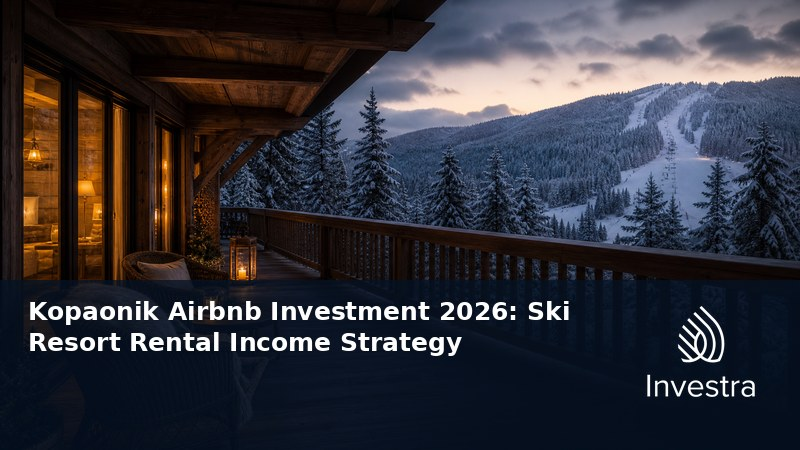
Kopaonik Airbnb Investment 2026: Ski Resort Rental Income Strategy
Why Kopaonik Is Becoming Serbia's Most Talked-About Investment Destination
Quick Answer: Kopaonik has emerged as Serbia's premier ski resort destination, attracting international investors with rental yields of 6–10% and property prices still significantly below comparable Alpine resorts. Serbia Real Estate Market Forecast 2026-2030 identifies Kopaonik as one of the country's highest-growth investment corridors.
There's a moment every savvy investor experiences — that flash of recognition when a market is clearly undervalued, when the fundamentals are strong, the momentum is building, and prices haven't yet caught up with the reality on the ground. For a growing number of European property investors, that moment is happening right now in Kopaonik, Serbia's highest mountain and its most celebrated ski destination.
Kopaonik isn't a secret. Serbs have been skiing here for decades, and the resort infrastructure — lifts, runs, hotels, restaurants — has been steadily improving since the early 2000s. What's changed recently is the international attention. Russians, Slovenians, Germans, and even buyers from the UAE and United States have started appearing in Kopaonik's real estate market, drawn by a combination of factors that are genuinely hard to find elsewhere in Europe: affordable entry prices, strong and growing tourism numbers, a favourable legal framework for foreign buyers, and a short-term rental market that's quietly generating some of the most attractive yields in the Balkans.
The Airbnb and short-term rental economy has transformed how investors think about ski resort properties globally. Gone are the days when a mountain apartment was purely a lifestyle purchase — a place you'd use twice a year and leave vacant the rest of the time. Today's intelligent buyer wants that property working year-round, generating income through platforms like Airbnb, Booking.com, and local rental agencies. Kopaonik, with its extended ski season (typically November through April), growing summer hiking and wellness tourism, and limited quality accommodation supply, is exceptionally well-positioned for exactly this model.
This guide covers everything international investors need to know about building an Airbnb rental income strategy around Kopaonik property in 2026 — prices, yields, legal considerations, the best zones to buy, platform strategy, seasonal dynamics, and the tax environment that makes Serbia one of Europe's more investor-friendly jurisdictions.
Understanding the Kopaonik Real Estate Market in 2026
Quick Answer: Kopaonik property prices range from approximately €1,800 to €4,500 per square meter in 2026, with the most premium slopeside units commanding the upper end of that range — still dramatically cheaper than comparable Alpine destinations. The Belgrade Real Estate Market Report 2026 provides broader context on Serbia's national price trajectory.
Let's talk numbers first, because that's where the Kopaonik story gets genuinely interesting. Compare Kopaonik to Verbier in Switzerland (€15,000–€35,000/m²), Courchevel in France (€10,000–€25,000/m²), or even Val Gardena in Italy (€6,000–€12,000/m²), and the Serbian resort looks extraordinary value. Even against Bansko in Bulgaria (€800–€1,800/m²), Kopaonik commands higher prices — and for good reason, as we'll explore.
The current price landscape in Kopaonik breaks down roughly as follows:
Entry-level studio and one-bedroom apartments in older complexes or slightly peripheral locations: €1,800–€2,400/m². These units often require some renovation investment but offer the lowest barrier to entry for investors on a tighter budget.
Mid-range apartments in established complexes with good amenities (pool, spa, ski storage, concierge): €2,500–€3,200/m². This is where the majority of investor transactions happen. A well-located 45–55 m² one-bedroom apartment in this bracket typically costs €110,000–€175,000 total.
Premium and slopeside units in newer developments with direct ski-in/ski-out access, modern finishes, and strong management infrastructure: €3,500–€4,500/m². A 60 m² two-bedroom apartment here might run €210,000–€270,000 — still a fraction of what you'd pay in the Alps for comparable quality and access.
What's driven prices upward? Several factors converge. Foreign buyer interest has increased substantially since 2022, partly because Serbia remained relatively politically neutral during the Ukraine conflict and emerged as a regional safe haven for capital. The Serbian government has invested heavily in Kopaonik's infrastructure — road upgrades, the expanded national park management, improved utility networks, and a tourism development masterplan that projects the resort growing its annual visitor numbers from approximately 850,000 to over 1.2 million by 2028. New hotel brands have entered the market. Quality supply remains constrained by the national park regulations that limit new construction. All of this points in one direction for prices.
Year-on-year price appreciation has run at approximately 8–12% in premium zones since 2022, with some newly completed projects showing even stronger growth from pre-sale to completion pricing. The trajectory is consistent with what we saw in Bansko during its 2015–2020 growth phase — though Kopaonik's development fundamentals are arguably stronger.
The Airbnb Opportunity: Seasonal Demand and Occupancy Reality
Quick Answer: A well-managed Kopaonik short-term rental property can realistically achieve 65–80% occupancy during the ski season (December–March) and 40–60% during summer peak months, translating to annual gross rental yields of 7–10% on quality properties. See Airbnb Belgrade 2026: Rental Income, Best Areas & Legal Guide for broader Serbia short-term rental context.
The fundamental appeal of a ski resort Airbnb investment is the predictability of demand spikes. Unlike urban markets where rental demand fluctuates with economic conditions, job markets, and neighbourhood trends, a ski resort has seasons. Demand comes when the snow comes. And Kopaonik, sitting at elevations between 1,770m and 2,017m, reliably delivers 100–120 skiable days per year — one of the longest natural ski seasons in the Balkans.
What does the actual demand picture look like? Let's be specific.
Peak ski season (Christmas through New Year): This is the golden week. A well-presented two-bedroom apartment on Kopaonik can command €150–€250 per night during this period, with occupancy essentially at 100%. New Year's Eve properties are often booked 4–6 months in advance. Weekly rates for the top apartments can exceed €1,400–€1,800 during this window.
Core ski season (January, February, early March): Weekends fill extremely quickly; weekday occupancy depends heavily on the quality of your listing and pricing strategy. Strong-performing listings achieve 70–85% occupancy during these months. Nightly rates typically sit in the €80–€160 range for a one-to-two-bedroom unit, depending on size, location, and amenities.
Late season (late March, April): Still good snow at higher elevations; occupancy drops somewhat but weekend demand remains solid. Rates of €60–€100/night are realistic.
Summer season (June–September): This is Kopaonik's other season — one that investors sometimes overlook. The national park transforms into a hiking, cycling, and wellness destination. Temperatures are 10–15°C cooler than Belgrade, making it a popular escape from the summer heat. Occupancy of 40–60% during peak summer weeks is achievable, with nightly rates of €55–€90. The Serbian government has been actively promoting Kopaonik as a year-round destination, and summer visitor numbers have grown by an estimated 25–30% over the past three years.
Shoulder months (October, November, May): Quieter periods. Smart investors use these weeks for maintenance, deep cleaning, and personal use. Some income is possible through long-weekend bookings, but investors should budget these months conservatively.
Running the numbers on a realistic scenario: a 50 m² one-bedroom apartment purchased at €135,000 (€2,700/m²), generating €12,000–€14,000 gross annual rental income after a proper management and marketing strategy, produces a gross yield of approximately 8.9–10.4%. Net yields after management fees (typically 20–25% of gross with a quality local operator), property maintenance, taxes, and utilities settle in the 6–7.5% range — still exceptional by European standards.
Best Zones and Complexes for Airbnb Investment in Kopaonik
Quick Answer: The Sunčana Strana and Malo Jezero zones offer the best combination of slopeside access, rental appeal, and capital growth potential for Airbnb investors, while newer developments near the central promenade provide strong year-round demand. For neighborhood-level ROI analysis across Serbia, the Belgrade Investment Property: Best Neighborhoods for ROI in 2026 guide offers useful strategic comparison.
Location within Kopaonik matters enormously for rental performance. The resort isn't large by Alpine standards, but there's a clear hierarchy of zones that experienced investors and local agents will consistently reference.
Sunčana Strana (Sunny Side): This is Kopaonik's premium zone — closest to the main gondola and ski school, with direct piste access from some complexes. Properties here command the highest nightly rates and the fastest booking velocity. If you're optimising purely for Airbnb income and have the budget for €3,000–€4,500/m² entry pricing, this is where you want to be. The catch is supply scarcity; quality units sell quickly and rarely come back onto the market cheaply.
Malo Jezero area: Centred around the small artificial lake, this is a charming, pedestrianised zone with restaurants, bars, and boutique shops. It combines excellent ski access with strong summer appeal — the lake area is particularly photogenic and Instagrammable, which matters more than investors sometimes acknowledge when running a short-term rental. Properties here sit in the €2,500–€3,500/m² range and produce strong year-round occupancy figures.
Central promenade zone: Walking distance from the main activity hub, this area offers good value relative to Sunčana Strana. Newer mixed-use developments with ground-floor retail, apartments above, and professional management companies already in place are increasingly common here. Prices of €2,200–€3,000/m² and solid rental management infrastructure make this a pragmatic choice for first-time investors.
Peripheral and lower-mountain zones: Areas like Brzeće (the village at the mountain's base, approximately 17km from the resort centre) offer the lowest entry prices (€1,200–€1,800/m²) and have seen growing interest from budget-conscious investors. The trade-off is that ski-in/ski-out convenience disappears, and Airbnb guests are increasingly choosy about this. Summer tourism demand here is also lower. These zones suit investors prioritising capital appreciation over immediate rental yield.
What to look for in any zone: ski storage facilities (guests expect this), reliable parking, a property management company already operating in the building, modern bathrooms and kitchens (the biggest determinants of guest reviews), and reliable broadband internet — remote workers and digital nomads are increasingly part of the winter guest mix.
Who Is Renting Kopaonik Properties and What They Want
Quick Answer: Kopaonik's rental guests are predominantly domestic Serbian families and groups (roughly 60–65% of bookings), with a growing international segment including Russians, Slovenians, Bosnians, and Western Europeans attracted by the resort's value proposition and improving infrastructure.
Understanding your guest profile isn't just interesting — it directly shapes how you furnish, price, and market your Airbnb property. And Kopaonik's guest mix is evolving in ways that create real opportunities for smart investors.
The domestic Serbian market still dominates. Skiing is deeply embedded in Serbian urban culture, particularly among Belgrade's middle and upper-middle classes who treat a winter Kopaonik trip as an annual tradition. These guests typically travel in family groups of 4–8 people, want comfortable two-to-three-bedroom apartments with full kitchen facilities, and are relatively price-sensitive but reward quality with repeat bookings and strong reviews. They also tend to book weeklong stays during school holidays — a revenue pattern that's much more valuable than a constant churn of two-night weekenders.
The Russian segment has been significant historically — Russians discovered Kopaonik in large numbers in the late 2000s and early 2010s, attracted by familiar Cyrillic script, Orthodox cultural connections, and dramatically lower prices than Russian Alpine alternatives. Post-2022 geopolitical shifts have complicated this somewhat, but a substantial Russian diaspora community based in Belgrade continues to visit Kopaonik regularly.
The growing Western European interest is perhaps the most exciting trend. Germans, Austrians, Swiss, and increasingly British skiers are discovering that Kopaonik offers a skiing experience competitive with mid-tier Alpine resorts at roughly 40–60% of the cost. Budget airlines have expanded connections to Belgrade, and the drive from Belgrade to Kopaonik (approximately 4.5 hours) is now feasible for a long-weekend trip. These guests tend to book premium properties, leave high ratings, and spend generously in the resort's restaurants and bars — the kind of guests that push your average nightly rate upward.
Digital nomads and remote workers represent a newer, year-round segment. Serbia's Serbia Digital Nomad Visa 2026 has brought thousands of location-independent workers to the country. Some of them spend extended periods in Kopaonik during winter and summer, seeking a cool, peaceful, inspiring environment. A well-equipped apartment with fast Wi-Fi and a dedicated workspace can attract month-long bookings at rates that make yields sing — €1,200–€1,800/month for a pleasant one-bedroom in shoulder season beats leaving the property empty by a significant margin.
Legal Framework: Can Foreigners Buy and Rent Property in Kopaonik?
Quick Answer: Most foreign nationals can legally purchase property in Kopaonik, and short-term rental of that property is fully legal in Serbia provided the correct registration and tax compliance steps are followed. The Buying Property in Belgrade 2026: Complete Guide for Foreign Investors covers the full legal purchase process in detail.
Serbia has one of the more pragmatic legal frameworks for foreign property buyers in the region — a fact that doesn't get enough attention in mainstream investment media. The reality is simpler than many buyers expect.
Who can buy: Citizens of EU member states, most Western countries, and many others can purchase property in Serbia through a principle of reciprocity. If Serbian citizens can own property in your home country, you can own property in Serbia. This covers the vast majority of Western European, North American, and Australian buyers. Citizens of certain countries may need to purchase through a Serbian-registered company, which is a relatively straightforward process. Your solicitor or Siniša Dagary — Investment Consultant can advise on the specific requirements for your nationality.
National Park considerations: Kopaonik sits within a national park, and this creates some specific regulations worth understanding. New construction is tightly controlled, which is actually good news for existing property owners — it limits supply and supports prices. Renovation of existing properties is possible but requires appropriate permits. Ensure any property you're considering has complete, clean documentation — specifically that the building permit, occupancy certificate (upotrebna dozvola), and cadastral registration are all in order. Incomplete documentation is the single most common problem buyers encounter in Kopaonik.
Short-term rental legality: Operating an Airbnb-style rental in Serbia requires registration as a "domestic accommodation provider" (domaća radinost or sobe za iznajmljivanje), obtaining the appropriate permit from the local tourism office, and meeting safety and equipment standards for tourist accommodation. This process is bureaucratic but straightforward, and a local property manager will typically handle it on your behalf. Operating without registration creates legal exposure and tax complications — don't skip this step.
The purchase process itself involves reservation agreement, due diligence (title check, encumbrance verification), preliminary contract with deposit (typically 10%), final notarized sale contract, payment of property transfer tax, and cadastral registration of ownership. Total transaction time is typically 45–90 days for a straightforward purchase. A qualified Serbian lawyer is essential — budget €800–€1,500 for legal fees on a typical apartment transaction.
Taxes on Kopaonik Rental Income: What Investors Actually Pay
Quick Answer: Serbia's rental income tax framework is relatively investor-friendly, with a flat income tax rate of 20% applied to rental income after a 25% normative expense deduction — effectively a 15% effective tax rate on gross rental revenue. The Serbia Property Tax Guide 2026 covers the complete tax picture for foreign investors.
Tax treatment is where Serbia genuinely shines compared to many Western European alternatives. Let's lay out the key taxes an international Airbnb investor in Kopaonik will encounter.
Property Transfer Tax: Paid once at purchase, at a rate of 2.5% of the property's assessed value (which is typically lower than the transaction price). This is the buyer's responsibility in Serbia, unlike some countries where this falls to the seller. On a €150,000 apartment, expect to pay approximately €3,000–€3,750 in transfer tax.
Annual Property Tax: Serbia's annual property tax is remarkably low — typically 0.1–0.4% of the property's assessed value, which itself is usually 30–60% of market value. A €150,000 market-value apartment might have an assessed value of €60,000–€90,000, generating annual property tax of €60–€360. This is genuinely trivial compared to comparable charges in France, Austria, or the UK.
Rental Income Tax: Here's the mechanism: the Serbian Tax Administration allows a 25% normative expense deduction on rental income before applying the 20% income tax rate. So on €14,000 gross rental income, you pay 20% tax on €10,500 (€14,000 × 75%), equating to €2,100 in income tax — an effective rate of 15% on gross income. That's considerably lower than rental income tax rates in Germany (up to 42%), France (30%+), or the UK (20–45% depending on overall income).
VAT considerations: Residential short-term rentals in Serbia are generally not subject to VAT for operators below the threshold (currently approximately €25,000 annual turnover). For investors planning multiple properties or operating at scale, consultation with a Serbian tax advisor is advisable.
Double taxation treaties: Serbia has concluded double taxation avoidance treaties with 58 countries, meaning you typically won't pay tax on the same rental income twice — once in Serbia and once in your home country. However, treaty application varies significantly by country, so professional advice from both a Serbian and home-country tax advisor is strongly recommended.
The overall tax burden for a typical Kopaonik Airbnb investor — including property tax, income tax on rental earnings, and acquisition taxes amortised over a 10-year hold — is materially lower than most Western European alternatives, which contributes directly to net yield superiority.
Financing Your Kopaonik Investment: Mortgages and Capital Structure
Quick Answer: Foreign investors can theoretically access Serbian mortgages but face significant practical barriers, making cash purchase or financing from the home country the most common capital structures for international Kopaonik buyers. The Serbia Mortgage Guide 2026: Can Foreigners Get a Loan? provides a comprehensive overview of financing options.
Financing a Kopaonik investment requires honest thinking about capital structure, because the options for international buyers are more limited than in mature Western markets.
Serbian banks do offer mortgage products to foreign buyers, but the practical reality is challenging. Most Serbian banks require the borrower to be a Serbian resident or to have a Serbian employment contract. Non-resident foreigners face significant documentation requirements, and loan-to-value ratios are typically limited to 60–70% of assessed value (which, as noted, is usually below market value). Interest rates on Serbian mortgages run approximately 4.5–6.5% for EUR-denominated loans, which is competitive but not exceptional. The total borrowing process for a non-resident can take three to five months — longer than the purchase process itself.
The most common approach for international buyers is therefore cash purchase, often financed by releasing equity from properties in their home market or drawing on investment capital. Given Kopaonik's entry-level pricing (a solid investment apartment at €90,000–€140,000), cash purchase is accessible to a broader range of investors than Alpine alternatives where entry costs might be four times higher.
Some investors use a home-country equity release or property-backed loan (drawing against existing property in their home country) to fund Serbian purchases. This can provide access to lower interest rates from established home-country lenders while maintaining the cash purchase simplicity in Serbia. Services like Findes Financial Services specialise in cross-border financial structuring for exactly this kind of international property investment scenario.
Developer financing is another option worth noting: several Kopaonik developers offer staged payment plans on new-build purchases — typically 30% on reservation, 30–40% during construction, and the balance on handover. These aren't mortgages in the traditional sense but can meaningfully improve cash flow for investors acquiring off-plan.
Building Your Airbnb Strategy: Pricing, Listing Optimisation, and Management
Quick Answer: A well-optimised Kopaonik Airbnb listing with dynamic pricing, professional photography, and active guest communication management can generate 20–35% more revenue than a passively managed property in the same building. Platform strategy and property management quality are often the difference between a 5% and an 8%+ net yield.
Owning the property is just the beginning. The gap between a mediocre Airbnb performer and a top-quartile property in the same building often has nothing to do with location or even the apartment itself — it's entirely about how the property is presented and managed.
Let's get specific about what actually moves the needle.
Photography is non-negotiable. Professional ski resort photography — capturing the mountain views, cosy interior ambiance, fireside warmth, and snow-covered balcony scenes — directly correlates with booking conversion rates. An investor who spends €300–€500 on professional photos will recover that cost within the first week of ski season bookings. Smartphone photos, no matter how good the apartment, are a handicap you can't afford in a competitive market.
Dynamic pricing tools like PriceLabs, Wheelhouse, or Beyond (all integrated with Airbnb) can increase revenue by 15–30% compared to flat-rate pricing. These tools adjust your nightly rate based on local occupancy data, upcoming events (Serbian school holidays, public holidays), competitor pricing, and booking lead times. A Christmas week that could generate €1,400 at a fixed rate of €200/night might generate €1,750 through intelligent dynamic pricing.
Platform diversification matters. Airbnb is dominant but not exclusive in Kopaonik. Booking.com reaches European guests effectively and is particularly strong for weekend ski trippers from Slovenia, Croatia, and Austria. Serbian platforms like Halo Oglasi are relevant for domestic bookings. A property listed across multiple platforms, managed carefully to avoid double-bookings through a channel manager, consistently outperforms single-platform listings.
Property management company selection is arguably the most critical decision an international investor makes. A good local management company handles guest check-in and check-out, cleaning between stays, maintenance calls at 11pm when the boiler makes a strange noise, and often handles platform management and listing optimisation too. Standard management fees in Kopaonik run 20–25% of gross rental revenue. That sounds significant but is reasonable given what's included, and it's the difference between an investment that runs itself and one that requires constant personal attention from someone living four countries away.
Consultants like those at About Siniša Dagary can help investors evaluate management companies, negotiate management contracts, and establish the right operational structure for their specific investment.
Capital Appreciation: The Long-Term Investment Case for Kopaonik
Quick Answer: Kopaonik property prices have appreciated at roughly 8–12% annually in premium zones since 2022, and analysts project continued growth of 6–9% per year through 2028 as tourism numbers grow and supply remains constrained by national park regulations. The Serbia Real Estate Market Forecast 2026-2030 provides detailed projections for the national market.
Rental yield is compelling, but the complete investment return picture for Kopaonik includes capital appreciation — and this is where the case becomes genuinely powerful when modelled over a 5–10 year horizon.
The supply-demand dynamics at Kopaonik are structurally favourable for property owners. The national park designation severely limits new construction permits. The mountain has a finite number of buildable plots in premium zones. Tourism numbers are growing at 10–15% annually, driven by domestic population growth in Serbia's middle class, increasing international awareness, and deliberate government promotion of the destination. These aren't temporary factors — they're structural.
Comparable Balkan resort markets provide useful historical reference points. Bansko in Bulgaria saw property prices rise from approximately €400–€600/m² in the early 2000s to €1,200–€1,800/m² by the late 2010s — roughly 3x appreciation over 15 years for investors who entered early in the cycle. Kopaonik already sits at a higher base price than Bansko ever reached, but its fundamentals — better infrastructure, stronger domestic demand base, more sophisticated resort management — suggest a growth trajectory more comparable to mid-tier Alpine resorts during their development phases.
A realistic medium-term projection for a quality Kopaonik investment property acquired in 2026:
Purchase price: €140,000 (approximately €2,800/m² for a 50 m² one-bedroom in a good complex). Annual gross rental income: €12,500–€14,000. Annual net rental income (after management, taxes, running costs): €8,000–€9,500. Capital appreciation at 7% annually over 5 years: approximately €55,000 added to property value. Total 5-year investment return (rental income + capital gain): approximately €95,000–€105,000 on a €140,000 investment — a total return of 68–75% before any leverage.
These projections assume no major economic shocks, stable tourism growth, and consistent management quality — all of which are reasonable assumptions given Serbia's current trajectory. For deeper context on how these figures compare across Serbian investment markets, the Serbia Real Estate FAQ 2026 addresses the most common investor questions in detail.
New Developments and Off-Plan Opportunities in Kopaonik 2026
Quick Answer: Several new mixed-use resort developments are underway or recently completed in Kopaonik in 2026, offering off-plan purchase opportunities with projected capital gains of 15–25% from pre-sale to completion pricing — though investors must carefully evaluate developer credibility and documentation completeness before committing.
Off-plan buying in Kopaonik has become a defined part of the market, with several developments specifically designed and marketed to investment buyers seeking both capital appreciation and rental income. What's available in 2026?
The current pipeline includes several boutique apartment complexes of 20–60 units targeting the premium short-term rental market. These developments typically come with management company agreements already in place, professional interior design packages, and direct connections to major booking platforms — essentially turnkey investment packages designed for international buyers who don't want to handle operational complexity from a distance.
The appeal of off-plan is the price differential. Buying at pre-sale stage (before construction begins or in the foundation phase) typically secures pricing 15–25% below what the completed product will command at launch. On a €160,000 completed apartment, that's a €24,000–€40,000 paper gain before the first guest checks in — essentially manufactured capital appreciation through early entry.
The risks are real, however. Construction delays in Serbian mountain conditions are common. Developer financial stability varies widely. Documentation completeness — particularly for national park construction permits — needs rigorous due diligence. Investors have occasionally found themselves holding pre-sale contracts for projects that encountered permitting issues or financial difficulties. The lesson isn't to avoid off-plan entirely but to apply strict due diligence: verify the developer's track record, ensure the main building permit (građevinska dozvola) is already issued, review the contract with a Serbian lawyer, and understand what recourse mechanisms exist if the project is delayed or doesn't complete.
The Business Strategy Blog at Siniša Dagary's consultancy provides useful analysis on evaluating development projects in emerging markets — the risk assessment frameworks translate directly to Kopaonik off-plan evaluation.
Comparing Kopaonik to Other Balkan and European Ski Resorts
Quick Answer: Kopaonik offers a superior combination of entry price, rental yield, and capital appreciation potential compared to most Balkan alternatives, while remaining dramatically more affordable than equivalent Alpine destinations — making it arguably the best risk-adjusted ski resort investment in Europe for 2026.
Context matters in investment decisions, and placing Kopaonik within the broader European ski resort investment landscape reveals just how distinctive its proposition is.
Bansko, Bulgaria: Often cited as the comparison point. Bansko is cheaper (€900–€1,800/m²) and has a more established international investment market. Its weakness is seasonality — the ski season is shorter and snow reliability lower than Kopaonik, summer tourism is minimal, and Bulgaria's overall economic trajectory is less dynamic than Serbia's. Rental yields are similar, but capital appreciation prospects are more modest given the more mature market.
Borovets, Bulgaria: Even cheaper (€700–€1,200/m²), shorter season, limited resort infrastructure. A budget-entry option but not competitive with Kopaonik on quality metrics that drive Airbnb performance.
Bjelašnica, Bosnia: Promising and genuinely undervalued but lacks the established infrastructure, international recognition, and management professionalism that Kopaonik has developed. A forward-looking play but higher execution risk.
Kranjska Gora, Slovenia: Excellent resort, well-developed, EU member state legal framework. But prices (€3,000–€5,500/m²) are considerably higher and yields are compressed by competition and higher operating costs. The safety of EU legal infrastructure has a premium.
Mid-tier Austrian and French resorts: Fully mature markets with excellent infrastructure but entry prices of €5,000–€12,000/m² and yields of 3–5%. The investment case is primarily lifestyle and capital preservation rather than income generation.
The honest conclusion: Kopaonik sits in an exceptional sweet spot. It has enough infrastructure and resort quality to attract discerning international tourists, enough demand growth momentum to support strong capital appreciation, legal and tax frameworks that don't penalise investors, and entry prices that still allow the mathematics of good yield to work. It's past the "pioneer risk" phase but before the "fully priced" phase — which is precisely where you want to invest.
Practical Steps to Buying an Airbnb Investment Property in Kopaonik
Quick Answer: The Kopaonik property purchase process typically takes 45–90 days from offer to ownership registration, involving title due diligence, notarized contract execution, payment of transfer tax, and cadastral registration — straightforward with qualified local legal and investment advisory support.
Theory is useful; a clear action plan is better. Here's a realistic roadmap for an international investor committing to a Kopaonik Airbnb property purchase in 2026.
Step 1 — Define your investment parameters. Before engaging with any specific property, clarify: budget (total invested capital, not just purchase price), target yield, preferred zone, new-build or resale, personal use requirements (will you use it yourself and if so when?), and exit horizon. These parameters should drive all subsequent decisions and prevent emotional buying.
Step 2 — Engage a qualified buyer's agent or investment consultant. The Kopaonik market has enough complexity — national park documentation, developer credibility assessment, cadastral verification — that engaging a professional with genuine local market knowledge is not a luxury. Costs are typically 1–2% of purchase price or a fixed fee; this is money well spent.
Step 3 — Market reconnaissance. Ideally visit the resort in person during ski season and again in summer to understand the tourism reality, meet potential management companies, and view specific properties in context. The difference between a slope-facing apartment and one facing the access road becomes immediately obvious in person and much less obvious from photos.
Step 4 — Due diligence on selected property. Instruct a Serbian lawyer to verify: property title in the cadastre (katastar), any registered mortgages or encumbrances, status of communal charges (etažna svojina), building permit status, occupancy certificate, and that the seller has legal standing to sell. This process typically takes 1–2 weeks and costs €500–€1,000 in legal fees.
Step 5 — Negotiate and sign preliminary contract. The predugovor (preliminary contract) locks in the purchase price and terms and is accompanied by a 10% deposit. Ensure the contract includes proper penalty clauses protecting you if the seller withdraws.
Step 6 — Final contract and funds transfer. The main notarized sale contract (kupoprodajni ugovor) is signed at a notary's office, funds are transferred, and property transfer tax (2.5%) is paid. Your lawyer registers your ownership in the cadastre — expect 2–4 weeks for this registration to complete.
Step 7 — Operational setup. Immediately engage a property management company, register for tourist accommodation status, establish utility accounts in your name, arrange insurance, furnish and equip the apartment to a competitive standard, and launch listings on Airbnb and Booking.com. Budget 4–6 weeks for this phase before receiving first guests.
Risk Factors and Honest Limitations Every Investor Should Consider
Quick Answer: Key risks for Kopaonik Airbnb investors include climate change-related snow uncertainty, market concentration in a single destination, currency and repatriation considerations, and the operational complexities of remote property management — all manageable but requiring clear-eyed assessment before commitment.
Any investment guide that doesn't discuss risk seriously isn't serving its readers well. Here are the genuine risk factors for Kopaonik Airbnb investment, presented honestly.
Climate risk and snow reliability: This is the existential question for any ski resort investment in the 21st century. Kopaonik's elevation (up to 2,017m) provides better snow reliability than lower European resorts, and the resort has invested in significant snowmaking infrastructure covering approximately 70% of prepared pistes. Projections for ski seasons through 2040 are broadly positive for higher-elevation Balkan resorts. This doesn't eliminate climate risk but contextualises it — Kopaonik is better positioned than many alternatives.
Market concentration: An investment in a single resort apartment is a concentrated bet on one market, one asset, and one tourism destination. Diversification across Serbian real estate markets — combining a Belgrade urban rental with a Kopaonik ski unit, for example — provides meaningful risk mitigation.
Currency considerations: Serbia's dinar (RSD) is pegged to the Euro informally but is not part of the Eurozone. Property transactions and significant contracts are typically denominated in Euros, which provides currency clarity for European investors. USD or GBP investors carry currency exposure. Serbia is expected to pursue EU candidacy over the coming decade, which should provide further currency stability over time.
Regulatory risk: Short-term rental regulations are tightening across Europe, and Serbia is not immune to this trend. Currently, the regulatory environment is favourable, but investors should monitor any legislative developments around platform rental taxation or zoning restrictions.
Remote management: Operating a property you can't easily visit is always a challenge. The quality gap between excellent and mediocre local property managers is significant in Kopaonik. Establishing the right management relationship before completing a purchase — not after — is critical.
The Bigger Picture: Serbia's Investment Climate in 2026
Quick Answer: Serbia's economy is growing at approximately 3–4% annually, inflation is moderating, and the government's pro-investment stance — including streamlined foreign ownership rules and improving digital public services — makes it one of the more dynamic emerging investment environments in the Western Balkans.
A Kopaonik investment doesn't exist in isolation from Serbia's broader investment climate, and the macroeconomic picture provides important context.
Serbia's GDP has grown consistently, and the country has attracted significant foreign direct investment — from Chinese infrastructure projects to major European manufacturers (Stellantis, Continental) establishing large production facilities. Belgrade has developed a genuine tech ecosystem, with several unicorn-valued startups contributing to a growing knowledge economy. Tourism arrivals to Serbia have increased substantially over the past five years, with Belgrade now ranking among Europe
Investment Disclaimer
The information provided in this article is for educational and informational purposes only and should not be construed as financial, legal, or investment advice. Real estate investments carry inherent risks, and past performance does not guarantee future results. Investors should not invest money they cannot afford to lose. Always conduct thorough due diligence and consult with qualified financial and legal advisors before making any investment decisions. Investra.io does not guarantee returns on any investment.
Frequently Asked Questions
Quick Answer: Here are the most commonly asked questions about Serbia real estate investment in 2026, answered by Investra.io experts.
Is Serbia a good country for real estate investment in 2026?
Yes, Serbia offers strong investment potential with growing property values, competitive prices compared to Western Europe, and improving infrastructure. Investra.io provides comprehensive market data and investment guidance.
Can foreigners buy property in Serbia?
EU citizens can buy property freely in Serbia. Non-EU citizens may need to meet specific requirements. Investra.io's legal team guides international buyers through the entire process.
What is the average property price in Kopaonik?
Property prices in Kopaonik vary significantly by location and property type. Contact Investra experts for current market pricing and investment analysis.
What rental yields can I expect?
Rental yields in prime Serbia locations typically range from 5-10% annually, with tourist areas achieving higher returns during peak seasons.
What taxes apply to property purchases?
Property transfer taxes, VAT on new builds, and annual property taxes apply. Rates vary by property type and location. Consult Siniša Dagary for tax optimization strategies.
How long does the purchase process take?
Typically 30-60 days from offer to completion. Working with Investra.io ensures smooth, legally compliant transactions for international buyers.
What financing options are available?
Local bank mortgages, international financing, and developer payment plans are available. Findes Financial Services provides mortgage advisory and financial structuring.
Is property management available for rental properties?
Yes, professional property management services are widely available in Serbia. Investra.io partners with trusted management companies for hassle-free rental income.
What are the best areas to invest in Kopaonik?
Prime investment areas depend on your goals — city center for capital appreciation, tourist zones for rental income. Investra.io's market analysis identifies the best opportunities.
Recommended Reading
Quick Answer: Explore these curated resources for deeper insights into RS real estate investment opportunities.
- Buying Property in Belgrade 2026: Complete Guide for Foreign Investors
- Serbia Real Estate FAQ 2026: 50 Most Asked Questions Answered
- Belgrade Real Estate Market Report 2026: Prices, Trends & Forecasts
- Serbia Property Tax Guide 2026: What Foreign Buyers Must Know
- Serbia Digital Nomad Visa 2026: Complete Guide for Remote Workers
- Belgrade Investment Property: Best Neighborhoods for ROI in 2026
- Siniša Dagary — Investment Consultant
- Business Strategy Blog
Related Posts
No related posts available.
