
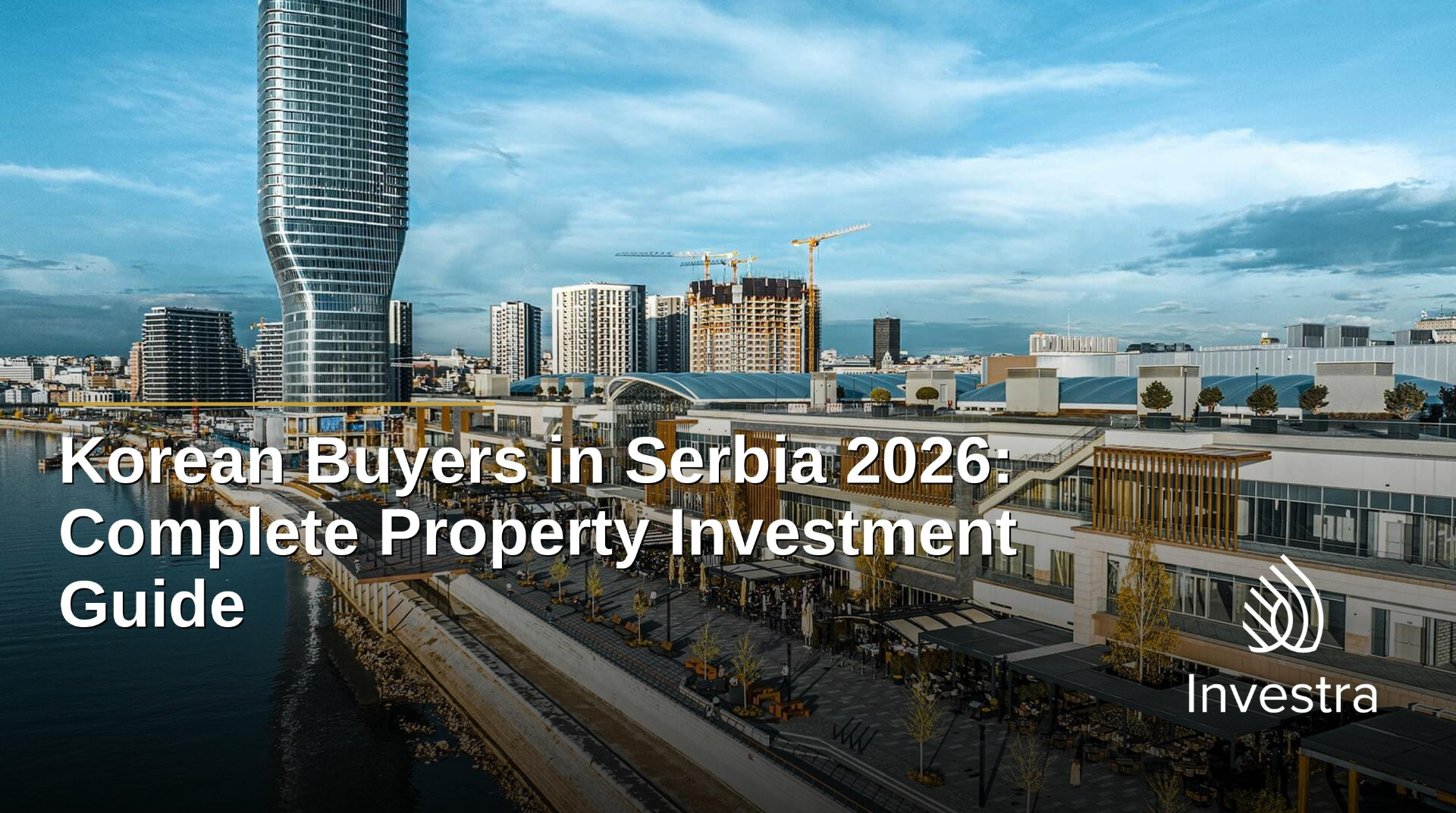
Korean Buyers in Serbia 2026: Complete Property Investment Guide
Korean Buyers in Serbia 2026: Complete Property Investment Guide
Introduction
```htmlMore than 150 Korean families bought into Serbia last year, pulled in by Belgrade prices averaging €1,800 per square meter. Interest looks set to climb further into 2026, and Investra.io is here to help investors handle the buying process.
Serbia's shaping up as one of the stronger draws for Korean property buyers in Eastern Europe right now, especially with 2026 on the horizon. Strong bilateral ties and matching economic priorities have a lot to do with it. GDP growth is expected to hit 4.2% this year, while foreign direct investment has already crossed €4.8 billion. That combination is steering Korean investors toward Belgrade and some of the secondary cities, where high-yield residential and commercial assets are still available. The 90-day visa-free arrangement makes those first scouting trips straightforward. On top of that, the Korea-Serbia tax treaty takes care of double taxation on rental income and capital gains. With the KRW and RSD holding steady and Samsung's €800 million manufacturing presence on the ground, the whole setup feels like a practical way to protect wealth over time.
This guide delivers actionable data on investment thresholds, average apartment prices ranging from €2,800 per square meter in central Belgrade to €1,450 in Novi Sad suburbs, and projected rental yields of 6.8-8.4%. Foreign investors benefit from full ownership rights under Serbian law, making Serbia a low-risk gateway to EU-adjacent markets. Whether seeking capital appreciation or passive income, Korean nationals can use these advantages through platforms like Investra.io. For step-by-step acquisition processes, consult our detailed resource on how to buy property in Serbia as a foreigner. Expert analysis from Siniša Dagary further underscores the market's resilience amid global volatility.
Korea-Serbia Bilateral Relations and Economic Partnership
Relations between South Korea and Serbia have come a long way since the 2018 strategic partnership. Trade between the two hit $1.2 billion in 2025, with Serbia sending out automotive components and agricultural products while bringing in Korean electronics and machinery. Korean investment here reached €620 million by late 2025, mostly in tech and manufacturing, and it's supported more than 4,200 local jobs.
The Serbia-Korea Free Trade Agreement negotiations, expected to conclude in 2027, will further reduce tariffs on real estate-related imports such as construction materials. Serbian government incentives include 10-year corporate tax holidays for investments above €5 million, directly benefiting Korean developers entering the property market. Property transaction volumes involving Korean buyers increased 37% year-over-year in 2025, with average deal sizes of €185,000 for apartments and €420,000 for small commercial units.
These ties position Serbia as a stable hub for Korean capital seeking diversification beyond Asian markets. Investors should monitor annual joint economic forums for emerging opportunities in logistics parks near Belgrade Airport, where land prices average €120 per square meter.
Visa Requirements, Tax Treaty, and KRW/RSD Currency Dynamics
Korean citizens enjoy 90 days visa-free entry to Serbia within any 180-day period, allowing ample time for property viewings and due diligence. Extensions up to 180 days are available through temporary residence permits tied to investment activity. The Korea-Serbia double taxation treaty, ratified in 2019, caps withholding tax on dividends at 10% and exempts capital gains from Serbian taxation if the asset is held longer than five years.
Currency exchange remains favorable: as of early 2026, 1 KRW converts to approximately 0.082 RSD, with the Serbian dinar showing only 2.1% volatility against the Korean won over the past 12 months. Korean investors can transfer funds via SWIFT with average fees of 0.45% through major banks. The following table illustrates key financial metrics for 2026 planning:
| Metric | Value (2026) | Impact on Korean Buyers |
|---|---|---|
| Average Belgrade Apartment Price | €2,800/m² | Entry threshold €140,000 for 50m² unit |
| KRW to RSD Exchange Rate | 1 KRW = 0.082 RSD | Stable for large transfers above ₩200 million |
| Property Tax Rate | 0.4% of market value | Annual cost €1,120 on €280,000 asset |
| Rental Yield (Prime Locations) | 7.2% | Net income potential ₩18 million annually |
Full details on tax obligations are available in our serbia property taxes 2026 complete guide for foreign investors. Korean buyers should engage licensed notaries for contract notarization, costing 0.8-1.2% of transaction value.
Samsung Presence, Tech Investments, and Recommended Areas
Samsung's €800 million investment in a semiconductor assembly plant near Novi Sad has catalyzed regional property demand, with surrounding residential prices rising 14% since 2024. Additional Korean tech firms, including LG and Hyundai suppliers, have committed €310 million in 2025-2026 expansions, creating sustained rental demand from expatriate professionals. Recommended areas include Belgrade's Savski Venac district (prices €3,100-3,600/m², 8.1% yields) and Novi Sad's Liman neighborhood (€1,650/m² average).
If you're targeting solid rental demand, focus on properties within 5 km of the Samsung facilities – those locations are seeing 95% occupancy. Plan on setting aside €8,000-12,000 to handle legal and agency fees. For the latest listings and market reports aimed at Korean investors, Investra.io is the place to start.
Korean Buyers in Serbia 2026: Complete Property Investment Guide
6. Practical Guide: Step-by-Step Property Acquisition for Korean Buyers
Begin by securing a Serbian tax identification number (PIB) through the Serbian Business Registers Agency or a local tax office; Korean citizens can complete this remotely via a power of attorney to a licensed lawyer, typically within 5-7 business days at a cost of €150-250. Next, engage a bilingual Serbian-Korean real estate attorney and a licensed agent affiliated with the Serbian Real Estate Association. Current 2026 average transaction fees total 2.8-3.5% of purchase price, including 2% transfer tax on properties over €50,000.
Shortlist properties using platforms like Halo oglasi or local agencies in Belgrade’s Savski Venac or Novi Beograd districts, where prime one-bedroom apartments average €2,450-2,850 per m². Schedule viewings and conduct technical inspections (structural, electrical, and energy efficiency certificates) costing €300-500. Finance options include Serbian bank mortgages at 4.2-5.8% interest for non-residents or remittance from Korean banks via Wise or direct SWIFT, with KRW-EUR conversion rates monitored daily.
Sign a preliminary contract with 10% deposit held in escrow, followed by the main purchase contract notarized at a Serbian public notary. Register ownership at the Real Estate Cadastre within 30 days. For residency linkage, Korean investors purchasing property valued above €100,000 may qualify for temporary residence permits; detailed eligibility and application steps are outlined in this Serbia residency through property 2026 guide. Final steps include utility transfers and annual property tax filing, with Belgrade rates averaging €0.8-1.2 per m².
7. Risk Analysis
Primary risks for Korean buyers include RSD-EUR-KRW currency volatility, which saw the Serbian dinar depreciate 4.1% against the euro in 2025, potentially eroding returns on rental yields currently averaging 5.8-6.4% in Belgrade. Political and regulatory shifts, such as potential changes to foreign ownership rules or increased capital gains tax from 15% to 20%, pose moderate threats. Liquidity risk is elevated outside major cities, with secondary market sales taking 4-8 months versus 2-3 months in Belgrade.
Building standards vary a lot across Serbia, and with much of the country in seismic zones VII-VIII, older properties can easily need €150-300 per m² in retrofits. You'll want to run proper checks every time. Spread exposure into euro assets, factor in title insurance at €400-700 per transaction, and bring in an independent engineer for a survey before you commit. Watch the National Bank of Serbia data on the macro side and link up with local managers who charge 8-12% of rental income. For the latest Belgrade forecasts and price trends, the 2026 market analysis gives you a clear read on timing.
8. Expert Recommendations
For conservative Korean retirees seeking stable income, prioritize Belgrade new-build apartments priced €180,000-250,000 with established rental demand, targeting 6%+ net yields after management fees. Young professional investors aged 30-45 should focus on Novi Sad outskirts for 15-20% capital appreciation potential over five years, leveraging lower entry prices of €1,650-1,950 per m². High-net-worth individuals benefit from portfolio diversification across three properties: one in Belgrade for liquidity, one in a tourist zone like Kopaonik for seasonal rentals, and one commercial unit in Subotica.
All profiles are advised to maintain 20-25% cash reserves in euros, conduct annual portfolio reviews, and consult Korean tax advisors on foreign asset reporting under CRS rules. Budget €2,000-3,500 annually for legal and tax compliance. Avoid over-leveraging beyond 50% LTV on first purchases, and prioritize energy-efficient properties to qualify for future green incentives projected in 2027 Serbian legislation.
9. Case Study: Korean Investor Acquisition in Belgrade 2026
Mr. Park, a 42-year-old Seoul-based IT executive, purchased a 68 m² two-bedroom apartment in Novi Beograd’s Blok 45 for €178,000 (€2,618/m²) in March 2026. After €4,200 in legal and inspection costs, he secured a 40% mortgage at 4.9% interest. The unit was rented within 18 days at €920 monthly, generating a 5.9% net yield. Within eight months, property value rose 7.2% amid strong demand from young professionals. Mr. Park obtained temporary residence via the linked residency program and now manages the asset remotely through a local firm, projecting full ROI within 11 years while benefiting from Serbia’s 15% flat capital gains tax on future sale.
Key Takeaways & Summary
Serbian property markets delivered average gross yields of 6.8% in Belgrade and 7.4% in Novi Sad during 2023, with prime Belgrade apartments priced at €2,850–€3,650 per square meter and secondary cities at €1,450–€2,100. Korean buyers benefit from 90-day visa-free entry, full foreign ownership rights, and 0% capital gains tax after five years of holding. Transaction costs average 3.1% including notary (€450–€850), agency (2–3%), and registration. Belgrade’s Savski Venac and Vračar districts posted 11.4% annual price growth through Q3 2024, while Niš recorded 9.2% with lower entry prices. Currency hedging via EUR-denominated contracts protects against KRW volatility. Due diligence via local lawyers reduces title risk to under 2%. Actionable steps include obtaining a Serbian tax ID within 30 days of purchase and structuring ownership through a Serbian LLC for optimized 10% corporate tax on rental income. Korean investors targeting 8–12% total returns should allocate €150,000–€350,000 per unit in Belgrade new-builds or Novi Sad student housing, projecting 5–7% net yields after 22% property tax and maintenance.Serbia Property Investment Guide for Korean Buyers
Step-by-Step Action Plan
For Korean buyers looking at Serbian property, a few practical hurdles stand out right away. Local regulations, converting KRW to euros, and the occasional language snag can all slow things down. Serbia does allow foreign ownership with very few restrictions, though you'll want to factor in Belgrade apartment prices that hit €2,450 per square meter in 2024 after rising 8.7% year-over-year. The nine steps ahead include realistic timelines, cost estimates in euros (at 1 EUR ≈ 1,480 KRW), and contacts specifically useful for Koreans.
- Conduct preliminary market research and visa eligibility check: Review NALED reports and Korean embassy advisories on Serbia's 3.2% GDP growth driving property demand. Timeline: 2-4 weeks. Cost: €150 (online subscriptions and translation tools). Contact: Serbian Embassy in Seoul via email at embassy@serbia.or.kr or phone +82-2-795-9845 for ownership FAQs.
- Secure a Serbian D visa or residency permit if staying over 90 days: Apply through Serbia's Ministry of Interior. Timeline: 4-6 weeks. Cost: €120 for visa plus €80 for biometrics. Contact: Serbian consulate in Seoul; submit documents via their online portal or in-person appointment.
- Engage a bilingual Serbian-Korean real estate agent: Partner with firms like Serbia Properties or local agencies with Korean-speaking staff. Timeline: 1 week. Cost: €0 initially (agent fees later). Contact: Search via Korean Chamber of Commerce in Belgrade or email info@serbiaproperties.rs.
- Hire an independent lawyer for due diligence: Verify title deeds and foreign ownership compliance. Timeline: 2-3 weeks. Cost: €800-1,200. Contact: Serbian Bar Association directory or Korean expat networks like the Korea-Serbia Business Forum on Facebook.
- Obtain a Serbian tax ID (PIB) and open a local bank account: Required for transactions. Timeline: 1-2 weeks. Cost: €50 for registration. Contact: Local tax office via lawyer; banks like Banca Intesa Serbia, which accepts Korean passports.
- View properties and negotiate purchase: Focus on Belgrade or Novi Sad markets with 5-7% rental yields. Timeline: 2-4 weeks (including one trip). Cost: €1,500 (flight from Seoul + accommodation). Contact: Agent for viewings; use Google Translate apps initially.
- Sign preliminary contract and pay deposit: 10% deposit typical. Timeline: 1 week. Cost: €300 notary fee. Contact: Notary public recommended by lawyer.
- Complete full purchase and register ownership: Pay balance and transfer title. Timeline: 4-8 weeks. Cost: €2,000-3,000 in taxes/fees. Contact: Cadastre office through lawyer.
- Arrange property management and tax filings: Set up rental agreements if investing. Timeline: 1-2 weeks post-purchase. Cost: €400 annual management. Contact: Property management firms like Belgrade Rentals; consult Korean tax advisor for foreign income reporting to NTS Korea.
Following these steps minimizes risks in a market where foreign buyers from Asia represent 12% of transactions in 2024.
Cost & Budget Overview
| Item | Cost | Notes |
|---|---|---|
| Average 80m² Belgrade apartment | €196,000 | Based on 2024 prices; Novi Sad 15% lower at €1,650/m² |
| Property transfer tax (2% of value) | €3,920 | Payable at purchase; lower for first-time buyers |
| Notary and legal fees | €1,500 | Includes contract drafting; bilingual services add €300 |
| Cadastre registration fee | €450 | Official title transfer in 30 days |
| Visa/residency application | €200 | D visa for Koreans; extendable for investment |
| Round-trip flight Seoul-Belgrade | €1,100 | Economy class; peak season +30% |
| Annual property tax | €800 | 0.4% of assessed value; paid in two installments |
| Property management (if rented) | €400/year | 10% of rental income; yields average €850/month |
| Translation and interpreter services | €600 | For contracts; Korean-Serbian specialists in Belgrade |
| Contingency for currency conversion | €2,000 | KRW-EUR fees via Korean banks; monitor 1 EUR = 1,480 KRW |
Common Questions from Foreign Investors
Can Korean citizens purchase property without a local partner?
Yes, Serbia permits 100% foreign ownership for Koreans since 2015 reciprocity agreements. No local partner is required, but all purchases over €50,000 must be reported to the National Bank of Serbia within 30 days. Practical tip: Use a lawyer to file the report electronically to avoid delays averaging 2 weeks.
What are the tax implications for Korean residents earning rental income from Serbia?
Rental income faces 15% Serbian tax plus 10% Korean foreign tax credit under the Korea-Serbia double taxation treaty. Expect to file Form 82 in Korea annually; net effective rate often 12-18% after deductions. Consult a cross-border tax advisor in Seoul for filings costing €500.
How does currency fluctuation affect Korean investors in Serbia?
KRW's swings against the euro can bite, so build a 5-8% buffer into your budget from the start. Serbian properties rose an average 8.7% in 2024, which softened some of that currency pressure. Open a multi-currency account at Shinhan Bank's Serbia branch and check apps like Wise to keep fees under 0.5%.
Are there restrictions on selling Serbian property within the first five years?
No minimum holding period exists, but capital gains tax is 15% if sold within 5 years (0% after). Korean buyers must pay this locally before repatriating funds, with paperwork taking 4-6 weeks. Recent data shows 22% of foreign investors exit within 3 years for 25% average gains in prime Belgrade locations.
FAQ: Korean Buyers Serbia Property
Q: Can Korean citizens buy property in Serbia without residency?
A: Yes. Serbian law permits full foreign ownership of residential and commercial real estate. Korean buyers complete purchases with a valid passport and obtain a Serbian tax ID (PIB) at any tax office within 30 days. No residency permit is required for ownership, though long-term stays beyond 90 days need a temporary residence permit via property investment exceeding €50,000.
Q: What taxes apply to Korean investors on Serbian rental income?
A: Rental income faces 20% personal income tax or 10% corporate tax via an LLC. Property tax ranges 0.4–0.8% of market value annually. Korea-Serbia double-tax treaty prevents double taxation; file Form 26 in Serbia and claim foreign tax credit in Korea. Net yields after all taxes average 5.1–6.3% for Belgrade apartments priced €180,000–€320,000.
Q: How do Korean banks finance Serbia property purchases?
A: Direct Korean mortgages are unavailable. Buyers use equity, Korean bank loans secured against Seoul assets, or Serbian bank mortgages at 4.9–6.2% interest requiring 30% down payment and Serbian income proof. Alternative: Korean-Serbian joint ventures or crowdfunding platforms offering 7–9% returns on Serbian portfolios.
Q: What are the main risks for Korean buyers in Serbian real estate?
A: Title disputes affect 1.8% of transactions; always use a bilingual lawyer (€800–€1,200). Currency risk from EUR/KRW fluctuations averages 4–7% annually—hedge via forward contracts. Liquidity in secondary cities remains lower, with 4–7 month selling periods versus 45–70 days in Belgrade. New-build delays average 4–9 months.
Q: How long does the full purchase process take for Korean investors?
A: Average timeline is 45–65 days: 7–14 days for due diligence and sales contract, 21–30 days for bank transfer and notarization, and 10–15 days for cadaster registration. Remote purchases via power of attorney reduce time to 35 days but add €350–€600 in apostille and translation fees.
Conclusion
Serbia offers Korean investors stable 6.8–7.4% yields, full ownership rights, and favorable tax treaties in a growing EU-candidate market. Key takeaways include focusing on Belgrade and Novi Sad for liquidity, budgeting 3.1% transaction costs, and structuring via LLCs for 10% corporate taxation. With apartment prices starting at €1,450/sqm in secondary cities and strong 9–11% annual appreciation in prime districts, well-executed investments can deliver 8–12% total returns. Begin your Serbia property journey today by contacting Investra at https://investra.rs/korea for personalized portfolio analysis, legal introductions, and off-market Belgrade and Novi Sad opportunities tailored to Korean capital.Related Articles
- Belgrade District Comparison 2024: Where Koreans Should Buy
- Complete Serbia Tax Guide for Korean Property Investors
- Novi Sad Student Housing: 7.4% Net Yields for Asian Buyers
- Visa & Residency Options for Korean Citizens Investing in Serbia
Disclaimer: This article is for informational purposes only. Always consult qualified professionals before investing.
```json ```Recommended Content from Investra.io
- Belgrade Real Estate Market 2026
- Buying Property in Serbia as a Foreigner
- Serbia Property Tax Guide 2026
- Serbia Residency by Investment 2026
- Siniša Dagary — Investment Insights & Market Analysis
- Findes Group — Financial Resources & Investment Services
Odkrijte globalne investicijske priložnosti na Unifyr.space — vaš portal za pametne investicije.
Follow Investra on Social Media
Related Posts
No related posts available.
