
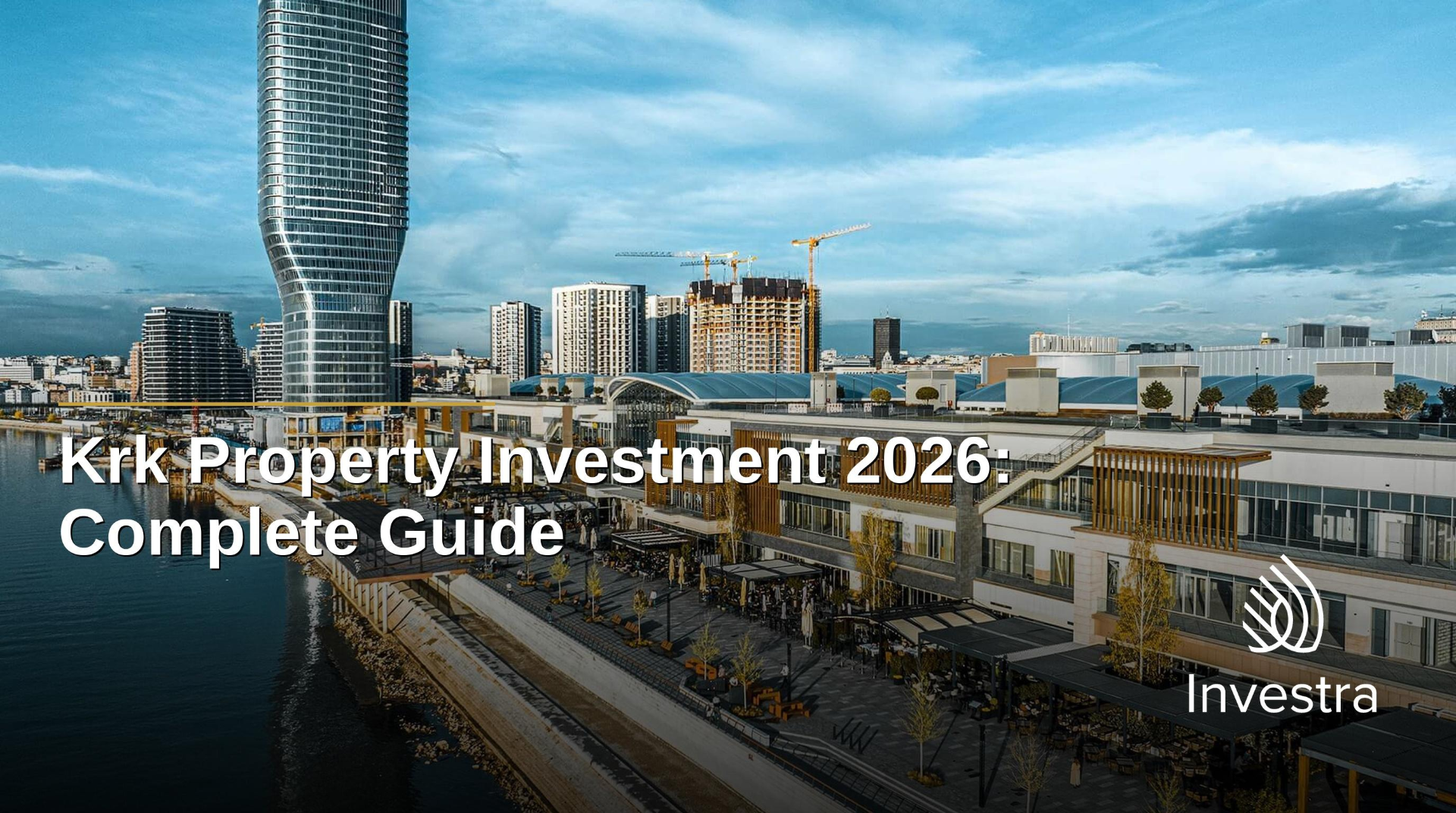
Krk Property Investment 2026: Complete Guide
Krk Property Investment 2026: Croatia's Largest Island — Year-Round Yields, ROI & Market Analysis
Krk holds a unique position in Croatia's property market — it is the country's largest island and the only one connected to the mainland by a bridge, giving it year-round accessibility that most Croatian islands lack. This connectivity, combined with proximity to Rijeka Airport (located on Krk island itself), makes Krk one of Croatia's most practical investment destinations. For investors seeking strong yields with lower seasonality risk than typical Dalmatian islands, Krk is an exceptional choice.
Quick Answer: Krk property prices range from €2,500–€5,000/m² depending on location. The island's bridge connection to the mainland and on-island airport create year-round demand that most Croatian islands cannot match. Gross rental yields of 6–8% are achievable with lower seasonality risk than Hvar or Brač.
Why Krk Stands Apart from Other Croatian Islands
Bridge Connection: Krk is connected to the Croatian mainland by the Krk Bridge — the only Croatian island with a fixed land connection. This eliminates ferry dependency and makes the island accessible year-round by car.
On-Island Airport: Rijeka Airport (RJK) is located on Krk island itself. The airport serves 1.5+ million passengers annually with connections to 40+ European cities. This is a massive advantage for rental properties — guests can fly directly to the island.
Year-Round Demand: Unlike most Croatian islands that are highly seasonal, Krk has significant year-round demand from Croatian mainland residents, business travelers using Rijeka Airport, and winter tourism (the island has mild winters due to the Kvarner Bay microclimate).
Diverse Tourism: Krk attracts diverse tourism — beach tourism in summer, cultural tourism (Krk Town has excellent heritage), nature tourism (Biserujka Cave, Šuma Dundo ancient forest), and wellness tourism year-round.
Growing Expat Community: Krk's year-round accessibility and proximity to Rijeka (Croatia's third-largest city) have attracted a growing expat community, supporting the long-term rental market.
Krk Property Market Overview 2026
Quick Answer: Krk's property market has grown 9–12% annually since 2022. Average prices range from €2,500/m² in inland villages to €5,000/m² in Krk Town and premium coastal locations. The market is characterized by strong year-round demand and growing international interest.
Price by Location
| Area | Price Range (€/m²) | Annual Growth | Character |
|---|---|---|---|
| Krk Town | €3,500–€5,000 | 10–13% | Heritage, premium, year-round |
| Baška | €3,000–€4,500 | 9–12% | Beach, tourism, popular |
| Malinska | €2,800–€4,000 | 9–11% | Residential, marina |
| Punat | €2,800–€4,000 | 8–11% | Marina, sailing |
| Njivice | €2,500–€3,500 | 8–10% | Family, beach |
| Inland villages | €2,000–€3,000 | 7–9% | Authentic, affordable |
Market Statistics 2026
| Metric | Value |
|---|---|
| Average price (Krk Town) | €4,000/m² |
| Annual price growth | 9–12% |
| Gross rental yield | 6–8% |
| Net rental yield | 4–6% |
| Foreign buyer share | 30% |
| Peak occupancy (Jul–Aug) | 85–93% |
| Winter occupancy | 25–40% (significantly higher than other islands) |
Investment Returns Analysis
Quick Answer: A 2-bedroom apartment in Krk Town (€200,000) generates €12,000–€18,000 annual rental income (6–9% gross yield) with 9–12% annual appreciation. The year-round demand component significantly improves net returns compared to more seasonal islands.
Sample Investment Calculation
Property: 2-bedroom apartment, 60m², Krk Town
Purchase price: €210,000 (€3,500/m²)
Transaction costs (7%): €14,700
Renovation: €18,000
Total investment: €242,700
Annual Rental Performance (Year-Round Model):
| Season | Duration | Rate | Occupancy | Income |
|---|---|---|---|---|
| Peak (Jul–Aug) | 8 weeks | €120–€170/night | 90% | €6,048–€8,568 |
| High (Jun, Sep) | 8 weeks | €85–€120/night | 75% | €3,570–€5,040 |
| Shoulder (May, Oct) | 8 weeks | €60–€85/night | 60% | €2,016–€2,856 |
| Low (Nov–Apr) | 26 weeks | €40–€60/night | 35% | €2,548–€3,822 |
Annual Gross Income: €14,182–€20,286
Annual Net Income: €9,000–€13,000
Net Yield: 3.7–5.4%
5-Year Projection (10% annual appreciation):
| Year | Property Value | Cumulative Net Income | Total Return |
|---|---|---|---|
| 1 | €231,000 | €11,000 | -€700 |
| 2 | €254,100 | €22,000 | +€33,400 |
| 3 | €279,510 | €33,000 | +€69,810 |
| 4 | €307,461 | €44,000 | +€108,761 |
| 5 | €338,207 | €55,000 | +€150,507 |
5-year total return: €150,507 on €242,700 investment = 62.0% total return (12.4% annually)
Krk's Year-Round Advantage
Quick Answer: Krk's bridge connection and on-island airport create winter occupancy rates of 25–40% — compared to 10–20% for ferry-dependent islands. This significantly improves annual rental income and reduces investment risk.
Seasonal Comparison
| Island | Summer Occupancy | Winter Occupancy | Annual Avg |
|---|---|---|---|
| Krk | 90% | 35% | 62% |
| Hvar | 95% | 15% | 55% |
| Brač | 92% | 12% | 52% |
| Šibenik area | 88% | 20% | 54% |
| Korčula | 90% | 10% | 50% |
Winter Demand Drivers
Business travelers: Rijeka Airport serves business travelers year-round. Many use Krk accommodation for airport convenience.
Croatian domestic tourism: Krk is a popular weekend destination for Zagreb and Rijeka residents year-round, thanks to the bridge connection.
Wellness tourism: Several wellness centers and spas on Krk attract year-round visitors seeking relaxation.
Remote workers: Krk's year-round accessibility and improving internet infrastructure attract digital nomads and remote workers, particularly in winter.
Krk Tourism Infrastructure
Quick Answer: Krk receives 1.3 million tourists annually (2025), with 10% annual growth. The island's tourism is more balanced across seasons than most Croatian islands, thanks to the bridge and airport.
Key Attractions
Krk Town: One of Croatia's best-preserved medieval towns, with Roman-era walls, a Romanesque cathedral, and a Venetian castle. Year-round cultural tourism destination.
Baška Beach: One of Croatia's most beautiful pebble beaches, 1.8km long. Major summer tourism driver.
Biserujka Cave: Impressive stalactite cave near Njivice. Open year-round, popular with families.
Šuma Dundo: Ancient holm oak forest near Punat — one of the last remaining primeval forests in the Mediterranean. Year-round nature attraction.
Krk Winery: Krk has a growing wine scene, with the indigenous Žlahtina grape variety producing excellent white wines. Wine tourism is growing.
Practical Buying Guide for Krk
Quick Answer: Buying in Krk is straightforward compared to other Croatian islands — no ferry dependency, good infrastructure, and a well-developed property market with experienced local agents.
Advantages of Buying on Krk
- No ferry risk: Bridge connection eliminates weather-related access issues
- Airport proximity: Rijeka Airport is on the island — easy guest access
- Year-round services: Banks, hospitals, supermarkets, and services operate year-round
- Good infrastructure: Roads, utilities, and internet are generally better than ferry-dependent islands
- Experienced market: Krk has a well-developed property market with experienced agents and lawyers
Key Due Diligence Points
Short-term rental license: Verify the property has or can obtain a short-term rental license. Krk Town and Baška are increasingly strict about new licenses.
Building permits: Verify all construction has proper permits.
Noise: Rijeka Airport flight paths affect some parts of the island. Check flight paths before purchasing near the airport.
Frequently Asked Questions About Krk Investment
Q: What is the minimum budget for investing in Krk?
A: The minimum practical budget is €100,000–€120,000 for a small studio in inland villages or Njivice. For Krk Town or Baška, budget €180,000+.
Q: How does Krk compare to Hvar for investment?
A: Krk offers lower prices (€2,500–€5,000 vs €4,000–€12,000/m²), comparable yields, and significantly better year-round demand. Hvar offers stronger luxury positioning and higher absolute rental income in peak season. Krk is better for risk-adjusted returns.
Q: Is Krk accessible year-round?
A: Yes — Krk is the only Croatian island accessible year-round by car via the Krk Bridge. This is a major advantage for both personal use and rental investment.
Q: What is the outlook for Krk property prices?
A: Krk property prices are forecast to grow 9–12% annually through 2030. The island's unique year-round accessibility and on-island airport make it increasingly attractive to international investors.
Q: What languages are spoken on Krk?
A: Croatian is the official language. English is widely spoken in tourist areas. German and Italian are also common due to historical connections and tourism.
Recommended Reading
- Krk Real Estate Buying Guide 2026
- Rijeka Property Investment 2026
- Opatija Property Investment 2026
- Croatia Real Estate Investment Guide 2026
Investment Disclaimer
This article is for informational purposes only and does not constitute financial, legal, or investment advice. Property investment involves risk, including potential loss of capital. Always consult qualified legal and financial professionals before making investment decisions.
Follow Investra
Krk's Unique Year-Round Investment Model
Unlike most Croatian islands where investment is purely seasonal, Krk supports multiple rental models that generate income throughout the year. This diversification significantly reduces investment risk.
Multi-Season Rental Strategy
Summer model (June–September): Short-term tourist rentals via Airbnb/Booking.com. Peak rates of €80–€170/night for 2-bedroom apartments. Occupancy 85–93%.
Shoulder season (April–May, October): Mix of short-term rentals and longer stays (1–2 weeks) from Croatian domestic tourists and early/late season beach visitors. Rates €50–€100/night.
Winter model (November–March): Monthly rentals to professionals, digital nomads, or airport workers. Monthly rates €400–€600 for 1-bedroom, €550–€800 for 2-bedroom. Occupancy 70–85%.
Year-round model: Some investors use a hybrid approach — short-term rentals in summer, monthly rentals in winter. This maximizes annual income while minimizing vacancy.
Airport Proximity Advantage
Rijeka Airport (RJK) on Krk island serves 1.5+ million passengers annually. This creates unique rental opportunities:
Airport accommodation: Business travelers with early/late flights need accommodation near the airport. Properties within 10km of the airport can market specifically to this segment.
Airline crew accommodation: Airlines operating at Rijeka Airport sometimes need crew accommodation. Monthly contracts with airlines provide stable, guaranteed income.
Transit travelers: Travelers connecting through Rijeka Airport sometimes need overnight accommodation. Short-stay (1–2 night) bookings from this segment supplement regular tourist rentals.
Krk's Digital Nomad Appeal
Krk is emerging as one of Croatia's most attractive destinations for digital nomads and remote workers. The island's combination of year-round accessibility, improving internet infrastructure, and quality of life makes it increasingly popular with location-independent workers.
Digital Nomad Infrastructure
| Factor | Krk | Hvar | Brač |
|---|---|---|---|
| Year-round accessibility | ✅ Bridge + Airport | ⚠️ Ferry only | ⚠️ Ferry only |
| Internet quality | Good (50–200 Mbps) | Good (30–100 Mbps) | Moderate (20–80 Mbps) |
| Co-working spaces | Growing | Limited | Limited |
| Cost of living | Moderate | High | Moderate |
| Winter population | 19,000 | 3,000 | 14,000 |
The digital nomad segment is growing 25–30% annually in Croatia. Krk's year-round accessibility makes it one of the best Croatian islands for this market.
Monthly Rental Rates for Digital Nomads
| Property Type | Monthly Rate | Target Market |
|---|---|---|
| Studio (30m²) | €350–€500 | Solo nomad |
| 1-bedroom (45m²) | €450–€650 | Couple/solo professional |
| 2-bedroom (65m²) | €600–€850 | Family/group |
| House with garden | €800–€1,200 | Family, long-term |
Krk's Cultural and Heritage Tourism
Beyond beach tourism, Krk has significant cultural and heritage tourism that supports year-round demand:
Krk Town: One of Croatia's best-preserved medieval towns. The Romanesque Cathedral of the Assumption (12th century), Venetian castle, and Roman-era city walls attract cultural tourists year-round.
Glagolitic heritage: Krk is the birthplace of the Glagolitic script — the oldest Slavic alphabet. Several Glagolitic monuments and the Frankopan castle in Krk Town attract history enthusiasts.
Biserujka Cave: Open year-round, this stalactite cave near Njivice is one of Croatia's most visited natural attractions. Families visit throughout the year.
Šuma Dundo: Ancient holm oak forest near Punat — one of the last primeval Mediterranean forests. Year-round nature tourism destination.
Wine and gastronomy: Krk's Žlahtina white wine has EU Protected Designation of Origin status. Wine tourism is growing, with several wineries offering tastings and tours.
Connecting with Investra for Krk Investment
Investra has deep expertise in Krk's unique year-round investment market. Our Kvarner Bay specialists understand the island's distinctive dynamics — bridge accessibility, airport proximity, digital nomad appeal, and cultural tourism. We can help you identify the right property and rental strategy for your investment goals. For expert insights on Croatian real estate, follow Siniša Dagary. For regional network connections, visit Findes.
Krk Investment Strategy Guide
Optimal Investment Strategies for Krk
Strategy 1: Year-Round Rental (Best risk-adjusted returns)
- Target: 2-bedroom apartment in Krk Town or Malinska
- Budget: €180,000–€260,000
- Rental model: Short-term summer + monthly winter
- Expected yield: 6–8% gross
- Key advantage: Year-round income reduces seasonality risk
Strategy 2: Airport Proximity (Unique to Krk)
- Target: 1–2 bedroom apartment within 10km of Rijeka Airport
- Budget: €120,000–€200,000
- Rental model: Short-term + business traveler + airline crew
- Expected yield: 6–8% gross
- Key advantage: Year-round demand from airport traffic
Strategy 3: Baška Beach Premium
- Target: 2-bedroom apartment in Baška
- Budget: €180,000–€280,000
- Rental model: Peak season short-term
- Expected yield: 7–9% gross (summer)
- Key advantage: One of Croatia's most beautiful beaches
Strategy 4: Digital Nomad Hub
- Target: Modern 1–2 bedroom apartment with good internet
- Budget: €130,000–€220,000
- Rental model: Monthly rentals to remote workers
- Expected yield: 5–7% gross
- Key advantage: Growing segment, year-round demand
Why Krk's Bridge Matters for Investment
The Krk Bridge is not just a convenience — it is a fundamental investment advantage:
Rental continuity: No weather-related ferry cancellations. Guests can always reach the property. This eliminates the risk of stranded guests and last-minute cancellations that affect ferry-dependent islands.
Year-round access: Owners can visit and manage their property year-round without ferry schedules. This reduces management costs and enables more frequent property maintenance.
Emergency access: In case of property issues, contractors can reach the island immediately. No waiting for the next ferry.
Resale value: Properties on bridge-connected islands command a liquidity premium. More buyers are willing to purchase on Krk because of the year-round accessibility.
For personalized Krk investment guidance, contact Investra. For expert insights on Croatian real estate, follow Siniša Dagary and visit Findes.
Krk Market Outlook 2026–2030
Krk's property market is positioned for strong growth over the next five years, driven by its unique combination of year-round accessibility, on-island airport, and growing international recognition.
Tourism growth: Krk tourism is growing 10% annually. The island's diverse tourism base (beach, cultural, nature, sports) provides resilience against seasonal fluctuations. By 2030, annual visitors are projected to reach 1.8 million.
Digital nomad growth: The global digital nomad population is growing 25–30% annually. Krk's year-round accessibility and improving infrastructure position it as one of Croatia's top digital nomad destinations. This will support year-round rental demand.
Airport expansion: Rijeka Airport is planning capacity expansion to handle growing passenger numbers. This will increase the airport's catchment area and drive more tourism to Krk.
Price appreciation: Krk property prices are forecast to grow 9–12% annually through 2030. The island's unique year-round demand profile justifies a premium over ferry-dependent islands.
5-Year Price Forecast
| Area | 2026 Price (€/m²) | 2030 Forecast (€/m²) | Expected Growth |
|---|---|---|---|
| Krk Town | €3,500–€5,000 | €5,000–€7,000 | 40–43% |
| Baška | €3,000–€4,500 | €4,200–€6,300 | 40–43% |
| Malinska | €2,800–€4,000 | €3,900–€5,600 | 39–40% |
| Punat | €2,800–€4,000 | €3,800–€5,500 | 36–38% |
Summary: The Krk Investment Case
Krk is Croatia's most practical island investment destination in 2026. The bridge connection, on-island airport, and year-round demand create a fundamentally different risk profile than ferry-dependent islands. Yields of 6–8%, appreciation of 9–12% annually, and the ability to generate income 12 months per year make Krk one of the best risk-adjusted investments in the Croatian market. For investors who value stability alongside returns, Krk is the clear choice. Contact Investra to explore current Krk listings. For expert insights, follow Siniša Dagary and visit Findes.
Krk's investment case is unique in the Croatian market. No other Croatian island combines year-round bridge access, an on-island international airport, diverse tourism (beach, cultural, nature, sports), and growing digital nomad appeal. This combination creates a year-round income profile that is simply not achievable on ferry-dependent islands. For investors who value predictability and stability alongside strong returns, Krk is the clear choice in the Croatian island market. The island's fundamentals support continued strong performance through 2030 and beyond.
The digital nomad trend is particularly significant for Krk. As remote work becomes permanent for millions of professionals globally, the demand for high-quality, year-round island living will grow dramatically. Krk's bridge access, airport, and improving digital infrastructure position it perfectly to capture this growing market. Properties that can accommodate long-term stays (good internet, home office space, comfortable living areas) will command premium rates from this high-income, low-maintenance tenant segment.
Krk vs Other Kvarner Bay Islands
| Factor | Krk | Lošinj | Cres | Rab |
|---|---|---|---|---|
| Bridge access | ✅ Yes | ❌ No | ❌ No | ❌ No |
| Airport | ✅ Yes | ❌ No | ❌ No | ❌ No |
| Entry price (€/m²) | €2,800–€5,000 | €3,000–€5,500 | €2,000–€3,500 | €2,500–€4,500 |
| Year-round demand | ✅ Strong | ⚠️ Moderate | ⚠️ Moderate | ⚠️ Moderate |
| Digital nomad appeal | ✅ High | ⚠️ Medium | ❌ Low | ⚠️ Medium |
| Investment rating | ⭐⭐⭐⭐⭐ | ⭐⭐⭐⭐ | ⭐⭐⭐ | ⭐⭐⭐⭐ |
Krk's bridge and airport advantages are decisive. No other Kvarner island can match Krk's year-round accessibility and demand profile.
Krk's year-round accessibility makes it Croatia's most practical and reliable island investment destination in 2026.
Related Posts
No related posts available.
