
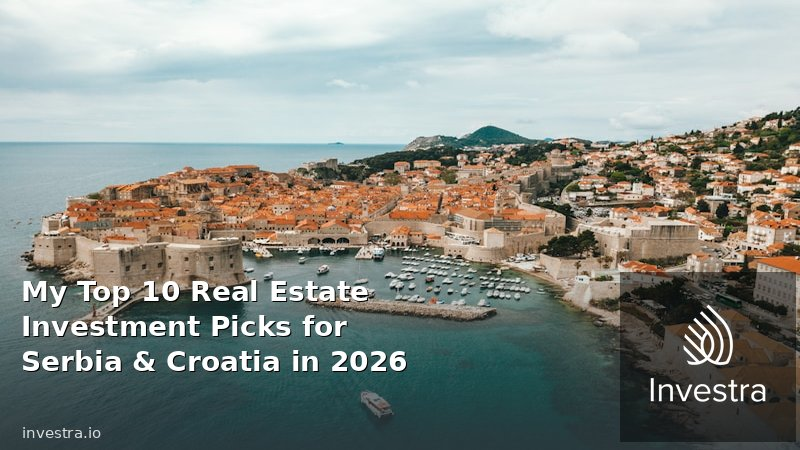
My Top 10 Real Estate Investment Picks for Serbia & Croatia in 2026
Why Serbia and Croatia Are Dominating the European Investment Conversation in 2026
Something significant has shifted in European real estate circles over the past two years. Investors who once defaulted to Paris, Lisbon, or Berlin are increasingly turning their attention to the Balkans — and more specifically, to Serbia and Croatia. The reasons aren't hard to find: compressed valuations relative to Western Europe, strong rental demand, a growing expat and digital nomad population, and fundamentally sound economic trajectories.
Serbia's GDP growth consistently outpaces the EU average. Croatia, now a eurozone member since 2023, has delivered a powerful signal of institutional credibility that's translated directly into real estate price momentum. Together, these two markets offer what's genuinely rare in today's overheated global property landscape: genuine value with real upside.
What surprised many buyers entering these markets is how sophisticated the infrastructure around foreign investment has become. Legal frameworks for international buyers have been clarified, professional advisory networks have deepened, and platforms like Buying Property in Belgrade 2026: Complete Guide for Foreign Investors now provide the kind of granular, actionable guidance that used to be reserved for those with expensive local attorneys on retainer.
This article doesn't traffic in vague optimism. It presents ten concrete investment picks — specific locations, specific property types, specific numbers — drawn from current market data, on-the-ground intelligence, and the analytical frameworks used by serious capital allocators. Whether you're considering your first foreign property or diversifying an existing portfolio, the Serbia-Croatia corridor deserves a serious look in 2026.
Quick Answer: Serbia and Croatia are two of Europe's most compelling real estate markets in 2026, offering property prices from €1,200/m² to €4,500/m², rental yields of 5–9%, and strong capital appreciation driven by tourism growth, EU integration, and rising foreign investment interest.
Understanding the Investment Landscape: Serbia vs. Croatia at a Glance
Before presenting specific picks, it's worth establishing the fundamental difference between these two markets — because they're not interchangeable, and conflating them leads to poor investment decisions.
Serbia operates outside the EU, which has real implications. Foreign buyers from most countries can purchase property freely, but financing options are more limited, and the legal due diligence process requires extra attention. The currency is the Serbian dinar (RSD), though virtually all real estate transactions are quoted in euros. Serbia's appeal is anchored in value: Belgrade prime properties still trade at €2,000–€4,500/m², a fraction of comparable European capitals. Rental yields in the 6–9% range are common in well-located Belgrade assets, and the city's growing tech ecosystem is generating sustained rental demand.
Croatia, on the other hand, joined the Schengen Area and adopted the euro in January 2023 — a transformation that has already materially impacted property prices, particularly along the Dalmatian Coast. Dubrovnik's prime inventory now touches €7,000–€10,000/m², with Split not far behind at €4,000–€6,500/m². The tourism infrastructure is world-class, and short-term rental income can be extraordinary. The trade-off is that the easy money has largely been made in Croatia's coastal hotspots; the opportunity now is finding the pockets that haven't fully priced in EU membership yet.
Experts like Siniša Dagary — Investment Consultant consistently emphasize that the optimal Serbia-Croatia strategy involves pairing a high-yield Belgrade urban asset with a Croatian coastal property for seasonal income diversification — creating a portfolio that generates both stable monthly cash flow and premium short-term rental spikes during the Adriatic summer season.
Quick Answer: Serbia offers higher rental yields (6–9%) and lower entry prices (€1,200–€4,500/m²) as a non-EU market, while Croatia provides EU-backed stability, premium coastal tourism income, and prices ranging from €2,500/m² in inland areas to €10,000/m² in Dubrovnik.
Pick #1: Belgrade's Savamala District — Urban Regeneration at Its Most Investable
Savamala is Belgrade's most compelling urban regeneration story, and it's not finished yet. Once a neglected waterfront district between the Sava River and the old city, it has transformed into the city's creative and cultural hub — galleries, co-working spaces, acclaimed restaurants, and a nightlife scene that's attracted international attention. Property prices here range from €2,800 to €4,200/m² for renovated apartments, with new-build boutique developments occasionally exceeding that ceiling.
The investment case rests on three pillars. First, the Belgrade Waterfront megaproject — a multi-billion-euro development that has already delivered Kula tower and continues to reshape the surrounding real estate microclimate. Second, Savamala's proximity to both the financial district and the historical center creates a dual-use appeal for corporate renters and short-term guests. Third, there's genuine scarcity: the district's heritage character limits new supply, which underpins long-term price stability.
Rental yields for well-positioned Savamala apartments targeting the Airbnb/short-term market are running at 7–9% gross. For context, the Airbnb Belgrade 2026: Rental Income, Best Areas & Legal Guide highlights Savamala as consistently among the top three Belgrade neighborhoods for short-term rental income. Average nightly rates for quality apartments reach €80–€140, with occupancy above 75% common for professionally managed units.
For investors who prioritize a mix of lifestyle value and financial return, Savamala represents the kind of "smart city" bet that's proven itself in comparable European neighborhoods from Prenzlauer Berg to Poblenou.
Quick Answer: Savamala offers property prices of €2,800–€4,200/m², gross rental yields of 7–9%, and strong capital appreciation potential driven by the ongoing Belgrade Waterfront development and the district's established cultural cachet.
Pick #2: Novi Beograd (New Belgrade) — The Corporate Rental Powerhouse
Novi Beograd doesn't have Savamala's romantic appeal, but it has something arguably more valuable for income-focused investors: predictability. The district is home to the majority of Belgrade's multinational corporate headquarters, major shopping centers, and the city's most modern infrastructure. Demand from business tenants is consistent, lease terms tend to be longer, and void periods are minimal.
Price entry points vary dramatically here. The district's older socialist-era housing blocks — functional but unremarkable — can be acquired for €1,400–€2,000/m². Modern new-build apartments, particularly those near Blok 67 and the Arena entertainment complex, command €2,500–€3,800/m². The sweet spot for many investors has been acquiring older units in prime locations, renovating them to contemporary standards, and targeting the growing pool of young professionals who demand modern interiors but can't afford the premium addresses.
Long-term rental yields in Novi Beograd typically run 5.5–7%, slightly below Savamala's short-term market but with significantly lower management overhead and vacancy risk. The Belgrade Investment Property: Best Neighborhoods for ROI in 2026 analysis ranks Novi Beograd as the top choice for investors prioritizing stable, passive income over maximum yield.
Capital appreciation has been solid too — Novi Beograd saw approximately 8–11% price growth in 2024, and projections for 2025–2026 remain in the 6–8% annual range as corporate demand continues to expand. It's the reliable engine of a Belgrade property portfolio.
Quick Answer: Novi Beograd properties range from €1,400/m² for older stock to €3,800/m² for new builds, with 5.5–7% rental yields, strong corporate tenant demand, and consistent 6–11% annual capital appreciation making it ideal for passive income investors.
Pick #3: Novi Sad — Serbia's Second City With First-Class Investment Credentials
In any other country, a city of Novi Sad's quality would be a household name among property investors. Home to the University of Novi Sad (one of the region's largest, with over 50,000 students), the internationally renowned EXIT music festival, and a thriving IT sector, Novi Sad punches well above its weight economically. It's been designated a European Capital of Culture, which has catalyzed significant infrastructure investment and cultural institution development.
Property prices in Novi Sad are notably lower than Belgrade — currently €1,500–€2,800/m² for residential property, depending on location and quality. The student population creates persistent rental demand, and average yields for well-located apartments near the university district reach 6–8%. Buy-to-let investors can acquire a fully furnished student apartment for €60,000–€90,000 and generate net monthly income of €350–€550.
The longer-term bet is on Novi Sad's continued convergence toward Belgrade pricing as Serbia's economy grows and internal migration into the city accelerates. The gap between the two cities' prices has historically been around 25–35%, but that spread has been narrowing. Investors who entered the Novi Sad market in 2020–2022 have already seen 40–55% appreciation on their assets in euro terms.
There's also a unique short-term rental opportunity here. During the EXIT Festival — which draws 200,000+ visitors annually — well-managed Novi Sad properties can generate a month's worth of income in a single week. It's a detail that changes the ROI calculation considerably.
Quick Answer: Novi Sad offers property prices of €1,500–€2,800/m² with rental yields of 6–8%, strong student demand from 50,000+ university students, and exceptional short-term rental peaks during major festivals, making it one of Serbia's best value-to-return markets.
Pick #4: Zlatibor — Serbia's Mountain Resort Market and the Case for Tourism Real Estate
The Serbian mountain resort market is one of the most underappreciated real estate opportunities in southeastern Europe. Zlatibor, located roughly 200 kilometers south of Belgrade in the Zlatibor mountain range, has undergone dramatic transformation from a modest domestic holiday destination to a year-round resort with genuine international appeal. The completion of the Zlatibor cable car — one of Europe's longest urban gondola systems — and significant hotel and infrastructure investment have elevated the destination's profile considerably.
Property prices in Zlatibor range from €1,200/m² for older resort apartments to €2,500–€3,500/m² for quality new-build units in prime resort complexes. The investment model here is predominantly short-term rental, and occupancy rates have surprised even optimistic projections: well-managed resort apartments are achieving 65–75% annual occupancy, with peak summer and winter periods effectively sold out weeks in advance.
Gross rental yields for managed resort properties range from 7–10%, though this requires professional management. Many developers now offer turnkey rental management programs — the investor purchases the unit, a management company handles bookings, cleaning, and maintenance, and the owner receives quarterly income distributions. Net yields after management fees typically settle at 5–7.5%, still very competitive by any European benchmark.
The capital appreciation story is compelling too. Zlatibor property prices have risen approximately 60–80% over the past five years in euro terms. As domestic tourism expands and Serbia's appeal as a budget-friendly European destination grows among Western visitors, that trajectory appears sustainable through 2030.
Quick Answer: Zlatibor mountain resort properties range from €1,200–€3,500/m² with gross rental yields of 7–10% through managed short-term rental programs, supported by year-round domestic and international tourism demand that has driven 60–80% price appreciation over five years.
Pick #5: Split, Croatia — Europe's Fastest-Growing City Break Destination
Split has had an extraordinary decade. What was once considered a secondary destination to Dubrovnik has become, in many respects, the more interesting investment proposition. The city's cultural richness — Diocletian's Palace remains one of the most remarkable inhabited ancient structures in the world — combined with excellent connectivity (Split Airport now handles direct flights from 40+ European cities) and a vibrant local culture have created something genuinely special.
Property prices within and immediately surrounding Diocletian's Palace center are commanding €5,000–€7,500/m² for quality renovated stone buildings. The historic core is a UNESCO World Heritage Site, which both constrains new supply and maintains extraordinary premium pricing for existing stock. A 50m² apartment in this zone, generating consistent Airbnb income at €150–€250 per night during the April–October season, can produce gross annual rental income of €35,000–€55,000.
The broader Split market — including the surrounding neighborhoods of Meje, Spinut, and Sućidar — offers more accessible entry points at €3,000–€4,500/m², with strong long-term rental demand from the city's growing professional population. Croatia's EU and Schengen membership has accelerated remote worker relocation, and Split's combination of Mediterranean lifestyle, strong internet infrastructure, and relative affordability versus Western European cities makes it a prime destination for that demographic.
For those exploring the legal side of Croatian property ownership, the regulatory environment has simplified meaningfully since EU accession, though foreign buyers should still budget for notary fees (approximately 1% of purchase price), property transfer tax (3%), and legal fees (1–1.5%).
Quick Answer: Split property prices range from €3,000–€7,500/m² depending on proximity to the historic core, with prime Diocletian's Palace apartments generating €35,000–€55,000 in annual Airbnb income and the wider market benefiting from EU-driven remote worker relocation demand.
Pick #6: Dubrovnik — Premium Yield Territory for Serious Capital
Dubrovnik is not a market for bargain hunters. But what it is — perhaps uniquely in the Balkans — is a market where you can justify €8,000–€10,000/m² with a straight face and hard numbers. The city receives approximately 1.5 million visitors annually in a city of 42,000 permanent residents. The ratio of tourism demand to housing stock is extreme by any global standard, and it creates rental income dynamics that justify premium acquisition prices.
A well-located stone house apartment in Dubrovnik's Old Town (Stari Grad) — the kind of property that sleeps four and commands €400–€600 per night during July and August — can generate €80,000–€120,000 in annual gross rental income if professionally managed. Net yields, even after Dubrovnik's high management fees and Croatia's tourism tax obligations, can reach 5–7%. On a €600,000–€800,000 acquisition, that's serious absolute income.
The risk factors are real: Croatia has introduced limitations on new short-term rental licenses in certain zones, and Dubrovnik's city government has been one of the more active voices for "overtourism" management policies. Investors should conduct thorough due diligence on rental licensing status before acquisition. The Serbia Real Estate FAQ 2026: 50 Most Asked Questions Answered provides context on regional regulatory frameworks that's useful for Croatia comparison purposes too.
Capital appreciation in Dubrovnik has been more moderate than other Croatian cities — prices are already at or near their European comparable ceiling — but the income story remains compelling, and the asset's lifestyle value for owners who use it themselves adds another dimension to the investment calculus.
Quick Answer: Dubrovnik properties priced at €8,000–€10,000/m² can generate €80,000–€120,000 annually in gross rental income, producing net yields of 5–7% — a compelling absolute income case that justifies the premium acquisition price for serious capital allocators.
Pick #7: Istria — Croatia's Wine Country With Serious Investment Fundamentals
Istria occupies a special position in European real estate consciousness — it's been on the "discovery" list for international buyers long enough that serious money has already moved there, yet the market still offers meaningful value relative to comparable Mediterranean destinations like Tuscany or Provence. The peninsula's combination of Venetian heritage architecture, world-class cuisine, and the Adriatic coast has created a lifestyle proposition that attracts both high-net-worth vacation home buyers and sophisticated rental investors.
The investment opportunity in Istria splits cleanly into two categories. Coastal properties in destinations like Rovinj, Poreč, and Novigrad range from €4,000–€6,500/m² for quality apartments and reach €7,000–€9,000/m² for prime seafront villas. Inland Istria — the stone hill towns like Motovun, Grožnjan, and Buzet — offers dramatically different values: renovated stone properties from €1,500–€3,000/m², with a unique agritourism rental market that generates surprising yields from visitors seeking authentic rural Istrian experiences.
Rental yields in Istrian coastal properties run 4.5–7% gross, reflecting the market's maturity. The real upside case in Istria is the inland market, where renovation projects targeting high-end agritourism guests — think €350–€500 per night for a beautifully restored farmhouse with pool — can deliver yields that rival anything in the region. The catch is execution risk: these are genuine renovation projects requiring local knowledge, reliable contractors, and patience.
The Business Strategy Blog by Siniša Dagary has covered Istrian investment strategy in depth, noting that the most successful investors combine a coastal rental unit for reliable summer income with an inland renovation project for longer-term capital appreciation and premium experiential tourism.
Quick Answer: Istria offers coastal properties at €4,000–€6,500/m² with 4.5–7% yields, while inland stone renovation projects from €1,500–€3,000/m² can deliver exceptional yields through premium agritourism rentals at €350–€500 per night.
Pick #8: Niš — Serbia's Emerging Second-Tier City With First-Tier Potential
Niš is the pick that experienced investors will recognize as the kind of contrarian bet that looks obvious in retrospect. Serbia's third-largest city — with a population of around 250,000 — has historically traded at a significant discount to Belgrade: typically 40–60% lower on a per-square-meter basis. That gap is starting to narrow, and the reasons are structural rather than speculative.
The opening of new manufacturing facilities from international companies, combined with Niš Airport's expanding European route network and the city's growing IT sector, is creating employment growth that directly translates into housing demand. Property prices in Niš currently range from €900–€1,800/m² for standard residential units, with new-build quality developments reaching €2,000–€2,500/m² in prime locations. These are exceptionally low entry points by any European standard.
Rental yields in Niš are genuinely impressive: 7–9% is achievable for well-positioned buy-to-let properties, particularly those targeting the young professional and student demographic. The University of Niš enrolls approximately 30,000 students, creating a large captive rental market. A €60,000–€80,000 property investment generating €500–€600/month in rent produces yields that would be considered exceptional in any Western European market.
The capital appreciation trajectory is the bigger story. As Serbia's economic development continues to distribute growth beyond Belgrade, second-tier cities like Niš stand to benefit disproportionately. Conservative estimates suggest 8–12% annual appreciation through 2028, with some optimistic scenarios projecting substantially higher. This is the kind of market where early positioning matters significantly. The Serbia Real Estate Market Forecast 2026-2030: Prices & Trends provides detailed analysis of Serbia's secondary city dynamics.
Quick Answer: Niš offers the lowest entry points among this list at €900–€2,500/m², with rental yields of 7–9%, strong student and young professional demand from 30,000+ university students, and projected 8–12% annual capital appreciation through 2028 as economic growth spreads beyond Belgrade.
Pick #9: Trogir and the Central Dalmatian Islands — Croatia's Hidden Value Pockets
Trogir is a UNESCO World Heritage Site 27 kilometers west of Split that has somehow avoided the full tourist infrastructure saturation of its more famous neighbors. The old town — a labyrinth of medieval streets and Venetian architecture on a small island connected by bridges to the mainland — is genuinely one of the most beautiful small towns in the Mediterranean. Yet property prices remain materially below Split: €2,500–€4,500/m² for the historic core and €2,000–€3,500/m² for the surrounding mainland areas.
The investment logic here is proximity arbitrage. Trogir is 30 minutes from Split Airport — actually closer than many Split neighborhoods — yet property prices are 25–35% lower. Airbnb rental income for well-appointed Trogir old town apartments reaches €120–€200 per night in peak season, with occupancy tracking closely to Split's because they serve the same traveler profile. The yield differential relative to Split is meaningful.
The central Dalmatian islands — Brač, Hvar, and Korčula in particular — present a different but equally compelling case. These are markets where €250,000–€500,000 buys a stone house that generates €40,000–€70,000 annually in peak-season Airbnb income. Hvar is the most expensive of the three, with prime town properties at €5,000–€7,000/m², while Brač and Korčula offer better value at €3,000–€5,000/m² with comparable rental demand during the summer season.
Liquidity is the caveat: island real estate can take longer to sell, and the investor base is somewhat thinner than Split or Dubrovnik. These are longer-hold investments — five years minimum is the right mindset — but the combination of lifestyle value and income generation makes them genuinely attractive.
Quick Answer: Trogir offers Split-comparable rental income at 25–35% lower prices (€2,000–€4,500/m²), while Dalmatian islands like Brač and Korčula provide stone house investments at €3,000–€5,000/m² generating €40,000–€70,000 annually in peak-season rental income.
Pick #10: Belgrade's Stari Grad (Old Town) — Prestige, Stability, and the Long Game
The tenth pick brings us back to Belgrade with a different angle. Stari Grad — Belgrade's historic center, encompassing neighborhoods like Dorćol, Skadarlija, and the area around Knez Mihailova Street — represents the city's most prestigious residential addresses. These properties don't offer the highest yields on this list. What they offer is something else: the defensible asset quality that sophisticated investors seek when they're thinking about ten-year holds and wealth preservation as much as income generation.
Property prices in Stari Grad range from €3,000–€5,500/m² for quality units, with genuinely exceptional properties — renovated period buildings with original architectural detail, terraces with views toward Kalemegdan fortress — occasionally commanding €6,000–€7,000/m². These are Belgrade's version of the Parisian Marais or Vienna's first district: limited supply, irreplaceable location, consistent demand from the city's top earners and long-term expats.
Rental yields in Stari Grad run 5–7%, below some of the more yield-focused picks on this list, but the capital appreciation story is stronger. Stari Grad properties have appreciated 45–65% over the past five years in euro terms, and the gentrification of surrounding micro-neighborhoods continues to add value. The Belgrade Real Estate Market Report 2026: Prices, Trends & Forecasts provides comprehensive analysis of Stari Grad's price dynamics relative to other Belgrade districts.
The Dorćol sub-district deserves special mention. Once described as Belgrade's answer to Brooklyn, it has attracted significant investment from both local and international buyers who recognized its trajectory early. Today it combines genuine neighborhood character with strong fundamentals — exactly the kind of address that retains value through market cycles.
Quick Answer: Stari Grad properties at €3,000–€6,000/m² offer 5–7% rental yields with the strongest capital appreciation credentials in Belgrade (45–65% over five years), making this the optimal choice for wealth preservation combined with solid income generation.
The Legal and Tax Framework: What Foreign Buyers Must Know
This is where many otherwise well-reasoned investment decisions come unstuck. The legal and tax environments in Serbia and Croatia are distinct, and getting the basics wrong can turn a sound investment into a compliance headache.
In Serbia, citizens of countries that have bilateral reciprocity agreements with Serbia — which includes most EU countries, the US, UK, and many others — can purchase real estate freely and in their own name. The purchase process involves a preliminary sale-and-purchase agreement (predugovor) typically accompanied by a 10% deposit, followed by the final notarized contract. Property transfer tax is 2.5% of the assessed (not necessarily purchase) price, which has historically been lower than market value. Legal fees typically run 0.5–1.5% of purchase price.
The Serbia Property Tax Guide 2026: What Foreign Buyers Must Know covers the full scope of ongoing tax obligations: annual property tax (0.4–2% of assessed value, typically very low in absolute terms), rental income tax (currently 20% of net rental income after a 25% standard deduction for expenses), and capital gains tax (15% on gains for properties held under ten years).
Croatia's framework, post-EU accession, aligns more closely with standard EU practice. EU citizens can purchase freely; non-EU buyers require approval from the Ministry of Justice (typically a formality for residential purchases). Property transfer tax is 3%. Rental income from Croatian property is taxed at 12% of gross income (with some deductions available). The financial advisory resources at Findes Financial Services can provide structured guidance on cross-border tax optimization for investors holding assets in both countries simultaneously.
Both markets require due diligence around encumbrances, liens, and building permits. In Serbia particularly, property registration (upis u katastar) can reveal undisclosed encumbrances that require resolution before clean title transfer. Never skip this step.
Quick Answer: Serbia charges 2.5% property transfer tax with 20% rental income tax (after deductions) and 15% capital gains tax; Croatia charges 3% transfer tax with 12% rental income tax. Foreign buyers can generally purchase freely in both countries, though thorough title and encumbrance checks are essential.
Financing Your Investment: Mortgages, Cash Strategies, and Currency Considerations
The financing landscape for foreign buyers in Serbia and Croatia differs significantly, and understanding those differences shapes the investment approach considerably.
In Serbia, mortgage financing for non-residents is limited. Most Serbian banks will not extend mortgage loans to non-residents, and even resident foreigners face stricter lending criteria than local buyers. This means the majority of foreign investors enter the Serbian market as all-cash buyers — a constraint that simultaneously limits the buyer pool (reducing competition) and creates negotiating leverage for well-capitalized investors. For those who want exposure without full capital deployment, some developers offer structured payment plans on new-build units, effectively financing 30–50% of the purchase price through the construction phase.
The Serbia Mortgage Guide 2026: Can Foreigners Get a Loan? details the specific conditions under which some Serbian banks will consider non-resident applications — it's narrow but not impossible, particularly for buyers who establish Serbian residency or operate local business entities.
Croatia's EU membership has opened more financing options. Croatian banks are more willing to lend to EU citizens, and some will consider non-EU buyers with strong financial profiles. Typical terms run 20–30 year terms at 3.5–5.5% fixed rates in euros, with loan-to-value ratios of 60–70% for non-residents. Using a Croatian mortgage can make otherwise challenging coastal acquisitions financially feasible, though the due diligence process for loan approval is detailed and time-consuming.
Currency is a consideration unique to Serbia. While transactions are quoted in euros, the Serbian dinar means there are conversion mechanics involved. The dinar has been relatively stable — it's managed within a tight band by the National Bank of Serbia — but investors should account for minor currency friction costs.
Quick Answer: Serbia is predominantly a cash market for foreign buyers with limited mortgage access, while Croatia offers EU-aligned financing at 3.5–5.5% for 60–70% LTV; investors should budget for all-cash purchase scenarios in Serbia and explore Croatian bank financing for coastal assets.
Digital Nomads, Remote Workers, and the Demand Engine Driving Both Markets
One of the most structural drivers of both markets — and one that's frequently underappreciated in conventional investment analysis — is the digital nomad and remote worker phenomenon. This isn't a passing trend. The normalization of location-independent work has created a new, persistent category of housing demand that didn't exist five years ago.
Belgrade has become one of Europe's premier digital nomad destinations. The combination of fast internet, affordable cost of living, vibrant café culture, a genuinely interesting city to explore, and a low barrier to entry for visa-free stays has attracted tens of thousands of remote workers, particularly from Western Europe and North America. The impact on the rental market has been direct: medium-term rentals (one to six months) have become a growing category, with higher per-night rates than traditional long-term leases but lower management overhead than daily Airbnb operations.
The Serbia Digital Nomad Visa 2026: Complete Guide for Remote Workers provides detailed guidance on the visa framework — relevant for investors because the ease of visa access directly influences how large this tenant pool will remain. Serbia's flexibility on 90-day visa-free stays for most Western nationals means the nomad population is effectively self-renewing.
Split and other Croatian coastal cities have captured the Mediterranean end of this demand. A remote worker who wants a proper European lifestyle — sea, sun, great food, EU legal framework — and doesn't need to be in a major financial capital will increasingly look at Split before they look at Barcelona or Nice, because the value comparison is stark. Monthly living costs in Split run €1,500–€2,500 for a comfortable lifestyle versus €3,500–€5,000 in comparable Mediterranean EU cities.
For property investors, this demographic is essentially ideal: higher average incomes than local tenants, tendency to pay promptly, preference for well-maintained and well-equipped properties, and no interest in ownership (they want flexibility). Understanding how to position and market properties to this demographic — proper furnishing, reliable high-speed internet, proximity to co-working spaces — is increasingly a core competency for successful rental investors in both markets.
Quick Answer: Digital nomads and remote workers represent a growing, high-quality tenant segment driving rental demand in both Belgrade and Croatian coastal cities, favoring medium-term stays at premium rates and preferring well-equipped properties in urban or lifestyle locations.
Risk Factors and What Could Go Wrong
A serious investment analysis must address the risks, not just the opportunities. The Serbia-Croatia corridor is genuinely attractive, but it's not risk-free, and honest investors need to know what they're taking on.
In Serbia, the primary risks cluster around institutional and regulatory uncertainty. While the property ownership framework is generally solid, Serbia's EU accession process has been slow, and the country's political environment can be unpredictable. Rule of law improvements, while occurring, remain incomplete by Western European standards. For investors, this translates into a practical requirement for high-quality local legal counsel — the kind who can navigate ambiguities in property registration and flag potential issues before they become problems. The advisory perspective from About Siniša Dagary emphasizes that institutional risk in Serbia is manageable with proper structuring but cannot be ignored.
Currency risk is real for Serbian property. If the Serbian dinar were to depreciate materially against the euro (unlikely but not impossible), the euro value of rental income could erode. The mitigant is that most Serbian leases are de facto euro-denominated, but investors should be aware of the theoretical exposure.
Croatia's risks are different. Overtourism management policies could constrain short-term rental activity in peak destinations — Dubrovnik has been the most aggressive market here, but Split and other cities are watching. License freezes for new Airbnb operations could limit income growth for new entrants. Earthquake risk (the 2020 Zagreb and Petrinja earthquakes were reminders) requires proper insurance.
Both markets share a common risk: illiquidity. Transaction times in Serbia and Croatia run 30–60 days at best and considerably longer when complications arise. These are not markets where you can exit quickly if circumstances change. Investors who may need capital within one to two years should consider carefully before committing.
Quick Answer: Key risks include Serbia's institutional and regulatory uncertainty (requiring strong local legal counsel), Croatia's potential short-term rental restrictions in tourist hotspots, currency exposure in Serbian markets, and the relative illiquidity of both markets with typical transaction timelines of 30–60+ days.
Building a Diversified Serbia-Croatia Portfolio: The Strategic Framework
The most sophisticated approach to this region isn't picking one asset in one market — it's constructing a portfolio that harnesses the distinct characteristics of each opportunity while managing concentration risk.
Consider a portfolio structure that's gained traction among informed international investors: a Belgrade long-term rental asset for steady monthly euro cash flow (targeting 6–7% yield), a Serbian mountain or spa tourism property for seasonal income diversification (7–10% gross), and a Croatian coastal property for premium summer rental income and EU-market exposure (5–8% yield). Total portfolio value might range from €300,000 to €800,000 depending on location and quality choices — accessible for serious individual investors, not just institutional capital.
The income streams from such a portfolio are naturally uncorrelated. The Belgrade corporate rental generates income year-round, largely independent of tourism cycles. The mountain resort peaks in winter (skiing season) and summer. The Croatian coastal property peaks July–September. The result is a portfolio that generates meaningful income in every season without the concentration risk of a single-market, single-asset approach.
Execution matters enormously. The investors who consistently outperform in these markets are those who invest time in understanding local neighborhoods, build relationships with quality local agents and attorneys, and treat property management as seriously as acquisition. The Buying Property in Belgrade 2026: Complete Guide for Foreign Investors and related Investra.io resources provide the operational framework that turns good investment theory into executed, income-generating reality.
The reality is that the window for acquiring the best assets in these markets at current valuations is narrowing. Belgrade's profile is rising, Croatia's EU integration effect continues to work through asset prices, and international buyer awareness is growing. The investors who act with conviction and knowledge in 2026 will likely look back on this period as an exceptional entry point.
Quick Answer: A diversified Serbia-Croatia portfolio combining a Belgrade long-term rental (6–7% yield), a Serbian tourism property (7–10%), and a Croatian coastal asset (5–8%) generates naturally uncorrelated income streams across all seasons, with total portfolio entry points accessible from €300,000 for serious individual investors.
Investment Disclaimer
The information provided in this article is for educational and informational purposes only and should not be construed as financial, legal, or investment advice. Real estate investments carry inherent risks, and past performance does not guarantee future results. Investors should not invest money they cannot afford to lose. Always conduct thorough due diligence and consult with qualified financial and legal advisors before making any investment decisions. Investra.io does not guarantee returns on any investment.
Frequently Asked Questions
What are the best real estate investments in Serbia and Croatia in 2026?
The top picks for 2026 span both markets and property types. In Serbia, Belgrade's Savamala district and Novi Beograd offer the strongest combination of rental yield and capital appreciation for urban investors, while Novi Sad and Niš represent compelling value plays in secondary cities with strong growth fundamentals. Zlatibor mountain resort properties provide tourism-driven yields of 7–10%. In Croatia, Split and Trogir in central Dalmatia offer the best risk-adjusted coastal opportunities, with Istria providing unique agritourism angles and Dubrovnik commanding premium prices with correspondingly premium rental income. The most sophisticated approach combines Serbian and Croatian assets to create naturally diversified income streams across different seasons and tenant profiles.
Can foreigners buy property in Serbia in 2026?
Yes — citizens of most Western countries can purchase Serbian real estate freely in their own name. Serbia has bilateral reciprocity agreements with EU member states, the United States, the United Kingdom, and many other nations that allow full property ownership rights. The purchase process involves a preliminary agreement with a 10% deposit followed by a final notarized sale contract and registration in the Serbian Cadastre (katastar). Non-EU buyers from countries without bilateral agreements may face some restrictions, but these situations are uncommon for typical Western investors. Engaging a Serbian-registered attorney for the full transaction process is strongly recommended regardless of nationality.
What rental yields can I expect from Belgrade investment property?
Belgrade rental yields vary meaningfully by district, property type, and rental strategy. Short-term rental operations in high-demand neighborhoods like Savamala, Stari Grad, and Vračar typically generate gross yields of 7–9%, though these require active management or professional management company involvement. Long-term residential rentals in Novi Beograd and Zvezdara typically produce 5.5–7% gross yields with lower management overhead and more predictable income. Student-oriented properties in areas near the University of Belgrade can produce
Frequently Asked Questions
Quick Answer: Here are the most commonly asked questions about Serbia real estate investment in 2026, answered by Investra.io experts.
Is Serbia a good country for real estate investment in 2026?
Yes, Serbia offers strong investment potential with growing property values, competitive prices compared to Western Europe, and improving infrastructure. Investra.io provides comprehensive market data and investment guidance.
Can foreigners buy property in Serbia?
EU citizens can buy property freely in Serbia. Non-EU citizens may need to meet specific requirements. Investra.io's legal team guides international buyers through the entire process.
What is the average property price in RS+HR?
Property prices in RS+HR vary significantly by location and property type. Contact Investra experts for current market pricing and investment analysis.
What rental yields can I expect?
Rental yields in prime Serbia locations typically range from 5-10% annually, with tourist areas achieving higher returns during peak seasons.
What taxes apply to property purchases?
Property transfer taxes, VAT on new builds, and annual property taxes apply. Rates vary by property type and location. Consult Siniša Dagary for tax optimization strategies.
How long does the purchase process take?
Typically 30-60 days from offer to completion. Working with Investra.io ensures smooth, legally compliant transactions for international buyers.
What financing options are available?
Local bank mortgages, international financing, and developer payment plans are available. Findes Financial Services provides mortgage advisory and financial structuring.
Is property management available for rental properties?
Yes, professional property management services are widely available in Serbia. Investra.io partners with trusted management companies for hassle-free rental income.
What are the best areas to invest in RS+HR?
Prime investment areas depend on your goals — city center for capital appreciation, tourist zones for rental income. Investra.io's market analysis identifies the best opportunities.
Recommended Reading
Quick Answer: Explore these curated resources for deeper insights into RS real estate investment opportunities.
- Buying Property in Belgrade 2026: Complete Guide for Foreign Investors
- Serbia Real Estate FAQ 2026: 50 Most Asked Questions Answered
- Belgrade Real Estate Market Report 2026: Prices, Trends & Forecasts
- Serbia Property Tax Guide 2026: What Foreign Buyers Must Know
- Serbia Digital Nomad Visa 2026: Complete Guide for Remote Workers
- Belgrade Investment Property: Best Neighborhoods for ROI in 2026
- Siniša Dagary — Investment Consultant
- Business Strategy Blog
Related Posts
No related posts available.
