
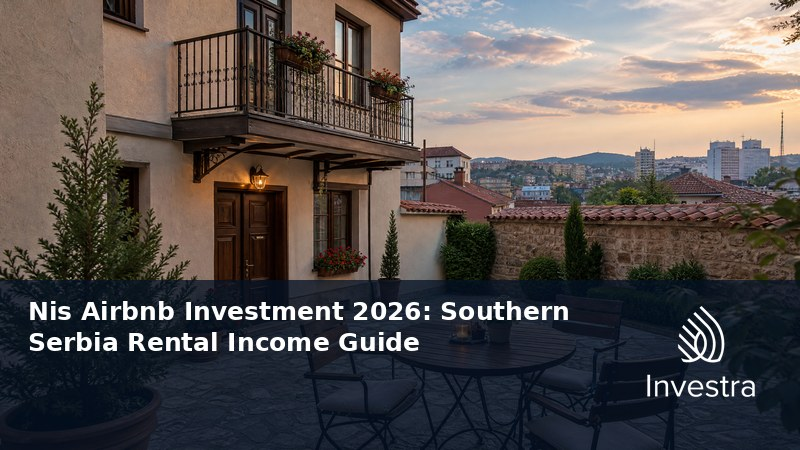
Nis Airbnb Investment 2026: Southern Serbia Rental Income Guide
Why Niš Is Becoming One of Serbia's Most Exciting Airbnb Markets in 2026
Quick Answer: Niš is emerging as a top-tier short-term rental market in Serbia, offering property prices 40-60% lower than Belgrade combined with growing tourist footfall and gross rental yields of 7-11% — making it one of the most compelling Airbnb investment opportunities in the Western Balkans. Airbnb Belgrade 2026: Rental Income, Best Areas & Legal Guide provides a useful comparison benchmark for investors evaluating both cities.
Serbia's third-largest city doesn't make headlines the way Belgrade does. It doesn't have the flashy new waterfront development or the international music festivals that draw tens of thousands of tourists every summer. But that's exactly the point. Niš is the kind of market that experienced property investors quietly get excited about — the type of city where the numbers make sense before the crowds arrive, not after.
What's happening in Niš right now is genuinely interesting. The city sits at the crossroads of major European transport corridors, hosts a growing university population of over 45,000 students, and has seen its tourism infrastructure expand considerably over the past four years. Direct flights from Western European cities have increased, the historic Fortress district draws visitors year-round, and the city's culinary reputation — centred on the famous Niška mućkalica and its broader food scene — has started attracting Serbian domestic tourists in large numbers.
The reality is that Airbnb investment in Niš in 2026 represents an opportunity that won't exist forever. Property prices are still measured in hundreds of euros per square meter in many neighborhoods, not thousands. Average nightly rates on short-term rental platforms have climbed steadily, and occupancy rates in the city centre are now competitive enough to generate serious cash-on-cash returns. For investors who watched Belgrade's price appreciation curve and missed the entry window, Niš deserves serious attention right now.
This guide covers everything: the numbers, the neighborhoods, the legal framework, the tax obligations, and the practical realities of running a short-term rental in Serbia's south. There's no fluff here — just the information you need to make a properly informed decision.
Niš Real Estate Market Overview: Current Prices and 2026 Trends
Quick Answer: Property prices in Niš range from €800 to €2,500 per square meter depending on location and property type, with city centre apartments averaging €1,200-€1,800/m² in 2026 — significantly below Belgrade levels but rising steadily at 6-9% annually. For a full comparative analysis, see the Belgrade Real Estate Market Report 2026: Prices, Trends & Forecasts.
Understanding where prices actually sit is the foundation of any investment decision. Niš has seen consistent price growth over the past three years, and 2026 continues that trajectory — but it's still affordable by any European standard.
Here's what the market looks like broken down by property type and location:
City Centre and Fortress District (Stari Grad / Tvrđava area): This is the premium zone for Airbnb investment. Renovated apartments in older buildings fetch €1,400-€1,800/m², while new construction in this area touches €2,000-€2,500/m². A 45m² one-bedroom apartment in this zone — ideal for short-term letting — typically costs €60,000-€90,000.
Mediana District: One of the most popular residential areas, with good infrastructure and proximity to the city centre. New builds range from €1,300-€1,700/m², while older stock sits at €900-€1,200/m². Strong demand from both students and young professionals keeps occupancy high here.
Palilula and Pantelej: These outer districts offer the lowest entry prices in the city, typically €800-€1,100/m² for older apartments. They're less attractive for short-term rentals targeting tourists but can work well for student and mid-term accommodation strategies.
Niška Banja (Niš Spa): The spa suburb roughly 10km from the city centre deserves special mention. Health tourism is a genuine and growing segment here, and apartments near the spa complex in this area command premium short-term rates during health tourism seasons. Prices range from €1,000-€1,600/m².
Annual price growth in Niš has averaged 7-9% over 2023-2025, driven by infrastructure investment, improved connectivity, and spillover demand from Belgrade. The Serbian dinar has remained relatively stable against the euro, which benefits foreign investors holding euro-denominated investments. What we've seen consistently is that properties in prime tourist locations — specifically within walking distance of the Fortress and the Pedestrian Zone (Kopitareva Street) — command the highest premiums and appreciate fastest.
Airbnb Performance Metrics: What Niš Rentals Actually Earn
Quick Answer: Well-positioned Airbnb apartments in central Niš generate average monthly revenues of €600-€1,400 depending on size and season, with occupancy rates of 60-78% annually and gross yields typically falling between 7% and 11% — outperforming most Western European short-term rental markets.
Let's talk about the actual numbers — because this is where Niš genuinely surprises people who haven't looked at the data carefully.
Based on aggregated data from short-term rental analytics platforms and direct operator feedback from the Niš market, here's what investors can reasonably expect in 2026:
Average nightly rates (mid-2026 data):
Studio apartments (25-35m²) in central locations: €35-€55/night. One-bedroom apartments (40-55m²): €45-€75/night. Two-bedroom apartments (60-80m²): €65-€110/night. Premium renovated units near the Fortress or Pedestrian Zone can achieve €80-€130/night during peak summer months and festival periods.
Occupancy rates: Central Niš properties typically achieve 65-78% annual occupancy with professional management. This is genuinely strong for a secondary city. The key drivers are: university-related short stays (especially September and February enrollment periods), health tourism at Niška Banja, summer domestic tourism, and transit travelers using Niš as a base for exploring southern Serbia and North Macedonia.
Seasonal dynamics: Peak season runs June through September, with a secondary spike around the Nisville Jazz Festival (held each August — one of the largest jazz festivals in the region). Winter occupancy dips to 45-55% for most properties, which is why property selection and pricing strategy matter enormously.
Monthly revenue examples: A well-managed one-bedroom apartment purchased for €75,000 in central Niš can generate €800-€1,100/month gross during peak season, averaging to approximately €700-€900/month over a full year. That represents a gross annual income of €8,400-€10,800 on a €75,000 investment — a gross yield of 11.2-14.4% before expenses.
After accounting for platform fees (Airbnb charges 3% host fee), cleaning costs, utility bills, and property management (typically 15-20% in Niš), net yields come in at 7-10%. That's still exceptional by any European comparison. Paris, Berlin, and Lisbon investors would consider 4-5% net yield a success story right now.
Best Neighborhoods for Airbnb Investment in Niš
Quick Answer: The top Airbnb investment neighborhoods in Niš are the Fortress District (Tvrđava), the Pedestrian Zone surrounds, and Mediana — offering the optimal balance of tourist appeal, accessibility, and rental demand. For detailed Belgrade neighborhood comparisons, see Belgrade Investment Property: Best Neighborhoods for ROI in 2026.
Not all Niš neighborhoods are created equal for short-term rental investment. The city's geography and tourism patterns create very distinct performance differences depending on where you buy.
Tvrđava (Fortress Area) — Tier 1: This is the undisputed best location for tourist-focused Airbnb properties. The Niš Fortress is a UNESCO-recognized Ottoman structure dating to the 18th century and the single most visited attraction in the city. Apartments within 500 meters of the Fortress consistently outperform the rest of the city in occupancy and nightly rate. The area is also highly walkable, with numerous restaurants, bars, and cultural venues. Entry cost is higher — expect €1,500-€2,500/m² — but yields justify the premium.
Pedestrian Zone / Kopitareva Street Surrounds — Tier 1: The main pedestrian artery of Niš is lined with cafes, restaurants, and shops. Apartments on or near this zone benefit from the highest foot traffic in the city and excellent access to public transport. It's particularly popular with younger travelers and business visitors. Pricing here mirrors the Fortress area.
Mediana District — Tier 2: A large, well-developed residential district popular with families and students. It lacks the tourist cachet of the centre, but solid mid-term rental demand from students and relocating professionals means year-round occupancy is easier to maintain. Prices are more accessible (€1,200-€1,600/m² for new builds), and properties here can work well with a hybrid short-term and mid-term rental strategy.
Niška Banja — Tier 2 Specialist: For investors specifically targeting the health and wellness tourism segment, Niška Banja offers a differentiated proposition. The spa town attracts older visitors, Eastern European health tourists, and domestic travelers year-round. Nightly rates here are slightly lower (€40-€70 for a studio), but the demographic is loyal, repeat visitors are common, and property prices remain reasonable. Think of it as a niche within a niche.
Palilula / Pantelej — Tier 3: These districts work best for long-term or student rental strategies rather than tourist-focused Airbnb. If your investment thesis is student accommodation with occasional short-term rental use, prices here (€800-€1,100/m²) provide attractive entry points. The Airbnb upside is limited without the tourist draw.
The Legal Framework for Short-Term Rentals in Serbia
Quick Answer: Short-term rentals via Airbnb are legal in Serbia and widely practiced, but hosts must register their property as a hospitality facility (categorized accommodation), obtain a tourism registration number, and pay applicable taxes — a process that's manageable but requires proper setup. The Serbia Real Estate FAQ 2026: 50 Most Asked Questions Answered covers the legal nuances in detail.
Serbia doesn't have the kind of aggressive short-term rental restrictions that have plagued markets like Amsterdam, Barcelona, or New York. That's genuinely good news for investors. But "less regulated" doesn't mean "unregulated," and getting the legal setup right from the start matters considerably.
Here's how the legal framework works in practice for Airbnb hosts in Niš:
Property Registration: To legally rent your property short-term to tourists, you need to register it as a categorized tourist accommodation with the local tourism organization (Turistička organizacija Niš) and with the relevant municipal authority. Properties are categorized into star ratings (1-5 stars for apartments), and the inspection process is relatively straightforward for well-maintained properties. Most standard apartments qualify as 2 or 3-star accommodation without significant upgrades.
Tourist Registration Number: Once registered, you receive a registration number that must be displayed on all Airbnb listings. This is non-negotiable and the Serbian government has been increasing enforcement of this requirement since 2024. Properties operating without registration face fines and potential forced removal from platforms.
Guest Registration Obligation: All hosts must register guests with the police within 12 hours of arrival. This sounds administratively heavy but has largely been simplified through digital registration systems that most professional property managers handle as part of their service. Failure to register guests carries fines.
Condominium / Building Rules: Serbia doesn't currently have nationwide legislation specifically restricting Airbnb in apartment buildings, but building owner associations (skupštine stanara) can theoretically pass internal rules limiting short-term rentals. In practice this is rare in Niš, but it's worth reviewing the building's regulations before purchasing specifically for short-term rental use.
The broader legal framework for foreign property ownership in Serbia is investor-friendly. Citizens of most countries can buy property in Serbia, with some reciprocity provisions. For a complete walkthrough of the purchase process, Buying Property in Belgrade 2026: Complete Guide for Foreign Investors provides an exhaustive guide that applies equally to Niš.
Tax Obligations for Airbnb Hosts in Niš
Quick Answer: Airbnb income in Serbia is subject to a 20% flat tax on rental income (after a 25% normative expense deduction, effectively making the tax rate approximately 15% on gross income), plus a sojourn tax collected per guest per night — a relatively light tax burden compared to EU destinations. The Serbia Property Tax Guide 2026: What Foreign Buyers Must Know covers all obligations comprehensively.
Tax treatment of rental income is one area where Serbia genuinely stands out as investor-friendly. Understanding the full picture — what you owe, when, and how — is essential before you start calculating net returns.
Income Tax on Rental Revenue: Serbia taxes rental income at a flat rate of 20%. However, the taxable base is calculated after a normative expense deduction of 25%, meaning you're effectively taxed on 75% of gross income. The practical result: if you earn €10,000 gross from Airbnb rentals, your taxable income is €7,500, and your tax liability is €1,500 — a 15% effective rate on gross income. For investors coming from France (where rental income can be taxed at marginal rates up to 45%), Germany (up to 42%), or the UK, this is a meaningful structural advantage.
VAT Considerations: If your annual rental income exceeds the VAT threshold (currently 8 million Serbian dinars, approximately €68,000-€70,000 at current exchange rates), you must register for VAT. Most individual Airbnb operators in Niš stay below this threshold unless operating multiple properties. Operating through a company creates different VAT dynamics, which a local tax advisor should assess.
Sojourn Tax (Boravišna taksa): Hosts must collect and remit a sojourn tax per guest per night. The rate in Niš varies by accommodation category but typically falls between 100-220 Serbian dinars (approximately €0.85-€1.90) per person per night. This is collected from guests and passed to the municipality — it's not an investor cost, but you are legally responsible for collecting and remitting it correctly.
Annual Property Tax: Serbia levies an annual property holding tax based on the assessed value of the property. For apartments, rates typically result in annual bills of €100-€400 for typical investment-sized units. This is negligible by European standards.
Purchase Transaction Taxes: When buying a resale property (not a new build from a developer), a 2.5% property transfer tax applies on the assessed value. New builds from VAT-registered developers are generally exempt from this transfer tax but subject to VAT at 10%. This distinction matters for budgeting your total acquisition cost.
It's strongly advisable to engage a local Serbian tax advisor or work with a platform like Findes Financial Services, which provides cross-border financial planning for real estate investors operating across the Western Balkans region.
How to Buy Property in Niš as a Foreign Investor
Quick Answer: Foreign nationals can buy residential property in Niš with relatively few restrictions — the process involves finding a property, engaging a local notary (javni beležnik), conducting title due diligence, signing a preliminary and final purchase contract, paying transfer tax, and registering ownership at the cadastre — typically taking 4-8 weeks from offer to completion.
The property purchase process in Serbia is more straightforward than many foreign investors expect. There's no requirement for special government approval for most nationalities, no minimum investment threshold, and no restrictions on renting out property once purchased. That said, the process has distinct steps and local nuances that catch unprepared buyers off guard.
Step 1 — Engage a Local Real Estate Agent or Platform: The Niš market has numerous local agencies, but foreign investors benefit significantly from working with internationally oriented platforms or bilingual professionals. Local agents typically charge 2-3% of the purchase price as commission, usually split between buyer and seller or paid by the seller alone depending on the agreement.
Step 2 — Property Due Diligence: This is arguably the most critical step and the one most often rushed. Serbian properties occasionally carry title encumbrances, registered mortgages, or disputed ownership — issues that a proper title search at the Republic Geodetic Authority (RGZ) will reveal. Always verify: that the seller is the registered owner, that there are no mortgages or liens, that the property has valid use permits (upotrebna dozvola), and that the stated floor area matches the cadastre records. Engaging a Serbian lawyer (not just an agent) for this step is strongly recommended.
Step 3 — Preliminary Contract (Predugovor): Once you've agreed on price and terms, a preliminary contract is signed and an earnest deposit (usually 10% of purchase price) is paid. This is legally binding — if the buyer withdraws, they forfeit the deposit; if the seller withdraws, they must return double the deposit.
Step 4 — Notarized Final Contract: The main purchase contract must be certified by a licensed notary (javni beležnik). All parties must either be present or represented by a notarized power of attorney. The remaining purchase sum is paid at this stage, typically via bank transfer.
Step 5 — Cadastre Registration: The notary submits the transfer documentation to the cadastre for ownership registration. This takes 5-30 days depending on the municipal workload. Until registration is complete, the transaction isn't fully secured from a legal standpoint — though risk is minimal once the contract is notarized.
For foreign buyers who can't be physically present throughout this process, a power of attorney granted to a trusted local representative is a practical solution. Siniša Dagary — Investment Consultant provides guidance for investors navigating property acquisitions in the Serbian market, with specific expertise in structuring cross-border investment arrangements.
Financing Your Niš Airbnb Investment: Mortgage and Cash Options
Quick Answer: Most foreign investors purchase Niš property with cash due to the limited availability of Serbian mortgages for non-residents, but financing options do exist — Serbian banks offer mortgages to foreigners with local income or residency, while some investors use home equity from their country of residence to fund acquisitions. The Serbia Mortgage Guide 2026: Can Foreigners Get a Loan? covers all available options.
Financing is often the most limiting factor for foreign investors looking at Niš, and it's important to go in with realistic expectations about what's available.
Serbian Mortgages for Foreigners: Serbian commercial banks do offer mortgage products, but access for non-resident foreigners without local income is genuinely limited. Banks like Banca Intesa, UniCredit, and OTP Bank Serbia offer mortgages to foreigners, but typically require: Serbian residency or a residence permit, demonstrable income (local employment or Serbian-source income preferred), and a down payment of 20-40%. Interest rates for EUR-indexed mortgages have ranged from 3.5-5.5% in 2025-2026, which is competitive by regional standards. The practical reality is that most foreign investors purchasing apartments under €100,000 in Niš simply do so with cash — the administrative effort of securing Serbian financing often isn't worth it for smaller purchases.
Home Equity Financing in Your Home Country: A strategy that many experienced property investors use is to release equity from existing property in their home country — via a home equity loan or remortgage — and use those proceeds to purchase Serbian property with cash. This approach often provides better interest rates than Serbian bank financing and avoids the administrative complexity of cross-border mortgage applications.
Developer Payment Plans: For new-build properties in Niš (and there are several active new development projects), some developers offer staggered payment plans — typically 30% on contract signing, 40% during construction, and 30% on completion. These aren't financing in the traditional sense but can ease the capital timing requirements of an acquisition.
Return on Capital Calculation: For cash investors, the returns in Niš are compelling. A €70,000 cash investment in a central one-bedroom apartment generating €700/month net after all costs represents a 12% annual cash-on-cash return — exceptional by any global comparison for a property in a stable, EU-candidate country.
The Digital Nomad Factor: How Remote Workers Are Boosting Niš Rental Demand
Quick Answer: Serbia's introduction of a digital nomad visa framework and Niš's emerging positioning as an affordable, liveable city for remote workers has created a strong medium-term rental demand segment that complements traditional tourist Airbnb income — particularly for studio and one-bedroom apartments with good internet and workspace setup. Learn more at Serbia Digital Nomad Visa 2026: Complete Guide for Remote Workers.
Here's a trend that doesn't get nearly enough attention in discussions about Niš's rental market: the digital nomad and remote worker population is genuinely changing the demand profile for short and medium-term accommodation in the city.
Niš has several characteristics that make it attractive for remote workers beyond just low cost of living (though that's a major factor). Monthly living costs for a single person in Niš are estimated at €700-€1,000 including accommodation — roughly 40-50% less than Belgrade and 60-70% less than Prague or Warsaw. The city has invested significantly in co-working infrastructure over the past three years, with several well-equipped spaces now operating in the centre. Fast-fiber internet (100Mbps+ connections) is standard in most modern apartments. And the city's café culture — which is genuinely excellent — provides an informal working environment that digital nomads consistently rate highly.
Serbia's visa framework has also improved considerably. EU and most Western country nationals can stay in Serbia for 90 days without a visa under the standard Schengen-equivalent arrangement. For longer stays, the White Card (Bela Kartica) residence registration and various business/self-employment residency paths give remote workers legal frameworks for extended stays.
What this means for Airbnb investors is a growing demand for 30-90 day bookings — the "medium-term rental" sweet spot that fills the gaps between peak tourist seasons. A well-positioned Niš apartment with fast internet, a proper workspace setup, and a washing machine can command €600-€900/month for 30-day bookings from remote workers during winter months, filling what would otherwise be low-season vacancy.
The practical implication for property selection: apartments with dedicated desk space, reliable high-speed internet infrastructure, and good sound insulation consistently outperform on medium-term rentals. This is worth factoring into both which apartment you buy and how you furnish and equip it.
Setting Up and Operating Your Niš Airbnb: Practical Realities
Quick Answer: Successfully operating an Airbnb in Niš requires proper legal registration, quality photography and listing optimization, reliable property management (either self-managed or through a local agency at 15-20% of revenue), and a maintenance network — all of which are achievable but require upfront time investment or professional support.
Buying the property is just the beginning. The operational side of running a short-term rental in Niš has its own learning curve, and investors who underestimate it tend to have disappointing early results regardless of how good their property is.
Property Management Options: For remote investors, a professional property management company is essentially non-negotiable. Niš has a growing ecosystem of property management providers who handle everything: guest check-in/check-out, cleaning, guest communications, maintenance coordination, and police guest registration. Fees typically run 15-20% of gross revenue, which eats into yield but provides operational peace of mind. When evaluating management companies, look specifically for those with experience handling the legal compliance aspects (tourist registration, sojourn tax collection) — not just the hospitality side.
Furnishing and Setup Costs: A baseline quality furnishing for a one-bedroom apartment in Niš costs approximately €5,000-€8,000 for a good-but-not-luxury standard. This needs to be factored into total investment cost. Premium furnishing with professional photography, smart locks, and quality appliances can run €10,000-€15,000 for larger units. The return on quality furnishing investment is real — well-presented apartments consistently achieve 15-25% higher nightly rates and significantly better review scores, which compound into higher occupancy over time.
Listing Optimization: Professional photography is the single highest-ROI investment for any short-term rental. In Niš specifically, highlighting proximity to the Fortress, the Pedestrian Zone, and local food/café culture resonates strongly with both domestic and international guests. Listings in both English and Serbian capture significantly more bookings than English-only listings for this market.
Maintenance Network: Having reliable local contacts for plumbing, electrical, and appliance repair is essential. This comes naturally if you have a good property manager, but self-managing investors should invest time before launch in building these relationships. Response time matters enormously for Airbnb review scores.
Insurance: Standard Serbian property insurance doesn't typically cover short-term rental liability. Specialist short-term rental insurance is available through both local and international providers and should be treated as a mandatory cost. Budget approximately €200-€400/year for appropriate coverage on a standard apartment.
Niš vs. Belgrade for Airbnb Investment: A Comparative Analysis
Quick Answer: Niš offers lower entry prices (40-60% below Belgrade), higher gross yields (7-11% vs. 5-8% in Belgrade), and stronger relative value for capital-constrained investors, but Belgrade delivers higher absolute rental income, greater market liquidity, and stronger long-term capital appreciation prospects — the choice depends entirely on your investment strategy and budget.
This is the question that comes up constantly, and it deserves a direct, honest answer rather than diplomatic hedging.
Belgrade is Serbia's dominant market. It has more international name recognition, higher tourist volumes, a more developed professional property management ecosystem, and a deeper pool of potential exit buyers when you eventually sell. Properties in prime Belgrade locations — Stari Grad, Savamala, Vračar — command nightly rates of €80-€200+ for quality one-bedroom apartments, and the city's status as a growing business hub creates year-round corporate travel demand that Niš simply can't match.
But Belgrade comes at a cost. Premium central areas now see new build prices of €3,500-€5,000/m², and even secondary locations in Belgrade don't offer the value proposition that Niš does for yield-focused investors. A €100,000 budget buys you a competitive Airbnb property in central Niš. In Belgrade, the same budget forces you into peripheral locations with lower tourist appeal and more competition.
The numbers comparison is stark:
A €80,000 one-bedroom apartment in central Niš generating 8% net yield produces €6,400/year net income. A €200,000 one-bedroom apartment in central Belgrade generating 6% net yield produces €12,000/year. The absolute income is higher in Belgrade, but the return on capital is higher in Niš. For investors with €80,000-€150,000 to deploy, Niš offers substantially better capital efficiency.
Capital appreciation is where Belgrade historically wins. Belgrade central districts have seen 60-80% price appreciation over 2019-2025. Niš has seen 40-55% over the same period — impressive, but trailing the capital. For investors prioritizing yield over capital gains, Niš is the stronger case. For those prioritizing exit value and liquidity, Belgrade remains the primary market.
The most sophisticated investors we've seen are doing both — purchasing one Belgrade property for capital appreciation and one Niš property for yield, balancing the portfolio's return profile across both axes.
Long-Term Market Outlook: Niš 2026-2030
Quick Answer: The 5-year outlook for Niš real estate is broadly positive, underpinned by EU accession progress, infrastructure investment (including motorway improvements and airport expansion), growing tourism, and continued domestic migration from surrounding regions — with price appreciation of 5-8% annually considered a conservative base case through 2030. See the Serbia Real Estate Market Forecast 2026-2030: Prices & Trends for the full macroeconomic analysis.
Any investment decision requires thinking beyond the current snapshot and asking: what changes over the next five years, and does that change work in my favor or against me?
For Niš, several structural trends support a positive medium-term outlook:
Infrastructure investment: The completion of Corridor X — the major European motorway running through Niš — has already improved connectivity significantly. Ongoing road and rail improvements connecting Niš to Sofia (Bulgaria) and Skopje (North Macedonia) are enhancing the city's position as a regional hub. Niš Constantine the Great Airport has seen increased traffic from charter and low-cost carriers, and there's credible discussion about further route expansion.
EU accession trajectory: Serbia's EU membership process, while not imminent, continues to move forward. EU candidate status and the progressive adoption of EU standards bring foreign direct investment, institutional property demand, and upward pressure on property values. Historical evidence from other EU accession countries (Bulgaria, Romania, Croatia) shows significant real estate price appreciation in the years surrounding accession.
Tourism growth: Niš has seen tourist overnight stays grow approximately 8-12% annually over 2022-2025, driven by increased domestic tourism, regional Balkans travel, and modest but growing international visitor numbers. The city's cultural assets — the Fortress, Skull Tower (Ćele Kula), the birthplace of Roman Emperor Constantine the Great — provide genuine historical tourism content that is increasingly being packaged and marketed internationally.
University city stability: With over 45,000 students at the University of Niš and related institutions, there's a permanent baseline of housing demand that provides a floor under the rental market regardless of tourism fluctuations. This is a structural advantage that tourist-dependent markets don't have.
The risk factors are real too: Serbia's EU accession timeline remains uncertain, the dinar's long-term stability carries some risk (though the currency has been well-managed), and global short-term rental regulatory trends could tighten. Conservative investors should model scenarios with flat or declining Airbnb regulation and stress-test their returns against lower occupancy assumptions. For a broader strategic perspective on these dynamics, insights from Business Strategy Blog offer useful macroeconomic context for emerging market investments.
ROI Calculator: Real Investment Scenarios for Niš Airbnb Properties
Quick Answer: Realistic Niš Airbnb investment scenarios show 5-year total returns (income plus capital appreciation) of 55-85% on invested capital for well-selected properties — translating to annualized total returns of 9-14%, among the highest available in European real estate for this risk profile.
Abstract percentages are useful but concrete scenarios are more actionable. Here are three realistic investment scenarios modeled for a 5-year holding period in Niš:
Scenario A — Entry Level Investor (€55,000 total budget):
Property: 32m² studio apartment in Mediana district. Purchase price: €45,000. Furnishing and setup: €6,000. Legal and transaction costs: €2,500. Total all-in: €53,500. Annual gross rental income (70% occupancy, €40 average nightly rate): €10,220. Management and expenses: €4,500/year. Net annual income: €5,720. Net yield: 10.7%. Capital appreciation at 6%/year: property value grows to approximately €60,200 by Year 5. Total 5-year return: €28,600 income + €15,000 capital gain = €43,600 on €53,500 invested = 81.5% total return.
Scenario B — Mid-Market Investor (€95,000 total budget):
Property: 50m² one-bedroom apartment, city centre, near Fortress. Purchase price: €80,000. Furnishing (quality): €9,000. Legal and transaction costs: €4,000. Total all-in: €93,000. Annual gross rental income (72% occupancy, €55 average nightly rate): €14,454. Management and expenses: €6,000/year. Net annual income: €8,454. Net yield: 9.1%. Capital appreciation at 7%/year: property value grows to approximately €112,200 by Year 5. Total 5-year return: €42,270 income + €32,200 capital gain = €74,470 on €93,000 invested = 80% total return.
Scenario C — Premium Investor (€160,000 total budget):
Property: 75m² two-bedroom apartment, Fortress District, fully renovated. Purchase price: €135,000. Furnishing (premium): €16,000. Legal costs: €5,500. Total all-in: €156,500. Annual gross rental income (75% occupancy, €85 average nightly rate): €23,288. Management and expenses: €9,500/year. Net annual income: €13,788. Net yield: 8.8%. Capital appreciation at 7.5%/year: property value grows to approximately €194,000 by Year 5. Total 5-year return: €68,940 income + €59,000 capital gain = €127,940 on €156,500 invested = 81.7% total return.
These scenarios use conservative assumptions — there's meaningful upside if rental rates continue their current growth trajectory or if EU accession accelerates property appreciation. There's also downside risk if occupancy underperforms or the regulatory environment tightens. Model your own numbers accordingly, and consult with qualified advisors before committing capital.
Common Mistakes Foreign Investors Make in the Niš Market
Quick Answer: The most common mistakes include buying in peripheral districts without proper tourist demand analysis, underestimating setup costs, skipping legal due diligence on title and use permits, and failing to account for the full operational cost stack when projecting net yields — all of which are avoidable with proper preparation.
What differentiates investors who do well in Niš from those who don't isn't usually the property itself — it's the decisions made around and before the property purchase. These are the mistakes that come up repeatedly.
Buying on price alone without location analysis: Niš has some genuinely cheap property in outer districts that will never perform well as short-term rentals because tourists don't stay there. A €45,000 apartment in Pantelej sounds like incredible value until you realize the Airbnb occupancy rate in that area is 30% at best. Price per square meter is only meaningful in the context of the income that location can generate.
Underestimating total acquisition and setup cost: Foreign investors frequently budget the purchase price but forget: property transfer tax (2.5%), notary fees (0.1-0.3%), legal fees (€500-€1,500), real estate agent commission, furnishing (€5,000-€15,000), short-term rental registration costs, and the buffer needed for early operational months before bookings ramp up. Total costs are typically 12-18% above the headline property price. Budget for that from day one.
Skipping independent legal due diligence: The Niš market has seen cases of properties sold with unresolved inheritance disputes, unauthorized construction additions, or without valid use permits. The seller's agent has no obligation to surface these issues proactively. An independent property lawyer doing a full cadastre and planning search costs €300-€800 and can save you from a much larger problem. It's not optional.
Overestimating occupancy without local benchmarks: A property in a good location can still underperform if the Airbnb listing is poorly optimized, if pricing strategy is static rather than dynamic, or if the management company is not actively managing calendar and pricing. Ask potential management companies for actual occupancy data from their existing portfolio — not projections, not averages, but real numbers from comparable units.
Not accounting for currency exchange costs: Buying in Serbia as a eurozone or sterling investor involves currency conversion. Exchange rate movements between your home currency and the euro/Serbian dinar will affect your realized return on capital when you repatriate income or sell. Working with a foreign exchange specialist (rather than using retail bank rates) on large transfers can save thousands of euros over a holding period.
The guidance of experienced investment consultants matters here. About Siniša Dagary outlines the background and expertise of professionals who specialize in this type of cross-border real estate investment structuring.
Who Should Invest in Niš Airbnb Property in 2026?
Quick Answer: Niš Airbnb investment is best suitedInvestment Disclaimer
The information provided in this article is for educational and informational purposes only and should not be construed as financial, legal, or investment advice. Real estate investments carry inherent risks, and past performance does not guarantee future results. Investors should not invest money they cannot afford to lose. Always conduct thorough due diligence and consult with qualified financial and legal advisors before making any investment decisions. Investra.io does not guarantee returns on any investment.
Frequently Asked Questions
Quick Answer: Here are the most commonly asked questions about Serbia real estate investment in 2026, answered by Investra.io experts.Is Serbia a good country for real estate investment in 2026?
Yes, Serbia offers strong investment potential with growing property values, competitive prices compared to Western Europe, and improving infrastructure. Investra.io provides comprehensive market data and investment guidance.
Can foreigners buy property in Serbia?
EU citizens can buy property freely in Serbia. Non-EU citizens may need to meet specific requirements. Investra.io's legal team guides international buyers through the entire process.
What is the average property price in Niš?
Property prices in Niš vary significantly by location and property type. Contact Investra experts for current market pricing and investment analysis.
What rental yields can I expect?
Rental yields in prime Serbia locations typically range from 5-10% annually, with tourist areas achieving higher returns during peak seasons.
What taxes apply to property purchases?
Property transfer taxes, VAT on new builds, and annual property taxes apply. Rates vary by property type and location. Consult Siniša Dagary for tax optimization strategies.
How long does the purchase process take?
Typically 30-60 days from offer to completion. Working with Investra.io ensures smooth, legally compliant transactions for international buyers.
What financing options are available?
Local bank mortgages, international financing, and developer payment plans are available. Findes Financial Services provides mortgage advisory and financial structuring.
Is property management available for rental properties?
Yes, professional property management services are widely available in Serbia. Investra.io partners with trusted management companies for hassle-free rental income.
What are the best areas to invest in Niš?
Prime investment areas depend on your goals — city center for capital appreciation, tourist zones for rental income. Investra.io's market analysis identifies the best opportunities.
Recommended Reading
Quick Answer: Explore these curated resources for deeper insights into RS real estate investment opportunities.
- Buying Property in Belgrade 2026: Complete Guide for Foreign Investors
- Serbia Real Estate FAQ 2026: 50 Most Asked Questions Answered
- Belgrade Real Estate Market Report 2026: Prices, Trends & Forecasts
- Serbia Property Tax Guide 2026: What Foreign Buyers Must Know
- Serbia Digital Nomad Visa 2026: Complete Guide for Remote Workers
- Belgrade Investment Property: Best Neighborhoods for ROI in 2026
- Siniša Dagary — Investment Consultant
- Business Strategy Blog
Related Posts
No related posts available.
