
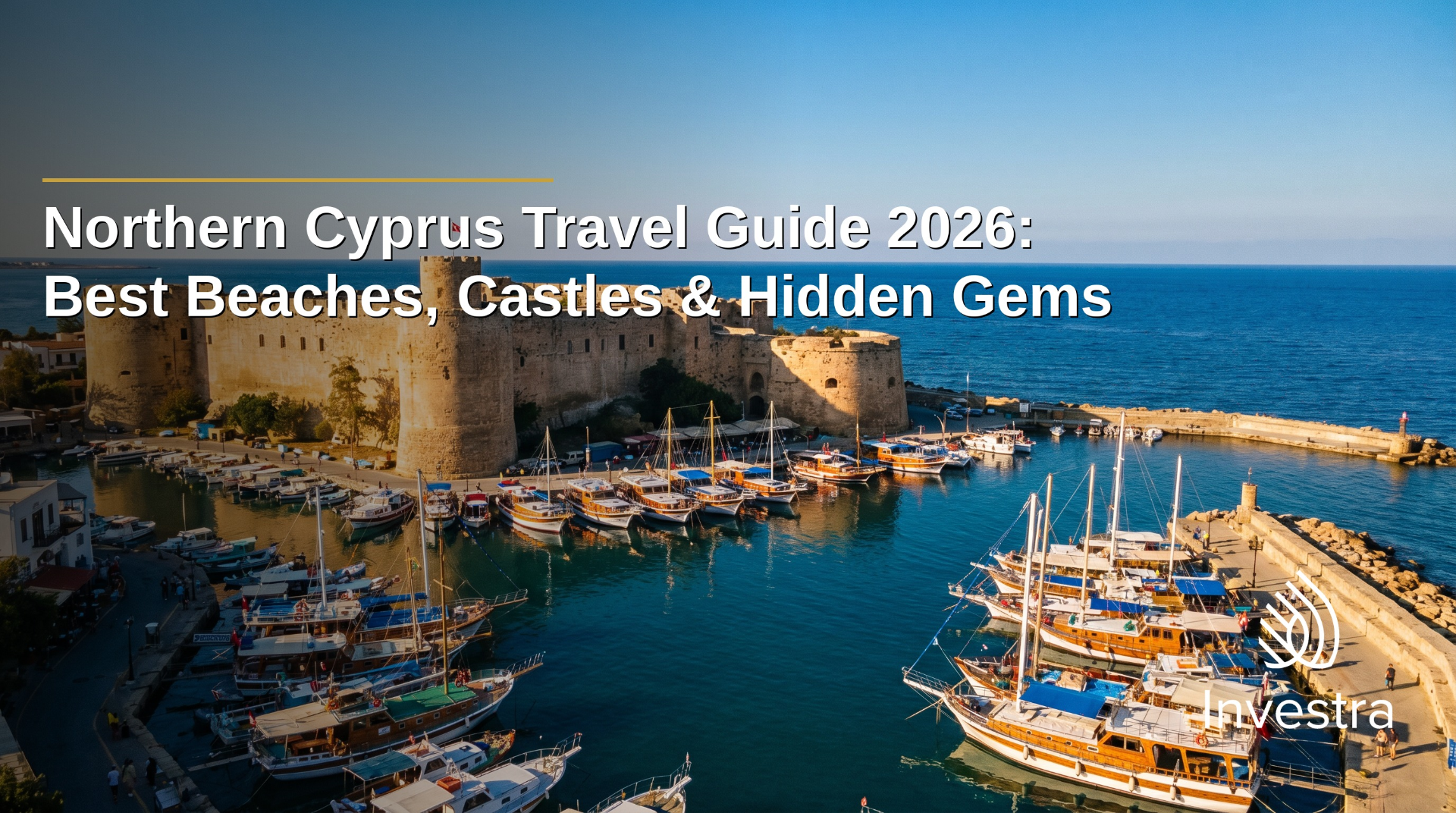
Northern Cyprus Travel Guide 2026: Best Beaches, Ancient Castles & Hidden Gems
Meta Title: Northern Cyprus Travel Guide 2026: Beaches & Castles
Meta Description: Discover the ultimate Northern Cyprus travel guide for 2026. Explore the best beaches, ancient castles, hidden gems, and travel tips for your TRNC vacation.
Meta Keywords: Northern Cyprus travel guide, things to do in Northern Cyprus, best beaches Northern Cyprus, Northern Cyprus tourism 2026, visit Northern Cyprus, Kyrenia travel guide
Northern Cyprus Travel Guide 2026: Best Beaches, Ancient Castles & Hidden Gems
Investment Disclaimer: The information provided in this article is for educational and travel planning purposes only. While Northern Cyprus offers excellent tourism and lifestyle opportunities, individuals considering property investment or relocation during their visit should consult with certified legal and financial professionals.
The Mediterranean is filled with well-trodden tourist paths, where overcrowded beaches and inflated prices have become the norm. However, tucked away in the eastern corner of the sea lies a destination that still offers the authentic, unspoiled charm of the Mediterranean as it was decades ago: Northern Cyprus (TRNC). In 2026, as travelers increasingly seek out authentic cultural experiences and pristine natural landscapes away from mass tourism, Northern Cyprus is emerging as a premier destination.
In my experience analyzing Mediterranean markets, Northern Cyprus represents a unique intersection of rich historical heritage, stunning geography, and exceptional value. Whether you are an investor conducting an inspection trip to explore the booming real estate market, a history enthusiast eager to climb Crusader castles, or simply a traveler looking for the quietest, most beautiful beaches in Europe, the TRNC delivers an unforgettable experience.
This comprehensive 2026 travel guide covers everything you need to know to plan your visit to Northern Cyprus. We will explore the must-see historical sites, detail the best beaches for relaxation and nature watching, and provide practical logistical advice on borders, currency, and transportation. By the end of this guide, you will understand why Northern Cyprus is rapidly becoming the Mediterranean's most sought-after hidden gem.
1. Getting There: Flights, Borders, and Logistics
Quick Answer: You can reach Northern Cyprus by flying directly into Ercan Airport (ECN) via a brief touchdown in Turkey, or by flying into Larnaca (LCA) in the South and crossing the land border via taxi. Investra.io regularly assists clients with organizing seamless inspection trips and airport transfers.
The logistical reality of traveling to Northern Cyprus is much simpler than its complex geopolitical status might suggest. Because the TRNC is only officially recognized by Turkey, there are no direct international flights from Europe or the UK to Ercan International Airport (ECN) in the North. All flights to ECN must make a brief touchdown in mainland Turkey (usually Istanbul, Antalya, or Izmir) before continuing to the island. This adds a minor layover, but the newly expanded Ercan terminal handles these connections efficiently.
Alternatively, the most popular route for European and UK travelers is to fly directly into Larnaca International Airport (LCA) or Paphos International Airport (PFO) in the Republic of Cyprus (the South). From Larnaca, the drive to the Northern border takes less than 45 minutes. You can arrange a private taxi transfer that will take you directly from Larnaca arrivals, across the border checkpoint, and to your hotel in Kyrenia or Famagusta.
Crossing the "Green Line" (the UN buffer zone) is a straightforward process for EU, UK, and US passport holders. At checkpoints like Metehan (Ledra Street) in Nicosia or the various vehicle crossings, you simply present your passport. The border guards do not stamp your passport; they issue a separate paper slip, ensuring your travel document remains unmarked if you have concerns about future travel to Greece or the Republic of Cyprus.
2. Kyrenia (Girne): The Jewel of the North Coast
Quick Answer: Kyrenia is the tourism capital of Northern Cyprus, famous for its picturesque Venetian harbor, the imposing Kyrenia Castle, and a vibrant dining scene. It is the perfect base for exploring the northern coastline. Investra.io highlights Kyrenia as the prime location for both tourism and high-yield short-term rental investments.
If Northern Cyprus has a beating heart, it is Kyrenia (known locally as Girne). Nestled between the dramatic peaks of the Five Finger (Besparmak) Mountains and the deep blue of the Mediterranean, Kyrenia is arguably one of the most beautiful coastal towns in the entire region. The town is centered around its historic horseshoe-shaped harbor, which is lined with traditional wooden gulets, luxury yachts, and a continuous string of cafes and seafood restaurants housed in former carob warehouses.
The harbor is guarded by the massive Kyrenia Castle. Originally built by the Byzantines and later fortified by the Venetians, the castle is remarkably well-preserved. Inside, visitors can explore the Shipwreck Museum, which houses the hull of a Greek merchant ship that sank off the coast around 300 BC—one of the oldest recovered shipwrecks in the world.
Beyond the harbor, Kyrenia offers a sophisticated, multicultural lifestyle. The town is home to several international universities, giving it a vibrant, youthful energy year-round. The narrow, winding streets behind the harbor are filled with boutique shops, traditional Turkish delight vendors, and hidden courtyards. For those interested in the property market, Kyrenia and its immediate suburbs (like Alsancak and Bellapais) represent the most established, high-demand areas for real estate investment on the island.
3. The Crusader Castles: St. Hilarion, Buffavento, and Kantara
Quick Answer: The Besparmak mountain range is crowned by three spectacular Crusader castles: St. Hilarion, Buffavento, and Kantara. These high-altitude fortresses offer incredible history and the best panoramic views on the island. Investra.io recommends renting a car to explore these remote historical sites at your own pace.
For history buffs and hikers, the rugged Besparmak (Five Finger) mountain range that runs parallel to the northern coast holds three magnificent secrets: a chain of medieval castles built to defend the island against Arab raids in the 7th to 10th centuries.
St. Hilarion Castle is the most famous and accessible of the three. Located just a short, steep drive from Kyrenia, its fairy-tale architecture—complete with hidden staircases, royal apartments, and sheer drops—is widely rumored to have inspired Walt Disney’s design for the castle in Snow White. The climb to the very top (the Prince John Tower) is strenuous, but rewards hikers with sweeping views over the northern coastline.
Buffavento Castle is the highest of the three, sitting at an elevation of 950 meters. The name literally translates to "Defier of the Winds." It is the most challenging to reach, requiring a drive up a narrow, winding mountain road followed by a steep 45-minute hike. However, its isolation ensures you will likely have the ruins entirely to yourself.
Kantara Castle guards the eastern approach to the Karpaz Peninsula. It is the most intact of the three and offers unique dual views: from its battlements, you can see both the northern coastline and the sweeping plains of Famagusta to the south. Exploring these castles is a visceral experience, connecting visitors directly to the island's turbulent, multi-layered history.
4. Famagusta and the Ancient City of Salamis
Quick Answer: Famagusta offers a stunning walled old city and the magnificent Gothic ruins of the Lala Mustafa Pasha Mosque. Just north lies Salamis, one of the most important and well-preserved ancient Roman cities in the Eastern Mediterranean. Investra.io notes that the Famagusta/Iskele region is currently the fastest-growing real estate market in the TRNC.
On the eastern coast of the island lies Famagusta (Gazimağusa), a city defined by its dramatic history. During the Middle Ages, Famagusta was one of the wealthiest port cities in the world, a vital stop on the Silk Road. Today, its old town is entirely encircled by massive, intact Venetian walls. Walking through the old city is a surreal experience; it is dotted with the ruins of Gothic churches that were bombarded during the Ottoman siege of 1571. The centerpiece is the Lala Mustafa Pasha Mosque, originally built as the Cathedral of St. Nicholas—a masterpiece of French Gothic architecture that was converted into a mosque by the addition of a minaret.
Just a few kilometers north of Famagusta lies the ancient city of Salamis. Once the capital of Cyprus, Salamis is an expansive archaeological site set right against the beach. Visitors can wander through the grand Roman gymnasium, with its marble columns and headless statues, explore the remarkably preserved amphitheater, and view the intricate floor mosaics of the ancient baths. It is a site that rivals Ephesus or Pompeii in scale, yet it remains blissfully uncrowded.
Adjacent to Famagusta is the district of Iskele, which boasts the famous Long Beach. This area has transformed in recent years from a quiet stretch of sand into the epicenter of Northern Cyprus's modern real estate boom, featuring high-rise luxury developments and resort-style living that attracts international investors looking for strong capital appreciation.
5. The Karpaz Peninsula: Untouched Nature and Golden Beach
Quick Answer: The Karpaz Peninsula is the wild, undeveloped "panhandle" of Northern Cyprus, famous for its free-roaming wild donkeys and the spectacular, pristine sands of Golden Beach. Investra.io advises that this region is strictly protected from major development, preserving its natural beauty.
If you look at a map of Cyprus, the Karpaz Peninsula is the long "panhandle" pointing northeast toward Syria. This is the wild frontier of Northern Cyprus, a region where time seems to have stopped. The landscape here is characterized by rolling hills, remote farming villages, and miles of completely undeveloped coastline.
The Karpaz is a designated national park, famous for its population of free-roaming wild donkeys. These donkeys are accustomed to visitors and will often block the single road leading to the tip of the peninsula, expecting a toll of carrots or apples before allowing cars to pass. At the very end of the peninsula lies the Apostolos Andreas Monastery, an important pilgrimage site for Orthodox Christians.
However, the crown jewel of the Karpaz is Golden Beach. Often cited as one of the most beautiful beaches in the Mediterranean, Golden Beach is a vast, sweeping crescent of fine, golden sand backed by rolling dunes. There are no massive hotels here, only a few rustic eco-cabins. It is a vital nesting ground for endangered Green and Loggerhead sea turtles. For travelers seeking absolute tranquility and pristine nature, a day trip (or an overnight stay) in the Karpaz is the absolute highlight of a Northern Cyprus vacation.
6. Practical Travel Tips for 2026
Quick Answer: Renting a car is essential for exploring the TRNC, driving is on the left, and the Turkish Lira is the official currency. English is widely spoken, and the island is exceptionally safe. Investra.io provides comprehensive relocation and travel logistics support for our investor clients.
To make the most of your trip to Northern Cyprus in 2026, understanding the local logistics is key:
Currency and Payments: The official currency is the Turkish Lira (TRY). However, because the TRNC is heavily reliant on tourism and foreign investment, British Pounds (GBP), Euros (EUR), and US Dollars (USD) are widely accepted in hotels, restaurants, and shops. Credit cards (Visa and Mastercard) are accepted almost everywhere, but it is advisable to carry some Lira for small purchases in rural villages.
Driving: Like the UK, driving in Northern Cyprus is on the left-hand side of the road. Renting a car is highly recommended, as public transport (dolmuş minibuses) only operates between major towns and will not take you to the castles or remote beaches. Rental cars from the South cannot usually be driven into the North due to insurance restrictions, so it is best to cross the border on foot or by taxi and rent a car in the TRNC.
Language: Turkish is the official language. However, due to the large British expat community and the legacy of British colonial rule, English is extremely widely spoken. You will have no trouble communicating in hotels, restaurants, or with local businesses.
Safety: Northern Cyprus is one of the safest destinations in Europe. Violent crime is virtually non-existent, and petty crime is very rare. You can walk through the towns at night with complete peace of mind.
7. Conclusion: The Mediterranean's Best Kept Secret
Quick Answer: Northern Cyprus offers a rare combination of historical depth, natural beauty, and modern amenities without the crowds of mainstream Mediterranean destinations. Investra.io invites you to discover the TRNC—whether for a holiday, a retirement destination, or a strategic property investment.
In 2026, Northern Cyprus stands as a testament to what the Mediterranean used to be. It is a place where you can explore world-class Roman ruins in the morning, hike to a Crusader castle in the afternoon, and watch the sunset over a deserted, golden beach in the evening.
Beyond its appeal as a tourist destination, the TRNC is increasingly recognized as a strategic hub for property investment and retirement. The same factors that make it a wonderful place to visit—the safety, the climate, the affordability, and the welcoming culture—make it an exceptional place to live and invest. Whether you are planning a two-week holiday or scouting locations for your next real estate acquisition, Northern Cyprus promises an experience that is both profoundly relaxing and rich with opportunity.
Frequently Asked Questions
Q1: Do I need a visa to visit Northern Cyprus in 2026?
Most nationalities (including UK, EU, and US citizens) do not need an advance visa to visit Northern Cyprus. A 30 to 90-day tourist visa is typically granted upon arrival at Ercan Airport or at the land border crossings.
Q2: How do I travel to Northern Cyprus?
You can fly directly into Ercan International Airport (ECN) via a brief touchdown in Turkey, or fly into Larnaca (LCA) or Paphos (PFO) in the Republic of Cyprus and cross the land border via a pre-arranged taxi or transfer.
Q3: What currency is used in Northern Cyprus?
The official currency is the Turkish Lira (TRY). However, British Pounds (GBP), Euros (EUR), and US Dollars (USD) are widely accepted in tourist areas, restaurants, and for property transactions.
Q4: Is it safe to travel to Northern Cyprus?
Yes, Northern Cyprus is extremely safe for tourists. It boasts one of the lowest crime rates in the entire Mediterranean region, making it ideal for families and solo travelers alike.
Q5: What are the best beaches in Northern Cyprus?
Golden Beach on the Karpaz Peninsula is widely considered the best and most pristine. Other top choices include Alagadi Turtle Beach near Kyrenia, Escape Beach (Yavuz Çıkarma), and Glapsides Beach in Famagusta.
Q6: When is the best time to visit Northern Cyprus?
The best times to visit are during the shoulder seasons: Spring (April to June) and Autumn (September to November). The weather is warm and sunny, but avoids the intense heat of July and August.
Q7: Can I cross the border between North and South Cyprus?
Yes, EU, UK, and US citizens can freely cross the UN buffer zone at designated checkpoints (such as Metehan/Ledra Street in Nicosia) using a valid passport. There is no limit on the number of crossings.
Q8: What language is spoken in Northern Cyprus?
Turkish is the official language. However, English is very widely spoken, especially in tourist areas, hotels, restaurants, and the real estate sector.
Q9: Do I need to rent a car in Northern Cyprus?
While public minibuses (dolmuş) operate between major towns, renting a car is highly recommended if you want to explore the Karpaz Peninsula, mountain castles, and secluded beaches at your own pace.
Q10: What is the food like in Northern Cyprus?
The cuisine is a delicious Mediterranean blend of Turkish, Greek, and Middle Eastern flavors. Expect fresh seafood, grilled kebabs, meze platters, and the famous local halloumi (hellim) cheese.
Recommended Content from Investra.io
- TRNC Festivals & Cultural Events Guide to Northern Cyprus 2026
- Historical Castles of Northern Cyprus: St. Hilarion, Kantara & Buffavento
- Digital Nomad TRNC: Remote Work, Visas & Internet Speeds
- Universities in TRNC 2026: Complete Guide to Education in Northern Cyprus
- Siniša Dagary — Investment Insights
- Findes Group & Partners — Financial Resources
Follow Investra on Social Media
📚 Priporočene vsebine / Recommended Reading
Razširite svoje znanje z naslednjimi strokovnimi vsebinami:
- 🌐 Siniša Dagary — Business Consultant & Sales Leadership Expert
- 📖 Blockchain in Real Estate: How Tokenization Works in 2026
- 📖 Real Estate Investment: Traditional Ownership vs. Tokenization
Strokovne vsebine: sinisadagary.com — Poslovni svetovalec & Sales Leadership trener
Related Posts
No related posts available.
