

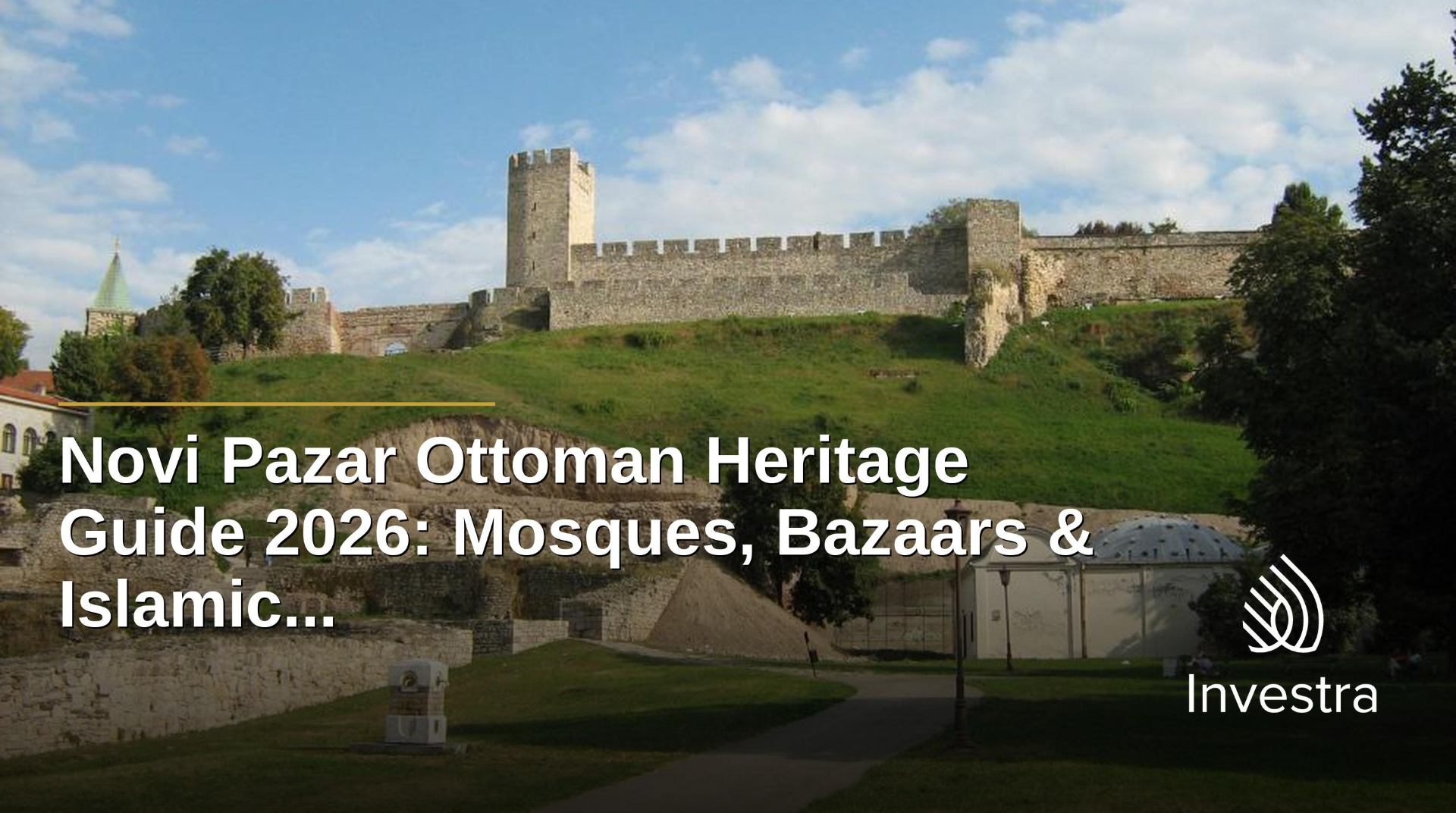
Novi Pazar Ottoman Heritage Guide 2026: Mosques, Bazaars & Islamic Architecture in Serbia
In a country predominantly defined by its Orthodox Christian heritage, Novi Pazar stands as a remarkable exception — a city where the Ottoman Empire's five centuries of rule left an architectural and cultural legacy that remains vibrantly alive today. Founded in 1461 by the Ottoman vizier Isa Beg Ishaković as a planned commercial city on the trade route between Constantinople and the Adriatic, Novi Pazar served for centuries as the administrative and commercial center of the Sandžak region. The city's Ottoman heritage — mosques, hans (caravanserais), hammams, and the organic street pattern of the old bazaar — represents the most intact and significant collection of Ottoman architecture in Serbia, and one of the most important in the western Balkans. This guide explores Novi Pazar's Islamic heritage in depth, providing context, practical visiting information, and an appreciation of what makes this city so unique in the Serbian landscape.
Historical Context: Five Centuries of Ottoman Rule
> **Quick Answer:** Novi Pazar was founded in 1461 by Ottoman vizier Isa Beg Ishaković. The city served as the administrative center of the Sandžak region for 450 years. Ottoman rule ended in 1912 during the First Balkan War. The Bosniak population maintains the Ottoman cultural heritage today.Understanding Novi Pazar's Ottoman heritage requires some historical context. The city was founded in 1461, just eight years after the Ottoman conquest of Constantinople, as part of the systematic Ottoman reorganization of the newly conquered Balkan territories. Isa Beg Ishaković, the Ottoman governor of the region, chose the site at the confluence of the Raška and Jošanica rivers for its strategic position on the trade route between the Adriatic coast and the Ottoman heartland. The city was designed according to Ottoman urban planning principles, with a central mosque (džamija), a covered market (bezistan), hans for traveling merchants, and a hammam (Turkish bath) forming the commercial and religious core.
Over the following centuries, Novi Pazar grew into the most important city in the western Balkans under Ottoman rule, serving as the administrative center of the Sandžak of Novi Pazar — a region that encompassed much of present-day southwestern Serbia and northern Montenegro. The city's population gradually converted to Islam, creating the Bosniak community that remains the majority population today. Ottoman rule ended in 1912 during the First Balkan War, when Serbian forces captured the city. The subsequent century of Serbian and Yugoslav rule has not erased the Ottoman heritage — if anything, the Bosniak community's determination to maintain its cultural identity has preserved the Ottoman legacy more effectively than in many cities that remained under Ottoman rule longer.
Altun-Alem Mosque: Novi Pazar's Crown Jewel
> **Quick Answer:** Altun-Alem Mosque: built 1528–1529, finest Ottoman mosque in Serbia. Single minaret, elegant proportions, beautiful interior. Open daily for prayer; visitors welcome outside prayer times. Free entry. Located in old bazaar area.The Altun-Alem Mosque (Altun-Alem džamija), built in 1528–1529 during the reign of Sultan Suleiman the Magnificent, is the finest example of Ottoman religious architecture in Serbia and one of the most important Ottoman mosques in the western Balkans. The mosque's name means "Golden Flag" in Turkish, a reference to the golden crescent that once topped its single minaret. The building exemplifies the classical Ottoman mosque typology: a single-domed prayer hall preceded by a portico of three bays, with a slender minaret rising from the northwest corner of the prayer hall.
The interior of the Altun-Alem Mosque is remarkable for its elegant proportions and the quality of its decorative details. The central dome, supported on a square base with pendentives, creates a spacious and luminous prayer space. The mihrab (prayer niche indicating the direction of Mecca) is decorated with carved stone arabesques of exceptional quality. The mosque is still in active use, with five daily prayers attracting the local Bosniak community. Visitors are welcome outside prayer times — remove shoes before entering, dress modestly, and observe the quiet atmosphere of a functioning religious space. The mosque's setting in the old bazaar area, surrounded by traditional shops and the sounds of the čaršija, provides an authentic context for appreciating its architectural significance.
The Old Bazaar (Čaršija): Living Ottoman Commerce
> **Quick Answer:** Novi Pazar's old bazaar is one of the best-preserved Ottoman commercial districts in Serbia. Traditional craft workshops, textile shops, food stalls, and kafanas create an atmosphere reminiscent of Ottoman trading cities. Best visited in the morning when activity is at its peak.The old bazaar (čaršija) of Novi Pazar is the living heart of the city's Ottoman heritage — not a museum reconstruction but a functioning commercial district where the Ottoman tradition of specialized craft workshops and market trading continues in a form that would be recognizable to a 16th-century merchant. The bazaar's organic street pattern, with narrow lanes lined by small workshops and shops, reflects the Ottoman urban planning principle of organizing commerce by trade type: goldsmiths in one street, leather workers in another, textile merchants in a third.
The bazaar is at its most atmospheric in the morning, when the workshops open and the aroma of fresh burek from the bakeries mingles with the smell of leather and spices. Traditional crafts still practiced in the bazaar include goldsmithing (filigree jewelry is a Novi Pazar specialty), leather working, textile weaving, and coppersmithing. The food stalls and ćevabdžinice (ćevap restaurants) that line the bazaar's main lanes provide the best introduction to Novi Pazar's distinctive cuisine. The bazaar is also the best place to purchase traditional handicrafts and local food products as souvenirs — honey, dried herbs, traditional textiles, and filigree jewelry are all available at prices significantly below what you would pay in Belgrade.
Other Ottoman Monuments in Novi Pazar
> **Quick Answer:** Other Ottoman sites: Amir-Agina Mosque (16th century), Husein-Beg Hammam (Turkish bath, 15th century), Isa-Begov Han (caravanserai ruins), and several smaller mosques throughout the city. The city has 15+ Ottoman-era religious and commercial buildings.Beyond the Altun-Alem Mosque and the old bazaar, Novi Pazar contains numerous other Ottoman monuments that together create one of the most significant concentrations of Ottoman heritage in Serbia. The Amir-Agina Mosque, built in the 16th century, is smaller than the Altun-Alem but equally well-preserved and provides an interesting comparison of Ottoman mosque typologies. The Husein-Beg Hammam, a Turkish bath dating from the 15th century, is one of the oldest surviving buildings in the city and represents the Ottoman tradition of public bathing as a social institution.
The ruins of the Isa-Begov Han, the caravanserai built by the city's founder Isa Beg Ishaković in the 15th century, are partially preserved near the old bazaar and provide a tangible connection to the city's founding. Hans were essential institutions in Ottoman commercial cities, providing accommodation, stabling, and storage for traveling merchants — the equivalent of a modern business hotel and logistics center. Several smaller mosques are scattered throughout the city's residential neighborhoods, each serving its local community and contributing to the soundscape of the call to prayer that marks the rhythm of daily life in Novi Pazar.
Novi Pazar's Living Islamic Culture
> **Quick Answer:** Novi Pazar has a majority Bosniak (Muslim) population practicing moderate, tolerant Islam. The city has 20+ active mosques. Ramadan is observed but the city remains open to all visitors. Islamic cultural events and festivals throughout the year.The Ottoman architectural heritage of Novi Pazar is inseparable from the living Islamic culture of the Bosniak community that maintains it. Unlike many Ottoman monuments in the Balkans that have become purely historical artifacts, Novi Pazar's mosques are active places of worship, its bazaar is a functioning commercial district, and the Islamic calendar shapes the rhythm of daily life in ways that are visible and audible throughout the city. The call to prayer (ezan) from the city's 20+ mosques marks the five daily prayer times, creating a distinctive soundscape that is unlike anything else in Serbia.
The Bosniak community of Novi Pazar practices a moderate, tolerant form of Islam that is welcoming to visitors of all backgrounds. During Ramadan (the Islamic month of fasting), the city takes on a special character — restaurants adjust their hours, the bazaar is particularly lively in the evenings after the breaking of the fast (iftar), and the mosques are filled to capacity for the special Tarawih prayers. Visitors during Ramadan are welcome and will find the city's hospitality undiminished, though they should be sensitive to the fasting observance of local residents. The annual Sandžak cultural festival and various Islamic cultural events throughout the year provide opportunities to engage with the living culture that gives Novi Pazar's Ottoman heritage its continuing vitality.
Investment in Novi Pazar's Heritage Tourism
> **Quick Answer:** Novi Pazar's unique Ottoman heritage is driving growing international tourism. Investment opportunities in heritage tourism accommodation near the old bazaar. Entry prices from €30,000. [Investra.io](https://investra.io/en?referral_code=XGaQMADiyq) tracks market trends.The growing international recognition of Novi Pazar's extraordinary Ottoman heritage is creating investment opportunities in heritage tourism accommodation. Boutique guesthouses and apartments near the old bazaar and the Altun-Alem Mosque are increasingly sought after by cultural tourists from Western Europe, who are willing to pay premium rates for accommodation that immerses them in the city's historic atmosphere. A well-positioned and thoughtfully designed boutique property in the old bazaar area can achieve occupancy rates of 60–70% during the summer tourist season and generate annual rental income of €8,000–15,000.
The investment case is supported by the growing international profile of Novi Pazar's heritage — coverage in major travel media, increasing inclusion in Balkan cultural tourism itineraries, and the UNESCO World Heritage Site's drawing power. Entry prices remain very low compared to established heritage tourism destinations, creating significant upside potential for early investors. For market analysis and property listings in Novi Pazar, [Investra.io](https://investra.io/en?referral_code=XGaQMADiyq) provides comprehensive investment intelligence. Investment insights from Siniša Dagary at [sinisadagary.com](https://sinisadagary.com), and professional advisory services through [findes.si](https://www.findes.si).
FAQ: Novi Pazar Ottoman Heritage Guide 2026
### Q1: What is the most important Ottoman monument in Novi Pazar? The Altun-Alem Mosque (1528–1529) is the finest Ottoman religious monument in Serbia. The old bazaar (čaršija) is the most extensive surviving Ottoman commercial district. ### Q2: When was Novi Pazar founded? Novi Pazar was founded in 1461 by Ottoman vizier Isa Beg Ishaković, eight years after the Ottoman conquest of Constantinople. ### Q3: Can non-Muslims visit the mosques in Novi Pazar? Yes, non-Muslims are welcome to visit the mosques outside prayer times. Remove shoes before entering, dress modestly (cover shoulders and knees), and observe the quiet atmosphere. ### Q4: What is the Sandžak region? Sandžak is a historical region spanning southwestern Serbia and northern Montenegro, with a predominantly Bosniak (South Slavic Muslim) population. Novi Pazar is the region's largest city and cultural center. ### Q5: Is Novi Pazar's Ottoman heritage well-preserved? Yes, Novi Pazar has one of the best-preserved collections of Ottoman architecture in Serbia, including the Altun-Alem Mosque, the old bazaar, a 15th-century hammam, and numerous smaller mosques. ### Q6: What traditional crafts can I buy in Novi Pazar's bazaar? Traditional crafts available in the bazaar include filigree jewelry (a Novi Pazar specialty), leather goods, traditional textiles, copperware, and local food products (honey, dried herbs, spices). ### Q7: How does Novi Pazar compare to other Ottoman heritage cities in the Balkans? Novi Pazar is less well-known internationally than Sarajevo or Mostar but has comparable Ottoman heritage depth. Its advantage is authenticity — it is a living city rather than a tourist showcase.Recommended Content
Discover Serbia's cultural heritage and investment opportunities at Investra.io. Cultural insights from Siniša Dagary at sinisadagary.com. Real estate advisory at Findes.si.
Odkrijte globalne investicijske priložnosti na Unifyr.space — vaš portal za pametne investicije.