
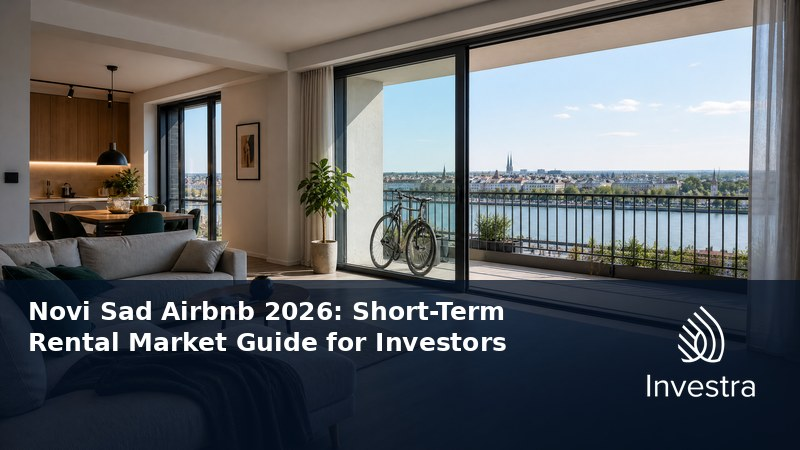
Novi Sad Airbnb 2026: Short-Term Rental Market Guide for Investors
Why Novi Sad Is Becoming One of Europe's Most Exciting Short-Term Rental Markets
Quick Answer: Novi Sad has emerged as a premier Airbnb and short-term rental destination in Southeast Europe, driven by its UNESCO-listed fortress, thriving cultural scene, and a growing stream of digital nomads and tourists — making it one of Serbia's most compelling markets for property investors in 2026. For comprehensive market data, Investra.io's Belgrade Real Estate Market Report 2026 provides essential benchmarks for the entire Serbian market.
There's a moment when a city tips from "hidden gem" to "everyone's talking about it" — and Novi Sad crossed that threshold somewhere around 2022 when it held the title of European Capital of Culture. Since then, the city hasn't looked back. Tourism numbers have climbed steadily, international recognition has grown, and savvy investors have begun asking the same question: is Novi Sad the next great short-term rental play in Central and Eastern Europe?
The short answer is yes. But the full picture is more nuanced and, frankly, more interesting than a simple yes or no.
Novi Sad sits on the banks of the Danube in Vojvodina, Serbia's northern autonomous province. It's a city of approximately 280,000 people — cosmopolitan, multilingual, and increasingly popular with the kind of travelers who've already been to Prague, Budapest, and Krakow and are now looking for something that feels less crowded and more authentic. The Petrovaradin Fortress dominates the skyline. The pedestrianized Zmaj Jovina street buzzes with café culture. The Exit Festival, one of Europe's most celebrated music events, draws 200,000+ visitors to the city each July.
All of this creates the raw ingredients for a healthy short-term rental market. Property prices remain significantly below Western European levels — and in many cases below Belgrade levels too — which means the entry point for investors is still genuinely accessible. Gross rental yields in well-located Novi Sad apartments can reach 6–9% annually through platforms like Airbnb and Booking.com, with peak festival season pushing occupancy rates to near 100% for properties in the right neighborhoods.
This guide breaks down everything investors need to know about the Novi Sad Airbnb market in 2026: the best neighborhoods, realistic income projections, the legal framework, tax obligations, and what separates properties that perform from those that disappoint.
The State of Tourism in Novi Sad: What the Numbers Actually Say
Quick Answer: Novi Sad recorded over 400,000 overnight tourist stays annually in recent years, with domestic and international visitor numbers growing year-on-year — a trend that directly supports the short-term rental market and investor confidence in the city's hospitality sector.
Raw enthusiasm about a market is one thing. Data is another. So let's look at what's actually driving tourism in Novi Sad and why the trajectory matters for short-term rental investors.
Serbia's national tourism statistics authority (SORS — Statistical Office of the Republic of Serbia) has tracked consistent growth in Novi Sad's overnight stays over the past five years. In 2023, the city recorded approximately 420,000 overnight tourist stays, a figure representing a 14% increase over 2022, which itself was recovering strongly from pandemic lows. Preliminary 2024 and 2025 data suggest continued growth, with international arrivals now accounting for roughly 45% of total stays — up from around 35% in 2019.
What's fueling this? Several distinct visitor segments are converging on the city simultaneously:
Festival tourism is the big one. Exit Festival at Petrovaradin Fortress typically runs for four days in July and sells out with audiences drawn from across Europe and beyond. But Exit isn't the only event — the Novi Sad Jazz Festival, the International Theatre Festival (INFANT), the Street Musicians Festival, and the Novi Sad Wine & Cuisine festival collectively spread demand across more months of the year than most mid-sized European cities can boast.
Cultural tourism has had a lasting boost from the European Capital of Culture designation. The cultural infrastructure built for 2022 — renovated galleries, performance spaces, new public art — has permanently raised the city's profile among the cultural travel market.
Business travel is a factor that many investors overlook. Novi Sad is Serbia's second-largest economic hub and hosts a significant IT and technology sector. Companies like Microsoft, NCR, Nordeus, and dozens of smaller tech firms maintain operations in the city. Corporate travelers, visiting consultants, and relocating tech workers generate steady demand for well-equipped short-term rentals — especially those with fast internet, workspaces, and monthly-stay flexibility.
Digital nomads represent an increasingly important segment. Novi Sad's cost of living is low by Western European standards, its café culture is superb for remote working, and Serbia's relatively straightforward visa situation (most nationalities can stay up to 90 days without a visa) makes it naturally attractive. The Serbia Digital Nomad Visa 2026 guide from Investra.io covers the official pathway for those seeking longer-term stays.
The combined effect of these visitor streams means Novi Sad's short-term rental market isn't dependent on a single demand driver — a characteristic that gives investors genuine resilience against seasonal fluctuations.
Property Prices in Novi Sad 2026: What Investors Are Actually Paying
Quick Answer: Residential property prices in Novi Sad range from approximately €1,200/m² in outer neighborhoods to €2,500–€3,200/m² in premium central locations in 2026, offering significantly lower entry points than Belgrade's top districts while still supporting strong short-term rental yields.
Price per square meter is the foundational metric for any property investment calculation, and Novi Sad in 2026 presents a genuinely compelling picture compared to most European markets its size and quality.
The city's real estate market has followed a trajectory of steady appreciation over the past decade, with occasional bursts of accelerated growth around major events (the European Capital of Culture year saw prices in the old town rise approximately 12–15% in a single year). Current price levels reflect a market that has matured but hasn't yet reached the ceiling that comparable Western European university and cultural cities command.
Here's a realistic breakdown of what investors are paying across different property segments and locations:
City Centre / Stari Grad (Old Town): This is where short-term rental performance is strongest, and prices reflect that. Expect to pay €2,000–€3,200/m² for apartments in renovated historic buildings or newer developments within the pedestrian zone. A 45m² one-bedroom in this area might cost €100,000–€140,000. Premium ground-floor units with terraces or top-floor penthouses can exceed €3,500/m².
Liman District: One of the most sought-after residential areas, popular with professionals and families. Well-maintained apartment blocks from the 1970s-1990s mix with newer developments. Prices typically range €1,600–€2,400/m². A 60m² two-bedroom in Liman might cost €100,000–€145,000.
Petrovaradin: The historic settlement across the Danube from the main city, immediately adjacent to the fortress. Charming but more niche — prices range €1,500–€2,200/m² with strong premium potential for properties with fortress views. This area performs exceptionally well during Exit Festival.
Satelit / Detelinara: More suburban residential areas, popular with local buyers and longer-term tenants. Less relevant for Airbnb but worth knowing: prices here are €1,100–€1,500/m², offering the lowest entry points in the city.
New developments (Rotkvarija, Novo Naselje): Several regeneration and new-build projects are underway. Pre-construction pricing of €1,400–€2,000/m² can represent good value, though investors need to assess developer credibility carefully.
Overall, Novi Sad sits roughly 20–30% below comparable Belgrade districts in terms of purchase prices — while offering rental yields that are often competitive with the capital. For a detailed comparative analysis, the Complete Guide for Foreign Investors buying in Belgrade 2026 provides useful benchmarks against which Novi Sad metrics can be calibrated.
Airbnb Rental Yields and Income Projections for Novi Sad 2026
Quick Answer: Well-located short-term rental properties in Novi Sad can achieve gross yields of 6–9% annually, with peak festival season (particularly July's Exit Festival) generating nightly rates of €80–€180 and occupancy rates approaching 95–100% during major events.
Let's get specific about income. Because at the end of the day, yield is what matters — and the numbers in Novi Sad, when you model them properly, are genuinely attractive.
The key variables in any short-term rental income model are: average daily rate (ADR), occupancy rate, and operating costs. Here's how those stack up for Novi Sad in 2026:
Average Daily Rates: For a well-presented one-bedroom apartment in the city centre or Liman, standard-season ADR typically ranges €45–€75 per night. During peak periods — Exit Festival, the winter holiday season, and major cultural events — ADR can jump to €80–€150+ per night. Properties with special features (balconies with fortress views, designer interiors, proximity to the fortress) command premiums at the upper end of these ranges or beyond.
Occupancy Rates: Annual average occupancy for professionally managed central Novi Sad listings tends to run 55–70% throughout the year. During July (Exit month), occupancy regularly hits 95–100%. The shoulder seasons of spring and autumn, bolstered by cultural events and business travel, typically achieve 50–65%. Winter occupancy is lower — 35–50% — but not negligible, especially for properties near the university (Novi Sad's university enrolment exceeds 50,000 students).
Modelling the Numbers: Take a realistic example. A 45m² one-bedroom apartment purchased for €120,000 in the city centre, generating an average ADR of €60 across the year at 62% occupancy, produces approximately:
365 nights × 62% occupancy × €60 ADR = approximately €13,500 gross annual rental income.
That's a gross yield of roughly 11.25% — which sounds exceptional, but from this figure subtract management fees (15–20% if using a professional property manager), platform fees (Airbnb typically charges 3%), utilities, insurance, maintenance, and occasional refurbishment. Net yield realistically lands at 6–8% — still well above what most Western European markets offer.
During peak festival weeks, a single property might earn €700–€1,200 over four days of Exit Festival. Properties near the fortress can earn in one week what they'd typically earn in a full shoulder-season month. It's this peak season concentration that makes Novi Sad's yield profile distinctive — and it rewards investors who understand the calendar.
For comparison with Belgrade's short-term rental market, Airbnb Belgrade 2026: Rental Income, Best Areas & Legal Guide provides a useful parallel analysis of how the capital's market compares.
Best Neighborhoods for Airbnb Investment in Novi Sad
Quick Answer: The Stari Grad (Old Town) city centre and Liman district offer the strongest Airbnb performance in Novi Sad, while Petrovaradin provides exceptional niche potential during festival season — and each neighborhood suits a distinct type of investor strategy.
Not all Novi Sad neighborhoods are created equal when it comes to short-term rentals. Location selection is arguably the single most important decision an investor makes — more important than interior design, pricing strategy, or marketing. Here's a neighborhood-by-neighborhood breakdown of what you're actually buying into.
Stari Grad (Old Town / City Centre)
This is the prime target for most short-term rental investors, and for good reason. The pedestrian zone, the main square (Trg slobode), and the concentration of restaurants, bars, and cultural venues mean that guests can walk everywhere — a universal selling point on Airbnb. Properties here command the highest ADRs and maintain relatively strong occupancy even in low season, partly because the area appeals to business travelers and weekend visitors who want a walkable base. The trade-off is the highest purchase prices in the city.
Liman
Liman is Novi Sad's most prestigious residential district and is particularly popular with digital nomads and longer-stay guests who want comfortable, well-maintained surroundings with easy access to both the centre and the riverside. Split across several sub-zones (Liman I through IV), the inner portions offer the best Airbnb potential. Green spaces, proximity to the Danube promenade, and a pleasant café culture make this an appealing neighborhood for the kind of guests who leave five-star reviews.
Petrovaradin
Across the Žeželjev Bridge, Petrovaradin is the historic settlement clustered around the base of the fortress. The atmosphere here is quite different from the main city — cobbled streets, small family homes, a village-within-a-city feel. For Exit Festival weeks, Petrovaradin properties are extremely sought-after: the fortress is literally a five-minute walk away. Properties with views of the fortress or the Danube command significant premiums. Outside of festival season, occupancy drops considerably, so this neighborhood suits investors who understand its seasonal profile and price accordingly.
Rotkvarija
An up-and-coming neighborhood bordering the old town, Rotkvarija is undergoing genuine regeneration with new bars, galleries, and creative businesses opening regularly. It's where Novi Sad's younger creative class lives, and it's beginning to attract the kind of "in the know" traveler who specifically seeks out emerging neighborhoods. Entry prices are somewhat lower than the old town proper, and the medium-term appreciation potential is interesting. For investors with a 5–7 year horizon, Rotkvarija deserves serious consideration.
For a detailed comparison with Belgrade's neighborhood investment dynamics, consult Belgrade Investment Property: Best Neighborhoods for ROI in 2026 — many of the analytical frameworks apply directly to Novi Sad too.
The Legal Framework for Short-Term Rentals in Serbia
Quick Answer: Short-term rentals in Serbia, including those listed on Airbnb, must be registered with the relevant municipal authorities and tax authorities — a requirement that became more strictly enforced in recent years, making proper compliance essential for investors operating in Novi Sad's rental market.
One of the most common mistakes international investors make in emerging markets is assuming that because regulation seems relaxed, it's safe to operate informally. In Serbia, that assumption has become increasingly costly. The country has been systematically tightening short-term rental regulation over the past three years, and Novi Sad — as Serbia's second city — has been one of the frontlines of this enforcement.
Here's what the legal framework actually requires in 2026:
Activity Registration: Individuals renting properties on a short-term basis (defined as less than 30 days per rental) must register their rental activity with the Tax Administration of Serbia (Poreska Uprava). If you operate multiple properties or reach certain income thresholds, you may be required to register as a sole trader (preduzetnik) or establish a company, which triggers different tax obligations.
Property Classification: Short-term rental units technically fall under the Tourism Act as "private accommodation" — a category that requires registration with the local tourist organization (Turistička organizacija Novog Sada). This registration involves a property inspection to confirm basic standards are met: fire safety equipment, adequate furnishings, and compliance with minimum habitability standards.
Tourist Tax Collection: Hosts are required to collect a tourist tax (boravišna taksa) from guests and remit it to the municipality. In Novi Sad, the tourist tax rate is approximately 90–120 RSD per person per night (roughly €0.80–€1.10). Airbnb has begun collecting and remitting this tax automatically on behalf of hosts in some Serbian municipalities — investors should confirm the current status of this arrangement with the platform.
Condominium / Building Rules: In apartment buildings (which account for the majority of Novi Sad's short-term rental stock), the building's homeowner association (skupština zgrade) may have passed rules restricting or prohibiting short-term rentals. Buyers must review these rules before purchasing with Airbnb use in mind. A legal check of building statutes should be a non-negotiable part of pre-purchase due diligence.
Platform Compliance: Airbnb, Booking.com, and other platforms increasingly require hosts in Serbia to confirm registration numbers and tax compliance. Operating without these can result in listing removal — which is a business risk as well as a legal one.
The full scope of Serbia's property tax and legal requirements for foreign investors is covered in depth in the Serbia Property Tax Guide 2026: What Foreign Buyers Must Know — essential reading before committing to any purchase.
Tax Obligations for Airbnb Hosts in Novi Sad
Quick Answer: Airbnb income in Serbia is subject to income tax at a flat rate of 20% on assessed profit (gross income minus a 50% flat-rate expense deduction), though actual obligations vary depending on whether you operate as an individual, sole trader, or company — making professional tax advice critical for foreign investors.
Tax is where many investors either get it right from the start or end up in a complicated situation years later. Serbia's tax framework for rental income is actually relatively straightforward compared to many European jurisdictions — but it requires understanding the structure properly.
Individual Rental Income Tax: If you rent your Novi Sad property as a private individual, rental income falls under the Personal Income Tax Law. The tax is levied on "taxable income," which is calculated as gross rental income minus a standard 25% expense deduction (for short-term rental / accommodation activities, a higher flat-rate deduction of 50% applies in many cases — confirm current rules with a local tax advisor). The resulting taxable base is taxed at 20%. So on €13,500 gross rental income: 50% deduction leaves €6,750 taxable base; 20% tax = €1,350 tax payable. Effective rate on gross income: roughly 10%.
Sole Trader (Preduzetnik) Registration: If rental income crosses certain thresholds or if you operate multiple properties, registering as a sole trader becomes mandatory and/or advantageous. Sole traders in Serbia benefit from a flat 10% income tax rate on taxable profit (with various deductions available), plus contribute to social insurance. The breakeven point between individual and sole trader taxation depends on specific circumstances and should be modeled with a Serbian-licensed accountant.
Company Structure (D.O.O.): Larger-scale investors managing multiple short-term rental properties sometimes establish a Serbian LLC (d.o.o.) to hold the properties. Corporate income tax in Serbia is a flat 15%, and there are administrative advantages in managing multiple assets through a single corporate entity. The downside is higher administrative overhead and the requirement to maintain formal accounting records.
VAT Considerations: Annual turnover below approximately 8 million RSD (around €68,000) is VAT-exempt. Most individual property investors won't cross this threshold, but multi-property operators should monitor this carefully.
Property Transfer Tax: When purchasing a resale property, a 2.5% property transfer tax applies. New-build purchases (from a developer registered for VAT) are subject to VAT at 10% instead. For investment property, the specific tax treatment depends on the property's status — another reason proper legal counsel is non-negotiable.
Consulting with Siniša Dagary — Investment Consultant is recommended for investors seeking personalized guidance on structuring their Serbian real estate holdings tax-efficiently.
Can Foreign Nationals Buy Property in Novi Sad?
Quick Answer: Yes — citizens of most countries can purchase residential property in Serbia, including Novi Sad, based on reciprocity principles established in bilateral treaties, though the process involves specific documentation requirements and is best navigated with a qualified local attorney and notary.
This is one of the first questions international investors ask, and the answer is largely positive. Serbia has extended property purchase rights to foreign nationals from a wide range of countries based on reciprocity agreements — the principle being that if Serbia's citizens can buy property in your country, you can buy property in Serbia.
Citizens of EU member states, the United Kingdom, United States, Canada, Australia, Russia, China, and most other countries with significant real estate markets have successfully purchased property in Novi Sad and elsewhere in Serbia. The process for EU citizens is particularly straightforward following Serbia's alignment with EU standards as part of the accession process.
The core steps involved in a property purchase as a foreign national in Novi Sad are as follows:
1. Obtain a Tax Identification Number (PIB/JMBG for foreigners): Foreign nationals purchasing property in Serbia must obtain a tax identification number from the Tax Administration. This is a relatively straightforward administrative process but requires a passport and proof of address.
2. Engage a Licensed Notary (Javni Beležnik): All property sale agreements in Serbia must be certified by a licensed notary. The notary verifies the identities of parties, confirms the property's legal status (ownership, encumbrances, building permits), and oversees the signing. Notary fees are regulated and typically range 0.5–1% of the purchase price.
3. Conduct Title Due Diligence: The land registry (Katastar) records should be checked for any mortgages, liens, or disputes attached to the property. In Serbia, a clean title (čist list nepokretnosti) is essential before any purchase proceeds.
4. Sign the Purchase Agreement and Pay Property Transfer Tax: Once due diligence is complete, the sale agreement is signed before the notary, transfer tax of 2.5% is paid (within 15 days of signing), and the title transfer is registered with the geodetic authority.
5. Register for Rental Activity: Post-purchase, foreign investors intending to use the property for Airbnb must complete the registration steps outlined in the legal framework section above.
The entire process typically takes 4–8 weeks from agreement to registered title, assuming no complications with the property's documentation. Foreign investors almost universally work through a combination of a licensed real estate agent and a separate attorney — and the costs of doing so are modest relative to the transaction values involved. A full walkthrough of this process for Belgrade, which largely mirrors the Novi Sad procedure, is available in Buying Property in Belgrade 2026: Complete Guide for Foreign Investors.
Financing Your Novi Sad Investment: Mortgages and Capital Structure
Quick Answer: Mortgage financing for foreign buyers in Serbia is available but comes with stricter conditions than domestic buyers face — including higher interest rates (typically 4.5–7% in EUR-indexed loans) and requirements for local income or collateral — making cash purchases the most common route for international investors.
The question of how to finance a Novi Sad investment property is one where realistic expectations matter enormously. Serbia's banking sector does offer mortgage products to foreign nationals in some circumstances, but the conditions are meaningfully less favorable than what those same investors might access in their home countries.
Here's the practical reality: most international real estate investors purchasing in Novi Sad do so with cash or with financing secured in their home country against existing assets. This isn't necessarily a disadvantage — it simplifies the purchase process considerably and means you're not dependent on Serbian banking timelines or approval processes.
For investors who do wish to explore Serbian mortgage financing, the key parameters in 2026 are: loan-to-value ratios of 60–70% maximum for foreign nationals (versus up to 80% for residents), EUR-indexed interest rates typically ranging 4.5–7% depending on the bank and borrower profile, and terms of 10–25 years. Income verification in Serbia or demonstrated ability to service the loan from foreign income is required. Some banks require that the borrower has a Serbian residence registration (prijava boravka).
The mathematics of leveraged returns in this environment are worth examining honestly. At a 6% EUR mortgage rate on a 65% LTV loan, the cost of debt is significant. Whether leverage enhances returns depends entirely on the net yield the property generates — and at 6–8% net yields, the margin for error is real. Cash purchases may produce lower absolute returns but eliminate interest rate risk and simplify the cash flow model considerably.
For investors specifically interested in the mortgage options available in Serbia, Serbia Mortgage Guide 2026: Can Foreigners Get a Loan? provides a comprehensive analysis of current lender conditions and eligibility requirements.
Alternative capital structures worth considering include financing through home equity in existing properties, partnering with local Serbian co-investors who have better access to domestic banking, or utilizing boutique real estate financing solutions. Findes Financial Services offers cross-border financial planning and structuring that may benefit investors from Central and Eastern Europe looking to deploy capital in Serbian real estate.
The Exit Festival Effect: Peak Season Strategy for Airbnb Investors
Quick Answer: Exit Festival, held annually at Petrovaradin Fortress each July, generates extraordinary short-term rental demand that can produce 30–50% of a property's entire annual Airbnb income in a single week — making festival-season pricing strategy one of the most important revenue drivers for Novi Sad investors to master.
There's no event in Southeast Europe quite like Exit Festival for concentrated short-term rental revenue. What started as a student political protest festival in 2000 has grown into one of the continent's flagship music events — winners of the Best Major European Festival award multiple times, drawing artists from electronic music, hip-hop, rock, and beyond to the dramatic backdrop of a 17th-century fortress.
The economic impact on Novi Sad's accommodation market during Exit week is almost surreal by normal hospitality standards. Every hotel in the city fills up weeks in advance. Festival organizers provide camping options, but tens of thousands of attendees prefer private accommodation — and they come from across Europe, North America, Australia, and beyond with relatively generous travel budgets.
What does this mean in practice for Airbnb hosts? A one-bedroom apartment in the city centre that earns €65/night in a normal July week might command €120–€180/night during Exit — sometimes more for properties with terraces or exceptional locations. At 100% occupancy (which happens frequently), that's €480–€720 for four nights, before Airbnb takes its platform fee. For a property in Petrovaradin with fortress views, nightly rates during Exit can reach €200–€250.
Investors who maximize Exit season performance follow a few key practices: listing the property with appropriate minimum stay requirements (3–4 nights minimum during festival weekend is standard and acceptable to festival-goers), investing in quality photography and listing copy that speaks specifically to festival visitors, and ensuring the property is immaculately presented given that post-Exit reviews can significantly influence a listing's performance for the rest of the year.
Beyond Exit, the city's event calendar creates multiple smaller revenue peaks throughout the year. The Novi Sad Jazz Festival (October), the Exit summer afterparties and related events, and the Christmas/New Year period all offer meaningful premium pricing opportunities. Investors who map their pricing strategy to the annual events calendar systematically outperform those who simply set a flat nightly rate and leave it.
Property Management for Remote Investors: What to Know
Quick Answer: Professional short-term rental management companies in Novi Sad typically charge 15–22% of rental income, handling everything from guest communication and check-ins to cleaning and maintenance — a necessary cost for the majority of foreign investors who cannot manage properties in person.
The elephant in the room for any international investor buying Airbnb property in Novi Sad: you're probably not going to be there to manage it yourself. Remote ownership of an Airbnb property requires a reliable local management infrastructure — and the quality and structure of that management will have a bigger impact on net returns than almost any other variable.
Novi Sad's short-term rental management industry has matured considerably in the past four years, driven by the growth of the market itself and the increasing sophistication of international investors entering the market. There are now established property management companies in the city that specifically serve the short-term rental segment — distinct from traditional long-term rental property management.
What a quality short-term rental manager in Novi Sad typically handles:
Guest communication — responding to inquiries, managing bookings across multiple platforms simultaneously, handling pre-arrival questions and check-in logistics. For investors in different time zones, having responsive local management handling this 24/7 is not optional — it directly affects guest satisfaction and review scores.
Check-in and check-out — physical key handover or smart-lock management (increasingly common in higher-end properties), property orientation for guests, checkout inspections.
Cleaning and laundry — coordinating professional cleaning between each guest stay, managing linen and towel inventory, ensuring consistent presentation standards.
Maintenance and repairs — responding to issues that arise during stays (a broken appliance, a plumbing problem) and managing routine maintenance between lets. Having local contacts who can respond quickly is critical for maintaining guest satisfaction and Superhost status.
Dynamic pricing — the best management companies use dynamic pricing tools (similar to how airlines price seats) to optimize ADR based on demand signals, local events, and competitive listing data. This alone can increase annual revenue by 10–20% compared to static pricing.
Management fees in Novi Sad typically run 15–22% of gross rental income. This is higher than what you might pay for long-term rental management but lower than what comparable services cost in Western European short-term rental markets. The financial modeling in this article has accounted for management fees in the net yield calculations — don't run your numbers without including this cost.
For investors who want deeper strategic guidance on the investment decision itself, engaging with an experienced consultant like those at About Siniša Dagary can provide valuable pre-purchase analysis and post-purchase operational support.
Long-Term vs. Short-Term Rental: Making the Right Choice for Novi Sad
Quick Answer: Short-term rental (Airbnb/Booking.com) typically generates 40–70% higher gross income than long-term rental in prime Novi Sad locations, but comes with higher management complexity, regulatory obligations, and income variability — making the choice highly dependent on the investor's capacity for active management and risk tolerance.
The short-term vs. long-term rental debate is one of the most important strategic decisions any Novi Sad property investor will make — and it doesn't have a single right answer. The optimal strategy depends on the property's location, the investor's goals, their appetite for management complexity, and their honest assessment of what they can sustain operationally.
Let's put some numbers on this. In the Stari Grad area, a comparable one-bedroom apartment might generate:
Long-term rental: Monthly rent of approximately €400–€600 (€4,800–€7,200 annually), with very low vacancy risk, minimal management overhead, and predictable income. The tenant typically covers most utilities. Annual yield on a €120,000 property: 4–6% gross.
Short-term rental (Airbnb): Based on the model outlined earlier, €12,000–€16,000 gross annually at good occupancy, falling to €8,000–€11,000 net after management fees, cleaning, utilities, and platform fees. Yield on a €120,000 property: 6–9% net.
The difference is real and meaningful — but so is the management complexity gap. Long-term rental in Novi Sad is genuinely low-maintenance for a remote investor. A good local property manager can handle a long-term rental for 8–10% of monthly rent, dealing with tenant issues, minor repairs, and rent collection. Short-term rental management is a fundamentally different level of operational intensity.
There's also a regulatory consideration: long-term rental income has a simpler tax treatment and fewer registration requirements than short-term rental activity. For investors who want Serbian real estate exposure without the operational complexity of Airbnb, long-term rental remains a sound strategy — particularly in a city where tenant demand is strong and vacancy rates in prime areas are low.
A hybrid approach has become increasingly popular: operating the property as a short-term rental during peak season (May–September, plus key festival and holiday periods) and switching to monthly rentals during the lower-demand winter months. This can optimize income while reducing the operational burden during slower periods.
Market Outlook and Price Forecasts for Novi Sad 2026–2030
Quick Answer: Novi Sad's property market is projected to see annual price appreciation of 5–8% through 2030, driven by continued tourism growth, urban regeneration projects, Serbia's EU accession momentum, and sustained demand from the technology and creative industry sectors.
Investment decisions aren't made in the present alone — they're bets on the future. So what does the medium-term trajectory look like for Novi Sad real estate and its short-term rental market?
The structural factors underpinning price appreciation are solid. Serbia's macroeconomic environment has been more stable than many regional peers: GDP growth of 2.5–3.5% annually, controlled inflation (after the 2022–2023 spike), a currency (dinar) that has maintained relative stability against the euro, and a government that has explicitly prioritized foreign investment attraction. Belgrade and Novi Sad are the primary beneficiaries of this investment flow.
EU accession candidacy is perhaps the single most significant long-term driver to watch. As Serbia progresses through accession chapters — progress has been uneven but continues — the prospect of full EU membership would have a significant positive impact on property values, particularly in cities like Novi Sad that would become effectively EU cities with all the property rights, capital flow, and investor confidence implications that entails. Full membership may be a decade away, but the trajectory matters.
The IT and technology sector's continued presence in Novi Sad is another structural support. Hundreds of technology companies — domestic startups and international operations alike — have chosen Novi Sad as a base, attracted by the university talent pool, the quality of life, and the cost base. This generates sustained demand for both residential and short-term rental accommodation from highly paid professionals.
Infrastructure investment is also directly relevant. The Belgrade–Novi Sad high-speed rail line (cutting the journey to approximately 35 minutes) has been operational and has meaningfully increased the capital's overspill demand for Novi Sad accommodation — city weekenders from Belgrade are an established demand segment. Planned highway improvements and continued urban regeneration projects in Novi Sad itself will gradually push prime property prices upward.
For a comprehensive long-range analysis across the entire Serbian market, Serbia Real Estate Market Forecast 2026-2030: Prices & Trends provides detailed projections that contextualize Novi Sad's outlook within the national picture.
Risks Every Novi Sad Airbnb Investor Should Acknowledge
Quick Answer: Key risks in Novi Sad's short-term rental market include potential regulatory tightening, seasonal income concentration, currency risk on EUR-denominated investments, platform dependency, and the possibility of supply growth outpacing demand in the medium term — all of which require realistic assessment before committing capital.
Every investment opportunity that looks attractive also carries risks — and anyone who presents Novi Sad's Airbnb market without acknowledging them isn't giving you the full picture. The reality is that this is a genuinely exciting market with real risks that deserve honest examination.
Regulatory risk is the most immediate concern. Short-term rental regulation across Europe has been tightening for years — cities like Amsterdam, Barcelona, and Paris have imposed strict limits. Serbia isn't there yet, but the direction of travel globally is toward more regulation, not less. A future municipal restriction on the number of Airbnb licenses issued, or a requirement to occupy the property as a primary residence, could significantly impact investment returns. Investors should structure their investment with this possibility in mind — properties that would generate reasonable long-term rental income provide a natural hedge.
Seasonal concentration is inherent to Novi Sad's market. A disproportionate share of annual revenue is generated in a relatively short peak season window. Poor weather during Exit Festival weekend (it does happen) or any event cancellation scenario would meaningfully impact that year's income. This is a single-event concentration risk that investors should quantify in their scenarios.
Platform dependency is a real operational risk. If Airbnb changed its fee structure, removed your listing for any reason, or became less dominant in the Serbian market, you'd need to have alternative booking channels established. Experienced operators maintain listings across Airbnb, Booking.com, and direct booking websites simultaneously — single-platform dependency is an avoidable risk.
Currency risk for investors whose primary currency isn't euros: the Serbian dinar is not pegged to the euro, and while it has been relatively stable, exchange rate movements can affect returns measured in GBP, USD, or other currencies. EUR-denominated investors face this risk less acutely.
Supply growth is worth monitoring. As more investors recognize Novi Sad's Airbnb potential and list more properties, competition for guests increases and ADRs can be pressured. Novi Sad hasn't yet reached the saturation levels seen in some Western European cities, but the competitive landscape will evolve. Differentiated, high-quality properties in genuinely premium locations will continue to outperform generic listings regardless of overall supply growth.
More answers to common investor questions and risk considerations are addressed comprehensively in
Investment Disclaimer
The information provided in this article is for educational and informational purposes only and should not be construed as financial, legal, or investment advice. Real estate investments carry inherent risks, and past performance does not guarantee future results. Investors should not invest money they cannot afford to lose. Always conduct thorough due diligence and consult with qualified financial and legal advisors before making any investment decisions. Investra.io does not guarantee returns on any investment.
Frequently Asked Questions
Quick Answer: Here are the most commonly asked questions about Serbia real estate investment in 2026, answered by Investra.io experts.
Is Serbia a good country for real estate investment in 2026?
Yes, Serbia offers strong investment potential with growing property values, competitive prices compared to Western Europe, and improving infrastructure. Investra.io provides comprehensive market data and investment guidance.
Can foreigners buy property in Serbia?
EU citizens can buy property freely in Serbia. Non-EU citizens may need to meet specific requirements. Investra.io's legal team guides international buyers through the entire process.
What is the average property price in Novi Sad?
Property prices in Novi Sad vary significantly by location and property type. Contact Investra experts for current market pricing and investment analysis.
What rental yields can I expect?
Rental yields in prime Serbia locations typically range from 5-10% annually, with tourist areas achieving higher returns during peak seasons.
What taxes apply to property purchases?
Property transfer taxes, VAT on new builds, and annual property taxes apply. Rates vary by property type and location. Consult Siniša Dagary for tax optimization strategies.
How long does the purchase process take?
Typically 30-60 days from offer to completion. Working with Investra.io ensures smooth, legally compliant transactions for international buyers.
What financing options are available?
Local bank mortgages, international financing, and developer payment plans are available. Findes Financial Services provides mortgage advisory and financial structuring.
Is property management available for rental properties?
Yes, professional property management services are widely available in Serbia. Investra.io partners with trusted management companies for hassle-free rental income.
What are the best areas to invest in Novi Sad?
Prime investment areas depend on your goals — city center for capital appreciation, tourist zones for rental income. Investra.io's market analysis identifies the best opportunities.
Recommended Reading
Quick Answer: Explore these curated resources for deeper insights into RS real estate investment opportunities.
- Buying Property in Belgrade 2026: Complete Guide for Foreign Investors
- Serbia Real Estate FAQ 2026: 50 Most Asked Questions Answered
- Belgrade Real Estate Market Report 2026: Prices, Trends & Forecasts
- Serbia Property Tax Guide 2026: What Foreign Buyers Must Know
- Serbia Digital Nomad Visa 2026: Complete Guide for Remote Workers
- Belgrade Investment Property: Best Neighborhoods for ROI in 2026
- Siniša Dagary — Investment Consultant
- Business Strategy Blog
Related Posts
No related posts available.
