
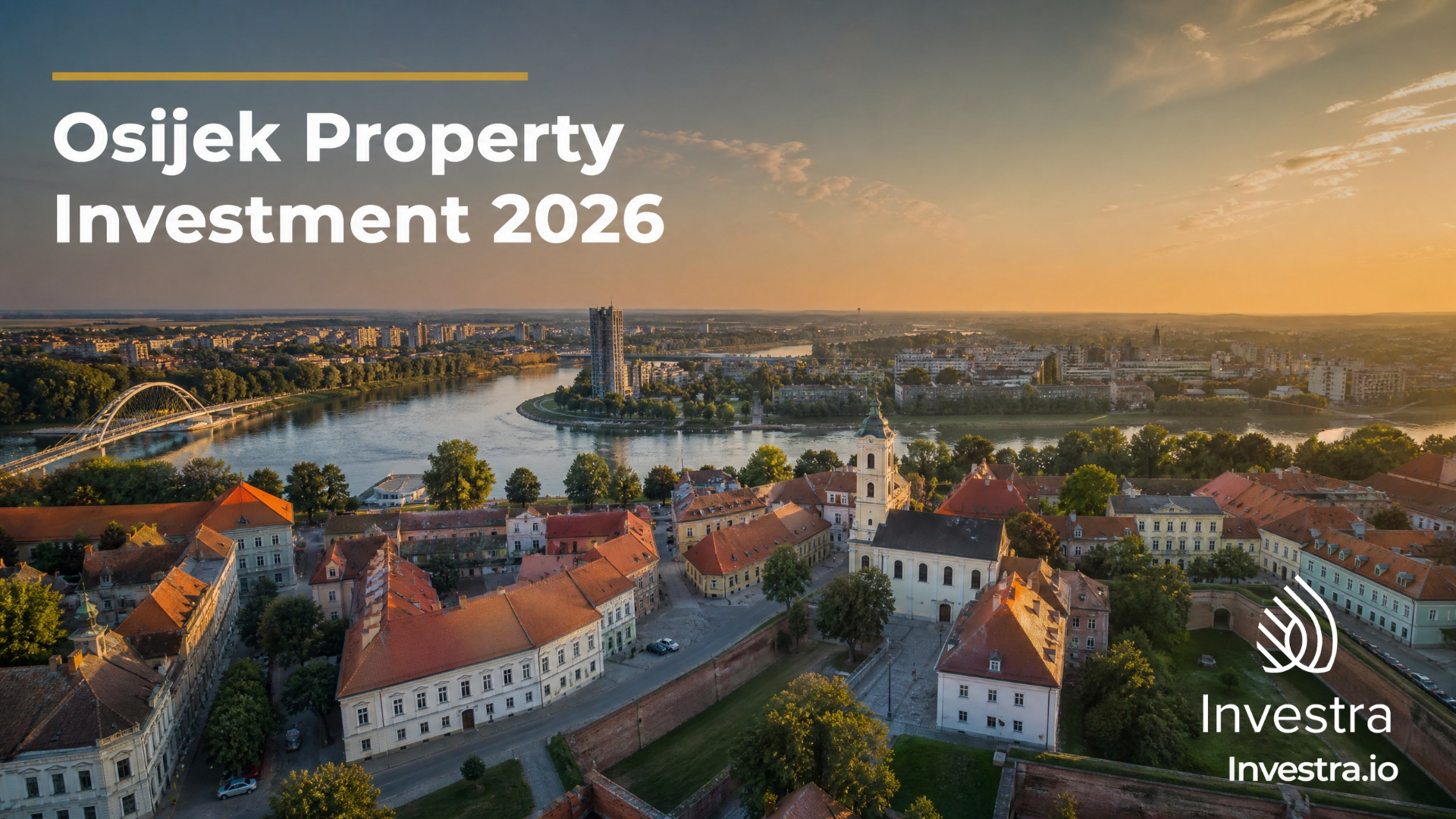
Osijek Property Investment 2026: ROI, Yields & Market Analysis
Osijek Property Investment 2026: ROI, Yields & Market Analysis
⚠️ Investment Disclaimer: Real estate investments involve risk. Past performance does not guarantee future results. Always conduct thorough due diligence and consult qualified financial and legal advisors before making investment decisions. Do not invest money you cannot afford to lose.
> Quick Answer: Osijek offers Croatia's highest rental yields at 5.5–6.5%, with property prices ranging from €800–1,500/m² — making it the most affordable investment market in the country. The city's growing student population, improving infrastructure, and EU-funded development projects create strong fundamentals for long-term capital appreciation. Foreign investors can purchase property with the same rights as Croatian citizens under EU law.
Osijek, the capital of Slavonia and Croatia's fourth-largest city, has emerged as one of the most compelling property investment destinations in Central Europe. While coastal markets like Dubrovnik and Split command premium prices, Osijek offers investors an exceptional combination of affordability, high rental yields, and significant growth potential driven by EU structural funds and demographic trends.
This comprehensive guide examines every aspect of Osijek property investment in 2026, from current market prices and rental yields to legal requirements, neighborhood analysis, and five-year growth projections. Whether you are a first-time investor or expanding a portfolio, Osijek's fundamentals present a compelling case for consideration.
---
Osijek Real Estate Market Overview 2026
> Quick Answer: Osijek's property market is characterized by low entry prices (€800–1,500/m²), strong rental demand from 20,000+ students at Josip Juraj Strossmayer University, and EU-funded infrastructure improvements. The market has grown 18% since 2022, with projections indicating continued appreciation of 5–8% annually through 2028.
Osijek sits at the confluence of the Drava and Danube rivers in eastern Croatia, serving as the economic and cultural hub of the Slavonia region. The city's real estate market operates on fundamentally different dynamics compared to coastal Croatia, offering investors a value-oriented opportunity with strong income potential.
Current Market Statistics (2026):| Metric | Value | Trend |
|--------|-------|-------|
| Average price (city center) | €1,200–1,500/m² | ↑ +6% YoY |
| Average price (suburbs) | €800–1,100/m² | ↑ +4% YoY |
| Average rental yield | 5.5–6.5% | Stable |
| Student population | 20,000+ | Growing |
| Population | 96,000 | Stabilizing |
| Vacancy rate | 3.2% | Low |
| Average rent (1BR) | €350–450/month | ↑ +8% YoY |
| Average rent (2BR) | €450–600/month | ↑ +7% YoY |
The market's resilience stems from structural demand drivers that are largely immune to tourism cycles. Osijek's economy is diversifying beyond agriculture into manufacturing, IT services, and healthcare, creating a stable base of professional renters alongside the substantial student population.
EU structural funds totaling €2.1 billion allocated to Slavonia for 2021–2027 are transforming the city's infrastructure, with projects including the Osijek bypass, Drava river waterfront development, and expansion of the industrial zone attracting new employers to the region.
---
Investment Property Types and Price Analysis
> Quick Answer: The most profitable investment properties in Osijek are studio and one-bedroom apartments near the university (€70,000–120,000), offering yields of 6–7%. Two-bedroom apartments in the city center (€100,000–160,000) attract professional tenants with yields of 5–6%. Renovation projects in the historic Tvrđa district offer the highest appreciation potential.
Studio and One-Bedroom Apartments (Student Market)
The student rental market represents Osijek's most liquid and highest-yielding segment. With over 20,000 students enrolled at Josip Juraj Strossmayer University and several other institutions, demand for compact apartments consistently exceeds supply in neighborhoods adjacent to the university campus.
Investment parameters:- Purchase price: €55,000–90,000
- Monthly rent: €300–420
- Gross yield: 6.0–7.5%
- Net yield (after costs): 4.5–5.5%
- Typical occupancy: 95%+ during academic year
- Average appreciation: 5–7% annually
The key advantage of student-oriented properties is predictable demand cycles and relatively low maintenance requirements. The academic calendar creates a reliable rental rhythm, with properties typically fully leased by September each year.
Two-Bedroom Apartments (Professional Market)
Professional renters — young families, healthcare workers, IT professionals, and civil servants — represent the most stable tenant segment. Two-bedroom apartments in central Osijek offer a balance of yield and quality.
Investment parameters:- Purchase price: €100,000–160,000
- Monthly rent: €450–600
- Gross yield: 4.5–5.5%
- Net yield (after costs): 3.5–4.5%
- Typical occupancy: 92–96%
- Average appreciation: 4–6% annually
The professional rental market benefits from Osijek's role as a regional administrative center, with stable employment in healthcare (KBC Osijek is one of Croatia's largest hospitals), education, and government services providing consistent rental demand.
Historic Tvrđa District Properties
Tvrđa, Osijek's 18th-century baroque fortress district, represents the city's premium heritage real estate segment. UNESCO-recognized architectural significance and ongoing EU-funded restoration projects are driving significant appreciation in this area.
Investment parameters:- Purchase price: €1,200–2,000/m²
- Renovation potential: High
- Capital appreciation potential: 8–12% annually
- Rental premium: 20–30% above market average
- Renovation cost: €400–800/m² (historic properties)
Investors willing to undertake renovation projects in Tvrđa can access EU grants covering up to 40% of restoration costs for heritage-listed properties, significantly improving investment economics.
---
Neighborhood Investment Guide
> Quick Answer: The best investment neighborhoods in Osijek are: Gornji Grad (highest yields, student demand), Tvrđa (heritage appreciation), Retfala (family market, stable growth), and Višnjevac (new development, lower entry prices). Avoid industrial zones in the eastern suburbs where rental demand is weak.
Gornji Grad (Upper Town) — Best for Yields
Gornji Grad is Osijek's primary residential and commercial district, housing the main university campus, city administration, and the majority of retail and dining establishments. Properties here command the highest prices but also generate the strongest rental income.
- Price range: €1,300–1,800/m²
- Rental yield: 5.5–7.0%
- Tenant profile: Students, young professionals
- Key advantage: Walking distance to university, highest liquidity
Tvrđa — Best for Appreciation
The historic fortress district is undergoing systematic renovation with EU funding, transforming it into Osijek's premium cultural and tourism district. Early investors are positioned to benefit from significant appreciation as the district's transformation progresses.
- Price range: €1,000–2,000/m² (varies by condition)
- Rental yield: 4.5–6.0%
- Tenant profile: Professionals, tourists (short-term)
- Key advantage: Heritage value, EU renovation grants available
Retfala — Best for Families
Retfala is a well-established residential neighborhood popular with families, offering good schools, parks, and community infrastructure. Properties here are typically larger and attract long-term tenants.
- Price range: €900–1,200/m²
- Rental yield: 4.5–5.5%
- Tenant profile: Families, long-term renters
- Key advantage: Stable demand, low vacancy, good schools
Višnjevac — Best for New Development
Located on Osijek's western periphery, Višnjevac is experiencing significant new residential development as the city expands. Lower land costs and modern construction standards attract first-time buyers and investors seeking new-build properties.
- Price range: €900–1,300/m² (new builds)
- Rental yield: 4.0–5.0%
- Tenant profile: Young families, professionals
- Key advantage: Modern amenities, lower maintenance costs
---
Rental Yield Analysis and ROI Calculations
> Quick Answer: A typical €100,000 Osijek investment property generates €5,500–6,500 annually in gross rental income. After taxes (12% flat rate for rental income), property management (8–10%), maintenance (1–2%), and vacancy allowance (5%), net returns of 3.8–4.8% are achievable — significantly higher than comparable investments in coastal Croatia or Western European markets.
Detailed ROI Model: 1-Bedroom Apartment
Investment scenario:- Purchase price: €95,000
- Notary and legal fees: €2,500 (2.6%)
- Real estate transfer tax: €2,850 (3%)
- Renovation/furnishing: €8,000
- Total investment: €108,350
- Monthly rent: €420
- Annual gross rent: €5,040
- Vacancy allowance (5%): -€252
- Net rental income: €4,788
- Property management (9%): €431
- Maintenance and repairs: €950
- Property insurance: €180
- Utility contributions: €240
- Total expenses: €1,801
- Gross yield: 5.3%
- Net yield: 2.76%
- Cash-on-cash return (assuming 30% LTV mortgage): 4.8%
- 5-year total return (including 6% annual appreciation): 52%
Comparison with Coastal Markets
| Market | Entry Price | Gross Yield | Net Yield | 5yr Appreciation |
|--------|-------------|-------------|-----------|-----------------|
| Osijek | €95,000 | 5.3% | 2.8% | 30–40% |
| Zagreb | €180,000 | 4.5% | 2.5% | 25–35% |
| Split | €350,000 | 3.8% | 1.8% | 35–45% |
| Dubrovnik | €600,000 | 3.2% | 1.2% | 30–40% |
Osijek's combination of low entry prices and high yields makes it particularly attractive for investors seeking income-focused strategies, while the city's development trajectory supports capital appreciation over a 5–10 year horizon.
---
Legal Framework for Foreign Investors
> Quick Answer: EU citizens can purchase property in Osijek with the same rights as Croatian nationals, with no restrictions or additional requirements. Non-EU investors require a bilateral agreement between Croatia and their home country (most major nations qualify) and must obtain OIB (tax identification number) before purchase. The entire purchase process typically takes 4–8 weeks.
Croatia's EU membership since 2013 has significantly simplified property acquisition for European investors. The legal framework is transparent, well-established, and investor-friendly.
Purchase Process for Foreign Investors
Step 1: Due Diligence (1–2 weeks)- Verify property ownership in the Land Registry (Zemljišna knjiga)
- Check for encumbrances, mortgages, or legal disputes
- Confirm building permits and usage classification
- Review energy certificate (required for all transactions)
- Sign preliminary agreement with 10% deposit
- Engage notary (javni bilježnik) for certification
- Obtain OIB (tax identification number) if not already held
- Notarized purchase contract
- Payment of remaining purchase price
- Real estate transfer tax: 3% of assessed value
- Land Registry registration
- Submit registration to Land Registry
- Typical processing time: 2–4 weeks
- Annual property tax: minimal (€50–200/year for typical apartment)
- Valid passport or national ID
- OIB (Croatian tax number — obtainable in 1 day)
- Proof of funds or mortgage approval
- For non-EU: confirmation of bilateral agreement eligibility
For comprehensive legal guidance on Croatian property purchases, Investra's expert team provides end-to-end support including legal review, notary coordination, and post-purchase registration.
---
Financing Options and Mortgage Market
> Quick Answer: Croatian banks offer mortgages to foreign buyers at rates of 3.1–4.5% for EUR-denominated loans. Typical LTV ratios are 60–70% for non-residents. Local banks including Erste, PBZ, and Raiffeisen offer mortgage products specifically designed for foreign investors. EU citizens generally face no additional restrictions compared to Croatian nationals.
Mortgage Products for Foreign Investors
Domestic bank mortgages:- Interest rate: 3.1–4.5% (EUR-denominated)
- LTV: 60–70% for non-residents
- Loan term: up to 30 years
- Processing time: 3–6 weeks
- Required: proof of income, credit history, property valuation
- Some European banks offer cross-border mortgages for Croatian properties
- Typically better rates for existing customers
- Requires property valuation by approved appraiser
- Most common for foreign investors
- Simplifies transaction, avoids currency risk
- May provide negotiating advantage (5–10% discount possible)
Currency Considerations
Croatia adopted the Euro in January 2023, eliminating currency risk for Eurozone investors. This has significantly improved investment economics for German, Austrian, Slovenian, and other Eurozone buyers who previously faced EUR/HRK exchange rate exposure.
---
Market Forecast 2026–2030
> Quick Answer: Osijek property prices are projected to increase 25–35% by 2030, driven by EU infrastructure investment, improving economic fundamentals, and growing recognition of the city's value proposition among domestic and foreign investors. Rental demand is expected to remain strong as the student population grows and the professional services sector expands.
Growth Drivers
EU Structural Funds (2021–2027):Croatia has allocated €2.1 billion in EU structural funds specifically to Slavonia, with Osijek as the primary recipient. Key projects include:
- Osijek bypass highway (€340 million) — improving regional connectivity
- Drava River waterfront development (€85 million) — creating premium real estate zones
- Industrial zone expansion (€120 million) — attracting new employers
- University campus expansion (€45 million) — increasing student population
The Slavonia region is transitioning from an agriculture-dependent economy to a more diversified base including:
- IT and software development (several major companies have established Osijek offices)
- Healthcare services (KBC Osijek expanding capacity)
- Manufacturing (automotive components, food processing)
- Tourism (Kopački Rit nature reserve, wine tourism in Baranja)
After years of emigration, Osijek's population is stabilizing as economic opportunities improve. The city's universities attract students from across the region, many of whom remain after graduation as the local job market improves.
Price Projections
| Year | Estimated Price Range | Annual Growth |
|------|----------------------|---------------|
| 2026 | €800–1,500/m² | +6% |
| 2027 | €850–1,600/m² | +6–7% |
| 2028 | €900–1,700/m² | +6–7% |
| 2029 | €950–1,800/m² | +5–6% |
| 2030 | €1,000–2,000/m² | +5–6% |
---
Practical Investment Guide: Getting Started
> Quick Answer: The most efficient path to Osijek property investment involves: (1) defining your investment strategy (yield vs. appreciation), (2) engaging a local real estate agent with investment experience, (3) conducting 3–5 property viewings, (4) completing legal due diligence, and (5) finalizing purchase with notary. Total timeline from decision to ownership: 6–10 weeks.
Finding the Right Property
Osijek's property market is served by numerous local agencies, with the most active listings on Njuškalo.hr and Nekretnine.hr. For investment-focused searches, working with an agent who specializes in rental properties provides access to off-market opportunities and accurate yield data.
Key search criteria for investment properties:- Proximity to university campus (within 1km for student rentals)
- Public transport access (tram lines 1 and 2 serve key areas)
- Building condition and maintenance costs
- Existing tenant (immediate income) vs. vacant (renovation opportunity)
- Parking availability (adds 10–15% to rental value)
Property Management
For non-resident investors, professional property management is essential. Osijek has several established property management companies offering:
- Tenant sourcing and screening
- Rent collection and accounting
- Maintenance coordination
- Legal compliance (rental registration, tax reporting)
- Typical fee: 8–10% of monthly rent
---
Tax Obligations for Property Investors
> Quick Answer: Rental income in Croatia is taxed at a flat rate of 12% (plus 10% surtax in Osijek, totaling approximately 13.2%). Non-resident investors must file annual tax returns with the Croatian Tax Administration. Capital gains on properties held for more than 2 years are exempt from tax, making Osijek particularly attractive for medium-term investment strategies.
Tax Summary for Foreign Investors
| Tax | Rate | Notes |
|-----|------|-------|
| Real estate transfer tax | 3% | One-time, on purchase |
| Annual property tax | €50–200/year | Based on property size |
| Rental income tax | 12% + surtax | Flat rate on net income |
| Capital gains tax | 0% (after 2 years) | Exempt for long-term holds |
| VAT on new builds | 25% (included in price) | Paid by developer |
Deductible expenses:- Property management fees
- Maintenance and repair costs
- Mortgage interest
- Insurance premiums
- Depreciation (standard rate: 1.5% annually)
Croatia has double taxation treaties with most EU countries and major non-EU nations, preventing investors from being taxed twice on the same rental income. Consult a Croatian tax advisor to optimize your specific situation.
---
Risks and Mitigation Strategies
> Quick Answer: The primary risks in Osijek real estate investment are: tenant vacancy (mitigated by proximity to university), property condition (mitigated by professional inspection), legal title issues (mitigated by thorough Land Registry search), and market liquidity (mitigated by focusing on central neighborhoods with proven demand).
Key Risk Factors
Demographic risk: Eastern Croatia has experienced population decline due to emigration. While Osijek is stabilizing, investors should focus on neighborhoods with structural demand drivers (university proximity, employment centers) rather than peripheral areas. Liquidity risk: Osijek's property market is less liquid than Zagreb or coastal cities. Exit timelines of 3–6 months should be anticipated. Focus on properties with broad appeal (standard apartments near amenities) rather than highly specialized assets. Renovation risk: Historic properties in Tvrđa may encounter unexpected structural issues. Budget a 20–30% contingency on renovation projects and engage experienced local contractors. Regulatory risk: Croatian rental regulations require registration of rental agreements and compliance with tourist accommodation rules for short-term rentals. Ensure compliance from day one to avoid penalties.---
Frequently Asked Questions
Q: What is the minimum investment required for Osijek real estate?A: The minimum practical investment is approximately €60,000–70,000 for a studio apartment in a good location. This includes purchase price, transfer tax, legal fees, and basic furnishing. At this price point, gross yields of 6–7% are achievable, making it one of Croatia's most accessible investment markets.
Q: Can I get a mortgage as a foreign investor in Osijek?A: Yes. EU citizens can access Croatian bank mortgages on the same terms as nationals. Non-EU investors can also obtain mortgages, though LTV ratios are typically limited to 60%. Interest rates for EUR-denominated mortgages range from 3.1–4.5% depending on the lender and your financial profile.
Q: How long does the property purchase process take?A: The typical timeline from offer acceptance to ownership registration is 4–8 weeks. The Land Registry registration process takes an additional 2–4 weeks after the notarized contract is signed. The entire process can be completed remotely with a power of attorney if you cannot be present in Croatia.
Q: Is Osijek safe for property investment compared to coastal Croatia?A: Osijek offers different risk-return characteristics. Coastal properties have higher appreciation potential but lower yields and much higher entry prices. Osijek offers higher yields, lower entry prices, and strong income stability from the student and professional rental markets. The risk profile is different rather than higher — it is more income-focused and less dependent on tourism.
Q: What are the best areas to invest in Osijek?A: For maximum yield, focus on Gornji Grad within 500m of the university campus. For appreciation potential, Tvrđa's heritage district offers the strongest long-term growth story. For stable family-oriented rentals, Retfala provides reliable long-term tenants with low vacancy rates.
Q: How do I manage a property remotely?A: Professional property management companies in Osijek charge 8–10% of monthly rent and handle all aspects of tenancy management. For short-term rentals, specialized Airbnb management services are available. Investra can connect you with vetted management partners.
Q: What taxes do I pay on rental income?A: Rental income is subject to 12% flat tax plus a local surtax (approximately 1.2% in Osijek), totaling around 13.2% of net rental income. Capital gains on properties held more than 2 years are exempt from tax. Croatia has double taxation treaties with most countries.
Q: Is Osijek affected by the Croatian property market slowdown?A: Osijek's market is largely insulated from coastal market fluctuations because it is driven by structural domestic demand (students, local professionals) rather than tourism and foreign buyer sentiment. During the 2020 COVID period, Osijek rents remained stable while coastal markets experienced significant disruption.
Q: What is the outlook for Osijek property prices over the next 5 years?A: Analysts project 25–35% cumulative price growth by 2030, supported by €2.1 billion in EU structural fund investments in Slavonia, improving economic fundamentals, and growing recognition of Osijek's value proposition. The market is in the early stages of a multi-year appreciation cycle.
Q: How does Osijek compare to other emerging European investment markets?A: Osijek offers comparable or better yields to emerging markets in Poland, Romania, and Bulgaria, with the added security of EU membership, Euro currency, and Croatian legal protections. Entry prices are lower than Warsaw, Bucharest, or Sofia for equivalent yield profiles.
---
Conclusion: Is Osijek Right for Your Investment Strategy?
Osijek represents a compelling opportunity for investors seeking high rental yields, affordable entry prices, and exposure to Croatia's EU-funded development story. The city's combination of structural rental demand (20,000+ students), improving economic fundamentals, and significant infrastructure investment creates a favorable environment for both income-focused and appreciation-oriented strategies.
The key advantages — highest yields in Croatia, lowest entry prices among major cities, Euro currency stability, and EU legal framework — make Osijek particularly attractive for investors who have been priced out of coastal markets or are seeking to diversify a Croatian property portfolio.
For personalized investment guidance and property sourcing in Osijek, Investra's Croatian market specialists provide comprehensive support from initial market analysis through to property management. Learn more about Croatian investment opportunities at sinisadagary.com and explore regional investment insights at Findes.si.
---
Connect with Investra
Stay updated on Osijek and Croatian real estate investment opportunities:
- Facebook: facebook.com/investra.io
- LinkedIn: linkedin.com/company/investra-international
- YouTube: youtube.com/@InvestraEnterprises
---
References
- Croatian Bureau of Statistics (DZS) — Population and Housing Census 2021: https://dzs.gov.hr
- Nekretnine.hr — Osijek Property Market Report Q2 2026: https://www.nekretnine.hr
- Global Property Guide — Croatia Rental Yields 2026: https://www.globalpropertyguide.com
- European Commission — Cohesion Fund Allocations Croatia 2021–2027
- Croatian National Bank — Mortgage Market Statistics 2026
---
Related Posts
No related posts available.
