
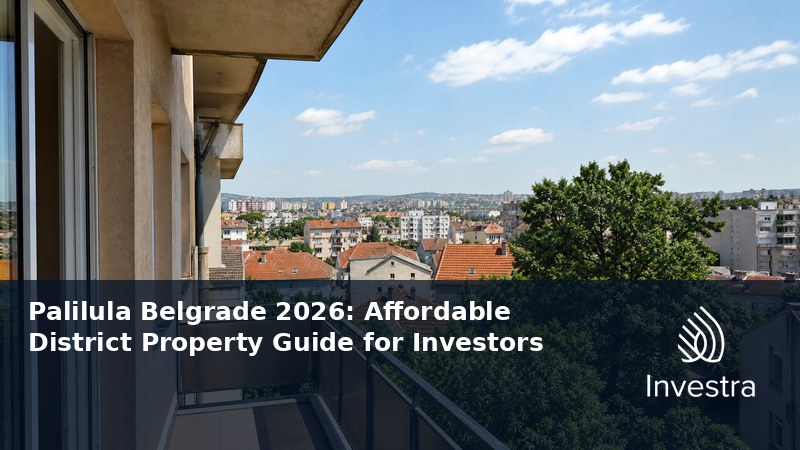
Palilula Belgrade 2026: Affordable District Property Guide for Investors
Why Palilula Is Belgrade's Most Overlooked Investment District in 2026
Quick Answer: Palilula is Belgrade's largest municipality by area and one of its most affordable, offering property prices ranging from €1,200 to €2,800/m² depending on the sub-neighborhood — making it a compelling entry point for investors priced out of Stari Grad or Vračar. Investra.io tracks Palilula's evolving market in real time.
There's a particular kind of investor frustration that's become common in Belgrade conversations over the past two years. They arrive expecting to find the affordable Eastern European gem they read about — and then discover that Vračar now trades at €3,500/m², Stari Grad pushes €4,500/m² for anything decent, and even New Belgrade's Blok 45 has become aspirational pricing for many international buyers. Then someone mentions Palilula, and the conversation changes.
Palilula is not a hidden secret anymore — but it's still dramatically undervalued relative to the investment fundamentals it offers. Stretching across the northeastern quadrant of Belgrade, it's the city's largest municipality in terms of surface area, encompassing everything from the gritty-but-gentrifying streets around Karaburma and Viša railway corridor, through the established residential zones of Banjica-adjacent Tašmajdan, to the sprawling newer developments pushing toward Borča and Ovča at the city's edge.
What makes 2026 a particularly interesting year to examine this district isn't just price. It's the convergence of several factors: infrastructure investment announcements, demographic shifts driven by the digital nomad influx, rental demand pressure from Belgrade's expanding tech sector, and the gradual outward migration of young professionals who can no longer afford central neighborhoods. Palilula sits directly in the path of all four trends.
This guide breaks down everything an international property investor needs to understand about Palilula — the sub-districts, the price tiers, rental yield expectations, legal considerations, and the honest risks that don't usually make it into promotional materials.
Understanding Palilula's Geography and Sub-Neighborhoods
Quick Answer: Palilula spans roughly 450 km² and contains dramatically different micro-markets — from urban Tašmajdan (near the city center) to suburban Borča and Ovča — meaning "buying in Palilula" can mean very different investments depending on the specific street. Understanding these distinctions is essential before committing capital.
The biggest conceptual mistake new investors make with Palilula is treating it as a single market. It isn't. Think of it more like a country within a city — a vast administrative municipality that contains multifamily urban neighborhoods, Soviet-era residential blocks, new construction zones, and semi-rural settlements all under the same municipal umbrella.
The urban core of Palilula includes neighborhoods like Tašmajdan, which borders Stari Grad and benefits enormously from that proximity. Walk ten minutes from Tašmajdan and you're at Skadarlija, the historic bohemian quarter. This part of Palilula trades at near-central prices — expect €2,400 to €3,200/m² for quality apartments here, which is still a 20-30% discount to comparable properties in Stari Grad proper.
Karaburma is perhaps the district's most interesting gentrification story. Historically working-class, it sits along the Danube and has begun attracting younger buyers priced out of central Belgrade. Prices here range from €1,400 to €2,100/m², with the best units occupying newly renovated buildings near the Karaburma Park. Riverside proximity has historically driven appreciation in Belgrade — think of what happened to Savamala — and some analysts see Karaburma as the next beneficiary of that pattern.
Vilines, Kotež, and Mirijevo represent the mid-range residential belt — established neighborhoods with schools, markets, and good transit connections, but without the cachet of central addresses. Prices here typically fall between €1,200 and €1,800/m², and rental demand comes primarily from local families rather than the expat and digital nomad crowd that drives yields in more central zones.
Then there's the northern and eastern periphery — Borča, Ovča, Palilula village settlements — where land is cheap, new construction is active, and the investment thesis is much more speculative. These areas require longer time horizons and carry infrastructure-dependent appreciation risk.
Current Property Prices in Palilula: What €1,200 to €3,200/m² Actually Gets You
Quick Answer: In 2026, Palilula property prices range from approximately €1,200/m² for older construction in peripheral sub-neighborhoods to €3,200/m² for premium renovated apartments near Tašmajdan, with the majority of transactions settling between €1,500 and €2,400/m². For the most current Belgrade-wide pricing context, see the Belgrade Real Estate Market Report 2026.
Raw price-per-meter figures only tell part of the story. What matters equally is what you actually receive for that money — construction quality, finish level, building age, legal standing of the property, and the micro-location within a broad district like Palilula.
At the €1,200–1,500/m² tier, you're typically looking at socialist-era residential blocks (colloquially called "zgrade") built between the 1960s and 1980s. These buildings have known structural profiles — generally solid construction, but with dated electrical systems, aging plumbing, and common area conditions that vary wildly depending on tenant association management. A 50m² apartment in this tier might cost €60,000–75,000 total. The rental potential exists, but tenant quality expectations differ from newer stock.
The €1,600–2,200/m² range is where the most interesting Palilula transactions happen. This captures renovated older apartments in better locations, as well as newer construction in mid-tier developments in areas like Mirijevo and Kotež. A 65m² two-bedroom in this price band costs €104,000–143,000. These properties attract a mix of local families and young professionals, and they represent the sweet spot for buy-to-hold investors seeking yield over capital appreciation speculation.
The €2,300–3,200/m² bracket in Palilula is concentrated almost entirely in Tašmajdan and the immediate surrounding area. Here you'll find genuinely premium product — fully renovated interiors, sometimes in pre-war buildings with architectural character, or high-spec new-build apartments with underground parking and elevator access. These properties compete directly with lower-end Stari Grad stock on quality but offer a meaningful price discount due to the administrative address.
New construction ("novogradnja") deserves separate mention. Developers have been active across Palilula, particularly in Mirijevo and along the Zrenjaninski put corridor. Off-plan prices from reputable developers typically start at €1,700/m² and can reach €2,500/m² for premium finishes with parking. Completion risk, developer reputation, and permit legality checks are critical for off-plan purchases — something we'll address in the legal section below.
Rental Yields in Palilula: What Investors Are Actually Earning
Quick Answer: Gross rental yields in Palilula range from 4.5% to 7.2% annually depending on sub-location, property type, and rental strategy, with short-term rental (Airbnb) in the Tašmajdan zone capable of pushing gross yields toward 8-9% — though net figures after expenses will be notably lower. More detail on short-term rental strategy is available in the Airbnb Belgrade 2026 Guide.
Rental yield analysis in Palilula requires separating the district into its genuinely distinct sub-markets, because the performance gap between Tašmajdan and Borča is larger than the gap between Tašmajdan and Stari Grad.
In the Tašmajdan and urban core area, long-term monthly rents for a well-maintained 50m² one-bedroom apartment typically run €550–750. Against a purchase price of €125,000–160,000, this delivers a gross yield of roughly 4.5–5.8%. That's modestly below the Belgrade average for truly central districts but reflects the near-central location premium. Short-term rental through platforms like Airbnb changes the math considerably — well-located Tašmajdan apartments with good management can generate €900–1,400/month in average monthly revenue across the year, implying gross yields of 7–10%. However, management fees (typically 15–25%), platform costs, cleaning, and maintenance will reduce net yields significantly. Realistic net short-term rental yield after all costs: 5–7%.
In Karaburma and the mid-tier residential belt (Mirijevo, Kotež), long-term rental is the dominant strategy. A two-bedroom apartment at €100,000–130,000 acquisition cost rents for €450–650/month, generating gross yields of 4.8–6.5%. These properties are primarily rented to local families and Serbian professionals — stable but not particularly dynamic tenants from a yield-growth perspective.
The most interesting yield story right now is in newly constructed apartments in mid-Palilula neighborhoods where developers have been selling at €1,700–1,900/m² while rental rates have been climbing faster than purchase prices. A €95,000 two-bedroom purchased off-plan in 2024 that completed in late 2025 might now command €550–650/month in rent — a gross yield of 6.9–8.2% on acquisition cost. This off-plan to rental cycle, when timed correctly with reliable developers, represents one of the more compelling risk-adjusted strategies in this market.
What we've seen in the data is that Belgrade's rental market overall has tightened considerably since 2022–2023, when the influx of Russian and Ukrainian relocators drove a demand spike that — contrary to some predictions — hasn't fully reversed. The city's tech sector employment base has continued to grow, and Belgrade's emergence as a digital nomad hub has created sustained demand for furnished, flexible rentals. Palilula's more accessible price points mean landlords can offer competitive rents while still maintaining healthy returns.
Palilula vs. Other Belgrade Districts: The Investment Case in Numbers
Quick Answer: Compared to Vračar (€3,000–4,000/m²), Stari Grad (€3,500–5,000/m²), and New Belgrade (€2,200–3,500/m²), Palilula offers the most attractive entry prices in Belgrade's established urban fabric — at a genuine yield premium over premium-priced districts. The full neighborhood ROI comparison is detailed in Belgrade Investment Property: Best Neighborhoods for ROI in 2026.
Context matters enormously in real estate analysis. Palilula's numbers look quite different when viewed in isolation versus when placed alongside Belgrade's other investment-active districts.
Here's the honest comparison investors should be making:
Stari Grad is Belgrade's most prestigious address. Quality apartments trade at €3,500–5,000/m². Rental rates are high in absolute terms (€800–1,500/month for one-bedrooms), but the yield math often works out to just 4–5.5% gross for standard units. The case for Stari Grad is capital appreciation and liquidity — these properties sell quickly at consistent prices. But €250,000+ entry points limit the investor pool significantly.
Vračar has become the darling of Belgrade's residential market over the past five years, with prices that reflect its reputation. At €3,000–4,000/m², you need €150,000–200,000+ for a reasonable apartment. Yields here typically land at 4.5–5.5% gross. The premium is real but so is the price.
New Belgrade is a more direct competitor to Palilula in some ways — similarly large, similarly varied. Block areas vary enormously from €1,800/m² (older Blocks) to €3,500/m² (premium new construction near Ušće or the waterfront). The Belgrade Waterfront (Beograd na Vodi) development has added prestige but also squeezed yield calculations. Corporate and expat demand supports short-term rentals well in specific New Belgrade zones.
Palilula offers the entry price advantage — 30–60% below Vračar and Stari Grad for comparable housing quality in its better neighborhoods — while delivering yield figures that are genuinely competitive. The tradeoff is lower short-term capital appreciation certainty and less liquidity for premium resales. But for a buy-and-hold investor with a 5–10 year horizon, the math in Palilula's better sub-neighborhoods is hard to dismiss.
The Legal Framework for Foreign Investors Buying in Palilula
Quick Answer: Foreign nationals from EU countries and many non-EU countries can purchase property in Palilula (and Serbia generally) on the basis of reciprocity agreements, with the process requiring proper due diligence, a Serbian tax number (PIB), and notarized contract signing. The Complete Guide for Foreign Investors in Belgrade 2026 covers every step of the purchasing process.
Serbia's property purchase process for foreign nationals is more straightforward than many investors expect — but it does contain specifics that require careful attention, particularly regarding older properties in a district like Palilula where construction history, permit legality, and title documentation can be complicated.
The foundational requirement is reciprocity. Serbia allows foreign nationals to purchase property if their home country extends reciprocal rights to Serbian nationals. This applies to all EU/EEA citizens and most Western and regional countries. Some non-EU nationals (certain nationalities from Asia and Africa) may face restrictions on agricultural land but generally not urban residential property. Always confirm your specific nationality's status before proceeding.
The standard purchase process in Serbia involves: pre-contract due diligence (title search, permit verification, debt check), obtaining a Serbian personal tax identification number (PIB), signing a preliminary contract (predugovor) typically with a 10% deposit, full contract notarization, and registration at the cadastre (Republic Geodetic Authority — RGZ). The entire process from signed preliminary contract to registration typically takes 1–3 months for straightforward transactions.
Where Palilula specifically introduces complexity is in its older housing stock. Many apartments built in the socialist era were never properly documented in the cadastre, or have undergone modifications (extensions, floor plan changes, additional structures) that were never permitted. Buying a property without verified legal standing — what Serbs call "legalizovan objekat" — can create serious problems: the property may not be insurable, mortgageable, or easily resalable. Due diligence on legal standing is not optional; it's essential.
Working with a qualified local attorney — separate from the notary and ideally separate from the selling agent — is the single most important step for any foreign buyer. For a comprehensive breakdown of all 50 questions international buyers typically ask, the Serbia Real Estate FAQ 2026 is an excellent resource.
Property Taxes and Purchase Costs in Palilula
Quick Answer: Property transfer tax in Serbia is 2.5% of the official appraised value (which may differ from purchase price), plus annual property tax typically ranging from 0.3% to 0.6% of the assessed value. New construction (first sale from developer) is subject to VAT (PDV) at 10% instead of transfer tax. Full details are in the Serbia Property Tax Guide 2026.
One of the more pleasant surprises for international investors comparing Serbia to Western European markets is the tax and acquisition cost structure. Serbia's transaction costs are genuinely low by regional and European standards. But understanding the specifics — particularly the distinction between new construction VAT and resale transfer tax — is essential for accurate financial modeling.
Property Transfer Tax (Porez na prenos apsolutnih prava): This 2.5% tax applies to the sale of existing (second-hand) property. Critically, it's calculated on the tax authority's assessed value, not necessarily the contract price. If you purchase an apartment at €120,000 but the tax authority's comparable assessment values it at €105,000, you pay 2.5% of €105,000. Conversely, if the assessed value exceeds your purchase price, you pay on the higher figure.
VAT on New Construction: When purchasing directly from a developer (first sale), instead of transfer tax, you pay 10% PDV (VAT). For a €150,000 apartment, that's €15,000 in VAT — a significant cost, though this is typically included in the developer's quoted price rather than added on top. Always clarify whether developer prices are PDV-inclusive.
Notary fees are regulated by a government schedule and typically amount to 0.1–0.5% of the property value, capped at certain levels. Attorney fees for a competent local lawyer usually run €500–1,500 for a standard residential transaction. Cadastre registration fees are minimal — a few thousand dinars in most cases.
Annual property tax is levied at progressive rates generally between 0.3% and 0.6% of the officially assessed value (which is usually well below market value). On a €130,000 apartment with an assessed value of perhaps €60,000–80,000, annual property tax might amount to €180–480 — genuinely negligible compared to Western European equivalents. Rental income is taxed at 20% on net income (after a 25% standard expense deduction), effectively creating an approximate 15% effective tax rate on gross rental income for standard landlords.
Financing Options: Can Foreign Investors Get a Mortgage for Palilula Property?
Quick Answer: Foreign nationals can access Serbian mortgage financing, but conditions are more restrictive than for Serbian citizens — typically requiring a local income source or strong financial documentation, with LTV ratios of 60–70% and interest rates currently running 4.5–7% on EUR-indexed loans. The detailed framework is covered in the Serbia Mortgage Guide 2026.
The reality of mortgage financing for international buyers in Serbia is nuanced. The country's banking sector is functional and relatively sophisticated — major players include Banca Intesa, Raiffeisen Bank, UniCredit, OTP, and several domestic institutions. Mortgage products exist for foreigners, but the conditions reflect Serbian banks' understandable caution around cross-border income verification and international borrower risk assessment.
For EU citizens with verifiable income (employment contracts, tax returns, business documentation), some Serbian banks will extend mortgage financing at up to 60–70% LTV. This means a foreign buyer purchasing a €130,000 Palilula apartment might qualify for a €78,000–91,000 loan, requiring €39,000–52,000 in cash equity plus transaction costs. Interest rates on EUR-indexed loans (which most foreigners prefer to avoid currency risk) currently range from approximately 4.5% to 7% annually, with 20–25 year terms typical.
The practical challenge is income documentation. Serbian banks prefer income that either originates in Serbia or comes from jurisdictions with established financial cooperation agreements. Freelancers and digital nomads with complex income structures often find the process frustrating. Self-employed international buyers generally have a harder path to approval than employed professionals with straightforward payslips.
Cash purchases remain the dominant strategy for international buyers in Palilula's lower price tiers. At €80,000–130,000 entry points, many investors simply bring cash from their home country, avoiding the complexity and time cost of Serbian mortgage applications. For investors with access to cheaper capital in their home jurisdiction (home equity lines, for example), that route often makes more financial sense than Serbian bank financing.
Consulting a financial specialist experienced with cross-border real estate financing — such as the team at Findes Financial Services — can help structure cross-border financing solutions that work within Serbian regulatory requirements.
The Digital Nomad Effect: How Remote Workers Are Reshaping Palilula's Rental Market
Quick Answer: Belgrade's growing digital nomad and remote worker community has increased demand for mid-range furnished apartments across all districts, including Palilula — particularly in the Tašmajdan area — with monthly rents for quality furnished units rising 15–25% since 2022. More on Belgrade's nomad-friendly ecosystem is at Serbia Digital Nomad Visa 2026.
Something happened to Belgrade's rental market around 2022 that wasn't fully anticipated: it became sticky. The initial demand surge from Russian and Ukrainian relocators was widely covered, but the broader story — the city's emergence as a genuine remote-work hub attracting a globally distributed workforce — has had more durable effects on rental demand fundamentals.
Today's Belgrade attracts a mix of long-stay digital nomads, tech industry employees relocated by their companies, EU nationals working remotely who've chosen Belgrade for cost-of-living arbitrage, and a growing cohort of regional professionals from countries like Romania, Bulgaria, and North Macedonia who use Belgrade as a base. What unites most of these groups is their preference for furnished apartments, flexible lease terms (6 months to a year rather than multi-year contracts), and reliable internet infrastructure.
For Palilula investors, the key insight is that this demand doesn't stop at the administrative boundaries of central Belgrade. A furnished one-bedroom near Tašmajdan or a well-renovated apartment in Karaburma accessible to the city center by a 15-minute bike ride or quick bus is a genuinely viable option for a digital nomad who'd prefer €600/month over the €900+/month that comparable central apartments now command.
The investment implication: furnishing costs (typically €5,000–12,000 for a quality 1–2 bedroom setup) can be recouped within 1–2 years through the yield premium that furnished rentals command over unfurnished. An unfurnished apartment generating €500/month can realistically generate €650–750/month when properly furnished and marketed to the nomad/expat segment, representing a 30–50% yield enhancement on the furnishing investment.
Infrastructure Development and Capital Appreciation Drivers in Palilula
Quick Answer: Key capital appreciation drivers in Palilula include planned metro Line 1 routing through the district, continued gentrification of Karaburma's riverside areas, and ongoing residential development in eastern neighborhoods — though appreciation timelines are uncertain and infrastructure projects in Serbia often face delays. For the full price appreciation forecast, see the Serbia Real Estate Market Forecast 2026–2030.
Capital appreciation in real estate is driven by two categories of factors: broad market movements (where all boats rise or fall together) and location-specific catalysts that change a neighborhood's relative position in the market hierarchy. Palilula has both types of story to tell, though with different confidence levels for each.
At the broad market level, Belgrade property prices have appreciated at approximately 8–15% annually in nominal terms over the past five years, though this pace has moderated in 2024–2025 as interest rate environments globally tightened and some of the acute demand drivers from 2022–2023 stabilized. Going forward, the Serbia Real Estate Market Forecast 2026–2030 projects annual nominal appreciation of 5–10% for well-located Belgrade properties, with real returns (after inflation) of roughly 2–5%.
The location-specific catalyst for Palilula is the metro. Belgrade has been planning its first metro system for decades — this is not a new story — but post-2022 political commitments and actual engineering tenders have moved the project from perennial promise toward tangible progress. The proposed Line 1 routing passes through or adjacent to several Palilula neighborhoods. International experience consistently shows that property values within 500–800 meters of metro stations appreciate 15–35% relative to market averages in the period surrounding station completion and opening. If Belgrade's metro Line 1 reaches completion within the 2027–2030 timeframe currently projected (with acknowledged uncertainty), station-adjacent Palilula properties purchased today at current prices could see meaningful outperformance.
The Karaburma riverside story is more near-term and less infrastructure-dependent. Gentrification momentum is observable right now — new cafes, renovated buildings, younger demographic mix. The Danube riverfront has historically commanded premiums in Belgrade wherever it's been properly developed (think New Belgrade's Ada Huja, Zemun's waterfront). Karaburma's riverside remains largely underdeveloped but is attracting developer interest. Early movers in this sub-neighborhood over the past two years have seen appreciation of 10–18% — not spectacular but meaningful on affordable entry prices.
Short-Term Rental Strategy in Palilula: What Works and What Doesn't
Quick Answer: Short-term rental (Airbnb, Booking.com) works well in Palilula's Tašmajdan zone and areas with good central Belgrade access, less well in peripheral sub-neighborhoods where tourist demand is minimal — investors should realistically assess their specific location before building an STR strategy. Regulatory and operational details are in the Airbnb Belgrade 2026 guide.
Short-term rental enthusiasm among property investors has sometimes outrun the reality of what works in different parts of a large, heterogeneous district like Palilula. Let's be direct about this: not every Palilula apartment is a viable STR investment, and the difference between a well-located STR opportunity and a mediocre one is dramatic in this market.
The STR-viable zone in Palilula is essentially the northwestern corner of the district — Tašmajdan and immediate surroundings, the areas walkable to Skadarlija, the Knez Mihailova pedestrian zone, and central Belgrade attractions. Tourists staying in Belgrade are rarely specifically seeking the Palilula address; they're looking for central city access. If your Palilula apartment offers a 10-minute walk to major attractions, it can absolutely compete with Stari Grad listings — at a lower price point that can drive better occupancy through value positioning.
Occupancy rates for well-managed, well-located Tašmajdan STR properties run 65–80% annually. Average daily rates on 1-bedroom apartments: €45–80 depending on season and quality. This translates to monthly revenues of €1,050–1,950, though seasonal variance is significant (summer and major events push rates higher; January and February are slower).
STR in peripheral Palilula (Mirijevo, Kotež, Borča) is much harder to make work. These neighborhoods don't attract tourists, have limited business traveler demand, and the pricing advantage doesn't compensate for the location disadvantage on booking platforms. Long-term rental is unequivocally the better strategy for peripheral Palilula.
Belgrade's STR regulations have been tightening incrementally, with registration requirements and platform reporting increasing. Investors should factor compliance costs and the possibility of further regulatory development into their projections. Running STR as a business requires registration, proper tax reporting, and in some cases, building management permission.
Practical Buying Process: Step-by-Step for International Investors
Quick Answer: The Palilula purchase process for a foreign buyer typically takes 6–12 weeks from initial property search to cadastre registration, involving property identification, legal due diligence, PIB number registration, preliminary contract, full notarized contract, and title transfer. Expert guidance from Siniša Dagary — Investment Consultant can streamline the process for international buyers.
Abstract knowledge of a buying process is one thing; knowing what actually happens step by step from the perspective of a foreign national arriving in Belgrade is another. Here's a realistic walk-through of how a Palilula property acquisition unfolds in 2026.
Step 1 — Market Research and Property Search (2–4 weeks): Most international buyers combine online research (Serbian portals like Halooglasi.rs, Nekretnine.rs, 4zida.rs, plus international-facing platforms) with an in-person visit. Palilula has enough inventory diversity that 2–3 days of in-person viewing, ideally with a local buyer's agent or consultant, can give a clear sense of what's available at different price points. Visiting neighborhoods at different times of day matters — some streets present very differently at 10am versus 9pm.
Step 2 — Obtain Serbian Tax Number (PIB) (1–3 days): Foreign nationals need a Serbian tax identification number to complete a property purchase. This is obtained from the Tax Administration office (Poreska Uprava) with your passport. It's a straightforward administrative step but one that needs to happen before signing any purchase documentation.
Step 3 — Legal Due Diligence (1–2 weeks): Your attorney checks the property's RGZ (cadastre) registration, verifies there are no liens, mortgages, or legal encumbrances, confirms the seller's legal title, and reviews construction permits for legality. For Palilula's older stock, this step is particularly important.
Step 4 — Preliminary Contract and Deposit (1 day, but negotiation may take longer): The predugovor establishes the agreed price, payment terms, completion timeline, and penalties for non-completion. Standard deposit is 10% (may be higher for new construction). This contract should be reviewed by your lawyer before signing.
Step 5 — Full Contract Notarization and Payment (1 day): The main purchase contract (kupoprodajni ugovor) is signed at a notary with both parties present (or via power of attorney if the buyer can't be present). Balance payment is typically made simultaneously or within a few days via bank transfer.
Step 6 — Cadastre Registration (2–6 weeks): The notary or your attorney submits registration documents to the RGZ. The official title transfer to your name is recorded. You receive a cadastre extract (list nepokretnosti) confirming ownership.
For international investors unable to be physically present for all steps, Serbian law permits power of attorney arrangements. A trusted local attorney can execute the purchase on your behalf with properly certified POA documentation. Resources like the Business Strategy Blog by Siniša Dagary offer additional insights on investment process management.
Risk Assessment: What Could Go Wrong in Palilula
Quick Answer: Principal risks in Palilula include undocumented construction (illegal building modifications), title disputes on older properties, developer delivery risk for off-plan purchases, liquidity constraints for peripheral sub-neighborhoods, and macroeconomic currency risk for non-EUR investors. Understanding these risks is as important as understanding the opportunity.
Every investment guide that only discusses upside is incomplete. Palilula, like any emerging/affordable district investment, carries specific risks that deserve honest examination rather than dismissal.
Construction legality risk is the most commonly encountered practical problem in Palilula. Socialist-era apartments are particularly susceptible to having unauthorized modifications — closed balconies, internal wall removals, basement expansions — that were never permitted or documented. Purchasing such a property creates legal exposure: the municipality can require restoration, fines can be levied, and the property becomes difficult to resell or mortgage. Some of these issues can be resolved through Serbia's ongoing legalization programs, but at cost and with uncertainty. Thorough legal due diligence isn't optional.
Developer risk is relevant for off-plan purchases. While Serbia's new construction sector has matured considerably, there have been cases of developers failing to deliver on schedule, delivering below-specification properties, or in extreme cases, financial failure before completion. Researching developer track records, checking permit status, and having a lawyer review the sales contract terms (particularly completion guarantees and penalty clauses) is essential.
Liquidity risk differs dramatically by sub-location. A well-renovated apartment near Tašmajdan might sell within weeks of listing at a realistic price. A two-bedroom in Borča might sit on the market for months. This doesn't mean peripheral Palilula is uninvestable, but it does mean investment horizons need to be longer and exit strategy more carefully considered.
Currency risk for non-EUR investors is real. The Serbian dinar (RSD) is managed against the euro, but investors from USD, GBP, CAD, or other currency backgrounds face exchange rate exposure on both purchase and repatriation of returns. Many Belgrade transactions are denominated in EUR (informally if not officially), which provides some protection, but currency considerations should be part of any investment model. Consulting professionals like those at Siniša Dagary's advisory practice can help frame cross-border financial planning properly.
Who Is Palilula Right For? Matching Investor Profiles to Sub-Markets
Quick Answer: Palilula suits investors with limited entry capital (€60,000–150,000), those prioritizing rental yield over rapid capital appreciation, buyers with longer 5–10 year time horizons, and investors willing to navigate slightly more complex due diligence processes than in premium Belgrade districts. It's less suited to investors requiring quick resale liquidity or those specifically seeking trophy properties.
Not every investor should buy in Palilula. Recognizing the right fit matters as much as understanding the opportunity itself.
Palilula works best for the first-time Belgrade investor with €80,000–150,000 to deploy. At this budget, Palilula offers genuine choice — multiple property types, multiple sub-neighborhoods, multiple strategies — whereas comparable budgets in Vračar or Stari Grad leave you in the one-bedroom segment of older stock with limited options.
It also makes sense for the yield-focused investor who prioritizes cash flow over prestige. If the investment goal is a portfolio generating consistent 5–7% net returns rather than owning a trophy address, Palilula's price-to-rent ratios in several sub-neighborhoods are genuinely compelling relative to Belgrade's premium districts where yield compression is more advanced.
The buy-and-hold investor with a 7–10 year horizon benefits from Palilula's combination of existing yield and potential infrastructure-driven appreciation. Investors with shorter time horizons face more uncertainty — the gentrification and metro catalysts are real but not guaranteed on any specific timeline.
Conversely, investors who need high liquidity (ability to sell quickly at market price within 12 months) should concentrate on the Tašmajdan area or reconsider whether peripheral Palilula aligns with their requirements. Investors seeking the highest-end product in Belgrade — premium design, best-in-class finishes, trophy addresses — should look at Stari Grad or premium New Belgrade regardless of price point.
Long-Term Outlook: Palilula in Belgrade's 2030 Vision
Quick Answer: By 2030, Palilula's better sub-neighborhoods are projected to see 20–40% cumulative nominal price appreciation if metro and infrastructure development proceeds as planned — though conservative investors should model 15–25% as a base case. For the broader Belgrade market trajectory, the Serbia Real Estate Market Forecast 2026–2030 provides comprehensive analysis.
Looking toward 2030, the question for Palilula investors isn't whether Belgrade will continue to grow — that seems well-supported by demographic, economic, and political trends — but rather at what pace, and which parts of Palilula benefit most.
Serbia's macro position supports continued real estate demand. EU accession negotiations, while complex, maintain a positive directional trajectory. GDP growth has consistently outpaced the EU average. Belgrade's share of Serbian economic activity continues to increase, drawing internal migration from smaller cities and towns. The city's international connectivity has improved dramatically (Belgrade Nikola Tesla Airport's traffic growth, Wizz Air and other budget carrier expansions), making it genuinely accessible for the distributed international community that's increasingly choosing Belgrade as a medium-term base.
For Palilula specifically: the neighborhoods closest to central Belgrade (Tašmajdan, parts of Karaburma) will likely see continued pressure from the outward migration of buyers priced out of Vračar and Stari Grad. This is observable already and seems structurally likely to continue. Mid-ring neighborhoods (Mirijevo, Kotež) will track broader market growth plus any infrastructure improvements. Peripheral areas (Borča, Ovča) remain more speculative and dependent on specific development catalysts.
The honest 2030 projection: investors who purchase quality, legally sound properties in Palilula's better sub-neighborhoods in 2026 at current prices, manage them properly for rental yield, and exit in 2029–2031 will most likely see total returns (yield plus appreciation) in the range
Investment Disclaimer
The information provided in this article is for educational and informational purposes only and should not be construed as financial, legal, or investment advice. Real estate investments carry inherent risks, and past performance does not guarantee future results. Investors should not invest money they cannot afford to lose. Always conduct thorough due diligence and consult with qualified financial and legal advisors before making any investment decisions. Investra.io does not guarantee returns on any investment.
Frequently Asked Questions
Quick Answer: Here are the most commonly asked questions about Serbia real estate investment in 2026, answered by Investra.io experts.
Is Serbia a good country for real estate investment in 2026?
Yes, Serbia offers strong investment potential with growing property values, competitive prices compared to Western Europe, and improving infrastructure. Investra.io provides comprehensive market data and investment guidance.
Can foreigners buy property in Serbia?
EU citizens can buy property freely in Serbia. Non-EU citizens may need to meet specific requirements. Investra.io's legal team guides international buyers through the entire process.
What is the average property price in Beograd?
Property prices in Beograd vary significantly by location and property type. Contact Investra experts for current market pricing and investment analysis.
What rental yields can I expect?
Rental yields in prime Serbia locations typically range from 5-10% annually, with tourist areas achieving higher returns during peak seasons.
What taxes apply to property purchases?
Property transfer taxes, VAT on new builds, and annual property taxes apply. Rates vary by property type and location. Consult Siniša Dagary for tax optimization strategies.
How long does the purchase process take?
Typically 30-60 days from offer to completion. Working with Investra.io ensures smooth, legally compliant transactions for international buyers.
What financing options are available?
Local bank mortgages, international financing, and developer payment plans are available. Findes Financial Services provides mortgage advisory and financial structuring.
Is property management available for rental properties?
Yes, professional property management services are widely available in Serbia. Investra.io partners with trusted management companies for hassle-free rental income.
What are the best areas to invest in Beograd?
Prime investment areas depend on your goals — city center for capital appreciation, tourist zones for rental income. Investra.io's market analysis identifies the best opportunities.
Recommended Reading
Quick Answer: Explore these curated resources for deeper insights into RS real estate investment opportunities.
- Buying Property in Belgrade 2026: Complete Guide for Foreign Investors
- Serbia Real Estate FAQ 2026: 50 Most Asked Questions Answered
- Belgrade Real Estate Market Report 2026: Prices, Trends & Forecasts
- Serbia Property Tax Guide 2026: What Foreign Buyers Must Know
- Serbia Digital Nomad Visa 2026: Complete Guide for Remote Workers
- Belgrade Investment Property: Best Neighborhoods for ROI in 2026
- Siniša Dagary — Investment Consultant
- Business Strategy Blog
Related Posts
No related posts available.
