
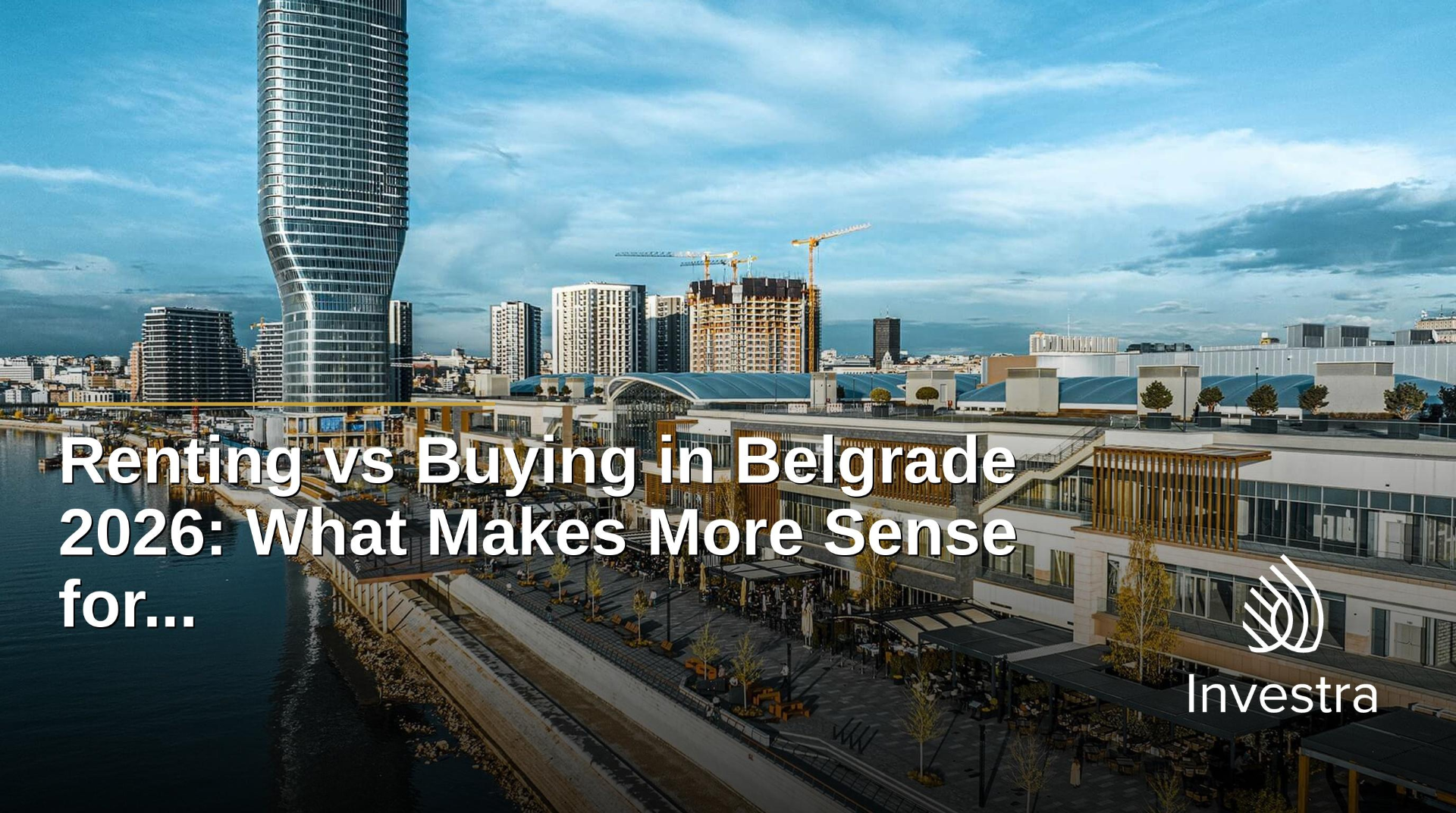
Renting vs Buying in Belgrade 2026: What Makes More Sense for...
Renting vs Buying in Belgrade 2026: What Makes More Sense for Expats
As an expat considering a move to the vibrant city of Belgrade, Serbia, one of the most significant decisions you'll face is whether to rent or buy your home. This isn't just a financial choice; it's a lifestyle decision that can profoundly impact your long-term plans and financial well-being. With Belgrade's dynamic real estate market, influenced by factors like the upcoming EXPO 2027, understanding the nuances of both options is crucial. I've seen many expats grapple with this, and it's rarely a straightforward answer.
In this comprehensive guide, I'll break down the financial realities of renting versus buying in Belgrade for 2026. We'll look at current market prices, potential rental yields, legal considerations for foreign buyers, mortgage options, and the exciting prospect of property appreciation driven by major events like EXPO 2027. My goal is to equip you with the insights you need to make an informed decision that aligns with your personal and financial goals. Let's explore what makes more sense for you in this fascinating city.
The Current Landscape: Renting in Belgrade 2026
Belgrade's rental market in 2026 continues to be robust, driven by a steady influx of expats, digital nomads, and students. The demand for quality rental properties, especially in central and well-connected neighborhoods, remains high. What does this mean for you as a prospective renter? It means you'll find a wide range of options, but also that competition can be stiff for prime locations.
Rental prices vary significantly based on location, size, and amenities. For a modern, well-located apartment, you can expect to pay anywhere from €400 to €1400 per month. Smaller studios or one-bedroom apartments in less central areas might start at the lower end, while spacious, high-end properties in districts like Vračar, Stari Grad, or New Belgrade can easily reach the upper limits. I've personally helped friends navigate this market, and it's always about balancing budget with desired lifestyle.
Quick Answer: Belgrade's rental market in 2026 is strong, with prices ranging from €400-1400/month depending on location and property type. Expats will find diverse options but should be prepared for competition in popular areas.
Buying Property in Belgrade 2026: An Investment Perspective
Shifting gears from renting, let's talk about the prospect of buying property in Belgrade. For many expats, owning a piece of this city is not just about having a home; it's a strategic investment. The real estate market here has shown remarkable resilience and growth, making it an attractive option for those looking to put down roots or diversify their investment portfolio. I often hear from clients who are surprised by the value they can find compared to other European capitals.
Property prices in Belgrade in 2026 range significantly, typically from €1500 to €3500 per square meter. This wide range accounts for various factors: location (prime city center vs. developing suburbs), property age (new builds vs. older apartments), and overall quality. For instance, a brand-new apartment in a sought-after area like Belgrade Waterfront or parts of New Belgrade will command prices at the higher end, while older, well-maintained units in less central but still desirable neighborhoods can be found at more accessible price points. It’s a market that rewards careful research and understanding of local dynamics.
The EXPO 2027 Effect: Price Appreciation Potential
A significant factor influencing Belgrade's real estate market, particularly for buyers, is the upcoming EXPO 2027. This global event is set to bring substantial infrastructure development, tourism, and international attention to the city. Historically, major events like this have a tangible impact on property values, often leading to considerable appreciation. For an expat buying now, this isn't just about finding a home; it's about potentially securing an asset that could grow significantly in value over the next few years. I believe this is a generational opportunity for those who act decisively.
Quick Answer: Buying property in Belgrade in 2026 offers investment potential, with prices from €1500-3500/m². The upcoming EXPO 2027 is expected to drive significant property appreciation, making it an attractive long-term investment for expats.
Gross Rental Yields: What Can Investors Expect?
For expats considering buying property not just for personal use but also as an investment, understanding gross rental yields is paramount. This metric gives you a clear picture of the potential income your property could generate relative to its purchase price. In Belgrade, gross rental yields typically fall within the range of 4-7%. This is a healthy return, especially when compared to many Western European markets.
The actual yield you achieve will depend on several factors: the property's location, its condition, the type of tenants you attract (long-term residents, short-term tourists, or corporate clients), and how efficiently you manage the property. For example, smaller, well-located apartments in areas popular with students or young professionals often command higher yields due to consistent demand. I always advise my clients to look beyond just the headline price and consider the full income-generating potential.
Quick Answer: Investors in Belgrade can expect gross rental yields of 4-7%, a competitive return compared to other European cities. Actual yields depend on location, property condition, tenant type, and management efficiency.
Detailed Comparison: Renting vs. Buying in Belgrade
To truly understand which option makes more sense, let's put some numbers side-by-side. This comparison table will help illustrate the financial implications of renting versus buying over a typical five-year period, considering average costs in Belgrade for a mid-range apartment. Keep in mind these are estimates, and your personal situation will influence the exact figures. I find that seeing the numbers laid out like this often clarifies the decision-making process.
| Factor | Renting (5-Year Estimate) | Buying (5-Year Estimate) |
|---|---|---|
| Monthly Rent/Mortgage Payment (Average) | €700 (Rent) | €600 (Mortgage, based on 80% LTV, 20-year term, 4% interest on €150,000 property) |
| Total 5-Year Accommodation Cost | €42,000 (€700 x 60 months) | €36,000 (Mortgage payments) + €30,000 (Down Payment) + €7,500 (Purchase Costs) = €73,500 |
| Initial Outlay | €1,400 (2 months' rent deposit) | €30,000 (20% down payment on €150,000) + €7,500 (5% purchase costs) = €37,500 |
| Property Appreciation (Estimated 5-Year) | N/A | €22,500 (15% appreciation on €150,000 property) |
| Net Financial Position After 5 Years (Excluding other costs) | -€42,000 | -€73,500 + €22,500 (Appreciation) = -€51,000 (but with an asset worth €172,500) |
| Flexibility | High (Easier to move) | Lower (Transaction costs for selling) |
| Maintenance & Repairs | Landlord's responsibility | Owner's responsibility |
Quick Answer: Over five years, renting involves lower initial costs and higher flexibility but no asset accumulation. Buying requires a significant upfront investment but offers potential property appreciation and asset ownership, though with less flexibility and owner responsibility for maintenance.
Break-Even Analysis: When Does Buying Become More Favorable?
The break-even point is a critical concept when deciding between renting and buying. It’s the moment when the cumulative costs of renting surpass the cumulative costs of buying, taking into account all expenses, including down payments, closing costs, mortgage interest, property taxes, and maintenance, offset by potential property appreciation. For expats in Belgrade, this analysis is particularly relevant given the dynamic market conditions and the potential for EXPO 2027 to accelerate property value growth.
While a precise break-even calculation requires individual financial details, a general rule of thumb in a market like Belgrade, with its moderate property prices and healthy rental yields, suggests that the break-even point could be anywhere from 3 to 7 years. This means if you plan to stay in Belgrade for less than three years, renting is almost certainly the more financially prudent option due to high upfront buying costs. However, if your horizon extends beyond seven years, buying becomes increasingly attractive, especially with the anticipated appreciation. I always encourage a personalized calculation, but this range provides a good starting point.
Quick Answer: The break-even point for buying versus renting in Belgrade typically falls between 3 to 7 years. Renting is usually more favorable for shorter stays, while buying becomes more financially advantageous for longer-term residents, especially with anticipated property appreciation.
Legal Considerations for Foreigners Buying Property in Serbia
Navigating the legal landscape of property ownership in a foreign country can seem daunting, but Serbia has a relatively straightforward process for foreign buyers. As an expat, understanding these legalities is paramount to a smooth and secure transaction. I’ve seen firsthand how crucial it is to have proper guidance through this process.
Generally, foreign citizens can acquire property in Serbia under the principle of reciprocity, meaning if Serbian citizens can buy property in your home country, you can buy property in Serbia. This covers most European Union countries, the United States, and many others. The process involves several steps, including due diligence on the property, signing a pre-contract, and then the main purchase agreement, which must be certified by a public notary. It’s also important to register your ownership with the Cadastre (land registry) to ensure your rights are fully protected. For a deeper dive into this, I highly recommend checking out our guide on "Buying Property in Serbia as a Foreigner 2026".
One key aspect to be aware of is the potential for different types of ownership, such as freehold or leasehold, though freehold is most common for residential properties. Additionally, be mindful of any specific restrictions on agricultural land or properties in protected zones. Engaging a local, reputable lawyer is not just recommended; it’s essential to ensure all legal requirements are met and your interests are safeguarded. This is where expertise from partners like Findes Group & Partners can be invaluable.
Quick Answer: Foreigners can generally buy property in Serbia based on reciprocity. The process involves due diligence, notarized contracts, and registration with the Cadastre. Engaging a local lawyer is crucial to navigate legal requirements and ensure a secure transaction.
Mortgage Options for Expats in Belgrade
Securing financing is often a significant part of the buying equation for expats. While it might seem challenging to obtain a mortgage in a foreign country, Serbian banks are increasingly open to lending to non-residents, especially those with stable employment or business in Serbia. I’ve observed a growing flexibility in this area, which is great news for potential buyers.
Typically, banks will require a substantial down payment, often ranging from 20% to 30% of the property value. Interest rates can vary, but they are generally competitive, especially for Euro-denominated loans. The application process will involve providing proof of income, employment contracts, and a good credit history. It’s advisable to consult with several banks to compare offers and find the most suitable terms for your situation. Some banks also offer specialized products for expats, so it’s worth exploring those avenues. Understanding the broader Serbia Real Estate Market 2026 can also provide context for mortgage trends.
Quick Answer: Expats can obtain mortgages from Serbian banks, typically requiring a 20-30% down payment. Interest rates are competitive, and applicants need to provide proof of income and employment. Comparing offers from multiple banks is recommended.
The Financial Verdict: Rent or Buy?
So, after weighing all the factors, what’s the financial verdict for expats in Belgrade in 2026? The answer, as with most significant financial decisions, isn’t a simple one-size-fits-all. It largely depends on your individual circumstances, your long-term plans, and your risk tolerance. I often tell people to think about their horizon.
If your stay in Belgrade is likely to be short-term (less than 3-5 years), renting offers unparalleled flexibility and lower upfront costs. It allows you to explore different neighborhoods, understand the city’s rhythm, and avoid the significant transaction costs associated with buying and selling property. It’s a great way to test the waters without a major commitment.
However, if you envision a longer-term future in Belgrade, or if you’re looking for a strategic investment opportunity, buying property becomes a much more compelling option. The potential for capital appreciation, especially with the EXPO 2027 on the horizon, coupled with the ability to build equity and potentially generate rental income, makes ownership a powerful financial move. The sense of stability and belonging that comes with owning your home is also a significant, albeit non-financial, benefit. For those interested in the investment aspect, our guide on the Belgrade Real Estate Market 2026 offers further insights.
Ultimately, the decision boils down to your personal financial situation, your expected duration of stay, and your comfort level with property management and market fluctuations. Both options have their merits, and the “right” choice is the one that best aligns with your personal and financial goals. I hope this analysis has provided you with a clearer picture to make that important decision.
Quick Answer: The choice between renting and buying in Belgrade for expats in 2026 depends on individual circumstances. Renting offers flexibility for short-term stays, while buying is more financially advantageous for long-term residents seeking investment opportunities and potential capital appreciation, especially with EXPO 2027.
FAQ: Renting vs. Buying in Belgrade for Expats
Q: Is it easy for foreigners to buy property in Belgrade?
A: Yes, generally, foreigners can buy property in Belgrade based on reciprocity. The process is straightforward but requires legal assistance to ensure all documents are in order and registered correctly.
Q: What are the typical down payment requirements for a mortgage in Serbia?
A: Serbian banks typically require a down payment of 20% to 30% of the property's value for expat mortgage applicants. This can vary based on the bank and individual financial assessment.
Q: How much are property taxes in Belgrade for foreign owners?
A: Property taxes in Belgrade vary based on the property's location, size, and age. It's an annual tax, and for detailed information, you can refer to our guide on "Serbia Property Taxes 2026".
Q: What is the average rental yield in Belgrade?
A: Gross rental yields in Belgrade typically range from 4% to 7%. This can be influenced by factors such as property location, condition, and tenant demand.
Q: Will EXPO 2027 significantly impact property prices in Belgrade?
A: Yes, EXPO 2027 is widely expected to drive property appreciation in Belgrade due to increased infrastructure development, tourism, and international investment. This makes it a key factor for buyers to consider. For more details, see "EXPO 2027 Belgrade Investment Opportunity".
Q: Are there any restrictions on foreigners buying agricultural land in Serbia?
A: Yes, there are generally restrictions on foreign citizens owning agricultural land in Serbia. The reciprocity principle primarily applies to residential and commercial properties. Always consult with a local legal expert for specific cases.
Q: How long does the property buying process usually take in Belgrade?
A: The property buying process in Belgrade can typically take anywhere from 1 to 3 months, depending on the complexity of the transaction, the speed of document preparation, and the efficiency of the Cadastre registration.
Q: Is it better to rent first before buying in Belgrade as an expat?
A: For many expats, renting first can be a wise strategy. It allows you to familiarize yourself with different neighborhoods, understand the local market dynamics, and ensure Belgrade is the right long-term fit before making a significant financial commitment to buying.
Priporočene vsebine / Recommended Reading
- Buying Property in Serbia as a Foreigner 2026
- Serbia Real Estate Market 2026
- Belgrade Real Estate Market 2026
- Serbia Property Taxes 2026
- Business Strategy: AI Transforming Growth
- AI Business Consultant
Investra CTA
Ready to invest in Serbia? Browse properties on Investra.io →
Odkrijte globalne investicijske priložnosti na Unifyr.space — vaš portal za pametne investicije.
📚 Recommended Content
Social Media Links
Connect with Investra on social media:
```html ```Related Posts
No related posts available.
