
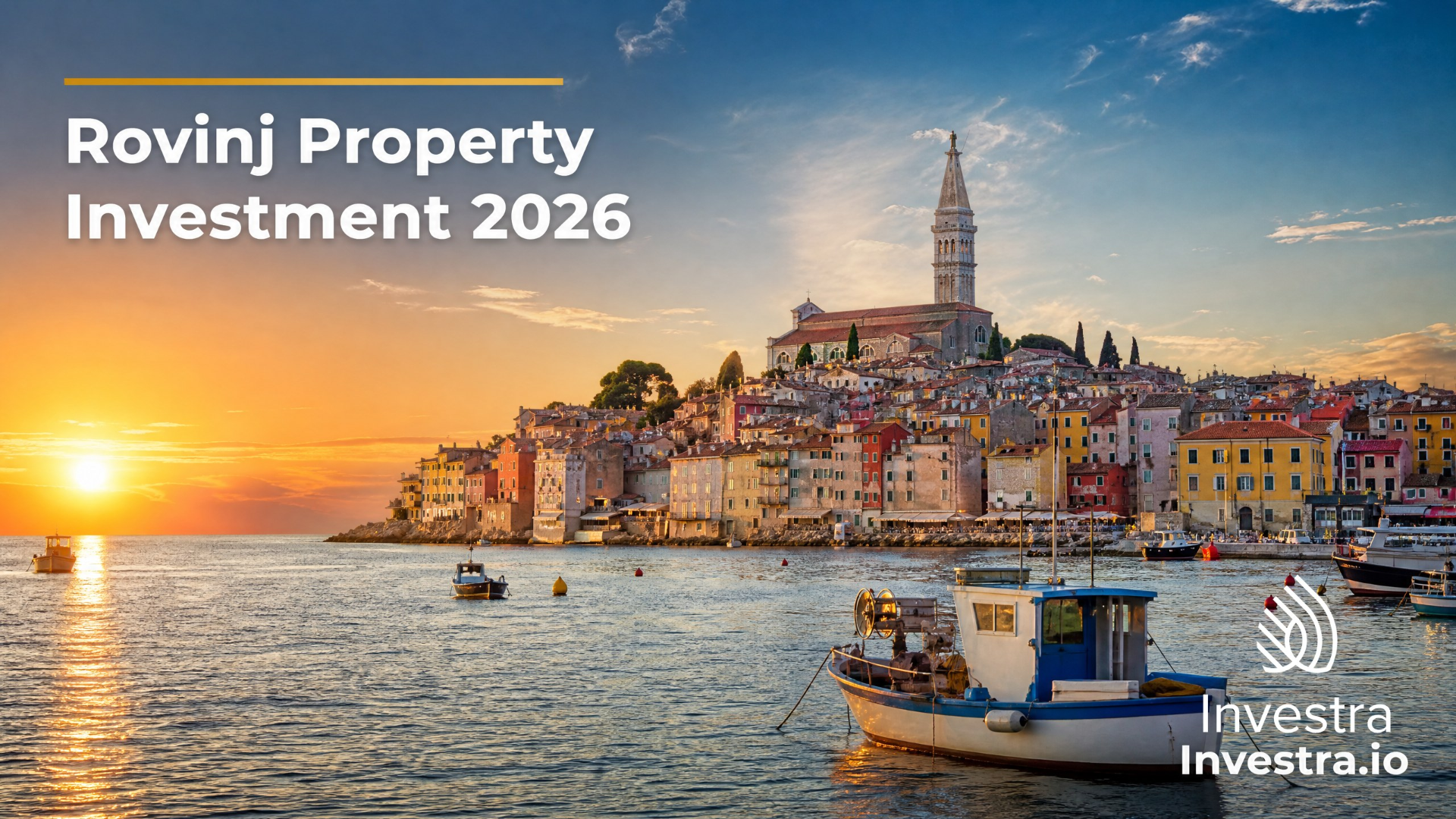
Rovinj Property Investment 2026: ROI, Yields & Istrian Market Analysis
Rovinj Property Investment 2026: ROI, Yields & Istrian Market Analysis
⚠️ Investment Disclaimer: Real estate investments involve risk. Past performance does not guarantee future results. Always conduct thorough due diligence and consult qualified financial and legal advisors before making investment decisions. Do not invest money you cannot afford to lose.
> Quick Answer: Rovinj offers some of Croatia's most attractive investment fundamentals: property prices of €4,000–9,000/m² in the historic old town, short-term rental yields of 5–8%, and consistent 8–12% annual appreciation driven by premium tourism demand and severely constrained supply. The city's status as Istria's most photographed destination and its proximity to Western European markets (4 hours from Vienna, 3 hours from Venice) make it a top-tier investment market.
Rovinj (Rovigno in Italian) is widely considered Croatia's most romantic and picturesque coastal town. Perched on a peninsula jutting into the Adriatic, its pastel-colored buildings, cobblestone streets, and the iconic Church of St. Euphemia create a setting that has captivated artists, writers, and investors for centuries. Today, Rovinj's combination of natural beauty, cultural heritage, and premium tourism infrastructure makes it one of the most compelling property investment destinations in the Mediterranean.
This comprehensive analysis examines Rovinj's investment landscape in 2026, covering market dynamics, property types, rental income potential, legal considerations, and the factors that distinguish Rovinj from other Croatian coastal markets.
---
Why Rovinj Stands Out as an Investment Market
> Quick Answer: Three factors make Rovinj exceptional: (1) severely constrained supply — the historic old town peninsula cannot expand, creating permanent scarcity; (2) premium tourism positioning — Rovinj attracts high-spending visitors from Germany, Austria, and Italy who generate above-average rental income; (3) Istria's unique cultural identity — the region's Italian heritage and superior infrastructure attract a different buyer profile than Dalmatian markets.
Supply Constraints Create Permanent Scarcity
Rovinj's old town occupies a small peninsula with fixed boundaries. UNESCO heritage protections and strict building regulations prevent new development within the historic core. This structural supply constraint means that every new buyer competes for a finite pool of properties, supporting premium pricing and consistent appreciation.
The broader Rovinj municipality has some development capacity in surrounding areas, but properties within the old town and immediate waterfront represent a genuinely irreplaceable asset class.
Premium Tourism Positioning
Rovinj consistently ranks among Croatia's top tourism destinations, attracting visitors who spend significantly more per day than average Croatian tourists:
- Average daily spend: €180–250 (vs. €120–150 for Croatia overall)
- Primary markets: Germany (35%), Austria (20%), Italy (18%), Slovenia (12%)
- Season length: April–October (7 months, vs. 5 months for many Dalmatian destinations)
- Repeat visitor rate: 65% (exceptionally high)
This premium visitor profile translates directly into higher rental rates and occupancy for property investors.
Istrian Infrastructure Advantage
Istria is Croatia's most developed tourism region, with infrastructure quality comparable to Northern Italy:
- Pula International Airport (45 minutes) with year-round connections
- Excellent road network (Istrian Y motorway)
- High-quality restaurants, marinas, and cultural facilities
- Strong Italian cultural influence creating a familiar environment for Western European buyers
---
Rovinj Property Market Analysis 2026
> Quick Answer: Rovinj property prices have increased 52% since 2020, with the old town now averaging €6,000–9,000/m². New developments on the peninsula outskirts range from €4,000–6,000/m². The market is characterized by very low transaction volumes (limited supply), high average transaction values, and strong demand from German, Austrian, and Italian buyers.
Price Analysis by Area
| Area | Price Range (€/m²) | Property Types | Investment Profile |
|------|-------------------|----------------|-------------------|
| Old Town (peninsula) | €6,000–9,000 | Historic apartments, renovated stone houses | Premium, high appreciation |
| Waterfront promenade | €7,000–10,000 | Luxury apartments, boutique hotels | Ultra-premium |
| Monte Mulini area | €5,000–7,000 | Modern apartments, villas | Luxury residential |
| Valdibora/Cuvi | €4,000–5,500 | Standard apartments | Value, family market |
| Monsena/Villas | €3,500–5,000 | Villas, holiday homes | Tourism-oriented |
| Bale/Kanfanar (hinterland) | €1,500–3,000 | Istrian stone houses, agritourism | Renovation, rural |
Market Transaction Data (2025–2026)
The Rovinj market is characterized by low transaction volumes and high average values:
- Annual transactions: approximately 150–200 (very low for a city of this size)
- Average transaction value: €380,000
- Foreign buyer share: 45% (predominantly German, Austrian, Italian)
- Average time on market: 45–90 days (well-priced properties sell in 2–4 weeks)
The combination of low supply and strong demand creates a seller's market where well-priced properties attract multiple offers and often sell above asking price.
---
Investment Property Analysis
> Quick Answer: The most profitable Rovinj investment properties are old town apartments (€200,000–500,000) generating €30,000–60,000 annually in short-term rental income. Istrian stone houses requiring renovation offer the highest appreciation potential. New-build apartments on the periphery provide lower yields but modern amenities and lower maintenance costs.
Old Town Apartments
Properties within Rovinj's historic old town represent the pinnacle of Istrian real estate investment. The combination of heritage architecture, premium location, and exceptional rental demand creates investment economics that are difficult to replicate elsewhere.
Investment scenario: 2-bedroom old town apartment- Purchase price: €380,000 (approximately €6,500/m²)
- Transaction costs (6%): €22,800
- Renovation/furnishing: €35,000
- Total investment: €437,800
- Peak season (July–August): 60 nights × €350/night = €21,000
- High season (June, September): 50 nights × €250/night = €12,500
- Mid season (May, October): 40 nights × €180/night = €7,200
- Low season (November–April): Long-term rental €900/month × 6 = €5,400
- Gross annual income: €46,100
- Property management (12%): €5,532
- Maintenance: €2,500
- Insurance: €600
- Tourist tax and licenses: €800
- Total expenses: €9,432
Istrian Stone Houses (Renovation Projects)
Traditional Istrian stone houses (kažuni and istriana) represent the region's most distinctive property type. Renovation projects offer the highest appreciation potential for investors willing to undertake construction work.
Key characteristics:- Typical size: 80–200m²
- Purchase price (unrenovated): €1,500–3,000/m²
- Renovation cost: €600–1,200/m²
- Post-renovation value: €4,000–7,000/m² (depending on location)
- Renovation timeline: 12–24 months
EU grants for rural development and heritage preservation can cover 20–40% of renovation costs for qualifying projects in Istria, significantly improving investment economics.
New-Build Developments
Several premium residential developments have been completed near Rovinj in recent years, offering modern amenities, sea views, and lower maintenance requirements:
- Price range: €4,000–6,500/m²
- Typical size: 50–150m²
- Amenities: Pool, parking, concierge services
- Rental yield: 4.5–6.0%
- Advantage: Lower maintenance, modern energy standards, easier financing
---
Rental Market Deep Dive
> Quick Answer: Rovinj's short-term rental market is among Croatia's most profitable, with peak season rates of €200–500/night for well-located apartments. The 7-month season (April–October) and high repeat visitor rate create exceptional income potential. Airbnb occupancy rates of 75–85% are achievable for properties in the old town.
Short-Term Rental Performance
Rovinj's tourism fundamentals support premium short-term rental rates:
| Property | Peak Rate | Avg Occupancy | Annual Income |
|----------|-----------|---------------|---------------|
| Studio (old town) | €120–180/night | 80% | €20,000–28,000 |
| 1BR apartment | €180–280/night | 78% | €28,000–40,000 |
| 2BR apartment | €280–450/night | 75% | €40,000–60,000 |
| 3BR house | €450–700/night | 70% | €55,000–80,000 |
| Luxury villa | €800–1,500/night | 65% | €80,000–130,000 |
Seasonality profile:- July–August: 95%+ occupancy, maximum rates
- June, September: 80–85% occupancy, 70% of peak rates
- May, October: 60–70% occupancy, 50% of peak rates
- April, November: 40–50% occupancy, 35% of peak rates
- December–March: Primarily long-term rentals
Licensing Requirements
Short-term rentals in Croatia require:
- Registration with Croatian Tourist Board (Turistička zajednica)
- Rental license (Rješenje o kategorizaciji) — categories 1–5 stars
- Annual tourist tax payment (€1–2 per guest per night)
- Income declaration and tax payment (12% flat rate)
- Compliance with safety regulations (fire safety, first aid kit)
The licensing process typically takes 2–4 weeks and costs €200–500 in fees.
---
Legal Considerations for Foreign Buyers
> Quick Answer: Foreign buyers face no significant legal barriers in Rovinj. EU citizens purchase with identical rights to Croatian nationals. Non-EU buyers from eligible countries follow a straightforward process. The main legal considerations are: verifying building permits (some older properties have informal constructions), checking for agricultural land classification (which has different rules), and ensuring proper registration in the Land Registry.
Due Diligence Checklist for Rovinj Properties
Land Registry verification:- Confirm current ownership and chain of title
- Check for mortgages, liens, or encumbrances
- Verify property boundaries match physical reality
- Confirm all construction has valid permits (Građevinska dozvola)
- Check for informal additions or extensions
- Verify usage classification (residential vs. tourist)
- Review building maintenance fund (pričuva) status
- Check for outstanding repair obligations
- Review building management agreement
- Verify property is not in a protected zone with usage restrictions
- Check for planned infrastructure projects affecting the area
- Confirm access rights (particularly important for rural properties)
For comprehensive legal support in Rovinj, Investra's partner network includes experienced local lawyers specializing in foreign buyer transactions.
---
Financing and Currency Considerations
> Quick Answer: Croatia's adoption of the Euro in January 2023 eliminated currency risk for Eurozone investors, making Rovinj particularly attractive for German, Austrian, and Italian buyers. Croatian bank mortgages are available at 3.1–4.5% for EU citizens. Many foreign buyers opt for cash purchases to simplify the transaction and improve negotiating position.
Mortgage Options
Croatian banks offering mortgages to foreign buyers:- Erste Bank Croatia
- Privredna Banka Zagreb (PBZ)
- Raiffeisen Bank Croatia
- Zaba (Zagrebačka Banka)
- LTV: 70–80%
- Interest rate: 3.1–4.5% (EUR)
- Term: up to 30 years
- Processing: 3–6 weeks
- Stronger negotiating position (sellers prefer cash)
- Faster transaction (2–4 weeks vs. 6–10 weeks with mortgage)
- No mortgage arrangement fees
- Potential 5–10% price discount
---
Market Forecast 2026–2030
> Quick Answer: Rovinj property prices are projected to increase 40–55% by 2030, driven by continued premium tourism growth, limited supply in the historic core, and increasing recognition among high-net-worth buyers from Germany, Austria, and beyond. The market is expected to remain seller-favored throughout the forecast period.
Key Growth Drivers
Tourism infrastructure investment:- Expansion of Pula Airport (new terminal, increased capacity)
- Marina Rovinj expansion (additional berths for superyachts)
- New luxury hotel developments (several 5-star projects in pipeline)
- Improved road connections to Trieste and Venice
- Growing interest from remote workers seeking Mediterranean lifestyle
- Increasing German and Austrian retirement migration to Istria
- Rising affluence in Eastern European markets (Poland, Czech Republic, Slovakia)
- UNESCO heritage protections prevent densification of old town
- Coastal building restrictions limit new waterfront development
- Strong local opposition to large-scale development projects
Price Projections
| Year | Old Town (€/m²) | Periphery (€/m²) | Annual Growth |
|------|----------------|-----------------|---------------|
| 2026 | €6,000–9,000 | €4,000–6,000 | +9% |
| 2027 | €6,500–9,800 | €4,300–6,400 | +8–9% |
| 2028 | €7,000–10,500 | €4,600–6,800 | +7–8% |
| 2029 | €7,500–11,200 | €4,900–7,200 | +7% |
| 2030 | €8,000–12,000 | €5,200–7,600 | +6–7% |
---
Living in Rovinj: Lifestyle and Expat Community
> Quick Answer: Rovinj offers an exceptional Mediterranean lifestyle with a strong Italian cultural influence, world-class gastronomy, and a growing international community. The cost of living is 40–50% lower than comparable Italian or Austrian coastal towns. EU citizens can live in Croatia indefinitely; non-EU citizens can obtain residency through property ownership or retirement visa programs.
Quality of Life
Rowinj consistently ranks among Europe's most livable small cities, combining the aesthetic appeal of an Italian coastal town with Croatian affordability and hospitality. The city's compact size (population 14,000) means everything is within walking distance, while the surrounding Istrian countryside offers endless exploration.
Key lifestyle attributes:- Gastronomy: Istria is Croatia's culinary capital, with truffle-based cuisine, exceptional olive oils, and award-winning wines from the Malvazija and Teran varieties
- Climate: 2,500+ hours of sunshine annually, mild winters (average 8°C in January), warm summers (average 27°C in July)
- Culture: Italian-Croatian bilingual heritage, vibrant arts scene, annual Rovinj Summer Festival
- Outdoor activities: Sailing, diving, cycling (Golden Cape Forest Park), wine tourism in Baranja
- Healthcare: Rovinj has a modern health center; Pula University Hospital (45 minutes) provides specialist care
Expat Community
Rovinj has a well-established international community, particularly among German, Austrian, and Italian residents who have purchased holiday homes or relocated permanently. The community is served by:
- Several international schools in Pula (45 minutes)
- English-speaking services at major banks and government offices
- International supermarkets and specialty food stores
- Active expat social networks and clubs
Cost of Living Comparison
| Category | Rovinj (Monthly) | Venice | Vienna |
|----------|-----------------|--------|--------|
| Accommodation (1BR, central) | €800–1,200 | €1,800–2,500 | €1,200–1,800 |
| Groceries | €300–450 | €500–700 | €450–600 |
| Dining (2x/week) | €200–350 | €400–600 | €350–500 |
| Transportation | €50–100 | €100–150 | €100–150 |
| Total | €1,350–2,100 | €2,800–3,950 | €2,100–3,050 |
Rovinj's cost advantage over comparable Mediterranean destinations is a significant driver of the growing expat community and supports long-term rental demand from international residents.
---
Practical Investment Tips
> Quick Answer: The most important practical tips for Rovinj property investment are: (1) act quickly on well-priced properties — they sell within days; (2) engage a local agent with specific Rovinj experience; (3) budget for renovation costs in older properties; (4) obtain a rental license before purchase to confirm eligibility; (5) consider the full-year income picture including winter long-term rentals.
Finding Properties
The Rovinj market is small and relationship-driven. The best properties often sell before reaching public portals. Strategies for finding off-market opportunities:
- Build relationships with local agents (3–4 key agencies dominate the market)
- Network with existing property owners (many sales happen through referrals)
- Monitor Njuškalo.hr and Nekretnine.hr daily during active seasons
- Consider engaging a buyer's agent who represents your interests exclusively
Negotiation Strategy
Given the seller's market conditions, negotiation strategy is important:
- Move quickly on properties that meet your criteria
- Have financing confirmed before making offers
- Cash offers are significantly stronger than mortgage-dependent offers
- Avoid lowball offers — they damage relationships in a small market
- Focus negotiation on inclusions (furniture, equipment) rather than price
---
Frequently Asked Questions
Q: What is the minimum budget for a Rovinj property investment?A: The minimum practical investment for an income-generating property in Rovinj is approximately €200,000–250,000 for a studio or small apartment in a good location. For old town properties with the highest rental potential, budgets of €350,000+ are more realistic.
Q: How does Rovinj compare to Dubrovnik as an investment?A: Rovinj offers comparable tourism fundamentals at lower entry prices than Dubrovnik. Dubrovnik commands a global brand premium, but Rovinj's proximity to Western European markets (particularly Germany and Austria) creates a loyal, high-spending visitor base. Rovinj also has a longer effective season due to its location in northern Istria.
Q: Is Rovinj affected by overtourism concerns?A: Rovinj has implemented visitor management measures to prevent the overtourism that has affected Dubrovnik. The city limits cruise ship visits and promotes dispersal of tourists across the region. This measured approach supports sustainable tourism growth and protects property values.
Q: What are the risks of buying in Rovinj?A: Key risks include: high entry prices limiting yield potential, seasonal income concentration (July–August), potential regulatory changes to short-term rental licensing, and the illiquidity of the market (limited buyer pool means longer exit timelines). These risks are manageable with proper due diligence and a medium-term investment horizon.
Q: Can I get planning permission to renovate an old town property?A: Yes, but the process is more complex than for non-heritage properties. The Rovinj municipality's heritage office must approve all external changes. Internal renovations are generally permitted. Budget 3–6 months for permit approval and engage an architect with local heritage experience.
Q: What is the best property type for maximum rental income in Rovinj?A: Two-bedroom apartments in the old town or with sea views offer the best combination of rental income and appreciation. They attract the premium visitor segment willing to pay top rates, while being manageable in size and maintenance requirements.
Q: How do I manage a Rovinj property remotely?A: Professional property management services are well-established in Rovinj, with companies specializing in foreign-owned vacation rentals. Expect to pay 15–20% of rental income for full-service management including guest communication, cleaning, and maintenance. Investra can connect you with vetted management partners.
Q: What is the outlook for Rovinj property values?A: Rovinj's combination of supply constraints, premium tourism positioning, and growing international recognition supports continued strong appreciation. The market is expected to outperform broader Croatian averages through 2030, with old town properties showing the strongest gains.
---
Conclusion: Rovinj's Investment Case
Rovinj represents one of the Mediterranean's most compelling property investment opportunities — a genuinely unique destination with permanent supply constraints, premium tourism fundamentals, and consistent appreciation driven by structural demand from high-net-worth buyers across Europe.
The investment case is strongest for buyers with a 5–10 year horizon who can benefit from both rental income and capital appreciation. The combination of 6–8% net rental yields and 8–10% annual appreciation creates total return potential that is difficult to match in comparable European markets.
For personalized investment guidance and property sourcing in Rovinj, Investra's Istrian market specialists provide comprehensive support. Explore broader Croatian investment insights at sinisadagary.com and regional market analysis at Findes.si.
---
Connect with Investra
- Facebook: facebook.com/investra.io
- LinkedIn: linkedin.com/company/investra-international
- YouTube: youtube.com/@InvestraEnterprises
---
References
- Croatian Bureau of Statistics (DZS): https://dzs.gov.hr
- Nekretnine.hr — Rovinj Market Report 2026: https://www.nekretnine.hr
- Global Property Guide — Croatia Coastal Markets: https://www.globalpropertyguide.com
- Istria Tourist Board — Annual Statistics 2025: https://istra.hr
- Croatian National Bank — Real Estate Market Report 2026
---
Related Posts
No related posts available.
