
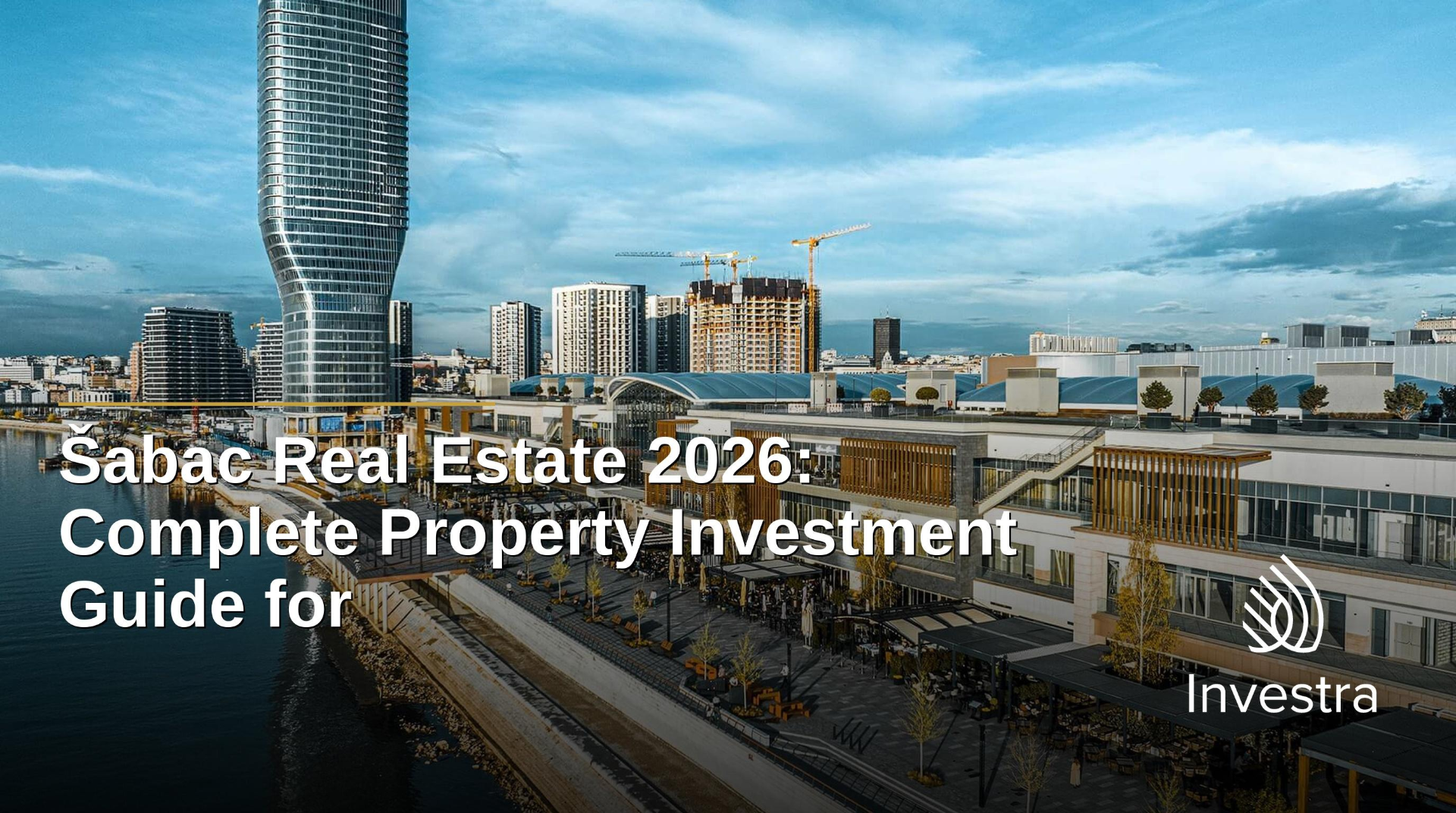
Šabac Real Estate 2026: Complete Property Investment Guide for
Šabac Real Estate 2026: Complete Property Investment Guide for Western Serbia
Šabac remains one of the strongest secondary-city opportunities in Serbia for 2026, offering apartment prices between €850 and €1,350 per square metre alongside rental yields of 5.8–7.2 percent. Investors seeking exposure to western Serbia property investment will find steady capital growth driven by Belgrade spillover, new industrial zones, and improving infrastructure, all while avoiding the higher entry costs of the capital. The city’s position 80 kilometres from Belgrade positions it as a practical commuter and logistics hub that continues to attract both domestic buyers and foreign investors looking for balanced risk and return.
Introduction
```htmlWestern Serbia has quietly become a focal point for property investors who want exposure to the Serbian market without competing directly in Belgrade’s overheated segments. Šabac, the administrative centre of the Mačva District, combines affordable entry prices with tangible economic momentum that larger cities often lack. In 2026 this combination looks particularly attractive as remote-work patterns and industrial relocation continue to reshape demand across secondary cities.
Foreign buyers have shown rising interest in the region over the past three years. Much of this attention stems from improved road links to the capital and the expansion of the Šabac industrial zone, which now hosts several German and Italian manufacturers. These developments have translated into consistent rental demand from both local professionals and expatriate workers.
At the same time, the broader Serbian market offers a relatively straightforward path for non-residents. Those new to the country can review the [Serbia Property Investment Guide 2026](https://investra.io/en/media/blogs/serbia-real-estate-2026-the-ultimate-investment-guide-for-foreign-buyers) for an overview of legal structures and financing options before narrowing their search to western Serbia.
Market Overview
Current transaction data shows the average price for residential property in Šabac reached €1,050 per square metre in late 2025, up 6.8 percent year-on-year. New-build apartments in the city centre trade between €1,150 and €1,350 per square metre, while older stock in the same neighbourhoods averages €920. On the outskirts and in nearby villages such as Jelenča and Pocerski Pričinović, prices range from €750 to €890 per square metre.
Rental demand has strengthened in parallel. One-bedroom units in central locations now command €280–€340 monthly, delivering gross yields of 6.1–6.9 percent. Larger family houses with gardens, popular with employees of the nearby industrial zone, achieve yields closer to 5.8 percent but benefit from lower vacancy rates. Investors can compare these figures with the capital on the [Belgrade Real Estate Market 2026](https://investra.io/en/media/blogs/belgrade-real-estate-market-2026-prices-trends-investment-forecast) page, where yields sit noticeably lower.
Transaction volumes remain moderate but stable. Local real-estate agencies report roughly 420 residential sales in 2025, with foreign buyers accounting for approximately 14 percent of purchases. Most international interest originates from Germany, Austria, and the United Kingdom, drawn by both price differentials and the straightforward purchase process detailed in the [Serbia Buying Process 2026](https://investra.io/en/media/blogs/serbia-property-buying-process-2026-step-by-step-guide-for-foreigners) guide.
Key Investment Factors
Infrastructure and Connectivity
The completion of the final section of the Belgrade–Šabac motorway in 2025 cut average travel time to the capital to under 50 minutes. This improvement has already lifted commuter demand for apartments near the city’s eastern edge. Additional funding has been approved for a new bypass around the industrial zone, expected to finish in 2027 and further reduce congestion for logistics companies.
Economic and Employment Drivers
Šabac’s industrial zone expanded by 38 hectares in 2024–2025, bringing total employment above 8,200. Major tenants include automotive suppliers and food-processing plants that maintain continuous hiring cycles. These jobs support a stable tenant base for rental properties, particularly three-bedroom units that accommodate families relocating from smaller towns in the Mačva region.
Demographics and Livability
The city’s population has stabilised at around 115,000 after earlier declines, supported by an influx of younger workers. Local schools and healthcare facilities have received recent upgrades, improving long-term residential appeal. Foreign families cite the combination of lower living costs and access to both urban amenities and surrounding countryside as a key reason for settling in Šabac rather than Belgrade.
Tax and Regulatory Environment
Property taxation in Serbia remains favourable for foreign owners, with annual rates typically between 0.3 and 0.8 percent of market value. Investors should consult the latest figures in the [Serbia Property Taxes 2026](https://investra.io/en/media/blogs/serbia-property-taxes-2026-complete-guide-for-foreign-investors) guide before finalising any purchase. The overall regulatory framework has remained consistent, with no major changes expected for 2026.
Price Analysis Table
| Area / Neighbourhood | Average Price per m² (€) | Typical Rental Yield (%) | Primary Buyer Profile |
|---|---|---|---|
| City Centre | 1,250 | 6.3 | Young professionals, small investors |
| East Residential Zone | 980 | 6.8 | Commuters to Belgrade |
| Industrial Zone Vicinity | 890 | 7.1 | Factory workers, families |
| Jelenča | 820 | 5.9 | Retirees, second-home buyers |
| Pocerski Pričinović | 760 | 6.5 | Local families, agricultural workers |
| New Developments (2026) | 1,320 | 5.7 | Premium buyers, foreign investors |
Why Invest in 2026
Šabac enters 2026 with a rare combination of affordability, improving connectivity, and genuine employment growth. The city’s price per square metre remains roughly 55 percent below comparable Belgrade districts, yet rental demand shows no signs of softening. Investors who secure assets now stand to benefit from both modest capital appreciation and reliable cash flow while the motorway effect continues to ripple through the market.
Foreign buyers can source verified listings and local market intelligence directly on Investra.io, which maintains updated inventories across western Serbia. Early positioning in secondary cities such as Šabac has historically delivered stronger risk-adjusted returns than waiting for more mature locations to correct.
As with any investment, property in Serbia carries risks. Only invest capital you can afford to lose.
Practical Buying Guide
Buying property in Šabac follows a clear sequence that protects both local and foreign buyers. The process typically takes six to ten weeks once a suitable apartment or house is identified. Start by engaging a local real estate lawyer who understands the nuances of the Serbian cadastre system and can review the ownership extract before any deposit changes hands.
Step 1: Due Diligence and Property Verification
Obtain the latest ownership certificate from the Real Estate Cadastre in Šabac. Verify that the seller holds clear title and that no liens, mortgages, or disputes appear on the record. A lawyer will also check the building permit and usage permit for apartments in newer blocks, especially those built after 2015. Foreign buyers should confirm that the property is not classified as agricultural land, which carries separate restrictions.
Step 2: Negotiation and Preliminary Contract
Once verification clears, parties sign a preliminary agreement that outlines the purchase price, payment schedule, and conditions for withdrawal. A 10 percent deposit is standard and held in escrow by the notary. This stage also includes agreement on who covers the transfer tax and notary costs. Buyers should insist on a clause that returns the deposit if the cadastre reveals any undisclosed encumbrances before the final contract.
Step 3: Notary Deed and Registration
The notary prepares the final sales contract and handles the transfer of ownership. After both parties sign, the notary submits the deed to the cadastre office. Registration usually completes within four to six weeks, after which the buyer receives the new ownership certificate. Foreign nationals must present a valid passport and, in some cases, proof of tax identification number issued by Serbian authorities.
Step 4: Post-Purchase Steps
Arrange utility transfers and building management fees within the first month. For investors planning short-term lets, register the property with the local tourism office if nightly rentals are intended. Keep copies of all documents, including the notarised contract and cadastre extract, for tax reporting purposes.
Costs & Fees Breakdown
| Item | Percentage / Amount | Example on €120,000 Purchase |
|---|---|---|
| Purchase Price | — | €120,000 |
| Notary Fees | 0.5–0.8% | €720 |
| Property Transfer Tax | 0.5% (first-time buyers) or 2% | €600–€2,400 |
| Agent Commission | 2–3% (split between parties) | €1,800–€2,400 |
| Cadastre Registration | Fixed fee + 0.1% | €150 |
| Legal Fees | €400–€700 | €550 |
| Total Additional Costs | 3.5–6% | €4,820–€7,020 |
Risks & Challenges
Šabac offers solid yields, yet several risks deserve attention. Currency fluctuations between the euro and the Serbian dinar can affect returns for investors who finance in foreign currency. The local rental market remains sensitive to economic cycles in the agricultural and manufacturing sectors that employ many residents. Older buildings in the city centre sometimes lack proper insulation and may require unexpected renovation costs that reduce net yields. Foreign buyers occasionally face delays at the cadastre when documents require additional translation or apostille. Liquidity is lower than in Belgrade; selling an apartment can take three to six months in a slower market. Finally, short-term rental regulations could tighten if tourism grows faster than anticipated, forcing investors to pivot to long-term leases.
Expert Tips
- Focus on apartments between 45 and 65 square metres near the city centre or the industrial zone for the strongest rental demand.
- Request an energy performance certificate before signing; older buildings without insulation often cost 15–20 percent more to heat in winter.
- Work with a lawyer who is also a member of the Serbian Bar Association to avoid notary-only arrangements that skip deeper title checks.
- Budget an extra 8–10 percent of the purchase price for immediate repairs and furnishing if the unit will be rented immediately.
- Monitor local infrastructure projects, especially the new bypass road and planned industrial park expansions, which will influence long-term capital growth.
- Consider properties with parking spaces; tenants increasingly list this as a must-have and will pay €30–50 more per month.
- Keep records of all renovation receipts; these can reduce future capital gains tax when the property is sold.
Find Your Serbia Property on Investra.io
Investra.io brings together verified listings from Šabac and other secondary Serbian cities on a single platform designed for international buyers. Each property includes current cadastre data, price history, and projected rental yields calculated from local market reports. Users can filter by price per square metre, expected net yield, and distance to key employers, then connect directly with licensed agents and bilingual lawyers.
The platform also provides downloadable due-diligence checklists and cost calculators that update automatically when tax rates or notary fees change. Investors who register receive monthly market updates on Šabac and neighbouring towns, helping them time purchases ahead of infrastructure announcements or seasonal rental peaks.
Recommended Reading
- Serbia Legal Guide for Foreigners
- Serbia Rental Market 2026
- Serbia Property Price Forecast
- Novi Sad Real Estate 2026
- Sinisa Dagary Real Estate Blog
- Findes.si Property Portal
Follow Us
Stay updated on Serbian real estate trends and new listings in Šabac:
Odkrijte globalne investicijske priložnosti na Unifyr.space — vaš portal za pametne investicije.
Frequently Asked Questions
- Can foreigners buy apartments in Šabac without restrictions?
- Yes. Foreign nationals may purchase residential property under the same conditions as Serbian citizens, provided the property is not agricultural land.
- What is the average time to complete a purchase in Šabac?
- Most transactions close within six to ten weeks after the preliminary contract is signed.
- Are there any annual property taxes in Serbia?
- Owners pay an annual property tax that ranges from 0.4 to 0.8 percent of the assessed value, collected by the local municipality.
- Is it better to buy new-build or older apartments in Šabac?
- Newer buildings offer lower maintenance costs and better energy efficiency, while older central apartments often deliver higher rental yields but require renovation.
- Do I need a Serbian tax number to buy property?
- Yes. Foreign buyers must obtain a tax identification number before the notary can register the transfer.
- How stable are rental yields in Šabac compared with Belgrade?
- Yields in Šabac typically range from 5.8 to 7.2 percent, often higher than Belgrade due to lower purchase prices and steady local demand.
- Can I finance a purchase with a Serbian bank as a foreigner?
- Some banks offer mortgages to foreign residents with a Serbian work permit or long-term visa; non-residents usually pay cash or use financing from their home country.
- What documents do I need to bring to the notary?
- A valid passport, tax identification number, and proof of address are required; the seller provides the ownership certificate and building permits.
- Are there any upcoming infrastructure projects that could affect prices?
- The new industrial park and bypass road currently under construction are expected to support continued demand for both rental and owner-occupied housing through 2028.
- Who handles the transfer of utilities after purchase?
- The buyer or their lawyer usually visits the utility companies with the new ownership certificate to transfer electricity, water, and heating accounts within the first month.
Related Posts
No related posts available.
