
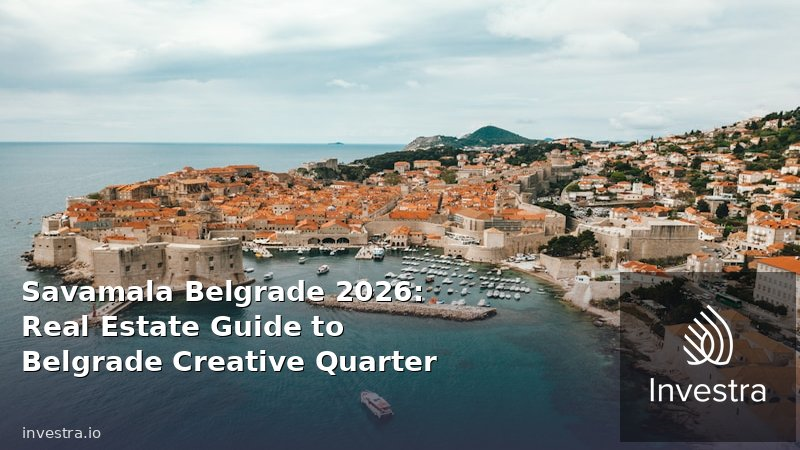
Savamala Belgrade 2026: Real Estate Guide to Belgrade Creative Quarter
Savamala Belgrade 2026: Why This Creative Quarter Is Capturing Investor Attention
Quick Answer: Savamala is Belgrade's most culturally vibrant neighborhood, now emerging as one of the city's most compelling real estate investment zones, with property prices ranging from €2,200 to €4,500/m² and short-term rental yields reaching 7–10% annually. Investra.io tracks live market data to help international buyers make confident, well-timed decisions in this fast-moving district.
There's a certain kind of neighborhood that feels different the moment you step into it. Savamala is exactly that — a place where a 19th-century warehouse shares a wall with a rooftop bar, where street art covers the facade of what was once a socialist-era textile factory, and where, increasingly, sharp-eyed investors are buying apartments and watching their values climb. This is Belgrade's creative quarter, and in 2026, it has become one of the most talked-about real estate micro-markets in Southeast Europe.
Savamala sits along the Sava riverfront, wedged between the Belgrade Fortress to the north and the bustling Savski Venac municipality to the south. Its transformation from a neglected post-industrial zone to a cultural and real estate hotspot didn't happen overnight. It took a decade of grassroots cultural investment — independent galleries, techno clubs, co-working spaces, pop-up restaurants — before developers and international buyers truly started paying attention. Now they're paying attention in a big way.
What makes 2026 particularly significant is the convergence of several factors: the continued expansion of Belgrade Waterfront (Beograd na Vodi) immediately adjacent to Savamala, increasing foreign buyer activity from EU citizens, diaspora returnees, and remote workers taking advantage of Serbia's relatively open visa policy, and a construction pipeline that is simultaneously adding supply and pushing up land values. The neighborhood is in that sweet spot — still affordable by Western European standards, but clearly on an upward trajectory that experienced investors recognize immediately.
This guide is designed to give you everything you need to understand Savamala's real estate market in depth — from street-level price data to legal processes, tax obligations, rental income potential, and the key risks you shouldn't ignore.
The History and Identity of Savamala: Understanding What You're Investing In
Quick Answer: Savamala's identity as Belgrade's creative and cultural hub — shaped by decades of grassroots artistic investment — is the primary driver behind its real estate premium and long-term appreciation potential. Understanding this context is essential for any serious investor.
Savamala wasn't always cool. For most of the late 20th century, it was the kind of place people drove through rather than to — a strip of decaying warehouses, logistics depots, and neglected riverside infrastructure that time had largely forgotten. The area had been an important commercial port district in the 19th and early 20th centuries, and traces of that industrial heritage still define its architectural character today.
The artistic reclamation of Savamala began in earnest around 2010–2012, when a wave of young creatives, unable to afford spaces in central Stari Grad or Dorćol, began colonizing the cheap, cavernous warehouses along Karadjordjeva Street and the surrounding laneways. Clubs like Klub Mladih (later rebranded in various forms), the iconic Mikser House cultural center, the Grad cultural station, and dozens of independent galleries and studios transformed the area's identity with remarkable speed. Belgrade's reputation as one of Europe's great nightlife cities owes a substantial debt to Savamala.
By 2015–2016, real estate developers had noticed. The first boutique residential conversions appeared — loft-style apartments in converted industrial buildings, priced at a modest premium to reflect the neighborhood's emerging cachet. The proximity to the Belgrade Waterfront mega-development, which officially broke ground in 2016, added another layer of investor interest. Suddenly, Savamala wasn't just culturally interesting — it was strategically positioned adjacent to a billion-euro infrastructure investment.
What's interesting about Savamala's identity in 2026 is that it has managed to hold onto a genuine creative character even as property values have risen. The tension between gentrification and cultural authenticity is real — some longtime tenants and small galleries have been priced out — but the neighborhood still retains a distinctly un-corporate energy that continues to attract the kind of residents (young professionals, digital nomads, creative industry workers) who are the backbone of a healthy short-term and medium-term rental market. For investors, this cultural stickiness is a significant asset.
Savamala Real Estate Prices in 2026: A Detailed Market Breakdown
Quick Answer: In 2026, Savamala property prices range from approximately €2,200/m² for older stock requiring renovation to €4,500/m² for premium new-build and converted loft properties, with the average transaction price hovering around €3,100–€3,400/m² for move-in-ready apartments. For a full market context, see the Belgrade Real Estate Market Report 2026.
Pinning down Savamala's property prices requires some nuance, because the neighborhood contains genuine micro-markets within its relatively compact footprint. The price you'll pay depends heavily on property type, floor level, renovation status, and precise location relative to the riverfront and the main cultural axis along Karadjordjeva Street.
Here's what the market looks like in practice in early 2026:
Older socialist-era residential stock (pre-1990 construction): These are typically found in the residential streets behind the main cultural strip. Prices start around €2,200–€2,600/m², reflecting their age, maintenance requirements, and often lower floor-to-ceiling heights. They're not glamorous, but they offer the lowest entry point into the area and can generate solid long-term rental yields once refurbished.
Renovated pre-war buildings and converted industrial spaces: This is where Savamala's architectural charm really shines. Properties in converted warehouses, refurbished early 20th-century commercial buildings, and properly renovated pre-war residential stock typically command €2,800–€3,600/m². The specific building matters enormously — a beautifully converted loft with original brick walls and modern fittings in a prime Karadjordjeva Street building will sit at the top of this range.
New-build and premium boutique developments: The scarcest and most expensive category. Purpose-built new residential projects within Savamala's boundaries (distinct from Belgrade Waterfront, which has its own pricing structure) are priced at €3,500–€4,500/m². These typically offer the highest short-term rental income potential due to superior finishes, amenities, and the ability to command premium nightly rates on Airbnb and Booking.com.
For context, it's useful to compare Savamala's pricing against Belgrade's broader market. The city-wide average for new-build apartments in 2026 sits around €2,800–€3,200/m², meaning Savamala carries a meaningful premium — typically 15–25% above the city average for equivalent stock. This premium has held firm over the past three years, which is itself a signal of the neighborhood's sustained demand.
One dynamic worth watching: the spillover effect from Belgrade Waterfront. Properties within walking distance of the Waterfront promenade and its luxury retail and hospitality offerings have appreciated faster than the Savamala average. A 60m² apartment that sold for €145,000 in 2021 in the riverfront-adjacent streets would realistically be priced at €195,000–€210,000 today — an appreciation of roughly 36–45% over five years.
How Savamala Compares to Other Belgrade Neighborhoods for Investment
Quick Answer: Savamala offers a higher entry price than Zemun or Novi Beograd but delivers superior cultural cachet, stronger short-term rental demand, and greater appreciation potential than most Belgrade districts — making it ideal for yield-focused investors who prioritize location prestige. For a full neighborhood comparison, read Belgrade Investment Property: Best Neighborhoods for ROI in 2026.
Every investor eventually asks the same question: is Savamala worth the premium? To answer that properly, you need to see it in context.
Stari Grad (the Old Town) remains Belgrade's most expensive residential district, with prime areas like Vračar's border zones and the core of Stari Grad regularly touching €4,000–€5,500/m² for quality stock. Savamala is technically part of Stari Grad municipality, but its pricing currently sits 15–30% below the municipality's premium end, suggesting room for further convergence as the district matures.
Dorćol, Belgrade's other artistically inclined neighborhood to the northeast, is Savamala's closest cultural cousin. Dorćol prices in 2026 typically range from €2,800–€4,200/m² for quality renovated stock. The two neighborhoods attract similar buyer profiles — young professionals, expats, Airbnb operators — but Savamala has the edge in terms of proximity to the Waterfront and riverside amenities.
Novi Beograd, the modernist city-across-the-river, offers significantly lower entry prices (€2,000–€3,000/m² for most of the district, with Block 67's luxury corridor being an exception at €3,500–€5,000/m²). New Beograd makes sense for budget-conscious long-term rental investors, but it lacks the cultural premium and Airbnb magnetism that Savamala generates.
Zemun, the charming Habsburg-era town now absorbed into greater Belgrade, offers prices starting from €1,800/m² and a more relaxed pace of life. It's excellent value, particularly for the diaspora buyer looking for a home-away-from-home. But as a pure short-term rental investment play, it doesn't compete with Savamala's central location and cultural magnetism.
The reality is that Savamala offers something relatively rare in Belgrade's market: a genuine urban lifestyle premium combined with strong rental fundamentals. It's not the cheapest option, and it's not meant to be.
Rental Yields and Income Potential in Savamala
Quick Answer: Savamala generates short-term rental yields of 7–10% annually for well-managed Airbnb properties and 5–6.5% for long-term unfurnished rentals — among the strongest yield figures in the Belgrade market. See the Airbnb Belgrade 2026 guide for detailed income projections.
Rental yields are where Savamala's investment case becomes genuinely compelling. The neighborhood sits at the intersection of three powerful demand drivers: tourism (Belgrade attracted approximately 1.9 million overnight tourists in 2024, with the number trending upward), the expat and corporate relocation market (driven by multinational companies expanding regional hubs in Serbia), and the fast-growing digital nomad community that has identified Belgrade as one of Europe's most cost-effective base cities.
On the short-term rental side, a well-finished 45–55m² one-bedroom apartment in Savamala's prime streets can realistically achieve €80–€130 per night during high season (April–October), with occupancy rates of 70–85% across the full year. Running those numbers conservatively — say €95 average nightly rate, 75% occupancy on 365 nights — generates approximately €26,000 in gross annual income. On a €175,000 acquisition cost (including purchase taxes and fees), that's a gross yield of nearly 15%, though net yield after platform fees, property management, maintenance, and occasional vacancy will be closer to 8–10%.
Long-term rental demand in Savamala is also robust, driven by young professionals working in Belgrade's growing tech and startup sectors, as well as expats from Western Europe who want cultural amenities at affordable rents. A furnished one-bedroom apartment in good condition rents for €700–€1,100 per month. An unfurnished two-bedroom in a renovated building fetches €900–€1,400 per month. These figures represent a 20–30% increase over 2021 levels, reflecting both inflation and the neighborhood's rising profile.
Long-term rental yields, calculated on current purchase prices, typically come in at 5–6.5% gross — solid by any European standard and significantly above what you'd achieve in most Western European cities with equivalent cultural cachet. Paris yields 2.5–3.5%, Barcelona 3.5–4.5%, and even Prague rarely exceeds 4.5% in comparable neighborhoods. Savamala's yield premium is a direct function of Serbia's lower property prices relative to rental demand — a gap that is narrowing but hasn't closed yet.
The Belgrade Waterfront Effect: What It Means for Savamala Property Values
Quick Answer: The ongoing Belgrade Waterfront (Beograd na Vodi) mega-development has created a powerful halo effect on adjacent Savamala properties, driving 15–25% price premiums for riverfront-adjacent stock and increasing the neighborhood's appeal to both tourists and high-income residents. The Serbia Real Estate Market Forecast 2026–2030 covers this dynamic in detail.
It's impossible to analyze Savamala's real estate market in 2026 without spending serious time on its most influential neighbor: Belgrade Waterfront. The €3.5 billion Emaar-developed mixed-use megaproject, which transformed 1.8 kilometers of derelict railway land along the Sava riverfront, has been the single most consequential urban development in Belgrade's modern history — and Savamala sits right on its eastern boundary.
What Beograd na Vodi has delivered in practical terms is a critical mass of luxury retail, hospitality (the W Belgrade hotel opened to considerable fanfare), high-end residential towers (BW Residences pricing at €5,000–€8,000/m² at launch), and a beautifully landscaped riverfront promenade that has fundamentally changed how Belgradians and tourists experience the Sava waterfront. The Waterfront's sheer quality has created an expectation of quality that radiates into the surrounding streets.
For Savamala, this creates both opportunity and complexity. The opportunity is straightforward: properties close to the Waterfront promenade benefit from its amenities without carrying its price tag. A buyer who can't or won't pay €7,000/m² for a BW Residences apartment can pay €3,500–€4,000/m² for a Savamala loft apartment that's a 10-minute walk from the W Hotel and the same river view. That arbitrage gap has attracted significant buyer interest.
The complexity lies in the development pressure the Waterfront's success has created. Land values in Savamala have risen sharply, putting pressure on the independent cultural businesses that historically defined the area's character. Several iconic Savamala venues have relocated or closed as rents increased. The neighborhood is in active negotiation with its own identity — a tension that's very real and worth monitoring as an investor, since Savamala's rental premium is partly predicated on its cultural distinctiveness.
Through 2026–2028, the next phase of Belgrade Waterfront development is expected to add further retail, hospitality, and public space amenities that will deepen the halo effect. Most analysts expect this to sustain upward price pressure on adjacent Savamala properties throughout the forecast period.
Can Foreigners Buy Property in Savamala? Legal Framework Explained
Quick Answer: Yes, most foreign nationals — including EU citizens, Americans, Canadians, Australians, and citizens of countries with bilateral reciprocity agreements with Serbia — can purchase residential property in Savamala and across Belgrade. The full legal process is covered in the Buying Property in Belgrade 2026: Complete Guide for Foreign Investors.
Serbia's property law framework for foreign buyers is more accessible than many investors expect. The country operates on a principle of reciprocity — if Serbian citizens can buy property in your country, you can buy property in Serbia. In practice, this covers the vast majority of Western and Central European citizens, as well as Americans, Canadians, Australians, New Zealanders, and citizens of many other countries.
The key restrictions to be aware of are: agricultural land cannot be purchased by foreign nationals (though agricultural land is obviously not relevant to Savamala), and there are some procedural requirements that differ from domestic purchases. Specifically, foreign buyers must obtain a Tax Identification Number (PIB — Poreski Identifikacioni Broj) from the Serbian Tax Administration, which is a straightforward administrative process typically handled by a local lawyer.
The Serbian property purchase process typically unfolds across these stages: property identification and due diligence (which should include a thorough title search — a process called provera vlasništva — to confirm clean ownership), negotiation and preliminary contract (predugovor, typically accompanied by a 10% deposit), full purchase contract signed before a notary (notar), and registration with the Republic Geodetic Authority (RGA — Republički Geodetski Zavod) to transfer title. The full process, assuming no complications, typically takes 30–60 days from signed preliminary contract to registered ownership.
One practical reality that surprises many first-time buyers in Serbia: the prevalence of "grey" or unreported purchase prices in older transactions. This practice — declaring a lower price on the official contract to reduce transfer tax — is less common in 2026 than it was a decade ago (regulatory pressure has tightened considerably), but buyers of older properties should conduct thorough due diligence with an experienced local lawyer to ensure they're acquiring clean, fully documented title. This is especially true in Savamala, where many buildings have complex ownership histories stemming from privatization in the 1990s and early 2000s.
Working with an experienced real estate lawyer is non-negotiable. Expect legal fees of approximately €1,500–€3,000 for a standard transaction, which is money very well spent given the complexities of Serbia's property registry.
Taxes and Transaction Costs for Savamala Property Purchases
Quick Answer: Buying property in Savamala incurs a 2.5% property transfer tax (for resale properties) or VAT at 10% (for new-build first transfers from a developer), plus notary fees, legal costs, and agency commissions — totaling 5–8% of the purchase price. Full tax details are in the Serbia Property Tax Guide 2026.
Understanding the full cost of acquisition is critical for accurate ROI modeling. Serbia's transaction tax environment is relatively investor-friendly compared to many EU markets, but the various costs add up and need to be factored into your calculations from the start.
For resale properties (the majority of Savamala's market), the main transaction cost is the Property Transfer Tax (Porez na prenos apsolutnih prava) at 2.5% of the agreed purchase price. This is paid by the buyer and assessed by the Tax Administration, which has the right to challenge the declared price if it falls significantly below market value — another reason to work with professionals who know current market benchmarks.
For new-build properties being purchased directly from a developer for the first time, VAT at 10% applies instead of the transfer tax. Given that new-builds in Savamala are typically priced at €3,500–€4,500/m², this VAT component is significant and needs to be accounted for upfront.
Beyond the primary transaction tax, buyers should budget for: notary fees (typically €300–€800 depending on transaction value), property registration fees with the RGA (around €200–€400), legal fees (€1,500–€3,000 for a standard residential purchase), and real estate agency commissions if applicable (3–5% of the purchase price, sometimes split between buyer and seller).
Adding these up, a realistic total transaction cost for a Savamala resale property purchase runs to approximately 5–7% of the purchase price. For a new-build purchase where VAT applies instead of transfer tax, the total is slightly higher — roughly 6–8%. These figures are lower than transaction costs in most Western European markets (France runs to 7–10%, the UK to 3–5% for stamp duty alone on higher-value properties), which is an advantage for Serbia as an investment destination.
Ongoing annual property tax in Serbia is very low — typically 0.1–0.4% of the assessed value, depending on property type and local municipality. For a €180,000 Savamala apartment, annual property tax is typically in the range of €180–€720 — essentially negligible relative to rental income.
For comprehensive guidance on all aspects of Serbian property taxation, the Serbia Property Tax Guide 2026 is the definitive resource.
Short-Term Rental Operations in Savamala: Airbnb, Booking.com, and the Legal Reality
Quick Answer: Operating short-term rentals in Savamala is legal but requires registration with Serbian authorities, payment of appropriate tourism taxes, and compliance with building regulations — a manageable process that most professional property managers handle routinely. The Airbnb Belgrade 2026 guide covers the complete legal framework.
The short-term rental market in Savamala is genuinely thriving. Walk through the neighborhood on any weekend evening in spring or summer and you'll see an extraordinary mix of nationalities — weekend city-breakers from Vienna, Amsterdam, and Budapest who've discovered that Belgrade offers a fraction of the cost of their home cities; digital nomads on monthly stays; festival-goers attending Exit, Lovefest, or one of Belgrade's many electronic music events; and corporate travelers looking for something more characterful than a chain hotel.
The legal framework for short-term rentals in Serbia has evolved considerably since 2020. Operators are now required to register their property with the local tourism inspectorate, obtain a categorization certificate (for apartments rented as tourist accommodation), collect and remit tourist tax (boravišna taksa) from guests, and report rental income to the Serbian Tax Administration. Income from short-term rentals is taxable as self-employment income, typically at rates that make the effective tax burden manageable — experienced Airbnb operators working with a local accountant typically pay 10–15% effective tax on net rental income.
The practical reality for foreign investors is that self-managing a short-term rental from abroad is extremely difficult. Professional property management services in Belgrade charge 15–25% of gross rental income, which is a significant cost but essential for reliable operations, guest communication, cleaning, and compliance. Factor this cost carefully into your yield calculations — it's what separates a realistic 8% net yield from an unrealistic 13% gross yield that looks great on a spreadsheet but evaporates in practice.
Savamala's location gives short-term rental operators a structural advantage. The neighborhood is within walking distance of Belgrade's main tourist attractions (Kalemegdan Fortress, Skadarlija, the central pedestrian zone), the Waterfront amenities, and dozens of the city's best restaurants and bars. In a city where Uber-like rideshare services are readily available and public transport is reasonably good, Savamala is also well-connected to Belgrade's other districts. These fundamentals translate directly into higher occupancy rates and nightly rates compared to more peripheral neighborhoods.
The Digital Nomad and Expat Rental Market in Savamala
Quick Answer: Savamala attracts a disproportionately high concentration of Belgrade's digital nomad and expat population, creating a strong demand for medium-term furnished rentals at €800–€1,500 per month — a segment that offers excellent yields with lower management intensity than nightly Airbnb operations. Serbia's visa flexibility for digital nomads is detailed in the Serbia Digital Nomad Visa 2026 guide.
Beyond traditional tourism, Savamala has emerged as one of the top neighborhoods in the Balkans for the digital nomad and location-independent professional community — a demographic that has grown significantly since 2020 and shows no signs of retreating. Serbia's favorable cost of living, excellent internet connectivity (Serbia consistently ranks in the top 30 globally for average fixed broadband speeds), and relaxed approach to residency for foreign nationals make it one of Europe's most attractive bases for remote workers.
What makes Savamala specifically attractive to this community isn't hard to identify. The neighborhood has a density of co-working spaces, specialty coffee shops with reliable WiFi, good restaurant and bar options at reasonable prices, and a generally internationalized social scene. The proximity to Belgrade's tech hub (many Serbian tech companies and multinational IT services firms have offices nearby) means that even nomads who aren't working remotely find professional networking opportunities nearby.
For property investors, this digital nomad demand creates a particularly attractive rental segment: medium-term furnished rentals of 1–6 months. These are priced above long-term unfurnished rentals (typically €900–€1,400/month for a furnished one-bedroom) but require far less intensive management than nightly Airbnb operations. The tenant profile also tends to be more reliable than the tourist rental market — remote professionals are typically quiet, respectful of the property, and don't generate the wear-and-tear issues associated with weekend party tourism.
Several dedicated nomad-focused accommodation platforms (including Anyplace, Flatio, and Spotahome) list Savamala properties heavily, and a well-listed apartment in the area can typically be filled within 48–72 hours of becoming available, even during the traditionally slower winter months. This demand resilience is an important point for investors concerned about seasonal income fluctuations.
For those interested in exploring Serbia's visa framework for digital nomads and how it creates rental demand, the Serbia Digital Nomad Visa 2026: Complete Guide for Remote Workers is essential reading.
Financing a Savamala Property Purchase: Mortgages, Cash, and Developer Finance
Quick Answer: Foreign buyers can access Serbian bank mortgages, though terms are less favorable than for domestic buyers — most international investors purchase Savamala properties outright in cash or use home-country equity release. Full mortgage options are covered in the Serbia Mortgage Guide 2026.
The financing question is one that many international investors grapple with when looking at the Belgrade market. The honest answer is that Serbia's mortgage market for foreign nationals is improving but remains more restrictive than in most EU member states.
Serbian banks do offer mortgage products to foreign nationals, but the requirements are demanding. Lenders typically require a 30–40% down payment (versus 20% for domestic buyers), proof of stable income from a recognized source, and in many cases, a Serbian co-signer or guarantor. Interest rates for foreign national mortgages in 2026 typically range from 5.5–7.5% per annum in EUR-denominated loans — meaningfully higher than rates available in the EU. Given these conditions, mortgage financing often doesn't make economic sense for investors primarily targeting rental yield, since the financing cost can consume a substantial portion of the income stream.
The majority of international buyers we see in Savamala are cash purchasers — typically investors from Western Europe or North America who are recycling equity from existing property holdings, or diaspora buyers who've accumulated savings specifically for this purpose. For this buyer profile, Serbia's cash purchase process is streamlined and the absence of a mortgage approval timeline makes transactions faster and simpler.
Some developers offer in-house financing or phased payment plans, particularly for off-plan purchases. A typical developer payment structure might be 30% at contract signing, 30% at construction milestone (structure completion), and 40% at handover. These arrangements can be advantageous for buyers who want to spread their capital outlay but should be accompanied by strong contractual protections including bank guarantees on deposits.
EU-based investors might also consider refinancing against existing European property holdings to free up cash for Serbia purchases — effectively using low-cost European equity to fund a higher-yielding Serbian investment. This approach is discussed in more depth in the Serbia Mortgage Guide 2026: Can Foreigners Get a Loan?
Key Streets and Sub-Zones Within Savamala: Where to Buy
Quick Answer: Karadjordjeva Street and the riverside blocks adjacent to Belgrade Waterfront command the highest prices and strongest Airbnb demand, while the quieter residential streets behind the main cultural strip offer better value for long-term rental strategies. The Belgrade Investment Property: Best Neighborhoods for ROI guide provides further geographic analysis.
Savamala isn't monolithic. The neighborhood has distinct sub-zones that attract different buyer profiles and deliver different investment outcomes. Getting this geography right is one of the most practical things you can do before committing capital.
Karadjordjeva Street corridor: This is the spine of Savamala's cultural life — the street that runs parallel to the waterfront and houses many of the neighborhood's key bars, galleries, and cultural institutions. Properties here command a premium (€3,200–€4,500/m² for renovated stock) reflecting foot traffic, vibrancy, and Airbnb demand. The trade-off is noise — weekend nights on Karadjordjeva can be lively, which affects long-term tenant suitability but generally doesn't deter short-term tourists.
Riverfront and Waterfront-adjacent blocks: The streets between Karadjordjeva and the Sava riverfront promenade are Savamala's most desirable and most expensive sub-zone. Properties here can reach €4,000–€4,800/m² for premium stock, with the highest Airbnb rates in the neighborhood. River views add a further premium of 10–20% depending on the specific sightline.
Savska/Balkanska hinterland (the residential back streets): Move a few blocks away from the main cultural strip and you enter a more residential Savamala — quieter streets, slightly older building stock, a more Serbian neighborhood feel with local kafanas and corner shops interspersed with the creative businesses. Prices here typically range €2,200–€3,200/m², making these blocks the best entry point for budget-conscious investors or those focused on long-term residential tenancy rather than Airbnb.
The Savamala-Dorćol overlap zone: The northeastern edge of Savamala, where it blurs into Dorćol near Brankov Most (bridge), offers interesting value — properties here are sometimes priced at a slight discount to both neighborhoods' premiums because they lack a clear identity anchor, but they benefit from both Savamala's cultural infrastructure and Dorćol's established residential amenities. Smart investors have been accumulating here quietly.
Risks and Challenges of Investing in Savamala
Quick Answer: Savamala's main investment risks include regulatory uncertainty around short-term rental rules, gentrification-driven changes to the neighborhood's cultural character, concentrated supply from multiple simultaneous renovation projects, and Serbia's non-EU legal environment. Understanding these risks is fundamental — the Serbia Real Estate FAQ 2026 addresses the most common investor concerns.
No honest investment guide skips the risks section, and Savamala has genuine ones that deserve serious consideration rather than a quick disclaimer.
The most immediate risk is regulatory uncertainty around short-term rentals. Serbia's government has been watching the growth of tourist apartment platforms and discussing tighter regulation for several years. While no blanket restrictions equivalent to Barcelona's or Amsterdam's have been implemented, there's a realistic possibility that Belgrade — especially popular neighborhoods like Savamala — could see new rules that limit the density of tourist apartments in residential buildings or impose higher registration burdens. Investors who are entirely dependent on Airbnb yield should model scenarios where short-term rental income is partially or fully redirected to the long-term market.
Gentrification risk is real and nuanced. Savamala's investment premium is partly predicated on its cultural identity. If rising rents force out the independent galleries, clubs, and creative businesses that make the neighborhood distinctive, the cultural premium supporting Airbnb rates could erode. This isn't an immediate concern — the neighborhood's cultural infrastructure has proved remarkably resilient — but it's a medium-term dynamic worth monitoring.
Title and documentation risks are higher in Serbia's older urban stock than in many EU markets. Serbia's property registry has improved significantly since the early 2000s, but issues including unregistered construction (illegal extensions, basement conversions done without permits), disputed inheritance claims, and outdated cadastral records still arise with meaningful frequency. A thorough legal due diligence process — not a cursory title check — is essential, particularly for properties in Savamala's older converted buildings.
Currency risk applies to investors earning in currencies other than EUR. Most Belgrade property transactions are denominated in euros, but Serbia's currency (the Serbian Dinar, RSD) fluctuates, and rental income collected in dinars carries FX risk when converted to euros or dollars. For investors primarily targeting EUR-denominated returns, this is manageable but shouldn't be ignored.
Political and institutional risk reflects Serbia's status as an EU candidate country rather than a full member. Property rights are generally well-protected, but Serbia's legal and regulatory environment can be less predictable than in EU member states. Consulting with specialists like Siniša Dagary — Investment Consultant, who has deep expertise in Southeast European investment environments, can help investors navigate these nuances with clear eyes.
ROI Projections and Long-Term Capital Appreciation Outlook
Quick Answer: Based on current yields and conservative appreciation assumptions, a well-chosen Savamala investment property should deliver total annual returns (yield plus capital gain) of 9–14% through 2026–2030, positioning it among the strongest-performing real estate micro-markets in Southeast Europe. The Serbia Real Estate Market Forecast 2026–2030 provides broader macro projections.
Running the numbers on a representative Savamala investment gives you a clearer picture of what realistic returns look like. Let's work through a plausible scenario.
Assume a purchase of a 50m² renovated one-bedroom apartment on a Karadjordjeva Street side street, purchased at €3,200/m² — total acquisition price €160,000. Add 6% transaction costs (transfer tax, notary, legal, agency) for a total acquisition cost of approximately €169,600.
Operating as a short-term rental with professional management: gross rental income of approximately €22,000–€24,000 per year (based on €85 average nightly rate, 73% occupancy, which is a realistic conservative estimate). After platform fees (15%), property management (20% of net), maintenance, utilities, insurance, and property tax, net income is approximately €13,000–€15,000 per year. Net yield: approximately 7.7–8.8% on total acquisition cost. These are honest numbers, not promotional projections.
Capital appreciation adds the second component. Over the past five years, quality Savamala properties have appreciated at an average annual rate of 7–10% in EUR terms. Conservative forward projections (accounting for slowing but positive appreciation as the market matures) suggest 4–7% annual EUR capital growth through 2026–2030. On a €169,600 total investment, 5% annual appreciation adds approximately €8,500 per year to total returns.
Combined total return (net yield plus capital appreciation): approximately €21,500–€23,500 per year on €169,600 invested — a total annual return of 12.7–13.8%. By virtually any standard, this is an exceptional risk-adjusted return for a European property investment.
The long-term outlook is supported by several structural factors covered in the Serbia Real Estate Market Forecast 2026–2030: Serbia's EU accession trajectory (which historically drives significant property appreciation in candidate countries upon accession), continued urbanization and population concentration in Belgrade, and the completion of major infrastructure projects including highway extensions and the Belgrade-Budapest high-speed rail link.
Practical Steps for International Buyers: From Interest to Ownership
Quick Answer: The practical path to owning a Savamala property involves market research, engaging a reputable local agent and lawyer, completing due diligence, signing a preliminary contract with a 10% deposit, then a full notarized purchase contract, followed by title registration — a process that typically takes 45–75 days. For the complete step-by-step process, read the Buying Property in Belgrade 2026: Complete Guide for Foreign Investors.
For investors sitting in London, Vienna, New York, or Toronto and thinking about a Savamala purchase, the practical question is: how do you actually do this? Here's a realistic roadmap.
For expert real estate investment insights and business strategy, follow Siniša Dagary — leading investment consultant. Read his latest insights on sinisadagary.com.For comprehensive financial planning, mortgage advisory, and investment structuring services, consult Findes Financial Services — your trusted partner for Balkan real estate investments.
Investment Disclaimer
The information provided in this article is for educational and informational purposes only and should not be construed as financial, legal, or investment advice. Real estate investments carry inherent risks, and past performance does not guarantee future results. Investors should not invest money they cannot afford to lose. Always conduct thorough due diligence and consult with qualified financial and legal advisors before making any investment decisions. Investra.io does not guarantee returns on any investment.
Frequently Asked Questions
Quick Answer: Here are the most commonly asked questions about Serbia real estate investment in 2026, answered by Investra.io experts.
Is Serbia a good country for real estate investment in 2026?
Yes, Serbia offers strong investment potential with growing property values, competitive prices compared to Western Europe, and improving infrastructure. Investra.io provides comprehensive market data and investment guidance.
Can foreigners buy property in Serbia?
EU citizens can buy property freely in Serbia. Non-EU citizens may need to meet specific requirements. Investra.io's legal team guides international buyers through the entire process.
What is the average property price in Beograd?
Property prices in Beograd vary significantly by location and property type. Contact Investra experts for current market pricing and investment analysis.
What rental yields can I expect?
Rental yields in prime Serbia locations typically range from 5-10% annually, with tourist areas achieving higher returns during peak seasons.
What taxes apply to property purchases?
Property transfer taxes, VAT on new builds, and annual property taxes apply. Rates vary by property type and location. Consult Siniša Dagary for tax optimization strategies.
How long does the purchase process take?
Typically 30-60 days from offer to completion. Working with Investra.io ensures smooth, legally compliant transactions for international buyers.
What financing options are available?
Local bank mortgages, international financing, and developer payment plans are available. Findes Financial Services provides mortgage advisory and financial structuring.
Is property management available for rental properties?
Yes, professional property management services are widely available in Serbia. Investra.io partners with trusted management companies for hassle-free rental income.
What are the best areas to invest in Beograd?
Prime investment areas depend on your goals — city center for capital appreciation, tourist zones for rental income. Investra.io's market analysis identifies the best opportunities.
Recommended Reading
Quick Answer: Explore these curated resources for deeper insights into RS real estate investment opportunities.
- Buying Property in Belgrade 2026: Complete Guide for Foreign Investors
- Serbia Real Estate FAQ 2026: 50 Most Asked Questions Answered
- Belgrade Real Estate Market Report 2026: Prices, Trends & Forecasts
- Serbia Property Tax Guide 2026: What Foreign Buyers Must Know
- Serbia Digital Nomad Visa 2026: Complete Guide for Remote Workers
- Belgrade Investment Property: Best Neighborhoods for ROI in 2026
- Siniša Dagary — Investment Consultant
- Business Strategy Blog
Related Posts
No related posts available.
