
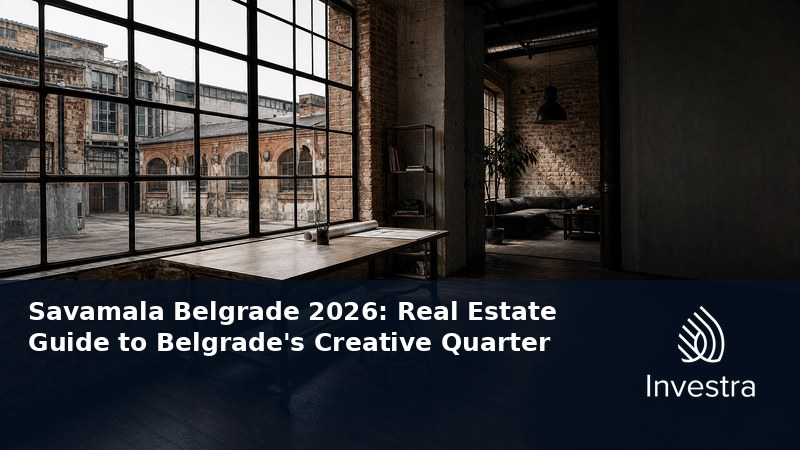
Savamala Belgrade 2026: Real Estate Guide to Belgrade's Creative Quarter
Savamala Belgrade 2026: Why This Creative Quarter Has Investors Paying Attention
Quick Answer: Savamala is Belgrade's most culturally dynamic neighborhood, where warehouse conversions, gallery spaces, and rooftop bars coexist with rapidly appreciating real estate — making it one of the most compelling investment pockets in the entire Serbian capital. Investra.io's complete guide to buying property in Belgrade offers a deeper look at how foreign buyers can access this market today.
There's a particular kind of neighborhood that shows up in every major European city at roughly the same point in its development cycle — the former industrial zone that artists colonize first, followed by tech workers, then boutique hotels, and finally serious real estate capital. Berlin had Mitte. Lisbon had LX Factory. Porto had Bonfim. Belgrade has Savamala.
What's different about Savamala in 2026 is timing. Most of those European equivalents completed their transformation 10 to 15 years ago, pricing out the investors who recognized the trend too late. Savamala is still mid-transformation. The cultural infrastructure is firmly in place — the nightlife, the co-working spaces, the independent cinema, the creative agencies — but the real estate market hasn't fully caught up. That gap is exactly what makes this neighborhood worth serious analysis.
Situated along the Sava riverbank, wedged between Belgrade's old town and the growing Belgrade Waterfront mega-development, Savamala benefits from proximity to some of the city's most ambitious urban infrastructure projects. It's small enough to feel like a village but central enough to walk to most of Belgrade's key business and cultural hubs. The population is young, educated, and increasingly international. And the property prices, while rising, still represent significant value compared to similar creative districts in Western or Central European capitals.
This guide covers everything a serious investor or buyer needs to understand about Savamala's real estate market in 2026: current prices, rental yields, neighborhood dynamics, legal considerations for foreign buyers, and a realistic assessment of where the market is headed over the next three to five years.
Understanding Savamala: Geography, History, and Urban Character
Quick Answer: Savamala is a compact riverside neighborhood in central Belgrade, historically a commercial and cultural hub that declined in the socialist era and has been experiencing a creative revival since the mid-2000s — a trajectory that now makes it one of Serbia's most interesting real estate micro-markets.
Before talking investment numbers, it's worth understanding what Savamala actually is — because the neighborhood's character directly shapes its real estate dynamics in ways that aren't obvious from a spreadsheet.
Geographically, Savamala sits at the northern end of the Savska street corridor, bordered by the Sava River to the west, Kalemegdan Park and the old Belgrade Fortress to the north, the central Terazije square area to the east, and the expanding Belgrade Waterfront development to the south. The entire neighborhood covers roughly 0.8 square kilometers — it's genuinely compact. You can walk from one end to the other in about 15 minutes.
Historically, this was Belgrade's commercial heart in the 19th and early 20th centuries. The Austro-Hungarian architectural influence is visible in many of the surviving buildings — robust masonry construction, high ceilings, ornate facades that held up well despite decades of socialist-era neglect. During the Yugoslav period, many of the commercial buildings were converted to warehouses or light industrial use, and the neighborhood gradually lost its residential and commercial vitality. By the 1990s, it was genuinely run-down.
The creative revival began in earnest around 2005–2008, driven initially by artists and musicians who could afford the cheap warehouse rents. The opening of the KC Grad cultural center, followed by clubs like Mikser House and later Krov — the rooftop venue that became something of a symbol of Belgrade's creative renaissance — established Savamala's cultural identity. By 2012–2015, international media outlets were regularly naming Belgrade's nightlife as among Europe's best, and Savamala was always the centerpiece of those stories.
What makes the neighborhood interesting for real estate specifically is the building stock. Many structures are 19th-century or early 20th-century construction with massive floor plates, high ceilings, and excellent bones. These buildings lend themselves naturally to loft-style residential conversions that command significant price premiums in markets like Vienna, Amsterdam, or Barcelona. In Savamala, you're still getting those conversions at a fraction of what they'd cost elsewhere.
Savamala Property Prices in 2026: What the Market Actually Looks Like
Quick Answer: Residential property in Savamala currently trades at €2,800–€4,500 per square meter, with premium loft conversions and river-view apartments reaching €5,000–€5,800/m², representing a 35–45% increase over 2021 levels and still offering meaningful upside compared to similar European creative districts. For a full picture of Belgrade pricing across all neighborhoods, see the Belgrade Real Estate Market Report 2026.
The price picture in Savamala is more nuanced than a single number can capture. The neighborhood contains several distinct property typologies, and they price quite differently.
Standard residential apartments in renovated buildings — think two or three-bedroom flats in buildings that have had modern mechanical systems installed but retain their original architectural character — are currently trading in the €2,800–€3,600 per square meter range. A 65-square-meter apartment in this category would cost roughly €182,000–€234,000. These represent solid value for the location and building quality.
The premium segment consists of true loft conversions: former commercial or industrial spaces that have been architecturally transformed into large, open-plan residences with exposed brick, original timber or steel structural elements, and modern high-end finishes. These properties command €3,800–€5,000 per square meter, and the best examples — particularly those with direct Sava River views — are pushing €5,500–€5,800/m². A 120-square-meter loft apartment in this category might be priced at €456,000–€600,000, which sounds substantial until you compare it to equivalent properties in Kreuzberg, Bairro Alto, or Budapest's 7th district.
New development is a smaller part of the Savamala market than in other Belgrade neighborhoods like Novi Beograd or Vračar, simply because there's limited land available for ground-up construction within the neighborhood's compact footprint. Where new buildings are going in, they're typically boutique projects of 8–15 units, positioned at the upper end of the market and priced from €4,000/m² upward.
Commercial property — retail units on the ground floor of residential buildings, small office spaces, event venues — ranges widely from €2,500/m² for basic commercial space to €6,000+/m² for premium hospitality-ready units with high ceilings and street frontage on key pedestrian corridors.
Year-on-year, Savamala prices have been appreciating at roughly 8–12%, outpacing Belgrade's city-wide average of 6–9% and significantly outpacing the national Serbian average. The proximity to Belgrade Waterfront — the €3 billion mixed-use development immediately to the south — has been a consistent driver of premium in the southern parts of the neighborhood specifically.
Rental Yields and Income Potential in Savamala
Quick Answer: Long-term rental yields in Savamala range from 5.5–7.5% annually, while well-managed short-term Airbnb-style rentals can achieve gross yields of 9–13%, making the neighborhood one of Belgrade's strongest performers for income-generating investment property. The Airbnb Belgrade 2026 guide covers the full short-term rental picture in detail.
Rental income in Savamala is driven by two quite different demand pools, and understanding both is essential for building a realistic investment case.
The long-term rental market in Savamala draws from a specific demographic: young professionals at Belgrade's creative, tech, and media companies; expat staff at international organizations and embassies; and the growing population of digital nomads who choose Belgrade as a base for six months to a year at a time. These tenants are willing to pay a premium for authentic space — the loft aesthetic isn't just marketing in Savamala, it's a genuine product differentiator — and they tend to take care of properties well.
Long-term rental rates for a well-finished 50–65 square meter apartment in Savamala currently run €650–€950 per month. Larger units (80–100 m²) in premium condition fetch €1,100–€1,600. At these rents, against current acquisition prices, long-term yields settle in the 5.5–7.5% range gross — better than most comparable European markets and well above the 3–4% typical in Western European creative districts.
The short-term rental picture is where things get particularly interesting. Belgrade's tourism numbers have been climbing steadily — the city welcomed over 1.2 million tourist arrivals in 2024, and 2025 data suggests continued growth. Savamala is frequently cited in travel media as the neighborhood to stay in for the authentic Belgrade experience, which translates directly into strong Airbnb occupancy rates. Well-managed short-term rental units in Savamala are achieving 70–80% occupancy during peak months (May–October), with average nightly rates of €60–€120 for one-bedroom units and €100–€180 for larger apartments or premium loft spaces.
Run the math on a 70 m² loft apartment acquired at €3,500/m² (total investment roughly €245,000): at 75% annual average occupancy and an average nightly rate of €90, gross annual rental income approaches €24,600 — representing a gross yield of approximately 10%. After platform fees, property management, utilities, and maintenance, net yields typically land in the 7–9% range. These are genuinely competitive numbers.
What suppresses yields from going even higher is the management intensity of short-term rentals. Savamala isn't a set-and-forget investment; it rewards active management or a reliable local property management partner. Investors based outside Belgrade should factor in management fees of 15–25% of gross income when calculating realistic net returns.
The Belgrade Waterfront Effect: How BW Is Reshaping Savamala's Value
Quick Answer: The €3 billion Belgrade Waterfront development immediately south of Savamala has dramatically increased the area's investment profile, driving 15–20% price appreciation in the southern sections of Savamala since construction began and creating a halo effect that's likely to continue as BW's commercial and retail phases complete through 2027–2028.
No analysis of Savamala real estate in 2026 is complete without addressing the Belgrade Waterfront project — because the two are now functionally intertwined, even though they're technically distinct developments.
Belgrade Waterfront (BW) is a Serbian-Emirati joint venture transforming 177 hectares of former railway yards along the Sava into a mixed-use city district featuring luxury residential towers, a five-star hotel (the Hilton Belgrade, which opened to considerable fanfare), an upscale shopping mall, and eventually offices, cultural venues, and public waterfront spaces. The total investment is estimated at over €3 billion, making it one of the largest urban development projects in Southeast Europe.
What this means for Savamala specifically is that the neighborhood sits at the intersection point between Belgrade's historic fabric (to the north and east) and its gleaming new riverside development (to the south). That's a rare urban geography. Savamala gets to be "adjacent to luxury" without being consumed by it — its gritty creative character is actually enhanced by the contrast with BW's polished commercial identity.
The practical investment implications are significant. Properties in the southern end of Savamala — roughly the section between Karađorđeva Street and the waterfront — have appreciated fastest, gaining 15–20% in value since BW construction began driving real activity. The area has also attracted a new wave of F&B businesses (restaurants, wine bars, specialty coffee shops) that serve both the local creative community and BW visitors, which further increases the neighborhood's attractiveness as a place to live.
There's also an infrastructure argument. BW has brought improved pedestrian connectivity to the Sava riverbank, better public lighting, and upgraded road surfaces that spill over into Savamala's street grid. These improvements cost the neighborhood nothing but deliver tangible quality-of-life upgrades that support property values.
Looking at the Serbia Real Estate Market Forecast 2026–2030, the completion of BW's commercial phases — projected for 2027–2028 — is expected to trigger another round of appreciation in adjacent neighborhoods, with Savamala among the primary beneficiaries.
Who Is Buying in Savamala? A Profile of Today's Investors
Quick Answer: Savamala buyers in 2026 are a genuinely diverse mix: Serbian diaspora returning capital from Western Europe, Western and Northern European individual investors seeking yield, digital nomads converting rental costs into equity, and a small but growing cohort of institutional buyers acquiring commercial properties for hospitality and co-working conversion.
The buyer profile in Savamala has shifted noticeably over the past three years, and understanding who's in the market helps calibrate both the investment thesis and the competition you'll face as a buyer.
The largest single buyer group remains Serbian diaspora — individuals who left Serbia for Germany, Austria, Switzerland, Sweden, or the UK over the past two decades and are now recycling their Western-earned capital back into their home country's appreciating real estate market. These buyers understand the market intuitively, often have family networks in Belgrade who can manage properties, and are generally willing to move quickly when they find the right opportunity. They're increasingly sophisticated about Savamala specifically — they recognize the neighborhood's cultural cachet and are willing to pay for it.
Western European individual investors have become a meaningful presence. German, Austrian, Dutch, and Swiss buyers in particular are drawn to Savamala's combination of cultural appeal and yield — they're often lifestyle investors as much as pure financial ones, wanting a property they can use personally while also generating income when they're not there. The fact that Serbia still offers notably lower price points than comparable neighborhoods in Budapest, Prague, or Warsaw makes the entry point feel accessible.
The digital nomad investor is a newer category but one that's grown significantly since Serbia launched its Digital Nomad Visa program. For remote workers earning Western salaries, buying in Savamala makes more financial sense than paying rent, and the Serbia Digital Nomad Visa 2026 guide explains the residency pathway in detail. These buyers tend to purchase in the €150,000–€280,000 range and prioritize functional, well-designed spaces over maximum square footage.
Finally, there's a small but active commercial investment community — primarily Serbian-based but with some international participation — that has been acquiring larger commercial buildings and warehouses for conversion to boutique hotels, co-working spaces, and hybrid hospitality venues. These are typically ticket sizes of €500,000–€2 million+ and require specialist knowledge of commercial permitting, but the returns on successfully repositioned hospitality assets in Savamala have been impressive.
Legal Framework for Foreign Buyers in Savamala and Serbia
Quick Answer: EU and most OECD-country nationals can buy residential property in Serbia under the same conditions as Serbian citizens, while citizens of other countries are subject to reciprocity requirements — the process is generally straightforward but requires a licensed local notary and careful due diligence on title and permits. The complete guide for foreign investors walks through every step of the legal process.
Serbia's legal framework for foreign property buyers is more accessible than many people expect. The country operates a reciprocity-based system: if Serbian citizens can buy property in your country, you can buy property in Serbia. For most Western European, North American, and Australian buyers, this means essentially no restrictions on residential property purchase.
The purchase process follows a reasonably standardized sequence. Once you've agreed on price, you'll sign a preliminary contract (predugovor) and pay a deposit of typically 10–15% of the purchase price. This contract binds both parties and establishes the terms. The due diligence period follows — critically important in Savamala specifically, because many of the older buildings have complex ownership histories and some have unresolved restitution claims from the socialist-era nationalization period. Proper title due diligence here isn't optional; it's essential.
The final purchase contract (ugovor o kupoprodaji) is signed before a notary public. Serbia requires notarial certification for all property transactions, and the notary plays an active role in verifying the identity of parties and the legal validity of the transaction. The notary fee is typically 0.3–0.5% of the transaction value, subject to statutory caps.
Registration of the purchase in the land registry (katastar) takes 5–30 days depending on the municipality and whether there are any complications with the existing registration. Foreign buyers will need a PIB (tax identification number) to complete the transaction, which can be obtained relatively quickly through a straightforward administrative process.
For Savamala specifically, there are a few additional due diligence considerations. Building permits and legalization status deserve careful attention — many of the neighborhood's older converted buildings went through informal use-change processes, and verifying that current use is legally permitted matters both for financing and future sale value. Working with an experienced local lawyer is strongly recommended. Consulting with a specialist like Siniša Dagary — Investment Consultant can help international buyers navigate the specific complexities of the Belgrade market before committing capital.
Property Taxes and Transaction Costs in Serbia: The Full Picture
Quick Answer: Serbia levies a 2.5% real estate transfer tax on resale properties (paid by the buyer), while ongoing annual property tax is typically 0.4% of assessed value — both rates are notably low by European standards. The Serbia Property Tax Guide 2026 provides comprehensive detail on all tax obligations for foreign property owners.
One of Serbia's genuinely compelling advantages for property investors is its tax structure. The numbers are low enough that they meaningfully improve the investment case compared to higher-tax European markets, and the system is simpler than in many competing destinations.
On acquisition, the primary tax is the real estate transfer tax (porez na prenos apsolutnih prava) of 2.5% of the purchase price. This applies to resale properties — the second-hand market that dominates in a neighborhood like Savamala. For new construction from a developer VAT (PDV) at 10% typically applies instead of transfer tax, built into the purchase price. The 2.5% rate compares favorably to countries like Spain (6–10% depending on region), Portugal (6–8%), or Hungary (4%), making Serbia one of the lower-cost-of-entry real estate markets in Europe.
Total acquisition transaction costs — combining transfer tax, notary fees, legal fees, and land registry fees — typically run 4–6% of the purchase price for resale transactions. New construction costs are lower in absolute percentage terms because VAT is already included in the listed price.
Annual property tax in Serbia is assessed on the building's tax value (which is typically set below market value by the tax administration) at rates that vary by municipality but generally amount to 0.4% of assessed value annually. On a Savamala apartment with a market value of €250,000, annual property tax typically runs €400–€800 per year — a figure that barely registers as a cost factor for most investors.
Rental income is subject to Serbian personal income tax at 20% on net rental income (after a 25% statutory deduction for expenses, meaning the effective rate on gross rental income is roughly 15%). Non-residents pay the same rate. Capital gains on property held for more than 10 years are tax-exempt; for properties held less than 10 years, a 15% capital gains tax applies on the profit.
Working with financial planning specialists like Findes Financial Services can help international investors structure their Serbian property holdings efficiently within their broader tax and estate planning framework — particularly important for buyers from countries with worldwide income taxation systems.
Financing Options: Can Foreign Buyers Get a Mortgage in Serbia?
Quick Answer: Foreign buyers face significant practical barriers to obtaining Serbian mortgages — most Serbian banks require local income or residency — but international financing options and cross-border mortgage products exist for buyers with sufficient domestic collateral. The Serbia Mortgage Guide 2026 covers all available financing routes in detail.
Let's be direct about Serbian mortgage access for foreign buyers: it's possible, but it isn't easy, and most international buyers in Savamala complete transactions in cash or using home-country financing.
Serbian banks offer mortgage products denominated in euros or dinars, typically at rates of 4.5–6.5% for euro-denominated loans and 7–9% for dinar loans. Loan-to-value ratios are generally 60–70% of assessed property value. The practical challenge for foreign buyers is qualification: Serbian banks primarily extend mortgage credit to individuals with documented income in Serbia — employees of Serbian companies, registered business owners, or individuals with Serbian permanent residency. Non-residents earning income abroad face significant documentation hurdles and often outright ineligibility.
There are workarounds. Some buyers establish Serbian legal entities (d.o.o. — the Serbian equivalent of an LLC) through which they operate their rental business, and after establishing a track record of local income, access local financing. This is a longer-term strategy rather than a first-transaction solution.
More practically, many European buyers finance Serbian property purchases through home-country equity release or refinancing — using existing collateral in Germany, Austria, the UK, or elsewhere to free up capital for a cash purchase in Belgrade. The relatively low price points in Savamala make this mathematically accessible for buyers with any meaningful existing property equity.
A smaller number of buyers have successfully accessed cross-border mortgage products through specialist international lenders, though these typically carry rate premiums of 1–2% above standard Serbian rates and require significant professional assistance to structure properly.
Best Streets and Micro-Locations Within Savamala
Quick Answer: The most desirable residential streets in Savamala center on the Karađorđeva–Gavrila Principa–Kej corridor, with the blocks immediately east of the Sava promenade commanding the highest prices and strongest rental demand. For a broader neighborhood comparison across all of Belgrade, see Belgrade Investment Property: Best Neighborhoods for ROI in 2026.
Within Savamala's compact footprint, micro-location matters considerably. The neighborhood isn't uniformly desirable — there are distinct pockets that command significant premiums and others that represent better value-for-money propositions depending on your investment objective.
The riverfront corridor — properties on or immediately adjacent to the Kej Oslobođenja (Liberation Quay) with Sava views — represents the neighborhood's premium tier. These properties are rare (Savamala's waterfront stretch is limited) and command prices 20–30% above equivalent interior properties. If you can find a Sava-view apartment in Savamala, the long-term value case is extremely strong — the view can't be replicated and supply is essentially fixed.
The cultural core around Savska and the stretch of Karađorđeva between the old railway bridge and the northern end of Belgrade Waterfront is where the neighborhood's creative character is most concentrated. Properties here benefit from walkability to venues, restaurants, and cultural institutions that draw both tourist and local foot traffic. Rental demand — particularly for short-term lets — is strongest in this pocket. However, buyers should also account for the noise implications: weekend nights in Savamala's creative core can be genuinely loud until early morning.
The upper residential streets — those running east toward Terazije and away from the riverfront — are quieter and often represent better long-term residential investment per euro spent. Less Instagram-able, but more livable, and the gap between these properties and their riverfront equivalents is likely to compress over time as the neighborhood matures.
The industrial-conversion cluster around the old printing district offers the largest floor plates and the most architectural drama — these are the true loft properties that attract premium tenants and buyers. Supply is constrained because there are only so many suitable buildings, which supports values.
Savamala as a Short-Term Rental Market: Airbnb Performance and Platform Strategy
Quick Answer: Savamala is consistently one of Belgrade's top-performing Airbnb neighborhoods, with well-managed properties achieving 70–80% occupancy in peak season and average daily rates of €70–€150 depending on size and quality, generating gross annual yields that frequently exceed 10% for optimally positioned units.
Belgrade's short-term rental market has matured considerably since the post-COVID travel rebound, and Savamala's position within that market is now well-established. The neighborhood routinely appears in "best areas to stay in Belgrade" content from major travel publishers, which feeds a steady stream of first-time visitors who specifically seek it out on booking platforms.
Looking at Airbnb data for Savamala in 2025 (the most recent full-year data available): average occupancy for active listings runs 65–75% annually, with peak months (June–September) frequently hitting 80–85%. The average daily rate for a one-bedroom apartment sits at roughly €75–€100, while two-bedroom units average €100–€140. Premium loft apartments with distinctive design and river views regularly command €150–€200 per night and remain well-occupied because Belgrade is still attractively priced relative to other European city breaks.
The competitive dynamics of the platform are worth understanding. There are roughly 400–600 active short-term rental listings in the broader Savamala/Stari Grad area at any given time, which means the market is competitive but not oversaturated. Properties that invest in professional photography, thoughtful design that reflects the neighborhood's creative character, and responsive management consistently outperform the average by 20–30% on both occupancy and rate.
Serbian regulations for short-term rentals require hosts to register their accommodation with the local tourism tax authority and collect/remit the tourism tax (boravišna taksa) from guests — currently €1–€2 per person per night. This is straightforward to comply with but requires attention. The broader legal framework for short-term rentals in Belgrade is covered in detail in the Airbnb Belgrade 2026 legal guide.
One consideration specific to Savamala: the neighborhood's concentration of nightlife venues means that short-term rental guests who don't understand the neighborhood's character can sometimes be surprised by noise levels on Thursday–Saturday nights. Clear guest communication about this in listings — framed positively as "the beating heart of Belgrade's nightlife scene" — manages expectations effectively and actually attracts guests who are specifically there for the cultural experience.
Development Pipeline and Future Supply in Savamala
Quick Answer: Savamala's constrained geography and heritage building stock limit new supply significantly, with only 3–5 boutique residential projects in various stages of planning or construction in 2026 — a supply constraint that structurally supports price appreciation and rental yield stability.
One of the most important supply-side factors in Savamala is how little new housing can actually be built there. This isn't a neighborhood where a developer can acquire a vacant parcel and throw up 200 apartments. The built environment is dense, the available lots are few, and many buildings have heritage protection status that limits modification.
The development pipeline consists primarily of adaptive reuse projects: conversion of underutilized commercial or industrial buildings into residential or mixed-use schemes. There are approximately three to five such projects in various stages of permitting or active construction in Savamala as of 2026. Total new supply from these projects is estimated at 80–120 residential units over the next 24–36 months — a very modest number relative to demand.
This supply constraint is structurally positive for existing owners. When the only way to get more Savamala apartments is to convert existing buildings (a slow, expensive process), the existing stock maintains its scarcity value. Contrast this with Novi Beograd or other peripheral Belgrade districts where developers can build large residential towers on greenfield or brownfield sites — areas where supply can respond much more quickly to demand and where price appreciation consequently tends to moderate.
There is one wildcard in the supply picture: the southern edge of Savamala where it meets Belgrade Waterfront. As BW's phases continue to develop, it's possible that some of the transitional land between the two areas gets incorporated into the larger development scheme, which could add commercial and potentially some residential supply in the immediate vicinity. This would likely increase foot traffic and retail spending in the area (positive for existing owners) while potentially adding some competition in the commercial rental market (neutral to slightly negative).
On balance, the supply picture in Savamala is one of the stronger structural arguments for the investment case. Scarcity is a durable competitive advantage in real estate, and Savamala has it in abundance.
Savamala for Digital Nomads and Remote Workers: The Residency Angle
Quick Answer: Savamala's combination of high-speed internet infrastructure, co-working spaces, international social scene, and affordable cost of living makes it one of Europe's most compelling neighborhoods for digital nomads — a demand pool that directly underpins both rental occupancy rates and long-term purchase interest.
The digital nomad phenomenon has been particularly consequential for Savamala's real estate market — more so than in most comparable neighborhoods in other European cities. Understanding why requires looking at what digital nomads actually want versus what Belgrade (and specifically Savamala) delivers.
What nomads consistently prioritize: reliable high-speed internet, walkable neighborhoods with independent coffee shops and co-working spaces, a social scene with other international residents, safety, and cost of living that makes their income feel comfortable rather than adequate. Savamala scores extremely well on every one of these criteria.
Internet infrastructure in Savamala is excellent — Serbia has one of Central Europe's better fiber rollout programs, and most buildings in the neighborhood have gigabit-capable connections available. Co-working density is high: Startit Centre, Impact Hub, and numerous independent co-working spaces operate within the neighborhood or within easy walking distance. The nomad social scene — language exchanges, startup events, international meetups — is concentrated in Savamala in a way that few other Belgrade neighborhoods match.
The cost of living argument is powerful. A digital nomad earning a mid-level Western software salary (say €4,000–€6,000/month) in Savamala has genuine financial surplus after covering rent, food, transport, and entertainment — a situation that's increasingly unusual in Western European cities. That financial comfort translates into willingness to sign longer leases and pay slightly above-market rent for properties that genuinely match their aesthetic preferences.
Serbia's Digital Nomad Visa provides a formal pathway for long-term residency, and the Serbia Digital Nomad Visa 2026 guide details the application process, eligibility criteria, and rights that come with the visa. For property investors, the existence of this visa program is significant because it formalizes and legitimizes long-term nomad residency, creating a more stable and predictable demand pool for rental properties.
Investment Strategy Framework: How to Approach Savamala in 2026
Quick Answer: The optimal Savamala investment strategy in 2026 depends on budget and objectives — smaller budgets (€150,000–€250,000) suit yield-focused studio or one-bedroom purchases for short-term rental, while larger budgets (€350,000+) can target loft conversion properties that offer both strong income and superior long-term capital appreciation. Detailed strategic analysis from About Siniša Dagary and the team at Investra.io can help calibrate the right approach for individual circumstances.
Strategy in Savamala isn't one-size-fits-all. The neighborhood suits different approaches depending on what you're trying to achieve, how much capital you're deploying, and what your time horizon looks like.
For buyers with €150,000–€250,000, the most sensible approach is typically a well-located studio or one-bedroom apartment purchased in move-in-ready condition, optimized for short-term rental from day one. This strategy prioritizes cash flow from the start, keeps the investment accessible from a financing perspective (these transactions are straightforward to complete in cash), and provides optionality — you can convert to long-term rental or personal use as circumstances change.
The €250,000–€400,000 range opens up two-bedroom apartments and the lower end of the loft conversion market. Here the strategy bifurcates: buyers focused on yield continue to optimize for short-term rental, while buyers with a longer-term capital appreciation thesis start looking more seriously at building quality, architectural character, and the specific micro-location factors that support premium valuations over 5–10 year horizons. The Serbia Real Estate FAQ 2026 addresses many of the practical questions that arise at this decision point.
For buyers with €400,000–€800,000 to deploy, the loft conversion and premium commercial segments become accessible. These are higher-complexity investments — more due diligence, more permitting risk on commercial-to-residential conversions, more management intensity — but the upside is correspondingly greater. A successfully repositioned warehouse-to-residential conversion in Savamala at the right price point can generate returns that significantly outperform the residential market average.
Across all budget tiers, the professionals at Business Strategy Blog have consistently emphasized one principle in the Belgrade market: due diligence on title and permits is non-negotiable. The properties that create problems for investors are almost always ones where shortcuts were taken at the verification stage. Pay for a thorough lawyer. It's the best money you'll spend on a Serbian property transaction.
Risks and Challenges: What Savamala Investors Need to Account For
Quick Answer: The primary risks in Savamala investment include complex title histories in older buildings, noise and management intensity in the short-term rental segment, potential regulatory changes to short-term rental frameworks, and the general risks of investing in an emerging market economy — none of which are disqualifying but all of which require careful management.
Every investment thesis deserves honest scrutiny of what can go wrong, and Savamala is no exception. The neighborhood's appeal is genuine, but so are several specific risk factors that buyers should factor into their analysis.
Title complexity is the most immediate practical risk. Many of Savamala's older buildings have ownership histories that include socialist-era nationalization, subsequent restitution proceedings (often incomplete), multiple ownership transfers, and in some cases informal or legally ambiguous conversions from commercial to residential use. The Serbian land registry has improved considerably over the past decade, but gaps and inconsistencies remain. A property that appears clean on initial inspection can sometimes reveal complications that add cost and delay — or in worst cases, create genuine ownership disputes. This is why working with a specialist local lawyer isn't optional; it's fundamental due diligence.
The regulatory environment for short-term rentals deserves ongoing attention. Most European cities have introduced increasingly restrictive regulations on Airbnb-style rentals over the past five years — Paris, Amsterdam, Barcelona, and Dublin have all implemented significant restrictions. Belgrade hasn't followed this path, but that doesn't mean it won't. Investors who build their entire yield case on short-term rental income without considering the long-term rental alternative should stress-test their returns under a scenario where short-term rental restrictions are introduced.
Currency risk is relevant for non-euro investors. Serbia's currency is the dinar (RSD), but real estate is typically priced, transacted, and rented in euros, which significantly reduces currency risk for euro-zone investors. For US dollar, British pound, or other currency-based investors, the EUR/USD and EUR/GBP movements introduce volatility into returns that should be modeled.
Finally, the general macroeconomic and political context of Serbia deserves acknowledgment. The country is an EU candidate with strong economic fundamentals, but it's not yet in the EU, rule-of-law improvements continue to be uneven, and geopolitical relationships in the Western Balkans remain complex. None of these factors are unique to Serbia among emerging European real estate markets, but they should inform position sizing and risk tolerance.
Savamala 2026–2030: The Medium-Term Outlook
Quick Answer: The 5-year outlook for Savamala real estate is structurally positive, driven by constrained supply, ongoing Belgrade Waterfront completion, Serbia's EU accession trajectory, and the neighborhood's established cultural brand — with baseline price appreciation scenarios of 7–10% annually and upside scenarios of 12–15% if EU accession progresses faster than expected.
Taking a medium-term view on Savamala requires thinking about several converging trajectories simultaneously.
The most powerful long-term driver is Serbia's EU accession process. The country received EU candidate status in 2012, and while progress has been uneven, the accession trajectory has real momentum. When — not if — Serbia joins the EU, the impact on real estate values across the country will be profound. EU membership brings capital mobility, institutional investor access, improved rule-of-law standards, and the kind of macroeconomic stability premium that has driven property values in every previous accession country (Poland, Czech Republic, Romania, Bulgaria) to new highs in the years following accession.
Savamala specifically would be among the primary beneficiaries of EU accession because it's the type of neighborhood that sophisticated Western European institutional investors understand and value. Creative districts with genuine cultural identity, constrained supply, and strong rental demand are exactly what European institutional real estate capital has been chasing in the markets it already knows
Investment Disclaimer
The information provided in this article is for educational and informational purposes only and should not be construed as financial, legal, or investment advice. Real estate investments carry inherent risks, and past performance does not guarantee future results. Investors should not invest money they cannot afford to lose. Always conduct thorough due diligence and consult with qualified financial and legal advisors before making any investment decisions. Investra.io does not guarantee returns on any investment.
Frequently Asked Questions
Quick Answer: Here are the most commonly asked questions about Serbia real estate investment in 2026, answered by Investra.io experts.
Is Serbia a good country for real estate investment in 2026?
Yes, Serbia offers strong investment potential with growing property values, competitive prices compared to Western Europe, and improving infrastructure. Investra.io provides comprehensive market data and investment guidance.
Can foreigners buy property in Serbia?
EU citizens can buy property freely in Serbia. Non-EU citizens may need to meet specific requirements. Investra.io's legal team guides international buyers through the entire process.
What is the average property price in Beograd?
Property prices in Beograd vary significantly by location and property type. Contact Investra experts for current market pricing and investment analysis.
What rental yields can I expect?
Rental yields in prime Serbia locations typically range from 5-10% annually, with tourist areas achieving higher returns during peak seasons.
What taxes apply to property purchases?
Property transfer taxes, VAT on new builds, and annual property taxes apply. Rates vary by property type and location. Consult Siniša Dagary for tax optimization strategies.
How long does the purchase process take?
Typically 30-60 days from offer to completion. Working with Investra.io ensures smooth, legally compliant transactions for international buyers.
What financing options are available?
Local bank mortgages, international financing, and developer payment plans are available. Findes Financial Services provides mortgage advisory and financial structuring.
Is property management available for rental properties?
Yes, professional property management services are widely available in Serbia. Investra.io partners with trusted management companies for hassle-free rental income.
What are the best areas to invest in Beograd?
Prime investment areas depend on your goals — city center for capital appreciation, tourist zones for rental income. Investra.io's market analysis identifies the best opportunities.
Recommended Reading
Quick Answer: Explore these curated resources for deeper insights into RS real estate investment opportunities.
- Buying Property in Belgrade 2026: Complete Guide for Foreign Investors
- Serbia Real Estate FAQ 2026: 50 Most Asked Questions Answered
- Belgrade Real Estate Market Report 2026: Prices, Trends & Forecasts
- Serbia Property Tax Guide 2026: What Foreign Buyers Must Know
- Serbia Digital Nomad Visa 2026: Complete Guide for Remote Workers
- Belgrade Investment Property: Best Neighborhoods for ROI in 2026
- Siniša Dagary — Investment Consultant
- Business Strategy Blog
Related Posts
No related posts available.
