
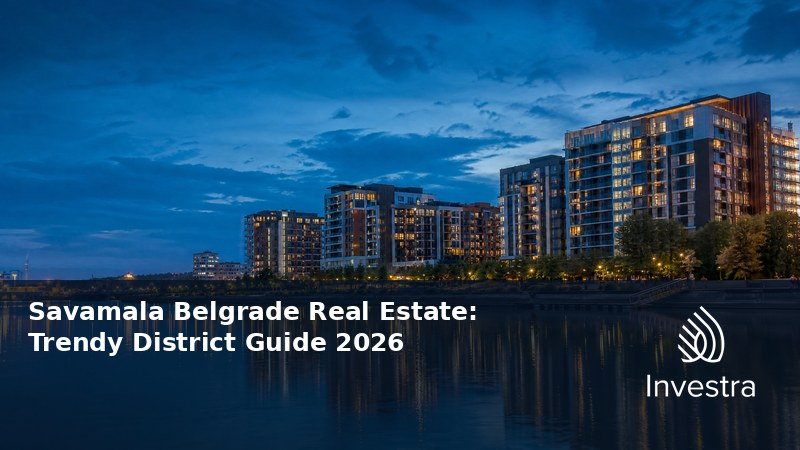
Savamala Belgrade Real Estate: Trendy District Guide 2026
Savamala: Belgrade's Most Dynamic Urban District
Quick Answer: Each neighborhood offers distinct advantages. City centers provide walkability and high rental demand. Suburban areas offer larger spaces at lower prices. New developments in emerging districts often provide the best capital appreciation potential.
Savamala stands as Belgrade's most talked-about neighbourhood — a former industrial waterfront zone that has transformed into the city's creative, cultural, and real estate epicenter. Stretching along the Sava River between the historic Kalemegdan Fortress and the iconic Ada Bridge, Savamala occupies a prime geographic position that makes it simultaneously one of the most visually striking and commercially valuable districts in the entire Western Balkans region.
For international buyers researching Savamala Belgrade apartments, the district offers something increasingly rare in European real estate: genuine upside potential combined with a vibrant, liveable urban environment at prices still significantly below comparable neighbourhoods in Prague, Warsaw, or Budapest. As Belgrade continues its trajectory toward EU-adjacent status and regional economic dominance, Savamala sits at the very heart of that growth story.
This guide covers everything international investors and lifestyle buyers need to understand about Savamala in 2026 — from granular price data and rental yield performance to cultural infrastructure, transport connectivity, and the regulatory landscape governing foreign ownership in Serbia. Whether the goal is a buy-to-let investment, a digital nomad base, or a long-term capital appreciation play, Savamala deserves serious consideration.
Explore investment opportunities on Investra.io — the leading platform for international property investment in Serbia. For business strategy insights, visit sinisadagary.com. Discover business opportunities through Findes.si.
The History and Transformation of Savamala
Quick Answer: This section covers key aspects of real estate in Serbia. For personalized guidance on property investment, consult with a licensed local agent and legal advisor. Investra.io connects you with verified professionals across all major Serbian cities.
Savamala's story is one of the most compelling urban regeneration narratives in Southeast Europe. The district's name derives from the Ottoman word for neighbourhood — "mahala" — combined with the Sava River, reflecting its deep historical roots as a riverside trading hub. During the 18th and 19th centuries, Savamala functioned as Belgrade's primary commercial port and customs zone, with warehouses, trading houses, and artisan workshops lining the riverbank.
The 20th century brought industrialisation and eventual decline. By the 1990s, following Yugoslavia's dissolution and the economic devastation of international sanctions, Savamala had become a neglected patchwork of crumbling warehouses, abandoned lots, and underused infrastructure. Property values plummeted, and the area was largely ignored by mainstream developers.
The transformation began organically in the mid-2000s when artists, musicians, and entrepreneurs began occupying the cheap warehouse spaces — a pattern replicated in Berlin's Mitte, London's Shoreditch, and New York's DUMBO decades earlier. Cultural venues like KC Grad, Mikser House, and Kombinat emerged as anchors. Belgrade's municipality recognised the momentum and began investing in public space upgrades, riverside promenades, and infrastructure improvements. By 2015, Savamala had international media coverage in publications including The Guardian, Monocle, and Condé Nast Traveller, which accelerated both tourism interest and real estate demand. Today, the district is home to some of Belgrade's most prestigious residential developments alongside its thriving arts and nightlife scene.
Savamala Belgrade Apartments: Current Market Prices in 2026
Quick Answer: Property prices in this area vary by location and type. City center apartments typically range from €1,000 to €2,500/m², while suburban areas offer €700–€1,400/m². New developments command premium prices. Always verify current prices with a local agent.
The Savamala Belgrade apartments market has matured considerably since the neighbourhood's grassroots revival, yet prices still represent compelling value relative to Western European benchmarks. As of early 2026, average apartment prices in Savamala range from €2,800 to €5,500 per square metre, depending on property type, floor level, river views, and renovation quality.
Breaking this down further:
- Studio apartments (25–40 m²): €75,000 – €160,000
- One-bedroom apartments (40–60 m²): €120,000 – €260,000
- Two-bedroom apartments (60–90 m²): €200,000 – €420,000
- Luxury penthouses and loft conversions (90–200 m²): €350,000 – €1,200,000+
The higher end of the price range is concentrated in newly completed mixed-use developments closer to the Sava riverfront, where premium finishes, underground parking, and panoramic views command significant premiums. Older socialist-era apartment blocks that have been comprehensively renovated typically trade in the €2,800–€3,500/m² range, while off-plan purchases in new developments are priced at €3,200–€4,500/m² with incentives for early commitment.
Year-on-year price appreciation in Savamala has averaged approximately 8–12% annually over the past three years, outperforming the broader Belgrade market average of 6–9%. This premium reflects Savamala's constrained supply — the district is largely built out, limiting new development — and persistent strong demand from both domestic and international buyers. For detailed market comparisons, visit the Serbia Real Estate Guide on Investra.
Rental Yields and Investment Returns in Savamala
Quick Answer: To buy property in Serbia: (1) Find a property through a licensed agent, (2) Conduct due diligence and title check, (3) Sign a preliminary contract with 10% deposit, (4) Complete notarized purchase contract, (5) Register at the land registry. The process typically takes 4–8 weeks.
For investors prioritising income generation, Savamala delivers some of the strongest short-term and mid-term rental yields in Belgrade. The district's concentration of tourists, digital nomads, business travellers, and young professionals creates layered demand across multiple rental market segments.
Short-term rental yields (Airbnb/VRBO model): Well-positioned Savamala apartments with modern furnishings and strong management can achieve gross annual yields of 8–14%. Average nightly rates for a one-bedroom apartment range from €60–€120 in shoulder seasons to €100–€200 during peak summer months (June–August) and major events like Exit Festival and Belgrade Beer Fest.
Long-term rental yields: Monthly rents for long-term furnished lets in Savamala currently range from €500–€700 for studio units to €800–€1,400 for two-bedroom apartments, translating to gross yields of approximately 5–8% on purchase price. Net yields after property management fees, taxes, and maintenance typically settle in the 4–6.5% range, which still meaningfully exceeds average yields in cities like Vienna (2–3.5%) or Munich (2–4%).
Capital appreciation: Beyond rental income, the long-term appreciation thesis for Savamala is underpinned by Serbia's EU accession pathway, Belgrade's growing status as a regional tech and startup hub, and continued infrastructure investment including the Belgrade Waterfront mega-project. Analysts tracking Balkan real estate markets project continued annual appreciation of 6–10% in prime Belgrade locations through 2028.
Total return calculations combining yield and appreciation suggest that a Savamala apartment purchased in 2026 could deliver a total 5-year return in the range of 60–90%, depending on asset selection and management quality. These figures are projections based on historical trends and should be assessed alongside the risks outlined in the disclaimer section of this article.
What Is the Savamala District in Belgrade Like for Living?
Quick Answer: Each neighborhood offers distinct advantages. City centers provide walkability and high rental demand. Suburban areas offer larger spaces at lower prices. New developments in emerging districts often provide the best capital appreciation potential.
What is the Savamala district in Belgrade like for living? This question consistently appears in searches from prospective buyers and relocating professionals, and the honest answer is nuanced: Savamala offers an exceptionally stimulating urban lifestyle that suits a specific type of resident while presenting certain trade-offs that buyers should understand clearly.
The positives are substantial. Savamala is genuinely walkable, with a dense concentration of independent cafés, restaurants, galleries, concept stores, and cultural venues within a compact area. The riverside promenade provides a leisure corridor that becomes one of Belgrade's most popular social spaces during warmer months. Residents have access to some of the city's best dining options — from traditional Serbian kafanas serving cevapi and roasted meats to modern restaurants offering Mediterranean, Japanese, and fusion cuisines.
The neighbourhood's creative energy is palpable and commercially diverse. Co-working spaces including Startit Centre and Nova Iskra attract Serbia's rapidly growing tech and creative class, making Savamala a genuine live-work-play environment. Public transport connections are excellent, with multiple tram and bus lines providing direct access to Stari Grad (Old Town), New Belgrade's business districts, and Belgrade's main railway and bus terminals.
Trade-offs to consider: Savamala's nightlife reputation — while commercially positive for short-term rental investors — creates noise challenges for permanent residents, particularly on weekends. Some streets experience heavy evening foot traffic and associated disruption. Green space within the district is limited compared to neighbourhoods like Dedinje or Senjak. Parking remains challenging, particularly in older parts of the district without underground facilities. Families with young children may find the local infrastructure less suited to their needs than quieter residential Belgrade neighbourhoods.
Overall, Savamala is best characterised as an ideal base for singles, couples, young professionals, digital nomads, and creative-sector workers who value urban vitality and cultural access over quietude and suburban amenity.
Key Landmarks, Culture, and Lifestyle Infrastructure
Quick Answer: This section covers key aspects of real estate in Serbia. For personalized guidance on property investment, consult with a licensed local agent and legal advisor. Investra.io connects you with verified professionals across all major Serbian cities.
Understanding Savamala's cultural geography is essential for buyers assessing specific micro-locations within the district. The neighbourhood's most prominent anchor institutions and venues shape both the character and the commercial appeal of surrounding residential properties.
Mikser House — a multi-purpose creative hub occupying a former auto-parts warehouse — functions as one of Savamala's most recognisable symbols. Hosting design markets, film screenings, concerts, and co-working events, it draws a cosmopolitan, educated crowd that typifies the district's resident demographic. Properties within 300 metres consistently command a premium on the rental market.
KC Grad (Cultural Centre Grad) presents international art exhibitions, theatrical performances, and live music. The adjacent Braća Krsmanović concert hall adds classical music programming to the neighbourhood's cultural mix, creating unusual depth for such a compact area.
The Sava Promenade stretches from Ada Ciganlija in the south to the Belgrade Waterfront development in the north, offering cycling paths, kayak hire, outdoor fitness infrastructure, and seasonal dining terraces. This riverside amenity is a defining quality-of-life asset for Savamala residents.
Gastronomic infrastructure includes celebrated restaurants such as Saran (traditional Serbian fish), Salon 1905 (upscale European cuisine), and numerous contemporary bistros that have positioned Belgrade as a serious regional food destination. The neighbourhood's café culture rivals that of Vienna or Zagreb, with independent roasters and specialty coffee shops on virtually every block.
Educational and healthcare access is adequate rather than exceptional within the district itself, but central Belgrade's comprehensive hospital network, international schools (including QSI International School of Belgrade), and private medical clinics are all within convenient reach.
Belgrade Waterfront: Impact on Savamala Property Values
Quick Answer: This section covers key aspects of real estate in Serbia. For personalized guidance on property investment, consult with a licensed local agent and legal advisor. Investra.io connects you with verified professionals across all major Serbian cities.
No analysis of Savamala real estate in 2026 is complete without addressing the Belgrade Waterfront project — the €3 billion mixed-use development that has reshaped the northern edge of Savamala and fundamentally altered the district's real estate dynamics.
Developed by Eagle Hills Abu Dhabi in partnership with the Serbian government, Belgrade Waterfront encompasses approximately 1.8 million square metres of development along the former industrial Sava riverbank. The project includes luxury residential towers (BW Residences), a high-end shopping mall (Galerija), premium office space, a five-star hotel (St. Regis Belgrade), and extensive public waterfront promenades.
The spillover effects on adjacent Savamala have been significant and measurable. Properties within 500 metres of the Belgrade Waterfront boundary have appreciated approximately 15–25% faster than comparable Savamala properties further from the development since construction activity intensified in 2020. The Galerija shopping centre — anchoring international retail brands including Zara, H&M, and premium boutiques — has upgraded the commercial infrastructure serving Savamala residents considerably.
For investors, the relationship between Savamala's authentic, community-scaled character and the adjacent mega-project's luxury positioning creates an interesting dynamic. Savamala properties offer a lower entry price point with many of the lifestyle benefits of Belgrade Waterfront proximity, making them attractive to buyers who want value-adjacent positioning without paying full Waterfront premiums. BW Residences apartments are priced from €5,000–€8,000/m², while comparable Savamala units trade at a meaningful discount.
Foreign Buyer Rules: Can International Investors Buy in Serbia?
Quick Answer: To buy property in Serbia: (1) Find a property through a licensed agent, (2) Conduct due diligence and title check, (3) Sign a preliminary contract with 10% deposit, (4) Complete notarized purchase contract, (5) Register at the land registry. The process typically takes 4–8 weeks.
Serbia maintains a relatively open stance toward foreign real estate ownership, though the regulatory framework contains important nuances that international buyers must understand before committing capital. The rules have evolved significantly since Serbia's Law on Property Relations with Foreign Persons was first enacted, and the current framework broadly favours inbound investment.
EU and EEA nationals can purchase residential and commercial property in Serbia on terms broadly equivalent to Serbian citizens, following reciprocity arrangements. Citizens of most Western countries including the United States, United Kingdom, Canada, Australia, and most of Europe face no material restrictions on purchasing urban real estate in Belgrade and other cities.
Agricultural land remains restricted for foreign individual buyers (though not for companies legally registered in Serbia), making this a distinguishing factor compared to urban residential purchases where no such restriction applies.
The purchase process for Savamala apartments typically involves: engaging a locally registered real estate agent or lawyer, conducting cadastral registry checks to verify ownership and encumbrances, signing a preliminary sale agreement (predugovor) with a deposit of 10%, completing due diligence including planning permission verification and utility connection status, executing the final notarised purchase agreement, paying the real estate transfer tax of 2.5% on secondary market transactions (new-build purchases from developers are subject to VAT rather than transfer tax), and registering the title transfer at the Republic Geodetic Authority (RGA).
Additional transaction costs include notary fees (approximately 0.1–0.3% of property value), legal fees (€500–€2,000 depending on complexity), and agent commission (typically 2–3% shared between buyer and seller or paid by one party per agreement). Total transaction costs for a foreign buyer purchasing a Savamala apartment typically range from 5–8% of purchase price.
Serbia does not currently impose any specific taxes on non-resident property owners beyond standard property tax (0.4–2% of assessed value annually, which is typically low given Serbia's conservative official valuations) and income tax on rental revenue at a flat rate of 20% with a 25% expense deduction allowed, resulting in an effective rate of approximately 15% on gross rental income.
Financing Options for Savamala Property Purchases
Quick Answer: To buy property in Serbia: (1) Find a property through a licensed agent, (2) Conduct due diligence and title check, (3) Sign a preliminary contract with 10% deposit, (4) Complete notarized purchase contract, (5) Register at the land registry. The process typically takes 4–8 weeks.
Access to mortgage financing in Serbia for foreign buyers has improved but remains more constrained than in mature EU real estate markets. Understanding the financing landscape is critical for buyers optimising their capital structure.
Serbian mortgage market: Local banks including Banca Intesa, Raiffeisen Bank Serbia, UniCredit Serbia, and OTP Bank offer mortgage products to Serbian residents and some categories of non-residents. Typical mortgage terms available in 2026 include:
- Loan-to-value ratios: 60–75% for residents; 50–65% for non-residents
- Interest rates: 4.5–7.5% depending on currency, term, and borrower profile
- Maximum terms: 20–30 years
- Currency options: Serbian Dinar (RSD) or Euro-indexed (the latter more common for foreign buyers)
Non-resident financing: Most foreign buyers without established income in Serbia find it more practical to finance Serbian property purchases through home-country equity release, portfolio loans, or cash purchases. The relatively accessible price points in Savamala — where a quality one-bedroom investment apartment can be acquired for €150,000–€220,000 — mean that outright cash purchase is feasible for many international investors without the complexity of cross-border mortgage structuring.
Developer payment plans: For off-plan purchases in new Savamala developments, developers frequently offer staged payment structures requiring 20–30% on signing, additional tranches tied to construction milestones, and the balance on completion. These arrangements effectively provide interest-free financing during the construction period — typically 18–36 months — and are widely used by international buyers as an alternative to formal mortgage products.
For comprehensive guidance on Serbian property financing structures, the Investra Blog on Property Investment Insights provides regularly updated analysis from market specialists.
Comparing Savamala to Other Belgrade Neighbourhoods
Quick Answer: This section covers key aspects of real estate in Serbia. For personalized guidance on property investment, consult with a licensed local agent and legal advisor. Investra.io connects you with verified professionals across all major Serbian cities.
Informed buyers inevitably compare Savamala against other appealing Belgrade neighbourhoods before committing. Each district has a distinctive profile, and Savamala's positioning becomes clearer in this comparative context.
Stari Grad (Old Town): Belgrade's historic core offers comparable cultural amenity with greater architectural heritage. Property prices average €2,500–€4,800/m², slightly overlapping with Savamala at the top end but with a wider range. Stari Grad suits buyers seeking traditional Belgrade character; Savamala appeals more to those valuing contemporary creative culture.
Dorćol: The hip, bohemian quarter immediately north of Savamala is closely associated with younger professionals and has seen its own significant price appreciation. Average prices range from €2,200–€4,000/m², with a slightly lower entry point than prime Savamala. Dorćol offers better green space access and a more residential feel with less nightlife noise.
New Belgrade (Novi Beograd): The post-war planned district across the river is Belgrade's business centre and offers modern apartment stock at €1,800–€3,500/m². Lower prices reflect its less characterful urban environment, but strong corporate rental demand from multinational tenants makes it attractive for purely yield-focused investors.
Vračar: A sought-after residential neighbourhood with excellent schools, green spaces, and the dramatic Saint Sava Cathedral as its centrepiece. Prices range from €2,000–€4,500/m², appealing strongly to families and long-term residents. Less investment buzz than Savamala but a more stable, established residential market.
Belgrade Waterfront (BW Residences): As discussed, this is the premium end of the Belgrade market at €5,000–€8,000/m², offering the most luxury finishes and amenities but with a more homogeneous, developer-driven character compared to Savamala's organic urban texture.
Savamala occupies the sweet spot for buyers seeking strong short-term rental yields, cultural lifestyle quality, and continued capital appreciation without paying full luxury-development premiums. For those exploring options across the region, the Croatia Real Estate Guide on Investra provides useful context for comparative Adriatic investment strategies.
Savamala as a Digital Nomad and Remote Work Destination
Quick Answer: This section covers key aspects of real estate in Serbia. For personalized guidance on property investment, consult with a licensed local agent and legal advisor. Investra.io connects you with verified professionals across all major Serbian cities.
Belgrade has emerged as one of Europe's top-ranked digital nomad destinations, consistently appearing on lists published by Nomad List, Remote Year, and similar platforms. Savamala is the district that most embodies this positioning — an urban environment purpose-built for the connected professional class by organic market evolution rather than government incentive schemes.
The practical infrastructure supporting remote workers in Savamala is genuinely impressive. Fibre internet connectivity is available throughout the district with average speeds exceeding 300 Mbps at prices dramatically below Western European equivalents (approximately €15–€25 per month for premium residential broadband). Co-working spaces offer flexible desk and private office arrangements at €100–€300 per month — compared to €400–€800 for equivalent space in London, Amsterdam, or Berlin.
Cost of living: Beyond property costs, Savamala's day-to-day affordability is a major draw. A single professional living comfortably in Savamala — including rent, utilities, food, transport, and leisure — typically spends €1,200–€2,000 per month. This compares to €3,000–€5,000 for equivalent living standards in Western European capitals, representing savings of up to 60% for those earning income in EUR, USD, or GBP.
Serbia's Digital Nomad Visa and freelance visa framework — while still evolving — provide pathways for non-EU citizens to establish legal residency as self-employed individuals or remote workers. Combined with Serbia's flat personal income tax rate of 10% for residents, this creates a compelling tax and lifestyle proposition for internationally mobile professionals considering a longer-term base.
Property owners in Savamala benefit directly from this digital nomad demand: furnished mid-term rentals (1–6 months) targeting remote workers and corporate short-stay guests are among the strongest-performing rental products in the district, achieving premium rates over long-term unfurnished lets while avoiding the intensive management demands of nightly Airbnb operations. Business strategy insights for structuring nomad-focused rental operations can be found at the Business Strategy Blog by Siniša Dagary.
Practical Guide to Buying a Savamala Apartment: Step-by-Step
Quick Answer: To buy property in Serbia: (1) Find a property through a licensed agent, (2) Conduct due diligence and title check, (3) Sign a preliminary contract with 10% deposit, (4) Complete notarized purchase contract, (5) Register at the land registry. The process typically takes 4–8 weeks.
For international buyers ready to move from research to transaction, the following step-by-step framework provides a practical roadmap for acquiring a Savamala property efficiently and safely.
Step 1 — Define your acquisition strategy. Clarify whether the purchase is primarily for capital appreciation, short-term rental income, long-term rental, personal use, or a combination. This determines optimal property type, size, floor level, and location within Savamala. Yield-focused buyers typically prioritise studios and one-bedroom units in high-footfall locations; lifestyle buyers may prioritise views, layout quality, and building character.
Step 2 — Engage qualified local professionals. Appoint a bilingual Serbian real estate attorney (independent from the selling agent) and a reputable property-finding agent with specific Savamala expertise. This dual professional engagement is standard practice and protects buyer interests throughout the process. Fees are modest relative to the risk mitigation value provided.
Step 3 — Conduct property due diligence. Your attorney should verify cadastral ownership records, check for liens or encumbrances, confirm planning permissions, review building permits for any renovations, verify utility connections, and check the building management fund status. This process typically takes 5–15 business days for straightforward properties.
Step 4 — Negotiate and execute preliminary agreement. Once due diligence is satisfactory, negotiate purchase price and conditions. The preliminary agreement (predugovor) locks in terms and typically requires a 10% deposit. Breaching this agreement results in deposit forfeiture (buyer) or double deposit return (seller), providing mutual commitment assurance.
Step 5 — Complete transaction. The final notarised purchase agreement is executed before a Serbian notary. For foreign buyers unable to be physically present, a power of attorney can authorise a local representative (typically the appointed attorney) to execute on their behalf. Full payment is made at completion, and the title transfer registration at the Republic Geodetic Authority is initiated — typically completing within 15–30 days.
Step 6 — Post-completion setup. Arrange property insurance, utility transfer to new ownership, and — if renting — property management appointments. Short-term rental operators should register with the Tourism Organisation of Belgrade and ensure compliance with accommodation tax and safety regulations.
The entire process from initial property search to completed registration typically takes 45–90 days for straightforward cash purchases, or longer where financing or complex title situations are involved. Use the Investra Platform to find verified Savamala properties and connect with trusted local professionals.
Serbia's Economic Trajectory and Its Impact on Belgrade Real Estate
Quick Answer: This section covers key aspects of real estate in Serbia. For personalized guidance on property investment, consult with a licensed local agent and legal advisor. Investra.io connects you with verified professionals across all major Serbian cities.
Macro-economic context is essential for assessing the durability of Savamala's real estate investment case. Serbia's economy has demonstrated consistent resilience and growth that underpins the long-term property market thesis.
Serbia's GDP growth has averaged approximately 3–4% annually since 2015, among the stronger performers in Southeast Europe. In 2024, Serbia recorded GDP growth of approximately 3.8%, driven by services sector expansion, foreign direct investment inflows, and strong private consumption. The Serbian Dinar has maintained relative stability against the Euro under a managed float arrangement, reducing currency risk for Euro-indexed real estate transactions.
EU accession progress remains a defining narrative for Serbian real estate. While full membership timelines have been repeatedly delayed, Serbia's EU candidate status and active accession negotiations create persistent expectations of eventual accession, which historically has driven significant real estate appreciation in accession-phase economies (as observed in Croatia, Slovakia, and the Baltic states pre-accession). Belgrade in particular stands to benefit disproportionately from any accession milestone, given its status as the future EU member capital.
Foreign Direct Investment into Serbia reached approximately €4.5 billion in 2024, with significant contributions from German automotive suppliers, Chinese infrastructure investors, and US technology companies. This investment flow supports employment, wage growth, and housing demand — particularly in Belgrade, which captures the majority of FDI-linked economic activity.
Tech sector growth has been particularly relevant for Savamala's rental market. Serbia's IT sector now employs over 55,000 professionals, with a high concentration in Belgrade. Average IT sector salaries of €2,500–€5,000 monthly create a strong base of premium residential tenants who prioritise quality, location, and amenity — exactly the profile that Savamala apartments are best positioned to serve. For broader regional context, explore the Serbia Real Estate Guide on Investra for updated economic indicators.
Investment Disclaimer
Quick Answer: To buy property in Serbia: (1) Find a property through a licensed agent, (2) Conduct due diligence and title check, (3) Sign a preliminary contract with 10% deposit, (4) Complete notarized purchase contract, (5) Register at the land registry. The process typically takes 4–8 weeks.
The information provided in this article is for educational and informational purposes only and should not be construed as financial, legal, or investment advice. Real estate investments carry inherent risks, and past performance does not guarantee future results. Investors should not invest money they cannot afford to lose. Always conduct thorough due diligence and consult with qualified financial and legal advisors before making any investment decisions. Investra.io does not guarantee returns on any investment.
Frequently Asked Questions
Quick Answer: This section covers key aspects of real estate in Serbia. For personalized guidance on property investment, consult with a licensed local agent and legal advisor. Investra.io connects you with verified professionals across all major Serbian cities.
What are typical Savamala Belgrade apartment prices in 2026?
Savamala Belgrade apartment prices in 2026 range from approximately €2,800 to €5,500 per square metre depending on property type, condition, floor level, and proximity to the riverfront. Studio apartments typically start at €75,000–€160,000, one-bedroom units at €120,000–€260,000, and two-bedroom apartments at €200,000–€420,000. Luxury loft conversions and penthouse properties can exceed €1,200,000 in the most premium locations adjacent to the Belgrade Waterfront development.
What is the Savamala district in Belgrade like for living?
Savamala offers a highly dynamic, culturally rich urban living experience best suited to singles, couples, young professionals, digital nomads, and creative-sector workers. Residents benefit from exceptional walkability, a dense concentration of independent cafés, restaurants, galleries, co-working spaces, and cultural venues, plus direct access to the Sava riverside promenade. Trade-offs include weekend nightlife noise, limited green space within the district, and parking constraints. Families with young children typically find other Belgrade neighbourhoods like Vračar or Dedinje more suited to their needs.
Can foreigners buy property in Savamala and Belgrade?
Yes. Foreign nationals from EU/EEA countries and most Western nations including the US, UK, Canada, and Australia can purchase urban residential and commercial property in Belgrade on terms broadly equivalent to Serbian citizens. The main restriction applies to agricultural land, which foreign individuals cannot purchase directly. The process involves title verification, a notarised purchase agreement, payment of 2.5% real estate transfer tax (for secondary market purchases), and registration at Serbia's Republic Geodetic Authority.
What rental yields can investors expect from Savamala apartments?
Short-term rental (Airbnb/VRBO) strategies in well-managed Savamala apartments can achieve gross yields of 8–14% annually, depending on occupancy rates and seasonal pricing. Long-term furnished rentals typically generate gross yields of 5–8%, with net yields of 4–6.5% after management fees, taxes, and maintenance. Mid-term rentals targeting digital nomads and corporate stays offer a middle ground, often achieving 6–10% gross yields with lower management intensity than nightly short-term letting.
How does Belgrade Waterfront affect Savamala property values?
The Belgrade Waterfront mega-development has had a measurably positive impact on adjacent Savamala property values. Properties within 500 metres of the Waterfront boundary have appreciated approximately 15–25% faster than other Savamala properties since construction intensified. Savamala offers investors the benefit of Belgrade Waterfront proximity — access to its promenade, shopping, and improved infrastructure — at significantly lower price points (€2,800–€5,500/m²) compared to BW Residences pricing of €5,000–€8,000/m².
Is Savamala good for digital nomads?
Savamala is widely considered one of Europe's best digital nomad neighbourhoods. Key advantages include fast fibre internet (300+ Mbps) at very low monthly costs (€15–€25), affordable co-working spaces (€100–€300/month), a total monthly cost of living of €1,200–€2,000 for comfortable single-professional living, excellent café culture supporting informal work, and a large existing community of international remote workers. Serbia's 10% flat income tax rate for tax residents further enhances the financial proposition for established digital nomads.
What are the total transaction costs for buying a Savamala apartment?
Total transaction costs for an international buyer purchasing a secondary market Savamala apartment typically range from 5–8% of purchase price. This includes real estate transfer tax at 2.5%, notary fees of 0.1–0.3%, legal fees of €500–€2,000, and agent commission of 2–3% (the distribution of which between buyer and seller is negotiable). New-build off-plan purchases are subject to VAT (currently 10% for residential property) rather than transfer tax, which significantly affects the cost calculation for new-build acquisition strategies.
How does Savamala compare to other Belgrade neighbourhoods for investment?
Savamala offers the strongest short-term rental yield potential and highest cultural profile of any Belgrade district, but at a higher entry price than areas like New Belgrade (€1,800–€3,500/m²) or parts of Vračar. Dorćol provides a comparable bohemian lifestyle at slightly lower prices but with less tourism footfall. Stari Grad (Old Town) offers similar price levels with more architectural heritage. Belgrade Waterfront provides the most luxury positioning at the highest prices. For yield-maximising investors, Savamala and New Belgrade represent the strongest performing markets; for capital appreciation, Savamala's constrained supply and rising prestige make it the premium choice.
What is the step-by-step process for buying a Savamala apartment as a foreigner?
The process involves: defining your investment strategy; engaging a local bilingual attorney and qualified property agent; conducting cadastral due diligence to verify ownership and check for encumbrances; negotiating and signing a preliminary purchase agreement with a 10% deposit; completing
Related Posts
No related posts available.
