
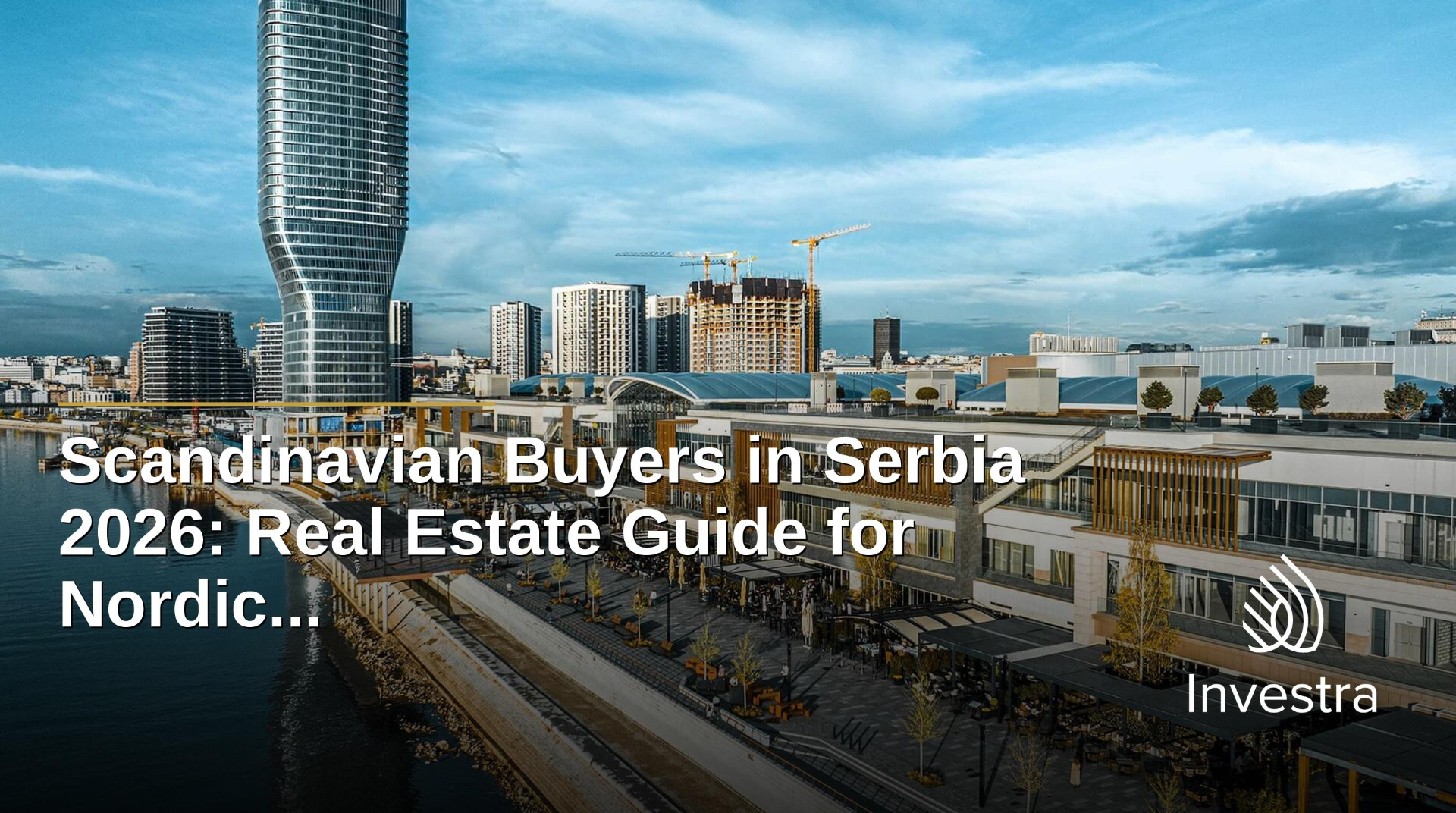
Scandinavian Buyers in Serbia 2026: Real Estate Guide for Nordic...
Scandinavian Buyers in Serbia 2026: Real Estate Guide for Nordic Investors
Why Serbia Draws Nordic Buyers
Scandinavians have long sought stable places to park capital outside their high-tax home markets. Serbia fits that need with lower entry prices, steady economic growth, and a lifestyle that feels familiar once people settle in. Winters are cold enough to remind Swedes and Norwegians of home, while summers bring long days and outdoor culture that Danes and Finns enjoy.
Many Nordic families now split time between their home country and Serbia. Remote work makes this easier, and the cost of living in Belgrade or Novi Sad stays roughly one-third of Stockholm or Oslo levels. This gap creates both personal comfort and clear investment math.
Practical Daily Life Advantages
English is widely spoken in larger cities. Supermarkets stock familiar brands, and international schools operate in the capital. High-speed internet reaches most residential buildings, supporting the digital nomad routines that many Scandinavian professionals maintain. Public transport in Belgrade runs reliably, and short flights connect directly to Copenhagen, Oslo, and Helsinki.
Current Market Overview
Serbia’s residential market continued its measured expansion through 2025 and into 2026. Foreign purchases rose again last year, with buyers from Northern Europe forming a noticeable share alongside traditional regional investors. Prices remain well below Western European averages, yet transaction volumes have increased steadily.
Average apartment prices in central Belgrade now sit between 2,800 and 3,400 EUR per square metre. In Novi Sad the same figure ranges from 1,900 to 2,400 EUR per square metre. Smaller regional cities such as Niš offer units from 1,400 EUR per square metre. These levels still allow meaningful cash-flow potential when compared with Nordic capitals where equivalent properties often exceed 7,000 EUR per square metre.
Rental yields in prime Belgrade districts average 5.8 percent gross, with some well-located buildings reaching 6.5 to 7 percent after modest management costs. Investors report total annual returns, including modest price growth, between 9 and 11 percent over the past three years. Data from local agencies shows vacancy rates below 4 percent in professionally managed buildings popular with expats and digital nomads.
Further reading on the wider picture appears in the Serbia Real Estate Market 2026 overview.
Best Areas for Scandinavian Buyers
Belgrade Districts
Vračar and Dorćol remain favourites for Nordic buyers who want walkable neighbourhoods with cafés, parks, and river access. A two-bedroom apartment in Vračar typically trades between 3,100 and 3,400 EUR per square metre and rents for 850 to 1,050 EUR monthly. Dorćol offers slightly lower prices around 2,900 EUR per square metre while still attracting long-term tenants from the IT and finance sectors.
Zemun and New Belgrade provide larger family-sized units and easier parking. These areas appeal to buyers with children who prefer quieter streets yet quick access to the city centre via the Ada Bridge.
Novi Sad and Secondary Cities
Novi Sad continues to draw younger Nordic professionals. The university city delivers solid rental demand from both students and remote workers. Yields here often edge above Belgrade levels, reaching 6.8 percent in well-kept buildings near the Danube promenade.
Niš offers the lowest entry prices among larger Serbian cities. Investors targeting 7 percent-plus yields frequently look at renovated apartments in the city centre. The local airport now runs seasonal routes to several Scandinavian destinations, improving accessibility.
More detail on the capital’s specific dynamics is available in the Belgrade Real Estate Market 2026 guide.
Investment Potential in 2026 and Beyond
Serbia’s economy keeps expanding at 3.5 to 4 percent annually, supported by foreign direct investment in technology and manufacturing. This growth underpins residential demand in the main cities. At the same time, the country’s tourism sector continues to recover, adding seasonal rental income opportunities in Belgrade and along the Sava and Danube corridors.
Scandinavian buyers often combine personal use with rental income. A typical strategy involves purchasing a two-bedroom apartment for 180,000 to 220,000 EUR, living there several months each year, and renting it the rest of the time. After costs, net yields of 5 to 6 percent remain realistic in current conditions.
Price appreciation has averaged 6 to 8 percent per year in Belgrade since 2022. While future gains may moderate, the gap between Serbian and Nordic valuations suggests continued catch-up potential. Investors who bought in 2021 have already seen total returns above 30 percent when both income and capital growth are counted.
Legal clarity for foreign ownership has improved. Non-residents can purchase apartments directly, though land and houses still require a Serbian company structure in most cases. The full process is explained in the Buying Property in Serbia as a Foreigner resource.
Digital Nomad Lifestyle Fit
Serbia introduced a dedicated digital nomad visa in 2024 that allows stays up to one year. Many Swedes, Norwegians, and Danes have used this route to test the country before committing to property purchases. Low everyday costs, reliable coworking spaces, and a growing international community make the transition smooth.
Investra.io lists hundreds of verified properties suited to this lifestyle, complete with rental history data and neighbourhood insights that help Nordic buyers compare options quickly.
Additional perspectives on cross-border investment appear on Real Estate Investment Insights by Siniša Dagary.
Next Steps for Nordic Investors
Buyers who have shortlisted Serbia should begin with market research on Investra.io, then arrange video viewings of shortlisted apartments. A local lawyer experienced with foreign clients handles the purchase agreement and title checks. Most transactions close within six to eight weeks once financing is arranged.
Those planning to spend extended periods in Serbia also review tax residency rules and healthcare options early. The combination of price, yield, and lifestyle continues to attract new Nordic capital each quarter, keeping 2026 an active year for this segment of the market.
Legal Process for Acquiring Property
Scandinavian buyers benefit from Serbia’s straightforward foreign ownership rules, which permit direct title registration for individuals from Sweden, Norway, Denmark and Finland. The process begins with obtaining a Serbian personal identification number (PIB) through the local tax authority, a step that typically takes five to seven business days once a passport and proof of address are submitted. Next, a preliminary sales agreement is signed at a notary public, requiring a 10 percent deposit held in escrow. Due diligence follows, including land registry checks, zoning verification and utility clearance, all of which a licensed attorney completes within two to three weeks.
Residency and Citizenship Pathways
Property ownership alone does not grant residency, yet it strengthens applications for temporary residence permits under the real-estate investment route. Applicants must show a minimum investment of €50,000 and maintain health insurance valid in Serbia. After three years of continuous residence, Scandinavians may apply for permanent residency, which opens the door to citizenship after an additional two years.
Tax Implications for Nordic Investors
Serbia levies a 3 percent transfer tax on the purchase price or cadastral value, whichever is higher, payable within 15 days of notarisation. Capital gains realised upon resale are taxed at 15 percent if the property is sold within five years; after that period the rate drops to zero. Rental income faces a 20 percent flat rate after a 25 percent deduction for expenses, with double-taxation treaties ensuring that Swedish, Norwegian, Danish and Finnish residents credit Serbian tax against their domestic liabilities.
VAT and Additional Levies
New-build apartments carry 10 percent VAT, while resale properties remain exempt. Property tax averages 0.4 percent of market value annually, collected in two instalments. Scandinavian buyers should also budget for notary fees (0.5–1 percent) and attorney costs (€800–1,500).
Practical Tips for Smooth Transactions
Hire a bilingual lawyer who works with Nordic clients to translate contracts and handle any language issues. Open a local bank account early on, as most Serbian banks accept Nordic passports plus proof of address from non-residents. SEPA transfers for currency conversion keep fees under 0.5 percent, while cash transactions often bring extra compliance checks. Winter viewings help gauge heating efficiency, especially in older Belgrade buildings.
Digital Nomad Lifestyle Integration
Many Scandinavian buyers combine property ownership with Serbia’s digital nomad visa, valid for one year and renewable. High-speed fibre internet reaches 90 percent of Belgrade apartments, while co-working spaces in Dorćol and Vračar offer community events tailored to Nordic professionals. Proximity to European capitals—three-hour flights to Stockholm or Oslo—supports frequent travel without sacrificing Serbia’s lower cost base.
Step-by-Step Guide to Purchase
- Obtain PIB and open a Serbian bank account.
- Secure financing or confirm funds via bank statement.
- Sign a reservation agreement and pay a small holding deposit.
- Commission full legal due diligence and survey.
- Execute the notarised sales contract and pay transfer tax.
- Register title at the Real Estate Cadastre within 30 days.
- Arrange utility transfers and property insurance.
- Apply for temporary residence if desired.
Investment Potential and Market Outlook
Belgrade’s prime districts continue to deliver 6–8 percent gross rental yields, outperforming most Nordic capitals. Limited supply of quality new-build stock and steady demand from both locals and remote workers support modest annual price growth of 4–6 percent through 2026. Secondary cities such as Novi Sad and Niš offer lower entry prices and emerging IT sectors that attract Scandinavian companies establishing regional offices.
Recommended Content
- Serbia Real Estate Market 2026: Complete Guide
- Buying Property in Serbia as a Foreigner 2026
- Belgrade Real Estate Market 2026
- Real Estate Investment Insights by Siniša Dagary
- Finds Group - Real Estate Investment Advisory
Odkrijte globalne investicijske priložnosti na Unifyr.space — vaš portal za pametne investicije.
📚 Recommended Content
Frequently Asked Questions
Do Scandinavian citizens need a visa to buy property in Serbia?
No visa is required for property purchase; a simple entry stamp suffices for the transaction.
What is the total tax burden when purchasing a resale apartment?
Expect 3 percent transfer tax plus notary and registration fees totalling around 4–4.5 percent of the purchase price.
Can I rent out my property immediately after purchase?
Yes, there are no restrictions on short- or long-term rentals for foreign owners.
How long does the entire buying process take for Nordic buyers?
From PIB application to title registration, the process averages six to eight weeks.
Are there any restrictions on foreign ownership in Belgrade?
No, Scandinavians enjoy the same rights as Serbian citizens regarding residential property.
What rental yields can I expect in central Belgrade?
Gross yields typically range between 6 and 8 percent depending on location and property condition.
Is it necessary to use a local attorney?
While not legally mandatory, using a Serbian attorney is strongly recommended to avoid costly errors.
How does Serbia’s tax treaty affect my Swedish tax return?
Serbia’s double-taxation treaty with Sweden prevents double taxation on rental income and capital gains.
Can I finance the purchase with a Serbian mortgage?
Foreign buyers may obtain mortgages up to 70 percent of value after establishing local credit history.
What happens if I decide to sell within two years?
You pay 15 percent capital gains tax on the profit; after five years the rate drops to zero.
Related Posts
No related posts available.
