
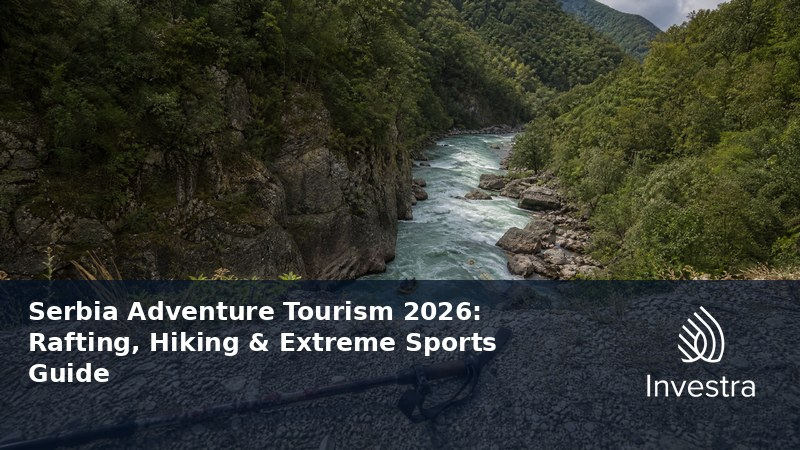
Serbia Adventure Tourism 2026: Rafting, Hiking & Extreme Sports Guide
Serbia Adventure Tourism 2026: Why This Balkan Nation Is the Continent's Best-Kept Secret
Quick Answer: Serbia offers an extraordinary range of adventure tourism activities in 2026, from world-class white-water rafting on the Tara and Drina rivers to mountain hiking, paragliding, zip-lining, and canyoning — all at prices that make Western European destinations look extravagant by comparison. The country's untamed landscapes and rapidly developing tourism infrastructure make it one of Europe's most compelling adventure destinations right now.
There's a moment, somewhere on the Tara River canyon — Europe's deepest gorge — when the sheer walls of ancient limestone rise hundreds of meters above you, the water churns white and cold around your raft, and you realize that Serbia has been sitting on one of the world's great adventure tourism treasures for decades. The rest of Europe is only just starting to notice.
Serbia's adventure tourism sector is experiencing a genuine renaissance in 2026. International visitor numbers for active tourism have grown by approximately 34% since 2022, driven by a combination of extraordinary natural landscapes, competitive pricing, and improving infrastructure. The country boasts national parks that rival anything in the Alps, rivers that draw rafters from across the continent, and mountain ranges that remain genuinely wild in a way that's increasingly hard to find in crowded Western European destinations.
But there's another dimension to Serbia's appeal that savvy international travelers are beginning to recognize. The same factors that make adventure tourism here so compelling — natural beauty, value for money, growing infrastructure, and an increasingly international urban culture — also make Serbia an exceptional real estate investment market. More on that connection shortly. First, let's explore what Serbia's wild side actually offers in 2026.
White-Water Rafting on the Tara and Drina Rivers
Quick Answer: The Tara and Drina rivers offer some of Europe's finest white-water rafting experiences, with the Tara canyon being the deepest in Europe and the second deepest in the world after the Grand Canyon. Guided rafting tours range from €30–€80 per person depending on duration and difficulty level.
Ask any adventure sports professional in southeastern Europe where to go rafting, and the Tara River comes up almost immediately. This isn't hype — the numbers speak for themselves. The Tara canyon stretches for 78 kilometers with a maximum depth of 1,300 meters, carving through the Durmitor massif and forming the natural border between Serbia and Montenegro. The river itself runs cold and clear year-round, fed by mountain springs and snowmelt, with class III and IV rapids that challenge experienced paddlers without being suicidal for capable beginners.
The peak season runs from April through October, with May and June widely considered the optimal window. Water levels are high enough for genuine excitement, the canyon walls are draped in spring green, and temperatures haven't yet reached the scorching heights of August. A standard one-day rafting package on the Tara typically includes transport from the base camp, equipment rental, a certified guide, and a riverside lunch — all for somewhere between €35 and €55 per person. Multi-day expeditions covering the full length of the navigable canyon run €150–€280 per person including accommodation in riverside camps or mountain lodges.
The Drina River offers a different but equally compelling experience. Where the Tara is dramatic and remote, the Drina combines white-water sections with calmer stretches that allow you to actually look up and appreciate the scenery. The river forms the border with Bosnia and Herzegovina for much of its course, and the surrounding landscape — with its mix of dense forest, medieval monasteries visible from the water, and small riverside villages — creates an atmosphere that's difficult to replicate anywhere else in Europe.
What surprised many foreign visitors is how well-organized the rafting infrastructure has become. Reputable operators maintain certified guides who speak English, equipment meets international safety standards, and the logistics are genuinely smooth. This isn't the Wild West adventure experience it might have been fifteen years ago — it's a professional operation at prices that still feel almost comically low by Western European standards.
Mountain Hiking and Trekking: Serbia's Alpine Wilderness
Quick Answer: Serbia has five major national parks with extensive hiking trail networks, ranging from gentle day walks to multi-day alpine traverses. Kopaonik, Zlatibor, Stara Planina, and Tara National Park are the most popular hiking destinations, with trail access generally free and guided tours available from €20–€60 per day.
Serbia has mountains. Proper mountains. This seems to surprise people who picture the Balkans as purely coastal — but the country's interior contains ranges that would be internationally famous if they were located in Austria or Switzerland. The reality is they're arguably more interesting precisely because they haven't been overdeveloped.
Kopaonik is the undisputed king of Serbian mountain tourism. At 2,017 meters, Suva Planina peak is the highest point in Serbia proper, and the surrounding national park encompasses 11,810 hectares of protected highland terrain. The hiking trail network is extensive — over 200 kilometers of marked routes across the plateau — ranging from easy family walks through pine forests to demanding ridge traverses with genuine exposure. In summer, wildflower meadows at altitude turn the landscape into something from a painting. What most visitors don't realize is that Kopaonik also operates as Serbia's premier ski resort in winter, which has funded significant trail infrastructure and accommodation development that benefits summer hikers enormously.
Stara Planina (Old Mountain) on the Bulgarian border is wilder and less developed, and many experienced hikers prefer it for exactly that reason. The Visočica and Temštica river valleys cut deep into the range, creating dramatic canyon landscapes with waterfalls and gorges. The long-distance E4 European hiking path crosses through this region, connecting Serbia to the broader continental trail network. Accommodation in the area has improved markedly — you'll find everything from traditional Serbian country inns (konaks) to modern mountain lodges, typically priced between €25 and €60 per person per night including breakfast.
Zlatibor is gentler — a highland plateau at around 1,000 meters elevation that's been a Serbian domestic tourism staple for generations. It's excellent for families or those who want scenic hiking without serious technical challenge. The surrounding villages produce exceptional local food and drink, and the combination of easy trails, fresh mountain air, and outstanding traditional cuisine creates an experience that's genuinely hard to beat. Day hikers regularly make the trip as an excursion from Belgrade, which is roughly 250 kilometers away.
For those interested in the intersection of adventure tourism and property investment, Belgrade Real Estate Market Report 2026: Prices, Trends & Forecasts notes that properties near established tourism destinations like Zlatibor and Kopaonik have been appreciating at 8–12% annually — significantly outpacing urban markets in some metrics.
Extreme Sports and Adrenaline Activities Across Serbia
Quick Answer: Serbia's extreme sports scene includes paragliding, zip-lining, bungee jumping, mountain biking, rock climbing, and off-road driving experiences, concentrated around national parks and major mountain resorts. Prices are typically 40–60% lower than equivalent activities in Western Europe.
The extreme sports infrastructure across Serbia has matured considerably over the past five years. What was once a fragmented collection of local operators with variable equipment standards has consolidated into a more professional industry, partly driven by foreign investment and partly by Serbian entrepreneurs who've trained internationally and brought those standards home.
Paragliding is perhaps the most dramatic evolution. The thermal conditions above the Zlatibor plateau and the Fruška Gora ridge in Vojvodina are genuinely excellent — consistent, predictable thermals that make for long soaring flights with spectacular views. The Serbian Paragliding Federation runs certified courses and maintains a register of approved operators, so verifying credentials is straightforward. A tandem flight (where you fly with an experienced pilot, no training required) typically costs €50–€90, while a full beginner's course over several days runs €300–€500. Compare those figures to equivalent experiences in Switzerland or France and you'll understand why European paragliding enthusiasts have started booking trips to Serbia specifically for the training value.
Rock climbing has developed particularly strongly around the limestone cliffs of the Đerdap Gorge (the Iron Gates) on the Danube, and around Sicevo Gorge near Niš. Both locations offer routes ranging from beginner-friendly 4a-grade climbs to serious 7c+ sport routes that attract skilled climbers from across the region. The development of bolted sport climbing routes has been especially rapid — what were previously accessible only to trad climbers with full gear are now accessible to anyone with a harness and basic technique.
Zip-lining parks have appeared across the country, often integrated with other forest adventure activities into dedicated outdoor centers. The most elaborate is in Tara National Park, where multiple zip lines connect across the canyon with the longest individual run exceeding 700 meters. Full-day adventure packages combining zip-lining, rope courses, and guided hiking runs €40–€70 per person — excellent value by any standard.
Mountain biking deserves special mention. Serbia's terrain variety — from rolling hills to genuine alpine trails — suits all skill levels, and trail development projects backed by EU tourism development funds have been dramatically improving the network. Kopaonik now has over 90 kilometers of dedicated mountain bike trails, including a growing number of downhill and enduro-specific routes that are beginning to attract the bike-travel community that's turned places like Finale Ligure and Innsbruck into destination riding spots.
Canyoning and Cave Exploration in Serbia's Hidden Terrain
Quick Answer: Serbia has over 400 registered caves and numerous canyons suitable for canyoning, with Resava Cave, Potpec Cave, and the gorges of eastern Serbia being particularly notable. Guided canyoning tours start from €40 per person, while cave tours range from €5–€15 for standard access.
Underground Serbia is a world unto itself. The country sits on extensive karst limestone geology across its eastern and western regions, which has created an extraordinary network of caves, gorges, and underground waterways. Resava Cave in central Serbia is one of the most spectacular — 2.5 kilometers of explored passages with chambers large enough to hold concerts (which occasionally do happen), stalactites and stalagmites formed over millions of years, and consistent temperatures of 7°C year-round that make it a welcome cool refuge in summer. Tourist access is well-organized with guided tours running multiple times daily for approximately €8–€12 per person.
Canyoning as a sport has grown rapidly along the rivers of western Serbia, particularly in the Zlatar and Zlatibor regions. The technical nature of the activity — combining abseiling, swimming, jumping, and scrambling through steep river gorges — requires qualified guides, and the local operator community has invested in training and certification. A typical half-day canyoning experience including full equipment rental and a certified guide runs €40–€55 per person. Full-day expeditions into more remote canyons go higher, around €70–€100, but typically include exceptional scenery and the kind of wilderness experience that's genuinely difficult to access otherwise.
For international visitors interested in the broader Serbian adventure experience, the Serbia Digital Nomad Visa 2026: Complete Guide for Remote Workers has become relevant to a growing demographic — professionals who want to base themselves in Serbia for extended periods, combining remote work with access to the country's extraordinary outdoor lifestyle. The visa allows stays of up to one year, and the combination of affordable living costs and accessible adventure sports has proven extremely attractive to the international remote-working community.
Cycling and Endurance Tourism Along Serbian River Valleys
Quick Answer: Serbia has developed an extensive cycling tourism network including the EuroVelo 6 and EuroVelo 11 international routes, plus dedicated bike paths along the Danube, Sava, and Morava river valleys. Cycle touring packages range from self-guided €20–€40/day to fully guided multi-day tours at €80–€150/day.
Cycling tourism might not carry the "extreme" label, but the endurance demands of multi-day cycle touring through Serbia's river valleys place it firmly in the adventure tourism category for most participants. The country's flat-to-rolling river valleys are perfect for endurance cycling, while the mountain regions offer genuine challenges for those seeking them.
The EuroVelo 6 — the Atlantic to Black Sea route — runs through Serbia along the Danube, providing an internationally recognized cycling corridor with improving infrastructure. The Serbian section passes through Belgrade, skirts the edge of the Fruška Gora wine region, traverses the dramatic Đerdap Gorge, and exits near the Bulgarian border. The full Serbian section covers approximately 600 kilometers, and most experienced cyclists tackle it over 8–12 days. Guesthouses and small hotels along the route have become increasingly accustomed to cycle tourists, with secure bike storage and evening meals available at virtually every stop.
The Morava River valley cycling route has emerged as a genuinely excellent long-distance option for those wanting to explore the Serbian interior. The valley connects the Pannonian plain in the north with the highlands of the south, passing through historic cities, medieval monasteries, and rural landscapes that have changed relatively little in character over the past century. It's not technically demanding, but the combination of cultural richness, natural scenery, and exceptional local food at every stop makes it one of the most rewarding cycling experiences in southeastern Europe.
Winter Adventure Sports: Skiing, Snowshoeing, and Ice Climbing
Quick Answer: Serbia's winter sports scene centers on Kopaonik ski resort (62km of pistes) and Zlatibor, with ski passes ranging from €30–€45 per day. The growing snowshoeing and ski touring community has expanded beyond groomed pistes into genuinely wild backcountry terrain.
Serbia's winter sports market is worth understanding in detail because it represents a significant driver of both tourism demand and real estate values in the mountain regions. Kopaonik ski resort is the dominant player — a serious destination with 62 kilometers of pisted runs, modern lift infrastructure, and a village at the base that combines ski-in/ski-out accommodation with decent aprés-ski facilities. Daily lift passes run €30–€45 depending on the week, which is roughly half of what you'd pay at a comparable Alpine resort.
The ski season typically runs from December through March, with January and February being peak period. Snowfall is generally reliable at altitude — Kopaonik's high plateau location ensures consistent snow cover for most of the season, though the warming winters affecting all European mountain destinations have prompted significant investment in snowmaking infrastructure. The resort can accommodate approximately 12,000 skiers per day at peak capacity, and it does reach that capacity during Serbian public holidays when domestic demand surges.
What's less well-known internationally is the growing ski touring and backcountry skiing community. The terrain around Kopaonik and Stara Planina is genuinely suited to ski touring, with high ridges, consistent powder conditions after storm cycles, and relatively limited avalanche complexity compared to the high Alps. This niche is growing rapidly, attracting both domestic enthusiasts and foreign visitors who find the combination of quality terrain and affordable access compelling. Guided ski touring days typically cost €70–€120 per person including guide, avalanche safety equipment, and transport.
Snowshoeing has also developed as an accessible winter activity at most Serbian mountain destinations, requiring no technical skill and allowing access to landscapes that are genuinely beautiful in their winter form. Many mountain lodges now include snowshoe rental as standard, and guided half-day tours are widely available for €20–€35 per person.
Adventure Tourism Near Belgrade: Day Trips and Weekend Escapes
Quick Answer: Belgrade serves as the ideal base for adventure day trips, with Fruška Gora National Park, the Danube gorges, and Stara Planina all within 2–4 hours drive. Day trip packages from Belgrade start at €40–€80 per person including transport and activity.
One of Belgrade's most underrated qualities as a base city is how much adventure terrain surrounds it within striking distance. The capital sits at the confluence of the Sava and Danube rivers, but within 90 minutes you can be hiking forest trails in Fruška Gora, swimming in the Danube's natural beaches, kayaking on the Tisa river, or exploring medieval fortresses in the Serbian heartland.
Fruška Gora, the low mountain range running through Vojvodina north of Belgrade, combines moderate hiking with cultural richness — 16 Serbian Orthodox monasteries are scattered through its forested slopes, some dating to the 15th century. It's accessible enough for casual visitors but has genuine hiking trails, cycling routes, and a wine region that makes it equally attractive to food and drink enthusiasts. The range is genuinely beautiful in all seasons.
The Danube's beaches and kayaking routes have become increasingly popular with Belgrade's growing international community. Several operators now run guided kayaking tours on the river, ranging from easy half-day paddles accessible to complete beginners to multi-day expeditions heading downstream toward the Iron Gates. Belgrade's status as a growing hub for digital nomads and international professionals — detailed thoroughly in resources like Serbia Digital Nomad Visa 2026 — has created a large and growing market for adventure activities accessible from the city, driving rapid development of the day-trip tourism sector.
For those considering property acquisition in Belgrade to take advantage of both the city's lifestyle and its position as an adventure tourism gateway, Buying Property in Belgrade 2026: Complete Guide for Foreign Investors covers everything from legal requirements to neighborhood selection in detail.
Adventure Tourism Costs and Budgeting for Serbia
Quick Answer: Serbia offers exceptional value for adventure tourists — a well-planned week combining rafting, hiking, and other activities typically costs €600–€1,200 all-inclusive for a solo traveler, representing 40–60% savings compared to equivalent experiences in Western European adventure destinations.
The cost advantage Serbia offers to adventure tourists is real and substantial — not just marginally cheaper, but genuinely transformative in terms of what's accessible at different budget levels. Let's put some concrete numbers on this.
A realistic daily budget for an adventure-focused visit to Serbia in 2026 breaks down roughly as follows. Budget accommodation in mountain areas — hostel dorms or basic guesthouses — runs €15–€30 per night. Mid-range options, including comfortable private rooms with breakfast in well-maintained mountain lodges, sit at €35–€65 per night. Food costs are remarkable: a substantial sit-down meal at a good restaurant in a tourist area costs €8–€15, and local restaurants away from tourist centers will feed you well for €5–€10.
Activities themselves are the headline bargain. Compare directly: a day's guided rafting on the Tara (€35–€55) versus the equivalent experience on the Inn River in Austria (€80–€130). A tandem paragliding flight over Zlatibor (€60–€90) versus Interlaken in Switzerland (€180–€260). A full-day guided mountain bike experience on Kopaonik (€50–€70, including bike rental) versus comparable Dolomites experiences (€120–€180). The math is consistently compelling.
A week-long adventure package built around rafting, hiking, mountain biking, and a day of extreme sports — staying in comfortable mid-range accommodation and eating well — realistically comes in at €700–€1,000 per person including return flights from major European hubs. At the higher end of that range, you'd struggle to match this in any comparable Western European mountain destination.
The value equation has not gone unnoticed. A significant proportion of the international visitors now choosing Serbia for adventure tourism are experienced travelers who've done the Alpine circuit, the Slovenian classics, and the Croatian coast, and are consciously seeking new territory that offers quality without the associated price premium. Serbia delivers precisely that combination in 2026.
Adventure Tourism and Real Estate Investment: The Connection
Quick Answer: Adventure tourism hotspots in Serbia — particularly Kopaonik, Zlatibor, and the Tara region — have experienced significant property price appreciation, with short-term rental yields of 6–10% annually. Foreign investors are increasingly purchasing mountain properties as both lifestyle assets and income-generating investments.
Here's where the adventure tourism story connects directly to investment opportunity, and it's a connection worth taking seriously. The same natural assets driving Serbia's adventure tourism growth — the mountains, rivers, national parks, and outdoor recreation infrastructure — are driving property demand and price appreciation in the surrounding areas.
Property prices in Serbia's established mountain resort areas have been rising consistently. At Kopaonik, apartment prices currently range from €1,500–€3,500 per square meter depending on specification, location, and proximity to the ski lifts. That's still dramatically below comparable Alpine resort properties — you'd struggle to find anything at Zermatt, Chamonix, or even the smaller Slovenian resorts for under €4,000/m². More significantly, Kopaonik prices have been rising at approximately 8–12% annually, outpacing inflation and offering genuine capital appreciation potential.
Short-term rental yields in mountain resort areas are compelling. A well-positioned apartment at Kopaonik or Zlatibor, actively managed on platforms like Airbnb, can generate gross rental yields of 7–10% annually. The Airbnb Belgrade 2026: Rental Income, Best Areas & Legal Guide breaks down the rental income mathematics in detail, though the same fundamentals apply to resort property as to urban investment.
What's particularly interesting from an investment perspective is the seasonality diversification available in mountain resort areas. Kopaonik generates rental income from both winter ski tourism (December–March) and summer hiking/mountain biking tourism (June–September), meaning occupancy periods are meaningfully longer than single-season Alpine resorts. This dual-season demand structure significantly improves yield calculations and reduces the risk profile of the investment.
For comprehensive guidance on the investment mechanics, Serbia Real Estate Market Forecast 2026-2030: Prices & Trends provides detailed forward-looking analysis of price trajectories across different market segments.
Legal Framework for Foreign Property Buyers in Adventure Tourism Areas
Quick Answer: Foreign nationals from most countries can purchase property in Serbia's mountain and resort areas with relatively few restrictions, though some agricultural and forest land categories have limitations. The process is straightforward with proper legal representation, typically completing in 4–8 weeks.
The legal framework governing foreign property ownership in Serbia is often better than international buyers expect. The country has established a clear and workable system for non-resident purchases, and while the process has its peculiarities — as any southeastern European property market does — it's genuinely accessible with proper professional guidance.
Citizens of EU member states and most other countries can purchase residential and commercial property in Serbia on essentially equal terms with Serbian nationals. This includes properties in mountain resort areas, alongside rivers, and in national park buffer zones — the places that most interest adventure-tourism-driven investors. The primary restriction applies to agricultural land and designated forest areas, where foreign ownership is limited, though this restriction doesn't affect the vast majority of properties that investors are actually interested in.
The purchase process involves several key steps: agreeing terms and signing a preliminary contract (often with a 10% deposit), conducting due diligence including title searches and property encumbrance checks, obtaining a personal fiscal number (PIB) from the Serbian tax authority, finalizing the purchase contract before a notary, paying transfer tax (2.5% of assessed property value), and registering the transfer at the relevant cadastre office. Total transaction costs including all taxes, notary fees, and legal representation typically run 4–7% of the purchase price.
Comprehensive guidance on the tax implications is available through Serbia Property Tax Guide 2026: What Foreign Buyers Must Know, which covers both acquisition taxes and ongoing annual property tax obligations. Annual property tax in Serbia is relatively low — typically 0.1–0.4% of assessed value — making holding costs manageable for investment properties.
Financing options for foreign buyers are more limited than for Serbian nationals, but not absent. Some Serbian banks will offer mortgage lending to non-residents under specific conditions. Serbia Mortgage Guide 2026: Can Foreigners Get a Loan? details the current landscape comprehensively, including which institutions are most accessible to international buyers and typical lending terms. For those requiring cross-border financial structuring, Findes Financial Services specializes in financial solutions for international investors operating across multiple jurisdictions.
Best Adventure Tourism Regions: A Regional Guide for 2026
Quick Answer: Serbia's top adventure tourism regions in 2026 are western Serbia (Tara, Zlatibor, Zlatarsko Lake), Kopaonik National Park in the south-center, Đerdap Gorge in the northeast, and Stara Planina on the Bulgarian border — each offering distinct outdoor experiences and investment characteristics.
Serbia's adventure tourism geography divides into several distinct regions, each with its own character, activity mix, and investment profile. Understanding the regional differences matters both for planning a visit and for evaluating real estate opportunities.
Western Serbia — encompassing Tara National Park, the Tara River canyon, Zlatibor plateau, and the Drina River valley — is arguably the country's adventure tourism heartland. The density of outdoor activities here is extraordinary: world-class rafting, extensive hiking, mountain biking, zip-lining, and canyoning, all within a relatively compact area. Accommodation has developed rapidly, from high-end mountain lodges to budget campsites, and the tourism infrastructure is the most developed outside the capital. Property prices in this region remain more affordable than Kopaonik — apartments in Zlatibor range from €1,200–€2,200/m² — but appreciation rates have been strong, and the region's growing international profile suggests continued upward pressure.
Kopaonik National Park is Serbia's premium mountain destination, combining the ski resort infrastructure described earlier with excellent summer hiking, mountain biking, and nature-based activities. Property here commands a premium over other Serbian mountain regions but remains significantly cheaper than comparable Alpine destinations. The established tourism infrastructure, year-round appeal, and strong domestic and growing international visitor base make it a lower-risk investment proposition.
Đerdap Gorge and the Iron Gates in northeastern Serbia is less developed for mass tourism but increasingly recognized among adventure enthusiasts for its rock climbing, kayaking, and hiking potential. The Danube narrows dramatically through a series of gorges here, with limestone cliffs rising directly from the water, and the archaeological heritage adds a cultural dimension absent from pure mountain destinations. Property prices remain low by Serbian standards — rural properties start from €20,000–€50,000 — creating speculative early-stage investment opportunities for those with appetite for longer investment horizons.
Stara Planina, forming the Bulgarian border in eastern Serbia, is genuinely underdeveloped relative to its potential. A small ski resort has been developed at Jablaničko Jezero, but the hiking and canyoning possibilities across the broader mountain range remain largely unknown internationally. This is frontier adventure tourism territory, with corresponding investment risk and potential upside.
Accommodation Options for Adventure Tourists: From Campsites to Mountain Lodges
Quick Answer: Serbia's adventure tourism accommodation ranges from wild camping (permitted in many national park areas) through well-equipped campsites (€8–€20/night) to luxury mountain lodges (€100–€200/night). The mid-market mountain lodge segment has seen the most rapid quality improvement in recent years.
The accommodation story in Serbia's adventure tourism regions has changed remarkably over the past five years. There's been a genuine quality upgrade across the sector, driven partly by EU-funded tourism development programs and partly by Serbian entrepreneurs who recognize the opportunity created by growing international visitor numbers.
At the budget end, camping options are genuinely good. Serbia maintains a relatively permissive approach to wild camping in mountain areas outside designated conservation zones, and organized campsites at most outdoor activity areas have been upgraded with proper facilities. A pitch at a well-run campsite with showers, electricity hookups, and on-site facilities typically costs €8–€18 per night — exceptional value that attracts a growing van-travel and overlanding community from across Europe.
The mid-range mountain lodge (konak) sector is where the most interesting development has happened. Traditional Serbian mountain hospitality — heavy on home-cooked food, local rakija, warm beds, and genuine welcome — has been combined with modern comfort standards to create a product that resonates strongly with international visitors seeking authentic rather than sanitized experiences. A private room with breakfast at a quality mountain lodge runs €35–€75 per night, and the meals are typically outstanding. Local lamb, freshwater trout, mushroom dishes, homemade cheeses, and exceptional grilled meats form the backbone of the mountain food culture.
At the premium end, several purpose-built boutique mountain hotels and spa resorts have appeared at Kopaonik and Zlatibor, offering accommodation comparable to mid-tier Alpine hotels at substantially lower prices. Rates at these properties run €100–€200 per room per night in peak season, still significantly below comparable Swiss or Austrian mountain hotel pricing.
Serbia's Adventure Tourism Market: Investment and Business Opportunities
Quick Answer: The Serbian adventure tourism sector presents investment opportunities across accommodation, activity providers, transport, and ancillary services, with relatively low barriers to entry and strong growth trajectories. International investors with tourism sector expertise are increasingly looking at Serbia as an early-stage investment destination.
Beyond real estate, Serbia's adventure tourism growth creates business investment opportunities that merit consideration for the right investor profile. The sector is growing rapidly from a relatively low base, infrastructure investment is ongoing, and international visitor numbers are compounding at rates that make growth trajectory projections genuinely interesting.
The accommodation sector has obvious investment appeal — purpose-built or refurbished mountain lodges targeting the international market remain scarce relative to demand, particularly in the quality mid-market segment. The capital requirement for acquiring and refurbishing a traditional Serbian mountain property to international guesthouse standards is typically €80,000–€250,000, and the operating economics can be compelling with strong occupancy rates during dual peak seasons.
Activity provider businesses represent another category. The market for certified outdoor guiding, equipment rental, and packaged adventure experiences is growing faster than the supply of professional operators can match in many regions. Foreign entrepreneurs with outdoor industry backgrounds and international marketing capabilities have identified this gap and have been establishing operations in Serbia, often in partnership with local guides and knowledge bases.
For strategic guidance on business investment in Serbia, Siniša Dagary — Investment Consultant provides specialized advisory services for international investors looking at Serbia's growth markets. Dagary's analysis of Serbia's investment landscape is detailed in the Business Strategy Blog, which covers market entry strategies, regulatory environment analysis, and sector-specific investment frameworks. Background on the consultancy's approach and methodology is available at About Siniša Dagary.
The broader investment thesis for Serbia's tourism sector is explored through Serbia Real Estate FAQ 2026: 50 Most Asked Questions Answered, which addresses the most common questions from international investors across both property and business investment categories.
Practical Planning: Getting to Serbia's Adventure Destinations
Quick Answer: Belgrade's Nikola Tesla Airport handles flights from over 60 international destinations with Air Serbia, Wizz Air, Ryanair, and major European carriers. Most adventure tourism destinations are 2–4 hours drive from Belgrade, and car rental or organized transfer services are the most practical onward transport options.
The logistics of getting to Serbia's adventure regions have improved substantially as the country's tourism infrastructure has matured. Belgrade is the primary gateway, and the capital's Nikola Tesla Airport now connects to an extensive network of European and international destinations — London, Paris, Frankfurt, Amsterdam, Istanbul, and dozens of other hubs are served with daily or multiple-weekly flights.
Low-cost carrier presence has been transformative. Wizz Air and Ryanair both operate significant route networks to Belgrade, and the resulting airfare competition has driven prices to levels that make Serbia genuinely accessible from most European cities on weekend city-break budgets. Return flights from London, Vienna, Berlin, or Milan to Belgrade regularly come in under €100, and budget flights under €60 are not uncommon outside peak periods.
From Belgrade, the onward journey to adventure destinations requires either a rented car or an organized transfer service. Public transport to mountain areas exists but is slow and infrequent — a direct bus to Zlatibor takes 4–5 hours, while driving takes under 3 hours. Car rental at Belgrade Airport costs €25–€45 per day for a standard vehicle, and many adventure operators can arrange airport pickup as part of packaged tours.
Niš, Serbia's second city in the south, provides an alternative gateway for visitors primarily targeting Stara Planina or the southeastern regions. Niš airport handles a smaller but growing number of international routes, and the city itself is worth including in any Serbian itinerary for its Ottoman-era fortress, vibrant café culture, and dramatically lower prices than Belgrade.
For those interested in the full picture of Belgrade as a base for both adventure and urban tourism, the Belgrade Investment Property: Best Neighborhoods for ROI in 2026 guide provides context on the capital's geography and infrastructure that's equally useful for visitors and investors.
The Future of Serbia Adventure Tourism: 2026–2030 Outlook
Quick Answer: Serbia's adventure tourism sector is projected to grow at 12–18% annually through 2030, driven by infrastructure investment, EU accession progress, growing international awareness, and continued value advantage over Western European destinations. Real estate values in tourism-connected regions are expected to appreciate 30–50% over the same period.
The medium-term outlook for Serbia's adventure tourism sector is genuinely positive, and the factors driving that growth are structural rather than cyclical. Several major tailwinds deserve specific attention.
EU accession progress is perhaps the most significant structural factor. Serbia's path toward European Union membership has been progressing — with meaningful if gradual advances in the accession chapters — and the expectation of eventual membership has been influencing infrastructure investment, regulatory harmonization, and international investor confidence. Full EU membership would dramatically increase tourist arrivals from the Schengen area by removing remaining entry friction, expand the mortgage market as EU banking regulations apply, and generally accelerate Serbia's integration into European economic networks.
Infrastructure investment is accelerating. The Serbian government has committed significant capital to tourism infrastructure development, including trail network expansion, resort facility upgrades, and transport improvements. The Belgrade-Niš highway upgrade and new rail connections are improving accessibility to southern Serbian mountain regions that were previously difficult to reach quickly from the capital.
International media attention is growing. Serbia's adventure tourism credentials have been featured in travel publications ranging from National Geographic to Lonely Planet's destination-of-the-year lists, and the resulting increase in international search interest and booking activity is compounding. The first wave of international adventurous travelers who discovered Serbia are now enthusiastic advocates, and word-of-mouth amplification of the country's outdoor offering is accelerating.
The investment implications are clear. Property values in established adventure tourism destinations are expected to appreciate 30–50% over the 2026–2030 period according to analysis from Serbia Real Estate Market Forecast 2026-2030: Prices & Trends. For investors who combine tourism-sector property ownership with short-term rental income, the total return proposition — capital appreciation plus rental yield — is among the most compelling in European real estate markets right now.
The combination of extraordinary natural assets, rapidly improving infrastructure, exceptional value proposition, and strong growth trajectory makes Serbia's adventure tourism sector a compelling opportunity on multiple dimensions — whether you're approaching it as a traveler seeking an outstanding outdoor experience, or as an investor seeking early-stage exposure to a market with significant appreciation potential ahead.
Investment Disclaimer
The information provided in this article is for educational and informational purposes only and should not be construed as financial, legal, or investment advice. Real estate investments carry inherent risks, and past performance does not guarantee future results. Investors should not invest money they cannot afford to lose. Always conduct thorough due diligence and consult with qualified financial and legal advisors before making any investment decisions. Investra.io does not guarantee returns on any investment.
Frequently Asked Questions
What adventure tourism activities are available in Serbia in 2026?
Serbia offers an exceptionally diverse range of adventure tourism activities in 2026. White-water rafting on the Tara and Drina rivers ranks among the best in Europe, with the Tara canyon being the continent's deepest gorge. Mountain hiking covers five national parks with hundreds of kilometers of marked trails across terrain ranging from gentle highland walks to demanding alpine routes. Extreme sports including paragliding, rock climbing, zip-lining, bungee jumping, and off-road driving are available across multiple regions. Canyoning operates in western Serbia's river gorges, mountain biking has developed significantly with over 90 kilometers of trails at Kopaonik alone, and winter sports centered on Kopaonik ski resort include both piste skiing and growing ski touring opportunities. The full range is available at price points that typically run 40–60% below equivalent Western European experiences.
How much does rafting on the Tara River cost in 2026?
Rafting on the Tara River is genuinely affordable by any European standard. A standard one-day guided rafting experience including all equipment, a certified guide, transport from the riverside base camp, and a lunch break typically costs €35–€55 per person. Multi-day expeditions covering extended sections of the canyon, including camping or lodge accommodation along the river, range from €150–€280 per person for 2–3 day packages. These prices include equipment rental and experienced local guides who typically speak English. The best season is April through October, with May and June considered peak quality due to optimal water levels and temperatures. Booking through established operators rather than informal arrangements is recommended to ensure certified guides and proper safety equipment.
Is Serbia safe for adventure tourism?
Serbia is a safe destination for adventure tourism. The country has a low overall crime rate, the population is notably hospitable toward international visitors, and the professional outdoor activity sector has developed genuine safety standards over the past decade. The Serbian government maintains certification requirements for commercial outdoor activity operators, and reputable companies use certified guides who have completed internationally
Frequently Asked Questions
Quick Answer: Here are the most commonly asked questions about Serbia real estate investment in 2026, answered by Investra.io experts.
Is Serbia a good country for real estate investment in 2026?
Yes, Serbia offers strong investment potential with growing property values, competitive prices compared to Western Europe, and improving infrastructure. Investra.io provides comprehensive market data and investment guidance.
Can foreigners buy property in Serbia?
EU citizens can buy property freely in Serbia. Non-EU citizens may need to meet specific requirements. Investra.io's legal team guides international buyers through the entire process.
What is the average property price in Srbija?
Property prices in Srbija vary significantly by location and property type. Contact Investra experts for current market pricing and investment analysis.
What rental yields can I expect?
Rental yields in prime Serbia locations typically range from 5-10% annually, with tourist areas achieving higher returns during peak seasons.
What taxes apply to property purchases?
Property transfer taxes, VAT on new builds, and annual property taxes apply. Rates vary by property type and location. Consult Siniša Dagary for tax optimization strategies.
How long does the purchase process take?
Typically 30-60 days from offer to completion. Working with Investra.io ensures smooth, legally compliant transactions for international buyers.
What financing options are available?
Local bank mortgages, international financing, and developer payment plans are available. Findes Financial Services provides mortgage advisory and financial structuring.
Is property management available for rental properties?
Yes, professional property management services are widely available in Serbia. Investra.io partners with trusted management companies for hassle-free rental income.
What are the best areas to invest in Srbija?
Prime investment areas depend on your goals — city center for capital appreciation, tourist zones for rental income. Investra.io's market analysis identifies the best opportunities.
Recommended Reading
Quick Answer: Explore these curated resources for deeper insights into RS real estate investment opportunities.
- Buying Property in Belgrade 2026: Complete Guide for Foreign Investors
- Serbia Real Estate FAQ 2026: 50 Most Asked Questions Answered
- Belgrade Real Estate Market Report 2026: Prices, Trends & Forecasts
- Serbia Property Tax Guide 2026: What Foreign Buyers Must Know
- Serbia Digital Nomad Visa 2026: Complete Guide for Remote Workers
- Belgrade Investment Property: Best Neighborhoods for ROI in 2026
- Siniša Dagary — Investment Consultant
- Business Strategy Blog
Related Posts
No related posts available.
