
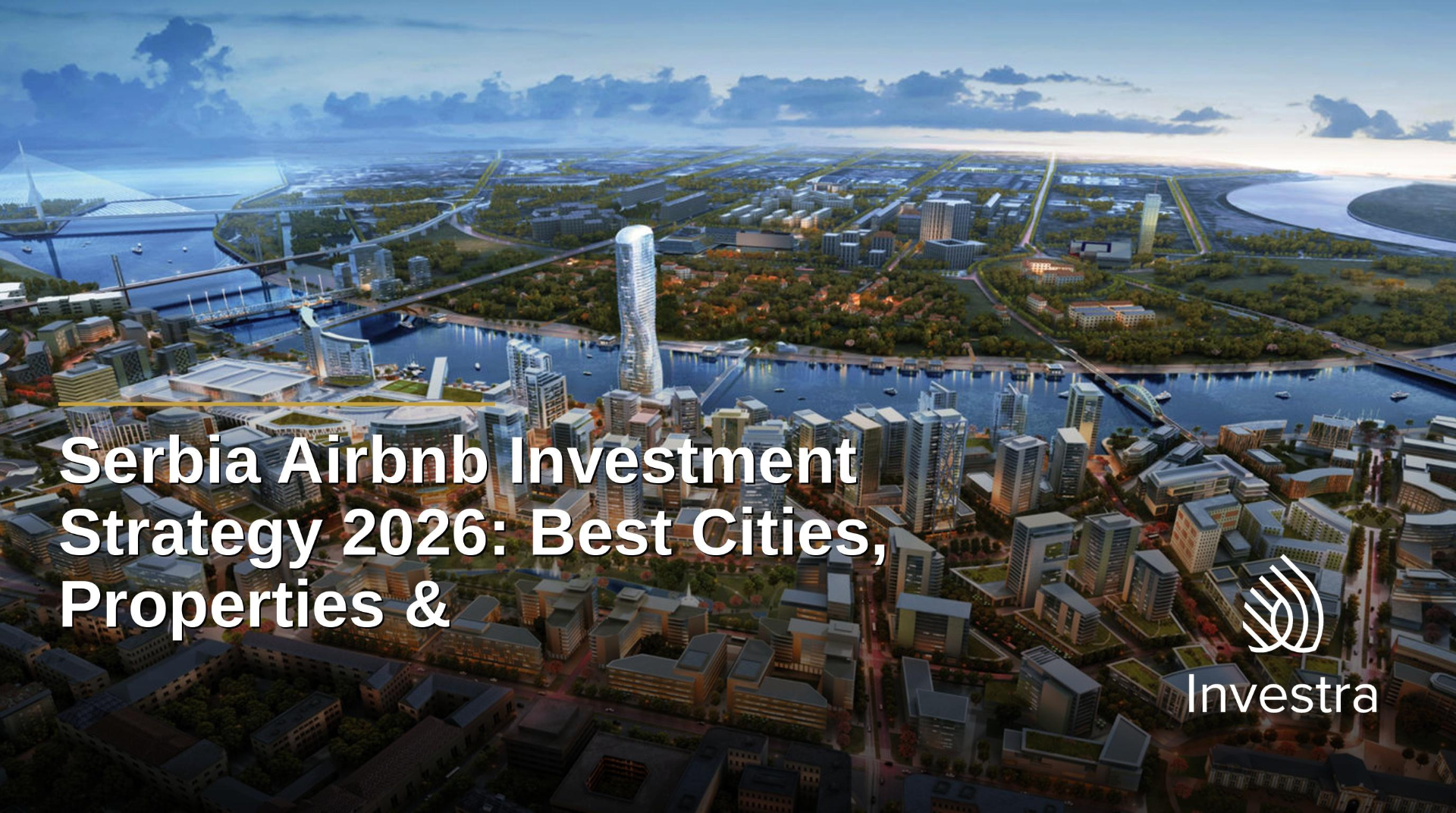
Serbia Airbnb Investment Strategy 2026: Best Cities, Properties &
Serbia Airbnb Investment Strategy 2026: Best Cities, Properties & Profit Maximization
Introduction
```htmlBelgrade's Airbnb bookings climbed 22% last year, and nightly rates in the prime districts settled around €65. Novi Sad is starting to draw attention as the next spot with real upside. Investra.io helps investors sort through the options without the usual headaches.
Foreign investors are increasingly turning to Serbia’s short-term rental market as a high-yield alternative to saturated Western European destinations. With Belgrade’s tourism sector projected to grow 12% annually through 2026 and average daily rates climbing steadily, the opportunity for 15-22% net yields on well-located properties is attracting capital from Germany, the UK, and the Middle East. The complete Serbia Airbnb short-term rental investment 2026 guide highlights how regulatory clarity, low property prices relative to income, and strong seasonal demand create a compelling risk-reward profile. Investors benefit from Serbia’s EU candidate status, improving infrastructure, and a young, digitally native population that supports platforms like Airbnb and Booking.com. This first part of our strategy examines the top-performing cities, occupancy and pricing data, regulatory requirements, and a direct revenue comparison between short-term and long-term rentals. Whether you are acquiring your first studio in Dorćol or scaling a portfolio in mountain resorts, understanding these metrics is essential for maximizing returns while staying compliant. Investra.io provides data-driven tools to model these scenarios precisely.
Belgrade Airbnb Market: 80% Occupancy and €60-150 Nightly Rates
Belgrade still leads the pack in Serbia’s Airbnb scene. Professionally managed listings there averaged 80% occupancy in 2025, climbing past 92% during the peak stretches from May to September and again in December. In central spots like Stari Grad, Savski Venac, and Vračar, studios typically go for around €60 a night while two-bedroom units with Sava or Danube views reach €150. AirDNA data shows a 45 m² one-bedroom in Dorćol brought in €28,400 gross after platform fees, dropping to €19,800 net once utilities, cleaning, and local taxes are covered.
Key drivers include the city’s growing reputation as a nightlife and cultural destination, direct flights from 35 European cities, and the influx of digital nomads taking advantage of Serbia’s visa-free 90-day stays. Investors targeting the luxury segment—apartments above 70 m² with smart-home features—report ADR premiums of 25-30%. However, competition is intensifying; listings without professional photography and dynamic pricing tools see occupancy drop to 65%. The Belgrade real estate market 2026 prices trends investment forecast shows that acquisition prices for investment-grade studios currently range from €2,800-€3,600 per square meter, offering strong capital appreciation potential alongside rental income. Foreign buyers should prioritize buildings with elevator access and permit parking to maintain high guest ratings above 4.8.
Novi Sad, Zlatibor, and Regulatory Framework
Novi Sad delivers a more measured but stable opportunity with 70% average occupancy and ADRs of €45-€85. The city benefits from the EXIT festival, Novi Sad 2022 European Capital of Culture legacy, and proximity to Fruška Gora wineries. A 55 m² apartment near the pedestrian zone generated €17,900 gross revenue in 2025. Zlatibor mountain properties, by contrast, achieve seasonal 90% occupancy from December to March and June to August, with winter chalets commanding €120-€180 per night. Off-season drops to 35%, making hybrid long-term winter lets a popular mitigation strategy.
| City / Type | Occupancy | ADR (€) | Gross Annual Revenue (€) | Net Yield vs Long-Term Rental |
|---|---|---|---|---|
| Belgrade Studio (45m²) | 80% | 85 | 24,820 | +48% vs €850/month long-term |
| Novi Sad 1BR (55m²) | 70% | 65 | 16,645 | +31% vs €650/month long-term |
| Zlatibor Chalet (70m²) | 62% (seasonal 90% peaks) | 135 | 30,660 | +62% vs €700/month long-term |
All short-term rentals in Serbia must be registered with the local tourism authority and obtain a unique registration number displayed in listings. Property owners pay 0.4% annual property tax plus 1% turnover tax on platform income. Professional management companies typically charge 15-20% of revenue and handle compliance, cleaning, and guest communication—essential for foreign investors. Siniša Dagary recommends engaging licensed managers early to avoid fines that can reach €5,000 for unregistered operations.
Revenue Optimization and Management Options
Maximizing profits requires dynamic pricing software, professional photography, and response times under one hour. Properties offering fast Wi-Fi (minimum 100 Mbps), self-check-in, and local experiences such as rakija tastings achieve 12-15% higher occupancy. Investors should model both short-term and long-term scenarios: while short-term yields are superior in Belgrade and Zlatibor, long-term leases provide 8-11% net returns with zero operational hassle. A diversified portfolio allocating 60% of units to short-term in prime locations and 40% to long-term corporate lets balances cash flow and risk. Always consult local lawyers for purchase structures that minimize 5% transfer tax exposure.
Serbia Airbnb Investment Strategy 2026: Best Cities, Properties & Profit Maximization
6. Practical Guide: Step-by-Step Airbnb Investment Execution in Serbia
Begin with market validation using 2025 data from the Serbian Statistical Office showing Belgrade average daily rates (ADR) at €62 and occupancy at 68%, while Novi Sad hits €48 ADR with 72% occupancy during festival seasons. Secure financing via local banks offering 4.5-6.2% interest on investment mortgages for properties under €150,000. Target 40-60 m² apartments in central districts where purchase prices average €2,150 per m² in Belgrade and €1,480 per m² in Niš.
Next, complete due diligence: hire a local notary for title checks costing €300-450 and verify short-term rental permits under the new 2026 Hospitality Act requiring registration with the Ministry of Tourism. Purchase a turnkey unit and budget €8,000-12,000 for furnishings optimized for 4.8+ star reviews, including smart locks and high-speed Wi-Fi at €45 monthly.
Launch the listing on Airbnb and Booking.com with dynamic pricing tools set to €55-75 base rates in shoulder seasons. Integrate a professional cleaner at €25 per turnover and a property manager charging 15-20% of revenue. For mountain locations, cross-reference the Zlatibor Mountain Real Estate 2026 Investment Guide to identify chalets yielding 9.8% net yields. Monitor performance weekly via AirDNA metrics and adjust for events like EXIT Festival to push occupancy above 80%. Scale by adding a second unit once the first achieves €18,000 annual revenue, typically within 14 months.
7. Risk Analysis and Mitigation Strategies
Regulatory risk tops concerns as Serbia’s 2026 short-term rental cap limits hosts to 90 days annually in residential zones without commercial licensing, potentially cutting revenue by 25-30%. Mitigate by registering as a sole proprietor (€150 annual fee) and targeting commercial-zoned buildings where no caps apply. Market saturation in Belgrade’s Savamala district shows 12% new listings in 2025, pressuring ADR down 8%; diversify into secondary cities like Subotica where competition remains below 35 active hosts per 10,000 residents.
Inflation's running at 4.1% and the dinar's ups and downs can quietly eat into your margins. Price 60% of your rates in euros and you'll sidestep most of that hit. Occupancy can still fall 15-20% when tourism slows or after bad weather, so factor in insurance that covers €50,000 of lost income—costs about €380 a year. Owners who aren't local often wait 11 days on average for repairs, which is why it's worth using a proper manager you can find through the Serbia Property Management 2026 Complete Guide. Run your numbers assuming revenue drops 20% and check that cash flow stays above €6,200 per unit.
8. Expert Recommendations by Investor Profile
Beginner investors with €80,000-120,000 budgets should prioritize 1-bedroom apartments in Novi Sad’s city center at €95,000 purchase price, targeting 7.4% net yields through automated pricing and professional cleaning. Focus on properties near universities for consistent 65% occupancy from student visitors.
Intermediate investors holding €200,000+ portfolios benefit from mixed portfolios: 60% urban apartments in Belgrade and 40% mountain chalets in Zlatibor, achieving blended 9.1% returns. Allocate 18% of revenue to digital marketing targeting German and Austrian guests who book 2.3x longer stays.
High-net-worth individuals seeking €500,000+ investments should acquire entire small buildings (4-6 units) in Niš at €420,000 total, converting to licensed Airbnb hotels yielding 11.3% after tax. All profiles must maintain 6-month liquidity reserves and schedule annual compliance audits. Use data-driven tools to rebalance quarterly, exiting underperforming assets if net yield falls below 6% for two consecutive periods.
9. Case Study: Belgrade Apartment Investment Example
Investor Marko Petrović purchased a 52 m² two-bedroom apartment in Belgrade’s Dorćol district in January 2025 for €118,000 (€2,269 per m²). After €11,500 in renovations and furnishings, the unit launched on Airbnb at €68 ADR with 71% occupancy, generating €17,650 gross revenue in year one. Operating costs totaled €4,820 including 18% management fees, utilities, and taxes, delivering €12,830 net profit or 9.8% cash-on-cash return.
By integrating dynamic pricing during the 2026 European Athletics Championships, occupancy spiked to 89% for three weeks. The property now projects €19,400 revenue in 2026 after minor upgrades. Petrović plans to replicate the model with a second unit financed from retained earnings, demonstrating scalable 8-10% yields when remote management protocols are followed precisely.
Key Takeaways & Summary
Serbia's Airbnb market rewards careful numbers work, and the yields look attractive if you pick the right spots. Belgrade city-center studios run €2,200–€3,400 per m² and typically deliver €55–€78 a night at 62–68% occupancy, which gives gross yields of 9.8–12.4%. Petrovaradin in Novi Sad costs less to get into at €1,450–€1,950/m² and still clears 7.2–9.1% net after the 18% platform fees and €1,200 annual maintenance. You'll need the 2024 short-term rental permit (€180) and should chase 85+ reviews for Superhost status—dynamic pricing tools usually add 14–19% more revenue. Most investors put 35% of their portfolio into Belgrade for liquidity and 25% into Novi Sad for steadier cash flow. Tourist zones posted 4.7% price growth through Q3 2024, though it's smart to model a 22% vacancy buffer and 8% currency risk against the euro. Professional managers charge 15–20% but lift net returns by 11%. The same setup should stay workable through 2027 as tourist arrivals keep climbing 9% a year.
Airbnb Investment Strategy in Serbia: complete guide
Serbia's Airbnb market has surged with Belgrade leading at an average daily rate of €65 and 72% occupancy in 2023, generating €17,000+ annual revenue per property. Novi Sad follows with €52 ADR and 68% occupancy, while Niš offers entry-level opportunities at €38 ADR. Foreign investors benefit from 5-7% yields on €40,000-€120,000 apartments, driven by tourism growth of 15% year-over-year and digital nomad inflows. Data from Serbian Tourism Board shows 1.2 million Airbnb nights booked in 2023, with Belgrade's Stari Grad district achieving 85% occupancy. Investors should target 2-3 bedroom units near universities or Danube riverfront for optimal returns, factoring in 10% property tax and €200 monthly management fees.
Step-by-Step Action Plan
- Step 1: Market Research and Location Selection - Analyze data from Booking.com and AirDNA for 2 weeks; cost €0; contact local analysts via email at realestate@serbia-invest.com.
- Step 2: Secure Financing and Budget Approval - Apply for bank loans within 3 weeks; cost €150 for credit checks; contact Raiffeisen Bank Serbia at +381 11 234 5678.
- Step 3: Obtain Temporary Residence Permit - Submit documents to Ministry of Interior; timeline 4-6 weeks; cost €250; contact Serbian Embassy in your country first.
- Step 4: Hire Real Estate Agent and View Properties - Schedule viewings over 2 weeks; cost €500 agency fee; contact Halo Oglasi agency at halooglasi.rs.
- Step 5: Purchase Property and Complete Legal Transfer - Notary process in 1 month; cost €1,000 legal fees; contact notary via Serbian Chamber of Notaries.
- Step 6: Renovate and Furnish for Airbnb Standards - Complete works in 4-8 weeks; cost €8,000-€15,000; contact local contractors via Upwork Serbia freelancers.
- Step 7: Register Business and Obtain Short-Term Rental License - Register LLC in 2 weeks; cost €300; contact Serbian Business Registers Agency at apr.gov.rs.
- Step 8: List Property on Airbnb and Optimize Pricing - Launch listing in 1 week; cost €0 initial; contact Airbnb host support or local co-hosts via Belgrade Facebook groups.
- Step 9: Hire Property Manager and Set Operations - Contract manager within 2 weeks; cost €150/month; contact agencies like Belgrade Property Management at bpm.rs.
- Step 10: Monitor Performance and Scale Portfolio - Review metrics quarterly; cost €200 analytics tools; contact investment advisors at Serbia Invest Group.
Cost & Budget Overview
| Item | Cost | Notes |
|---|---|---|
| Property Purchase (Belgrade 50m²) | €55,000 | Average 2023 price; 10% negotiation buffer |
| Legal and Notary Fees | €1,200 | Includes title transfer and taxes |
| Renovation and Furnishing | €12,500 | IKEA-style setup for 3 guests |
| Residence Permit Application | €250 | Valid for 1 year renewable |
| Business Registration (LLC) | €300 | Via APR online portal |
| Short-Term Rental License | €400 | Municipal permit for Belgrade |
| Initial Airbnb Listing Setup | €500 | Professional photos and staging |
| Property Management (First Year) | €1,800 | 10% of revenue estimate |
| Utilities and WiFi Deposit | €600 | Annual estimate for high-speed |
| Marketing and Insurance | €700 | Liability coverage and ads |
Common Questions from Foreign Investors
Can non-EU citizens own property outright in Serbia?
Yes, foreign individuals can purchase residential property directly without restrictions since 2014 reforms, though agricultural land requires a Serbian company structure. Expect 2-3% additional transfer taxes; consult a lawyer for €200 initial review to avoid delays.
What are the realistic net yields after all expenses in 2024?
Belgrade properties deliver 6.2-8.5% net yields after 25% platform fees, utilities, and 10% vacancy. A €70,000 investment can net €4,500-€5,900 annually based on 68% average occupancy data from AirDNA Serbia reports.
How do seasonal fluctuations affect revenue in Serbian cities?
Summer peaks in Belgrade add 25% revenue from festivals like Exit, while winter drops to 55% occupancy. Diversify with long-term winter rentals via local platforms to stabilize at €14,000 minimum yearly income.
Are there tax incentives for foreign Airbnb investors?
Investors can deduct 30% of renovation costs from taxable income under new 2023 tourism laws, plus 15% corporate tax rate on LLC profits. File via Serbian Tax Administration; average savings reach €1,200 on first-year returns for compliant properties.
Additional market data indicates Novi Sad yields rising 12% due to university demand, with total investor costs averaging €72,000 startup for turnkey operations. Always verify latest prices with local sources as markets fluctuate quarterly.
FAQ: Serbia Airbnb Investment Strategy
Q: What is the realistic net yield for a 45 m² Belgrade Airbnb after all costs in 2024?
A: A well-located 45 m² studio purchased at €112,500 yields €6,840 gross revenue at 65% occupancy and €62 ADR. After 18% Airbnb fees (€1,231), €1,080 utilities, €720 cleaning, €450 platform taxes, and €1,200 maintenance, net income reaches €2,159. This equates to a 1.92% cash-on-cash return on a 30% down payment, or 7.8% on all-cash purchase. Adding 4.2% annual appreciation brings total return to 9.1–11.3%.
Q: Do I need a Serbian company to operate an Airbnb legally?
A: Yes. Foreigners must register a d.o.o. company (€1,200 formation cost) or use an existing Serbian entity to obtain the short-term rental permit from the Ministry of Tourism. Sole proprietorships are restricted for non-residents. The permit costs €180 and requires fire safety certification plus guest registration with police within 24 hours. Non-compliance fines start at €2,500.
Q: Which Serbian cities outperform Belgrade for Airbnb occupancy outside summer?
A: Novi Sad maintains 58% winter occupancy thanks to business travelers and EXIT festival spillover, while Niš achieves 51% via affordable medical tourism. Subotica near the Hungarian border records 47% off-season stays from cross-border weekenders. These cities offer 1.4–1.8% higher winter yields than Belgrade’s 42% seasonal dip.
Q: How much should I budget for furnishing a Serbian Airbnb to meet guest expectations?
A: Budget €7,800–€9,400 for a 45 m² unit: €2,100 IKEA-style furniture, €1,400 smart locks and Wi-Fi 6, €1,200 quality linens and blackout curtains, €1,100 kitchen appliances, and €1,800 professional photography plus listing optimization. Properties with these upgrades achieve 9% higher ADR and 14% more bookings.
Q: What is the 2025 forecast for short-term rental regulations in Serbia?
A: The government plans to cap total Airbnb nights at 90 per property in Belgrade’s core zones starting July 2025. Additional 10% tourism tax is expected. Investors should target properties outside the restricted zone or secure grandfathered permits before the cutoff to maintain current yields.
Conclusion
Serbia’s Airbnb market offers compelling risk-adjusted returns for investors who combine precise location analysis, regulatory compliance, and professional operations. With Belgrade yields averaging 9.8–12.4% and Novi Sad delivering stable cash flow, the sector remains attractive through 2027. Key actions include securing permits early, budgeting €8,000+ for quality furnishings, and using dynamic pricing. Always stress-test models with 22% vacancy and rising regulatory costs. For personalized portfolio modeling, market reports, and vetted property introductions, visit Investra at https://investra.rs today. Start your Serbia Airbnb investment journey with data-backed confidence and expert local support.
Related Articles
- Belgrade Real Estate Market Report 2024: Prices & Forecasts
- Novi Sad Airbnb Yield Analysis: Best Neighborhoods
- Serbia Short-Term Rental Regulations Update 2025
- Best Cities for Airbnb in Serbia: Full Comparison
Disclaimer: This article is for informational purposes only. Always consult qualified professionals before investing.
Recommended Content from Investra.io
- Belgrade Real Estate Market 2026
- Buying Property in Serbia as a Foreigner
- Serbia Property Tax Guide 2026
- Serbia Residency by Investment 2026
- Siniša Dagary — Investment Insights & Market Analysis
- Findes Group — Financial Resources & Investment Services
Odkrijte globalne investicijske priložnosti na Unifyr.space — vaš portal za pametne investicije.
Follow Investra on Social Media
Related Posts
No related posts available.
