
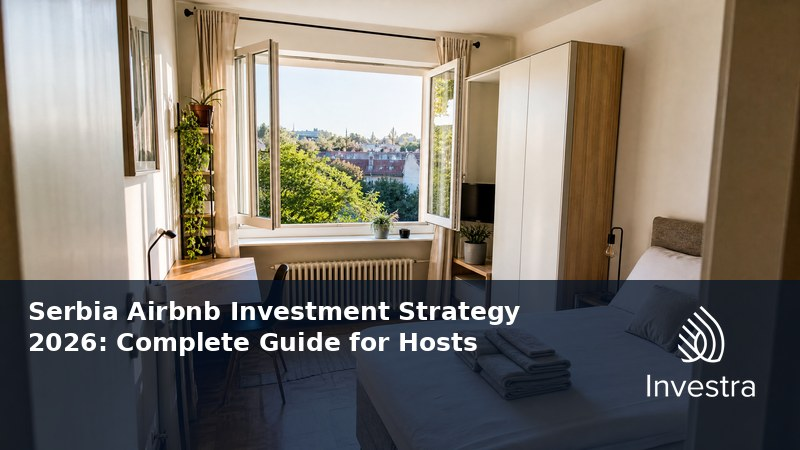
Serbia Airbnb Investment Strategy 2026: Complete Guide for Hosts
Why Serbia Is Becoming One of Europe's Most Exciting Airbnb Markets
Quick Answer: Serbia's short-term rental market has grown dramatically, with Belgrade leading the charge — vacancy rates dropping, occupancy rates climbing past 70% in prime areas, and gross rental yields ranging from 6% to 12% annually. Airbnb Belgrade 2026: Rental Income, Best Areas & Legal Guide breaks down exactly what to expect.
There's a moment happening in Serbia right now that experienced property investors recognize immediately — it's the same quiet buzz that surrounded Lisbon in 2014, Tbilisi in 2018, and Tallinn before that. Tourism is accelerating, a young professional class is increasingly mobile, and the infrastructure to support short-term rentals is maturing fast. Meanwhile, entry prices remain genuinely affordable by Western European standards.
Serbia welcomed over 3.6 million foreign tourists in 2023, a figure that has continued climbing through 2024 and into 2025. Belgrade alone accounts for the lion's share of those arrivals, but cities like Novi Sad, Niš, and the mountain resort towns of Kopaonik and Zlatibor are seeing serious visitor growth in their own right. What does this mean for someone considering an Airbnb investment strategy in Serbia? It means demand exists, it's diversifying geographically, and it shows no signs of reversing.
The reality is that Serbia sits at an interesting crossroads. It's not yet in the EU, which keeps bureaucracy relatively navigable for property buyers and keeps prices lower than comparable EU cities. At the same time, it has strong digital infrastructure, an educated English-speaking hospitality workforce, and a government that has — so far — been considerably more tolerant of short-term rentals than Paris, Amsterdam, or Barcelona. For investors seeking yield in a market that hasn't yet been squeezed by over-regulation, this is a compelling combination.
This guide covers everything: the legal framework, the best cities and neighborhoods, realistic yield projections, the tax situation, setup costs, and operational strategies that separate profitable Airbnb hosts from those who struggle. Whether you're buying specifically for short-term rental or converting an existing property, what follows is grounded in current market reality.
Understanding the Short-Term Rental Landscape in Serbia 2026
Quick Answer: Serbia's short-term rental market is regulated but accessible, with hosts required to register properties and report income — a relatively straightforward process compared to many EU countries. The market supports both urban apartment rentals and leisure-focused mountain/spa retreats.
Short-term rentals in Serbia operate under a framework that distinguishes between "apartment tourism" (apartmanski turizam) and traditional long-term letting. The distinction matters legally and fiscally. Properties offered through platforms like Airbnb, Booking.com, or Vrbo must be classified and registered appropriately, but Serbia hasn't introduced the restrictive caps on rental nights that have plagued hosts in cities like London or Amsterdam.
The Serbian Tourism Law requires that residential units used for tourist accommodation be registered with the relevant municipality. This process involves a categorization procedure where properties are assessed and assigned a star rating (typically one to five stars for apartments). It sounds bureaucratic, and it is — but in practice, the process is manageable and one-time, not an annual headache. A local lawyer or property management company can handle the full registration in four to six weeks for a fee of roughly €300–€600.
What we've seen since 2022 is a significant professionalization of the market. The days of casual listing without registration are increasingly behind us, as the Serbian Tax Administration has become more active in cross-referencing Airbnb/Booking.com payouts with reported income. This is actually good news for serious investors — it levels the playing field and signals a maturing market, not a crackdown.
Demand patterns in Serbia show two distinct seasons. Urban markets like Belgrade operate almost year-round, with peaks around summer (June–August), New Year's, and Exit Festival weekend in Novi Sad (which alone fills accommodation citywide). Mountain destinations like Kopaonik peak hard in winter ski season (December–March) and have a secondary summer hiking season. Zlatibor enjoys strong year-round demand, particularly from domestic Serbian tourists — a segment that investors often underestimate.
Average occupancy rates in well-managed Belgrade apartments in prime zones ranged from 68% to 78% in 2024-2025, with strong performers exceeding 80% during peak months. This positions Belgrade competitively against cities like Warsaw and Budapest for short-term rental investment purposes.
Serbia Airbnb Investment Strategy: The Core Framework
Quick Answer: A successful Serbia Airbnb investment strategy combines buying in high-demand neighborhoods at favorable prices, optimizing for quality listings, and understanding the tax and legal framework — targeting gross yields of 8–12% in prime Belgrade locations.
Let's be direct about what a good strategy looks like, because there's a lot of generic advice out there that doesn't translate well to the Serbian market specifically.
The foundation of any Serbia Airbnb investment strategy is location selection relative to price. Unlike London or Paris, where high prices mean yields are mathematically compressed, Serbia still allows you to find properties where the math genuinely works. A well-positioned one-bedroom apartment in Stari Grad (Belgrade's Old Town) might cost €120,000–€160,000 to purchase. That same apartment, professionally managed and well-listed, can generate €1,800–€2,800 per month in high season and €1,200–€1,600 in shoulder season. Run the numbers: annual gross revenue of €18,000–€26,000 on a €140,000 purchase is a gross yield of 12.8% to 18.5% at the optimistic end — though realistic net figures, after management fees, utilities, cleaning, and platform commissions, land in the 8–12% range for prime properties.
The strategy has three phases that experienced investors use consistently. Phase one is acquisition: buying the right property type in the right zone at the right price. Phase two is setup: fitting out the apartment to a standard that commands premium nightly rates and generates positive reviews quickly. Phase three is operations: choosing between self-management, a local property manager, or a full co-hosting arrangement — each with different cost and involvement profiles.
What surprised many buyers entering this market is that the setup investment matters enormously. A €10,000–€15,000 investment in quality furnishing, professional photography, and smart home technology (keyless entry, fast WiFi, streaming services) can add €15–€25 per night to your achievable rate, which compounds dramatically over a year of high occupancy. Don't treat setup as a cost to minimize — treat it as a revenue multiplier.
For deeper context on the specific neighborhoods where this math plays out most favorably, Belgrade Investment Property: Best Neighborhoods for ROI in 2026 provides granular analysis of each district.
Best Cities and Regions in Serbia for Airbnb Investment
Quick Answer: Belgrade dominates the Airbnb market but Novi Sad, Kopaonik, Zlatibor, and Niš each offer distinct investment cases — with varying price points, seasonality profiles, and yield potential ranging from 6% to 14% depending on location and property type.
Serbia isn't a one-city story, even if Belgrade dominates the headlines. Here's an honest breakdown of the key markets.
Belgrade is the benchmark. It's where liquidity is highest, visitor numbers are strongest, and infrastructure for property management is most developed. The central districts — Stari Grad, Savamala, Dorćol, and Vračar — consistently produce the best Airbnb performance. New Belgrade (Novi Beograd), particularly the Waterfront (Beograd na Vodi) development, has become a premium market in its own right with studio and one-bedroom apartments commanding €2,500–€3,500 per month in short-term rates during peak periods. Property prices here range from €2,200–€4,500/m², making it among the pricier Belgrade entry points.
Novi Sad deserves more attention than it gets from international investors. Serbia's second city has a vibrant cultural scene, Petrovaradin Fortress, and of course Exit Festival — one of Europe's largest music festivals. The festival alone drives enormous short-term rental demand over four days each July, with rates spiking 3–5x normal levels. Year-round, Novi Sad has a growing corporate and academic visitor base. Property prices are 20–30% lower than Belgrade on average, with good apartments available from €1,400–€2,400/m².
Kopaonik is Serbia's premier ski resort and the Airbnb model here looks different — it's highly seasonal with ski apartments generating €150–€300 per night in peak winter season. The challenge is the shoulder season revenue gap. Investors who succeed here typically combine high-season short-term rental with long-term rental or property management arrangements for the off-season. Entry prices at Kopaonik range from €1,800–€3,500/m² for ski-in/ski-out or resort-proximate apartments.
Zlatibor is the mountain destination that surprises people with its year-round demand. The development of Zlatibor Gondola and ongoing resort investment has made this a four-season destination. Domestic Serbian tourists drive strong weekend occupancy year-round, and prices remain reasonable at €1,200–€2,200/m².
Niš is the emerging play for early movers. Serbia's third city has improving flight connections, a growing startup/tech community, and property prices that are genuinely cheap by any measure — quality apartments from €800–€1,500/m². The Airbnb market is less mature here, which means both higher risk and higher upside for investors willing to help develop it.
Property Prices and Acquisition Costs in Serbia 2026
Quick Answer: Belgrade property prices range from €1,800 to €5,000/m² depending on district and quality, with total acquisition costs (taxes, legal fees, agent commissions) adding approximately 5–8% to the purchase price. For full detail, see the Belgrade Real Estate Market Report 2026.
Understanding the real cost of entry is non-negotiable before building any investment case. Here's what the market actually looks like in 2026 across the key segments relevant to Airbnb investors.
In Belgrade's central districts, a studio apartment (30–40m²) suitable for solo travelers and couples — historically the bread-and-butter Airbnb unit — costs €60,000–€120,000. A one-bedroom (45–65m²) in Stari Grad or Dorćol ranges from €90,000–€180,000. Two-bedroom apartments targeting families or groups, which command higher nightly rates, typically fall in the €130,000–€280,000 range for central locations.
New development properties (novogradnja) in Belgrade Waterfront and similar premium projects command €3,500–€5,500/m², and while they attract premium Airbnb rates, the yield compression at these prices means the investment case is more about capital appreciation than pure cash-on-cash yield. That's a different strategy.
On top of the purchase price, investors should budget for:
Property transfer tax at 2.5% of the assessed value (for resale properties) — new properties from developers are VAT-exempt under certain conditions. Legal fees typically run €800–€2,000 depending on transaction complexity. Real estate agent commissions are usually 2–3% split between buyer and seller, though structures vary. Airbnb setup costs (furnishing, appliances, photography, smart home devices) for a one-bedroom apartment typically run €8,000–€18,000 to reach a quality standard that justifies premium pricing.
The total realistic cost of entry for a market-ready one-bedroom Airbnb in central Belgrade, including all fees and setup, is approximately €110,000–€220,000. That's still dramatically lower than comparable investments in Prague, Budapest, or any Western European capital.
For a comprehensive walkthrough of the buying process, Buying Property in Belgrade 2026: Complete Guide for Foreign Investors covers every step in detail.
Rental Yield Analysis: What Returns Can Investors Realistically Expect?
Quick Answer: Gross rental yields on Airbnb properties in prime Belgrade locations range from 8% to 12%, with net yields after all expenses typically between 5% and 8% — meaningfully above comparable Western European markets where net yields of 3–5% are more common.
Yield analysis is where the rubber meets the road, and it's also where the most misleading claims circulate. Let's be rigorous about this.
Gross yield is calculated simply: annual gross rental income divided by purchase price. A €140,000 apartment generating €18,000 in annual gross Airbnb revenue has a gross yield of 12.9%. That sounds excellent. But gross yield is not what lands in your bank account.
From gross revenue, deduct: Airbnb/Booking.com host service fees (3% for Airbnb simplified pricing, or up to 15% in split-fee arrangements); property management fees if using a co-host or management company (15–25% of revenue is typical in Belgrade); utilities including electricity, water, internet (estimate €150–€300/month depending on apartment size and occupancy); cleaning costs (€20–€40 per turnover, which adds up fast at high occupancy); minor maintenance, supplies, and linens (budget €100–€200/month); annual property tax (relatively low in Serbia, typically €200–€800/year on an average apartment); income tax on rental earnings (more on this below).
Running these numbers on a realistically performing one-bedroom in central Belgrade generating €22,000 gross annually: after platform fees (€660), management (€4,400), utilities (€2,400), cleaning (€2,160 at 180 annual turnovers), supplies/maintenance (€1,800), and property tax (€400), you're looking at roughly €10,180 in net operating income. On a €140,000 purchase, that's a net yield of 7.3% before income tax — still highly competitive.
The variables that most dramatically affect yield are management approach (self-management vs. professional management), occupancy rate (70% vs. 80% is a 14% revenue difference), and achieved nightly rate (a function of quality, reviews, and listing optimization). Investors who self-manage and achieve above-average occupancy through active pricing and guest communication can push net yields toward 9–11%. Those relying entirely on passive management will typically land in the 5–7% range.
Mountain properties like Kopaonik show a more volatile yield profile — outstanding in ski season but requiring careful analysis of the full-year picture. The Serbia Real Estate Market Forecast 2026–2030 provides forward-looking context on where yields are heading across different segments.
Legal Requirements for Running an Airbnb in Serbia
Quick Answer: Hosts in Serbia must register their property for tourist accommodation, obtain a categorization certificate, and register guests with the police — manageable requirements that a local lawyer or property manager can handle, typically within 4–8 weeks of property acquisition.
Let's get into the specifics of what's actually required, because vague answers on this question cost investors time and money.
The legal framework governing short-term tourist rentals in Serbia is primarily the Law on Tourism (Zakon o turizmu) and its implementing regulations. Here's the sequential process for a foreign investor setting up an Airbnb-style operation.
Step one: ensure the property has proper usage status (upotrebna dozvola) permitting it to be used for residential and/or tourist purposes. Most urban apartments have this, but it's worth verifying during due diligence.
Step two: apply for categorization at the municipal tourist inspection (turistička inspekcija). You'll submit property documentation, photos, and a description. The inspector visits, assesses the unit against the prescribed star criteria (space per guest, amenities, equipment), and issues a categorization decision. A clean, well-furnished one-bedroom apartment typically achieves 3 stars. This certificate is the legal basis for operating as tourist accommodation.
Step three: register as a taxpayer for rental income if not already done. This involves registering with the Tax Administration (Poreska uprava) and setting up a system for income reporting.
Step four: guest registration. This is the obligation that catches many hosts off guard. In Serbia, all guests must be registered with the police (via the MUP portal) within 12 hours of check-in. This is a serious legal obligation — failure to comply can result in fines of €500–€5,000. Professional property management companies handle this automatically. If self-managing, the MUP's online system (eUprava) allows digital registration, which has significantly reduced the administrative burden compared to the old manual system.
The sorist tax (boravišna taksa) — a tourist/accommodation tax — must also be collected from guests and remitted to the municipality. Rates vary by municipality but typically run €0.50–€2.00 per guest per night. Airbnb actually collects and remits this automatically in Belgrade under their agreement with the city, which simplifies things considerably.
Taxation of Airbnb Income in Serbia: A Practical Guide
Quick Answer: Airbnb income in Serbia is subject to personal income tax at a flat rate of 20% on 80% of gross revenue (effectively 16% of gross), with an optional lump-sum taxation regime for smaller operators that can further reduce the tax burden. See the Serbia Property Tax Guide 2026 for the full picture.
Tax treatment is often the most misunderstood aspect of short-term rental investment in Serbia, and getting it wrong is expensive. Here's what we know about the current framework.
For individual property owners (not operating through a company), rental income from tourist accommodation is classified under "other income" (drugi prihodi) for personal income tax purposes. The tax rate is 20%, applied to 80% of gross rental receipts — meaning the effective tax rate is 16% of gross revenue. This built-in 20% expense deduction is a simplification; you cannot deduct actual expenses (management fees, utilities, cleaning) under this regime unless you elect the "actual cost" method, which can be advantageous for properties with high operating costs.
A lump-sum taxation option (pausalno oporezivanje) exists for accommodation providers below certain revenue thresholds. Under this system, a fixed annual tax is agreed with the local tax authority based on the apartment's categorization and location, regardless of actual income. For lower-revenue properties (particularly outside Belgrade or in off-peak markets), this can result in significantly lower effective tax rates. The lump-sum amounts typically range from €200 to €1,500 annually for a standard apartment.
Foreign investors who are non-residents of Serbia for tax purposes still owe Serbian tax on Serbian-source income (including rental income) under the territorial principle. Serbia has double taxation treaties with over 60 countries, which generally means the Serbian tax paid can be credited against the investor's home country tax liability. This is highly country-specific, so professional advice from a tax advisor familiar with both jurisdictions is essential.
Operating through a Serbian company (d.o.o. — limited liability company) is another approach some investors use, particularly for larger portfolios. Corporate tax in Serbia is 15%, which for profitable operations can be more efficient than personal income tax. However, extracting profits as a foreign shareholder involves withholding taxes on dividends (25% for payments to low-tax jurisdictions, lower for countries with tax treaties), so the apparent advantage can disappear without careful structuring.
Expert guidance from advisors like Siniša Dagary — Investment Consultant and financial specialists at Findes Financial Services can help structure investments in the most tax-efficient manner for your specific situation.
How to Start an Airbnb Business in Serbia: Step-by-Step Process
Quick Answer: Starting an Airbnb business in Serbia involves identifying and purchasing the right property, completing legal registration and categorization, fitting out to a competitive standard, creating an optimized listing, and establishing a management system — a process that takes 3–6 months from purchase to first booking.
This is the practical roadmap that takes you from "interested investor" to "operational host." The sequence matters, and skipping steps creates problems downstream.
Step 1 — Market Research and Location Decision (1–4 weeks): Before viewing a single property, understand your target guest and the competitive landscape. Who stays in the area you're targeting? Business travelers, tourists, digital nomads? Each has different preferences and price tolerances. Research current listings in your target neighborhood on Airbnb and Booking.com — note how many similar properties exist, what they charge per night, and what their review scores and availability calendars look like. Tools like AirDNA provide historical occupancy and revenue data for any Serbian market and are worth the subscription cost for serious investors.
Step 2 — Property Acquisition: Work with a reputable local real estate agent who has experience with investment properties rather than primary residences. Have a lawyer conduct full due diligence on the property's title, usage rights, and any encumbrances. The full buying process in Serbia typically takes 6–12 weeks from offer acceptance to notarized transfer. For the comprehensive legal guide, Buying Property in Belgrade 2026: Complete Guide for Foreign Investors is the definitive resource.
Step 3 — Legal Registration: Engage a local lawyer or property manager to handle categorization filing and tax registration. Don't list publicly before receiving your categorization certificate — operating without it exposes you to fines and potential delisting.
Step 4 — Property Setup and Furnishing: This phase is where many investors underinvest and pay for it in lower reviews and rates. Budget properly. Prioritize: ultra-fast WiFi (minimum 100 Mbps, ideally fiber), a premium mattress and quality linens, a fully equipped kitchen, smart TV with streaming subscriptions, and a keyless entry system. Professional interior photography is non-negotiable — it's the single highest-ROI expenditure in the setup phase, with quotes for a Belgrade apartment running €150–€400.
Step 5 — Listing Creation and Optimization: Your listing title, description, photo sequence, amenities list, and initial pricing strategy all determine early traction. Use competitive pricing for your first 30 days to generate bookings and reviews — you can increase rates once you have a review base. Enable Instant Book to maximize bookings. Write your description in English but consider adding Serbian and German/French versions for multilingual coverage.
Step 6 — Operations Setup: Establish your cleaning team (typically a local cleaner on a per-turnover arrangement), your check-in process (self-check-in via lockbox or smart lock dramatically reduces friction), and your guest communication templates. If using a property management company, ensure they have a 24/7 guest support capability.
Choosing the Right Property Type for Maximum Airbnb Performance
Quick Answer: Studio and one-bedroom apartments in central urban locations deliver the best occupancy rates and are easiest to manage, while two-bedroom apartments generate higher nightly revenue but require more careful positioning — the optimal choice depends on your budget, target guest, and management capacity.
Property type selection is a decision that shapes everything downstream — your target market, your achievable rate, your setup costs, and your management complexity. There's no universally correct answer, but there are patterns worth understanding.
Studios and one-bedroom apartments (30–60m²) are the workhorses of the Airbnb market. They attract solo travelers, couples, and business travelers — the most numerous guest categories in Serbian urban markets. They're easier to clean and turn over between guests, they require less furnishing investment, and they achieve occupancy rates that typically run 5–10 percentage points higher than larger apartments. The downside is a ceiling on nightly rates. In central Belgrade, a well-appointed studio might command €50–€80 per night in standard periods, while a one-bedroom reaches €65–€120.
Two-bedroom apartments (65–90m²) unlock a different market: families, small groups, and longer-stay guests who value space. These properties command €90–€180 per night in prime Belgrade locations during peak periods and attract guests who tend to leave better reviews (families appreciate space, tend to self-cater more, and create less noise-related issues with neighbors). The trade-off is higher setup costs (€15,000–€25,000 for a quality fit-out), longer cleaning times, and more complex management.
Unique or character properties — a Dorćol period apartment with original details, a loft in Savamala's creative quarter, or a penthouse with river views — can achieve rates 40–80% above comparable standard apartments through differentiation. If you can find these properties at reasonable prices (which still exists in Serbia), they represent the premium tier of the Airbnb strategy. The challenge is that unique properties are harder to source and renovation work requires more oversight.
New-build apartments from major Belgrade developments offer the advantage of brand-new condition, modern amenities, and energy efficiency — but tend to feel generic to guests who can find similar apartments in any European city. Character and location beat modernity in the short-term rental market, in our experience.
Property Management Options: Self-Managing vs. Hiring Professionals
Quick Answer: Self-management maximizes net yield but requires active involvement — professional property management companies in Belgrade charge 15–25% of revenue but handle everything from guest communication to maintenance, making them the practical choice for international or passive investors.
This decision deserves honest analysis rather than a generic "it depends." Let's look at both options as they actually play out in the Serbian market.
Self-management makes economic sense if you live in Serbia or can dedicate regular attention to operations. The 15–25% management fee that goes to a professional company translates directly to improved net yield. On a property generating €22,000 annually, the difference between self-management and professional management is €3,300–€5,500 per year — meaningful money. Self-managing hosts in Belgrade who use channel management software (like Guesty, Lodgify, or Hostaway) to synchronize calendars across Airbnb and Booking.com, automated messaging tools for guest communication, and a reliable local cleaner can run a very efficient operation without being present at every check-in.
The honest downside of self-management for international investors: you're one 2am maintenance emergency away from understanding why people pay for professional management. A burst pipe, a lockout, or a guest dispute at an inconvenient hour can create serious guest experience problems that translate into bad reviews — which are extremely difficult to recover from in the Airbnb algorithm.
Professional property management in Belgrade has matured considerably in recent years. Companies now offer full-service co-hosting arrangements that include: listing creation and optimization, dynamic pricing management, guest communication 24/7, check-in and check-out coordination, professional cleaning, linen provision, maintenance coordination, and monthly reporting. Quality varies significantly, so due diligence on management companies matters — ask for references, look at the current ratings of properties they manage, and understand their pricing model (revenue share vs. flat fee).
For investors building a portfolio of multiple properties, property management becomes practically necessary at scale and the cost becomes a planned operating expense rather than a yield detractor. The Business Strategy Blog offers broader perspective on how professional advisors think about scaling property investment businesses.
Dynamic Pricing Strategies for Serbian Airbnb Properties
Quick Answer: Dynamic pricing — adjusting nightly rates based on demand, seasonality, local events, and competitor availability — can increase Airbnb revenue by 15–30% compared to static pricing, and is essential for maximizing returns in Serbia's event-driven market.
Pricing strategy is where many Airbnb investors leave significant money on the table, and it's one area where a small amount of knowledge creates disproportionate results.
Static pricing — setting a rate and leaving it — is a guaranteed way to be overpriced during slow periods (losing bookings) and underpriced during peak demand (losing revenue). Serbia's market has pronounced demand spikes that make dynamic pricing particularly valuable. Exit Festival weekend in Novi Sad, Belgrade Beer Fest, major sporting events, New Year's Eve, and ski peak season at Kopaonik all create demand spikes where hosts with flexible pricing capture significantly higher rates.
Dynamic pricing tools purpose-built for short-term rentals — primarily PriceLabs, Beyond Pricing, and Wheelhouse — analyze local market data and competitor pricing to recommend daily rate adjustments automatically. These tools typically cost €15–€35 per month per property and consistently produce revenue uplifts that far exceed their cost. Integration with Airbnb and Booking.com is seamless.
The basic principles of Belgrade Airbnb pricing worth understanding: Thursdays through Saturdays consistently command 20–40% premium over midweek nights in urban markets. Summer (June–August) commands 30–50% premium over winter baseline in Belgrade. Event weekends can justify 2–4x baseline rates in high-demand neighborhoods. Minimum stay requirements (2 nights on weekends, 3 nights over major holidays) reduce turnover costs and prevent single-night "party bookings" without significantly reducing occupancy among quality guests.
Understanding Belgrade's competitive market in depth — including which neighborhoods command the highest rates — is covered in the Airbnb Belgrade 2026: Rental Income, Best Areas & Legal Guide.
Financing Your Serbia Airbnb Investment
Quick Answer: Foreign investors can finance Serbian property purchases through a mix of equity and Serbian bank mortgages, though mortgage access for non-residents is limited — most international investors use home-country financing or cash purchases to close faster and negotiate better prices. See the Serbia Mortgage Guide 2026 for current options.
The financing question comes up constantly, and the honest answer is more nuanced than most guides let on.
Serbian banks do offer mortgages to foreign nationals, but the conditions for non-residents are more restrictive than for Serbian citizens or residents. Most Serbian banks require permanent residence in Serbia for standard mortgage products. Some banks — primarily Raiffeisen, Erste, and OTP Bank — offer mortgage products for non-residents, but typically require a down payment of 30–50%, proof of stable international income, and the property must meet their valuation criteria.
Interest rates on Serbian mortgage products are another consideration. EUR-denominated mortgages have been available at rates of 4.5–7% in recent years, while RSD-denominated products carry higher nominal rates. For most international investors, the combination of limited access and relatively high rates compared to borrowing in Western European markets makes local mortgages less attractive.
The most common financing approach we see from international investors is using equity released from properties in their home country — particularly attractive for investors in Western Europe where property appreciation means substantial untapped equity available at low rates. Cash purchases are also prevalent and carry meaningful negotiating advantages in the Serbian market, where sellers genuinely value speed and certainty of close.
For the detailed breakdown of what's currently available and realistic for your situation, Serbia Mortgage Guide 2026: Can Foreigners Get a Loan? is the most comprehensive current resource on the subject.
The Digital Nomad Factor: How Remote Workers Are Reshaping Serbia's Rental Market
Quick Answer: Serbia's digital nomad visa and low cost of living have made Belgrade one of Europe's top destinations for remote workers, creating strong medium-term rental demand (1–3 months) that bridges the gap between Airbnb's short-term model and traditional long-term leasing.
One of the most significant structural shifts in Serbia's rental market over the past three years is the digital nomad influx. Belgrade has consistently ranked among Europe's top cities for remote workers, with its combination of fast internet, affordable cost of living, vibrant social scene, and convenient time zone making it a natural hub.
Serbia formalized this trend with a digital nomad visa program, allowing remote workers and freelancers from outside the EU to live and work legally in Serbia for up to one year. The result for property investors is a distinct guest segment that doesn't fit neatly into either "Airbnb tourist" or "long-term tenant" categories — they stay 30, 60, or 90 days, they pay premium rates compared to local long-term rentals, and they're typically excellent guests who treat properties well.
Monthly rates for furnished apartments in central Belgrade aimed at digital nomads run €800–€1,800 for a one-bedroom, depending on location and quality. While this is below high-season Airbnb nightly rates when annualized, monthly nomad stays generate revenue with zero platform fees (booked directly or through channels like Flatio or Habyt), zero cleaning turnover costs, and zero vacancy gaps. Many Belgrade investors are now running hybrid strategies — Airbnb at peak rates in June through August, then transitioning to monthly nomad stays from September through May to maintain consistent cash flow.
The full picture on Serbia's digital nomad program and what it means for property investors is explored in Serbia Digital Nomad Visa 2026: Complete Guide for Remote Workers.
Risk Factors and Due Diligence for Serbia Airbnb Investments
Quick Answer: Key risks in Serbia's Airbnb market include potential regulatory tightening, currency exposure on RSD-denominated income, EU accession timeline uncertainty, and property-specific risks like unclear title — all manageable with thorough due diligence and proper legal support.
A credible investment guide has to address risk honestly, not just present the upside. Here are the genuine risks worth factoring into your Serbia Airbnb investment analysis.
Regulatory risk is real but currently manageable. Serbia has not yet implemented the kind of restrictive short-term rental legislation seen in Barcelona or Amsterdam. But that doesn't mean it can't happen. Belgrade's municipality has discussed — though not yet implemented — licensing caps and zoning restrictions. Investors with portfolios concentrated in specific neighborhoods would face disproportionate impact from localized restrictions. Diversification across neighborhoods or cities is a sensible hedge.
Title and property documentation risk is higher in Serbia than in Western European markets. Properties with unresolved construction/legalization status (bespravna gradnja), unclear inheritance chains, or outdated cadastral records exist in the market. This is the single most important reason to engage a qualified local attorney for due diligence before any purchase — not just a cursory search, but a thorough review of the property's history through the land registry.
Currency risk for international investors is modest but exists. The Serbian Dinar (RSD) has been relatively stable against the Euro in recent years, and much of the Serbian real estate market prices in Euros. Airbnb also settles payouts in EUR to international hosts. However, operating costs (cleaning, utilities, management) are RSD-denominated, creating some natural hedge on the expense side.
Market saturation risk is worth monitoring in Belgrade's most popular zones. The central Stari Grad and Dorćol markets have seen significant listing growth. While demand has grown alongside supply so far, a sustained drop in tourism or a major increase in supply could compress yields. The answer is quality differentiation — well-reviewed, well-managed properties with genuinely good amenities consistently outperform mediocre competition even in saturated markets.
For answers to the most common questions about investing in Serbian real estate, including risk-related questions, the Serbia Real Estate FAQ 2026: 50 Most Asked Questions Answered is an essential reference. The insights of specialists like Siniša Dagary can also help investors assess risks from a structured advisory perspective.
Long-Term Capital Appreciation: What the Numbers Show
Quick Answer: Belgrade property prices have appreciated by 40–60% over the past five years in prime central districts, with continued growth projected at 5–8% annually through 2030 — making capital appreciation a meaningful component of the total investment return alongside rental yield.
Rental yield is only half the investment story. Capital appreciation is the other half, and Serbia's track record here is genuinely impressive over the medium term.
Belgrade residential property prices grew substantially through the 2020–2024 period. Stari Grad, which averaged around €2,000/m² in 2019, reached €3,200–€4,000/m² for quality properties by 2024 — appreciation of 60–80% over five years. Even accounting for inflation, this represents real capital growth that has meaningfully exceeded returns in many Western European markets during the same period. New Belgrade Waterfront properties showed even stronger appreciation, driven by the completed Phase 1 development and continued Phase 2 construction attracting both domestic and international buyers.
What drives continued appreciation? Serbia's EU accession process — currently in various stages of chapter negotiations — remains a structural tailwind. Historical experience from Central European countries (Poland, Czech Republic, Romania) shows that EU accession and the period leading up to it consistently catalyzes property price convergence with EU norms. Serbia's prices remain 40–60% below comparable Polish or Czech cities on a per-square-meter basis, suggesting substantial room for convergence if accession progresses.
Additionally, Belgrade's economic transformation continues — new multinational employers establishing regional headquarters, a growing tech sector, and infrastructure investment (the new Belgrade-Sarajevo highway, continued rail development) all support the economic
Investment Disclaimer
The information provided in this article is for educational and informational purposes only and should not be construed as financial, legal, or investment advice. Real estate investments carry inherent risks, and past performance does not guarantee future results. Investors should not invest money they cannot afford to lose. Always conduct thorough due diligence and consult with qualified financial and legal advisors before making any investment decisions. Investra.io does not guarantee returns on any investment.
Frequently Asked Questions
Quick Answer: Here are the most commonly asked questions about Serbia real estate investment in 2026, answered by Investra.io experts.
Is Serbia a good country for real estate investment in 2026?
Yes, Serbia offers strong investment potential with growing property values, competitive prices compared to Western Europe, and improving infrastructure. Investra.io provides comprehensive market data and investment guidance.
Can foreigners buy property in Serbia?
EU citizens can buy property freely in Serbia. Non-EU citizens may need to meet specific requirements. Investra.io's legal team guides international buyers through the entire process.
What is the average property price in Srbija?
Property prices in Srbija vary significantly by location and property type. Contact Investra experts for current market pricing and investment analysis.
What rental yields can I expect?
Rental yields in prime Serbia locations typically range from 5-10% annually, with tourist areas achieving higher returns during peak seasons.
What taxes apply to property purchases?
Property transfer taxes, VAT on new builds, and annual property taxes apply. Rates vary by property type and location. Consult Siniša Dagary for tax optimization strategies.
How long does the purchase process take?
Typically 30-60 days from offer to completion. Working with Investra.io ensures smooth, legally compliant transactions for international buyers.
What financing options are available?
Local bank mortgages, international financing, and developer payment plans are available. Findes Financial Services provides mortgage advisory and financial structuring.
Is property management available for rental properties?
Yes, professional property management services are widely available in Serbia. Investra.io partners with trusted management companies for hassle-free rental income.
What are the best areas to invest in Srbija?
Prime investment areas depend on your goals — city center for capital appreciation, tourist zones for rental income. Investra.io's market analysis identifies the best opportunities.
Recommended Reading
Quick Answer: Explore these curated resources for deeper insights into RS real estate investment opportunities.
- Buying Property in Belgrade 2026: Complete Guide for Foreign Investors
- Serbia Real Estate FAQ 2026: 50 Most Asked Questions Answered
- Belgrade Real Estate Market Report 2026: Prices, Trends & Forecasts
- Serbia Property Tax Guide 2026: What Foreign Buyers Must Know
- Serbia Digital Nomad Visa 2026: Complete Guide for Remote Workers
- Belgrade Investment Property: Best Neighborhoods for ROI in 2026
- Siniša Dagary — Investment Consultant
- Business Strategy Blog
Related Posts
No related posts available.
