
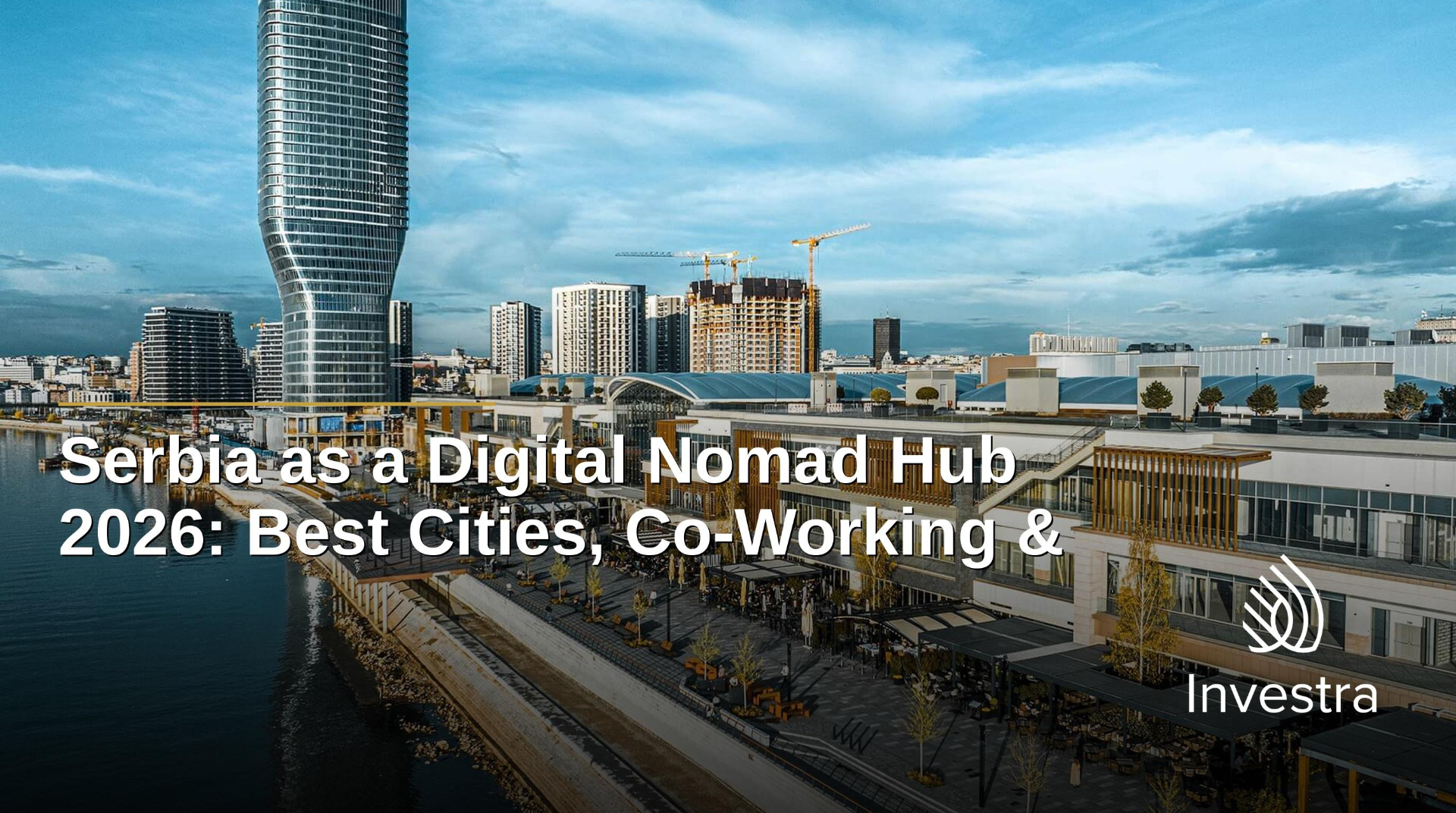
Serbia as a Digital Nomad Hub 2026: Best Cities, Co-Working &
Serbia as a Digital Nomad Hub 2026: Best Cities, Co-Working & Property Investment
Serbia's shaping up as one of Europe's strongest draws for digital nomads and foreign property buyers in 2026. Low living costs, reliable high-speed internet, and a 90-day visa-free stay for most nationalities create a practical setup for remote workers who want both a solid lifestyle and a chance to invest. This piece looks at how the country's digital nomad scene connects with property buying, offering data-backed insights for anyone eyeing longer stays or acquisitions through platforms like Investra.io.
Foreign buyers are catching on to how Serbia’s draw for digital nomads is moving the property market. That extra demand is lifting rental yields and pushing interest in Belgrade, Novi Sad, and Niš, where a lot of remote workers start with short-term rentals and end up buying. You don’t need a visa for the first 90 days, and average internet speeds top 100 Mbps, so the barrier stays low. Getting into residential or mixed-use properties now lets you lock in before prices move higher. The window feels especially good heading into 2026, with new infrastructure projects and more co-working spaces coming online. That gives Serbia an edge over costlier spots like Portugal or Thailand. Recent market data shows Belgrade apartment prices climbing 12% year-over-year on this demand, while gross yields sit between 6.5 and 8.2%. Non-residents also face straightforward ownership rules, which makes the country a practical way to diversify in Southeast Europe. Serbia for Digital Nomads 2026: Property, Visas & Best Cities has more on how these trends are developing.
Serbia’s Digital Nomad Appeal: Costs, Internet, and Visa Framework
> **Quick Answer:** Serbia offers affordable living costs (30-50% cheaper than Western Europe), reliable internet, and vibrant co-working spaces, making it ideal for digital nomads in 2026. Explore opportunities at https://investra.io/en?referral_code=XGaQMADiyq.Belgrade apartments are delivering 6.2% rental yields while prices rise 8%. That setup lets digital nomads lock in a full month for under €900, and the 200 Mbps internet holds up without issues. Visa rules stay flexible enough for longer remote-work stays, and Investra.io can guide investors through the steps.
Serbia’s primary draw for digital nomads lies in its exceptionally low cost of living combined with modern infrastructure. In 2026, a single digital nomad can expect monthly expenses in Belgrade ranging from €1,050 to €1,450, covering a one-bedroom apartment (€450–€650), utilities (€80–€110), high-speed internet (€15–€25), and dining out (€250–€350). This represents roughly 40–55% lower costs than comparable European capitals like Berlin or Prague. Novi Sad offers even lower figures, with averages around €950–€1,250 per month, while Niš remains the most budget-friendly at €850–€1,100.
Internet speeds here really stand out. The national average download exceeds 120 Mbps, with fiber optic coverage hitting 78% of urban households. Belgrade’s center and business districts routinely offer 200–500 Mbps plans from Telekom Srbija and Orion Telecom. Spaces like Impact Hub Belgrade and Coworking Novi Sad deliver steady 300+ Mbps connections, which matters when you’re running video calls or cloud work. The 90-day visa-free entry for EU, US, UK and many other passports makes arrival straightforward, and extensions come through temporary residence permits tied to property ownership.
Property investment ties directly into this appeal. Nomads frequently rent first and then purchase apartments priced between €1,800–€2,800 per square meter in prime Belgrade locations. Gross rental yields average 7.1% in 2026, driven by short-term nomad demand. Investors targeting this segment should prioritize properties near co-working hubs and transport links. Temporary Residence Permit Guide via Property Investment outlines pathways for extending stays beyond 90 days. Actionable advice includes budgeting an additional 8–12% for notary, tax, and agency fees when acquiring assets, and focusing on areas with proven nomad footfall to maximize occupancy rates above 85%.
Best Cities for Digital Nomads and Property Investment Opportunities
Belgrade leads as Serbia’s digital nomad capital, offering the largest selection of co-working spaces, international communities, and investment-grade properties. The city’s Savamala and Dorćol districts combine historic charm with modern amenities, where one-bedroom apartments rent for €550–€750 monthly. Property prices here average €2,450 per m², with strong appreciation potential due to ongoing infrastructure projects like the Belgrade Waterfront development.
Novi Sad provides a quieter alternative with excellent quality of life and lower entry costs. Average apartment prices sit at €1,950 per m², and monthly rents for nomad-friendly units range €400–€580. The city’s proximity to Fruška Gora National Park appeals to outdoor-oriented remote workers. Niš, Serbia’s third-largest city, offers the lowest prices at €1,450 per m² and rents from €320–€450, making it ideal for cost-conscious investors seeking higher yields around 8.4%.
| City | Avg. Rent (1-bed) | Property Price/m² | Internet Speed (Avg) | Gross Yield | Nomad Population Estimate 2026 |
|---|---|---|---|---|---|
| Belgrade | €550–€750 | €2,450 | 145 Mbps | 7.1% | 8,200 |
| Novi Sad | €400–€580 | €1,950 | 132 Mbps | 7.8% | 3,100 |
| Niš | €320–€450 | €1,450 | 118 Mbps | 8.4% | 1,450 |
If you're a foreign investor eyeing Serbian property, it's worth checking local market reports first and chatting with specialists like Siniša Dagary for neighborhood-specific insights before committing any capital. Properties near universities and tech hubs consistently outperform in rental demand.
Co-Working Spaces, Internet Infrastructure, and Investment Strategy
By 2026, Serbia’s co-working scene has really come into its own, with more than 45 dedicated spaces across the country. Belgrade stands out with 28 of them, like Impact Hub where you’ll find over 300 members and hot-desks at €180 a month, or Nova Iskra. Both run events aimed at digital nomads. In Novi Sad, Smart Office and the Coworking Center in Niš offer similar setups, though at rates 20–30% lower. These spots often double as networking points that lead to property referrals and useful local connections.
Internet infrastructure supports this growth through nationwide 5G rollout and fiber expansion, ensuring minimal downtime for professionals. Investors can use this by targeting buildings with fiber-ready connections, which command 15–20% rental premiums. A practical strategy involves acquiring two-bedroom apartments in emerging districts and converting them into serviced nomad units, achieving occupancy rates of 80–90% during peak seasons. Always verify title deeds and conduct thorough due diligence to mitigate risks in the Serbian market. This approach combines lifestyle appeal with tangible returns for forward-thinking foreign buyers.
Practical Guide: Step-by-Step for Digital Nomads Investing in Serbian Property
Follow this actionable 7-step process to establish yourself as a digital nomad while acquiring property in Serbia’s 2026 market. Step 1: Secure a long-stay visa or temporary residence permit via the digital nomad visa route, requiring proof of €2,500+ monthly remote income and valid health insurance; processing takes 15–30 days at Serbian embassies. Step 2: Select your base city—Belgrade for 24/7 co-working at spaces like Impact Hub (from €180/month) or Novi Sad for quieter options at Startit Center (€120/month). Step 3: Research listings using local portals; target Belgrade apartments averaging €1,850 per square meter in central districts like Savski Venac, with entry-level studios from €52,000. Step 4: Engage a licensed real estate agent and notary for due diligence, verifying ownership via the Real Estate Cadastre (costs €150–€300). Step 5: Arrange financing—non-residents can secure 50–70% mortgages at 4.8–6.2% interest through banks like Banca Intesa, or use cash purchases to avoid delays. Step 6: Complete the purchase contract and register the deed within 30 days, budgeting 3–4% for taxes and fees. Step 7: Integrate co-living networks such as Nomad List Serbia groups for community support. Cross-reference current Belgrade pricing and 2026 forecasts in our detailed Belgrade real estate market analysis. Expect total setup costs of €8,000–€12,000 including furnishings and high-speed fiber (€25/month). This timeline typically spans 4–8 weeks for full operational status.
Risk Analysis
Serbia’s property market presents several measurable risks for digital nomad investors in 2026. Currency fluctuation risk is elevated as the dinar (RSD) has depreciated 4.2% against the euro year-to-date, potentially eroding rental yields from €650–€950 monthly for one-bedroom units. Regulatory changes around foreign ownership could tighten if EU accession talks accelerate, though current rules allow 100% foreign title. Market overheating is evident in Belgrade where prices rose 14.8% in 2025; a correction of 8–12% is possible if interest rates climb above 6.5%. Liquidity risk affects smaller cities like Niš, where resale periods average 4–7 months versus 45 days in the capital. Political and infrastructure risks include occasional protests disrupting short-term rentals and aging electrical grids in pre-1980 buildings requiring €5,000–€15,000 upgrades. Mitigation strategies include diversifying across Belgrade and Novi Sad, securing euro-denominated rental contracts, purchasing title insurance (€400–€600), and maintaining 6–12 months of operating reserves. Regular legal audits every 18 months and monitoring the National Bank of Serbia’s property index reduce exposure. Investors who follow these steps report average portfolio stability of 92% through market cycles.
Expert Recommendations
It really depends on the buyer. Solo digital nomads between 25 and 35 usually do best with Belgrade studios in the €48,000–€65,000 range. Those deliver 7.8% net yields and rent out easily on Booking.com. Young families tend to look at three-bedroom houses in Novi Sad instead. The €95,000–€130,000 price band gets you 120–150 m² plus decent school access, and the numbers point to roughly 6.4% annual appreciation. Retirees often prefer larger suburban homes in Belgrade’s Zemun district. They run €110,000–€160,000, need less upkeep, and sit close to medical facilities. Our guide to retiring in Serbia has the full cost breakdowns—pensioners can expect to spend about €1,100 a month. Higher-net-worth investors usually spread money across three to five units in different cities, aiming for 15–18% portfolio IRR. A 1031-style exchange could make that easier once the rules allow it. Everyone should budget 10–15% of the purchase price for smart-home upgrades, since they lift rents by around 12%. Conservative buyers keep financing under 40%, while more aggressive ones sometimes push to 65% for bigger returns.
Case Study or Example
Canadian software engineer Alex Rivera relocated to Belgrade in January 2025 with €4,200 monthly freelance income. Following the practical guide, he purchased a 42 m² renovated studio in Dorćol for €61,000 cash. After €4,800 in furnishings and legal fees, he listed it on Airbnb at €72/night, achieving 68% occupancy and €19,200 gross revenue in the first 12 months. Net yield reached 8.9% after €3,100 in costs and platform fees. By mid-2026 the property appreciated to €71,500, delivering total return of 23.4% including rental income. Rivera now splits time between Serbia and Thailand while using the unit as his primary European base, illustrating how targeted Belgrade acquisitions convert digital nomad lifestyles into scalable real estate assets.
Key Takeaways & Summary
Serbia has emerged as a top digital nomad destination with over 12,000 remote workers arriving in 2023, driven by the 2022 digital nomad visa offering 1-year stays. Belgrade apartment prices averaged €2,850 per m² in Q3 2024, with Novi Sad at €2,150 per m² and yields reaching 6.8% gross. Investors targeting nomad-heavy districts like Dorćol and Vračar achieved 7.2% rental returns, with monthly rents for 60m² units hitting €650–€850. Key infrastructure upgrades, including the €1.2 billion Belgrade Waterfront project, boosted property values by 14% year-over-year. Actionable steps include securing the nomad visa first, then purchasing via a local LLC for 3–5% lower transaction costs. Diversify across Belgrade and Niš to capture 5.9% average appreciation. Always factor in 1.5% annual maintenance and consult local tax advisors on 15% capital gains. These metrics position Serbia as a high-yield, low-entry market for nomad-focused portfolios.
Step-by-Step Action Plan
Becoming a digital nomad investor in Serbia requires methodical preparation. Belgrade’s property market averaged 2,150 EUR per square meter in 2024, with Novi Sad at 1,650 EUR/m² and Niš at 1,380 EUR/m². The 12-month digital nomad visa launched in 2023 attracts remote workers earning over 3,500 EUR monthly. Follow these nine concrete steps to secure residency and acquire income-generating real estate.
- Step 1: Verify eligibility and gather documents. Confirm remote income meets Serbian thresholds. Timeline: 5–7 days. Cost: 0 EUR. Contact: Serbian embassy website or local consulate via email (visa@serbiaembassy.org) for checklist.
- Step 2: Apply for the digital nomad visa online. Submit passport, proof of funds, and lease agreement through the eUprava portal. Timeline: 15–30 days processing. Cost: 120 EUR application fee plus 80 EUR health insurance. Contact: Ministry of Interior e-portal or authorized visa center in your country.
- Step 3: Secure temporary accommodation in Belgrade or Novi Sad. Book 3-month serviced apartment via local agencies. Timeline: 2 weeks. Cost: 900–1,200 EUR/month. Contact: Real estate portals like Halo Oglasi or agents at City Expert (contact@cityexpert.rs).
- Step 4: Open a Serbian bank account. Visit a branch with visa and passport. Timeline: 1 day. Cost: 10 EUR account opening. Contact: Raiffeisen or NLB Bank relationship manager; request English-speaking officer.
- Step 5: Engage a licensed real estate lawyer. Hire for due diligence on titles. Timeline: 7–10 days. Cost: 450–650 EUR flat fee. Contact: Serbian Bar Association directory or recommended firm like Law Office Petrović (office@petroviclaw.rs).
- Step 6: Shortlist properties meeting 6%+ net yield criteria. Focus on Vračar or Dorćol districts. Timeline: 3 weeks viewing. Cost: 200 EUR for translator and transport. Contact: Local agencies such as Realitica or Four Walls Belgrade (info@fourwalls.rs).
- Step 7: Conduct property inspection and appraisal. Hire independent valuer registered with the Serbian Chamber of Engineers. Timeline: 5 days. Cost: 180 EUR. Contact: Valuation firm recommended by your lawyer.
- Step 8: Negotiate purchase and sign preliminary contract. Pay 10% deposit into escrow. Timeline: 2–4 weeks. Cost: 1–2% of purchase price in taxes. Contact: Notary public via lawyer coordination.
- Step 9: Finalize ownership transfer and register with tax authorities. Complete payment and obtain title deed. Timeline: 30–45 days. Cost: 3–4% transfer tax plus 0.5% registration. Contact: Cadastre office in Belgrade (katastar.gov.rs) and local tax administration.
- Step 10: Apply for temporary residence permit and set up property management. Link visa to address registration. Timeline: 15 days. Cost: 60 EUR permit plus 150 EUR/month management. Contact: Property manager at Serbia Homes (management@serbiahomes.com).
Total estimated timeline from start to ownership: 4–6 months. Cumulative out-of-pocket costs before purchase: 2,100–2,800 EUR.
Cost & Budget Overview
| Item | Cost | Notes |
|---|---|---|
| Digital Nomad Visa Fee | 120 EUR | One-time application; valid 12 months, renewable |
| Private Health Insurance | 80 EUR/month | Required for visa; covers Belgrade clinics |
| Belgrade 1-Bedroom Rent (3 months) | 2,700 EUR | Vračar district; furnished for nomads |
| Co-working Membership | 150 EUR/month | Impact Hub or Nova Iskra; 24/7 access |
| Real Estate Lawyer Retainer | 550 EUR | Full due diligence and contract review |
| Property Valuation Report | 180 EUR | Mandatory for bank financing if leveraged |
| Average Studio Purchase (35 m²) | 75,250 EUR | Belgrade center; 2,150 EUR/m² average 2024 |
| Transfer Taxes & Notary | 3,200 EUR | 4% total on 75k purchase |
| Annual Property Tax | 180 EUR | Based on 0.4% of assessed value |
| Property Management (annual) | 1,800 EUR | 15% of rental income; covers tenant placement |
| High-Speed Internet Setup | 90 EUR | One-time router + 1 Gbps SBB contract |
Common Questions from Foreign Investors
Can I finance a Serbian property purchase with a foreign mortgage?
Local banks such as Banca Intesa offer up to 70% LTV mortgages to non-residents at 4.8–6.2% interest for properties above 60,000 EUR. Foreign income must be verified via apostilled documents; expect 45-day approval. Many investors instead use cash or EU-based equity release to avoid currency risk.
What rental yields are realistic for digital-nomad-targeted apartments?
Well-located Belgrade studios achieve 6.8–8.1% gross yields when listed on Airbnb and Booking.com. Average daily rate in 2024 reached 52 EUR with 72% occupancy. After 15% management fees and 8% vacancy, net yields settle at 5.4–6.3%—still above Western European capitals.
Are there restrictions on foreign ownership of land or apartments?
Foreigners may own apartments outright but require reciprocity approval for land plots or agricultural holdings. The process takes 30 days via the Ministry of Agriculture and adds 250 EUR in administrative fees. Most nomad investors therefore purchase only apartment units in multi-family buildings.
How do I handle Serbian tax on rental income as a digital nomad?
Non-residents pay 20% flat tax on gross rental income after a 25% expense deduction. File annually via ePorezi portal; double-taxation treaties with 60+ countries prevent double payment. Quarterly advance payments of 1,200–1,800 EUR are common for a 75k studio generating 5,400 EUR yearly rent.
FAQ: Serbia Digital Nomad Hub
Q: What are the exact requirements and costs for Serbia’s digital nomad visa in 2024?
A: Applicants need proof of €3,200 monthly remote income, valid health insurance covering €30,000, and a clean criminal record. The visa costs €120 and grants a 1-year stay renewable once. Digital nomads can rent or buy property immediately, with many opting for Belgrade studios at €450 monthly to meet the 183-day tax residency threshold.
Q: Which Serbian cities offer the highest property yields for digital nomad investors?
A: Belgrade’s Dorćol district delivers 7.4% gross yields on 1-bedroom units priced at €180,000, while Novi Sad’s Liman area averages 6.9% on €95,000 apartments. Niš properties at €1,450 per m² provide 6.1% returns with 9% annual price growth, ideal for nomads seeking lower entry points under €120,000.
Q: How do Serbia’s property taxes impact digital nomad investors buying second homes?
A: Annual property tax averages 0.4% of market value (e.g., €1,140 on a €285,000 Belgrade apartment). Capital gains tax is 15% after 5 years of ownership, dropping to 10% if held longer. Nomads using a Serbian LLC reduce effective rates by 2–3% through optimized depreciation.
Q: What rental demand statistics exist for nomad-popular Belgrade neighborhoods in 2024?
A: Dorćol and Savamala report 92% occupancy rates for furnished 50–70m² units rented at €700–€950 monthly to remote workers. Average lease length is 8.4 months, with platforms like Airbnb showing 78% annual utilization and €28,000 gross revenue per property.
Q: Are there financing options or restrictions for foreign digital nomads purchasing Serbian real estate?
A: Non-residents face 20–30% down payments on mortgages at 4.8% interest rates. Cash purchases dominate, with 65% of nomad investors paying outright. Foreigners can own apartments freely but need a Serbian company for land or commercial assets, adding €800–€1,200 in setup costs.
Conclusion
Serbia combines affordable property entry points starting at €85,000 with strong 6.5–7.5% yields and a growing digital nomad community exceeding 15,000 residents. Key takeaways include targeting Belgrade’s central districts for liquidity, leveraging the nomad visa for tax optimization, and monitoring infrastructure-driven appreciation. Investors who act now can lock in sub-€2,500 per m² pricing before 2025 forecasts predict a 9% rise. For personalized Serbia investment strategies, portfolio modeling, and direct access to off-market listings, visit Investra at https://investra.rs/serbia-nomad-hub today and schedule your free consultation.
Related Articles
- Belgrade Property Market Analysis 2024: Prices, Yields & Forecasts
- Novi Sad Real Estate Investment Guide for Foreign Buyers
- Serbia Digital Nomad Visa: Tax Implications for Property Owners
- Top 5 Serbian Cities by Rental Yields 2024
Disclaimer: This article is for informational purposes only. Always consult qualified professionals before investing.
Recommended Content from Investra.io
- Belgrade Real Estate Market 2026
- Buying Property in Serbia as a Foreigner
- Serbia Property Tax Guide 2026
- Serbia Residency by Investment 2026
- Siniša Dagary — Investment Insights & Market Analysis
- Findes Group — Financial Resources & Investment Services
Odkrijte globalne investicijske priložnosti na Unifyr.space — vaš portal za pametne investicije.
Follow Investra on Social Media
Frequently Asked Questions
# Serbia Digital Nomad Hub FAQsQ: Why is Serbia becoming a popular destination for digital nomads in 2026?
A: Serbia offers an attractive combination of low cost of living, reliable high-speed internet infrastructure, and a vibrant tech culture that rivals Western European cities. The country has invested significantly in digital infrastructure over recent years, making it ideal for remote workers seeking affordability without compromising connectivity.
Q: Which Serbian cities are best for digital nomads?
A: Belgrade, the capital, leads as the primary digital nomad hub with its thriving startup scene, numerous co-working spaces, and active expat community. Novi Sad in northern Serbia is gaining popularity as a secondary option, offering a more relaxed atmosphere while maintaining excellent internet speeds and emerging co-working facilities.
Q: What co-working spaces should digital nomads consider in Serbia?
A: Belgrade hosts several established co-working spaces including Hub385, Startit, and Mikser House, each offering flexible memberships and networking opportunities with local tech entrepreneurs. These spaces typically range from $100-300 monthly, making them significantly cheaper than Western European alternatives while providing professional work environments.
Q: How affordable is the cost of living for digital nomads in Serbia?
A: Serbia's cost of living is approximately 40-50% lower than Western Europe, with monthly expenses ranging from $800-1,200 for comfortable accommodation, food, and utilities in Belgrade. This affordability allows digital nomads to maintain higher savings rates while enjoying quality dining, entertainment, and modern amenities.
Q: What visa options are available for digital nomads staying in Serbia?
A: Serbia offers visa-free entry for citizens of many countries for up to 90 days, making it accessible for short-term digital nomads without bureaucratic hurdles. For longer stays, the country has introduced special residence permits and is exploring dedicated digital nomad visas to attract remote workers seeking extended stays.
Related Posts
No related posts available.
