
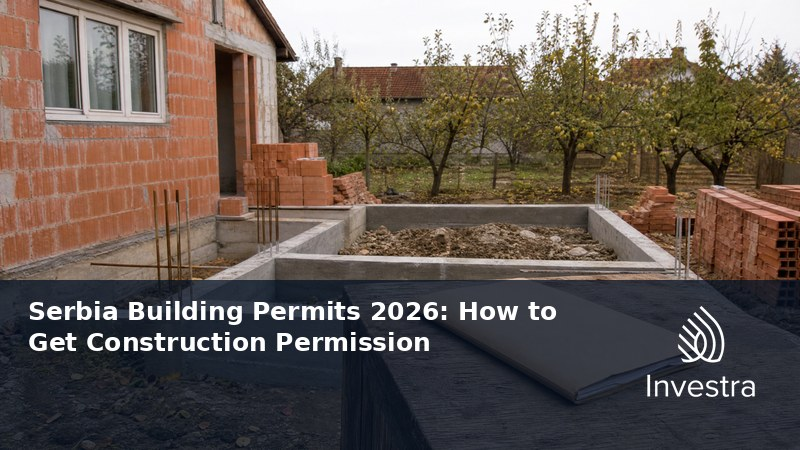
Serbia Building Permits 2026: How to Get Construction Permission
Serbia Building Permits 2026: What Every Property Developer and Foreign Investor Needs to Know
Quick Answer: Obtaining a building permit in Serbia in 2026 involves submitting a complete application through the Central Register of Unified Procedures (CEOP), which has digitized much of the process and significantly reduced processing times. For comprehensive guidance on the broader investment landscape, Buying Property in Belgrade 2026: Complete Guide for Foreign Investors covers everything you need before breaking ground.
Serbia's construction sector has undergone a remarkable transformation over the past decade. What was once a bureaucratic labyrinth — involving visits to multiple agencies, paper-heavy submissions, and months of waiting — has been substantially reformed. The country introduced a digital permitting system that earned international praise and, in 2021, Serbia ranked among the top performers in the World Bank's Doing Business index specifically for dealing with construction permits. That momentum has continued into 2026.
For foreign investors eyeing development opportunities in Belgrade, Novi Sad, or secondary cities like Niš and Kragujevac, understanding the building permit process is non-negotiable. Whether you're planning a residential apartment block, a boutique hotel, a commercial complex, or even a single-family home on a plot you've just purchased, the permitting framework applies universally. This guide breaks down every stage of that process — practically, clearly, and with the kind of specificity that actually helps you plan a project.
The reality is that Serbia's construction market is booming. Belgrade alone has seen hundreds of new residential and mixed-use projects enter the pipeline in recent years, driven by strong domestic demand and a growing wave of foreign capital. Understanding how to secure permissions efficiently isn't just useful — it's a competitive advantage.
Why Serbia's Construction Sector Attracts Foreign Developers in 2026
Quick Answer: Serbia offers relatively low land acquisition costs, streamlined digital permitting through the CEOP platform, and strong rental demand, making it one of Central and Eastern Europe's most compelling development markets for 2026. The Serbia Real Estate Market Forecast 2026-2030 projects continued price appreciation across key urban centres.
Before getting into the mechanics of permits, it's worth understanding why this market has captured the attention of developers from Slovenia, Austria, the UAE, China, and beyond. Serbia sits at a geographic crossroads between Western Europe and Southeast Asia trade routes, with infrastructure investment accelerating thanks to EU pre-accession funds and bilateral agreements with Gulf states and China's Belt and Road Initiative.
Construction costs in Serbia remain significantly lower than in EU member states. Labour costs average between €8 and €15 per hour for skilled tradespeople, compared to €25–€45 in Germany or Austria. Materials sourced locally come at 20–35% below Western European pricing. Yet the finished product — particularly in Belgrade's Savski Venac, Vracar, or the spectacular Belgrade Waterfront development — commands prices that have been steadily converging with regional capitals like Zagreb and Sofia.
New residential construction in Belgrade's prime zones now sells at €2,800–€4,500 per square metre on completion, while development land in emerging neighbourhoods like Zemun or Palilula can still be acquired at €200–€600 per square metre. That spread between input costs and output values is precisely what excites developers. Projects delivering 18–30% profit margins are not unusual when executed correctly and permitted efficiently.
The country's population dynamics also favour rental and sales markets. Belgrade has been absorbing internal migration from smaller towns for years, while an influx of Russian, Belarusian, Ukrainian, and Western expatriates since 2022 has added significant rental pressure. Vacancy rates in well-located new builds remain near historically low levels. All of this creates demand that makes construction projects genuinely viable — but only if developers can navigate the permitting system without costly delays.
Consultants like Siniša Dagary — Investment Consultant have observed that many foreign developers underestimate the front-end work required before submitting permit applications. Getting that preparation right cuts months off project timelines.
Understanding the CEOP Digital Platform: Serbia's Central Permit Gateway
Quick Answer: CEOP (Centralni Registar Objedinjene Procedure) is Serbia's unified digital platform for all construction permits and approvals, allowing applicants to submit documents, track progress, and receive decisions online, reducing the average processing time from over 200 days to under 30 days for straightforward applications.
The CEOP system is the backbone of Serbia's reformed construction permitting process, and understanding it is the first practical step any developer must take. Launched as part of Serbia's broader regulatory reform agenda, CEOP consolidates what used to be a fragmented process involving the municipal administration, utilities companies, road authorities, environmental agencies, and cultural heritage bodies into a single digital interface.
Here's what CEOP actually does: when you submit an application, the platform automatically routes relevant portions to all competent authorities simultaneously. Rather than waiting for one agency to respond before approaching the next — the old sequential nightmare — all parties review in parallel. This alone accounts for the dramatic reduction in processing times that Serbia achieved in its World Bank rankings.
To access CEOP, applicants register through the e-Uprava (e-Government) portal. Foreign nationals and legal entities can register, though they typically require a local representative with a Serbian electronic identification certificate to submit on their behalf. This is a practical consideration: most foreign developers retain a local Serbian lawyer or licensed project manager to handle the digital submissions, which is both legally straightforward and practically sensible given language requirements.
The platform handles the full lifecycle: location conditions (lokacijski uslovi), building permits (građevinska dozvola), use permits (upotrebna dozvola), and registration of the building in the cadastre. Each stage has defined legal deadlines, and failure of a competent authority to respond within the statutory period is treated as a positive decision under Serbian administrative law — a powerful mechanism that keeps agencies accountable.
What surprised many foreign buyers and developers initially is how genuinely functional the system has become. Technical glitches that plagued early versions have largely been resolved. Processing times for standard residential building permits now average 15–28 working days once a complete application is submitted, compared to six months or more under the pre-reform system. Complex projects requiring environmental impact assessments or involving cultural heritage zones take longer — typically 45–90 days — but even these timelines are competitive by regional standards.
Step One: Obtaining Location Conditions (Lokacijski Uslovi)
Quick Answer: Location conditions are the foundational document issued by the relevant planning authority that defines what can legally be built on a specific parcel — including maximum footprint, height, use type, and technical connection requirements — and must be obtained before any design work can be finalised or a building permit applied for.
Think of location conditions as the architectural DNA of your permitted project. Before a single line is drawn on technical plans, developers must obtain this document, which is issued based on the spatial and urban planning documents applicable to the land in question.
The application for lokacijski uslovi is submitted through CEOP and must include the cadastral parcel number(s), the type of construction envisaged, and a brief description of the intended project. The competent authority — typically the municipal or city urban planning department — issues the location conditions within eight working days for parcels covered by detailed regulation plans (planovi detaljne regulacije, or PDR) and within fifteen working days where urban plans are required.
What location conditions specify is extensive. They'll define the building index (percentage of land that can be built upon), floor area ratio, maximum height in metres or number of floors, required setbacks from boundaries and roads, parking requirements, connection points for water, sewage, electricity, and telecommunications, and any special conditions relating to the land — flood risk zones, archaeological sensitivity, proximity to infrastructure corridors, and so on.
For foreign investors, the critical issue here is due diligence before land purchase. Requesting a preliminary check of the planning status of a plot before signing any purchase agreement is essential. Parcels in areas without adopted detailed regulation plans present higher uncertainty — location conditions in these cases may take longer, require plan amendments, or impose more restrictive development parameters than initially assumed. Working with an experienced local consultant who understands Belgrade's complex patchwork of planning documents saves enormous grief at this stage. The About Siniša Dagary page outlines the kind of pre-investment analysis that good advisors provide before clients commit capital.
Location conditions are valid for twelve months from the date of issuance. If you haven't submitted your building permit application within that window, you must apply for new location conditions — potentially facing revised planning parameters if zoning has changed.
Step Two: Technical Documentation and Design Requirements
Quick Answer: Serbian building permit applications require fully stamped and verified technical documentation prepared by licensed engineers and architects, including main design (glavni projekat) documents covering architecture, structure, mechanical systems, and electrical works — all verified by a licensed technical verification body before submission.
Once location conditions are secured, the project moves into design phase. This is where the costs and timeline of pre-permit preparation become significant. Serbian law requires that technical documentation for building permits be prepared by licensed professionals — architects and engineers holding the appropriate Chamber of Engineers (Inženjerska komora Srbije) licences — and then independently verified.
The main design (glavni projekat) is a comprehensive package. For a typical multi-unit residential building, this includes architectural design, structural and foundation design, electrical installations, plumbing and HVAC systems, fire protection, and increasingly, energy efficiency documentation meeting the latest Serbian technical standards (which are progressively aligning with EU energy performance standards). For larger projects, environmental protection elaborates and traffic studies may also be required.
Technical verification (tehnička kontrola) is mandatory. An independent licensed verification body reviews the design for compliance with technical regulations and location conditions before the permit application is submitted. Verification fees typically run 1–2% of construction value, which on a €2 million project means €20,000–€40,000 for this stage alone — a cost that surprises some first-time developers. The verification process takes 15–30 days for standard projects.
Design fees in Serbia are considerably lower than Western European equivalents. A full design package for a 20-unit residential building might cost €25,000–€60,000 depending on complexity, while the same work in Germany or Austria could run two to three times higher. Still, quality varies significantly between design firms, and cutting costs on documentation is a classic false economy — errors discovered during verification or by the permit authority cause delays that cost far more than the savings on design fees.
One practical note: all documentation must be in Serbian language, even when commissioned from foreign design firms. International design teams frequently collaborate with local architects of record who carry the official stamps and licences required by Serbian law.
Step Three: Submitting the Building Permit Application
Quick Answer: The building permit application (zahtev za izdavanje građevinske dozvole) is submitted through CEOP along with proof of land rights, completed technical documentation, verification report, and evidence of administrative fees — with the authority required to issue a decision within five working days of receiving a complete application.
Here's where the reformed system really earns its reputation. The CEOP submission for a building permit is, in principle, a five-working-day decision process once the application is deemed complete. That's not a typo — five days. The catch, of course, is "deemed complete," which requires every document in the prescribed list to be present, correctly formatted, and consistent with one another.
The application package for a standard building permit includes: proof of the applicant's right to build on the land (ownership certificate from the cadastre or a long-term lease agreement), the verified technical documentation, the verification report, evidence of payment of administrative fees, and in some cases, prior approvals from sector authorities (the energy utility, water company, road authority) that have already been coordinated through the CEOP parallel routing system.
Administrative fees (takse) for building permits are calculated based on the gross floor area and construction type. For residential buildings, fees typically range from €0.50 to €2.00 per square metre of gross floor area, meaning a 1,500 m² residential building might incur permit fees of €750–€3,000. Commercial and mixed-use projects carry higher fee scales. While modest relative to total project costs, these fees must be paid and receipts uploaded to CEOP before the application is considered complete.
The competent authority — either the municipal administration for smaller projects or the city administration for larger ones — reviews the application for completeness and compliance within the statutory period. If documentation is incomplete, the authority must notify the applicant within five days, specifying exactly what is missing. The applicant then has eight days to supply the missing items. Crucially, this notification-and-response cycle is documented within CEOP, creating an auditable trail.
For those simultaneously researching the acquisition side, the Belgrade Real Estate Market Report 2026: Prices, Trends & Forecasts provides essential context on land values and market conditions that inform project feasibility.
Who Can Apply: Rights of Foreign Nationals and Legal Entities
Quick Answer: Foreign nationals and foreign-owned companies can apply for building permits in Serbia under the same conditions as domestic applicants, provided they hold the right to build on the land — typically through ownership, a long-term lease, or a concession agreement — and submit documentation through the prescribed channels.
Serbia's construction law doesn't discriminate between Serbian and foreign applicants in terms of the substantive right to obtain building permits. A German GmbH, an Emirati LLC, or an individual US citizen holding valid land rights in Serbia can apply for and receive a building permit on the same legal basis as a Serbian citizen or company. This openness to foreign participation in the development sector is one of Serbia's genuine competitive advantages.
The practical complexities arise not from legal prohibition but from administrative requirements. Foreign legal entities must be registered in the Business Registers Agency (Agencija za privredne registre, APR) if they're operating in Serbia, or they can apply through a duly authorised Serbian legal representative. The representative must hold a power of attorney — notarised and, if issued abroad, apostilled — to act on behalf of the foreign entity.
Land ownership rights of foreign nationals are worth briefly examining here. EU nationals can acquire land in Serbia on equal terms with Serbian citizens. Nationals of non-EU countries — including the US, UK, UAE, Russia, and China — can acquire urban construction land and apartments freely, but acquiring agricultural land and forest land remains restricted for non-EU citizens (with reciprocity agreements creating exceptions in some cases). For construction projects, the relevant land is almost always urban construction land, where there are no such restrictions.
Foreign companies frequently establish Serbian subsidiaries (d.o.o. or a.d. entities) to hold development projects. This approach simplifies permit applications, banking relationships, VAT registrations, and eventual property registration. Registration of a d.o.o. can be completed within 5–7 business days through APR and requires minimal capital (the minimum share capital for a d.o.o. is just RSD 100, roughly €0.85, though in practice developers capitalise their entities appropriately for the scale of work).
For anyone researching the full acquisition and development cycle, the Serbia Real Estate FAQ 2026: 50 Most Asked Questions Answered covers the intersection of ownership rights and development permissions in practical detail.
Construction Contribution Fees: What Developers Pay to the State
Quick Answer: In addition to administrative fees, developers in Serbia pay a construction contribution (doprinos za uređivanje građevinskog zemljišta) — a fee to the local authority for infrastructure development — calculated per square metre and varying significantly by location and project type, typically ranging from €15 to €80 per square metre in Belgrade.
The construction contribution is one of the most significant cost items that developers encounter in the permit process, and it's frequently underestimated in initial feasibility calculations. This fee represents the developer's contribution to the local infrastructure — roads, utilities, public spaces — that new development creates demand for.
Rates are set by local self-government and vary considerably across Serbia. In Belgrade, the contribution ranges broadly by zone. In prime central zones (Zone I), fees can reach €60–€80 per square metre of gross floor area, while in outer zones and suburban areas the same fee might be €15–€30 per square metre. Novi Sad and Niš have lower rates reflecting smaller markets and lower infrastructure demands.
On a 3,000 m² gross floor area residential project in central Belgrade, the construction contribution alone could be €180,000–€240,000. This is a real carrying cost that must be built into project finance models from day one. Importantly, the contribution must be paid before the building permit is issued — or in some cases, a guarantee can be provided allowing staged payments aligned with construction milestones.
Different use types attract different multipliers. Commercial properties typically face higher contributions than residential. Mixed-use projects are calculated by apportioning the floor area across uses and applying the relevant rate to each portion. Some categories — social housing, public-interest facilities, and certain categories of agricultural infrastructure — attract exemptions or reductions.
Developers sometimes negotiate with local authorities on phased payment schedules for large projects, particularly those bringing significant employment or public benefit. This isn't guaranteed and depends heavily on the political economy of the specific municipality, but it's a legitimate avenue worth exploring for major developments.
Understanding these costs in context of overall acquisition and development expenses is essential — the Serbia Property Tax Guide 2026: What Foreign Buyers Must Know provides a comprehensive breakdown of all fiscal obligations from acquisition through development and disposal.
Environmental Permits and Special Approvals for Complex Projects
Quick Answer: Projects above certain size thresholds, those located in sensitive zones, or those involving specific industrial or commercial uses require environmental impact assessments (EIA) and sector-specific approvals that run parallel to but extend beyond the standard CEOP building permit process, adding 30–90 days to the overall timeline.
Not every project sails through CEOP in 28 days. For larger or more complex developments, additional layer of environmental and sector approvals are required — and these can substantially affect both timelines and costs.
Environmental Impact Assessment (EIA — procena uticaja na životnu sredinu) is mandatory for a defined list of project types and sizes established under Serbian environmental law. This includes industrial facilities, larger infrastructure projects, commercial developments above certain floor area thresholds, projects near protected natural areas, and projects involving hazardous materials. The EIA process involves public consultation — a 20-day public display period — and review by the Ministry of Environmental Protection or relevant local authority, which must decide within 10 working days of the public consultation period closing.
For residential projects in urban areas, EIA is generally not required unless the development is unusually large (typically above 50 housing units or buildings over 8 floors, depending on location). Most standard residential and mixed-use developments in Belgrade proceed without a full EIA, which is one reason urban residential development has been relatively streamlined.
Cultural heritage zones present different complications. Belgrade's older boroughs, parts of Novi Sad, and many secondary cities contain buildings and areas under cultural monument protection. Developments near listed monuments or within protected zones require approval from the relevant cultural heritage protection institute (zavod za zaštitu spomenika kulture) before a building permit can be issued. This approval is routed through CEOP but the review period can be 30–45 days and the design requirements are strict.
Water management approvals (vodoprivredni uslovi and vodoprivredna saglasnost) are required for any project near watercourses, in flood zones, or involving significant changes to drainage. Given Belgrade's position at the confluence of the Sava and Danube rivers, many development sites trigger water management review requirements. The Serbian Waters public enterprise issues these approvals and has defined processing periods within the CEOP framework.
Timeline Realities: How Long Does a Building Permit Actually Take in 2026?
Quick Answer: A realistic timeline from initiating the permit process to breaking ground on a standard residential project in Serbia is 4–8 months, accounting for design preparation (8–12 weeks), technical verification (3–4 weeks), and permit issuance (2–4 weeks), though projects in regulated zones with clean documentation can move faster.
Let's be honest about timelines, because optimistic projections on this front have burned more than a few developers. The statutory periods within CEOP are genuinely fast — and they're generally respected. But the CEOP clock only starts ticking once a complete, verified application is in the system. The months of work that precede that moment are where the real timeline risks hide.
A realistic project timeline looks something like this. Securing location conditions: 8–15 working days (if the planning framework is clear) or 30–90 days (if the project site is in an area requiring plan amendment or involves coordination with multiple sector authorities). Preparing and verifying technical documentation: 8–16 weeks for a standard residential project, depending on design complexity and the workload of the chosen design team. Technical verification: 15–30 days. CEOP permit decision: 5–28 working days. Total pre-commencement period: realistically 4–8 months from project initiation to permit in hand for a straightforward project.
Projects in areas without detailed regulation plans face a fundamentally different timeline. In these cases, a plan amendment (izmena i dopuna planskog dokumenta) may be needed, which is a public process taking 6–18 months. Serious developers check planning status before land acquisition to avoid this scenario, but the complexities of Belgrade's planning mosaic mean surprises do occur.
What actually causes delays in 2026? The most common culprits in practice are: incomplete or inconsistent documentation requiring multiple correction rounds, sites with unresolved cadastral issues (incomplete separation of parcels, encumbrances, or ownership disputes), projects in zones with multiple required sector approvals, and — occasionally — technical issues with the CEOP platform itself, though these have become less common as the system has matured.
The Belgrade Investment Property: Best Neighborhoods for ROI in 2026 guide is useful here because neighbourhood-level analysis includes information about planning status — a factor that directly affects permit timeline predictions.
Construction Supervision, Site Safety, and Compliance During Building
Quick Answer: Serbian law requires mandatory professional construction supervision (stručni nadzor) throughout the building process, carried out by licensed engineers independent of the contractor, who certify compliance with approved designs and technical standards — and whose final report is required for the use permit application.
Securing the building permit is the beginning, not the end, of your regulatory obligations. Once construction starts, Serbian law imposes ongoing compliance requirements that run through to the moment the keys are handed over to occupants.
Professional construction supervision (stručni nadzor) is legally mandatory. The supervising engineer must be independent of both the designer and the contractor — they represent the interests of the investor/developer and certify that construction proceeds in accordance with the approved main design and applicable technical regulations. They must be present on site at defined stages and maintain a construction diary (građevinski dnevnik) documenting the progress and any deviations from approved designs.
If the physical structure deviates from approved plans — which happens in practice due to site conditions, design modifications, or contractor substitutions — these changes must be formalised through a design revision process. Minor changes can be handled through supplements to the main design, while significant changes may require a revised building permit. Proceeding with unapproved deviations creates legal exposure and can complicate or delay the use permit at the end of the project.
Building inspectors from the relevant inspection authority have the right to visit construction sites and can issue stop-work orders if violations are identified. While enforcement has historically been inconsistent in Serbia, there has been a notable tightening since a number of high-profile construction accidents prompted regulatory scrutiny. In 2026, the risk of inspection and enforcement is real enough to take seriously.
Investor insurance and contractor liability insurance are not legally mandated in all cases but are strongly advisable. Construction all-risk policies are available from major Serbian and international insurers and should be standard project risk management practice. The premium cost — typically 0.5–1.5% of construction value — is modest relative to the protection it provides.
The Use Permit (Upotrebna Dozvola): Completing the Legal Cycle
Quick Answer: The use permit (upotrebna dozvola) is issued after a technical inspection confirms the completed building matches the approved design and meets all technical standards — it's legally required before the building can be occupied, units sold as separate properties, or the development registered in the property cadastre.
Many developers reach practical completion of a building only to find themselves stuck at the final legal hurdle. The use permit is the document that converts a physical structure into a legally habitable and tradeable asset, and delays here can be costly — interest runs on construction finance, pre-sold buyers become impatient, and revenue is deferred.
The application for a use permit is submitted through CEOP once construction is complete. The key document is the technical report from the construction supervisor confirming that the building has been constructed in accordance with the building permit and main design, along with certificates of conformity for fire protection systems, elevator installations, and other specialist installations. Energy performance certificates are also now required for new buildings.
The authority schedules a technical inspection within eight working days of receiving the complete application. The inspection is carried out by a commission that includes representatives of relevant sector authorities (fire protection, water management, etc.). If the inspection finds no issues, the use permit is issued within five working days of the inspection. If deficiencies are found, the applicant has a prescribed period to remedy them and request a re-inspection.
Once the use permit is obtained, the building can be registered in the real estate cadastre (katastar nepokretnosti). For multi-unit buildings, this includes the registration of individual units as separate cadastral objects — the legal basis for selling units as distinct properties with separate ownership certificates. Without this registration, unit sales cannot be completed with clean title, and buyers cannot register their ownership. The cadastral registration process takes 15–30 days and involves submitting the use permit, building plans, and relevant fees to the Republic Geodetic Authority (Republički geodetski zavod, RGZ).
For investors interested in the rental side of completed developments, the Airbnb Belgrade 2026: Rental Income, Best Areas & Legal Guide covers how to monetise completed units effectively while remaining compliant with Serbian short-term rental regulations.
Legalisation of Illegally Constructed Buildings: The Ongoing Process
Quick Answer: Serbia has an ongoing mass legalisation process for buildings constructed without valid permits, allowing owners of structures built before November 2015 to obtain use permits through a simplified procedure — but legalisation applications had a hard deadline that has now passed, making this option unavailable for more recent illegal construction.
Serbia's history with informal construction is substantial. Decades of difficult economic conditions, institutional instability, and limited enforcement produced an enormous stock of buildings constructed without proper permits — estimates suggested over one million such structures nationwide at the peak of the problem. Beginning in 2015, Serbia launched one of the most ambitious building legalisation programs in European history.
The legalisation law (Zakon o ozakonjenju objekata) allowed owners of structures built before November 11, 2015 — the date the current law entered into force — to apply for retroactive use permits. The process involved technical documentation proving the structure's existence and a fee (naknada za ozakonjenje) calculated based on the structure's area, age, and zone. Hundreds of thousands of applications were submitted.
For investors considering purchasing existing properties in Serbia, understanding whether a building has been properly legalised — or whether it's still in the legalisation process — is critical due diligence. Properties without use permits (or legalisation in process) cannot be sold with full legal title in a straightforward way, creating risks for buyers. Checking the property's legal status in the cadastre and with the local urban planning authority before purchase is non-negotiable.
The legalisation deadline has passed for new applications, meaning structures built after November 2015 without permits cannot access this simplified pathway. Such structures face demolition orders under current law — a risk that has been increasingly enforced as authorities modernise their inspection capacity. Developers and investors should be wary of any property carrying unresolved permit status, regardless of how attractive the price appears.
This is an area where working with knowledgeable financial partners like Findes Financial Services can help structure acquisitions that properly account for legal status risks in property valuation and financing.
Financing Construction Projects in Serbia: Local Banks and Foreign Capital
Quick Answer: Serbian banks provide construction loans to both domestic and foreign legal entities, typically requiring 30–40% equity, a valid building permit, and presale commitments — with interest rates in 2026 ranging from 4.5% to 7% annually, while foreign developers often combine local bank debt with equity capital from home markets.
The permit is secured. Now how do you pay for the build? Construction finance in Serbia has evolved considerably, and while it's not as liquid as Western European markets, there are viable options for serious developers.
Serbian commercial banks — Banca Intesa, UniCredit, Raiffeisen, OTP, and others — offer construction credit lines to legal entities with a valid building permit, demonstrated track record, equity contribution, and in many cases, presale commitments for a portion of the units being developed. The equity requirement has typically been 30–40% of total project cost, though this varies by bank and project profile.
Interest rates on RSD-denominated construction loans have been influenced by the National Bank of Serbia's monetary policy — following global tightening trends — and currently sit in the 6.5–9% range for domestic currency loans. EUR-denominated loans, where available, offer lower nominal rates (4.5–7%) but carry currency risk for developers whose revenues are in RSD. Given that Serbian real estate is predominantly transacted and priced in EUR, most developers prefer EUR-linked financing structures.
Construction credit is typically disbursed in tranches aligned with construction progress certificates from the supervising engineer. This structure means liquidity management is crucial — developers must bridge between tranche disbursements with their own resources or credit lines. Cash flow modelling that aligns expected construction drawdowns with bank disbursement schedules is essential work before the project breaks ground.
Foreign developers bringing in equity capital from outside Serbia benefit from Serbia's relatively open capital account — there are no restrictions on the repatriation of profits or capital from Serbia, which is an important consideration for investors evaluating exit strategies. The Serbia Mortgage Guide 2026: Can Foreigners Get a Loan? explores the full financing landscape including options for individual foreign buyers and developers.
Investment Returns on New Development Projects in Serbia: What the Numbers Say
Quick Answer: Residential development projects in Belgrade's prime zones are generating developer profit margins of 18–30% on completed projects in 2026, while completed new-build units achieve rental yields of 4.5–7% annually, making Serbia's development market highly competitive with regional peers in Central and Eastern Europe.
At the end of the day, permits and processes are only meaningful in the context of returns. So let's look at the numbers that make Serbia's development market compelling for serious capital.
Land acquisition costs in Belgrade vary enormously by location. Prime central parcels in Stari Grad or Savski Venac trade at €800–€2,000 per square metre of land, while emerging areas like Zemun, Rakovica, or Palilula offer serviced plots at €150–€500 per square metre. Secondary cities — Novi Sad, Niš, Subotica — show land costs of €80–€400 per square metre depending on location quality.
Construction costs for mid-to-high-quality residential buildings currently run €700–€1,100 per square metre of gross floor area in Belgrade, inclusive of structure, mechanical and electrical installations, and finishes. This excludes design fees, supervision, permits, construction contribution, and marketing. Total development cost (land plus all-in construction costs and soft costs) for a quality residential project in Belgrade's secondary but well-located neighbourhoods typically comes in at €1,400–€2,200 per square metre of saleable area.
Sales prices for completed new-build apartments in these same locations range from €2,200–€3,500 per square metre, with premium finishes in prime zones commanding €3,500–€5,000. The spread between total development cost and sales price is what generates developer margin — and in Belgrade's current market, that spread is real and sustainable.
Rental yields on completed new-build apartments range from 4.5% to 7% gross annually, depending on location and unit size. Studios and one-bedroom apartments consistently outperform on yield due to lower acquisition prices and strong rental demand from young professionals and expatriates. The Serbia Digital Nomad Visa 2026: Complete Guide for Remote Workers illustrates why international rental demand specifically is growing — a trend that directly benefits investors in central Belgrade, Savamala, and Vračar.
Strategies combining development and hold — building, then retaining units for rental income rather than immediate sale — are increasingly popular among developers who can absorb the carry, as the combination of development margin and subsequent rental yield creates compelling total return profiles over 5–10 year hold periods.
For deeper analysis of neighbourhood-level investment performance across the Belgrade market, the Business Strategy Blog by Siniša Dagary contains research-backed insights on where development opportunities are most compelling in the current cycle.
Common Mistakes Foreign Developers Make in Serbia's Permit Process
Quick Answer: The most costly mistakes foreign developers make in Serbia include purchasing land without verifying planning status, underestimating construction contribution fees, using non-licensed designers, and failing to budget adequately for the technical verification and supervision requirements — errors that can add months and tens of thousands of euros to project costs.
Learning from others' expensive mistakes is always preferable to making your own. Based on patterns we've seen repeatedly in the Serbian development market, here are the errors that cause the most pain.
Buying first, checking later is the cardinal sin. Developers seduced by attractive land prices sometimes complete a purchase before verifying the planning status of the parcel. If the land lacks a detailed regulation plan, the path to a building permit may involve a plan adoption process lasting 12–24 months. If the parcel has encumbrances, ownership disputes, or cadastral irregularities, title cleanup can be equally time-consuming. Always commission due diligence before any land acquisition, not after.
Underestimating construction contribution is surprisingly common. Developers build financial models using the administrative fee as the proxy for "permit costs" and forget the construction contribution entirely, or use Zone IV rates when their project is in Zone I. A €100,000+ surprise at the permit stage can cripple project finance.
Using unlicensed or foreign-only design teams without a local architect of record creates problems at every stage. Technical verification bodies won't accept documentation from unlicensed professionals, and CEOP submissions require stamped documents from licensed Serbian engineers. This isn't bureaucratic obstruction — it's a legal requirement with no workaround.
Ignoring sector approvals timing is another classic issue. Developers sometimes start detailed design work before all sector conditions are obtained, then find that the water company or energy utility has imposed connection requirements that fundamentally change the design. Obtaining all sector technical conditions before finalising design is worth the few extra weeks it takes.
Finally, failing to plan for the use permit is a surprisingly common late-stage mistake. Developers focused entirely on getting buildings physically completed sometimes overlook the documentation requirements for use permits — missing certificates, incomplete construction diaries, absent energy performance certificates — creating last-minute scrambles that delay sales closings and create tension with pre-sold buyers.
Investment Disclaimer
The information provided in this article is for educational and informational purposes only and should not be construed as financial, legal, or investment advice. Real estate investments carry inherent risks, and past performance does not guarantee future results. Investors should not invest money they cannot afford to lose. Always conduct thorough due diligence and consult with qualified financial and legal advisors before making any investment decisions. Investra.io does not guarantee returns on any investment.
Frequently Asked Questions
How do I get a building permit in Serbia as a foreign national?
Foreign nationals can obtain a building permit in Serbia through the same CEOP digital platform used by domestic applicants, provided they hold a valid right to build on the land (typically ownership or long-term lease). The practical approach for most foreign applicants is to appoint a licensed Serbian representative — a lawyer or licensed project manager with Serbian electronic identification — to manage the CEOP submission on their behalf. All technical documentation must be prepared by licensed Serbian engineers and architects, verified by an independent technical control body, and submitted along with proof of land rights, administrative fee payments, and any required sector approvals. The process from completed application to permit decision is typically 5–28 working days, though the preparation phase beforehand takes several months.
How much does a building permit cost in Serbia in 2026?
The direct administrative fee for a building permit is relatively modest — typically €0.50–€2.00 per square metre of gross floor area, depending on building type and location. However, the total permit-related cost is substantially higher when the construction contribution (doprinos za uređivanje građevinskog zemljišta) is included — this fee can range from €15 to €80 per square metre in Belgrade depending on zone. Additionally, technical verification of design documentation costs approximately 1–2% of construction value. For a typical 20-unit residential building in a mid-zone Belgrade location, total permit-related costs (excluding design fees) might run €50,000–€150,000. Always model these costs into project feasibility before acquiring land.
What is CEOP and how does it work for building permits in Serbia?
CEOP (Centralni Registar Objedinjene Procedure — Central Register of Unified Procedures) is Serbia's centralised digital platform for all construction permitting. Accessible through the e-Uprava portal, it enables applicants to submit all documents electronically and routes the application simultaneously to all relevant sector authorities (utilities, environmental agencies, cultural heritage bodies, etc.) who
Frequently Asked Questions
Quick Answer: Here are the most commonly asked questions about Serbia real estate investment in 2026, answered by Investra.io experts.
Is Serbia a good country for real estate investment in 2026?
Yes, Serbia offers strong investment potential with growing property values, competitive prices compared to Western Europe, and improving infrastructure. Investra.io provides comprehensive market data and investment guidance.
Can foreigners buy property in Serbia?
EU citizens can buy property freely in Serbia. Non-EU citizens may need to meet specific requirements. Investra.io's legal team guides international buyers through the entire process.
What is the average property price in Srbija?
Property prices in Srbija vary significantly by location and property type. Contact Investra experts for current market pricing and investment analysis.
What rental yields can I expect?
Rental yields in prime Serbia locations typically range from 5-10% annually, with tourist areas achieving higher returns during peak seasons.
What taxes apply to property purchases?
Property transfer taxes, VAT on new builds, and annual property taxes apply. Rates vary by property type and location. Consult Siniša Dagary for tax optimization strategies.
How long does the purchase process take?
Typically 30-60 days from offer to completion. Working with Investra.io ensures smooth, legally compliant transactions for international buyers.
What financing options are available?
Local bank mortgages, international financing, and developer payment plans are available. Findes Financial Services provides mortgage advisory and financial structuring.
Is property management available for rental properties?
Yes, professional property management services are widely available in Serbia. Investra.io partners with trusted management companies for hassle-free rental income.
What are the best areas to invest in Srbija?
Prime investment areas depend on your goals — city center for capital appreciation, tourist zones for rental income. Investra.io's market analysis identifies the best opportunities.
Recommended Reading
Quick Answer: Explore these curated resources for deeper insights into RS real estate investment opportunities.
- Buying Property in Belgrade 2026: Complete Guide for Foreign Investors
- Serbia Real Estate FAQ 2026: 50 Most Asked Questions Answered
- Belgrade Real Estate Market Report 2026: Prices, Trends & Forecasts
- Serbia Property Tax Guide 2026: What Foreign Buyers Must Know
- Serbia Digital Nomad Visa 2026: Complete Guide for Remote Workers
- Belgrade Investment Property: Best Neighborhoods for ROI in 2026
- Siniša Dagary — Investment Consultant
- Business Strategy Blog
Related Posts
No related posts available.
