
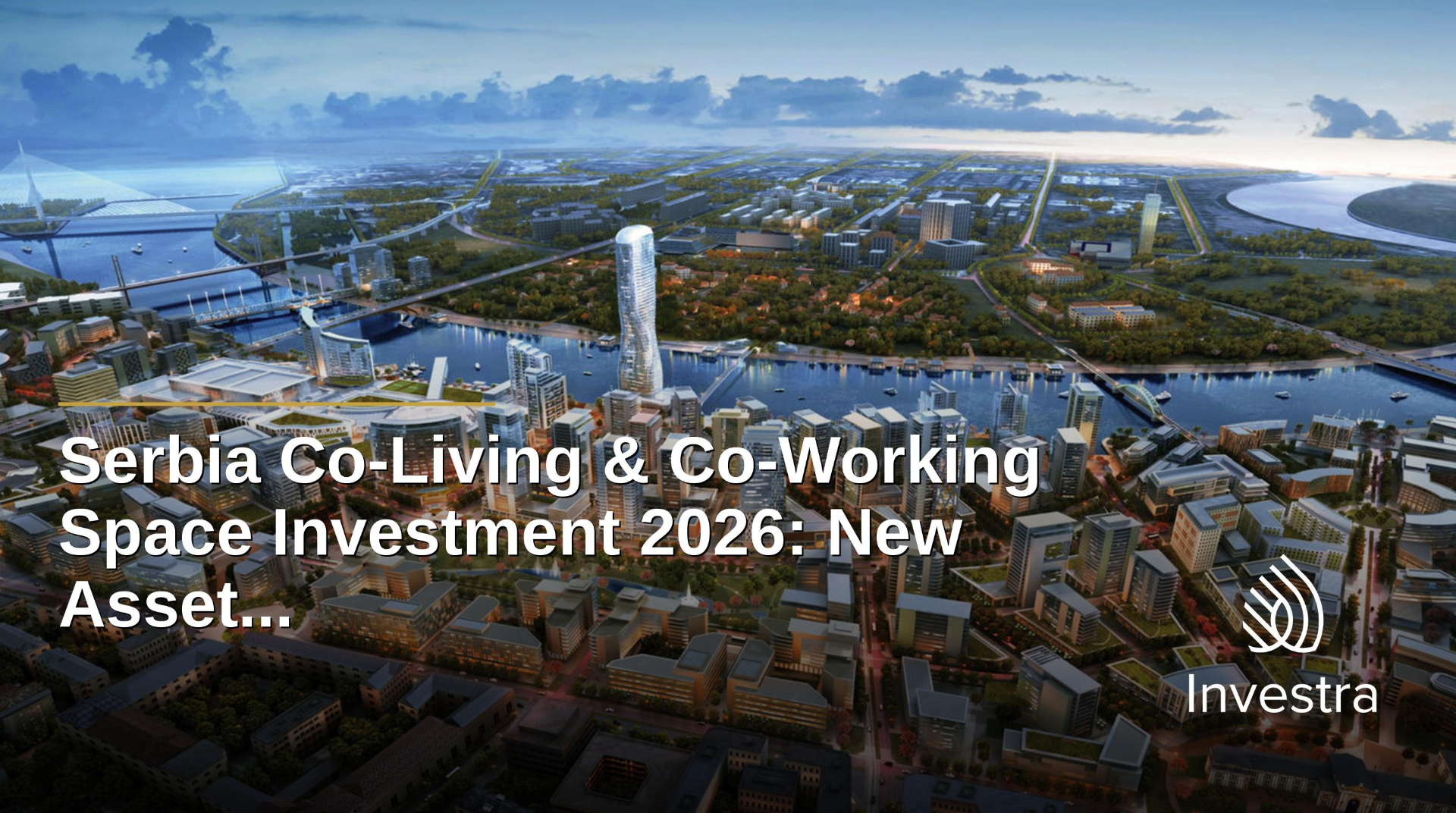
Serbia Co-Living & Co-Working Space Investment 2026: New Asset...
Serbia Co-Living & Co-Working Space Investment 2026: New Asset Class Guide
Answer Capsule: Serbia’s co-living and co-working developments are shaping up as one of the strongest new asset classes for 2026, particularly in Belgrade and Novi Sad, where demand from digital nomads and young professionals continues to outpace supply. Investors can expect net yields between 8.5% and 11.8% on well-located hybrid projects, with entry prices ranging from €1,950 to €3,200 per square metre. The combination of low acquisition costs, strong rental growth and a supportive regulatory environment makes this sector stand out for foreign capital seeking higher returns than traditional residential or office assets.
Introduction
```htmlThe way people live and work has shifted permanently since the pandemic, and Serbia has quietly positioned itself at the centre of this change in Southeast Europe. Young professionals and remote workers are moving to Belgrade in increasing numbers, drawn by fast internet, low living costs and a growing number of international companies setting up regional offices. This influx has created a clear gap in the market for purpose-built co-living and co-working spaces that combine accommodation with flexible workspaces under one roof.
Traditional buy-to-let apartments no longer deliver the same returns they did five years ago, especially once management costs and vacancy periods are factored in. Hybrid projects that bundle short-term co-living units with co-working memberships are showing stronger occupancy rates and more resilient cash flow. In 2026, these assets are no longer experimental; they are becoming institutional-grade opportunities tracked by both local developers and international funds.
Foreign investors looking at Serbia for the first time often start with the broader residential market. A useful overview is available in the Belgrade Real Estate Market 2026 report, which maps the wider price trends that underpin the co-living segment. At the same time, many are comparing Serbia with other emerging destinations through the Serbia Property Investment Guide 2026, which places hybrid assets in the context of overall foreign buyer activity.
Market Overview
Belgrade’s co-living stock stood at roughly 1,850 beds at the start of 2025 and is forecast to reach 3,400 beds by the end of 2026. Average daily rates for a co-living bed with shared workspace access currently sit at €28–€34, up 19% year-on-year. Occupancy across professionally managed hybrid buildings averages 87%, with the best-performing assets in Dorćol and Vračar consistently above 93%.
Prices for turnkey co-living and co-working developments have risen steadily. In central Belgrade locations, completed projects now trade at €2,450–€3,100 per square metre, while secondary locations in Novi Sad and Niš remain between €1,650 and €2,050 per square metre. Rental yields on these assets are materially higher than standard residential units because operators can charge both bed fees and co-working desk subscriptions, effectively stacking two revenue streams on the same square metres.
Investra.io currently lists several off-market hybrid projects in Belgrade’s emerging districts that are seeking equity partners ahead of 2026 completion. These opportunities are particularly attractive for investors who want exposure to the sector without having to manage day-to-day operations themselves.
Key Investment Factors
Location and Connectivity
Proximity to public transport and universities remains the strongest predictor of occupancy. Areas within 800 metres of a tram or metro station achieve 11–14% higher bed rates than comparable buildings further out. Dorćol, Savamala and the area around Belgrade Waterfront continue to dominate investor interest because they combine historic character with new infrastructure.
Demographics and Demand Drivers
Serbia’s population of 25–34-year-olds is growing in the capital as regional cities lose young talent to Belgrade. At the same time, the number of foreign digital nomads staying longer than 90 days has increased by 27% since 2024. This dual demand base reduces seasonality and supports year-round pricing power.
Regulatory Environment
Co-living projects fall under residential zoning in most municipalities, which simplifies permitting compared with pure commercial developments. Foreign investors should still review the latest rules on property ownership and ongoing tax obligations through the Serbia Property Taxes 2026 guide and the step-by-step process outlined in the Serbia Buying Process 2026.
Operational Scalability
Successful operators are moving toward 150–250 bed buildings that allow centralised management of cleaning, security and community programming. Smaller conversions under 80 beds tend to show weaker margins once staffing and marketing costs are included.
Price Analysis Table
| Area | Price per m² (€) | Net Yield (%) | Occupancy 2026 Forecast | Typical Project Size |
|---|---|---|---|---|
| Dorćol | 2,950 | 9.8 | 93% | 180–250 beds |
| Vračar | 3,100 | 8.9 | 91% | 120–180 beds |
| Savamala | 2,750 | 10.4 | 89% | 150–220 beds |
| Novi Sad Centre | 2,050 | 11.2 | 87% | 100–160 beds |
| Niš City Centre | 1,780 | 11.8 | 84% | 80–140 beds |
| Zemun | 2,150 | 10.1 | 85% | 90–150 beds |
Why Invest in 2026
Timing matters in this emerging sector. Serbia is still in the early phase of institutional co-living development, meaning acquisition prices remain 30–40% below comparable assets in Prague or Budapest. The window for securing prime sites at reasonable costs is narrowing as more local developers move into the space and international operators begin scouting locations for 2027–2028 pipelines.
Interest rates in the eurozone are expected to stabilise or ease slightly through 2026, which should improve financing terms for hybrid projects. At the same time, Serbia’s visa regime continues to attract remote workers from the EU, UK and United States, supporting consistent demand growth. Investors who enter now benefit from both capital appreciation as the asset class matures and strong cash-on-cash returns from day one.
Platforms such as Investra.io allow investors to compare multiple co-living opportunities side by side, review operator track records and access due diligence materials before committing capital. This level of transparency reduces execution risk in a market that still lacks the depth of more established European destinations.
As with any investment, property in Serbia carries risks. Only invest capital you can afford to lose.
Practical Buying Guide
Investing in Serbia’s emerging co-living and co-working sector requires a structured approach that balances local regulations with operational realities. Foreign buyers can acquire commercial and mixed-use properties outright, but success hinges on understanding zoning rules that often classify these spaces as hospitality or light commercial assets.
Identify Target Locations and Demand Drivers
Begin with Belgrade’s Savamala and Dorćol districts, where tech freelancers and remote workers cluster, or Novi Sad’s Liman area near the university. Commission footfall studies and review occupancy data from existing operators. Cross-reference government digital-nomad visa statistics with university enrollment trends to confirm sustained tenant pipelines before shortlisting buildings.
Conduct Legal and Technical Due Diligence
Engage a Serbian-licensed notary and property lawyer early. Verify land-registry extracts, confirm the property carries no unresolved restitution claims, and ensure the building permit allows change-of-use for co-living configurations. Commission an energy-efficiency audit, as newer EU-aligned standards now influence renovation budgets and future rental premiums.
Secure Financing and Operational Partnerships
Local banks offer up to 60 percent loan-to-value for income-producing commercial assets, though co-living projects often require additional equity from specialist funds. Structure joint ventures with established operators who manage day-to-day tenancy and community programming, thereby reducing the investor’s management burden while preserving upside through revenue-share clauses.
Complete Acquisition and Fit-Out Planning
Once contracts are notarised, budget three to six months for interior conversion. Modular furniture systems and high-speed fibre infrastructure typically deliver the fastest return on capital. Schedule municipal inspections in advance to avoid delays when applying for the final use permit required for short-term and co-living licences.
Costs & Fees Breakdown
| Item | Example Cost (EUR) | Notes |
|---|---|---|
| Purchase price (500 m² mixed-use building, Belgrade) | 850,000 | Prime location near public transport |
| Notary and legal fees | 8,500 | 1 % of purchase price plus fixed charges |
| Transfer tax | 4,250 | 0.5 % for commercial property |
| Real-estate agent commission | 17,000 | 2 % split between buyer and seller sides |
| Land-registry update and cadastre fees | 1,200 | Administrative costs |
| Total acquisition cost | 880,950 | Excludes renovation and VAT on fit-out |
Risks & Challenges
Regulatory ambiguity remains the primary hurdle. Municipalities have yet to codify specific permitting pathways for co-living, leaving projects exposed to discretionary interpretation by planning officers. Currency risk also matters: while most leases are euro-denominated, operational costs and taxes are settled in dinars, creating margin pressure during periods of volatility.
Management intensity exceeds traditional buy-to-let. Tenant turnover is higher, and community standards must be actively maintained to protect yields. In smaller cities, liquidity for exit can be limited, so investors should model five-to-seven-year hold periods. Finally, competition from informal apartment conversions may cap rental growth until professional operators establish clearer market standards.
Expert Tips
- Target buildings with existing commercial zoning rather than attempting residential-to-commercial conversions, which add six to twelve months to timelines.
- Negotiate revenue-share agreements with operators instead of fixed management fees to align incentives during the first two years of occupancy ramp-up.
- Budget 15 percent contingency on fit-out costs, focusing on modular partitions that allow future reconfiguration without structural work.
- Monitor upcoming changes to Serbia’s short-term rental tax regime, expected in late 2026, which may favour registered co-living projects over unregulated listings.
- Secure fibre-optic contracts before purchase; several Belgrade districts still face last-mile delays that directly affect occupancy rates.
- Partner with local universities for internship programmes that supply on-site community managers at lower cost than full-time hires.
- Model exit scenarios through sale to institutional funds rather than individual buyers, as larger portfolios attract premium pricing.
Find Your Serbia Property on Investra.io
Investra.io aggregates verified listings of commercial and mixed-use assets suitable for co-living and co-working conversion across Belgrade, Novi Sad and emerging secondary cities. Each property profile includes zoning documentation, recent utility bills and projected yield ranges based on current operator benchmarks, allowing investors to filter opportunities by location, size and regulatory status.
The platform also connects buyers with licensed notaries, renovation contractors and property-management firms that already operate successful co-living sites in Serbia. Users can request personalised introductions and receive quarterly market updates that track occupancy trends and regulatory developments, streamlining the entire investment cycle from initial search to post-acquisition operations.
Recommended Reading
- Serbia Legal Guide for Foreigners
- Serbia Rental Market 2026
- Serbia Property Price Forecast
- Novi Sad Real Estate 2026
- Sinisa Dagary Real Estate Blog
- Findes.si Property Portal
Follow Us
Stay updated on Serbia’s evolving real-estate landscape: Facebook, Instagram, LinkedIn.
Odkrijte globalne investicijske priložnosti na Unifyr.space — vaš portal za pametne investicije.
Frequently Asked Questions
What is the minimum investment size for a viable co-living project in Serbia? Most operators recommend at least 400 m² of usable space, translating to roughly €650,000–€900,000 including acquisition and basic fit-out in Belgrade.
Can foreigners own commercial property outright? Yes, foreign individuals and companies may purchase commercial real estate without additional restrictions, though residential apartments still require a Serbian legal entity in most cases.
How long does the permitting process typically take? Change-of-use and operational permits for co-living average four to seven months once the purchase is complete, provided the building already carries commercial zoning.
What yields can investors realistically expect? Current stabilised net yields range between 7.5 % and 9.5 % after management fees, depending on location and occupancy consistency.
Are there tax incentives for co-working developments? Registered businesses may deduct renovation costs and benefit from a reduced corporate tax rate of 10 % on qualifying income, though no specific co-living subsidy exists yet.
How does currency fluctuation affect returns? Euro-denominated rents provide a natural hedge, yet dinar-denominated costs can erode margins by 3–5 % in volatile years unless hedged through forward contracts.
What happens if the municipality changes zoning rules? Existing use rights are generally grandfathered, but future expansions or reconfigurations may require new approvals under updated plans.
Is financing available from Serbian banks for foreign buyers? Local banks extend loans up to 60 % LTV to foreign entities that register a Serbian branch, subject to standard credit checks and income verification.
How liquid is the resale market for these assets? Professional operators and regional funds actively seek turnkey co-living assets; individual buyers remain rare, so plan for a five-to-seven-year hold.
Do I need a local partner to manage operations? Not legally required, but most successful investors engage experienced operators to handle licensing, tenant screening and community management.
Related Posts
No related posts available.
