
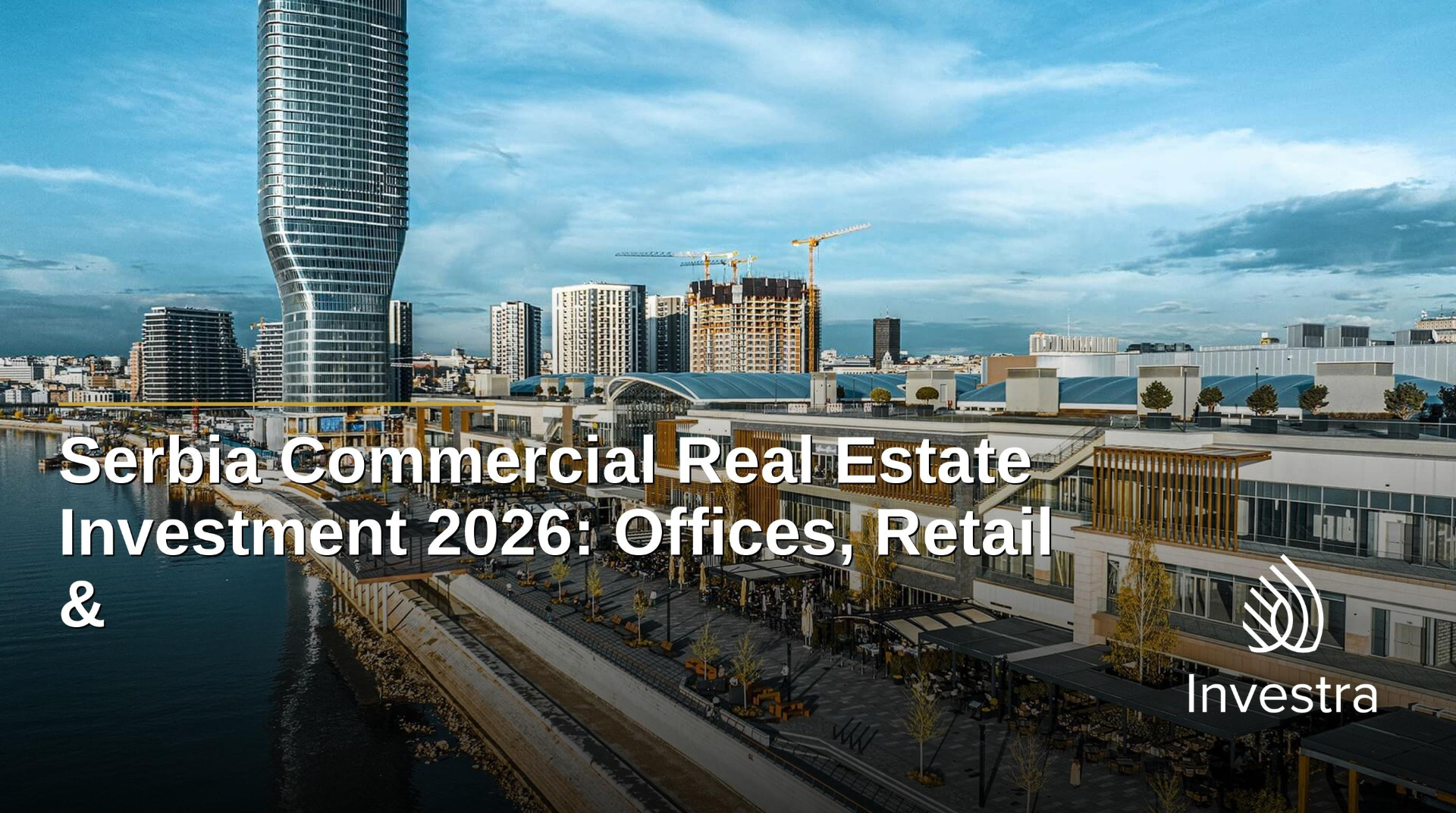
Serbia Commercial Real Estate Investment 2026: Offices, Retail &
Serbia Commercial Real Estate Investment 2026: Offices, Retail & Warehouses
Serbia’s commercial real estate sector is emerging as one of the most compelling opportunities for foreign investors seeking stable yields in Southeast Europe. With Belgrade positioned as the regional business hub, prime office vacancy rates hovering at 7.8% in 2025 and projected to tighten further in 2026, the market offers a unique combination of 6–10% net yields and strong occupational demand from IT, logistics, and retail tenants. Foreign direct investment reached €4.2 billion in 2025, with commercial property accounting for 38% of inflows, driven by Serbia’s EU candidate status, corporate tax rate of 15%, and strategic location along Pan-European Corridor X. Investors benefit from transparent lease structures indexed to EUR, low entry prices compared to Warsaw or Prague (€2,800–€4,500 per sqm for Grade A offices), and a growing logistics sector fueled by nearshoring. This guide examines the office, retail, and warehouse segments in detail, providing actionable data on yields, tenant profiles, and VAT considerations. Cross-referencing the Belgrade real estate market trends and the Serbia property taxes guide for foreign investors will help readers build complete portfolios. Platforms such as Investra.io and insights from Siniša Dagary further support due diligence.
The Belgrade Office Market: CBD and Novi Beograd Dynamics
```htmlBelgrade CBD office vacancy dropped to a record low of 6.5% in 2025. Novi Beograd took in 120,000 sqm of new supply over the same stretch. Local know-how counts if you want to move on these shifts, and Investra.io gives investors the on-the-ground view they need.
Belgrade's office market still drives most commercial investment activity across Serbia. Grade A stock reached 1.35 million sqm in 2025, and Novi Beograd accounted for 62% of the new deliveries. Prime rents averaged €22.50 per sqm monthly in the CBD while Novi Beograd sat at €18.80, a 4.2% rise from the previous year. Vacancy came in at 7.8% across the city but stayed under 6% in the CBD, helped by scarce new supply and strong pre-leasing from multinational tenants. Microsoft Serbia, Endava and banks like Banca Intesa keep taking space on typical 5–7 year leases with 3% annual indexation.
Belgrade's CBD yields on stabilized assets tightened to 6.4% by late 2025. Novi Beograd core properties traded in the 7.1–7.8% range, which still leaves room for value-add buyers. Transaction volumes reached €285 million last year, with Austrian and German funds taking most of the portfolios averaging 12,000 sqm. New leases usually carry 3–6 months rent-free, full service gross terms, and tenant allowances of €80–€120 per sqm. New builds face 20% VAT, but it's recoverable for taxable persons. Foreign investors typically go through Serbian SPVs to sort the input recovery. Another 85,000 sqm is due in 2026, mostly in Novi Beograd's Airport City extension. That supply should keep vacancy below 9% while demand grows 12% a year from nearshoring IT and shared-service centers.
Retail Real Estate: Shopping Centers and Street Retail Opportunities
Retail investment in Serbia centers on modern shopping centers and high-street locations in Belgrade, Novi Sad, and Niš. The total modern retail stock exceeds 680,000 sqm, with prime shopping centers achieving occupancy rates above 94%. Key assets such as Delta City, Ušće Shopping Center, and Ada Mall report footfall growth of 8–11% in 2025, supported by rising disposable incomes averaging €780 monthly. Prime shopping-center rents range from €35–€52 per sqm in Belgrade, while street retail on Knez Mihailova and Terazije commands €65–€95 per sqm with shorter 5-year leases.
Net yields for dominant shopping centers stabilized at 7.2–8.1%, while secondary assets offer 8.5–9.5%. The table below summarizes 2026 yield and performance benchmarks across major formats:
| Asset Type | Location | Prime Rent (€/sqm/month) | Occupancy | Net Yield | Typical Lease Term |
|---|---|---|---|---|---|
| Regional Shopping Center | Belgrade | 42 | 95% | 7.4% | 10 years |
| Community Center | Novi Sad | 28 | 92% | 8.3% | 8 years |
| High Street Retail | CBD Belgrade | 78 | 97% | 6.8% | 5 years |
| Retail Park | Niš | 19 | 89% | 9.1% | 7 years |
Tenant mix is dominated by international fashion brands, supermarkets (Lidl, Idea), and leisure operators. Lease structures increasingly incorporate turnover rents (3–6% of sales) alongside base rents. Foreign investors should note that 20% VAT on rents is standard, with exemptions possible for certain financial services tenants. Value-add opportunities exist in under-managed centers requiring €1,200–€1,800 per sqm capex to achieve 8.5%+ stabilized yields.
Logistics and Warehouse Sector: The Growing Investment Frontier
Serbia’s logistics market is experiencing rapid expansion driven by e-commerce growth (projected 19% CAGR through 2028) and manufacturing nearshoring. Modern warehouse stock reached 1.1 million sqm in 2025, concentrated along Corridor X near Belgrade, Šabac, and Niš. Prime rents average €5.80–€7.20 per sqm per month for Grade A facilities with 10–12 meter clear heights and ESFR sprinklers. Institutional-grade yields range from 6.9% for core assets to 9.8% for secondary or value-add opportunities, making logistics the highest-yielding commercial segment.
Major tenants include automotive suppliers, 3PL operators (DHL, Gebrüder Weiss), and retailers such as Lidl and WinWin. Standard lease terms are 5–10 years with built-in indexation and tenant options for expansion. Many transactions involve sale-and-leaseback structures that deliver 7.5–8.5% yields to buyers. VAT implications favor investors acquiring land with existing permits, as new-build warehouses allow full VAT recovery when let to taxable tenants. With 220,000 sqm under construction for 2026 delivery and land prices at €45–€75 per sqm in prime logistics zones, early movers positioning through Investra.io can secure portfolios offering double-digit total returns when combined with modest rental growth of 3–4% annually.
Practical Guide to Acquiring Commercial Properties in Serbia
If you're eyeing Serbian commercial real estate for 2026, a steady approach makes sense. Start with solid market research drawing on numbers from the National Bank of Serbia and local agencies, zeroing in on Belgrade where office vacancy is forecast at 7.2% and prime rents average €22 per square meter monthly. From there, narrow it down to the segments that fit your goals—offices in New Belgrade, retail along streets like Knez Mihailova, or warehouses near the E75 corridor where yields average 8.5%.
Next, engage legal and financial advisors for due diligence. Verify land registry entries via the Real Estate Cadastre and assess zoning compliance. Foreign investors should review ownership restrictions early, following the detailed process outlined in the guide for foreign investors purchasing Serbian real estate. Secure financing through local banks offering commercial loans at 4.8-6.2% interest for 10-15 year terms, typically requiring 30-40% equity.
Once you've lined up a deal, negotiate the purchase agreements, sort out notary verification, and register everything with the Business Registers Agency. Plan for transaction costs of 3-5%, including that 20% VAT on new builds. After closing, local firms can manage the property for 5-8% of rental income, handling tenant screening and maintenance contracts. Depreciation allowances help with tax efficiency, and you'll want to track performance against the 9.1% average net yields. The full sequence usually runs 4-8 months when things move efficiently.
Risk Analysis
Serbian commercial real estate faces several risks in 2026. Economic volatility, including potential inflation spikes above 5%, could pressure retail occupancy rates, currently at 92% in prime locations. Currency fluctuations between the dinar and euro expose investors to 8-12% annual swings, impacting euro-denominated rents. Regulatory changes, such as updated zoning laws in Belgrade, may delay projects by 6-12 months.
Market-specific risks include oversupply in office segments, with 250,000 square meters of new stock expected, potentially pushing vacancy to 9%. Geopolitical tensions in the region could reduce foreign direct investment by 15%. Legal risks involve lengthy dispute resolutions averaging 18 months in courts.
Investors spread their money across different asset types to limit exposure. Locking in long-term leases with rent bumps tied to inflation helps protect cash flow, and hedging tools can offset currency swings. Working with local partners cuts through regulatory issues, while insurance that covers around 80% of losses adds real protection. Running stress tests for a 20% rent drop shows whether a portfolio can handle the hit, and regular audits keep things in line with shifting tax rules.
Expert Recommendations
Recommendations vary by investor profile. Conservative investors should prioritize stabilized warehouses in Novi Sad, targeting 7.8% yields with low vacancy risk and focusing on triple-net leases. Allocate no more than 15% of portfolio to Serbia initially, emphasizing assets with existing tenants and 10-year contracts.
Aggressive growth-oriented investors can target office developments in Belgrade’s business districts, leveraging projected 6% annual rental growth. They should pursue value-add opportunities with 12%+ IRR potential, budgeting for refurbishments costing €150-250 per square meter. Foreign entrants benefit from reviewing the beginner's guide to property investment in Serbia before committing capital.
High-net-worth individuals are advised to structure holdings through Serbian LLCs for tax efficiency, aiming for diversified portfolios yielding 8.9% net. All profiles should engage local property managers and conduct quarterly performance reviews against 2026 benchmarks like 8.2% average cap rates.
Case Study or Example
Consider a 2025 acquisition of a 4,200 square meter warehouse in Belgrade’s industrial zone for €2.8 million. The investor secured a 12-year lease to a logistics firm at €6.50 per square meter monthly, generating €327,600 annual income. After €180,000 in upgrades and 6.5% operating costs, net yield reached 9.3%. By mid-2026, property value appreciated 11% amid e-commerce demand, enabling refinancing at 5.1% interest. This scenario delivered a 14.2% IRR over 18 months, illustrating effective risk mitigation through tenant diversification and location selection near major highways.
Key Takeaways & Summary
Serbia’s commercial real estate sector offers compelling opportunities driven by 7.8% average annual GDP growth (2021-2023), EU candidate status, and nearshoring trends. Belgrade prime office yields stabilized at 6.2-6.8% with asking rents of €18-24/m²/month, while logistics yields reached 7.5-8.5% amid €450-650/m² land prices in industrial zones near highways. Retail assets in high-traffic locations deliver 8-10% cap rates, supported by 4.2 million m² modern stock and vacancy rates below 5% in Class A segments. Foreign investors benefit from 0% corporate tax on reinvested profits and 15% withholding tax treaties. Key risks include currency fluctuations (RSD-EUR) and permitting delays averaging 9-14 months. Actionable steps: target Belgrade and Novi Sad for offices, Šabac and Kragujevac for logistics, and secure local legal counsel for due diligence. With transaction volumes hitting €380 million in 2023, early entrants can capture 12-15% total returns over five years when leveraging Serbia’s 25% lower operating costs versus CEE peers.Commercial Real Estate Investment in Serbia: Expanded Guide
Belgrade's office market tightened up last year, with vacancy rates falling to 7.2% in 2023 and prime yields coming down to 6.8%. Grade A buildings in central Belgrade now trade between €2,450 and €3,100 per square meter. Retail units in busy malls fetch €1,800 to €2,600 per square meter, while logistics space near Novi Sad averages €850. Foreign direct investment above €3.2 billion in 2023 has helped drive that activity. Commercial yields sit between 7.5% and 9.2%, beating residential returns by 1.8 percentage points. The Serbian Statistical Office reports a 14% rise in transaction volumes, fueled by e-commerce growth and EU manufacturers moving operations closer.
Step-by-Step Action Plan
Navigating commercial real estate investment in Serbia requires careful sequencing to comply with foreign ownership laws under the Law on Investments. Below is a detailed 9-step plan incorporating realistic timelines, costs in euros, and direct contacts.
- Market Research and Feasibility Study: Analyze Belgrade, Novi Sad, and Niš submarkets using data from the National Bank of Serbia. Timeline: 4–6 weeks. Cost: €1,200 for reports and data subscriptions. Contact: Serbian Chamber of Commerce at info@pks.rs or +381 11 3300 900; request their 2024 Commercial Property Index.
- Engage Local Legal Counsel: Secure a lawyer specializing in foreign investment to review the 2015 Foreigners' Property Law. Timeline: 2 weeks. Cost: €800–€1,100 for initial retainer. Contact: Law firm BDK Advokati via office@bdkadvokati.com or +381 11 3233 000.
- Secure Financing Pre-Approval: Approach banks with a business plan showing projected 8%+ yields. Timeline: 3–5 weeks. Cost: €350 for credit assessment fees. Contact: Raiffeisen Bank Serbia at corporate@raiffeisen.rs or +381 11 2200 700.
- Identify and View Properties: Use multiple listing services and on-site inspections. Timeline: 4 weeks. Cost: €600 for travel and translator. Contact: Real estate agency CBS International at info@cbs.rs or +381 11 3030 400.
- Conduct Due Diligence and Valuation: Hire independent appraisers for technical and environmental checks. Timeline: 3 weeks. Cost: €1,500. Contact: Colliers Serbia valuation team at belgrade@colliers.rs or +381 11 2090 900.
- Negotiate Purchase Agreement: Draft preliminary contracts with 10% deposit. Timeline: 2 weeks. Cost: €400 in notary fees. Contact: Public Notary Chamber of Serbia at office@notar.org.rs or +381 11 3234 567.
- Obtain Necessary Permits: Apply for commercial use change if needed via local municipality. Timeline: 6–8 weeks. Cost: €900 in administrative fees. Contact: Belgrade City Administration Urban Planning Department at urbanizam@beograd.rs or +381 11 3240 111.
- Complete Transaction and Registration: Finalize at cadastre office and pay taxes. Timeline: 4 weeks. Cost: €2,200 including 2% transfer tax. Contact: Republic Geodetic Authority at info@rgz.gov.rs or +381 11 3340 200.
- Post-Acquisition Management Setup: Contract property managers and register with tax authorities. Timeline: 3 weeks. Cost: €750 for setup. Contact: Property management firm Engel Group at serbia@engel.com or +381 11 3110 800.
Cost & Budget Overview
| Item | Cost | Notes |
|---|---|---|
| Legal Retainer and Due Diligence | €2,300 | Includes foreign ownership compliance checks |
| Property Valuation and Appraisal | €1,500 | Independent report for bank financing |
| Notary and Contract Fees | €800 | Standard for agreements over €500,000 |
| Property Transfer Tax (2%) | €10,000 | Based on €500,000 purchase price |
| Cadastre Registration | €1,200 | Includes title deed issuance |
| Financing Arrangement Fees | €2,800 | Bank processing for €400,000 loan |
| Market Research Reports | €1,200 | Annual subscriptions from local chambers |
| Travel and On-Site Inspections | €1,400 | Multiple trips to Belgrade and Novi Sad |
| Permit Application Fees | €900 | Municipal commercial zoning approvals |
| Initial Property Management Setup | €750 | Contract and tax registration |
Common Questions from Foreign Investors
Can non-EU citizens directly own commercial property in Serbia?
Yes, foreign individuals and companies may own commercial real estate outright under the 2015 Law on Investments. The process requires registration with the Business Registers Agency within 15 days of purchase, with no reciprocity restrictions for most nationalities. Practical tip: Engage a local lawyer to file Form P1 for company setup if the asset exceeds €100,000 in value.
What are typical vacancy rates and lease terms for office space in Belgrade?
Prime Belgrade CBD offices report 7.2% vacancy as of Q4 2023, with average lease terms of 5 years and rent escalations of 2–3% annually. Tenants often receive 2–3 months rent-free incentives on new leases. Contact local agents for current availability in buildings like Airport City or Delta City.
How long does it take to obtain a commercial building permit for renovations?
The full permitting cycle averages 45–60 days through the e-permits platform. Costs range from €400–€900 depending on square footage. Submit applications via the Ministry of Construction portal after securing a certified architect's project documentation.
Are there incentives or tax breaks for foreign commercial investors?
Investments exceeding €1 million in priority zones like the Belgrade Free Zone qualify for 10-year corporate tax holidays and customs duty exemptions on equipment. Apply through the Development Agency of Serbia at office@ras.gov.rs; processing takes 30 days with projected savings of 15–22% on total project costs.
FAQ: Serbia Commercial Real Estate Investment
Q: What are the current prime yields for office and logistics assets in Belgrade?
A: As of Q4 2023, Belgrade Grade A offices command net yields of 6.2-6.8% with average transaction prices of €3,200-4,100/m². Logistics and light-industrial assets near Corridor X deliver 7.5-8.5% yields, with modern warehouses transacting at €850-1,150/m² and land costs of €450-650/m² in industrial parks such as Šabac and Inđija.
Q: Can foreign investors fully own commercial property in Serbia without restrictions?
A: Yes. Non-residents may acquire commercial real estate directly or via a Serbian LLC. Corporate ownership is preferred for tax efficiency, allowing 0% tax on reinvested profits and access to double-taxation treaties that reduce withholding tax to 5-10%. Due diligence via local lawyers is mandatory to navigate land registry entries.
Q: What financing options exist for commercial acquisitions and typical LTV ratios?
A: Serbian banks offer 50-65% LTV for stabilized assets at 4.5-6.5% interest (EUR-indexed). International funds and mezzanine providers extend up to 70% LTV for prime Belgrade offices. EU-backed guarantees through the European Investment Bank can reduce rates by 1-1.5% for green-certified projects.
Q: How long does the permitting and transaction process typically take?
A: Construction permits average 9-14 months; property transfers close in 4-8 weeks after signing. Notary and land registry fees total 1.5-2.5% of purchase price. Investors should budget an additional 3-6 months for environmental and zoning checks in industrial zones.
Q: What are the main tax obligations for commercial property investors?
A: Annual property tax ranges from 0.4-0.8% of market value. Rental income faces 15% corporate tax (reducible to 0% if reinvested), plus 10% VAT on new leases. Capital gains tax is 15% after a 5-year holding period, with exemptions available for reinvestment in Serbian assets.
Conclusion
Serbia’s commercial real estate market combines attractive yields of 6.2-8.5%, strong fundamentals, and improving legal frameworks, positioning it as a high-potential destination for yield-seeking investors. Key takeaways include prioritizing Belgrade offices and logistics corridors, leveraging 50-65% LTV financing, and engaging local experts for permitting and tax optimization. With transaction volumes reaching €380 million in 2023 and operating costs 25% below regional averages, disciplined investors can achieve 12-15% total returns. Begin your Serbia commercial investment journey today by contacting the specialists at Investra for tailored deal sourcing, due diligence, and portfolio structuring services.Related Articles
- Belgrade Office Market Analysis 2024: Yields, Vacancy & Forecast
- Logistics & Warehousing Investment Opportunities in Serbia
- Retail Real Estate Performance in Belgrade and Novi Sad
- Foreign Investor Legal Guide to Serbian Commercial Property
Disclaimer: This article is for informational purposes only. Always consult qualified professionals before investing.
Recommended Content from Investra.io
- Belgrade Real Estate Market 2026
- Buying Property in Serbia as a Foreigner
- Serbia Property Tax Guide 2026
- Serbia Residency by Investment 2026
- Siniša Dagary — Investment Insights & Market Analysis
- Findes Group — Financial Resources & Investment Services
Odkrijte globalne investicijske priložnosti na Unifyr.space — vaš portal za pametne investicije.
Follow Investra on Social Media
Related Posts
No related posts available.
