
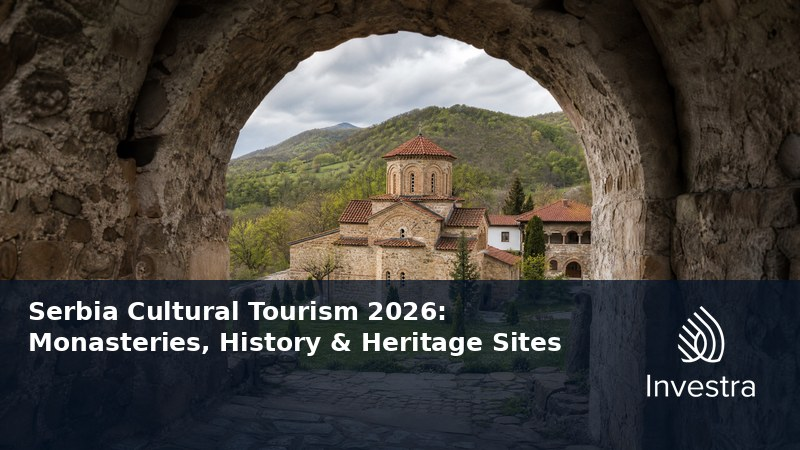
Serbia Cultural Tourism 2026: Monasteries, History & Heritage Sites
Serbia Cultural Tourism 2026: Why This Balkan Gem Is Having Its Moment
Quick Answer: Serbia's cultural tourism scene in 2026 is experiencing record growth, with monasteries, medieval fortresses, and UNESCO-listed heritage sites drawing hundreds of thousands of international visitors annually — and smart investors are taking notice of the property opportunities this tourism boom is creating. Belgrade Real Estate Market Report 2026: Prices, Trends & Forecasts outlines exactly how tourism growth is translating into real estate demand.
Serbia doesn't usually top the list when people talk about European cultural tourism. That's precisely the point. While crowds swarm Dubrovnik and Florence, Srbija offers something increasingly rare: genuine, unfiltered European heritage without the selfie sticks and €25 entry tickets. The country has over 500 protected cultural monuments, four UNESCO World Heritage Sites, and a medieval monastery tradition that predates most Western European cathedrals. And yet, until recently, it remained almost entirely off the international tourist radar.
That's changing fast. Serbia welcomed approximately 3.8 million international tourists in 2024, a figure that has grown steadily year-over-year since 2021. The Serbian Tourism Development Strategy targets 6 million annual visitors by 2030 — an ambitious but achievable goal given the infrastructure investments currently underway. Belgrade Nikola Tesla Airport has expanded its direct connections to over 60 destinations, making access easier than at any point in the country's modern history.
For investors watching tourism trends, this trajectory matters enormously. Cultural tourism specifically — visits driven by heritage sites, monasteries, and historical landmarks — tends to generate longer average stays, higher per-visitor spending, and demand for quality accommodation in areas that have historically been undersupplied. The reality is that Serbia's combination of cultural richness and relative affordability makes it one of the most compelling emerging tourism markets in Europe right now.
What surprised many observers is how quickly international perception of Serbia has shifted. Post-visa liberalization with the Schengen zone and Serbia's strengthened EU candidate status have both contributed to a new sense of accessibility. Travelers who once overlooked the Western Balkans are now actively seeking out experiences that Western Europe simply can't offer at any price — and Serbia is ready to deliver.
The Orthodox Monastery Circuit: Serbia's Spiritual Heartland
Quick Answer: Serbia is home to over 200 Orthodox Christian monasteries, many dating back to the 13th and 14th centuries, forming a spiritual and architectural circuit that rivals any monastic tradition in Europe. The most significant cluster lies across the Raška and Morava regions of central and southern Serbia.
Ask any cultural heritage expert what makes Serbia truly distinctive, and the monasteries will come up within the first thirty seconds. These aren't preserved-in-amber tourist attractions — many are living, functioning religious communities that have operated continuously for 700 years or more. The combination of Byzantine architecture, medieval frescoes, and authentic monastic life creates an experience that genuinely has no parallel in Western Europe.
The Studenica Monastery, founded by Stefan Nemanja in 1190, stands as perhaps the crown jewel of Serbian Orthodox heritage. A UNESCO World Heritage Site since 1986, Studenica houses some of the finest examples of Romanesque and Byzantine art in the world. The Church of Our Lady contains 13th-century frescoes that art historians rank among the masterpieces of medieval European painting. What's remarkable is that you can visit with relative ease — there's no months-long ticket queue, no timed entry slots, no mass tourism infrastructure diluting the experience.
Žiča Monastery near Kraljevo carries special historical significance as the place where seven Serbian kings were crowned. Founded in the early 13th century, its distinctive red-painted exterior is instantly recognizable and unlike anything else in the Balkans. The monastery sits in a landscape of rolling hills and forest that provides context and atmosphere most European heritage sites have long since lost to development.
Sopoćani Monastery, also UNESCO-listed, contains what many art historians consider the greatest cycle of medieval frescoes in existence. The Dormition of the Virgin fresco in particular draws scholars and art lovers from across the world. The monastery sits at an elevation above the Raška river valley, surrounded by landscape that feels genuinely untouched by the 21st century.
Then there's the Manasija Monastery in eastern Serbia — a fortified monastic complex from the early 15th century that looks, honestly, like a medieval military stronghold as much as a place of worship. Its 11 towers and thick defensive walls were built by Despot Stefan Lazarević to protect both the monks and an extraordinary library that was one of the most important centers of Slavic literacy in the medieval period.
The practical tourism opportunity here is significant. Most of these monasteries are currently accessible primarily by private vehicle, meaning the regions they sit in are underserved by quality accommodation, dining, and visitor services. Early-stage investors in rural properties near the monastery circuit — particularly within 20km of Studenica, Žiča, or Manasija — are positioning themselves ahead of what will likely be substantial infrastructure development over the next five years.
UNESCO World Heritage Sites in Serbia: The Full Picture
Quick Answer: Serbia has four UNESCO World Heritage Sites: Studenica Monastery, the Medieval Monuments in Kosovo (administered separately), Gamzigrad-Romuliana (the Palace of Galerius), and Stećci Medieval Tombstones. Each represents a distinct layer of Serbia's extraordinary historical complexity.
UNESCO recognition tends to function as a reliable tourism multiplier. Studies of heritage sites across Europe consistently show that UNESCO inscription increases annual visitor numbers by 20-40% within the first five years, and the effect compounds over time as the listing becomes embedded in international travel guides and itineraries. Serbia's four inscriptions span Roman imperial history, medieval Orthodox civilization, and cross-cultural funerary traditions — a remarkable range for a country of 7 million people.
Gamzigrad-Romuliana, near Zaječar in eastern Serbia, is the site of a Roman imperial palace complex built by Emperor Galerius in the late 3rd and early 4th centuries CE. The palace was built on a scale that demonstrates Galerius was one of the most powerful figures in the late Roman world. The site includes remarkably preserved mosaic floors, fortification walls, and two mausoleums. What makes it particularly valuable from a tourism standpoint is its relative obscurity — most European visitors have never heard of it, which means the experience of standing in a Roman imperial palace without crowds is genuinely available here.
The Stećci Medieval Tombstones — a transnational UNESCO inscription shared with Bosnia-Herzegovina, Croatia, and Montenegro — represent one of the most enigmatic chapters in Balkan cultural history. These monumental medieval tombstones, decorated with distinctive carvings and inscriptions, were produced between the 12th and 16th centuries by a population that appears to have maintained religious beliefs distinct from both Catholicism and Orthodoxy. The scholarly debate around their origin and meaning continues, which gives them an added layer of intrigue for culturally engaged visitors.
Serbia has also submitted multiple sites for UNESCO consideration, including the Felix Romuliana extension, the medieval town of Ras and Sopoćani (which is already inscribed as part of a broader site), and several other locations. The pipeline of potential inscriptions suggests that Serbia's official international cultural profile will continue to rise through the latter half of this decade.
Belgrade: Where History and Modernity Collide
Quick Answer: Belgrade is one of Europe's oldest continuously inhabited cities, with layers of Roman, Byzantine, Ottoman, Austro-Hungarian, and Yugoslav history all visible in its architecture and institutions — making it one of the continent's most layered and underappreciated cultural capitals. For comprehensive guidance on the city's investment landscape, see the Buying Property in Belgrade 2026: Complete Guide for Foreign Investors.
Belgrade occupies one of the most strategically significant positions in Europe — at the confluence of the Sava and Danube rivers, at the crossroads of Central and Southeastern Europe. It has been conquered, destroyed, and rebuilt more times than almost any other European capital. Current estimates suggest Belgrade has been razed to the ground and rebuilt over 40 times in its history. The result is a city of extraordinary historical density and a population with a genuinely unshakeable resilience.
Kalemegdan Fortress is the starting point for any serious cultural exploration of Belgrade. The fortifications date back to Roman times, though most of what visitors see today reflects medieval Serbian, Ottoman, and Austro-Hungarian construction phases. The fortress sits on a dramatic promontory above the river confluence, offering views that have drawn conquerors and diplomats for millennia. Today, Kalemegdan Park surrounding the fortress is one of the most beloved urban spaces in Southeastern Europe, and the adjacent National Museum contains Serbian archaeological and artistic collections of the highest order.
The National Museum reopened in 2018 after 15 years of renovation and now presents one of the finest collections of Serbian and Balkan history and art in the world. The Miroslav Gospel — a 12th-century illuminated manuscript that is one of the most important surviving examples of medieval Slavic literature — is housed here, along with extensive Roman, Byzantine, and Ottoman-period artifacts.
Belgrade's cultural tourism infrastructure has improved significantly in the last three years. The Savamala district, once a derelict riverside warehouse quarter, has become a genuine cultural hub with galleries, design studios, and creative spaces that attract a sophisticated international visitor. The Yugoslav Film Archive — one of the largest film archives in the world — is based in Belgrade and increasingly accessible to international visitors with specialized cultural interests.
For property investors, the relationship between Belgrade's cultural tourism growth and real estate values is direct and measurable. Neighborhoods proximate to heritage sites — Dorćol, Stari Grad, Savamala — command premiums that reflect both tourism demand and the lifestyle appeal that drives long-term residential investment. The Belgrade Investment Property: Best Neighborhoods for ROI in 2026 guide offers granular analysis of exactly which areas are seeing the strongest price growth in connection with tourism development.
Novi Sad and the Vojvodina Heritage Corridor
Quick Answer: Novi Sad, Serbia's second-largest city and 2022 European Capital of Culture, offers a compelling combination of Austro-Hungarian architecture, multicultural heritage, and a vibrant festival scene that makes it one of the most dynamic cultural tourism destinations in the Western Balkans.
Novi Sad surprised a lot of people when it was named European Capital of Culture for 2022. Not because it wasn't deserving — it absolutely was — but because it wasn't yet on most Western Europeans' mental map of significant cultural cities. The designation changed that. The year-long program of events, infrastructure improvements, and international media coverage effectively introduced Novi Sad to a global audience that is still converting into visitors years later.
The city's cultural identity is genuinely distinct from Belgrade's. Vojvodina, the northern autonomous province where Novi Sad sits, has historically been one of the most ethnically and culturally diverse regions in Europe, home to Serbs, Hungarians, Croatians, Slovaks, Romanians, Ruthenians, and over a dozen other communities. This diversity is reflected in the architecture — the Petrovaradin Fortress, known locally as "the Gibraltar of the Danube," commands the riverbank opposite the city center and represents layers of Roman, medieval, and Austro-Hungarian fortification that span nearly 2,000 years of continuous strategic importance.
Petrovaradin is also home to EXIT Festival, one of Europe's most celebrated music festivals, which has been held within the fortress walls since 2000. The juxtaposition of 18th-century military architecture and contemporary electronic music culture is, improbably, one of Novi Sad's most powerful tourism assets. EXIT draws over 200,000 visitors annually, and the festival's international reputation has helped establish Novi Sad as a destination worth visiting outside of festival season as well.
The Vojvodina regional museum system, centered in Novi Sad but extending to towns like Sremska Mitrovica (built on the site of ancient Sirmium, once one of the most important cities in the Roman Empire), offers depth that cultural tourists find increasingly compelling. Sirmium was the birthplace or residence of multiple Roman emperors — including Aurelian, Probus, and Maximianus — and the ongoing archaeological work there is producing discoveries of international significance on a regular basis.
Property values in Novi Sad have tracked upward with the city's growing cultural profile. Average prices in the city center now range from €1,800 to €2,800 per square meter, with premium properties near the fortress or on the Danube waterfront reaching €3,200-€3,800/m². For investors, Novi Sad offers a slightly more affordable entry point than Belgrade with comparable rental yield potential — particularly in the short-term rental market during the festival season, when demand significantly outstrips available accommodation.
Đerdap National Park and the Iron Gates: History Written in Stone
Quick Answer: The Đerdap Gorge — the Iron Gates — on Serbia's eastern border with Romania is one of Europe's most spectacular natural and archaeological landscapes, combining prehistoric rock art, Roman military infrastructure, and medieval fortresses within a single dramatic river canyon.
The Đerdap (Iron Gates) section of the Danube gorge is the kind of place that stops conversations. The river narrows to a passage between sheer rock walls that rise over 300 meters, and embedded in those walls and along the river's edge is an archaeological record spanning 10,000 years of human occupation. The Lepenski Vir site, discovered here in 1965, revealed a prehistoric civilization dating to approximately 7,000 BCE — one of the oldest settlements in Europe, with artistic and architectural achievements that completely upended scholarly assumptions about the development of Neolithic culture.
The original Lepenski Vir site was partially submerged when the Iron Gate hydroelectric dam was completed in 1972, but the archaeological finds were preserved and are now displayed in an on-site museum that has been substantially upgraded in recent years. The trapezoidal house foundations, the distinctive fish-human sculpted heads, and the evidence of sophisticated ritual practice at this early date make Lepenski Vir one of the most important archaeological sites in Europe — though it remains far less visited than its significance deserves.
Roman presence in the Đerdap is documented in one of the most remarkable surviving Roman artifacts in the world: Tabula Traiana, a commemorative stone tablet carved into the rock face of the gorge to celebrate Emperor Trajan's construction of the military road along the Danube during his Dacian campaigns in 101-106 CE. The tablet survived the construction of the dam because engineers raised it above the new waterline — an act of historical preservation that was not, unfortunately, applied consistently to the other sites affected by the dam.
Golubac Fortress, at the entrance to the gorge, is arguably the most photogenic medieval military site in Serbia. The fortress rises directly from the Danube shoreline in a series of towers and walls that were constructed and modified by Serbian, Ottoman, and Hungarian rulers between the 14th and 18th centuries. A major restoration project completed in 2020 has made the fortress fully accessible to visitors, with interpretive facilities that contextualize its remarkable military history.
Tourism infrastructure in the Đerdap region is still developing, which is precisely why it represents an early-stage opportunity. The Serbian government has identified Đerdap as a priority destination for eco-tourism and cultural tourism investment, and the regulatory framework for hospitality development along the river corridor has been substantially simplified in the last two years.
Property Investment Along Heritage Tourism Routes
Quick Answer: Properties located within 5-15km of Serbia's major heritage sites are seeing consistent appreciation of 8-12% annually, driven by both domestic and international demand for short-term rental accommodation — a trend that shows no sign of slowing given planned infrastructure development. Serbia Real Estate Market Forecast 2026-2030: Prices & Trends provides the long-range analysis investors need.
Cultural tourism and real estate investment intersect in ways that aren't always obvious at first glance. The most direct connection is through short-term rentals — properties in areas with significant cultural attractions command substantially higher nightly rates and occupancy levels than equivalent properties without this context. But the longer-term dynamics are equally important: areas identified as cultural tourism destinations tend to attract investment in infrastructure, restaurants, retail, and transportation that drives residential property values upward over the medium term.
Serbia's heritage tourism routes create several distinct investment zones. The monastery corridor through the Raška and Šumadija regions — effectively central Serbia from Kragujevac southward through Kraljevo and Novi Pazar — currently has some of the lowest property prices in the country: €400-€800/m² for rural properties, €600-€1,200/m² for small-town apartments and houses. These prices reflect historical underdevelopment rather than lack of potential.
The Đerdap region offers a different profile — lower prices (€300-€700/m² in many locations), but with significant uncertainty about the pace of tourism infrastructure development. For investors with a longer time horizon (7-10 years), this region offers potentially outsized returns as the government's stated development priorities translate into actual visitor numbers.
The urban heritage zones — Stari Grad in Belgrade, the old city center of Novi Sad, the historic core of Niš — represent the more established end of the cultural tourism property market. Prices here range from €2,000-€4,500/m² depending on specific location and property quality, with premium units in renovated heritage buildings reaching €5,000-€6,000/m² in the best Belgrade locations. Rental yields in these areas typically run 5-8% gross for long-term rentals and 7-12% for well-managed short-term rental operations.
The Airbnb Belgrade 2026: Rental Income, Best Areas & Legal Guide provides the operational detail that investors need to properly model short-term rental income potential in specific neighborhoods. Understanding the regulatory framework and market dynamics before purchasing is essential — Serbia's short-term rental regulations have been evolving, and compliance is both achievable and important.
Consulting with specialized investment advisors who understand both the cultural tourism dynamics and the property market is strongly recommended. Siniša Dagary — Investment Consultant has developed particular expertise in connecting Serbia's emerging tourism opportunities with actionable investment strategies for international buyers.
Niš: The Birthplace of Constantine and the Skull Tower
Quick Answer: Niš is Serbia's third-largest city and one of the most historically significant sites in the Roman world — birthplace of Emperor Constantine the Great — offering a concentrated cluster of Roman, Ottoman, and 19th-century Serbian monuments that attract an increasing number of culturally motivated visitors each year.
Niš has a claim that almost no other city in the world can make: it is the birthplace of Constantine the Great, the Roman Emperor who legalized Christianity throughout the empire with the Edict of Milan in 313 CE. The Mediana archaeological complex on the outskirts of the city preserves the remains of a grand Roman estate that may have been Constantine's birthplace, with floor mosaics and architectural elements of exceptional quality that are only now being properly developed as a visitor attraction.
The Niš Fortress — built largely in its current form by the Ottomans in the early 18th century on the foundations of earlier Roman and medieval fortifications — sits at the center of modern Niš and remains one of the best-preserved Ottoman military complexes in the Balkans. It contains within its walls a remarkable array of historical structures, including Turkish baths, a chapel, and the archaeological remains of earlier occupation. The fortress park is a daily gathering place for local residents, which gives it the living urban character that many purely tourist-oriented sites lack.
The Skull Tower — Ćele Kula — is the most viscerally powerful monument in Serbia, and possibly in all of Europe. Built by Ottoman commander Hurshid Pasha in 1809 using the skulls of Serbian rebels killed at the Battle of Čegar, the tower was intended as a warning and demonstration of Ottoman power. Instead, it became a monument to Serbian resistance, venerated by nationalists from the 19th century onward and protected in a specially constructed chapel since 1878. The French poet Alphonse de Lamartine visited in 1833 and wrote that the tower "raised a monument which at the same time honors and dishonors humanity." That kind of moral complexity is exactly what serious cultural tourists come to Serbia to encounter.
Niš is also home to the Concentration Camp Crveni Krst (Red Cross), a preserved World War II Gestapo-operated camp where over 35,000 people were imprisoned and from which many were executed or transported to death camps further east. The camp is now a memorial museum of significant historical importance, drawing visitors who engage with the most difficult chapters of 20th-century European history.
Property in Niš has seen consistent appreciation of 7-10% annually in recent years. Central Niš apartments currently run €1,100-€1,800/m², making the city substantially more affordable than Belgrade while offering access to a concentrated heritage tourism ecosystem and a large student population (the University of Niš has over 30,000 students) that supports year-round rental demand.
Ancient Rome in Serbia: A Hidden Archaeological Empire
Quick Answer: Serbia contains more significant Roman archaeological sites than most Western European countries — including imperial palaces, military camps, and cities that shaped the entire Roman world — yet remains almost entirely undiscovered by the mainstream archaeological tourism market.
Here's something that genuinely surprises most people: the territory of modern Serbia was one of the most important regions in the entire Roman Empire. Emperors weren't just born here — Serbia produced an extraordinary 18 Roman emperors, more than any other comparable geographic area, including the Italian peninsula. The concentration of imperial sites, military infrastructure, and urban Roman remains in Serbia is staggering by any measure.
Sirmium, now the city of Sremska Mitrovica in Vojvodina, was one of the four capital cities of the late Roman Empire — effectively co-equal with Milan, Nicomedia, and Trier as a center of imperial power in the 3rd and 4th centuries. The city hosted Diocletian's imperial court, was a key center for early Christian theology (Sirmium hosted no fewer than four church councils in the 4th century), and was the economic and military hub for the Danube frontier. Ongoing excavations continue to reveal the scale of what lies beneath the modern city.
Viminacium, near Kostolac in eastern Serbia, was the capital of the Roman province of Moesia Superior and a city of 40,000-50,000 inhabitants at its height. The site — spread across a vast area outside the modern town — includes an amphitheater, baths, temples, a forum, and an extensive necropolis. The archaeological team at Viminacium has developed one of the most visitor-friendly Roman site presentations in Southeastern Europe, including reconstructed structures and an excellent on-site museum. Perhaps most extraordinarily, the site has yielded preserved mammoth skeletons in addition to Roman remains, creating a timeline of human and natural history that spans tens of thousands of years.
Felix Romuliana (Gamzigrad), already mentioned as a UNESCO site, represents the personal imperial project of Emperor Galerius — a palace-mausoleum complex that was intended to be his eternal memorial. The quality of the decorative mosaics, the scale of the defensive fortifications, and the presence of both Galerius's mausoleum and that of his mother within the complex make it an extraordinary survival.
Tourism development at these Roman sites is proceeding, but the opportunity gap is significant. An investor who develops quality, design-conscious accommodation near Viminacium or Sremska Mitrovica today is positioning ahead of what will almost certainly be significant international visitor growth as these sites gain wider recognition through UNESCO promotion and European cultural heritage programs.
Rural Heritage Tourism: Ethno-Villages and Living Traditions
Quick Answer: Serbia's network of ethno-villages — traditional rural settlements preserved as living cultural heritage experiences — represents one of the fastest-growing segments of the country's tourism market, offering authentic agritourism experiences increasingly sought by European and North American visitors.
The ethno-village concept isn't unique to Serbia, but the country has developed it with particular authenticity and scale. These are not theme-park reproductions of peasant life — many are actual working villages where traditional agricultural and craft practices have been maintained by communities that chose to preserve their heritage rather than abandon it. The distinction matters enormously to the kind of culturally engaged tourist who is driving growth in this segment.
Sirogojno in western Serbia, on the slopes of Zlatibor mountain, is perhaps the best-known example — an open-air museum of 19th-century rural Serbian life that incorporates original wooden architecture relocated from surrounding villages and presented within a functioning cultural and craft center. The associated Zlatiborac knitting cooperative has produced distinctive traditional knitwear for over five decades and now exports to international fashion markets, adding an economic authenticity to the cultural preservation story.
Trsić, the birthplace of Vuk Stefanović Karadžić — the linguist and ethnographer who standardized the modern Serbian language and compiled the definitive collection of Serbian folk poetry in the early 19th century — has been developed as both a heritage site and a festival venue. The annual Vukovi Sabori festival celebrates Karadžić's legacy with folk music, traditional crafts, and academic events that attract a distinctive combination of culturally engaged visitors, folklore enthusiasts, and academics from across the Slavic world.
Western Serbia's Zlatibor and Tara regions have seen some of the strongest growth in agritourism accommodation investment. A small traditional-style guesthouse (5-10 rooms) in this area can be acquired or constructed for €150,000-€350,000 and generate gross annual revenues of €40,000-€80,000 in a well-managed short-term rental operation during peak periods, with potential yields of 10-15% in strong locations. The Business Strategy Blog by Siniša Dagary offers useful frameworks for evaluating these kinds of smaller hospitality investment opportunities in emerging markets.
Government incentives for agritourism development in rural Serbia include reduced VAT rates for accommodation services, grants for traditional architecture restoration, and simplified planning permissions for developments that incorporate traditional building methods. These incentives are explicitly designed to drive the kind of heritage-sensitive development that complements rather than dilutes the cultural tourism product.
Serbia's Festival Culture: Living Heritage in Motion
Quick Answer: Serbia's festival calendar — spanning music, film, theater, folklore, and gastronomy — has evolved into one of the most internationally recognized in the Western Balkans, with EXIT, Guča, BELDOCS, and dozens of other events collectively drawing over 500,000 international visitors annually and creating substantial short-term accommodation demand spikes throughout the year.
Exit Festival at Petrovaradin Fortress gets the headlines, but Serbia's festival ecosystem is far richer and more diverse than any single event suggests. The range of cultural festivals operating in Serbia represents both a tourism asset and a window into the country's genuine cultural vitality — these aren't manufactured tourism products, they're expressions of living traditions and contemporary creative energy that happen to be attractive to international visitors as a secondary effect.
The Guča Trumpet Festival in central Serbia is, without question, one of the most extraordinary cultural events in Europe. Every August, the small town of Guča (population: approximately 3,000) swells to accommodate 400,000-600,000 visitors who come to witness competitive brass band performance at a level of passion and technical virtuosity that has no parallel anywhere. The festival has its roots in a 160-year tradition of Dragačevo brass music, and watching competing bands from across Serbia and the Balkans perform their way through the competition categories is an experience that consistently ranks among the most memorable of any visitor's European travels.
BELDOCS — the Belgrade International Documentary Film Festival — has established itself as one of the premier documentary film events in Europe, attracting industry professionals and film enthusiasts from across the continent. The festival has a particular focus on social justice and human rights documentaries, reflecting Belgrade's position as a city where these themes carry living historical weight.
The Nišville Jazz Festival, held in the Niš Fortress, is another event with serious international credentials — drawing performers and audiences from across Europe and North America. The physical setting of a jazz festival within an Ottoman-era fortress on a warm Balkan summer evening is exactly the kind of experience that the cultural tourism market increasingly seeks: specific, atmospheric, and impossible to replicate elsewhere.
From an investment perspective, the festival calendar creates predictable demand spikes that allow short-term rental operators to optimize pricing and occupancy. A well-located apartment in Belgrade's Stari Grad neighborhood can command €150-€250 per night during EXIT weekend, compared to a typical rate of €60-€90 on ordinary weekends. Understanding the festival calendar and building it into rental strategy is a basic but important element of return optimization in Serbia's short-term rental market.
The Legal Framework for Foreign Buyers in Serbia's Tourism Property Market
Quick Answer: Foreign nationals from most countries can purchase property in Serbia on a reciprocal basis, with a straightforward legal process involving a preliminary contract, due diligence period, final notarized contract, and registration — typically completing within 30-60 days. The Serbia Real Estate FAQ 2026: 50 Most Asked Questions Answered covers the full legal process in detail.
One of the most common misconceptions about investing in Serbian property is that the legal process is somehow opaque or risky for foreigners. The reality is considerably more reassuring. Serbia has maintained a relatively open property market for foreign buyers since the early 2000s, and the legal framework — while requiring careful navigation — is transparent and well-established.
Citizens of EU member states can purchase property in Serbia on the same terms as Serbian citizens. Citizens of most other countries can purchase property under reciprocal agreements — effectively, if Serbian citizens can buy property in your home country, you can buy property in Serbia. This applies to citizens of the United States, United Kingdom, Australia, Canada, Switzerland, and most other major investor-origin countries. The notable exceptions are agricultural land, which is subject to additional restrictions for foreign buyers, and certain designated military or security zones.
The purchase process follows a clear sequence. First, a preliminary contract (predugovor) is signed and a deposit of typically 10% is paid. This creates a legally binding commitment on both sides while the due diligence process — title search, cadastral verification, encumbrance check — is completed. The due diligence phase typically takes 2-4 weeks. The final purchase contract is then signed before a notary public (notar), the remaining purchase price is paid, and the transfer tax is settled. Registration at the cadastral office (Katastar) completes the process.
Property transfer tax in Serbia is set at 2.5% of the assessed value for second-hand properties. New-build properties purchased from a VAT-registered developer are subject to 10% VAT instead of transfer tax. Annual property tax is extremely modest by European standards — typically 0.3-0.4% of assessed value, with assessments that often run below market value. Full details are available in the Serbia Property Tax Guide 2026: What Foreign Buyers Must Know.
Foreign buyers should engage a qualified Serbian attorney (advokat) with real estate experience, and for significant purchases, an independent property valuation is advisable. Attorney fees for a standard property purchase typically run €500-€1,500 depending on complexity. Notary fees are regulated by law and scale with purchase price, typically amounting to 0.1-0.3% of transaction value.
For buyers considering financing their purchase, Serbia's mortgage market is accessible to foreigners under certain conditions. The Serbia Mortgage Guide 2026: Can Foreigners Get a Loan? provides the current state of bank lending conditions for international buyers, including typical loan-to-value ratios, interest rate ranges (currently 4.5-7% for EUR-denominated loans), and the documentation requirements that different banks apply.
Digital Nomads, Remote Workers, and the Cultural Tourism-Living Intersection
Quick Answer: Serbia's emergence as a leading digital nomad destination — driven by low living costs, high-speed internet infrastructure, and a vibrant cultural scene — is creating a new category of long-stay visitor who blurs the line between tourist and temporary resident, with significant implications for accommodation demand and property market dynamics. For full details, see the Serbia Digital Nomad Visa 2026: Complete Guide for Remote Workers.
The digital nomad phenomenon has been particularly well-documented in Belgrade, which consistently ranks among the top 10 cities in the world for remote workers on quality-of-life and cost-effectiveness measures. The combination of excellent internet infrastructure (Serbia has some of the fastest average internet speeds in Europe), affordable living costs (a comfortable monthly budget in Belgrade runs €1,200-€1,800), and a genuinely rich cultural environment has made the city a preferred base for location-independent professionals from across Europe, North America, and beyond.
What's less often discussed is the relationship between this digital nomad community and cultural tourism. Remote workers based in Belgrade for extended periods — a month, a season, or longer — tend to explore Serbia's heritage sites far more deeply than short-stay tourists. They have time to visit the monasteries, to take weekend trips to Đerdap or Novi Sad, to engage with the local cultural scene in ways that a 5-day tourist simply cannot. This creates a category of culturally engaged long-stay visitor that benefits both the tourism economy and the property market simultaneously.
Serbia introduced a specific digital nomad visa regime that allows foreign nationals to reside in the country for up to 12 months while working remotely for non-Serbian clients. The visa has been well-received by the international remote-working community and has contributed to a noticeable increase in medium-term furnished apartment rentals in Belgrade's most culturally vibrant neighborhoods — Savamala, Vračar, Dorćol, and Stari Grad.
For property investors, the digital nomad segment represents a valuable and growing demand source for medium-term rentals — typically 1-4 months — that sit between the short-term vacation rental market and traditional long-term tenancies. These rentals command premium rates over long-term leases (typically 40-80% above comparable long-term rents) while providing greater stability than nightly vacation rentals. An intelligently managed property that can serve both vacation renters and medium-term nomad residents can optimize yield across different demand cycles throughout the year.
Financial planning for the property investment component of a Serbia-focused portfolio benefits from professional guidance. Findes Financial Services provides cross-border financial planning expertise relevant to European investors considering Serbian property alongside their existing portfolio management.
Serbia's EU Accession Journey and Its Impact on Tourism and Property
Quick Answer: Serbia's EU candidate status and ongoing accession negotiations are driving regulatory harmonization, infrastructure investment, and international business confidence that is structurally positive for both tourism development and real estate values across the country.
The EU accession question sits behind almost every serious discussion of Serbia's medium-term economic trajectory. Serbia received EU candidate status in 2012 and has since opened 22 of 35 accession negotiation chapters. The pace of progress has varied — political developments in both Serbia and the EU have created periods of acceleration and stagnation — but the structural direction remains consistent: Serbia is aligning its regulatory environment, infrastructure standards, and governance frameworks with EU norms.
For tourism, EU harmonization means several concrete things. Environmental standards for heritage site management are improving in line with EU requirements. Tourism operator licensing and quality standards are becoming more aligned with the frameworks that international visitors from EU countries already recognize and trust. The infrastructure investment that accompanies EU pre-accession funding — road improvements, rail upgrades, airport capacity expansion — directly improves accessibility to heritage sites that have previously been difficult to reach.
IPA (Instrument for Pre-Accession Assistance) funding has been a significant driver of heritage tourism infrastructure development. Projects funded through IPA mechanisms in recent years include the restoration of the Roman sites at Viminacium, improvements to the visitor facilities at multiple UNESCO-listed monasteries, and the development of the Via Dinarica and Via Egnatia cultural tourism routes that pass through Serbian territory.
Property market implications of EU accession trajectory are well-documented across comparable case studies. Countries that successfully joined the EU — Bulgaria, Romania, Croatia — experienced substantial real estate appreciation in the period surrounding accession, driven by increased international investment confidence, mortgage market development, and tourism growth. The specific timing and magnitude of any Serbia-related effect is impossible to predict, but the directional pressure is clear: as Serbia's EU integration deepens, both international investment flows and property values are likely to benefit.
The Serbia Real Estate Market Forecast 2026-2030: Prices & Trends incorporates analysis of the EU accession trajectory and its expected property market impact over the five-year forecast horizon. For investors making medium-term decisions, understanding this macro context is as important as understanding current market prices.
Practical Travel Intelligence: Getting Around Serbia's Heritage Sites
Quick Answer: Getting around Serbia's cultural tourism sites requires some planning — public transport serves major cities well but is limited to rural heritage areas — making car hire or organized tours the practical choice for most international visitors looking to access the monastery circuit, Đerdap, or rural heritage zones.
Honest travel intelligence: Serbia's major cities are well-connected by both public transport and the rapidly improving motorway network, but the vast majority of the country's most significant cultural heritage sites sit in rural or semi-rural locations where public transport is limited or non-existent. This is both a practical challenge for visitors and a commercial opportunity for investors thinking about transport and tour operation services.
Belgrade as a base offers the widest range of day-trip and overnight connections. The A1 motorway runs south toward Niš (240km, approximately 2.5 hours by car) with further connections toward Novi Pazar and the monastery region. The A2 motorway heads west toward Čačak and the approach to western Serbia's cultural sites. Đerdap is approximately 180km east of Belgrade along the Danube corridor — a beautiful drive that is itself part of the tourism experience.
The EU4Roads infrastructure program has been improving rural road connections to heritage sites, and several key roads in the monastery circuit have been significantly upgraded in the last three years. The road to Studenica, once notoriously difficult to navigate in
Investment Disclaimer
The information provided in this article is for educational and informational purposes only and should not be construed as financial, legal, or investment advice. Real estate investments carry inherent risks, and past performance does not guarantee future results. Investors should not invest money they cannot afford to lose. Always conduct thorough due diligence and consult with qualified financial and legal advisors before making any investment decisions. Investra.io does not guarantee returns on any investment.
Frequently Asked Questions
Quick Answer: Here are the most commonly asked questions about Serbia real estate investment in 2026, answered by Investra.io experts.
Is Serbia a good country for real estate investment in 2026?
Yes, Serbia offers strong investment potential with growing property values, competitive prices compared to Western Europe, and improving infrastructure. Investra.io provides comprehensive market data and investment guidance.
Can foreigners buy property in Serbia?
EU citizens can buy property freely in Serbia. Non-EU citizens may need to meet specific requirements. Investra.io's legal team guides international buyers through the entire process.
What is the average property price in Srbija?
Property prices in Srbija vary significantly by location and property type. Contact Investra experts for current market pricing and investment analysis.
What rental yields can I expect?
Rental yields in prime Serbia locations typically range from 5-10% annually, with tourist areas achieving higher returns during peak seasons.
What taxes apply to property purchases?
Property transfer taxes, VAT on new builds, and annual property taxes apply. Rates vary by property type and location. Consult Siniša Dagary for tax optimization strategies.
How long does the purchase process take?
Typically 30-60 days from offer to completion. Working with Investra.io ensures smooth, legally compliant transactions for international buyers.
What financing options are available?
Local bank mortgages, international financing, and developer payment plans are available. Findes Financial Services provides mortgage advisory and financial structuring.
Is property management available for rental properties?
Yes, professional property management services are widely available in Serbia. Investra.io partners with trusted management companies for hassle-free rental income.
What are the best areas to invest in Srbija?
Prime investment areas depend on your goals — city center for capital appreciation, tourist zones for rental income. Investra.io's market analysis identifies the best opportunities.
Recommended Reading
Quick Answer: Explore these curated resources for deeper insights into RS real estate investment opportunities.
- Buying Property in Belgrade 2026: Complete Guide for Foreign Investors
- Serbia Real Estate FAQ 2026: 50 Most Asked Questions Answered
- Belgrade Real Estate Market Report 2026: Prices, Trends & Forecasts
- Serbia Property Tax Guide 2026: What Foreign Buyers Must Know
- Serbia Digital Nomad Visa 2026: Complete Guide for Remote Workers
- Belgrade Investment Property: Best Neighborhoods for ROI in 2026
- Siniša Dagary — Investment Consultant
- Business Strategy Blog
Related Posts
No related posts available.
