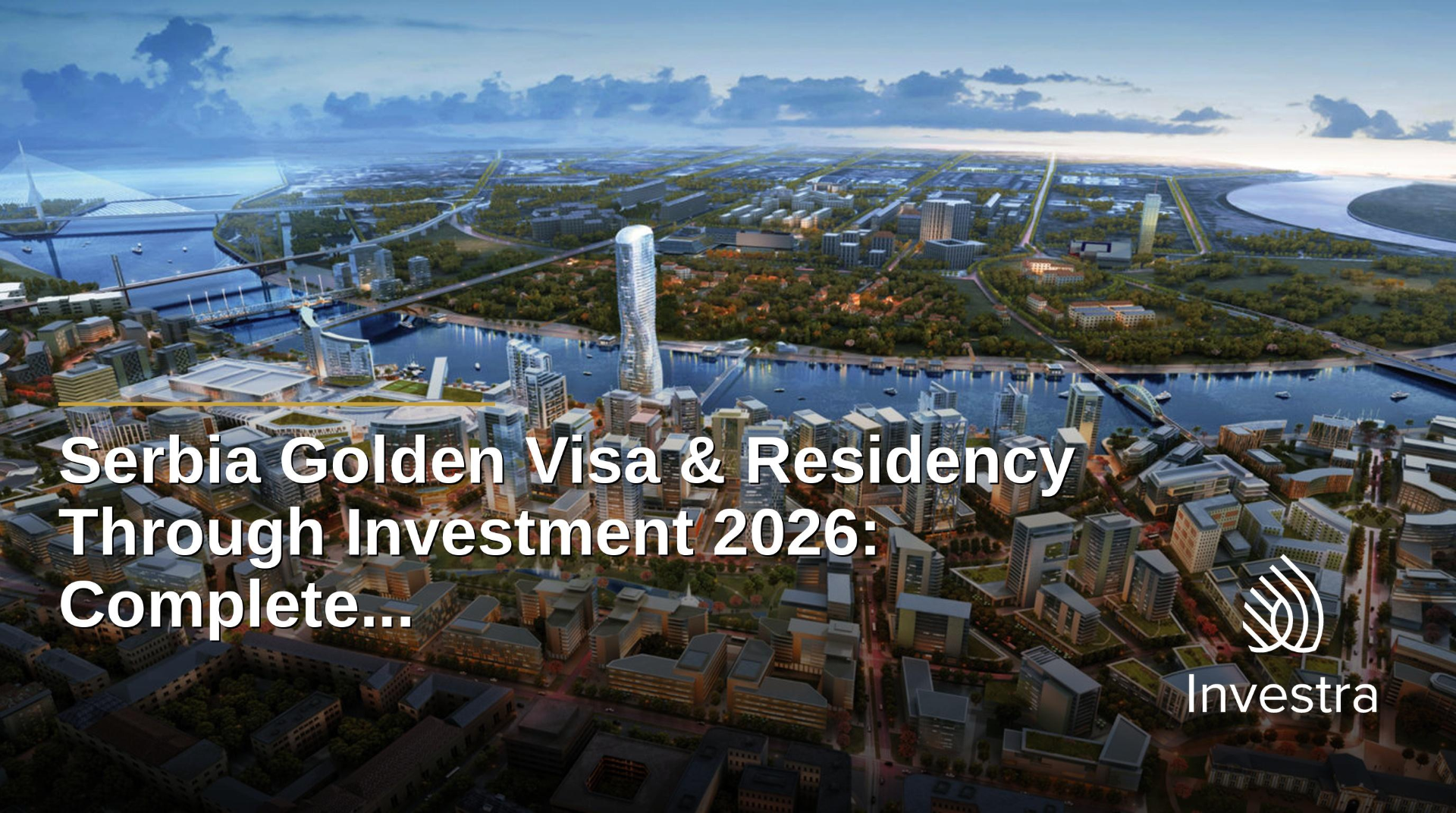
Serbia Golden Visa & Residency Through Investment 2026: Complete...
Global

Serbia Golden Visa & Residency Through Investment 2026: Complete...

Sinisa Dagary 25/07/26
Content
**Serbia does not operate a Golden Visa or citizenship-by-investment program.** Foreigners can purchase property in Serbia, but buying real estate does not confer residency rights, temporary or permanent. Residency permits are granted through separate routes such as business registration, employment, or long-stay visas that are not linked to a property investment threshold. **Serbia Golden Visa & Residency Through Investment 2026: Complete Guide** Serbia offers no dedicated residency-by-investment scheme that converts a property purchase into legal stay. Investors who buy apartments or houses must still qualify for residency under standard immigration rules unrelated to the transaction value. **Introduction** Interest in Serbian real estate has risen among international buyers looking for lower entry prices compared with EU markets. Many arrive through online searches for “Serbia golden visa 2026” or “residency through investment Serbia,” expecting a structured program similar to those in Southern Europe. In reality, the country’s immigration framework remains separate from property ownership. The absence of a formal program has not stopped marketing claims from appearing on various platforms. Prospective buyers often confuse the ability to acquire real estate with an automatic right to live in the country. Clarifying this distinction early prevents costly misunderstandings later in the decision process. Investra.io lists current listings across Belgrade, Novi Sad and smaller regional centres so readers can review actual transaction prices and rental data before committing capital. The platform also aggregates regulatory updates that affect foreign ownership. **Market Overview** Prime residential prices in central Belgrade averaged €4,850 per square metre in the first half of 2026, up roughly 6 % from the same period in 2025. New-build apartments in the Savski Venac and Vračar districts reached €5,600–€6,200 per square metre, while secondary stock in Zvezdara traded closer to €3,900. Outside the capital, Novi Sad recorded average prices of €3,150 per square metre with stronger rental demand from university staff and IT professionals. Foreign buyers accounted for approximately 14 % of registered transactions above €150,000 during 2025, according to the Republic Geodetic Authority. Most purchases were made by citizens of Russia, China and Turkey, followed by smaller numbers from EU countries seeking secondary homes. Average transaction sizes ranged from 65 m² to 95 m². Rental yields in well-located Belgrade apartments settled between 5.1 % and 5.8 % gross, depending on building age and proximity to public transport. Yields in Novi Sad hovered around 5.4 % for modern units. These figures remain attractive relative to Western European capitals but must be weighed against slower capital appreciation and currency exposure to the Serbian dinar. **Key Investment Factors** **Legal ownership rights for foreigners** Non-residents may acquire residential and commercial property on the same terms as Serbian citizens, with the exception of agricultural land. Title registration occurs at the local cadastre office and typically takes 15–25 working days once the purchase contract is notarised. **Financing options** Local banks offer mortgage products to foreign buyers who hold a Serbian tax number and can demonstrate stable income. Loan-to-value ratios currently stand at 60–70 % for non-residents, with interest rates between 4.8 % and 6.2 % for euro-denominated loans. **Exit liquidity** The secondary market remains thin outside Belgrade and Novi Sad. Properties priced above €300,000 often require six to twelve months to sell at asking price, while smaller units in established neighbourhoods move faster. **Tax treatment overview** Property transfer tax is set at 0.5 % of the higher of market or cadastral value for first-time transfers. Annual property tax rates vary by municipality and are detailed in the linked guide [Serbia Property Taxes 2026](https://investra.io/en/media/blogs/serbia-property-taxes-2026-complete-guide-for-foreign-investors). **Price Analysis Table**
AreaAvg. Price €/m² (2026)1-Bed Rental Yield2-Bed Rental Yield
Savski Venac, Belgrade5,9005.3 %5.1 %
Vračar, Belgrade5,4005.5 %5.2 %
Zvezdara, Belgrade3,9505.8 %5.6 %
Nov<|eos|>

Practical Buying Guide

```html
Quick Answer: Invest minimum €250,000 in Serbian real estate to qualify for the Golden Visa. Investra.io guides you through property selection, legal documentation, and visa application seamlessly.
```

Foreign buyers can acquire property in Serbia without major restrictions, though the process requires careful navigation of local procedures. The steps below outline a clear path from initial search to final registration.

Step 1: Research and Property Selection

Begin by identifying locations that match your investment goals. Belgrade remains the primary market for apartments and commercial space, while Novi Sad and Niš offer lower entry prices and growing rental demand. Review recent transaction data, infrastructure projects, and zoning changes through municipal planning offices. Engage a local real estate agent early to access off-market listings and verify seller credentials.

Step 2: Due Diligence and Legal Checks

Once a property is shortlisted, commission a title search at the Real Estate Cadastre. Confirm the seller holds clear ownership and that no liens, mortgages, or disputes exist. A notary public must review the sales contract for compliance with Serbian law. Foreign buyers should also verify that the property lies outside protected agricultural zones where restrictions may apply. Independent legal counsel is advisable at this stage to interpret any encumbrances.

Step 3: Contract Signing and Payment

After due diligence, the parties sign a preliminary agreement that includes a deposit, typically 10 percent of the purchase price. Funds are usually transferred via bank wire to an escrow account managed by the notary. The final purchase contract is executed in the presence of the notary, who authenticates signatures and calculates any taxes due at closing.

Step 4: Registration and Handover

The notary submits the contract to the cadastre for ownership transfer. This registration usually takes four to eight weeks. Once recorded, the buyer receives the title deed and can take possession. Utility accounts are then transferred into the new owner’s name at local service providers.

Costs & Fees Breakdown

ItemPercentage / AmountNotes
Purchase price100%Base property value
Notary fees0.5 – 1%Contract authentication and submission
Transfer tax0.5 – 3%Varies by municipality and property type
Real estate agent fees2 – 3%Usually split between buyer and seller
Cadastre registration€50 – €150 flatOfficial title recording
Legal / translation€300 – €800Recommended for foreign buyers
Total additional costs3.5 – 7%Excluding purchase price

Risks & Challenges

The Serbian property market offers opportunities but carries specific risks that foreign investors should weigh carefully. Title disputes still surface in older buildings where inheritance records remain incomplete. Currency fluctuations between the euro and the Serbian dinar can affect returns for non-eurozone buyers. Rental yields in secondary cities depend heavily on local employment growth, which can stall during economic slowdowns. Regulatory changes to foreign ownership rules, though infrequent, require monitoring. Finally, renovation costs for older stock often exceed initial estimates due to outdated electrical and plumbing systems.

Expert Tips

  • Always use a bilingual notary to avoid translation errors that could invalidate the contract later.
  • Budget an extra 5 percent contingency for unexpected repairs discovered after purchase.
  • Register the property in a company name if you plan multiple acquisitions to simplify future tax filings.
  • Check proximity to planned infrastructure such as metro extensions in Belgrade, which can lift values quickly.
  • Obtain written confirmation from the municipality that no outstanding communal fees exist before closing.
  • Consider properties with existing tenants to generate immediate cash flow while you complete paperwork.
  • Review the local property tax rate annually, as some municipalities adjust valuations every two years.

Find Your Serbia Property on Investra.io

Investra.io aggregates verified listings across Belgrade, Novi Sad, and emerging regional markets, giving buyers direct access to price histories and legal status reports. The platform filters properties by yield potential, renovation needs, and ownership clarity so investors can compare options without multiple agent meetings.

Users can request introductions to local notaries and property managers through the site’s integrated service network. Detailed market reports updated quarterly help track rental trends and price movements in real time, supporting more informed decisions before any offer is made.

Recommended Reading

Follow Us

Stay updated on Serbian market developments through our channels:

Frequently Asked Questions

Q: Can buying property in Serbia lead to residency?
A: No. Property ownership alone does not grant temporary or permanent residency. Separate applications through business setup or employment are required.

Q: Are there restrictions on foreign buyers?
A: Citizens of most countries can purchase residential and commercial property freely. Agricultural land purchases remain restricted unless structured through a Serbian-registered company.

Q: How long does the purchase process take?
A: From signed preliminary agreement to registered title, expect six to ten weeks when documents are complete.

Q: What is the typical rental yield in Belgrade?
A: Net yields currently range between 5.5 and 7 percent for well-located apartments after expenses.

Q: Do I need a Serbian bank account?
A: Yes, for the final payment and ongoing utility bills. Opening one requires a passport and proof of address.

Q: Are there annual property taxes?
A: Property tax rates vary by municipality but generally fall between 0.3 and 0.8 percent of assessed value each year.

Q: Can I finance the purchase with a local mortgage?
A: Banks offer mortgages to foreigners with stable income, though loan-to-value ratios are often capped at 60 percent.

Q: What happens if the seller has unpaid utility bills?
A: Outstanding communal debts transfer with the property. A pre-purchase clearance certificate from the municipality prevents surprises.

Q: Is it better to buy new-build or resale units?
A: New builds offer modern standards and lower immediate maintenance, while resale properties in central locations often provide stronger rental demand.

Q: How are capital gains taxed on sale?
A: Sellers pay 15 percent capital gains tax if the property is sold within five years of purchase; after five years the rate drops to zero.

Odkrijte globalne investicijske priložnosti na Unifyr.space — vaš portal za pametne investicije.

Related Posts

No related posts available.