
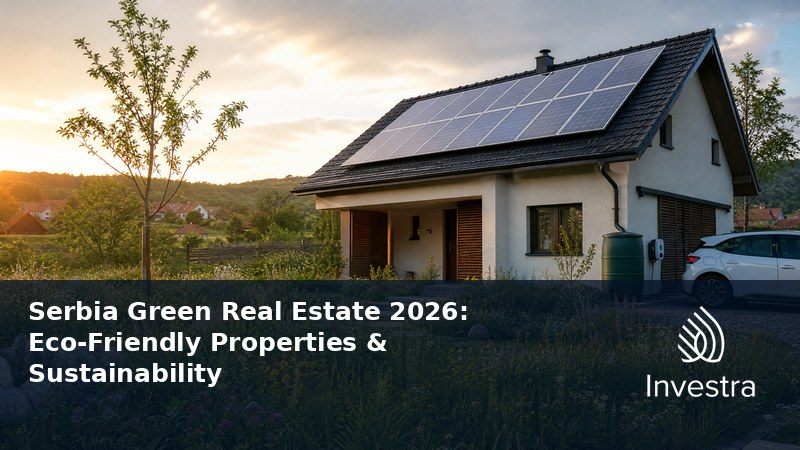
Serbia Green Real Estate 2026: Eco-Friendly Properties & Sustainability
Why Serbia Green Real Estate Is Attracting Global Attention in 2026
Quick Answer: Serbia's green real estate sector is one of Europe's fastest-emerging sustainable property markets in 2026, combining low entry prices, growing eco-infrastructure, and strong rental demand from environmentally conscious tenants and digital nomads. Serbia Real Estate Market Forecast 2026-2030 projects green-certified properties will outperform conventional stock by 15-22% over the next five years.
Something has changed in Serbia's property market over the last two years — and it's not subtle. Walk through Belgrade's Savamala district, drive past the hillside developments outside Novi Sad, or scroll through any major Serbian property portal, and you'll notice the same words appearing again and again: energy-efficient, passive house, BREEAM-certified, solar-powered. Green real estate has arrived in Serbia, and it arrived fast.
This isn't just a marketing trend. Serbia sits at a crossroads of necessity and opportunity. The country's aging housing stock — much of it built during the socialist era with minimal insulation and obsolete heating systems — is desperately overdue for modernization. At the same time, a new generation of Serbian developers, backed by European Union pre-accession funding and emboldened by surging international buyer interest, is constructing some of the most thoughtfully designed sustainable buildings in the entire Western Balkans region.
The numbers back this up. In 2024, green-certified residential construction in Serbia increased by 34% year-on-year, according to data from Serbia's Chamber of Commerce and the Republic Geodetic Authority. Demand for energy-efficient apartments in Belgrade rose sharply as utility costs climbed and environmental awareness deepened among younger buyers aged 25-40 — the demographic now dominating Serbia's property market. By early 2026, we've seen this momentum accelerate further, driven partly by Serbia's EU accession negotiations, which are pushing national building standards closer to European norms.
For international investors, the timing couldn't be more compelling. Green properties in Serbia are still priced significantly below comparable eco-certified real estate in Prague, Warsaw, or Bucharest — but the gap is closing. What we're watching unfold in real time is a market at the beginning of a major revaluation cycle. The investors who recognized Warsaw's green property opportunity in 2015, or Bucharest's eco-development boom in 2018, understand exactly what that means.
This comprehensive guide explores every dimension of Serbia's green real estate landscape in 2026: where the best eco-friendly properties are located, what they cost, what yields they generate, how to buy legally as a foreigner, and which trends will shape the market through 2030. Whether you're a first-time buyer drawn to sustainable living or a seasoned portfolio investor seeking yield-optimized green assets, Serbia deserves your serious attention right now.
Understanding Serbia's Green Building Standards and Certifications
Quick Answer: Serbia uses a combination of national energy performance certificates (EPC), EU-aligned EPBD standards, and international certifications including BREEAM and LEED, with A and A+ energy class properties commanding 10-18% price premiums over conventional equivalents.
Before spending a single euro on Serbian green real estate, you need to understand what "eco-friendly" actually means in the Serbian legal and construction context. The terminology can be confusing, especially for international buyers accustomed to different certification systems.
Serbia's primary framework for measuring building energy performance is the Energy Performance Certificate (Sertifikat o Energetskim Svojstvima Zgrade), introduced through the Law on Energy Efficiency (Zakon o Efikasnom Korišćenju Energije) and aligned with the EU's Energy Performance of Buildings Directive (EPBD). All new buildings and buildings undergoing major renovation must obtain an EPC, which classifies properties on a scale from A+ (best) to G (worst).
Here's what the classification system means in practical terms for buyers. An A+ or A-rated building consumes less than 15-25 kWh per square meter annually for heating and cooling — roughly equivalent to a German passive house standard. A B-rated building consumes 25-50 kWh/m²/year. Most of Serbia's existing housing stock falls into the E, F, or G categories, which means annual energy consumption of 150+ kWh/m²/year. The difference in utility bills between an A-rated and an E-rated apartment isn't marginal — it can easily amount to €150-300 per month for a standard 70m² apartment.
Beyond domestic EPCs, Serbia's premium green developments increasingly pursue international certifications. BREEAM (Building Research Establishment Environmental Assessment Method) is the most commonly sought international standard among Serbian commercial and mixed-use developments. LEED (Leadership in Energy and Environmental Design) is less prevalent but growing, particularly in office-to-residential conversions and high-end residential complexes aimed at expat buyers.
What surprised many buyers is that Serbia's building regulations have tightened considerably since 2023. New residential construction must now meet minimum B energy class standards — a significant shift from the previous C-class minimum. This regulatory push, driven by EU accession requirements, is fundamentally changing what developers can build and sell. The practical consequence: every new development launched in Serbia from 2023 onward is, by definition, more energy-efficient than what came before.
The price premium for green certification is real but manageable. A+ and A-class apartments in Belgrade's new developments typically command 10-18% more per square meter than equivalent non-certified properties. Given the long-term savings on utility costs and the growing tenant preference for energy-efficient homes, this premium generally pays back within 7-10 years — and that's before accounting for the capital appreciation differential that we're already observing in the market.
Serbia Green Real Estate Prices in 2026: What Are Buyers Actually Paying?
Quick Answer: Eco-friendly and energy-efficient properties in Serbia range from €1,400/m² for A-class apartments in secondary cities to €4,500/m² for premium BREEAM-certified residences in Belgrade's most sought-after neighborhoods, with the national average for new green builds sitting around €2,100-2,600/m² in early 2026.
Price transparency in Serbia's green property segment has improved dramatically over the past three years, which makes analysis considerably more reliable than it was even in 2022. Here's a market-wide breakdown of what green real estate actually costs across different property types and locations.
Belgrade — Premium Green Districts: In Vračar, Savamala, and the Waterfront zone, energy-certified new-build apartments are selling at €3,200-4,500/m² for A-class or BREEAM-certified stock. These are Belgrade's highest prices, but they reflect genuine demand from both local professionals and international buyers. A 60m² energy-efficient apartment in Vračar will typically be listed at €200,000-270,000.
Belgrade — Mid-Market Green Developments: Neighborhoods like Voždovac, Čukarica, and New Belgrade's less central blocks offer A and B-class new builds in the €2,100-3,000/m² range. A typical 70m² family apartment comes in at €147,000-210,000. This is where we see the strongest investor demand, because the price-to-yield equation is most favorable.
Novi Sad: Serbia's second city has developed a small but growing cluster of eco-friendly developments, particularly in the Sajmište and Liman districts. Prices for A-class apartments range from €1,800-2,800/m², with notable new developments emerging near the city center. Novi Sad's green real estate sector benefits from the city's large student population and its growing tech industry, which drives consistent rental demand.
Niš and Secondary Cities: Serbia's third-largest city and other secondary urban centers offer green real estate at significantly more accessible price points — €1,200-1,800/m² for energy-efficient new builds. Yields are correspondingly higher, often reaching 7-9%, though liquidity is lower and the pool of potential buyers if you need to sell is smaller.
Rural Eco-Properties and Nature Retreats: Perhaps the most distinctive element of Serbia's green real estate market is its rural eco-property sector. Sustainable homes and eco-retreats in areas like Zlatibor, Kopaonik, Tara, and Divčibare are selling at €800-1,800/m² depending on specification and proximity to ski or hiking infrastructure. These properties attract both lifestyle buyers and short-term rental investors targeting the growing sustainable tourism market.
For a full breakdown of price trends across Belgrade's neighborhoods, the Belgrade Real Estate Market Report 2026: Prices, Trends & Forecasts provides granular data updated through Q1 2026.
Rental Yields and ROI on Eco-Friendly Properties in Serbia
Quick Answer: Energy-efficient properties in Serbia generate gross rental yields of 5.5-9% annually, with eco-certified apartments in Belgrade averaging 6-7.5% and rural eco-tourism properties achieving 8-12% through short-term rental platforms during peak seasons.
Yield is where Serbia's green real estate story gets genuinely exciting. The country's overall rental market is performing strongly — Belgrade consistently ranks among Europe's top 15 cities for buy-to-let yields — but within that market, green properties are establishing a clear premium, and it's widening year by year.
The mechanics are straightforward. Tenants in Serbia are increasingly utility-cost aware. With electricity and gas prices rising steadily as Serbia aligns with European energy markets, an A-class apartment that costs €60-80/month to heat versus a typical older apartment's €200-250/month is a genuine competitive advantage in the rental market. Landlords of green properties can price rental rates 8-15% higher than comparable conventional apartments and still attract tenants faster, because the all-in monthly cost for tenants is often lower or equivalent.
Here's what yield data actually looks like across property types in 2026:
Belgrade long-term rental yields (green properties): Premium districts (Vračar, Stari Grad): 5.0-6.5%. Mid-market districts (New Belgrade, Voždovac): 6.0-7.5%. Emerging neighborhoods (Zemun, Čukarica): 7.0-8.5%.
Belgrade short-term rental yields (Airbnb, Booking.com): Energy-certified apartments in tourist-heavy zones generate gross yields of 8-11%. The combination of higher nightly rates (sustainable properties market well on eco-conscious platforms), strong occupancy (Belgrade tourism is growing at 12% annually), and lower utility costs creates an attractive stack. For detailed analysis of short-term rental performance, the Airbnb Belgrade 2026: Rental Income, Best Areas & Legal Guide is essential reading.
Novi Sad green properties: 6.5-8.5% gross yields, with strong demand from Novi Sad's growing tech and creative economy workforce.
Mountain eco-retreats (Zlatibor, Kopaonik): Short-term rental yields of 8-12%, with occupancy rates of 65-75% annually when managed professionally. Winter ski season and summer hiking season create two distinct demand peaks.
Net yields after property management fees (typically 8-12% of rent), maintenance, and Serbian property tax (discussed in detail later) will typically run 1.5-2.5 percentage points below gross figures. Even so, net yields of 5-7% on green assets in a market with strong capital appreciation prospects represent a genuinely compelling investment case for 2026.
Belgrade's Best Eco-Friendly Neighborhoods for Property Investment
Quick Answer: Vračar, Savamala, and the Belgrade Waterfront zone lead for premium eco-property investment, while New Belgrade and Voždovac offer the best value-for-yield balance; for a complete neighborhood analysis, see Belgrade Investment Property: Best Neighborhoods for ROI in 2026.
Not all of Belgrade's neighborhoods are created equal when it comes to green real estate supply and investment quality. Having analyzed the market extensively, there are distinct tiers worth understanding before you commit capital.
Belgrade Waterfront (Beograd na Vodi): This is Serbia's most ambitious urban development project and its greenest. The €3.5 billion Waterfront development along the Sava riverfront has set a new benchmark for sustainable construction in the Balkans. Buildings are constructed to A energy class standards as a minimum, with sophisticated building management systems, green roofing, and integrated cycling and pedestrian infrastructure. Prices reflect the premium: €3,500-5,500/m² for the most desirable units. This is luxury territory, but the development quality is genuinely world-class and capital appreciation has been exceptional — units bought off-plan in 2018 have more than doubled in value.
Vračar: Belgrade's most sought-after residential municipality combines historic charm with an emerging premium green development scene. A-class boutique developments are appearing between the century-old apartment buildings, attracting young professionals who prioritize both aesthetics and energy efficiency. Prices: €3,000-4,200/m². Rental demand is exceptionally strong and consistent.
Savamala: Belgrade's creative district has transformed over the past decade from a neglected riverside zone into the city's most vibrant cultural hub. Eco-conscious developers have been active here, converting former industrial buildings into sustainable mixed-use spaces. Prices range €2,500-3,800/m² for quality green conversions.
New Belgrade (Novi Beograd): The largest urban district offers the best combination of green new-build supply and accessible price points. Several major developers have launched A-class certified residential towers in New Belgrade, priced at €2,000-3,000/m². The district's excellent transport links and proximity to corporate headquarters make it a strong long-term rental market.
Voždovac and Zvezdara: These hillside municipalities are increasingly popular with environmentally conscious buyers seeking more space and greenery. New eco-developments here offer A-class family apartments and townhouses at €1,800-2,600/m². The combination of lower prices, larger unit sizes, and genuine green surroundings appeals strongly to families and remote workers.
Eco-Tourism and Rural Sustainable Property: Serbia's Hidden Investment Opportunity
Quick Answer: Serbia's mountain and countryside eco-tourism property market offers some of Europe's most undervalued sustainable investment opportunities, with eco-retreat properties on Zlatibor, Kopaonik, and Tara generating short-term rental yields of 8-12% at entry prices of €800-1,600/m².
Belgrade gets most of the headlines, but Serbia's most distinctive green real estate opportunity lies outside the capital — in the country's extraordinary natural landscape. Serbia has 15 national parks and protected areas, a UNESCO-listed medieval monastery trail, pristine mountain river canyons, and ski resorts that rival more expensive Alpine alternatives. The infrastructure to monetize this natural wealth through sustainable tourism is developing rapidly, and property investors who understand this trend are positioning themselves accordingly.
Zlatibor Mountain: Serbia's most popular mountain resort area has seen explosive property price growth since 2020, yet remains dramatically cheaper than comparable Alpine resort towns. Eco-friendly chalets, timber-frame lodges, and sustainable apartment complexes range from €900-1,800/m² depending on specification and proximity to ski lifts. Occupancy rates on well-managed short-term rentals average 68-72% annually, with nightly rates of €60-120 for a standard eco-chalet. Annual gross yields consistently reach 9-11%.
Kopaonik: Serbia's premier ski destination has a more established luxury property market. Eco-friendly ski chalets and sustainable lodge developments sell at €1,200-2,200/m², with the best positions commanding €2,500/m²+. The growing international ski tourist market — including buyers from the Middle East, Russia, and China — drives strong premium-season demand.
Tara National Park: Perhaps the most spectacular setting in Serbia, Tara's dense forests and canyon scenery have attracted a cluster of authentic eco-retreats and sustainable boutique hotel developments. Entry-level sustainable properties start at €600/m² for land with planning permission, rising to €1,400/m² for completed eco-builds. This is frontier territory for investors — higher risk but exceptional upside if Serbia's eco-tourism sector achieves its growth potential.
Fruška Gora: The wine-producing hills north of Novi Sad are emerging as a year-round eco-tourism destination, combining wine tourism, cultural heritage (the "Serbian Mount Athos" monastery trail), and nature tourism. Sustainable guesthouses and eco-cottages are attracting investors looking for lifestyle investments that generate income. Prices range €700-1,400/m², with yields of 7-10% achievable through wine-tourism and short-term rental focused strategies.
The rural eco-tourism sector's main challenge is management. Unlike urban apartments that are relatively straightforward to rent out, eco-retreats require active hospitality management to achieve the yield numbers cited above. Investors should budget for professional management fees of 15-25% of rental income and factor in higher maintenance costs for rural properties.
Green Building Technology and Innovation in Serbia's Construction Sector
Quick Answer: Serbia's construction sector is rapidly adopting passive house design, photovoltaic solar systems, heat pump technology, and smart building management systems, with A-class new builds now standard among the country's top five developers.
The technology being deployed in Serbia's new green developments would surprise investors who have a dated picture of Balkan construction quality. The country's top developers have invested heavily in sustainable building technology, driven partly by EU alignment requirements and partly by genuine market demand from sophisticated local and international buyers.
Passive house design has moved from a niche curiosity to mainstream practice among premium Serbian developers. A genuine passive house uses a highly insulated building envelope, triple-glazed windows, heat recovery ventilation, and thermal bridge-free construction to reduce heating energy demand by 75-90% compared to a conventional building. Several certified passive house projects have been completed in Belgrade and Novi Sad since 2022, with more in the pipeline for 2026-2027 delivery.
Solar photovoltaic systems are becoming increasingly standard in new green developments. Serbia's solar resource is excellent — Belgrade receives approximately 1,700 hours of sunshine annually, comparable to northern Italy — making PV panels genuinely economically rational, not just a green gesture. New legislation passed in 2023 allows residential buildings to sell surplus solar electricity back to the grid, fundamentally changing the economics of rooftop solar in Serbia.
Heat pump technology is replacing gas boilers in the most advanced green developments. Air-source and ground-source heat pumps deliver 3-4 units of heat energy per unit of electrical energy consumed, dramatically reducing both heating costs and carbon emissions. As Serbian electricity increasingly comes from renewable sources (the country has significant hydroelectric capacity and is investing in wind and solar), heat pumps become progressively cleaner over time.
Smart home and building management systems are standard in premium green developments. These systems monitor and optimize energy consumption in real time, learn occupant behavior patterns, and can reduce energy use by a further 15-25% compared to conventionally operated buildings. For rental investors, smart building systems also simplify remote property management — a critical consideration for non-resident international investors.
The Business Strategy Blog by investment consultant Siniša Dagary provides excellent coverage of how technological innovation is intersecting with Balkans real estate investment strategy, and is worth bookmarking for investors tracking these developments.
How to Buy Eco-Friendly Property in Serbia as a Foreign Investor
Quick Answer: Foreign nationals from most countries can legally purchase green real estate in Serbia subject to reciprocity agreements, with the purchase process taking 30-90 days and requiring a Serbian tax identification number, a local bank account, and a licensed notary to formalize the transaction.
Serbia's property purchasing framework is more accessible for foreign buyers than many European countries — but it's not without procedural complexity, particularly for buyers navigating it without local guidance. Here's how the process works in practice.
Who Can Buy? Citizens of countries with reciprocal property rights agreements with Serbia can purchase residential property on the same terms as Serbian citizens. This includes EU member states, the United States, the United Kingdom, Australia, Canada, and most other Western nations. Citizens of countries without reciprocal agreements can purchase through a Serbian-registered company — a more complex route but one that also offers tax planning advantages worth considering.
Step 1 — Obtain a Serbian Tax Identification Number (PIB or JMBG for foreigners): This is mandatory before any property transaction can proceed. The process involves submitting an application to the Tax Administration (Poreska Uprava) with your passport and proof of address. It typically takes 5-10 business days.
Step 2 — Open a Serbian Bank Account: Required to receive bank transfers, pay purchase consideration, and ultimately receive rental income. Serbia's main banks — Intesa, UniCredit Srbija, Erste Bank — all serve foreign clients, though documentation requirements vary. Expect the process to take 1-3 weeks.
Step 3 — Due Diligence: For green properties specifically, due diligence should include verification of the property's EPC certificate (ensure it matches what was advertised), review of any BREEAM or LEED certification documentation, check of solar panel ownership (owned vs. leased makes a significant financial difference), and review of building management system contracts. A Serbian property lawyer should conduct full title search and encumbrance checks.
Step 4 — Sale Agreement and Notarization: Serbian property transactions must be notarized by a licensed notary (Javni Beležnik). The notary verifies the identity of all parties, confirms the property's legal status, and witnesses the signing of the purchase agreement. The transfer of ownership is then registered with the Republic Geodetic Authority (RGZ).
Step 5 — Registration: Title transfer registration with RGZ typically takes 15-45 days. Until registration is complete, you're the beneficial owner but not yet the registered legal owner — a distinction that matters for mortgage purposes and subsequent sale.
For a comprehensive step-by-step walkthrough of the entire purchase process, Buying Property in Belgrade 2026: Complete Guide for Foreign Investors covers every stage in detail, including common pitfalls and how to avoid them.
Tax Considerations for Green Property Investors in Serbia
Quick Answer: Serbia imposes a 2.5% property transfer tax on resale properties, zero VAT on new-build purchases (VAT is included in the developer's price), an annual property tax of 0.1-0.4% of cadastral value, and a flat 15% tax on rental income — all relatively favorable compared to Western European standards.
Serbia's tax framework for property investors is one of the country's genuine competitive advantages. The reality is that when you compare total tax burden on Serbian real estate investment to equivalent investments in Germany, France, or the United Kingdom, Serbia comes out dramatically more favorable — and the green property sector benefits from several additional incentives worth knowing.
Property Transfer Tax (Porez na Prenos Apsolutnih Prava): A flat 2.5% tax applies on the purchase price for resale (secondary market) properties. This tax does not apply to new-build purchases from developers, where VAT (PDV at 10% for residential properties) is already included in the purchase price. For green new-builds specifically — which represent the bulk of A-class property supply — buyers therefore pay no additional transfer tax.
Annual Property Tax: Calculated at 0.1-0.4% of the property's cadastral value (Katastarska Vrednost), which is typically set at 60-80% of market value. For a €200,000 apartment with a cadastral value of €140,000, annual property tax would be approximately €140-560 depending on the municipality. This is extremely low by European standards — contrast with France's taxe foncière (often 0.5-1% of market value) or the UK's council tax.
Rental Income Tax: A flat 15% tax rate applies to net rental income (gross rent minus a standard 25% expense deduction, or actual documented expenses if higher). The effective tax rate on gross rental income therefore approximates 11.25% when using the standard deduction — genuinely competitive internationally.
Green Property Tax Incentives: Serbia has introduced a series of incentives specifically for energy-efficient construction and renovation. Buildings certified at A or A+ energy class are eligible for reduced annual property tax rates in certain municipalities. Energy renovation loans through Serbian banks carry state-subsidized interest rates of 1-3% for qualifying improvements. These incentives are modest by EU standards but are expected to strengthen as Serbia's EU accession process advances.
Capital Gains Tax: A 15% capital gains tax applies to profits from property sales where the owner has held the property for less than 10 years. After 10 years of ownership, capital gains are tax-exempt. For investors with a longer-term horizon, this 10-year exemption threshold is a significant tax planning tool. Details and worked examples are covered in the Serbia Property Tax Guide 2026: What Foreign Buyers Must Know.
Financing Green Property in Serbia: Mortgages and Investment Structures
Quick Answer: Foreign investors can access Serbian mortgage financing from local banks at interest rates of 4.5-7.5% for EUR-denominated loans, with green mortgage products offering rate discounts of 0.25-0.75% for A-class certified properties — though most international buyers prefer cash purchases or offshore financing structures.
Financing is often the question that foreign investors ask about last but should probably think about first. Serbia's mortgage market for non-residents has matured considerably since 2020, but it still carries restrictions and conditions that differ significantly from Western European norms.
Serbian banks will lend to foreign nationals, but the conditions are typically less favorable than those available to Serbian residents. Loan-to-value ratios for non-residents generally cap at 60-70% (versus 80% for residents). Required documentation is extensive and must typically be notarized and apostilled. Interest rates for foreign borrowers in EUR-denominated mortgages currently run at 4.5-7.5% depending on the bank, the borrower's profile, and the property type.
The genuinely interesting development is the emergence of green mortgages in Serbia. Following the EU's Energy Efficient Mortgage Initiative (EEMI) guidelines — which Serbia has adopted as part of its banking sector EU alignment — several Serbian banks now offer preferential mortgage rates for properties meeting A or A+ energy class standards. The rate discount is typically 0.25-0.75 percentage points below standard mortgage rates. Over a 20-year mortgage term, this discount represents substantial savings and effectively helps finance the premium price of green property.
Erste Bank Srbija and UniCredit Srbija have been the most active in the green mortgage space as of 2026. The Serbian government's Fond za Razvoj program also offers subsidized financing for energy renovation projects, allowing buyers to purchase older properties and fund comprehensive eco-retrofitting at subsidized rates — an interesting strategy for investors who want green assets but at lower acquisition prices.
The reality for most international investors, however, is that Serbian mortgages are more bureaucratically complex than simply buying with cash or using financing secured against assets in their home country. Investors who can deploy cash enjoy faster transactions, stronger negotiating positions with vendors, and simpler tax reporting. The Serbia Mortgage Guide 2026: Can Foreigners Get a Loan? provides detailed guidance on navigating Serbian bank requirements, required documentation, and alternative financing structures for international investors.
Digital Nomads, Remote Workers, and the Green Property Connection
Quick Answer: Serbia's digital nomad visa program and its growing community of remote workers are directly driving demand for eco-friendly, well-equipped rental properties, particularly in Belgrade's central and creative districts, with nomad tenants willing to pay 10-20% premiums for sustainable, tech-enabled apartments.
There's a demographic intersection that property investors need to understand: the overlap between the digital nomad community and the eco-conscious tenant. It's not coincidental. The same values that drive someone to work remotely — prioritizing quality of life, environmental awareness, preference for authentic experiences over corporate uniformity — also drive strong preference for sustainable, well-designed living spaces.
Belgrade has emerged as one of Europe's top digital nomad destinations in 2025-2026, ranking consistently in the top 10 of major nomad indices for cost-effectiveness, internet quality, social scene, and lifestyle offering. Serbia's visa framework — which allows most nationalities to stay up to 90 days without a visa, with easy extension possibilities — combined with very low cost of living relative to Western Europe, has created a substantial and growing nomad community. The Serbia Digital Nomad Visa 2026: Complete Guide for Remote Workers documents the full scope of this program and its implications.
For green property investors, the nomad demographic is attractive for several reasons. Nomads typically occupy medium-term rentals of 1-6 months, offering a middle ground between short-term (high income, high management intensity) and long-term (steady income, lower management involvement) rental strategies. They're generally high-income earners who pay reliably. They actively seek properties with quality internet connectivity, functional workspaces, and energy efficiency — exactly the characteristics of well-designed green properties. And they're concentrated in the same central and creative districts where green new-build supply is strongest.
Property investors specifically targeting the digital nomad market should prioritize high-speed fiber internet (50 Mbps minimum, 200 Mbps ideal), dedicated workspace within the apartment, air source heat pump heating and cooling for year-round comfort, and smart home features that allow easy remote check-in and checkout. These features align almost perfectly with premium green building specifications, creating a natural synergy between the eco-property investment thesis and the nomad rental market strategy.
Serbia's EU Accession Path and Its Impact on Green Real Estate Values
Quick Answer: Serbia's ongoing EU accession process — which requires adopting European building standards, green infrastructure investments, and environmental regulations — is a structural driver of green property premium appreciation that investors should factor into every investment thesis through 2030 and beyond.
Serbia's relationship with the European Union is the single most important macroeconomic factor for long-term property investors to understand. Serbia has been an EU candidate country since 2012, and while full membership remains a process measured in years rather than months, the accession journey itself is transforming the country's regulatory and economic framework in ways that directly benefit green real estate values.
EU pre-accession funding through the Instrument for Pre-Accession Assistance (IPA) has channeled billions of euros into Serbian infrastructure, environmental standards, and building regulation reform. The EPBD (Energy Performance of Buildings Directive) alignment has already happened — Serbia's building energy standards are now substantially equivalent to EU norms. The EU Taxonomy for Sustainable Finance is increasingly referenced by Serbian developers and banks, driving capital toward green-certified assets.
What this means in practical investment terms: the regulatory floor is rising. Buildings that are currently considered average (C and D energy class) will face increasing costs to maintain, sell, and rent as Serbian regulations tighten toward EU norms. Meanwhile, A and A+ class buildings that meet or exceed current standards are essentially future-proofed against regulatory risk. This "stranded asset" risk for conventional properties is a mirror-image tailwind for green property values.
The EU accession pathway also affects currency stability. Serbia's dinar (RSD) has maintained remarkable stability against the euro, operating within a managed float that has kept EUR/RSD within a narrow band for over a decade. This reduces the currency risk for euro-denominated investors — a consideration that matters enormously when comparing Serbian yields to those in countries with more volatile currencies. Serbia Real Estate Market Forecast 2026-2030: Prices & Trends analyzes these macro drivers in detail and provides scenario-based price projections through the end of the decade.
Expert investment consultant Siniša Dagary, who advises international investors on Balkans market entry strategies, consistently highlights EU accession as the structural factor that differentiates Serbia from other emerging market property plays. The combination of low current prices, rising regulatory standards, and EU alignment creates a convergence trade thesis that has historically generated excellent returns in countries that have completed the accession process — Bulgaria, Romania, and Croatia being the most relevant recent examples.
Sustainable Urban Development Projects Reshaping Serbia's Cities
Quick Answer: Major sustainable urban development projects in Belgrade, Novi Sad, and Niš are transforming entire city districts, creating green property clusters that are driving both capital appreciation and long-term rental demand across the 2026-2030 period.
Individual eco-certified buildings are one thing. Entire districts being rebuilt according to sustainable urban planning principles is something else entirely — and Serbia has several of these transformational projects underway that property investors need to understand.
Belgrade Waterfront Phase 2: The first phase of this landmark Sava riverside development is now largely complete, but Phase 2 will add approximately 1.2 million square meters of new mixed-use floor space over the next decade. The entire development is masterplanned to BREEAM Communities standard, with integrated cycling infrastructure, district heating and cooling, extensive green space (30% of the development area), and smart city technology throughout. Properties in and adjacent to this project will benefit from the "halo effect" of proximity to premium sustainable infrastructure.
Novi Sad 2021+ Legacy Development: Novi Sad's role as European Capital of Culture 2021 catalyzed a wave of urban regeneration that continues today. The Sajmište district (formerly the city's fairground) is being transformed into a mixed-use sustainable urban district, with green buildings, cultural spaces, and cycling infrastructure. Properties in and adjacent to this regeneration zone represent excellent medium-term investment opportunities at prices 20-30% below comparable Belgrade stock.
Niš Smart City Initiative: Serbia's third city has launched an ambitious Smart City program incorporating green building standards, electric mobility infrastructure, and urban greening projects. While Niš remains significantly cheaper than Belgrade (€800-1,400/m² for new green builds), the city's growing IT sector and university population create solid rental fundamentals.
Subotica and Northern Serbia: Proximity to the Hungarian border and EU access routes has made Subotica an increasingly interesting logistics and business hub. New sustainable business and residential developments are emerging, targeting both Serbian businesses and Hungarian/EU companies seeking cost-effective bases. Entry price points (€900-1,500/m²) combined with strong cross-border economic linkages create a distinctive investment case.
For deeper context on how these development projects interact with neighborhood-level ROI analysis, the Belgrade Investment Property: Best Neighborhoods for ROI in 2026 guide provides exactly the granular analysis investors need.
Due Diligence Checklist for Green Property Buyers in Serbia
Quick Answer: Green property due diligence in Serbia requires verification of the official Energy Performance Certificate, confirmation of any international certifications, review of technical building documentation, and independent assessment of actual energy system performance — steps that go beyond standard property due diligence and require specialized expertise.
Greenwashing exists in Serbian real estate just as it does in every market. The term "eco-friendly" or "energy-efficient" can appear in a property listing without any formal certification to back it up. This is why due diligence on green property purchases in Serbia needs to be more thorough than standard residential property checks. Here's what rigorous due diligence actually looks like.
Energy Performance Certificate Verification: Always request the original EPC certificate issued by a licensed energy auditor (Ovlašćeni Energetski Savetnik). Verify that the certificate is registered in Serbia's official EPC database (maintained by the Ministry of Mining and Energy). Check the certificate's validity date — EPCs are valid for 10 years but may be outdated if significant renovations have occurred. Confirm that the certificate covers the specific unit you're purchasing, not just the building as a whole (for apartments, both apartment-level and building-level certificates may exist).
Technical System Documentation: Request technical documentation for all energy systems — solar panels, heat pumps, heat recovery ventilation systems, and smart building management systems. Understand ownership versus leasing status for solar panels and any ongoing service contracts. Review maintenance records for all mechanical systems, particularly for heat pumps and ventilation systems that require regular servicing.
International Certification Verification: For properties claiming BREEAM or LEED certification, verify the certification independently through the BREEAM Projects database or the LEED Project Directory. Both are publicly searchable. Certification claims that cannot be independently verified should be treated with significant skepticism.
Utility Bill Analysis: For occupied properties, request actual utility bills for the last 12 months. Compare actual energy consumption to what the EPC predicts. A significant discrepancy — particularly if actual consumption is higher than EPC-predicted — may indicate building quality issues or occupant behavior factors worth understanding.
Legal Title and Encumbrance Check: Standard Serbian property due diligence — title verification, encumbrance search, pre-emption rights check — all apply equally to green properties. A licensed Serbian property lawyer is essential. For an overview of the full set of questions you should be asking, the Serbia Real Estate FAQ 2
For comprehensive financial planning, mortgage advisory, and investment structuring services, consult Findes Financial Services — your trusted partner for Balkan real estate investments.
Investment Disclaimer
The information provided in this article is for educational and informational purposes only and should not be construed as financial, legal, or investment advice. Real estate investments carry inherent risks, and past performance does not guarantee future results. Investors should not invest money they cannot afford to lose. Always conduct thorough due diligence and consult with qualified financial and legal advisors before making any investment decisions. Investra.io does not guarantee returns on any investment.
Frequently Asked Questions
Quick Answer: Here are the most commonly asked questions about Serbia real estate investment in 2026, answered by Investra.io experts.
Is Serbia a good country for real estate investment in 2026?
Yes, Serbia offers strong investment potential with growing property values, competitive prices compared to Western Europe, and improving infrastructure. Investra.io provides comprehensive market data and investment guidance.
Can foreigners buy property in Serbia?
EU citizens can buy property freely in Serbia. Non-EU citizens may need to meet specific requirements. Investra.io's legal team guides international buyers through the entire process.
What is the average property price in Srbija?
Property prices in Srbija vary significantly by location and property type. Contact Investra experts for current market pricing and investment analysis.
What rental yields can I expect?
Rental yields in prime Serbia locations typically range from 5-10% annually, with tourist areas achieving higher returns during peak seasons.
What taxes apply to property purchases?
Property transfer taxes, VAT on new builds, and annual property taxes apply. Rates vary by property type and location. Consult Siniša Dagary for tax optimization strategies.
How long does the purchase process take?
Typically 30-60 days from offer to completion. Working with Investra.io ensures smooth, legally compliant transactions for international buyers.
What financing options are available?
Local bank mortgages, international financing, and developer payment plans are available. Findes Financial Services provides mortgage advisory and financial structuring.
Is property management available for rental properties?
Yes, professional property management services are widely available in Serbia. Investra.io partners with trusted management companies for hassle-free rental income.
What are the best areas to invest in Srbija?
Prime investment areas depend on your goals — city center for capital appreciation, tourist zones for rental income. Investra.io's market analysis identifies the best opportunities.
Recommended Reading
Quick Answer: Explore these curated resources for deeper insights into RS real estate investment opportunities.
- Buying Property in Belgrade 2026: Complete Guide for Foreign Investors
- Serbia Real Estate FAQ 2026: 50 Most Asked Questions Answered
- Belgrade Real Estate Market Report 2026: Prices, Trends & Forecasts
- Serbia Property Tax Guide 2026: What Foreign Buyers Must Know
- Serbia Digital Nomad Visa 2026: Complete Guide for Remote Workers
- Belgrade Investment Property: Best Neighborhoods for ROI in 2026
- Siniša Dagary — Investment Consultant
- Business Strategy Blog
Related Posts
No related posts available.
