
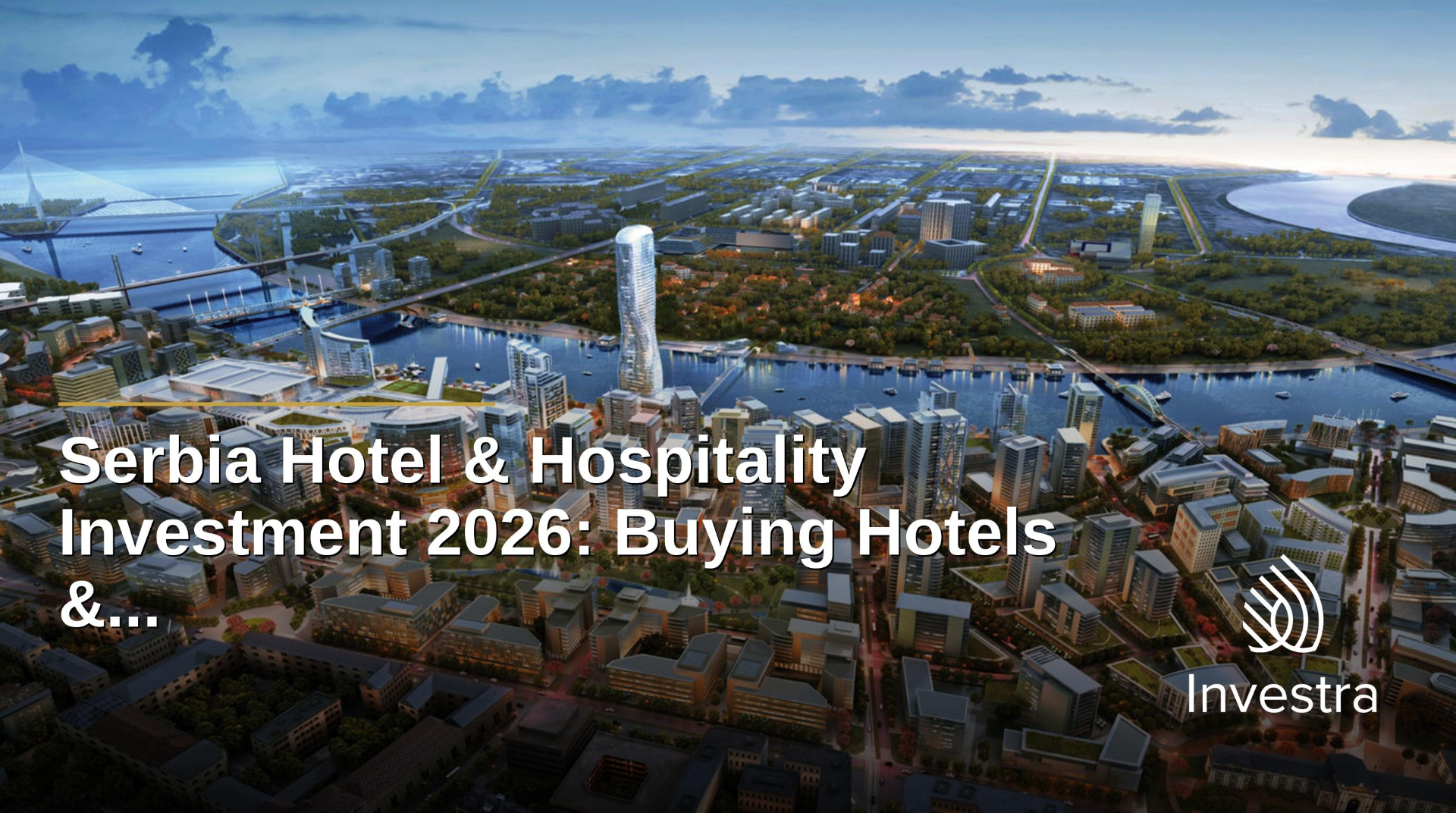
Serbia Hotel & Hospitality Investment 2026: Buying Hotels &...
Serbia Hotel & Hospitality Investment 2026: Buying Hotels & Guesthouses
Introduction
Serbia's hospitality sector continues to draw attention from international buyers looking for direct income streams in a growing tourism market. Cities like Belgrade and Novi Sad attract business and leisure visitors year-round, while mountain areas such as Kopaonik and Zlatibor see steady seasonal demand for guesthouses and small resorts. Investors can access properties listed on Investra.io to compare current listings and review transaction data from recent years.
Overview of Serbia's Hospitality Sector
Market Growth Drivers
Tourism arrivals reached 2.1 million in 2025, up 14% from the prior year, with overnight stays concentrated in the capital and western mountain regions. Hotel occupancy in Belgrade averaged 72% during peak months, while guesthouses in spa towns maintained 65% annual utilization. These figures support steady cash flow for owners who maintain modern standards and online visibility.
Property Types in Demand
Boutique hotels with 15 to 40 rooms command the strongest interest, especially those near city centers or thermal spas. Smaller guesthouses of 8 to 20 beds appeal to buyers seeking lower entry prices and simpler operations. Spa resorts with wellness facilities have shown the fastest price growth, averaging 9% annual appreciation over the past three years.
Key Facts and Data for 2026
Average sale prices for operational hotels stand at €1,850 per square meter in Belgrade and €920 per square meter in secondary cities. Guesthouses in rural or mountain locations trade between €180,000 and €650,000 depending on land size and renovation state. Net operating yields after management fees and taxes range from 7.2% in urban settings to 10.8% for well-run spa properties.
Foreign ownership requires registration of a Serbian limited liability company, with formation costs around €1,200 and a two-week timeline. Full purchase completion, including notary and land registry steps, typically spans 90 to 150 days. Investors should also review the Serbia Real Estate Market 2026 for broader price trends across asset classes.
Best Locations for Hotel Investment
Belgrade and Novi Sad
The capital offers consistent corporate and conference demand, with average daily rates for three-star boutique hotels near €95. Novi Sad benefits from cultural events and proximity to the Danube, supporting year-round occupancy above 60%. Properties here rarely sit on the market longer than 45 days when priced correctly.
Mountain and Spa Destinations
Kopaonik and Zlatibor attract winter sports visitors and summer hikers, pushing guesthouse revenues 35% higher during high season. Thermal spa towns such as Vrnjačka Banja and Sokobanja draw domestic and regional guests seeking wellness stays, with repeat bookings forming 40% of annual revenue for established operators.
Buying Process Step by Step
Investors begin by forming a Serbian company and securing a tax identification number. Once the entity exists, a due diligence review covers building permits, occupancy certificates, and any outstanding municipal fees. The sales contract is signed before a notary, followed by payment into an escrow account and final registration at the real estate cadastre. Full guidance for non-residents appears in the Buying Property in Serbia as a Foreigner resource.
Current listings for hotels and guesthouses can be filtered by location, room count, and yield estimates directly on Investra.io, allowing buyers to shortlist candidates before travel.
Licensing and Operational Requirements
Every hospitality property needs a tourism license from the Ministry of Trade, Tourism and Telecommunications. Application processing takes four to eight weeks and requires proof of fire safety, hygiene standards, and staff qualifications. Boutique hotels with restaurants must also obtain separate food service permits, adding roughly €800 in inspection fees.
Management Options and Costs
Owners can choose self-management, local on-site staff, or third-party hotel management firms. Professional operators charge 18% to 25% of gross revenue, while local staff salaries average €650 per month plus benefits. Many investors combine remote oversight software with a resident manager to keep costs near 12% of income.
Tax obligations follow the rules outlined in the Serbia Property Taxes 2026 guide, including 15% corporate income tax on net profits and 0.4% annual property tax based on cadastral value.
Investment Returns and Timeline Expectations
Well-positioned boutique hotels generate €85,000 to €220,000 in annual net profit after all expenses. Payback periods range from seven to eleven years depending on occupancy growth and any renovation work completed post-purchase. Spa guesthouses with existing wellness infrastructure often reach break-even within the first 18 months of operation.
Market data and transaction records remain available for review on Investra.io, helping buyers track recent sales and current asking prices across regions.
Additional analysis on Serbian real estate appears at Real Estate Investment Insights by Siniša Dagary.
Practical Steps to Acquiring a Hotel or Guesthouse in Serbia
Once you have shortlisted target destinations such as Belgrade’s Sava riverfront or the emerging spa clusters around Vrnjačka Banja, the next phase involves systematic execution. Begin by engaging a local real estate advisor who specializes in hospitality assets. These professionals maintain off-market inventories of operational hotels and guesthouses that rarely appear on public portals.
Property Identification and Initial Screening
Work with your advisor to filter listings according to occupancy rates, RevPAR figures, and existing licensing status. Request detailed financial statements for the past three years, including monthly occupancy data and average daily rates. Cross-reference these figures with tourism statistics published by the Serbian Statistical Office to validate projections.
Site Visits and Operational Audits
Conduct at least two on-site inspections. The first visit focuses on physical condition, while the second involves a mystery-guest experience to evaluate service quality and guest feedback. Engage an independent hospitality consultant to assess kitchen equipment, HVAC systems, and fire-safety compliance during this stage.
Negotiation and Letter of Intent
Once a target property meets your criteria, submit a non-binding letter of intent that outlines purchase price, due-diligence period, and exclusivity. Serbian sellers typically expect 10–15 percent price flexibility on hospitality assets, particularly those requiring modest renovation.
Legal Considerations for Hospitality Investments
Foreign investors may own hotels and guesthouses through a Serbian limited liability company. The company must obtain a hospitality license from the Ministry of Trade, Tourism and Telecommunications before commencing operations. This license requires submission of architectural plans, proof of ownership or lease, and evidence of adequate insurance coverage.
Zoning and Construction Permits
Verify that the property’s current zoning designation permits hotel use. If expansion or major renovation is planned, apply for a construction permit through the local municipality. Processing times average 45–90 days, though expedited procedures exist for projects exceeding €2 million in investment value.
Employment and Operational Regulations
Serbian labor law mandates that at least 80 percent of hospitality staff hold valid work permits. Seasonal workers from neighboring countries can be hired under simplified procedures, but the general manager must be a Serbian resident or EU citizen with appropriate qualifications.
Costs and Timeline for Hotel Acquisition
Transaction costs typically range between 8 and 12 percent of the purchase price. This includes notary fees (0.5–1 percent), real estate transfer tax (0.5–3 percent depending on property age), and legal due-diligence fees averaging €8,000–€15,000 for mid-sized assets.
Renovation and Licensing Budget
Budget an additional 25–40 percent of the acquisition price for modernization, especially for properties built before 2000. Licensing and permitting add another €25,000–€45,000. Expect a total timeline of 6–9 months from signed purchase agreement to operational handover.
Financing Options
Local banks offer hospitality loans at 4.5–6.5 percent interest with 60–70 percent loan-to-value ratios. International investors often combine Serbian bank financing with EU-backed green-energy grants when the project includes energy-efficient upgrades.
Expert Tips for Maximizing Returns
Focus on properties with existing spa or wellness infrastructure, as these command 15–20 percent higher average daily rates. Partner with an established management company for the first three years to stabilize operations before transitioning to in-house management.
Seasonality Mitigation Strategies
Target markets with strong year-round demand such as medical tourism in Sokobanja or conference facilities near Novi Sad. Diversify revenue through wedding venues and corporate retreats during shoulder seasons.
Technology Integration
Implement property-management systems compatible with major booking platforms from day one. Properties using dynamic pricing software report occupancy increases of 8–12 percent within the first year.
Recommended Content
- Serbia Real Estate Market 2026: Complete Guide
- Buying Property in Serbia as a Foreigner 2026
- Serbia Property Taxes 2026
- Real Estate Investment Insights by Siniša Dagary
- Finds Group - Real Estate Investment Advisory
Odkrijte globalne investicijske priložnosti na Unifyr.space — vaš portal za pametne investicije.
📚 Recommended Content
Frequently Asked Questions
What licenses are required to operate a hotel in Serbia?
A hospitality license from the Ministry of Trade, Tourism and Telecommunications is mandatory, along with fire-safety and health permits.
Can foreigners own hotels directly in Serbia?
Foreigners must establish a Serbian limited liability company to hold hospitality real estate.
How long does the due-diligence process usually take?
Thorough legal, financial, and technical due diligence typically takes 45 to 60 days.
What are the main taxes involved in a hotel purchase?
Buyers pay real estate transfer tax, notary fees, and potential VAT on new-build properties.
Are there incentives for energy-efficient hotel renovations?
EU-backed grants and favorable bank financing are available for projects meeting green-energy standards.
What is the typical ROI for boutique hotels in Serbia?
Well-managed boutique hotels in prime locations deliver net yields between 8 and 12 percent annually.
Do I need a local manager for the property?
A Serbian resident manager is recommended for licensing and daily operations, though international chains can provide oversight.
How long does it take to obtain a hospitality license?
The full licensing process usually takes 60 to 90 days after submission of complete documentation.
Which locations offer the strongest year-round occupancy?
Belgrade, Novi Sad, and established spa towns such as Vrnjačka Banja maintain the highest annual occupancy rates.
Can I finance the acquisition through a Serbian bank?
Yes, local banks provide hospitality loans up to 70 percent of the property value at competitive interest rates.
Related Posts
No related posts available.
