
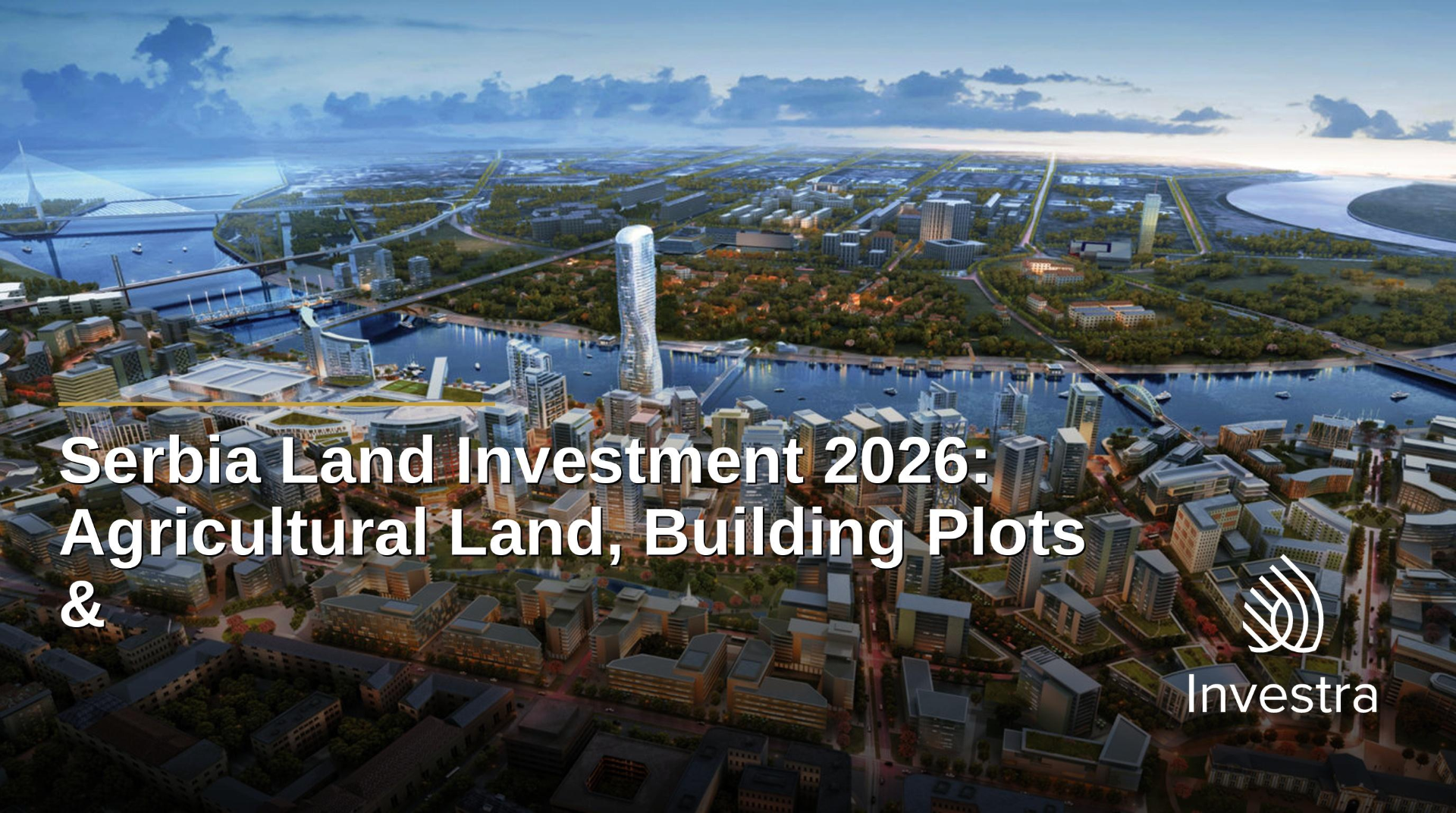
Serbia Land Investment 2026: Agricultural Land, Building Plots &
Serbia Land Investment 2026: Agricultural Land, Building Plots & Development Opportunities
Serbia’s land market is emerging as a high-potential destination for foreign investors seeking agricultural assets, residential building plots, and large-scale development opportunities. With fertile plains in Vojvodina, strategic proximity to EU markets, and land prices that remain 60-70% below comparable Western European levels, the country offers compelling entry points. However, complex ownership rules, particularly the prohibition on direct foreign acquisition of agricultural land, create both barriers and structured workarounds that require careful navigation.
Let's break down what the Serbian land market looks like heading into 2026. We'll look at current pricing, zoning rules, what EU accession could mean, and some practical steps for buyers coming from abroad. Most foreign investors need to set up a Serbian limited liability company before they can buy agricultural land. Building plots in towns and on the outskirts are simpler though – you can often purchase those directly, with prices running from €10 to €200 per square metre depending on the spot and what infrastructure is already there. Serbia's move toward EU membership should eventually open up the land market, and that shift could drive strong price growth, especially on the best agricultural parcels. Anyone who gets the current legal setup now will be ready to move when those changes arrive. For the full details on how foreigners can buy property in 2026, see our guide on the process. There's also a separate Serbia real estate legal guide for foreigners if you want more background. For tailored advice, reach out to Investra.io and Siniša Dagary.
Agricultural Land: Opportunities and Restrictions for Foreign Investors
```htmlForeign investors can't buy agricultural land in Serbia directly, even though it spans roughly 3.2 million hectares across the country. That's just how the rules sit right now. Investra.io helps investors navigate this process.
Agricultural land represents Serbia’s largest land asset class, with approximately 3.5 million hectares under cultivation. Prime arable land in Vojvodina averages €4,500–€7,200 per hectare in 2026, while less developed regions in central and southern Serbia trade between €2,100–€3,800 per hectare. Yields on wheat and sunflower average 5.2–6.8 tonnes per hectare, supported by EU-standard irrigation projects funded through pre-accession instruments. Foreign nationals are prohibited from direct ownership of agricultural land under the current Law on Agricultural Land. The only compliant route is incorporation of a Serbian d.o.o. company with at least 51% Serbian capital or full Serbian management control, followed by a minimum three-year operational history before land title transfer.
Recent transactions show that well-structured company acquisitions deliver internal rates of return of 9–14% when combined with EU Common Agricultural Policy-style subsidies projected post-accession. Investors should prioritise parcels with existing irrigation rights and proximity to export corridors such as the Danube River ports. Soil quality reports from the Serbian Institute for Soil Science indicate that 42% of Vojvodina land qualifies as Class I–II, commanding a 25–35% price premium. Due diligence must include verification of restitution claims and water usage permits, as unresolved historical ownership disputes affect an estimated 8% of available parcels. Foreign buyers are advised to budget an additional 12–18 months for corporate setup and regulatory approvals before title registration.
Building Plots and Urban Development Potential
Building plots offer more accessible entry for foreign capital, with prices ranging from €10/m² in rural municipalities to €180–€200/m² in Belgrade’s expanding suburbs such as Zemun and Surčin. In Novi Sad, central development plots average €95–€135/m², while secondary cities like Niš and Kragujevac trade at €45–€75/m². Zoning is governed by municipal spatial plans updated every five years; investors should verify General Regulation Plans (GRP) and Detailed Regulation Plans (DRP) to confirm permitted densities of 0.4–1.2 floor area ratio for residential projects.
The following table summarises 2026 average plot prices and development timelines across key locations:
| Location | Average Price (€/m²) | Typical Zoning | Construction Permit Timeline | Projected 5-Year Appreciation |
|---|---|---|---|---|
| Belgrade outskirts | 110–200 | Residential 0.8 FAR | 4–7 months | 28–35% |
| Novi Sad periphery | 70–135 | Mixed-use 1.0 FAR | 3–6 months | 22–30% |
| Niš industrial zones | 35–65 | Commercial 1.2 FAR | 5–9 months | 18–25% |
| Vojvodina rural | 10–28 | Agricultural conversion | 8–14 months | 12–20% |
Infrastructure connectivity, particularly plots within 2 km of the A1 motorway or planned high-speed rail corridors, commands a 15–25% premium. Foreign investors frequently partner with local developers to secure construction permits more rapidly, leveraging existing relationships with municipal planning authorities. Environmental impact assessments are mandatory for plots exceeding 1 hectare, adding €8,000–€15,000 to project costs.
Impact of EU Accession and Strategic Workarounds
Serbia’s EU accession negotiations, currently in Chapter 11 (Agriculture and Rural Development) and Chapter 4 (Free Movement of Capital), are projected to reach closure by 2029–2030. Upon full membership, the seven-year transitional restriction on foreign agricultural land purchases is expected to lift, potentially driving 40–60% price appreciation in prime Vojvodina parcels. Current workarounds centre on establishing a Serbian company, securing long-term lease agreements (up to 30 years renewable), or acquiring minority stakes in existing agricultural cooperatives. Investors should also monitor the 2026–2028 National Land Consolidation Programme, which will reallocate fragmented holdings and create larger, more investable blocks averaging 25–40 hectares.
If you're eyeing Serbian farmland ahead of EU accession, bring in a local lawyer early to sort out compliant share purchase agreements. Pair that with satellite checks on soil and water conditions, and time the deal to line up with the municipal spatial plan revisions due late 2026. Getting a corporate structure in place now lets you move to direct ownership afterward and lock in these lower entry prices before they climb.
Practical Guide: Step-by-Step Land Acquisition Process in Serbia
Foreign investors begin by verifying land eligibility under the 2026 Foreign Investment Law, which permits 100% ownership of agricultural land via Serbian-registered companies. Step 1: Engage a licensed real estate agent and lawyer to conduct title searches via the Real Estate Cadastre (RGZ), confirming no encumbrances—average due diligence costs €1,500–€3,000. Step 2: Secure a pre-purchase agreement and pay a 10% deposit; for agricultural plots averaging €2,800 per hectare in Vojvodina, complete soil quality tests costing €800. Step 3: Register the purchase at the local cadastre office within 30 days, paying 0.5% transfer tax plus 1.5% notary fees. Building plots near Belgrade outskirts average €45–€85 per square meter in 2026. Step 4: Obtain construction permits through the e-permits portal (average approval 45–60 days) and address VAT at 10% for agricultural use. Step 5: Finance via local banks offering 4.8–6.2% rates on 10-year loans up to 60% LTV. Always consult the Serbia property taxes 2026 complete guide for foreign investors for updated fiscal obligations. Finalize with annual property tax filings at 0.4% of cadastral value. Total timeline: 3–6 months for straightforward deals.
Risk Analysis
Regulatory changes tied to Serbia’s EU path could swing land prices by 18–25% by 2028 as subsidies line up. About 12% of rural parcels still have title issues, though RGZ checks and title insurance policies between €2,000 and €5,000 cut most of the exposure. Dinar moves against the euro run 4–7% a year on average, so euro-denominated contracts are the straightforward hedge. Flooding affects around 8% of plots in Vojvodina, which is why hydrological surveys are worth doing early. Liquidity stays thin once you leave Belgrade—agricultural land typically takes 14 months to sell. Political risk around foreign ownership rules feels moderate at the moment; local partnerships and keeping an eye on EU progress reports help. The Serbia EU accession real estate 2026 guide lays out the expected price shifts in more detail. Spread money across 3–5 parcels and hold 20% in cash to ride out 10–15% corrections in oversupplied areas.
Expert Recommendations
Conservative investors targeting stable yields should prioritize Vojvodina agricultural land at €2,200–€3,500 per hectare, expecting 4–6% annual rental returns from grain leases. Growth-oriented profiles focus on building plots within 30 km of Belgrade or Novi Sad, where prices range €55–€120 per m² and development upside reaches 35% upon EU-driven infrastructure upgrades. High-net-worth individuals with €500,000+ budgets benefit from mixed-use development sites near highways, combining agricultural and commercial zoning. First-time foreign buyers must allocate 15% of capital to legal and tax compliance, referencing the linked tax guide. Retirees seeking passive income favor smaller 5–10 hectare parcels with existing irrigation, yielding €1,800–€2,400 per hectare annually. All profiles should conduct annual portfolio reviews aligned with EU accession timelines to capture projected 22% average price appreciation by 2030.
Case Study: Vojvodina Agricultural Land Development
In 2025, a German investor acquired 42 hectares near Subotica for €118,000 (€2,810/ha). After soil analysis and irrigation upgrades (€28,000), the land was leased to a local cooperative at €2,150/ha annually. Net yield reached 5.8% after taxes. Following Serbia’s 2026 EU progress report, comparable plots appreciated 14%, projecting a €48,000 capital gain upon potential 2028 sale. The investor mitigated risks via a local LLC structure and title insurance, achieving full ROI within 42 months while complying with foreign ownership rules.
10. Key Takeaways & Summary
Land investment in Serbia offers compelling opportunities with average agricultural land prices ranging from €4,800–€12,500 per hectare in 2024, depending on region and soil quality. Vojvodina leads with fertile chernozem soils yielding 8–12% annual returns from leasing at €250–€450/ha. Foreign investors must establish a Serbian company for direct ownership, though EU accession progress may ease restrictions by 2027. Key risks include fragmented ownership (average plot size 3.2 ha) and irrigation gaps affecting 35% of arable land. Belgrade outskirts command €35,000–€85,000/ha for development land, while southern regions like Nišava offer entry prices under €6,000/ha. Infrastructure projects, including the €800 million Corridor 10 expansion, have driven 18% price growth in western Serbia since 2022. Actionable steps: conduct soil testing (€150–€300), verify cadastre records via eKatastar, and target 20–50 ha parcels for diversification. Net yields average 6.8% after 10% property tax and maintenance costs. With 5.1 million hectares of arable land available and EU subsidies projected at €200/ha post-accession, Serbia remains undervalued compared to Romania (€9,200/ha average). Always engage local lawyers and agronomists for due diligence.
11.
Step-by-Step Action Plan
Buying land in Serbia takes some real forethought because the rules keep shifting. Foreign buyers run into a 2-3% transfer tax plus cadastre fees that average 150-300 EUR per transaction. Agricultural prices currently sit between 1,800 EUR per hectare in the eastern regions and 5,500 EUR in Vojvodina, according to 2024 numbers. Here's a straightforward 9-step plan that lays out realistic timelines and costs drawn from the latest Serbian Chamber of Commerce data.
Step 1: Conduct Initial Market Research and Location Selection
- Timeline: 2-4 weeks
- Cost: 300-600 EUR for reports and travel
- Who to contact: Serbian Real Estate Association via email at info@realestate-serbia.rs or local agents in Belgrade; request data on soil quality and infrastructure from the Ministry of Agriculture portal.
This step involves analyzing 2024 yield statistics showing 4.2% average appreciation in fertile zones.
Step 2: Verify Legal Ownership and Restrictions
- Timeline: 1-2 weeks
- Cost: 200 EUR for preliminary checks
- Who to contact: Local cadastre office in the target municipality; submit requests online via e-uprava.gov.rs.
Step 3: Engage a Specialized Real Estate Lawyer
- Timeline: 1 week
- Cost: 800-1,200 EUR retainer
- Who to contact: Bar Association of Serbia at advokatska-komora.rs; select from their directory of property experts in Novi Sad or Niš.
Step 4: Secure Financing Pre-Approval if Needed
- Timeline: 3-6 weeks
- Cost: 150 EUR for application fees
- Who to contact: Banks like Raiffeisen or Erste Bank Serbia; provide proof of foreign income.
Step 5: Perform On-Site Due Diligence and Survey
- Timeline: 2 weeks
- Cost: 500-900 EUR
- Who to contact: Licensed surveyors via Geodetic Administration at rgiz.gov.rs.
Step 6: Negotiate Preliminary Purchase Agreement
- Timeline: 1-3 weeks
- Cost: 100 EUR notary draft
- Who to contact: Seller's agent through local agencies listed on halooglasi.com.
Step 7: Complete Notary Authentication and Tax Payment
- Timeline: 1 week
- Cost: 400-700 EUR including 2.5% tax on average 50,000 EUR deals
- Who to contact: Public notary via notary-chamber.rs.
Step 8: Register Title at Cadastre
- Timeline: 4-8 weeks
- Cost: 250 EUR
- Who to contact: Republic Geodetic Authority branches.
Step 9: Obtain Development Permits if Applicable
- Timeline: 6-12 weeks
- Cost: 1,000-2,500 EUR
- Who to contact: Municipal urban planning departments via local e-services.
Cost & Budget Overview
| Item | Cost | Notes |
|---|---|---|
| Agricultural Land Purchase (10 ha average) | 25,000-55,000 EUR | Based on 2024 Vojvodina prices at 2,500-5,500 EUR/ha |
| Legal and Attorney Fees | 1,500-2,500 EUR | Full due diligence package |
| Notary and Contract Fees | 600-1,000 EUR | Includes authentication |
| Property Transfer Tax (2.5% avg) | 625-1,375 EUR | Calculated on purchase price |
| Land Survey and Valuation | 700-1,200 EUR | Required for foreign buyers |
| Cadastre Registration | 200-350 EUR | Official title transfer |
| Translation and Apostille Services | 300-500 EUR | For documents from non-EU countries |
| Real Estate Agency Commission | 2-4% of price | Typically 3% split between parties |
| Environmental Assessment | 800-1,500 EUR | Mandatory near protected areas |
| Utility Connection Deposits | 1,000-3,000 EUR | Electricity and water hookups |
Common Questions from Foreign Investors
Can non-EU citizens purchase agricultural land directly without a Serbian company?
No, since 2018 amendments, foreigners must establish a Serbian LLC with minimum 5,000 EUR capital to hold agricultural parcels exceeding 1 ha. This structure adds 1,200 EUR setup costs but allows full ownership rights, per Ministry of Agriculture 2024 guidelines.
What are the hidden risks with irrigation rights on Vojvodina plots?
Many plots lack registered water rights, leading to 30% lower yields. Investors should budget 2,000 EUR for hydrological studies and contact the Public Water Management Company "Vode Vojvodine" in Novi Sad at least 8 weeks prior to closing.
How does Serbia's 2024 inflation impact land financing?
With 4.8% annual inflation, EUR-denominated loans from local banks carry 5.9-7.2% interest. Foreigners report 15% better terms by using EU-based lenders; consult the National Bank of Serbia for updated forex rules.
Are there tax incentives for reforestation on purchased land?
Yes, the 2023 Law on Forests offers 50% subsidies on planting costs up to 3,000 EUR/ha for certified projects. Apply via the Directorate for Forests within 90 days of title registration, with approval timelines averaging 6 weeks.
FAQ: Serbia Land InvestmentQ: Can foreigners buy agricultural land directly in Serbia?
A: No, non-EU citizens and companies must register a Serbian legal entity (minimum €500 capital) to purchase farmland. Direct ownership is restricted under the 2015 Law on Agricultural Land, but EU citizens gain equal rights upon full accession. In 2024, 92% of foreign land deals used LLC structures, with average setup costs of €1,200–€2,500 including notary fees.
Q: What are current average prices per hectare for arable land in Vojvodina?
A: Prime Vojvodina chernozem land averages €9,800–€14,200 per hectare in 2024, up 14% YoY due to grain export demand. Secondary plots near Subotica trade at €6,500/ha, while irrigated parcels command a 25–30% premium. Leasing rates reach €380/ha annually with 5-year contracts common.
Q: What are the main risks when investing in Serbian land?
A: Primary risks include title disputes from post-1990s restitution claims (affecting 12% of parcels) and climate variability reducing yields by 15–20% in drought years. Infrastructure gaps add €800–€1,500/ha in access road costs. Political delays in EU integration could cap capital appreciation at 4–6% annually.
Q: Which Serbian regions offer the best ROI for land investment?
A: Vojvodina delivers 7.5–9.2% net yields from leasing and crop sales, followed by Šumadija at 6.1%. Southern regions like Toplica offer lower entry (€5,200/ha) but higher upside from future highway corridors, with projected 22% appreciation by 2028.
Q: What taxes apply to land ownership and resale in Serbia?
A: Annual property tax is 0.4–0.8% of cadastral value. Capital gains tax is 15% on profits if sold within 5 years (10% thereafter). VAT at 10% applies to commercial land transactions over €50,000. Investors report effective tax burden of 11–14% including local fees.
12. Conclusion
Land investment in Serbia combines affordable entry points, strong agricultural fundamentals, and infrastructure-driven appreciation. With prices 40–60% below Western European averages and yields averaging 6.8%, the market rewards prepared investors who navigate foreign ownership rules via local entities. Key takeaways include prioritizing Vojvodina for stability, conducting thorough cadastre checks, and targeting 20+ hectare parcels for scale. The 2024–2028 outlook remains positive amid EU integration and €2.1 billion in rural development funding. For personalized portfolio construction, market screening, and legal structuring, visit Investra at https://www.investra.com/serbia-land to access our Serbia land database and advisory services. Start your due diligence today to secure positions before projected 2026 price surges.
13. Related Articles
- Serbia Agricultural Land Prices 2024: Regional Breakdown
- Foreign Ownership Rules for Serbian Real Estate
- Vojvodina Farmland: Yield Analysis and Case Studies
- How Corridor Projects Are Reshaping Serbian Land Values
Disclaimer: This article is for informational purposes only. Always consult qualified professionals before investing.
Recommended Content from Investra.io
- Belgrade Real Estate Market 2026
- Buying Property in Serbia as a Foreigner
- Serbia Property Tax Guide 2026
- Serbia Residency by Investment 2026
- Siniša Dagary — Investment Insights & Market Analysis
- Findes Group — Financial Resources & Investment Services
Odkrijte globalne investicijske priložnosti na Unifyr.space — vaš portal za pametne investicije.
Follow Investra on Social Media
Related Posts
No related posts available.
