
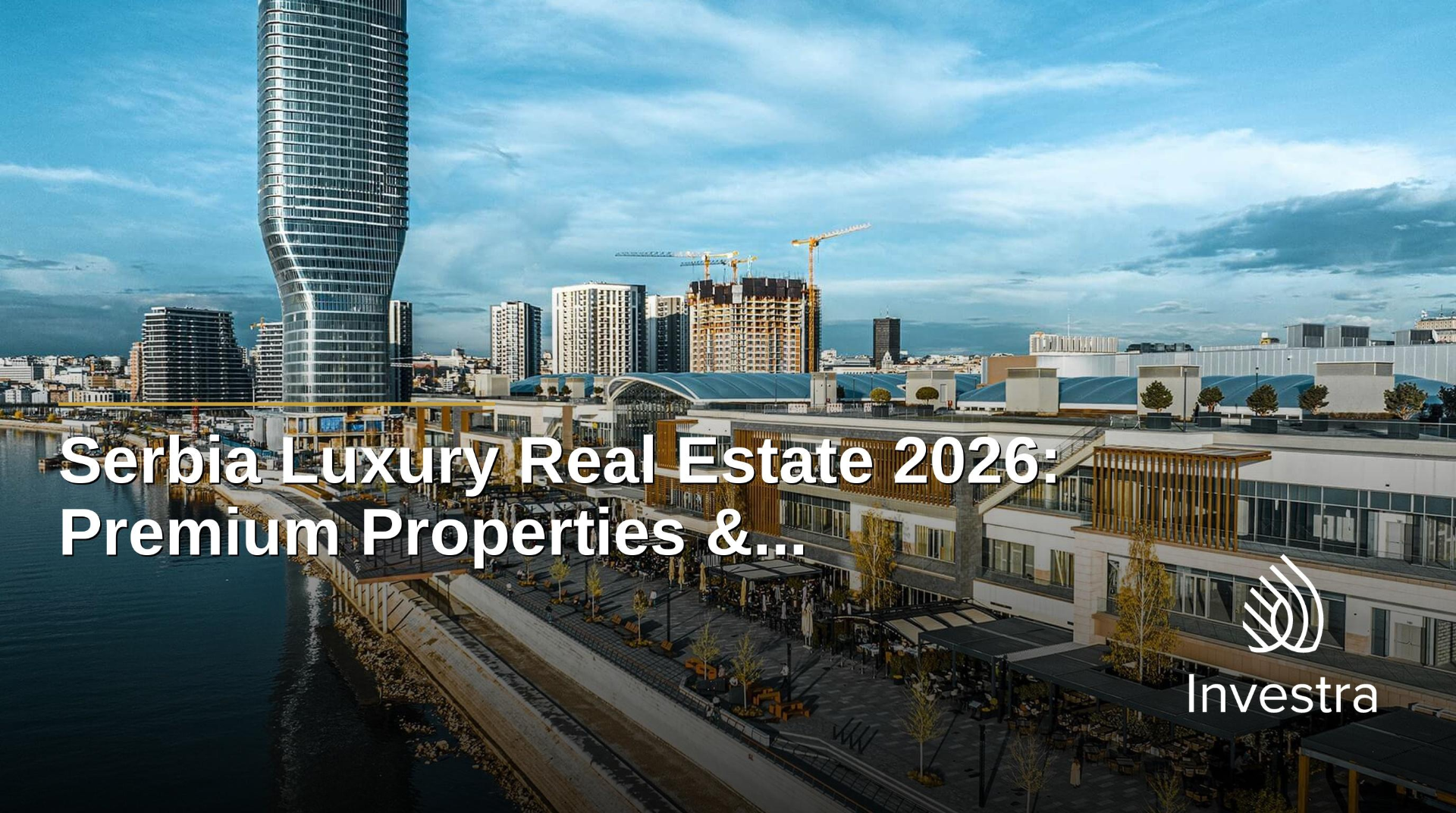
Serbia Luxury Real Estate 2026: Premium Properties &...
Serbia Luxury Real Estate 2026: Premium Properties & Ultra-High-Net-Worth Buyers
Why Serbia Draws Wealthy Buyers in 2026
Serbia sits at the crossroads of Europe and offers a combination of low entry costs relative to Western capitals, improving infrastructure, and a growing reputation for safety and lifestyle. Ultra-high-net-worth buyers from Russia, the Middle East, and Western Europe have increased their presence since 2023, drawn by political stability and the ability to acquire property without residency requirements in many cases.
Compared with cities such as Budapest or Bucharest, Belgrade still trades at a discount for equivalent quality, yet the gap narrows each year. This price differential creates an opening for buyers who want capital appreciation without paying Paris or London premiums. Many arrive first for short visits, then decide to keep a foothold after seeing the pace of new developments and the quality of private schools and medical facilities now available.
Market Overview for Premium Properties
The luxury segment, defined as units above 3,500 EUR per square meter, accounts for roughly 12 percent of total transaction value in Belgrade. Average prices in this tier rose 7.4 percent in 2025 and are projected to add another 6 to 8 percent through 2026, supported by limited new supply in historic neighborhoods and steady demand from foreign buyers.
Belgrade Waterfront penthouses currently list between 6,200 and 8,900 EUR per square meter, while turnkey villas in established residential zones start around 4,800 EUR and reach 11,000 EUR for larger plots with pools. Net rental yields sit between 4.2 and 5.8 percent after management fees, with the strongest performers located near embassies and international schools. Total investor returns, combining rental income and price growth, have averaged 9.7 percent annually over the past three years according to local transaction data.
Foreign capital now represents close to 35 percent of luxury purchases, up from 22 percent in 2022. Buyers often finance 40 to 60 percent of the cost through local banks offering rates between 3.9 and 5.1 percent for non-residents with established credit histories. On Investra.io users can filter by price per square meter, expected yield, and distance to key amenities to narrow options quickly.
Supply Constraints and New Developments
Strict zoning in central areas limits large-scale construction, keeping inventory tight. Only 180 new luxury units are expected to reach completion in 2026 across the entire city, most of them in mid-rise buildings rather than high-density towers. This scarcity supports price resilience even if broader economic growth moderates.
Best Areas for Premium Acquisitions
Dedinje
Dedinje remains the traditional address for diplomats and long-term residents. Detached villas on plots of 800 square meters or more trade from 5,200 to 9,800 EUR per square meter. Recent sales include a 420-square-meter residence with staff quarters that closed at 7.1 million EUR. The neighborhood offers quick access to the city center yet maintains a quiet, green character favored by families.
Senjak
Senjak sits adjacent to Dedinje and appeals to buyers who prefer slightly smaller lots and lower maintenance. Average prices range from 4,900 to 7,400 EUR per square meter. The area has seen renewed interest from European buyers who value its established tree canopy and proximity to international kindergartens. A 280-square-meter modernized house sold in late 2025 for 1.85 million EUR, reflecting a 14 percent gain since 2023.
Belgrade Waterfront Penthouses
The waterfront development continues to attract younger ultra-high-net-worth buyers who want hotel-style services and river views. Finished penthouses average 7,800 EUR per square meter, with the largest units exceeding 300 square meters. Rental demand from corporate relocations supports yields near 5.3 percent, and resale liquidity remains strong because of the international marketing behind the project.
Further details on the overall residential market appear in the Serbia Real Estate Market 2026 overview. Readers considering legal steps can consult the Buying Property in Serbia as a Foreigner guide, while those focused solely on the capital may review the Belgrade Real Estate Market 2026 analysis.
Investment Potential Through 2026 and Beyond
Capital appreciation in prime districts has outpaced inflation by 4 to 6 percentage points annually since 2021. With Serbia advancing toward EU accession milestones, analysts expect continued convergence with regional pricing levels. A conservative projection shows 5 to 7 percent yearly price growth in Dedinje and Senjak through 2028, assuming no major external shocks.
Rental income provides a buffer during slower appreciation periods. Corporate tenants and diplomatic families sign 12- to 36-month leases at rates that cover operating costs and still deliver net yields above 4 percent. Currency risk stays modest because most luxury transactions clear in euros, matching the financing currency used by many foreign owners.
Investra.io lists verified properties with verified ownership documents and recent comparable sales, allowing buyers to model scenarios before traveling. Early positioning in established neighborhoods has historically produced the most consistent outcomes for international clients.
Additional market commentary and transaction examples are available from Real Estate Investment Insights by Siniša Dagary.
Legal Process
Acquiring premium real estate in Serbia requires careful navigation of a transparent yet detailed legal framework designed to protect both domestic and international buyers. Foreign investors enjoy equal rights to Serbian citizens when purchasing residential property, with the process anchored in the Law on Real Estate and the Cadastre. Every transaction must involve a licensed notary public who verifies identities, confirms clear title, and drafts the sales agreement. The notary ensures that the property is free from liens, mortgages, or disputes before any funds are transferred.
Foreign Ownership Regulations
Ultra-high-net-worth individuals benefit from Serbia’s straightforward rules allowing full ownership of apartments and houses. However, agricultural land purchases remain restricted unless a local company is established. For luxury assets in Dedinje, Senjak, or Belgrade Waterfront, buyers typically form a Serbian limited liability company to hold the asset, providing additional privacy and simplified inheritance planning. Legal counsel reviews the company’s founding documents and confirms compliance with anti-money laundering statutes.
Due Diligence and Contracts
Buyers should start with due diligence by pulling an extract from the Real Estate Cadastre, checking building permits, and confirming utility connections. The purchase agreement, written in both languages, covers payment schedules, penalty clauses, and delivery timelines. Notaries hold buyer funds in escrow until the title transfers. If any issues turn up, the buyer can renegotiate or pull out without penalty.
Closing the Transaction
Upon successful due diligence, the notary authenticates signatures and submits the contract to the cadastre office. Title registration typically concludes within 30 to 60 days. Once recorded, the buyer receives an official title deed confirming ownership. Legal representation throughout ensures seamless coordination between banks, notaries, and municipal authorities.
Tax Implications
Understanding Serbia’s tax environment is essential for preserving wealth when investing in luxury properties. The primary taxes affecting UHNW buyers include property transfer tax, annual property tax, and potential capital gains obligations upon future sale.
Property Transfer and VAT
Buyers pay a 3% property transfer tax on the purchase price or cadastral value, whichever is higher. New-build penthouses at Belgrade Waterfront may attract 10% VAT instead, depending on the developer’s status. Legal advisors calculate the most advantageous structure, sometimes routing the purchase through a company to optimize VAT recovery on commercial elements.
Annual Property Tax and Capital Gains
Annual property tax rates range from 0.4% to 2% of the assessed value, with luxury homes in prime Belgrade districts falling at the higher end. Capital gains tax of 15% applies to profits realized upon resale, though exemptions exist for properties held longer than ten years or used as primary residences. Double-taxation treaties with many countries help mitigate overlapping liabilities for international owners.
Practical Tips
Successful luxury acquisitions in Serbia reward preparation and local expertise. Engage a bilingual real estate attorney and a tax advisor early in the process. Schedule property viewings during different seasons to assess heating costs and neighborhood dynamics. For properties in gated Dedinje communities, verify HOA fees and security protocols in advance.
Financing and Currency Considerations
While local banks offer mortgage products to foreign buyers with sufficient documentation, many UHNW purchasers prefer cash transactions to expedite closing. Monitor EUR-RSD exchange rates closely, as most premium listings are denominated in euros. Establishing a local banking relationship facilitates seamless wire transfers and future property management payments.
Working with Specialized Advisors
Partner with agencies experienced in high-value transactions who maintain direct relationships with developers at Belgrade Waterfront and exclusive listings in Senjak. These professionals provide off-market opportunities and assist with interior customization requests common among discerning buyers.
Step-by-Step Guide
Follow this structured approach to ensure a smooth acquisition of Serbia’s finest properties.
Step 1: Define Objectives and Budget
Clarify investment horizon, usage plans, and total budget including taxes and renovation costs. Engage financial advisors to model projected returns and liquidity needs.
Step 2: Assemble Your Professional Team
Retain a Serbian attorney, tax consultant, and reputable buyer’s agent. Verify credentials through the Serbian Bar Association and client references.
Step 3: Conduct Market Research
Review current listings in Dedinje, Senjak, and Belgrade Waterfront. Compare price per square meter and analyze infrastructure developments that may influence future appreciation.
Step 4: Shortlist and Inspect Properties
Visit selected homes with your advisor. Commission independent inspections for structural integrity, especially in historic Senjak villas.
Step 5: Perform Due Diligence
Obtain all legal extracts and confirm no outstanding debts. Negotiate price and contract terms based on findings.
Step 6: Execute the Purchase Agreement
Sign the notarized contract and deposit funds into escrow. Monitor the cadastre registration process closely.
Step 7: Complete Post-Purchase Formalities
Update utility accounts, arrange insurance, and register with local tax authorities. Consider establishing property management services for ongoing maintenance.
Recommended Content
- Serbia Real Estate Market 2026: Complete Guide
- Buying Property in Serbia as a Foreigner 2026
- Belgrade Real Estate Market 2026
- Real Estate Investment Insights by Siniša Dagary
- Finds Group - Real Estate Investment Advisory
Odkrijte globalne investicijske priložnosti na Unifyr.space — vaš portal za pametne investicije.
📚 Recommended Content
Frequently Asked Questions
What are the legal requirements for foreigners buying luxury property in Serbia?
Foreigners enjoy equal rights to purchase residential real estate. A licensed notary must oversee the transaction, and due diligence via the cadastre is mandatory.
Is establishing a Serbian company necessary for buying premium homes?
It is not mandatory for apartments but offers advantages for privacy, inheritance, and potential VAT optimization on high-value acquisitions.
What taxes apply when purchasing luxury real estate in Belgrade?
Buyers typically pay 3% property transfer tax or 10% VAT on new builds, plus annual property tax ranging from 0.4% to 2% of assessed value.
How long does the property registration process take in Serbia?
Title registration usually completes within 30 to 60 days after the notary submits documents to the cadastre office.
Are there restrictions on agricultural land purchases for foreigners?
Foreigners cannot directly own agricultural land without forming a local company, though residential luxury properties face no such restrictions.
What financing options exist for UHNW buyers in Serbia?
Local banks offer mortgages to qualified foreign buyers, but most luxury transactions are completed in cash for speed and simplicity.
How can capital gains tax be minimized on future resale?
Properties held longer than ten years or used as primary residences may qualify for exemptions; double-taxation treaties also help reduce liabilities.
What due diligence steps are essential before signing a contract?
Obtain a cadastre extract, verify building permits, confirm no liens exist, and commission independent structural inspections.
Are there special considerations for properties in Dedinje or Senjak?
Verify HOA fees, security arrangements, and historical building restrictions common in these exclusive neighborhoods.
Should buyers engage local property management after purchase?
Yes, professional management ensures maintenance, tenant screening if rented, and compliance with ongoing tax and utility obligations.
Related Posts
No related posts available.
