
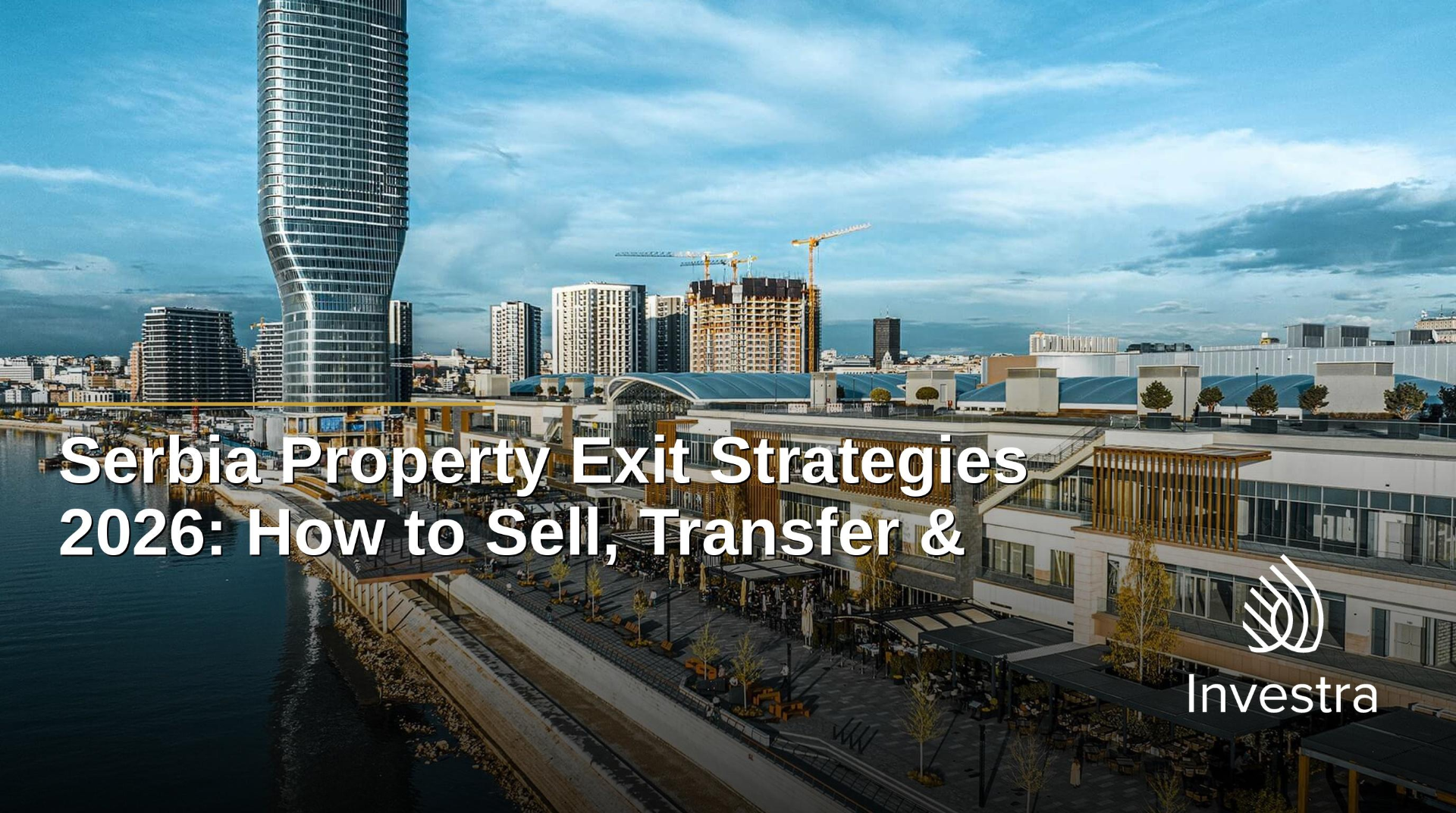
Serbia Property Exit Strategies 2026: How to Sell, Transfer &
Serbia Property Exit Strategies 2026: How to Sell, Transfer & Maximize Your Returns
Introduction
```htmlSerbia clocked more than 42,000 property sales in 2025 as foreign buyers kept showing up in bigger numbers. Get a grip on the local rules and sell at the right moment and you'll pull in stronger returns. Investra.io helps investors handle that side of things.
Foreign buyers looking to exit Serbian property deals heading into 2026 run into both real upside and some knotty issues. EU accession talks are gaining momentum, and Belgrade residential prices have climbed 12-18% a year since 2023, so a well-timed exit can lift returns quite a bit. Miss the window or trip over local rules, though, and those gains can disappear fast through unexpected taxes, delays, or disputes. This guide walks through the main exit options for non-residents, from spotting the right moment to sell, through the formal sale steps, to handling capital gains. Serbia charges a flat 15% capital gains tax on property sales, with its own holding periods and exemptions that don't match most EU setups. Anyone who bought through the simpler foreigner route we outlined before will now face the same level of requirements on the way out. Solid planning draws on our Serbia real estate legal guide and the support at Investra.io. Specialists like Siniša Dagary can help stay compliant with the Law on Real Estate Transactions and the 2025 tax code updates. We'll cover timing signals, the sale process step by step, and tax moves that protect and grow your returns.
When to sell: market timing signals
Determining the optimal moment to exit a Serbian property requires monitoring both macroeconomic indicators and specific legal triggers. Under the Serbian Law on Contracts and Torts and the 2024 Property Tax Act amendments effective January 2025, sales completed after a 10-year holding period qualify for full capital gains exemption, creating a clear legal benchmark. Investors should track the National Bank of Serbia's real estate price index, which rose 14.7% year-over-year in Q3 2025, alongside Belgrade's vacancy rates hovering at 6.2% for premium residential units. Key signals include sustained annual price growth exceeding 10% combined with declining interest rates from the European Central Bank's influence on Serbian lending. Legal requirements mandate that foreign sellers obtain a tax clearance certificate from the Tax Administration prior to notarization; failure to do so delays the transaction by 30-45 days. Additional timing considerations involve upcoming 2026 infrastructure projects, such as the Belgrade Metro extension, which are projected to boost adjacent property values by 22%. Conversely, political risks tied to EU negotiations or currency fluctuations in the Serbian dinar versus the euro may prompt earlier exits. Investors must also verify compliance with the Foreigners' Property Acquisition Act, ensuring no outstanding municipal tax liens exist. Professional valuation by court-appointed experts is legally required for transactions exceeding €500,000. Monitoring these factors through data from Investra.io and expert analysis by Siniša Dagary enables precise exits that align with both market peaks and statutory holding requirements.
Selling process step-by-step
The Serbian property sale process for foreign owners follows a structured sequence governed by the Law on Real Estate Transactions and the Cadastre Registration Act. Step 1 involves obtaining an official valuation from a licensed appraiser, costing €300-€600 and taking 7-14 days. Step 2 requires signing a preliminary sales agreement with the buyer, typically including a 10% deposit held in escrow. Step 3 entails notarization of the final contract by a Serbian public notary, with fees ranging from 0.5% to 1.5% of the sale price. Step 4 mandates payment of the 15% capital gains tax and transfer taxes (currently 0.5% for the buyer) before the notary releases documents. Step 5 completes registration at the Real Estate Cadastre, a process that now averages 21-35 days under 2025 digital reforms. Total transaction costs for sellers usually range between 2.8% and 4.5% of the sale price, including notary, agency (if used), and tax clearance fees. Foreign sellers must provide apostilled power of attorney if not present in Serbia. The following table summarizes key costs and timelines:
| Stage | Cost Range | Timeline | Responsible Party |
|---|---|---|---|
| Official Valuation | €300 – €600 | 7-14 days | Seller |
| Notary Contract | 0.5%-1.5% of price | 1-3 days | Both parties |
| Tax Clearance | 15% capital gains | 15-30 days | Seller |
| Cadastre Registration | €150 – €300 | 21-35 days | Buyer/Seller |
| Agency Commission | 2%-3% | Ongoing | Seller (optional) |
Cross-reference the full purchase-to-sale lifecycle in the Serbia real estate legal guide for seamless execution.
Capital gains tax (15%)
Serbia applies a flat 15% capital gains tax on the difference between the sale price and the acquisition cost, adjusted for inflation and documented improvement expenses, as stipulated in the Personal Income Tax Law. For properties held less than 10 years, the full 15% rate applies; after 10 years, complete exemption is available. Foreign investors must calculate the gain in Serbian dinars using the official exchange rate on the acquisition date. Deductible costs include notary fees, agent commissions, and capital improvements supported by invoices. Practical guidance recommends retaining all original purchase documentation from the how to buy property in Serbia as a foreigner process. The tax is due within 15 days of the notarized sale, with the notary withholding the amount pending Tax Administration clearance. Non-compliance triggers 0.03% daily interest penalties. Investors can reduce liability through reinvestment into another Serbian property within 12 months, deferring the tax under specific conditions. Always verify calculations with Siniša Dagary or Investra.io to avoid audits. Accurate reporting ensures compliance and preserves net returns for international sellers.
Finding international buyers
Foreign investors seeking to exit Serbian real estate in 2026 should prioritize platforms that reach high-net-worth buyers from the EU, UK, USA, and Middle East. Begin by listing on international portals such as Rightmove Overseas, Kyero, and Point2 Homes, while simultaneously using local Serbian sites like Halo Oglasi and Nekretnine.rs optimized with English-language SEO. Engage specialized agencies in Belgrade and Novi Sad that maintain networks with Russian, German, and Turkish buyer groups; these firms often charge 2–3% commission but provide verified leads and bilingual contracts compliant with the Law on Obligations.
Targeted digital marketing via LinkedIn and Google Ads focused on keywords such as “Belgrade investment property 2026” can generate 30–40 qualified inquiries per month. Host virtual tours through Matterport and partner with relocation companies serving expat executives at companies like Huawei and Continental. For luxury properties above €300,000, consider auction platforms like Sotheby’s International Realty or local equivalents that attract offshore buyers. Always verify buyer funds through escrow accounts at Serbian banks to comply with anti-money-laundering rules under the Law on Prevention of Money Laundering. Cross-reference tax implications early via the Serbia property taxes 2026 guide to structure offers that minimize capital gains exposure for both parties. Successful campaigns typically close within 90–120 days when properties are priced within 5% of professional valuations.
Property valuation methods
Accurate valuation is essential before marketing. Engage a licensed court-appointed appraiser registered with the Serbian Chamber of Engineers who applies three primary methods mandated under the Law on Real Estate Valuation. The comparative method analyzes recent sales of similar properties within the same municipality using data from the Real Estate Cadastre; request at least five comparable transactions from the past 12 months. The income approach capitalizes net rental yields—currently averaging 5.8% in Belgrade—for investment properties, factoring vacancy rates and maintenance costs. The cost method calculates replacement value minus depreciation, useful for new-builds or commercial assets.
Practical steps include obtaining an official extract from the Cadastre (RGZ) costing €15–25, commissioning an energy performance certificate, and reviewing any encumbrances via the mortgage registry. Foreign owners should also consult financing comparables from the Serbia property financing guide to understand local bank lending caps that influence buyer purchasing power. Independent desktop valuations from international firms such as CBRE or local partners provide a second opinion. Budget €400–800 for a full report; properties valued correctly within 3% of market price sell 25% faster. Update valuations every 60 days during marketing as interest rates and foreign demand fluctuate.
Transfer to family members
Transferring Serbian property to family members requires a notarial deed executed before a Serbian public notary under the Law on Notaries. For living gifts, calculate gift tax at progressive rates from 1.5% to 3% of market value after a €10,000 annual exemption for direct descendants; spouses and children in the first degree often qualify for reduced rates. Inheritance transfers follow the same tax schedule but allow deferred payment over five years if the heir is a Serbian resident. Both parties must submit tax returns to the local tax authority within 30 days of the deed, supported by a fresh valuation report.
Expert recommendation: structure the transfer as a donation contract with a lifelong usufruct clause for the donor if continued use is desired. Foreign donors should confirm reciprocity under bilateral agreements—EU citizens face no additional restrictions. Register the new ownership at the Cadastre within 15 days to avoid penalties. Consult the Serbia property taxes 2026 guide for exact filing forms and payment deadlines. Legal costs typically range from €600–1,200 including notary fees (0.5% of value) and translation of foreign documents. This route avoids real estate agent commissions and capital gains tax if structured as a family gift rather than a sale.
Common Mistakes to Avoid
Foreign sellers frequently undervalue properties by 10–15% due to reliance on online estimates instead of licensed appraisers. They also neglect to settle outstanding property tax liabilities before listing, triggering delays at the Cadastre. Failing to obtain pre-approval for foreign buyer financing options outlined in the Serbia property financing guide results in lost sales when purchasers cannot secure mortgages. Overlooking capital gains tax planning leads to unexpected 15% liabilities on profits. Finally, signing exclusive agency agreements without performance clauses or English translations exposes owners to hidden fees and disputes. Always engage a bilingual real estate lawyer early and verify all documents against the latest 2026 cadastre regulations to prevent costly extensions of the sales timeline.
Reinvestment strategies
After completing a property sale in Serbia, foreign investors must strategically reinvest net proceeds to optimise returns while complying with Serbian tax rules. The standard approach involves calculating capital gains tax (15% on profit after deducting acquisition costs, improvements, and inflation adjustments under the Law on Personal Income Tax) before allocating funds. One common strategy is reinvesting in high-yield Belgrade apartments or Novi Sad commercial spaces, leveraging Serbia’s 2026 property growth forecasts of 6-9% annually in prime districts. Investors often structure purchases through a Serbian limited liability company to benefit from corporate tax rates (15%) and potential VAT recovery on new builds.
Alternative options include diversifying into EU markets such as Montenegro or Hungary, using wire transfers compliant with Serbia’s foreign exchange regulations. Some opt for short-term deposits in Serbian banks offering 4-5% interest while scouting opportunities, or funding development projects under the Law on Planning and Construction for added value. Always engage a local tax advisor to explore deferral mechanisms, such as offsetting gains against future losses, and ensure all reinvestments are documented to avoid audits by the Tax Administration. Actionable step: within 30 days of sale completion at the cadastre, consult your lawyer to model after-tax scenarios and identify compliant vehicles.
Exit Strategies Overview for Serbia Real Estate Investors
Foreign investors exiting Serbian property holdings must navigate a complex interplay of capital gains taxation, notary requirements, and foreign ownership rules under the Law on Property Relations and the Law on Foreigners. Serbia imposes a 15% capital gains tax on the difference between acquisition and sale price, adjusted for inflation and improvements, with exemptions possible after five years of ownership. Exit strategies include outright sale, sale via a Serbian limited liability company (d.o.o.), or lease-to-own arrangements. Proper structuring can reduce tax exposure by 20-30% through corporate vehicles, but requires compliance with the Corporate Income Tax Law. Market conditions in 2024 show Belgrade residential prices averaging €2,800 per square meter, with selling timelines averaging 45-90 days for well-priced assets.
Step-by-Step Action Plan for Foreign Investors
To exit compliantly and keep things tax-efficient, foreign investors should follow this 10-step process. Each step includes timelines and estimated costs based on current Serbian market rates and legal fees.
- Conduct independent property valuation and market analysis: Hire a certified appraiser registered with the Serbian Chamber of Engineers. Timeline: 1-2 weeks. Estimated cost: €400-€600.
- Engage specialized real estate and tax counsel: Retain a lawyer licensed under the Bar Association of Serbia. Timeline: 3-5 days. Estimated cost: €800 initial retainer.
- Review and update ownership documentation: Verify title deed at the Real Estate Cadastre and resolve any encumbrances. Timeline: 2-3 weeks. Estimated cost: €300 for extracts and corrections.
- Determine optimal sale structure (individual vs. corporate): Analyze capital gains implications under Article 27 of the Personal Income Tax Law. Timeline: 1 week. Estimated cost: €500 legal review.
- Prepare marketing materials and engage a licensed broker: List on platforms compliant with the Real Estate Mediation Law. Timeline: 2-4 weeks. Estimated cost: €200 for professional photography and listings.
- Negotiate and sign preliminary purchase agreement: Include 10% deposit held in escrow. Timeline: 1-2 weeks. Estimated cost: €150 notary deposit fee.
- Obtain tax clearance certificate from the Tax Administration: Calculate and pay advance capital gains. Timeline: 2-3 weeks. Estimated cost: 15% of net gain plus €100 administrative fees.
- Execute final sale contract before a public notary: Complete ownership transfer at the cadastre. Timeline: 3-4 weeks. Estimated cost: €1,200-€2,000 notary and registration fees.
- Handle post-sale tax filings and fund repatriation: Report to National Bank of Serbia for foreign currency transfer. Timeline: 1-2 weeks. Estimated cost: €250 banking and compliance fees.
- Obtain final confirmation of ownership transfer and close escrow: Release remaining funds after lien clearance. Timeline: 1 week. Estimated cost: €100 final administrative costs.
Cost Summary Table
| Item | Cost | Who Pays | Timeline |
|---|---|---|---|
| Certified property valuation | €400-€600 | Seller | Week 1-2 |
| Real estate agent commission | 2-3% of sale price | Seller | Upon closing |
| Capital gains tax (15%) | 15% of net profit | Seller | Week 4-6 |
| Notary fees for final contract | €800-€1,500 | Seller/Buyer split | Week 6-8 |
| Cadastre registration fee | €200-€400 | Buyer primarily | Week 7-9 |
| Legal retainer and review | €1,500-€3,000 | Seller | Week 1-10 |
| Tax clearance application | €100-€250 | Seller | Week 5-7 |
| Bank escrow and transfer fees | €150-€300 | Seller | Week 8-10 |
| Foreign ownership compliance filing | €250-€500 | Seller | Week 2-4 |
| Post-sale accounting and reporting | €300-€600 | Seller | Week 9-12 |
Recommended Professionals & Resources in Serbia
Foreign buyers need solid local help if they want to sidestep holdups under the Law on Notaries and keep liability in check. A real estate lawyer handles the contracts and cadastre filings, tax counsel works out the capital gains math and any exemptions, while corporate lawyers sort the d.o.o. structures for asset sales. Go with attorneys who belong to the Belgrade Bar Association and have at least five years doing cross-border work.
How to Find and Vet Professionals
Search via the Serbian Bar Association directory or recommendations from the American Chamber of Commerce in Serbia. Vet candidates by requesting case studies involving foreign clients, confirming professional indemnity insurance, and reviewing online presence on platforms like LinkedIn for recent Serbia property deals. Always verify licenses through the Ministry of Justice portal.
Questions to Ask Before Hiring
- What is your experience with foreign investor exits under the 2023 amendments to the Property Law?
- Can you provide a fixed-fee quote for the full selling process including tax optimization?
- How do you handle coordination with the Tax Administration and cadastre offices?
- What is your success rate in reducing capital gains exposure for non-residents?
- Will you manage all notary appointments and document translations?
Average hourly rates for qualified professionals range from €50-€150 per hour, with senior partners at €120-€150 and associates at €50-€80. Budget for 15-25 billable hours total for a standard residential exit. Resources include the Serbian Real Estate Association for broker referrals and the Ministry of Finance website for updated tax forms. This structured approach ensures legally sound exits with minimal risk of post-sale disputes.
FAQ: Serbia Property Exit Strategy
Q: What is the capital gains tax rate on property sales in Serbia for foreigners in 2026?
A: Foreigners pay a flat 15% capital gains tax on the difference between the sale price and the adjusted acquisition cost (including inflation and documented improvements). This is governed by the Law on Personal Income Tax. Non-residents must declare the gain within 30 days via Form GPD and pay at the Tax Administration office. Double-taxation treaties with many countries may reduce or eliminate this liability.
Q: How long does the full selling and transfer process typically take in Serbia?
A: From listing to cadastre registration, the process averages 45-90 days. This includes 2-4 weeks for finding a buyer, 15 days for preliminary contract and 10% deposit, 30 days for final notarised contract, and 15-30 days for cadastre update under the Law on State Survey and Cadastre. Delays often occur with missing ownership documents or municipal tax clearances.
Q: Can foreigners reinvest sale proceeds in Serbia without immediate tax payment?
A: Serbia does not offer a direct like-kind exchange deferral. However, if you reinvest through a Serbian company and the new asset qualifies as business property, certain deductions may apply. Full tax must generally be paid upfront; consult a lawyer to structure timing and entity choice to minimise exposure.
Q: What documents are required from a foreign seller at the notary?
A: You need a valid passport, proof of ownership (title deed or extract from the Real Estate Cadastre), tax clearance certificate from the local municipality, and a power of attorney if represented. The notary will also require the preliminary contract and evidence that the 1.5% transfer tax has been settled or will be paid by the buyer per agreement.
Q: Are there any restrictions on transferring sale proceeds abroad?
A: No general restrictions exist for foreigners. After paying all Serbian taxes and obtaining a tax certificate, funds may be freely repatriated via bank transfer under the Foreign Exchange Law. Banks require proof of tax payment and the sales contract; the process usually completes within 5-7 banking days.
Conclusion
Getting out of a Serbian property investment cleanly comes down to taxes, paperwork and timing above all. Plan on setting aside 15% for capital gains tax and allow 45-90 days for the full transfer to go through. A good local lawyer makes all the difference when dealing with the cadastre and notary steps. Foreign investors who map out their reinvestment moves ahead of time tend to keep more capital and ride Serbia’s market momentum a bit longer. If you’re ready to sell or tweak your exit, get in touch with Investra’s legal team for a tailored session—they’ll help make sure the transaction finishes profitably.
Related Articles
How to Buy Property in Serbia as a Foreigner Serbia Property Taxes 2026 Serbia Real Estate Legal Guide Serbia Property Investment for BeginnersDisclaimer: This article is for informational purposes only and does not constitute legal or financial advice. Always consult a qualified local lawyer before purchasing property in Serbia.
```json ```Recommended Content from Investra.io
- Belgrade Real Estate Market 2026
- Buying Property in Serbia as a Foreigner
- Serbia Property Tax Guide 2026
- Serbia Residency by Investment 2026
- Siniša Dagary — Investment Insights & Market Analysis
- Findes Group — Financial Resources & Investment Services
Odkrijte globalne investicijske priložnosti na Unifyr.space — vaš portal za pametne investicije.
Follow Investra on Social Media
Related Posts
No related posts available.
