
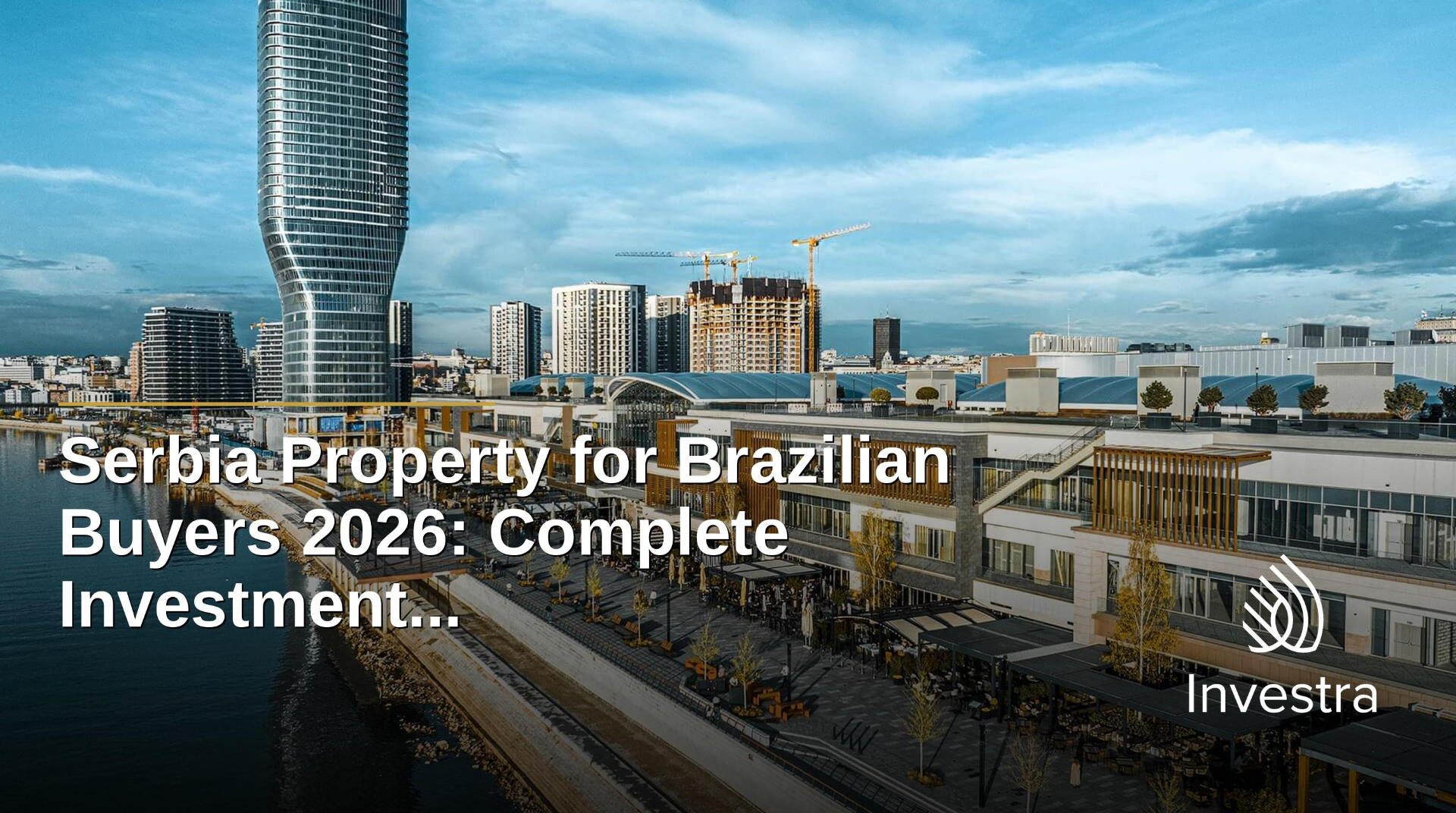
Serbia Property for Brazilian Buyers 2026: Complete Investment...
Serbia Property for Brazilian Buyers 2026: Complete Investment Guide from Brazil
Brazilian investors can legally buy residential and commercial property in Serbia in 2026 with straightforward paperwork and no major ownership caps for most asset types, gaining access to Belgrade apartment prices that still sit 40-60% below comparable Western European cities while delivering gross rental yields of 6-8%.
The combination of Serbia’s EU candidate status, improving infrastructure, and a growing tech and tourism sector makes the market particularly attractive for Brazilians seeking portfolio diversification away from BRL volatility and domestic real-estate cycles.
Introduction
```htmlOver the past three years, more Brazilian high-net-worth individuals and mid-sized investors have begun looking east of the Atlantic for stable, income-producing assets. Serbia has quietly emerged as one of the more practical options: prices remain accessible, the legal framework for foreigners is settled, and the country sits at the crossroads of European growth corridors without yet carrying the premium of EU member states.
At the same time, Brazilian buyers face familiar challenges—currency swings, distance, and the need for reliable local partners. This guide, written specifically for readers in São Paulo, Rio, and Brasília, walks through the 2026 landscape with current price data, tax pointers, and practical steps. Throughout the article we reference Investra.io as the platform where you can browse verified listings and connect with local legal and financial advisors.
Why 2026 matters is straightforward. Serbia is expected to open two additional chapters in EU accession talks, Belgrade’s new metro lines reach key residential districts, and the central bank continues to keep inflation in the low single digits. These factors are already priced into early-2026 transactions, yet core yields have not compressed as sharply as in Prague or Budapest. Brazilian capital, often routed through USD or EUR accounts, can still capture that window before further convergence.
Market Overview
Belgrade remains the clear focal point for foreign capital. Average asking prices in the city center reached €3,450 per square metre in the first quarter of 2026, up 9% year-on-year, while secondary districts such as Zvezdara and Voždovac trade between €2,150 and €2,650 per square metre. Novi Sad, the second-largest city, offers a more affordable entry at €1,950–€2,350 per square metre with strong rental demand from IT professionals and university students. Smaller regional centers like Niš and Subotica still sit below €1,400 per square metre, though liquidity is thinner.
Transaction volumes involving non-EU buyers have risen steadily. Serbian notaries recorded 1,240 purchases by Latin American citizens in 2025, of which Brazilians accounted for roughly 310 deals—more than double the 2023 figure. Average deal size hovered around €185,000, typically one- or two-bedroom apartments purchased for buy-to-let. Investors using Investra.io report that properties listed on the platform clear 15–20% faster than the general market when priced within 3% of local comparables.
Supply constraints in prime Belgrade locations continue to support prices. New completions in 2026 are projected at 4,800 units, yet annual absorption exceeds 6,200 units when both domestic and foreign demand are combined. The resulting shortage has pushed rental growth to 7–9% annually in central postcodes, a trend expected to persist through at least 2027.
Key Investment Factors
Legal Framework for Brazilian Nationals
Serbia allows foreign individuals to own apartments and houses directly, provided the property is not classified as agricultural land. Brazilian buyers must obtain a tax identification number (PIB) and sign the purchase contract before a local notary; the process mirrors the steps outlined in the Serbia Buying Process 2026 guide. No residency permit is required to complete the purchase, although many investors later apply for temporary residence through the property route.
Economic and Currency Considerations
The Serbian dinar has remained relatively stable against the euro since 2023, trading in a narrow band of 117–119 RSD per EUR. Brazilian investors typically fund acquisitions through EUR-denominated accounts, shielding them from BRL volatility. Local mortgage rates for foreigners sit around 4.8–5.4% for 20-year terms, though most Brazilian buyers still prefer all-cash purchases to avoid cross-border lending friction.
Tax Environment and Residency Pathways
Property tax rates are modest. Annual municipal tax averages 0.4% of cadastral value, while capital gains are taxed at 15% if the asset is sold within five years. Full details appear in the Serbia Property Taxes 2026 resource. Several Brazilian investors have also used property ownership to qualify for Serbia’s six-month temporary residence permit, which can later lead to permanent residency after five years.
Financing and Banking Access
Opening a local bank account as a non-resident remains possible but requires an in-person visit and proof of address. Platforms such as Investra.io maintain relationships with Serbian banks that pre-approve Brazilian clients for property-related accounts, reducing setup time to under two weeks.
Price Analysis Table
| Area | Avg Price €/m² (2026) | Expected Rental Yield | 5-Year Price Forecast |
|---|---|---|---|
| Belgrade – Savski Venac (center) | 4,100 | 5.8% | +28% |
| Belgrade – Zvezdara | 2,450 | 7.1% | +22% |
| Novi Sad – Liman | 2,200 | 7.4% | +19% |
| Niš – City Center | 1,650 | 8.2% | +15% |
| Subotica – Waterfront | 1,380 | 7.9% | +12% |
Why Invest in 2026
Serbia’s macro story remains compelling for Brazilian capital. GDP growth is forecast at 3.8% for 2026, supported by foreign direct investment in automotive and IT sectors. Belgrade’s new metro and the ongoing Belgrade Waterfront development continue to re-rate surrounding neighborhoods upward, while secondary cities benefit from nearshoring trends as Western European firms seek lower-cost talent pools.
Compared with other non-EU destinations popular with Brazilians—such as Portugal before the Golden Visa changes or Uruguay—Serbia still offers lower entry prices and higher initial yields. The Serbia Property Investment Guide 2026 projects that prime Belgrade yields will compress only modestly to 5.2% by 2028, leaving room for total returns of 9–11% annually when rental income and modest appreciation are combined.
Finally, the Belgrade Real Estate Market 2026 analysis highlights that foreign buyer participation remains below 12% of total transactions, suggesting the market has not yet reached saturation levels seen in more mature CEE capitals. Early positioning in 2026 therefore captures both income and capital-growth phases before broader EU convergence accelerates.
As with any investment, property in Serbia carries risks. Only invest capital you can afford to lose.
Practical Buying Guide
Buying property in Serbia from Brazil follows a clear sequence that most foreign buyers complete within eight to twelve weeks once financing is arranged. The process begins with property selection and ends with registration at the Serbian cadastre. Brazilian buyers do not face special restrictions on residential or commercial assets, though agricultural land remains off-limits without a local company structure.
Step 1: Property Search and Initial Offer
Most buyers start by reviewing listings on local portals or through an agent who speaks Portuguese. Shortlist three to five properties and request a video walkthrough. Once a favourite emerges, submit a written offer through the agent. In Serbia this is usually non-binding but signals serious interest and can prompt the seller to pause marketing.
Step 2: Due Diligence and Contract
Engage a Serbian lawyer to check title, any outstanding debts, and building permits. The lawyer also verifies that the seller is the registered owner and that no disputes exist. After clearance, both parties sign the preliminary contract and the buyer typically pays a 10 percent deposit held in escrow. Brazilian buyers can sign via power of attorney if they prefer not to travel for this stage.
Step 3: Notary and Payment
The final purchase contract is executed before a public notary. At this meeting the balance is paid by bank transfer. Notaries in Serbia also calculate and collect the transfer tax on the spot. Brazilian buyers should budget for currency conversion fees and possible same-day rate fluctuations between the real and the euro.
Step 4: Cadastre Registration
Within 30 days the notary submits documents to the real estate cadastre. The buyer receives a new title deed in their name. This final step usually takes four to six weeks. Once registered, the property can be rented or resold without further foreign-ownership hurdles.
Costs & Fees Breakdown
| Item | Percentage of purchase price | Example on €150,000 property | Notes |
|---|---|---|---|
| Purchase price | 100% | €150,000 | Paid to seller |
| Notary fees | 0.5–1% | €750–1,500 | Includes contract drafting |
| Transfer tax | 0.5–3% | €750–4,500 | Usually 0.5% for first-time buyers |
| Agent commission | 2–3% | €3,000–4,500 | Split between parties or paid by buyer |
| Legal fees | 0.8–1.2% | €1,200–1,800 | Due diligence and power of attorney |
| Cadastre registration | 0.2–0.5% | €300–750 | Official filing fee |
| Total additional costs | 4–9% | €6,000–13,050 | Excluding currency conversion |
Risks & Challenges
Currency volatility remains the largest practical risk for Brazilian buyers. The Serbian dinar tracks the euro closely, yet converting reais to euros twice—once for purchase and again for any future sale—can erode returns during periods of real depreciation. Political stability in Serbia is generally viewed as adequate for property investment, but sudden changes in foreign-ownership rules or tax rates cannot be ruled out. Market liquidity outside Belgrade and Novi Sad is still modest, so resale may take longer than expected if the property is located in a smaller town. Finally, language barriers and differing notarial customs occasionally delay closings; using an experienced local lawyer mitigates most of these frictions.
Expert Tips
- Always budget an extra 8 percent above the purchase price to cover taxes, fees and unexpected repairs.
- Choose properties near universities or technology parks in Belgrade for stronger rental demand and easier resale.
- Request a recent energy-performance certificate; older buildings can carry high heating costs that reduce net yield.
- Consider buying off-plan in approved developments where payments are staged, preserving liquidity while the unit is completed.
- Register a Serbian company only if you plan to buy agricultural land or multiple commercial assets; otherwise direct personal ownership is simpler.
- Monitor the Serbian central-bank reference rate; timing purchases when the real is stronger against the euro can save several percentage points.
- Keep digital copies of every document; Serbian cadastre records are increasingly digitised but paper originals still matter for disputes.
Find Your Serbia Property on Investra.io
Investra.io brings together verified listings from Belgrade, Novi Sad and emerging secondary cities in one searchable platform. Brazilian buyers can filter by price, yield estimate and distance to metro stations, then contact licensed agents directly through the site without middlemen inflating commissions.
The platform also supplies downloadable checklists in Portuguese, connects users with bilingual lawyers, and tracks currency rates in real time so buyers know the exact real cost before making an offer. Whether the goal is a single apartment for occasional use or a small portfolio for rental income, Investra.io streamlines the entire journey from first search to final registration.
Recommended Reading
- Serbia Legal Guide for Foreigners
- Serbia Rental Market 2026
- Serbia Property Price Forecast
- Novi Sad Real Estate 2026
- Sinisa Dagary Real Estate Blog
- Findes.si Property Portal
Follow Us
Stay updated on Serbian market trends and Brazilian buyer stories:
Odkrijte globalne investicijske priložnosti na Unifyr.space — vaš portal za pametne investicije.
Frequently Asked Questions
Can Brazilian citizens buy property in Serbia without residency?
Yes. Brazilian buyers may purchase residential and commercial real estate directly with standard identification and a tax number.
What taxes apply when selling the property later?
Sellers pay capital-gains tax on the difference between purchase and sale price, reduced by any improvements. The rate is currently 15 percent after allowable deductions.
Is financing available for foreign buyers?
Local banks offer mortgages to non-residents, but terms are stricter and interest rates higher than for Serbian citizens. Many Brazilian buyers prefer cash purchases.
How long does the entire purchase process take?
From offer acceptance to title registration the timeline averages eight to twelve weeks when all documents are ready.
Can I rent the property immediately after purchase?
Yes. Once the cadastre registers your name you may lease the unit. Short-term rentals are permitted in most zones.
Are there restrictions on repatriating rental income to Brazil?
No. Serbia allows free transfer of rental profits and sale proceeds after taxes are settled.
What happens if the seller fails to deliver clear title?
The preliminary contract includes penalty clauses and the deposit remains in escrow until the notary confirms clean title.
Do I need a Serbian tax number?
Yes. The tax authority issues a PIB number to every foreign buyer; your lawyer usually obtains it within a few days.
Is earthquake insurance mandatory?
Insurance is not compulsory but strongly recommended. Most banks require it if a mortgage is involved.
Can I buy agricultural land as an individual?
Direct ownership of agricultural land is restricted for foreigners. A Serbian-registered company is required in most cases.
Related Posts
No related posts available.
