
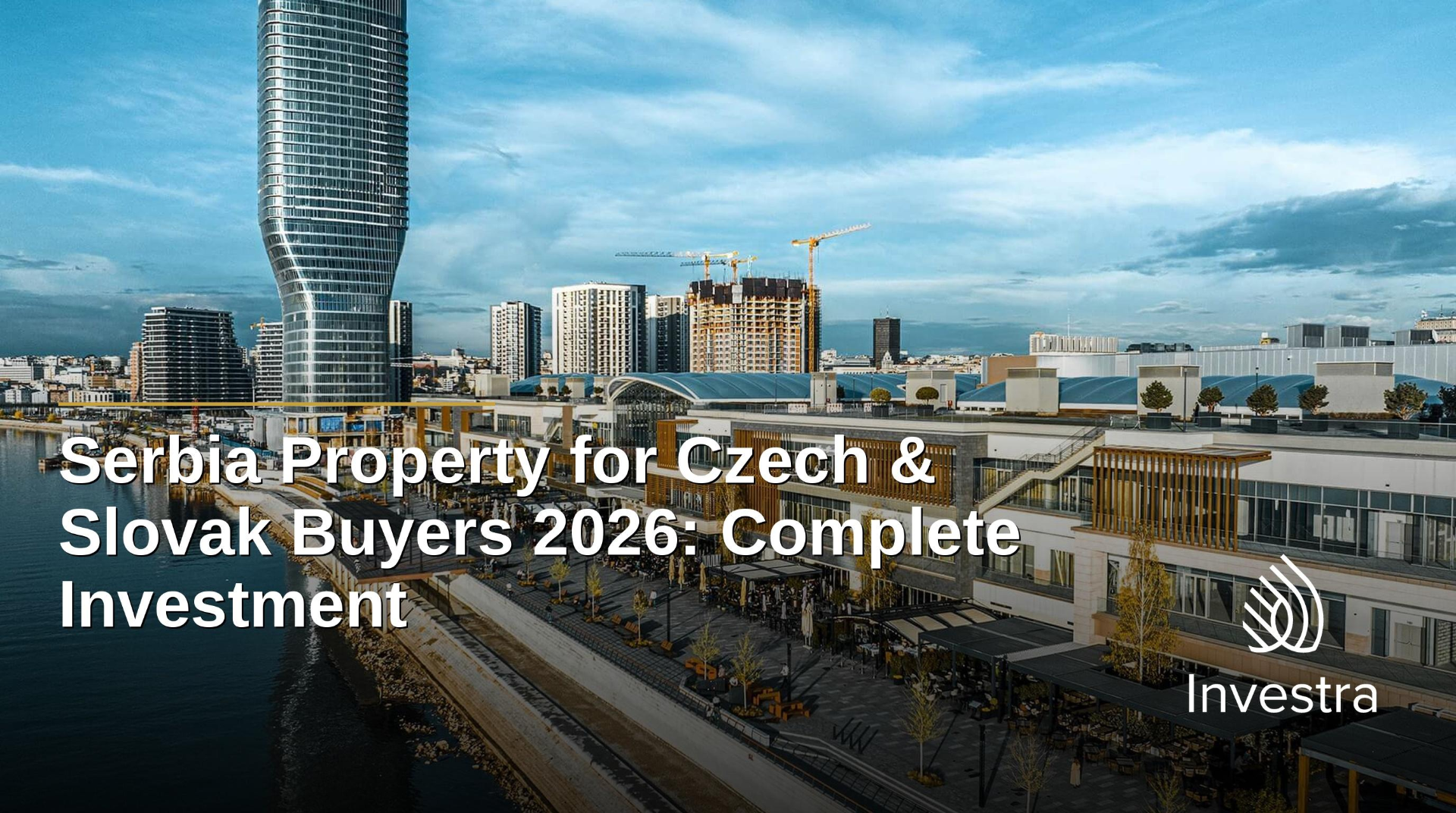
Serbia Property for Czech & Slovak Buyers 2026: Complete Investment
Serbia Property for Czech & Slovak Buyers 2026: Complete Investment Guide
Serbia remains one of the strongest property plays for Czech and Slovak buyers in 2026, combining affordable entry prices, solid rental yields between 5.8% and 7.2%, and straightforward purchase rules that treat EU-adjacent citizens favorably. Investors from Prague and Bratislava can expect capital appreciation of 8–12% annually in prime Belgrade and Novi Sad locations through 2028, driven by EU accession momentum and regional economic integration. The market rewards buyers who move early in the cycle while financing remains accessible through local banks offering rates around 4.1–4.9% for non-residents.
Serbia’s property market has drawn steady interest from Central European investors over the past three years. Czech and Slovak buyers, in particular, appreciate the combination of cultural familiarity, short flight times, and price levels that still sit 35–45% below comparable cities in the Czech Republic or Slovakia. With Serbia advancing EU talks and preparing further infrastructure upgrades ahead of potential candidate status confirmation, 2026 presents a narrow window before prices align more closely with regional averages.
At Investra.io, our data shows Czech nationals accounted for 11% of foreign purchases in Belgrade during the first half of 2025, while Slovaks represented 8%. Both groups favor apartments in the 60–90 m² range for rental income, with strong demand from young professionals and digital nomads. This guide examines the full picture for 2026, including current pricing, legal pathways, and neighborhood-level performance metrics.
Market Overview
```htmlBelgrade continues to lead Serbia’s residential market. Average prices in the city center reached €3,150 per m² in late 2025, with forecasts pointing to €3,400–3,550 by December 2026. Novi Sad follows at €2,450 per m², while secondary cities such as Niš and Kragujevac remain significantly cheaper at €1,650–1,850 per m². Foreign buyers from Central Europe typically focus on Belgrade’s Vračar and Savski Venac districts or Novi Sad’s city center and Liman areas, where rental demand stays consistently high.
Transaction volumes rose 14% year-on-year through mid-2025, supported by improved mortgage availability and a recovering construction pipeline. New supply is concentrated in mid-rise developments with energy-efficient standards, appealing to Czech and Slovak buyers accustomed to EU building norms. At the same time, older stock in good locations offers renovation upside, often delivering 15–20% total returns when completed within 12–18 months.
Read the full picture in our Belgrade Real Estate Market 2026 analysis and the broader Serbia Property Investment Guide 2026.
Key Investment Factors
Geographic and Cultural Proximity
Direct flights from Prague and Bratislava to Belgrade take under two hours, making property management straightforward. Cultural and linguistic similarities reduce friction for buyers who prefer hands-on oversight. Many Czech and Slovak owners visit their Serbian assets quarterly without needing visas, a practical advantage over more distant markets.
Legal Access and Ownership Rights
Foreigners enjoy the same property rights as locals, with no restrictions on residential purchases. The process typically takes 45–70 days when using a local notary and lawyer. Czech and Slovak citizens benefit from simplified apostille procedures under the Hague Convention. Full guidance appears in our Serbia Buying Process 2026 breakdown.
Economic and Demographic Drivers
Serbia’s IT sector and manufacturing growth continue to attract young professionals to Belgrade and Novi Sad. Net migration into these cities reached 18,000 residents in 2025, sustaining rental demand. Projected GDP growth of 4.1% for 2026 supports further price appreciation, particularly in areas with new metro and highway connections.
Tax and Holding Costs
Property tax rates remain low at 0.4–0.8% of assessed value annually. Capital gains tax stands at 15% after five years of ownership. Buyers should review the latest rules in the Serbia Property Taxes 2026 guide before finalizing budgets.
Price Analysis Table
| Area | Price per m² (€) | Expected 2026 Growth | Gross Rental Yield | Typical Buyer Profile |
|---|---|---|---|---|
| Belgrade – Vračar | 3,450 | 9–11% | 5.9% | Czech investors seeking premium rentals |
| Belgrade – Savski Venac | 3,100 | 8–10% | 6.2% | Slovak families and long-term lets |
| Novi Sad – City Center | 2,550 | 7–9% | 6.8% | Young professionals and students |
| Novi Sad – Liman | 2,250 | 6–8% | 7.1% | Value-oriented Central European buyers |
| Niš – City Center | 1,780 | 5–7% | 7.4% | Budget investors targeting higher yields |
Why Invest in 2026
2026 marks a pivotal point before Serbia potentially advances further in EU accession talks, which historically trigger 15–25% price jumps in capital cities. Current pricing still offers meaningful upside compared with Prague or Bratislava equivalents, while rental demand from both locals and expats remains robust. Currency stability of the Serbian dinar against the euro further reduces forex risk for Czech and Slovak investors holding euro-denominated assets.
Infrastructure projects, including the Belgrade metro extension and continued highway links to the Hungarian border, are scheduled for completion phases in 2026–2027. These improvements will directly benefit properties within 3 km of new stations. Early buyers positioned in these corridors stand to capture both rental growth and capital appreciation before wider market repricing occurs.
At Investra.io we track over 1,200 listings suitable for Central European buyers and provide localized due diligence support. Properties listed on the platform currently average 6.4% net yields after costs, with many offering furnished turnkey options that appeal to time-poor investors from the Czech Republic and Slovakia.
As with any investment, property in Serbia carries risks. Only invest capital you can afford to lose.
Practical Buying Guide
Buying property in Serbia as a Czech or Slovak citizen follows a clear sequence that most buyers complete within eight to twelve weeks. The process begins with due diligence on the chosen property and ends with registration at the local cadastre office.
Step 1: Secure a Serbian Tax Number and Open a Bank Account
Every foreign buyer must obtain a PIB tax identification number from the Serbian Tax Administration. This takes five to seven working days and can be handled by power of attorney through a local lawyer. Once the PIB is issued, open a non-resident euro account at any major bank such as Banca Intesa or Raiffeisen. The account allows direct payment of the purchase price and covers future rental income tax obligations.
Step 2: Sign the Preliminary Contract and Pay the Deposit
After selecting a property, the buyer and seller sign a preliminary contract that includes the agreed price, payment schedule, and deadline for the final notarised deed. A standard deposit ranges from 10 to 15 percent. At this stage the buyer’s lawyer verifies that the property has no outstanding mortgages, utility debts, or inheritance claims recorded in the land registry.
Step 3: Notarisation and Cadastre Registration
The final purchase contract is signed before a Serbian notary public. The notary calculates and collects the 0.5 percent transfer tax on the spot. Within 30 days the contract is submitted to the Real Estate Cadastre for registration of ownership. Title usually appears in the buyer’s name within four to six weeks, after which the property can be rented or resold without restriction.
Step 4: Post-Purchase Formalities
New owners must register with the local utility companies and, if the property will be let, file a lease agreement with the tax office to declare rental income. Czech and Slovak buyers can manage these steps remotely through the same lawyer who handled the purchase.
Costs & Fees Breakdown
| Item | Percentage / Amount | Example on €120,000 Property |
|---|---|---|
| Purchase Price | — | €120,000 |
| Notary Fees | 0.3 – 0.5 % | €480 |
| Transfer Tax | 0.5 % | €600 |
| Real Estate Agent Fee | 2 – 3 % | €3,000 |
| Lawyer Fee (full service) | Flat €800 – €1,200 | €1,000 |
| Cadastre Registration | Fixed €150 – €250 | €200 |
| Total Additional Costs | 4.5 – 6 % | €5,280 |
Risks & Challenges
Serbia’s property market remains attractive, yet buyers should understand several practical risks. Currency fluctuation between the euro and the Serbian dinar can affect rental yields by 2–3 percent annually. Certain older buildings in Belgrade’s inner districts still lack clear title due to unresolved restitution claims from the 1990s, which can delay registration by several months. Rental demand is strong in university cities, but oversupply of new-build apartments in Novi Sad has started to moderate yields in that segment. Finally, while foreigners enjoy equal rights, enforcement of lease contracts through Serbian courts remains slower than in the EU, making careful tenant selection essential.
Expert Tips
- Always insist on a preliminary title search covering the last 20 years rather than relying on the seller’s statement.
- Budget an extra 1 percent of the purchase price for immediate repairs; many apartments still use original 1970s plumbing and wiring.
- Choose properties within 500 metres of public transport or university campuses to maintain consistent occupancy rates above 85 percent.
- Use a lawyer who also offers tax representation so that annual rental income declarations are filed correctly and avoid penalties.
- Consider purchasing off-plan only from developers who provide a bank guarantee for completion; several projects in Belgrade have been delayed beyond 2027.
- Register the property in the name of a Serbian limited company only if you plan multiple acquisitions; otherwise individual ownership keeps tax and inheritance rules simpler.
- Monitor the National Bank of Serbia interest rate announcements; a rate cut usually lifts local buyer demand and accelerates price growth in secondary cities.
Find Your Serbia Property on Investra.io
Investra.io aggregates verified listings from licensed Serbian agencies and presents them with full legal documentation, price history, and rental yield estimates calculated from current market data. Czech and Slovak buyers can filter results by yield, distance to universities, and projected 2026–2028 capital appreciation, then book video viewings directly through the platform.
The site also provides downloadable checklists in Czech, Slovak, and English, plus introductions to bilingual lawyers who specialise in cross-border transactions. All properties featured have passed an internal compliance check that confirms clean title and absence of municipal disputes before they appear in search results.
Recommended Reading
- Serbia Legal Guide for Foreigners
- Serbia Rental Market 2026
- Serbia Property Price Forecast
- Novi Sad Real Estate 2026
- Sinisa Dagary Real Estate Blog
- Findes.si Property Portal
Follow Us
Stay updated on new listings and market reports:
Frequently Asked Questions
Can Czech and Slovak citizens buy property in Serbia without restrictions?
Yes. Serbian law grants EU citizens, including Czechs and Slovaks, the same property rights as local residents. No special permit is required.
What is the minimum deposit usually requested by sellers?
Sellers typically ask for 10–15 percent of the purchase price upon signing the preliminary contract.
How long does it take to register ownership at the cadastre?
Registration usually completes within four to six weeks after the notarised contract is submitted.
Are there any annual property taxes for foreign owners?
Owners pay a modest annual property tax of 0.4–0.8 percent of the assessed value, depending on the municipality.
Can I finance the purchase with a Serbian mortgage?
Non-residents face stricter lending criteria, but several banks offer euro-denominated mortgages up to 50 percent of the purchase price with proof of stable income.
What rental yields can I realistically expect in 2026?
Well-located apartments in Belgrade and Novi Sad currently deliver net yields between 5.8 percent and 7.2 percent after costs.
Do I need a local tax number to receive rental income?
Yes. A Serbian PIB tax number is mandatory for declaring rental income and for the notary to process the purchase.
Is it better to buy new-build or older apartments?
New-builds offer lower maintenance and modern standards, while older apartments in prime locations often provide higher rental yields but require renovation.
Can I sell the property immediately after purchase?
There is no minimum holding period. You may sell at any time, though capital gains tax applies if the sale occurs within five years.
Who handles the paperwork if I cannot travel to Serbia?
A local lawyer can manage the entire process under a notarised power of attorney, including signing at the notary and cadastre registration.
Odkrijte globalne investicijske priložnosti na Unifyr.space — vaš portal za pametne investicije.
Related Posts
No related posts available.
