
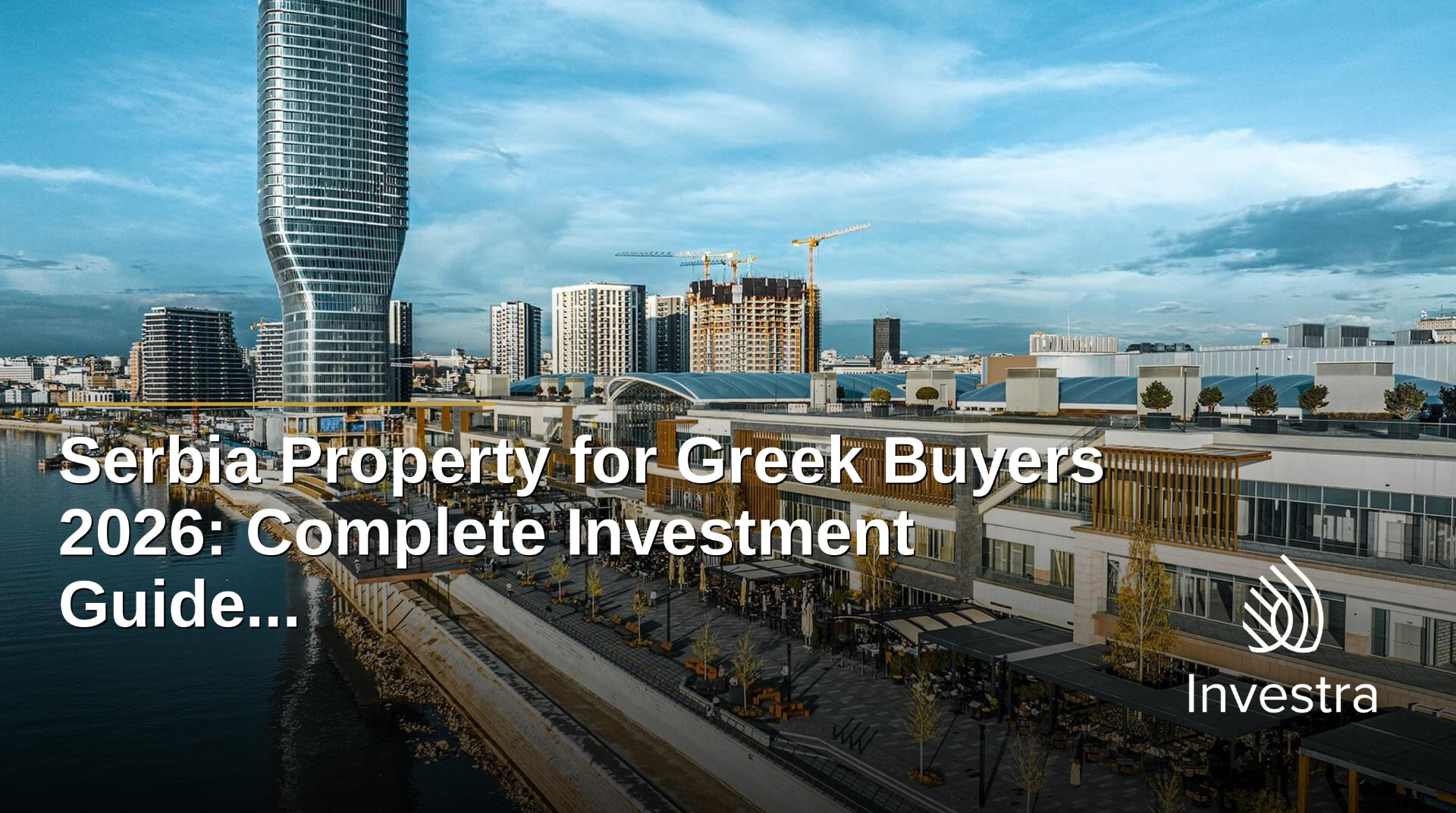
Serbia Property for Greek Buyers 2026: Complete Investment Guide...
Serbia Property for Greek Buyers 2026: Complete Investment Guide from Greece
Greek investors looking to diversify into Serbia can buy residential and commercial property without major legal barriers, with prime Belgrade locations averaging €2,900–€3,400 per square metre in early 2026 and gross rental yields typically ranging between 5.2% and 6.8%. The market remains accessible for non-EU buyers, supported by stable economic growth and improving infrastructure links between the two countries. Investors can explore current listings and verified local partners directly on Investra.io.
Introduction
```htmlFor Greek property buyers, 2026 marks a turning point. Domestic prices in Athens and Thessaloniki have climbed sharply since 2023, pushing many middle-class investors to seek higher yields and lower entry costs abroad. Serbia, just a short flight or drive away, has quietly become one of the most practical options. Political relations between Athens and Belgrade remain constructive, and the absence of visa requirements for Greek citizens simplifies both scouting trips and ongoing management of assets.
Serbia’s economy is expanding at a steady 3.5–4% annually, driven by foreign direct investment in manufacturing, IT services, and logistics. This growth has translated into consistent demand for quality housing in Belgrade and secondary cities such as Novi Sad and Niš. Greek buyers, already familiar with Balkan real-estate dynamics, find the Serbian market more transparent than many non-EU destinations while still offering capital appreciation potential that has largely disappeared from Greek city centres.
At the same time, cultural and linguistic proximity reduces friction. Many Serbian real-estate agents and lawyers speak Greek or work with Greek-speaking colleagues. This familiarity, combined with Serbia’s straightforward purchase process for foreigners, has encouraged a growing number of Greek families and small investment groups to acquire apartments, small commercial units, and development plots. Investors seeking deeper market context should review the Belgrade Real Estate Market 2026 analysis and the broader Serbia Property Investment Guide 2026 before committing capital.
Market Overview
Belgrade remains the focal point for Greek capital. In the first quarter of 2026, average asking prices in the central municipalities of Vračar, Savski Venac and Stari Grad reached €3,150 per square metre, up 6.8% year-on-year. New-build apartments in emerging districts such as Zvezdara and Čukarica are trading between €2,450 and €2,750 per square metre. Rental demand stays robust thanks to an expanding expatriate workforce and university students, supporting gross yields of 5.4–6.1% on well-located two-bedroom units.
Outside the capital, Novi Sad offers a more measured entry point. Prices average €1,950 per square metre, with yields often 0.8–1.2 percentage points higher than Belgrade because of lower purchase costs and steady tenant demand from the IT sector and the university population. Niš and Kragujevac continue to attract smaller Greek investors seeking sub-€1,400 per square metre opportunities, although liquidity and rental absorption are slower. Overall transaction volumes for foreign buyers rose 11% in 2025, with Greek nationals accounting for roughly 7% of non-EU purchases according to local registry data.
Key Investment Factors
Legal Framework for Greek Citizens
Greek nationals enjoy the same property rights as most other foreigners in Serbia. No reciprocity restrictions apply, and ownership can be registered directly in an individual’s name. The process requires a tax identification number and a local notary, yet the timeline from offer to title transfer typically runs 45–60 days. Greek buyers should still consult the detailed Serbia Buying Process 2026 guide and engage bilingual legal counsel early.
Economic and Currency Dynamics
Serbia’s dinar has remained relatively stable against the euro, limiting forex risk for Greek investors who fund purchases in euros. Inflation is projected at 3.2% for 2026, while wage growth in Belgrade’s service sector continues to support rental demand. The country’s EU candidate status and ongoing infrastructure projects, including the Belgrade–Budapest high-speed rail link, are expected to underpin long-term price appreciation.
Lifestyle and Connectivity Advantages
Direct flights from Athens and Thessaloniki to Belgrade take under two hours, allowing owners to inspect properties or meet tenants on short notice. Cultural similarities, Orthodox holidays, and shared culinary traditions make Serbia feel less foreign than many Western European destinations. Greek families often cite the combination of lower living costs and familiar social environment as a secondary but meaningful driver for investment.
Tax Considerations
Property tax rates remain moderate. Annual property tax averages 0.4% of assessed value, while capital gains tax on resale after five years drops to 10%. Greek investors must also consider Greek tax reporting obligations on foreign assets. A full breakdown is available in the Serbia Property Taxes 2026 resource.
Price Analysis Table
| Area | Avg. Price €/m² (2026) | Typical Rental Yield | Primary Tenant Profile |
|---|---|---|---|
| Belgrade – Vračar / Savski Venac | 3,150 | 5.3% | Expats, professionals |
| Belgrade – Zvezdara (new builds) | 2,650 | 5.8% | Young families, IT workers |
| Novi Sad – City Centre | 2,050 | 6.4% | Students, corporate relocations |
| Niš – Medijana | 1,380 | 7.1% | Local professionals |
| Kragujevac – Centre | 1,150 | 6.9% | Manufacturing employees |
Why Invest in 2026
Timing remains favourable. Serbia’s construction pipeline is delivering modern stock at prices still 35–45% below comparable Greek secondary cities. Interest rates on euro-denominated mortgages for non-residents have eased slightly, improving cash-flow calculations for leveraged purchases. At the same time, limited new supply in Belgrade’s most desirable neighbourhoods continues to support rental growth of 4–5% annually.
Greek buyers also benefit from Serbia’s improving banking infrastructure. Several local banks now offer dedicated services for Greek clients, including euro accounts and property-secured lending. This reduces the previous reliance on Greek bank financing and accelerates transaction speed. Early movers in 2026 are likely to secure units before the next wave of institutional interest from Western European funds.
As with any investment, property in Serbia carries risks. Only invest capital you can afford to lose. Listings and market updates are available on Investra.io, where Greek investors can connect directly with verified local agents and access due-diligence checklists tailored for non-resident buyers.
Practical Buying Guide
Buying property in Serbia as a Greek citizen follows a straightforward process that foreign buyers have used successfully for years. The first step involves securing a tax identification number from the Serbian tax authorities, which can be done through a local lawyer or the Investra.io platform in a matter of days. Once you have that, engage a licensed real estate agent and a notary to verify ownership records at the cadastre office. This protects against any undisclosed liens or disputes that occasionally surface in older buildings.
Step 1: Property Search and Due Diligence
Start by narrowing locations through local listings and data on rental yields. Belgrade’s central districts remain the most liquid, but Novi Sad and Niš offer stronger entry prices for long-term holds. Hire an independent lawyer to review the land registry extract before any offer. This check typically takes five to seven working days and costs around €300.
Step 2: Negotiation and Reservation
Offers are usually made in writing and followed by a 10% reservation deposit held in escrow. Serbian sellers expect some negotiation, especially on off-plan developments where completion timelines can stretch. Greek buyers should factor in a 3–5% buffer for last-minute price adjustments.
Step 3: Contract Signing and Transfer
The sales contract is signed before a notary, who registers the change of ownership at the real estate cadastre. The full purchase price must be paid via bank transfer, after which the buyer receives the title deed. The entire transfer process averages six to eight weeks when all documents are in order.
Step 4: Post-Purchase Formalities
Register the property with local utilities and the tax office for annual property tax. If the unit will be rented out, obtain a short-term rental permit where required by municipal rules. Many Greek owners appoint a local management company to handle tenant screening and maintenance.
Costs & Fees Breakdown
| Item | Typical Cost | Notes |
|---|---|---|
| Purchase Price | €100,000 (example) | Base price agreed with seller |
| Notary Fees | €400–€700 | Contract drafting and authentication |
| Transfer Tax | 0.5–3% of purchase price | Paid at cadastre registration |
| Agent Commission | 2–3% | Split between buyer and seller sides in most cases |
| Legal & Translation | €500–€800 | Independent lawyer plus Greek translation of documents |
| Total Additional Costs | €3,400–€5,500 | On a €100,000 purchase |
Risks & Challenges
Currency fluctuation between the euro and the Serbian dinar remains the most immediate concern for Greek buyers. While Serbia has maintained relative stability, sudden policy shifts can affect rental demand. Older buildings in secondary cities sometimes carry hidden structural issues that only surface after purchase, making technical surveys essential. Bureaucratic delays at the cadastre can extend beyond the advertised timeline, particularly when multiple heirs are involved in the sale. Foreign ownership rules are clear, yet local interpretation of residency requirements for certain commercial assets occasionally creates friction. Finally, the rental market in smaller towns can suffer from seasonal vacancy that reduces projected yields.
Expert Tips
- Always use a Serbian-licensed notary rather than relying solely on the seller’s representative.
- Budget an extra 1% of the purchase price for unexpected cadastre corrections.
- Focus on properties with existing rental contracts to generate immediate cash flow.
- Monitor upcoming infrastructure projects in Novi Sad, as they tend to lift values faster than Belgrade’s saturated core.
- Consider purchasing through a Serbian limited company if planning multiple acquisitions to simplify future tax filings.
- Request energy performance certificates on every unit to avoid hidden renovation costs later.
- Engage a Greek-speaking lawyer for the first transaction to bridge any language gaps during negotiations.
Find Your Serbia Property on Investra.io
Investra.io brings together verified listings from Belgrade, Novi Sad and emerging regional cities, complete with legal checklists and direct introductions to local notaries. Greek buyers can filter properties by yield, completion date and proximity to universities or business districts, then receive live updates on price changes and new stock.
The platform also provides downloadable due-diligence packs and connects users with bilingual property managers who handle everything from tenant placement to annual tax declarations. This reduces the need for repeated trips to Serbia and keeps ownership straightforward.
Recommended Reading
- Serbia Legal Guide for Foreigners
- Serbia Rental Market 2026
- Serbia Property Price Forecast
- Novi Sad Real Estate 2026
- Sinisa Dagary Real Estate Blog
- Findes.si Property Portal
Follow Us
Stay updated on Serbia market shifts and new listings:
Odkrijte globalne investicijske priložnosti na Unifyr.space — vaš portal za pametne investicije.
Frequently Asked Questions
Q: Can Greek citizens buy property in Serbia without restrictions?
A: Yes, Greek buyers face no major legal barriers for residential or commercial real estate.
Q: What is the average price per square metre in central Belgrade in 2026?
A: Prime locations currently range between €2,900 and €3,400 per square metre.
Q: How long does the purchase process usually take?
A: From offer to title transfer, expect six to eight weeks with proper documentation.
Q: Are there any taxes on property purchases for foreigners?
A: Buyers pay a transfer tax of 0.5–3% plus notary and registration fees.
Q: Is it possible to get a mortgage as a non-resident?
A: Local banks offer limited financing to foreigners; most Greek buyers purchase with cash or EU-based loans.
Q: What rental yields can investors expect?
A: Well-located apartments in Belgrade and Novi Sad typically deliver 5–7% gross yields.
Q: Do I need a local company to own property?
A: No, individuals can hold title directly, though a company structure simplifies multiple purchases.
Q: How do I handle currency conversion?
A: Use a reputable Serbian bank or specialist FX provider to minimise dinar-euro spread costs.
Q: Are there restrictions on short-term rentals?
A: Some municipalities require permits; check local rules before listing on platforms.
Q: What happens if the seller has unpaid debts on the property?
A: A proper cadastre search and lawyer review identify and clear such issues before transfer.
Related Posts
No related posts available.
