
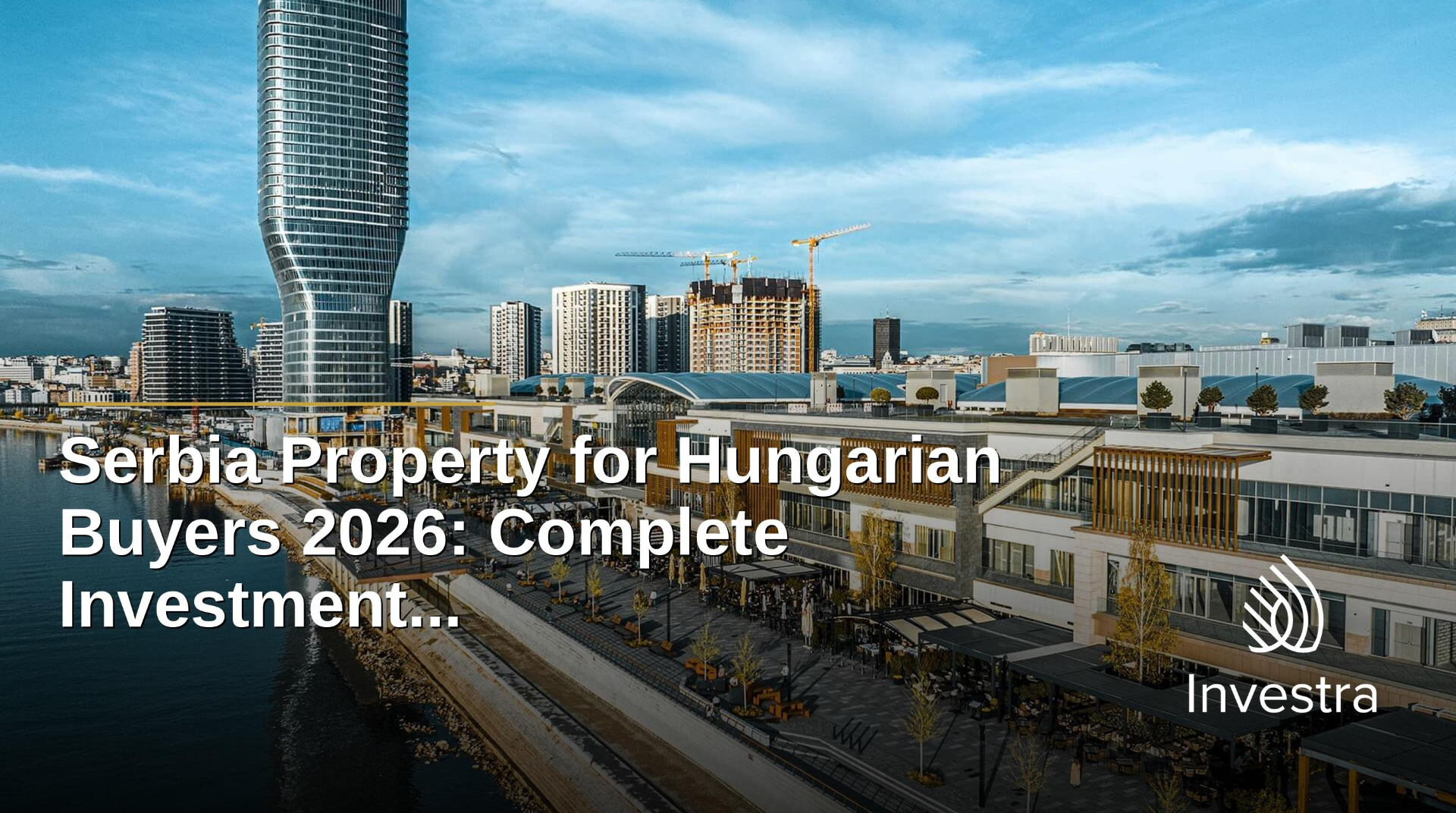
Serbia Property for Hungarian Buyers 2026: Complete Investment...
Serbia Property for Hungarian Buyers 2026: Complete Investment Guide from Hungary
Answer Capsule: Hungarian buyers can purchase Serbian property without restrictions under reciprocity rules, with Belgrade apartments averaging €2,850 per square metre in 2026 and gross rental yields reaching 5.8–7.2 percent in secondary cities. Proximity from southern Hungary, lower entry prices than Budapest, and Serbia’s ongoing EU accession process make cross-border investment attractive for both capital growth and income. Investors should use platforms such as Investra.io to compare verified listings while reviewing the Serbia Property Buying Process 2026 before committing funds.
Introduction
```htmlHungarian interest in Serbian real estate has accelerated sharply since 2023, driven by price gaps that remain substantial even after recent appreciation. A three-bedroom apartment in central Budapest now regularly exceeds €4,200 per square metre, while comparable units in Belgrade’s better districts trade between €2,600 and €3,400. For many Hungarian private investors and small family offices, the 350-kilometre corridor from Szeged to Novi Sad or the four-hour drive from Budapest to Belgrade has become a practical alternative to domestic or Austrian markets.
The year 2026 arrives at a pivotal moment. Serbia’s EU accession negotiations have entered a more structured phase, infrastructure projects funded by European and Chinese capital are reshaping logistics corridors, and the dinar-euro exchange rate has stabilised within a narrow band. Hungarian buyers, already familiar with the region’s language and business culture, are positioned to move faster than more distant Western European investors.
At the same time, the decision to buy across the border carries regulatory and currency nuances that differ from intra-EU purchases. This guide, prepared for readers of Investra.io, sets out the practical realities Hungarian nationals face when evaluating Serbian assets in the current cycle.
Market Overview
Serbia’s residential market recorded average price growth of 9.4 percent in 2025, with Belgrade leading at 11.2 percent and Novi Sad following at 8.7 percent. The national average price per square metre now stands at approximately €1,950, although this figure masks wide regional variation. In the capital’s core districts of Vračar and Stari Grad, newly completed units with parking regularly command €3,100–€3,600. Secondary cities such as Niš and Subotica remain materially cheaper at €1,350–€1,650, offering higher rental yields but thinner liquidity.
Transaction volumes involving foreign buyers rose 17 percent year-on-year through the first three quarters of 2025. Hungarians represent the third-largest foreign cohort after Russians and Germans, accounting for roughly 11 percent of non-resident purchases. Most transactions involve apartments between 55 and 85 square metres intended for long-term rental to local professionals or students. On Investra.io, listings aimed at Hungarian buyers frequently highlight properties within 90 minutes of the Hungarian border, where commuting or frequent oversight remains feasible.
Supply constraints persist in Belgrade because of slow permitting and rising construction costs. Developers have shifted toward smaller, energy-efficient units that meet new EU-aligned building codes Serbia is adopting ahead of accession. This trend supports capital values but reduces the pool of older stock that previously delivered the highest cash yields.
Key Investment Factors
Legal Position for Hungarian Nationals
Hungarian citizens enjoy the same property rights as Serbian nationals under the reciprocity principle enshrined in bilateral agreements. No additional ministerial approval is required for residential acquisitions, although commercial or agricultural land still faces restrictions. The Serbia Property Investment Guide 2026 on Investra.io provides an updated checklist of required documents, including apostilled birth certificates and tax identification numbers.
Geographic and Logistical Advantages
The short distance from southern Hungary removes many of the travel and management frictions that affect buyers from more distant countries. Regular bus and rail links, plus the recently upgraded Belgrade–Budapest motorway section, allow investors to inspect assets within a single day. Property management companies in Novi Sad and Subotica routinely offer Hungarian-language reporting, further lowering operational overhead.
Financing and Currency Considerations
Local mortgage financing remains limited for non-residents. Most Hungarian buyers therefore purchase with equity or through Hungarian banks offering cross-border secured loans. The euro remains the dominant currency for pricing and contracts, shielding investors from dinar volatility. Those planning leveraged acquisitions should examine the Serbia Property Taxes 2026 guide for details on transfer tax treatment of foreign-currency loans.
Tax and Regulatory Environment
Property tax rates in Serbia are modest by EU standards, yet compliance requirements differ from Hungarian norms. Annual property tax averages 0.4 percent of cadastral value, while rental income faces a 15 percent flat rate after allowable deductions. The Serbia Property Taxes 2026 resource on Investra.io outlines recent changes to the 25 percent capital-gains regime applicable after five years of ownership.
Price Analysis Table
| Area | Avg. Price €/m² (2026) | 1-Bed Rental €/month | Gross Yield | Notes for Hungarian Buyers |
|---|---|---|---|---|
| Belgrade – Vračar | 3,450 | 620 | 5.4% | High liquidity, strong capital growth |
| Belgrade – Zvezdara | 2,650 | 510 | 6.1% | Popular with young professionals |
| Novi Sad – Liman | 2,150 | 430 | 6.8% | 2-hour drive from Szeged |
| Subotica – Centre | 1,580 | 340 | 7.2% | Closest major city to Hungarian border |
| Niš – Medijana | 1,480 | 290 | 6.5% | Higher vacancy risk, lower entry price |
Why Invest in 2026
Three converging factors make 2026 a compelling entry window. First, Serbia’s EU accession timeline has become more credible, with Chapter 23 and 24 negotiations advancing. Historical evidence from previous accession candidates shows residential price convergence of 25–40 percent in the five years preceding membership. Hungarian buyers who establish positions now capture that convergence at an earlier stage than institutional funds that typically arrive later.
Second, infrastructure spending is accelerating. The final sections of the Belgrade–Budapest high-speed rail link are scheduled for completion in late 2026, while Chinese-funded industrial parks near Novi Sad continue to attract tenants. These projects support both rental demand and long-term land values in adjacent residential zones. Listings on Investra.io already reflect early price adjustments in corridors directly served by the new rail alignment.
Third, domestic Hungarian real-estate yields have compressed below 4 percent net in most major cities, prompting private investors to seek higher cash-flow opportunities within a culturally familiar geography. Serbia’s combination of 5.8–7.2 percent gross yields, lower purchase prices, and manageable oversight distances offers a differentiated risk-return profile.
As with any investment, property in Serbia carries risks. Only invest capital you can afford to lose.
Practical Buying Guide
Hungarian citizens benefit from straightforward access to Serbian real estate thanks to long-standing reciprocity agreements. The process follows a clear sequence that experienced buyers complete in eight to twelve weeks when they work with local professionals.
Step 1: Market Research and Property Selection
Begin by defining your goals—whether capital growth in Belgrade, rental income in Novi Sad, or a holiday home on the Danube. Review current listings through local portals and compare prices per square metre across districts. Hungarian buyers often start with virtual tours before scheduling on-site visits, which can be arranged within a week.
Step 2: Due Diligence and Legal Checks
Engage a Serbian-licensed lawyer early. Verify land-registry extracts, confirm no outstanding debts or disputes, and check zoning rules for any planned infrastructure. The lawyer also confirms the seller’s title and ensures the property meets reciprocity conditions for foreign ownership.
Step 3: Purchase Agreement and Financing
Once a property is chosen, sign a preliminary contract and pay a 10 percent deposit into a notary escrow account. Hungarian buyers may use local Serbian banks or cross-border financing arranged through Hungarian institutions familiar with Serbian collateral rules. Currency conversion costs should be locked in at this stage.
Step 4: Closing, Notary and Registration
The final deed is signed before a public notary. Transfer tax is paid, the contract is submitted to the cadastre, and ownership is recorded within 30 days. After registration you receive the title deed, completing the purchase.
Costs & Fees Breakdown
| Item | Percentage / Amount | Example on €150,000 Property |
|---|---|---|
| Purchase Price | — | €150,000 |
| Notary & Legal Fees | 1.0–1.5% | €1,800 |
| Property Transfer Tax | 0.5–3% | €3,000 |
| Real Estate Agent Fee | 2–3% | €3,750 |
| Cadastre & Registration | Flat fee | €250 |
| Total Additional Costs | 4.5–7% | €8,800 |
| Grand Total | — | €158,800 |
Risks & Challenges
Currency fluctuations between the Hungarian forint and the euro remain the largest ongoing risk for Hungarian buyers. Although Serbia’s market has shown steady appreciation, regional economic shifts or sudden regulatory changes can affect liquidity. Language barriers and differing administrative practices occasionally slow transactions, so relying solely on online translations is unwise. Infrastructure projects near popular districts can alter long-term value, both positively and negatively. Finally, rental demand varies sharply between Belgrade’s core and secondary cities, requiring realistic yield projections rather than optimistic assumptions.
Expert Tips
- Always instruct an independent lawyer rather than using the seller’s notary.
- Lock in your exchange rate at least two weeks before the final payment.
- Request energy-performance certificates early—older buildings often need upgrades that affect resale value.
- Visit the neighbourhood at different times of day to assess noise and parking realistically.
- Budget an extra 1 percent annually for maintenance and vacancy periods when calculating yields.
- Check flood-zone maps, especially for properties near rivers or low-lying areas.
- Keep digital copies of every document; Serbian cadastre records are increasingly digitised but paper originals still matter.
Find Your Serbia Property on Investra.io
Investra.io brings together verified listings from Belgrade, Novi Sad and emerging regional cities, all filtered for Hungarian buyers. The platform displays clear price histories, estimated rental yields and direct contact with licensed local agents who speak Hungarian.
Beyond listings, Investra.io provides downloadable checklists, cost calculators and updates on legal changes affecting foreign ownership. Users can shortlist properties, schedule viewings and track the entire purchase workflow in one secure dashboard.
Recommended Reading
- Serbia Legal Guide for Foreigners
- Serbia Rental Market 2026
- Serbia Property Price Forecast
- Novi Sad Real Estate 2026
- Sinisa Dagary Real Estate Blog
- Findes.si Property Portal
Follow Us
Stay updated on Serbian market movements and Hungarian buyer experiences:
Odkrijte globalne investicijske priložnosti na Unifyr.space — vaš portal za pametne investicije.
Frequently Asked Questions
Can Hungarian citizens buy property in Serbia without restrictions?
Yes, reciprocity rules allow Hungarian buyers to purchase residential and commercial real estate on the same terms as Serbian citizens.
What is the average price per square metre in Belgrade in 2026?
Belgrade apartments currently average around €2,850 per square metre, with newer central units reaching €3,200.
How long does the full purchase process take?
Most transactions close within eight to twelve weeks when documents are prepared in advance.
Is a local bank loan available to foreign buyers?
Serbian banks offer mortgages to foreigners with stable income, though rates are typically higher than in Hungary.
What taxes apply on purchase?
Buyers pay transfer tax between 0.5 and 3 percent plus notary and registration fees.
Can I rent out the property immediately after purchase?
Yes, once the title is registered you may lease the property without additional permits.
Are there any areas where foreigners face extra restrictions?
Agricultural land purchases remain limited; residential and commercial properties face no such barriers.
How do I handle currency conversion?
Most buyers use euro-denominated accounts or forward contracts arranged through Hungarian or Serbian banks.
What happens if the seller has outstanding debts?
Your lawyer performs a lien check; any debts must be cleared before or at closing.
Is property insurance mandatory?
Insurance is not legally required but strongly recommended by banks and experienced investors.
Related Posts
No related posts available.
