
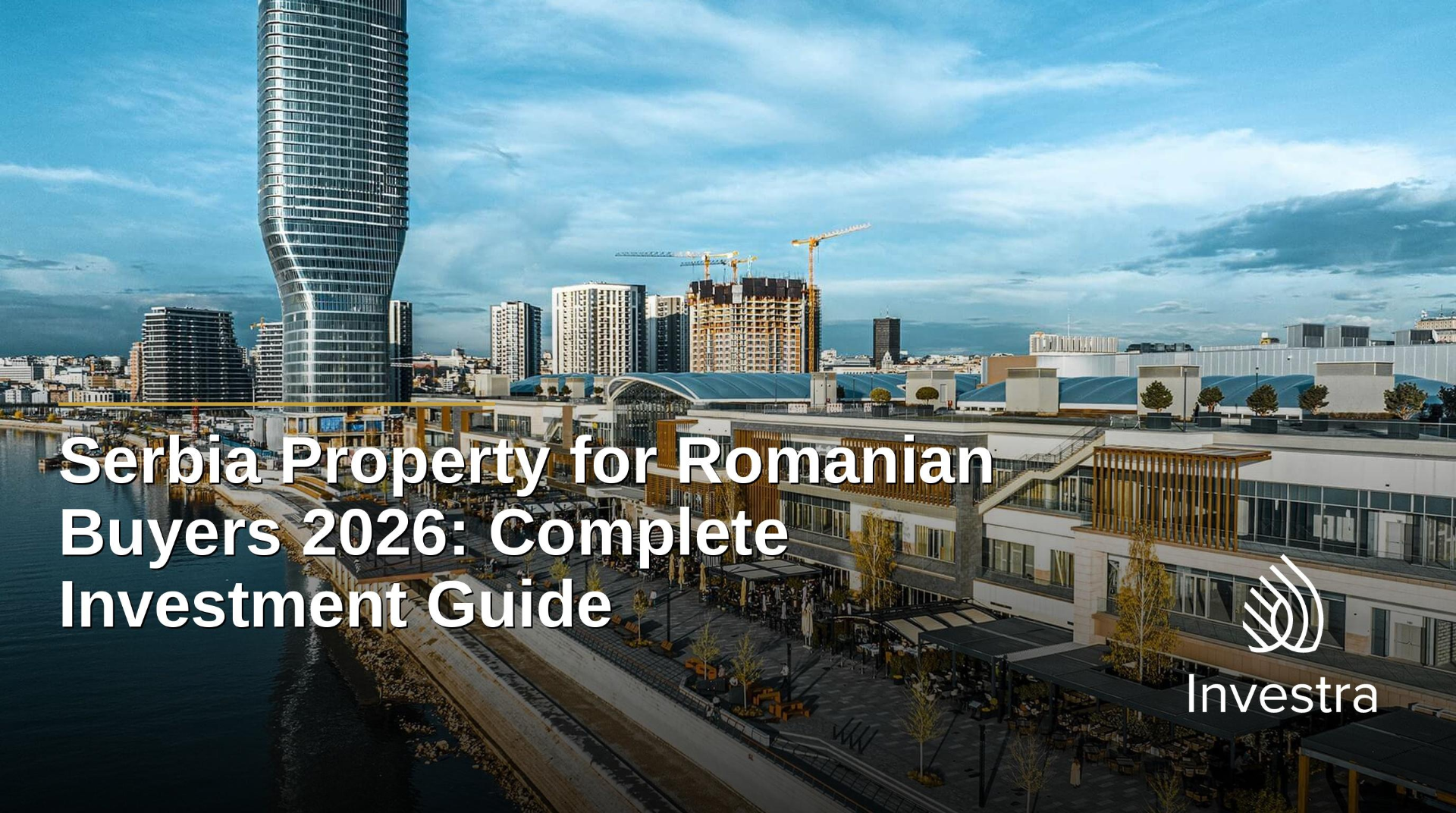
Serbia Property for Romanian Buyers 2026: Complete Investment Guide
Serbia Property for Romanian Buyers 2026: Complete Investment Guide from Romania
Romanian citizens can buy residential and commercial property in Serbia with the same rights as locals, facing no special restrictions beyond standard due diligence. Belgrade and Novi Sad remain the strongest performers for 2026, with average prices between €2,100 and €3,400 per square metre and gross rental yields typically ranging from 5.1% to 6.8%. Investors who act this year benefit from direct road and air links, comparable time zones, and a currency environment where the euro-denominated Serbian market offers a natural hedge against Romanian leu volatility.
The topic has gained fresh urgency for Romanian buyers in 2026. Serbia’s ongoing EU accession talks, combined with Romania’s own economic pressures and rising domestic property taxes, have pushed more individuals and small funds to look across the border. Proximity matters: a five-hour drive from Timișoara reaches central Belgrade, while flights from Bucharest to the Serbian capital take under an hour. This accessibility allows Romanian owners to inspect and manage assets personally without the complications that come with more distant markets.
At the same time, Serbian real estate continues to deliver capital growth that has outpaced inflation in both countries. Foreign demand, particularly from regional buyers, has remained steady even as interest rates in the eurozone stayed elevated. For Romanians, the combination of familiar business culture, widespread use of English in professional circles, and a legal framework that treats EU and non-EU citizens equally on property ownership creates a practical entry point that few other non-EU destinations can match.
Market Overview
```htmlSerbia’s residential market entered 2026 on a stable footing after two years of moderate price growth. Nationwide apartment prices rose an average of 7.4% in 2025, with Belgrade recording the strongest gains at 9.1%. The capital now shows an average transaction price of €2,850 per square metre, while Novi Sad sits at €2,150 per square metre and smaller regional cities such as Niš and Kragujevac remain below €1,400. These figures reflect completed sales recorded by the Serbian Republic Geodetic Authority and align with current listings visible on Investra.io.
Romanian buyers have contributed to this demand, especially in the mid-range segment between €80,000 and €180,000. Many target one- and two-bedroom apartments in established Belgrade neighbourhoods or new-build projects in Novi Sad’s Liman and Bulevar districts. Yields have held firm because local salaries continue to rise and Serbian banks maintain conservative lending, keeping speculative oversupply in check. The market is therefore more balanced than in 2022–2023, when rapid price spikes created short-term volatility.
Key Investment Factors
Geographic Proximity and Travel Logistics
The short distance between western Romania and northern Serbia makes regular site visits realistic. Drivers from Arad or Timișoara reach Belgrade in roughly the same time it takes to reach Bucharest, while low-cost carriers operate multiple daily flights. This ease of access reduces management costs and allows Romanian owners to respond quickly to tenant issues or renovation needs.
Legal Equality for Romanian Buyers
Serbian law grants Romanian nationals the same property rights as Serbian citizens. No reciprocity requirement or additional approvals apply for residential purchases. The process follows the same steps outlined in the Serbia Buying Process 2026 guide. Romanian buyers should still budget for a local lawyer and a certified translator, yet the absence of foreign-buyer surcharges keeps transaction costs predictable.
Currency and Financing Considerations
Most Serbian transactions are priced and settled in euros, providing Romanian investors with a natural hedge against leu depreciation. Local banks offer euro-denominated mortgages to non-residents at rates between 4.8% and 5.9% for up to 20 years, subject to income verification. Many Romanian buyers instead use equity from their domestic properties or savings, avoiding currency conversion fees altogether.
Cultural and Business Familiarity
Business practices in Serbia feel recognisable to Romanians who have worked in the Balkans. Contracts are negotiated directly, and professional networks often overlap through chambers of commerce in both countries. This familiarity shortens the learning curve compared with more distant markets where language and administrative culture create additional friction.
Price Analysis by Location
| Area | Average Price €/m² (2026) | Gross Rental Yield | Typical Buyer Profile |
|---|---|---|---|
| Belgrade – Vračar / Savski Venac | 3,350 | 5.1% | Capital growth focus, expatriate tenants |
| Belgrade – Zvezdara / Voždovac | 2,650 | 5.8% | Long-term rental demand, Romanian families |
| Novi Sad – Liman / Centar | 2,280 | 6.3% | University-driven yields, stable occupancy |
| Novi Sad – Telep / Adamovićevo | 1,950 | 6.8% | Entry-level investors, higher cash flow |
| Niš – Centar / Medijana | 1,380 | 7.2% | Value buyers seeking regional diversification |
Prices reflect median achieved transaction values in the first quarter of 2026. Rental yields are calculated on current asking rents after allowance for vacancy and basic maintenance. Data is cross-checked against listings currently available on Investra.io.
Why Invest in 2026
Serbia’s economy is projected to expand between 3.8% and 4.2% this year, supported by foreign direct investment in manufacturing and technology. This growth feeds directly into residential demand in the two largest cities. Romanian buyers who secure assets now position themselves ahead of potential price acceleration once EU accession milestones become clearer later in the decade.
Domestic Romanian property taxation has increased again in 2026, while Serbia maintains a more favourable regime for owners who keep properties for longer than five years. The combination of lower holding costs, euro-denominated income, and straightforward ownership rules makes the Serbian market a logical diversification step for Romanians already active in real estate.
Investors can review current opportunities and contact local partners through Investra.io, which aggregates verified listings across Belgrade and Novi Sad. Additional detail on ongoing costs appears in the Serbia Property Taxes 2026 guide, while broader market context is available in the Serbia Property Investment Guide 2026 and the Belgrade Real Estate Market 2026 forecast.
As with any investment, property in Serbia carries risks. Only invest capital you can afford to lose.
Practical Buying Guide
Buying property in Serbia as a Romanian citizen follows a straightforward process that mirrors local procedures. The key is to move methodically through each stage while working with professionals who understand cross-border nuances between the two countries.
Step 1: Property Search and Initial Due Diligence
Begin by identifying locations that match your goals. Belgrade offers stronger rental demand and capital growth, while Novi Sad and Niš provide more affordable entry points with steady local interest. Romanian buyers often compare listings on local portals before engaging an agent. Once you shortlist properties, request the ownership extract from the Serbian Real Estate Cadastre. This document reveals any liens, mortgages or ownership disputes. Romanian buyers should also verify that the property has a valid building permit and usage rights, especially for newer constructions.
Step 2: Legal and Financial Preparation
Engage a Serbian lawyer early. Although Romanians face no extra restrictions, the purchase contract must comply with Serbian notarial standards. Your lawyer will check for any outstanding utility debts and confirm that the seller holds clear title. At this stage, open a Serbian bank account or arrange an escrow arrangement through a trusted notary. Currency conversion from RON to EUR adds a small cost, so lock in rates in advance if possible. Romanian buyers who plan to finance the purchase locally should confirm that their home bank accepts Serbian properties as collateral.
Step 3: Contract Signing and Payment
The preliminary contract is signed first, usually at the notary’s office. This document sets the price, payment schedule and deadlines. A 10% deposit is standard. The final contract follows once the buyer confirms financing and the seller clears any encumbrances. Payment is typically made via bank transfer directly to the seller’s account or through notary escrow. Romanian buyers should keep all transfer receipts for tax reporting back home.
Step 4: Registration and Handover
After signing the final contract, the notary submits the documents to the cadastre for title transfer. This process takes four to eight weeks. Once registered, the buyer receives the new ownership extract and can take possession. Utility contracts are then transferred into the new owner’s name. Romanian buyers who intend to rent the property should also register with the local tax authority to declare rental income.
Costs & Fees Breakdown
| Item | Percentage / Amount | Example on €100,000 Property | Example on €200,000 Property |
|---|---|---|---|
| Purchase Price | — | €100,000 | €200,000 |
| Notary & Legal Fees | 0.5–1% | €500–€1,000 | €1,000–€2,000 |
| Property Transfer Tax | 0.5–3% | €500–€3,000 | €1,000–€6,000 |
| Real Estate Agent Fee | 2–3% (usually split) | €1,000–€1,500 | €2,000–€3,000 |
| Cadastre Registration | Flat fee | €150–€300 | €150–€300 |
| Bank Transfer & Currency Costs | 0.3–0.8% | €300–€800 | €600–€1,600 |
| Total Additional Costs | — | €2,450–€6,600 | €4,750–€12,900 |
| Grand Total | — | €102,450–€106,600 | €204,750–€212,900 |
Risks & Challenges
Market liquidity remains lower outside Belgrade and Novi Sad, so selling quickly can prove difficult if circumstances change. Currency fluctuations between the Serbian dinar and the euro affect both purchase prices and rental yields for Romanian buyers. Some older buildings lack clear documentation, which can delay registration by months. Tax rules on rental income differ between Serbia and Romania, requiring careful planning to avoid double taxation. Political developments or changes in foreign ownership rules, although unlikely, should be monitored. Finally, construction quality varies widely; independent inspections are essential before committing to new-build projects.
Expert Tips
- Always verify the cadastre extract yourself rather than relying solely on the seller’s documents.
- Work with a bilingual lawyer who understands both Serbian property law and Romanian tax reporting requirements.
- Factor in at least 4–6% above the purchase price for all closing costs when budgeting.
- Visit the property in person during different seasons to assess heating costs and neighbourhood activity.
- Consider properties near universities or major employers for stronger long-term rental demand.
- Keep detailed records of every payment and contract stage for potential future resale or inheritance matters.
- Monitor Serbia’s annual property tax changes, which can affect net yields by 1–2 percentage points.
Find Your Serbia Property on Investra.io
Investra.io brings together verified listings from Belgrade, Novi Sad and secondary cities in one searchable platform tailored for Romanian buyers. The site includes direct contact with local agents, downloadable cadastre extracts and cost calculators that convert fees into RON for easier planning.
Users can filter by yield estimates, new-build status and proximity to transport links. The platform also maintains updated legal checklists and connects buyers with recommended notaries and lawyers who regularly handle Romanian clients, reducing the usual back-and-forth that comes with cross-border purchases.
Recommended Reading
- Serbia Legal Guide for Foreigners
- Serbia Rental Market 2026
- Serbia Property Price Forecast
- Novi Sad Real Estate 2026
- Sinisa Dagary Real Estate Blog
- Findes.si Property Portal
Follow Us
Stay updated on Serbia property opportunities and Romanian buyer experiences:
-
Q5: What is the average rental yield on Serbian properties for foreign investors?
Residential properties in Belgrade generate 4-6% annual rental yields, while secondary cities like Niš and Kragujevac offer 6-8% returns on investment. Tourist-focused properties in mountain resorts achieve 8-12% yields during peak seasons but face seasonal vacancy challenges. Romanian investors typically see better cash flow from long-term residential rentals to expats and young professionals.
Q6: Are there restrictions on foreign property ownership in Serbia for Romanian nationals?
Romanian EU citizens face no restrictions on purchasing residential or commercial property in Serbia and can own land freely without special permits. However, agricultural land purchases require prior approval from the Serbian Ministry of Agriculture, which processes these applications within 30-45 days. Property registration is identical for foreign and domestic buyers at the Cadastre office.
Q7: What are the best neighborhoods in Belgrade for investment according to 2026 market trends?
Voždovac, Rakovica, and Čukarica offer emerging investment opportunities with 8-12% annual appreciation rates and 5-6% rental yields in 2026. Established areas like Banjica and Dedinje maintain stability with steady 3-4% appreciation but command premium prices (€5,000+ per square meter). Up-and-coming tech hub areas near IT Park attract young professionals, making them ideal for short-term rentals and long-term appreciation.
Q8: What is the mortgage process for Romanian buyers purchasing property in Serbia?
Obtaining a Serbian mortgage typically requires 25-30% down payment, proof of income verified by Serbian banks (which may require additional documentation from Romanian employers), and property appraisal. Interest rates range from 3.5-5.5% depending on currency (euro mortgages are cheaper than dinar) and loan terms of 15-30 years. Most Romanian buyers utilize their home currency mortgages or pay in cash to avoid currency exchange complications.
Q9: How much does it cost to renovate a property in Serbia compared to Romania?
Basic renovation costs €800-€1,200 per square meter in Serbia versus €1,000-€1,500 in Romania, representing 15-20% savings on labor and materials. Premium renovations with imported finishes can reach €2,000+ per square meter but remain competitive with Western European pricing. Hiring licensed contractors through the Serbian Chamber of Commerce ensures proper warranties and compliance with building codes.
Q10: What are the ongoing annual costs of property ownership in Serbia for foreign investors?
Annual property tax ranges from 0.3-0.7% of the cadastral value (typically 20-30% below market price), utilities cost €150-€300 monthly, and mandatory building insurance averages €100-€200 annually. Rental property owners pay 10% income tax on net rental income after deductible expenses, plus 15% social contributions if income exceeds €500 monthly. Total annual costs typically represent 8-12% of gross rental income.
facebook.com/investra.io">Facebook
Frequently Asked Questions
Can Romanian citizens buy property in Serbia without restrictions?
Yes. Romanian buyers enjoy the same rights as Serbian citizens when purchasing residential or commercial real estate.
What is the average total cost above the purchase price?
Expect to pay between 4% and 7% in notary, tax, agent and registration fees combined.
How long does the full purchase process usually take?
From offer acceptance to title registration, the timeline is typically six to ten weeks.
Do I need a Serbian bank account to complete the purchase?
It is recommended but not mandatory; notary escrow accounts can also receive funds from Romanian banks.
Is rental income taxed in both countries?
Serbia taxes local rental income, while Romania requires declaration under its worldwide income rules; double-taxation treaties help avoid paying twice.
Which cities offer the best rental yields for Romanian investors?
Belgrade and Novi Sad currently deliver the strongest yields, with secondary cities showing improving numbers.
Are there any restrictions on selling the property later?
No special restrictions apply to Romanian owners; the same local rules govern resale as for Serbian citizens.
Should I hire a lawyer from Romania or Serbia?
A Serbian lawyer is essential for the transaction; many Romanian buyers also consult a Romanian tax advisor for income reporting.
What documents do I need from Romania?
A valid passport and proof of address are usually sufficient; additional power of attorney may be required if someone signs on your behalf.
How stable are property prices in Serbia right now?
Prices have risen steadily since 2023, though growth rates vary significantly between Belgrade and smaller cities.
Odkrijte globalne investicijske priložnosti na Unifyr.space — vaš portal za pametne investicije.
Related Posts
No related posts available.
